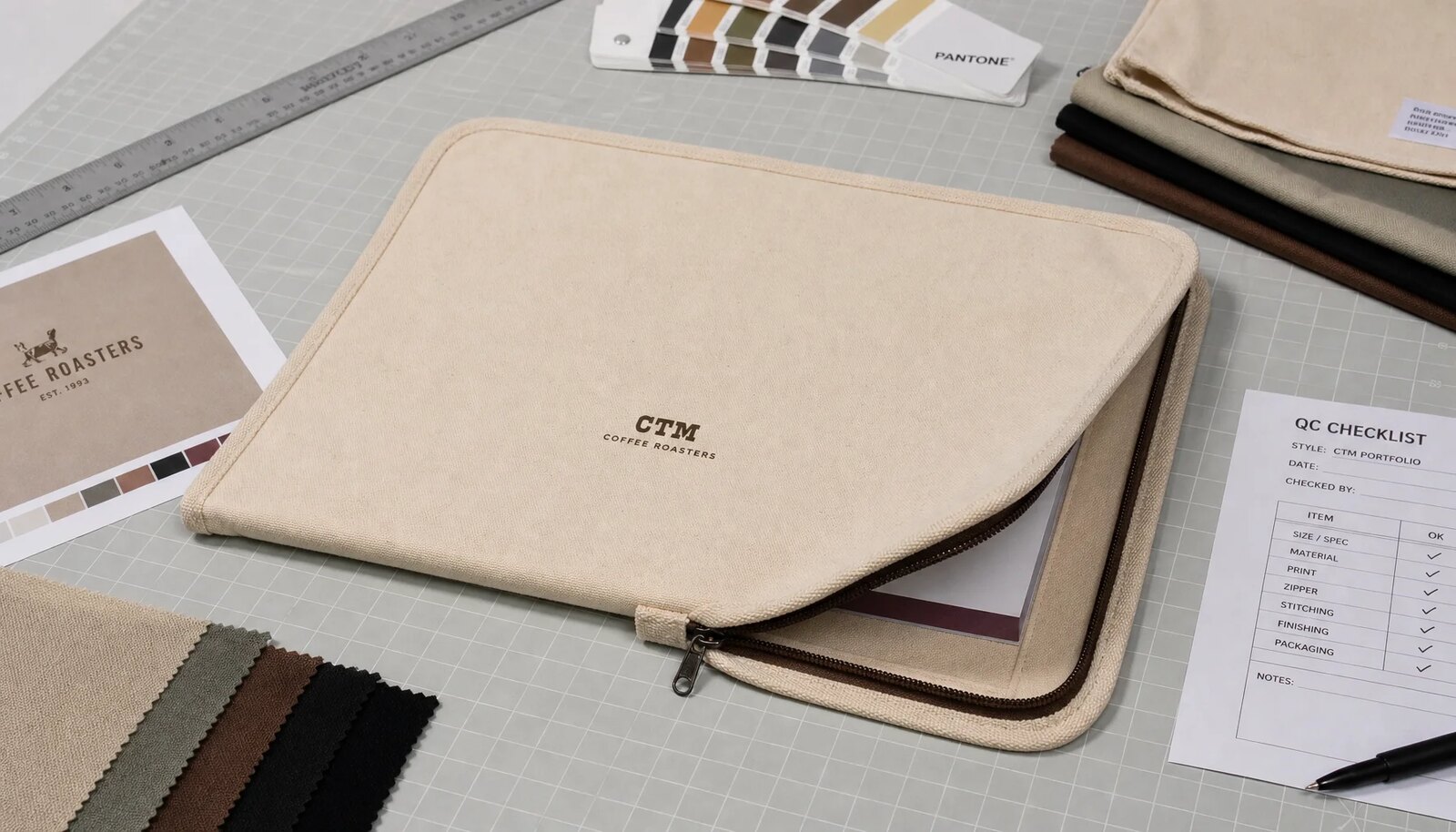
Start With the Commercial Use Case
Canvas zipper portfolios for coffee roasters are not just flat pouches with a logo. In practice, they sit somewhere between a business bag, a presentation folder, a sales kit, and a retail merchandise item. One roaster may use them for wholesale price sheets and cupping score forms. Another may pack them with origin notes, brew guides, cafe onboarding documents, distributor paperwork, or training materials. The item is often opened in front of cafe owners, hotel buyers, grocery category managers, event partners, and distributor teams, so weak sewing or a muddy logo is easy to notice.
Before asking for prices, define the job the portfolio must do. A reusable field-sales tool needs a smoother zipper, stronger edge finishing, and a cleaner internal layout than a one-time event handout. A retail merchandise item needs barcode planning, hang tag position, individual packing, and a consistent front panel. A distributor kit may care more about carton labels, inner pack counts, and fast receiving than premium hardware.
The common procurement trap is simple: teams compare photos and unit prices before they compare specifications. Two suppliers can both quote a natural canvas zipper portfolio, yet one may include 10 oz canvas, a No. 3 zipper, basic packing, and loose dimensional control. Another may include 14 oz canvas, a No. 5 nylon coil zipper, reinforced ends, an inner sleeve, print proofing, and flat carton protection. Those are different products, even if the mockups look similar.
A strong RFQ separates structure, print, packing, and inspection. List the finished size, usable inside size, canvas weight and finish, zipper construction, print method, artwork placement, sample stages, packing method, inspection tolerance, and lead-time trigger. This makes quotations easier to compare and makes it harder for a supplier to remove quality-critical details just to win the price line.
- Classify the item as a sales tool, retail SKU, distributor kit, training folder, event handout, or account onboarding portfolio.
- Quote against a written specification, not only a product photo or logo mockup.
- Separate construction approval from artwork approval because zipper function and print quality fail in different ways.
- Require suppliers to state exclusions such as sample fees, screen charges, tooling, barcode labels, inspection, and export packing.
- Keep one approved physical sample as the reference for inbound inspection and reorder comparison.
Specify Canvas by Weight, Finish, and Lot Control
For flat zipper portfolios, the usual B2B sourcing range is 12 oz to 16 oz cotton canvas, roughly 400 to 540 GSM depending on yarn count, weave density, and finishing. That range gives enough body for a professional presentation folder without making the zipper seam and corners too bulky. Lighter canvas can reduce cost and freight weight, but it may wrinkle around the zipper tape, show pocket outlines through the front panel, or feel too soft for a reusable sales item. Heavier canvas can feel substantial, yet it can also raise seam bulk, corner lift, needle stress, and carton weight.
Ask for both oz and GSM in the quote. Ounce descriptions are common in canvas sourcing, while GSM is easier to compare across mills and countries. Still, GSM alone is not a complete fabric spec. A tighter weave may print cleaner than a looser weave at the same weight. A rougher yarn may fit a rugged coffee brand, but it can also make fine lines and small text harder to hold.
Finish choice changes both appearance and print proofing. Natural canvas works well with kraft, cream, and brown coffee packaging, but the base shade can move from warm cream to grey beige. Bleached canvas gives dark logos a cleaner ground. Dyed canvas gives stronger brand-color control, though it usually adds lab dip review, dye-lot approval, and material MOQ. Washed canvas has a softer lifestyle feel, but measurements can relax and print edges may look less crisp.
If the roaster already sells canvas totes, aprons, or other merchandise, compare the portfolio swatch with those existing standards. A portfolio that feels much lighter than the brand’s tote may look like a downgrade. A very heavy one may impress in hand but create avoidable freight and storage cost. Label the approved swatch with weight, finish, color reference, supplier, and approval date so the same standard can be used for inspection and reorders.
- 10 oz to 12 oz: suitable for light document cases but higher wrinkle, show-through, and soft-hand risk.
- 12 oz to 16 oz: practical default for coffee roaster sales portfolios and reusable branded folders.
- 16 oz to 18 oz: stronger hand feel but higher seam bulk, corner thickness, and freight weight.
- Natural canvas: good for coffee branding but requires approved shade tolerance before logo proofing.
- Dyed canvas: useful for brand colors but confirm lab dip timing, dye MOQ, lot variation, and reorder availability.
- Washed canvas: casual look but requires closer checks for measurements, shrinkage effect, and print edge clarity.
Build the Size Around Real Inserts
Do not size the portfolio from a generic A4, letter, or document-folder label. Coffee roasters often need to hold laminated brew guides, wholesale order forms, sample cards, cupping sheets, pricing pages, origin maps, postcards, QR cards, menu inserts, and folded brochures. These pieces do not behave like loose office paper. Laminated sheets and heavy-stock cards need clearance, especially near zipper corners, or the user will fight the opening every time.
A useful size specification includes finished outside dimensions, usable inside dimensions, zipper opening width, sleeve depth, pocket width, pen-loop position, and maximum insert stack thickness. State all dimensions in millimeters. If there are several pockets, include a simple marked drawing. If the factory will pack inserts, provide the full kit thickness. If the roaster or distributor will add inserts later, send a dummy set so the factory can test the real fit.
Artwork placement should be planned at the same time as the size. A logo that sits too close to a zipper seam, rounded corner, or binding edge can skew after sewing. At least 20 mm of clearance from zipper tape, bound edges, and corner radii is a practical starting point when the design allows it. Final placement should be measured from fixed references, not adjusted by eye after the portfolio is sewn.
Flatness is also part of the spec. A thick pocket, pen loop, or insert stack on one side can create a visible lump under the front logo. For sales meetings, the front panel should stay smooth when the folder is lightly filled. For retail programs, the packed size must also work with hang tags, belly bands, barcode stickers, shelf trays, or ecommerce mailers.
- Measure the largest sheet, thickest insert stack, and widest card before approving dimensions.
- Define outside size, inside usable size, zipper opening width, sleeve depth, pocket depth, and stack thickness.
- Use a buyer-approved dummy insert to test fit, zipper closure, and pocket usability.
- Keep logos away from zipper seams, binding edges, and rounded corners by at least 20 mm where possible.
- Confirm whether factory-packed inserts, retail tags, or barcode labels affect the final packed size.
Treat the Zipper as a Functional Component
The zipper is often the first part users complain about. A canvas zipper portfolio can photograph well and still feel cheap if the zipper tape waves, the slider catches, the stop is weak, or the puller rubs against the printed face during packing. For soft flat canvas folders, a No. 5 nylon coil zipper is usually the practical default. It is flexible, durable enough for repeated handling, and easier to sew around curves than many heavier zipper options.
The quote should name the zipper size, tape material, tape color, slider type, puller shape, puller finish, opening direction, end-stop method, and sewing construction. Coffee brands often choose black, dark brown, natural, brass-tone, or contrast zipper details. Contrast tape can look intentional and premium, but it also makes uneven stitching, seam wander, and zipper waviness more visible.
Custom pullers deserve a separate decision. A metal or molded branded puller can improve retail presentation, but it may add tooling, MOQ, sample time, and packing risk. If the puller rests against the printed front panel in a carton, it may leave pressure marks or abrasion. For many B2B orders, a standard metal puller in a brand-compatible finish is the better balance.
Zipper testing must happen after sewing, not only when the zipper tape is loose. A zipper can run smoothly in a component check and then become tight once it is sewn into a corner or compressed by binding. Ask the factory to test full-length open-close movement after sewing, trimming, and packing. The check should cover the start point, corners, end stop, puller strength, and any area where canvas could catch in the coil.
- Specify No. 5 nylon coil zipper unless the design requires a lighter or more rugged look.
- Define tape color, slider, puller finish, opening direction, end-stop reinforcement, and zipper path.
- Test zipper smoothness after sewing and again after carton compression if the product ships tightly packed.
- Use contrast zipper tape only if sewing alignment and tape waviness can be controlled visually.
- Confirm custom puller tooling, MOQ, lead time, scratch risk, and replacement policy before adding branded hardware.
Set Print Proofing Criteria Before Sampling
Print proofing is the main brand risk for canvas zipper portfolios for coffee roasters. The logo is often the reason the item is being ordered. Coffee artwork also tends to include muted browns, cream grounds, kraft tones, fine-line crests, origin names, tasting icons, hand-drawn illustrations, or low-contrast label systems. These details behave differently on cotton canvas than they do on coated labels, kraft cartons, valve bags, or screens.
Screen printing is usually the most practical method for solid one- to three-color logos, origin badges, and repeat orders. It can give good opacity on natural canvas, but the final ink color will not match coated paper exactly because the fabric base has texture and absorbs light. Heat transfer can handle gradients, photographs, and complex full-color art, but buyers should test hand feel, edge durability, cracking risk, gloss level, and abrasion. Embroidery, woven labels, patches, or deboss-style details may work for retail merchandise, but they change cost, flatness, and inspection criteria.
Proofing should be measurable. State the final print size in millimeters, placement from fixed reference points, Pantone or brand-color references, minimum readable text height, minimum line thickness, acceptable registration tolerance, color tolerance against the approved fabric proof, and rub-resistance expectation. If the artwork contains a QR code, small support text, or fine badge lines, test the actual printed result on the selected canvas before approving bulk.
A digital mockup is useful for layout, but it should not be the final approval for a brand-critical order. The meaningful approval is a printed proof on final bulk canvas or on a clearly identified buyer-approved substitute. If substitute canvas is used early, the supplier should explain what may change when the bulk fabric arrives. The signed proof should show accepted color, placement, opacity, texture effects, and any limitations caused by natural slubs.
- Use screen print for solid logos, simple badges, and one- to three-color coffee artwork.
- Use transfer print only after checking hand feel, edge durability, gloss, cracking, and rub resistance.
- Avoid very small text on coarse canvas unless the factory proves readability on the selected fabric.
- Measure logo placement from seams, zipper edge, binding, or panel edge, not by visual centering.
- Approve the printed fabric proof, not the digital mockup, as the bulk production reference.
Compare Quotes on the Same Specification
Unit price is shaped by fabric consumption, canvas weight, zipper grade, internal pockets, binding method, print colors, label work, packing, inspection, order quantity, and incoterm. A lower quote may not save money if it removes a pocket, uses lighter canvas, switches to a smaller zipper, skips packing protection, or assumes there is no printed pre-production proof.
The simplest cost-control route is often stock natural canvas, standard zipper tape, standard puller, one-color screen print, a basic internal sleeve, and flat bulk packing. That can still produce a professional portfolio if sewing and printing are controlled well. Before adding custom hardware, dyed fabric, multi-color print, patches, or retail packaging, confirm that each upgrade supports the commercial use case rather than only making the sample look more elaborate.
MOQ should be broken down by component. A factory may be able to sew 300 to 500 pieces when stock fabric and standard zippers are available. Custom-dyed canvas, custom zipper tape, branded pullers, woven labels, patches, or special retail packaging can trigger upstream supplier minimums. If a supplier offers a very low MOQ for a custom color, ask whether the material comes from leftover stock and whether the same shade can be repeated.
A fair quote comparison sheet should normalize finished size, inside usable size, canvas oz and GSM, fabric finish, zipper specification, print method, number of print colors, pocket layout, label type, packing method, carton data, sample stages, inspection terms, lead-time start point, incoterm, payment terms, and excluded charges. Without that detail, procurement may choose the lowest price for a different product.
- Normalize all quotes by canvas weight, zipper type, print method, finished size, pocket layout, packing, and incoterm.
- Separate unit cost from screen charges, sample fees, tooling, courier, hang tags, barcode labels, and inspection.
- Ask whether custom-dyed fabric, zipper tape, pullers, labels, or patches drive MOQ more than sewing capacity.
- Use stock components first when speed, budget, and reorder simplicity matter.
- Request carton dimensions and gross weight before assuming the cheapest item has the lowest landed cost.
Use Three Approval Gates: Construction, Print, Packing
A construction sample and a printed pre-production sample answer different questions. The construction sample proves size, zipper path, internal layout, sleeve depth, seam allowance, binding width, corner radius, zipper smoothness, and document fit. It may be made in substitute fabric for speed, but then it does not approve final hand feel or print behavior. Let the people who will use the portfolio test it, not only the buying team.
The printed pre-production sample proves artwork position, ink behavior, color, opacity, line sharpness, small-text readability, and finish on the approved fabric. Brand, marketing, and procurement should review it together. Cotton canvas cannot be judged by the same standard as coated paper, so the reference should be the approved fabric proof rather than a packaging file viewed on screen.
A packing trial is the third gate when presentation matters. It checks whether the print rubs, the zipper puller marks the face, the corners curl, the product remains flat, and the carton is not overloaded. Ask for photos showing packing orientation, interleaving, individual wrap, carton dimensions, gross weight, inner pack count, and carton marks.
Approvals should be written down. A short approval sheet should list outside size, inside size, zipper opening, canvas reference, zipper specification, print dimensions, print location, pocket layout, packing method, tolerances, and accepted deviations. The factory should retain a sealed approved sample, and the buyer should keep one for inbound inspection and reorder comparison.
- Construction approval: size, pockets, zipper path, binding, corner shape, stitch quality, and document fit.
- Print approval: color, opacity, logo size, placement, line sharpness, small text, and rub performance.
- Packing approval: flatness, abrasion control, wrap method, carton weight, carton marks, and stacking direction.
- Change control: fabric, zipper, ink, print method, binding, pocket layout, or packing changes need written confirmation.
- Reference control: keep approved samples at both buyer and factory locations for bulk comparison.
Write QC Thresholds the Factory Can Inspect
Quality control works best when it is written in operational language. For soft sewn portfolios, a finished outside size tolerance of ±5 mm is often practical. A tighter tolerance may be needed for retail sleeves, fixed boxes, exact document inserts, or automated fulfillment. Usable inside dimensions and zipper opening width should be checked with the buyer-approved document dummy, not only with a ruler on the outside.
Print QC should refer to the approved fabric proof. Inspection points include print size, placement, color, opacity, registration, small-text readability, pinholes, smudges, missing ink, double images, and edge sharpness. Natural canvas texture can create small irregularities, but obvious defects on the front logo area should not pass. Placement should be measured from a fixed seam, zipper, binding, or edge reference point.
Canvas QC needs a clear line between natural character and defects. Small natural slubs may be acceptable outside the logo area. Oil marks, stains, heavy shade panels, front-panel creases, needle holes, and large dark fibers in the print area should be controlled. The front presentation face should have a stricter standard than hidden inside pockets.
Functional QC should include full zipper operation, loose threads, skipped stitches, pocket usability, binding finish, corner consistency, label placement, and carton condition. Loose-thread limits should be stated in advance, such as no visible loose thread longer than 3 mm to 5 mm on presentation areas. Zipper failure, wrong artwork, wrong size, and missing pocket features should be treated as major or critical defects depending on the order purpose.
- Measure outside size, usable inside size, zipper opening, pocket depth, print size, and print position.
- Check zipper operation through the full path after sewing, trimming, and packing.
- Inspect front panels for stains, oil marks, shade panels, creases, needle damage, and logo-area slubs.
- Reject print smudges, missing ink, unreadable text, severe pinholes, double images, and wrong placement.
- Define loose-thread limits, skipped-stitch rules, and stress-point reinforcement before production.
- Use an AQL inspection plan if appropriate, but still define portfolio-specific critical and major defects.
Pack to Protect Print, Flatness, and Receiving
Canvas zipper portfolios are broad, flat, and usually printed on the main face. Poor packing can damage them quickly. Folding to save carton volume can leave a permanent crease through the logo. Stacking printed faces directly against zipper pullers can cause rub marks. Overweight cartons can curl corners, distort zipper edges, and make the product look used before it reaches the sales team or retail shelf.
Packing should match the channel. A wholesale sales-kit component may need clean flat bulk packing and simple inner bundles. A retail item may need individual polybags, paper wraps, belly bands, hang tags, barcode labels, SKU stickers, and master carton labels. A distributor program may need destination-specific carton marks and inner pack counts that make warehouse receiving easier.
Sustainability preferences should be tested, not assumed. Many coffee brands prefer reduced plastic or paper wrap, but paper may protect less well against abrasion than a clear polybag. Dark prints on natural canvas and transfer prints should be checked for rubbing, moisture marks, and pressure transfer. Interleaving sheets can be a useful compromise when individual bags are not desired.
Carton data belongs in the quote. Request pieces per carton, carton dimensions, gross weight, stacking orientation, carton strength, and whether the portfolios ship flat or folded. Large flat cartons can create higher volumetric freight than expected, so procurement should evaluate landed cost rather than unit price alone.
- Use flat packing when the front logo must arrive smooth and presentation-ready.
- Use interleaving or face-to-back stacking when zipper pullers or rough canvas may rub printed areas.
- Confirm individual bag, paper wrap, belly band, hang tag, barcode sticker, and carton label requirements before quoting.
- Limit carton gross weight to reduce corner curl, compression marks, and warehouse handling damage.
- Request packing trial photos showing orientation, inner bundles, carton marks, dimensions, and gross weight.
Plan Lead Time Around Proof Rounds
Lead time is not only sewing time. A realistic schedule includes artwork checking, fabric sourcing, zipper sourcing, construction sample, print proof, buyer review, material approval, bulk cutting, panel printing, ink curing or drying, sewing, trimming, inspection, packing, export documents, and shipping booking. If the brand team requests several proof rounds, approval time can exceed production time.
Ask when the factory’s lead time starts. Some quotes count from deposit. Others count from artwork approval, sample approval, material arrival, or packing confirmation. A quoted 30-day production lead time may not include lab dips, printed proofing, courier time, or buyer review. If the portfolio is tied to a trade show, wholesale launch, new crop release, distributor onboarding, or retail campaign, backward planning is essential.
The fastest route is stock natural canvas, stock zipper tape, standard puller, one-color screen print, simple inner sleeve, and flat packing. Custom-dyed canvas, custom zipper tape, branded pullers, patches, embroidery, multi-color printing, retail hang tags, and barcode packing all add steps. None of these upgrades are wrong, but they need to appear in the calendar before the purchase order is placed.
Reorder planning should be discussed early. If the first order uses available stock canvas and the fabric is not reserved, the next order may arrive in a slightly different shade. That may be acceptable for internal sales tools but more visible for retail merchandise. Buyers expecting repeat orders should ask whether the supplier can keep a fabric standard, reserve material, or document acceptable shade tolerance.
- Define whether lead time starts after deposit, artwork approval, sample approval, material arrival, or packing approval.
- Build calendar time for construction sampling, printed fabric proofing, buyer review, and courier movement.
- Choose stock fabric, stock zipper, standard puller, and one-color print when timing is tight.
- Add time for lab dips, custom dyeing, custom hardware, multi-color print, patches, barcode packing, and split shipments.
- Keep approved swatches and samples for reorder shade and construction comparison.
Specification comparison for buyers
| Spec decision | Recommended option | When it fits | Buyer risk to check |
|---|---|---|---|
| Outer canvas weight | 12 oz to 16 oz cotton canvas, commonly about 400 to 540 GSM depending on yarn count and weave | Reusable coffee roaster sales folders, distributor kits, account onboarding documents, and branded presentation portfolios | Canvas below this range can wrinkle around zipper tape; heavier canvas can create bulky corners, raised seams, and higher freight weight |
| Fabric finish | Natural, bleached, dyed, washed, recycled blend, or organic cotton clearly identified in the quote | Natural and undyed canvas fit kraft-style coffee branding; dyed canvas fits strict brand-color programs; washed canvas fits casual retail merch | Shade varies by lot; washed fabric can soften print edges; dyed fabric may require higher material MOQ and longer lab-dip approval |
| Finished size basis | Finished outside size plus usable inside size, zipper opening width, pocket depth, and maximum insert stack thickness in millimeters | Wholesale price sheets, cupping score forms, laminated brew guides, sample cards, account contracts, or training kits | Generic A4 or letter labels can hide a tight zipper opening or insufficient inside clearance for laminated or heavy-stock inserts |
| Zipper specification | No. 5 nylon coil zipper with tape color, slider, puller finish, end-stop reinforcement, and operation requirement defined | Soft flat canvas portfolios used by sales reps, trainers, distributor teams, trade-show staff, or retail customers | Low-grade zippers can wave, catch fabric, or fail at stops; test after sewing and after carton compression, not only as loose zipper tape |
| Print method | Screen print for solid one- to three-color logos; transfer print for gradients, photos, or complex full-color artwork after durability check | Coffee roaster marks, origin badges, wholesale account logos, event graphics, and simple retail merchandise designs | Ink gain on coarse canvas can fill fine lines; proof on approved canvas and confirm minimum line weight, text height, opacity, and rub resistance |
| Artwork placement | Measured front-panel placement from fixed seam, edge, zipper, or binding reference points with at least 20 mm clearance where possible | Keeps logos visible and undistorted when the portfolio is stacked, photographed, opened, or handled in buyer meetings | Artwork too close to zipper seams, rounded corners, or binding can skew during sewing; require ruler photos and a signed placement proof |
| MOQ logic | 300 to 500 pieces may be feasible for stock canvas and standard zipper; higher MOQ for custom dyeing, custom pullers, custom zipper tape, or retail packaging | Regional distributor programs, roaster group purchasing, sales-kit replenishment, wholesale launches, and seasonal merchandise drops | Very low MOQ quotes may use available fabric lots; confirm repeat-order shade, zipper availability, and whether materials are reserved |
| Sample approval | Separate construction sample, printed pre-production sample, and packing trial when presentation matters | Orders where the portfolio must match coffee packaging, wholesale collateral, retail SKU requirements, or sales-team use | A digital mockup does not validate ink absorption, zipper waviness, inside capacity, sewing distortion, carton abrasion, or finished flatness |
| Packing method | Individual polybag, paper wrap, interleaving, face-to-back stacking, or flat bulk packing with carton weight and dimensions stated | Distributor handouts, retail backroom handling, wholesale presentation kits, and shipment to multiple roaster locations | Overweight cartons can curl corners; zipper pullers can abrade prints; folding to save freight can permanently crease the front logo |
Buyer checklist before sampling
- Define the portfolio use case first: reusable sales tool, wholesale onboarding folder, distributor kit component, retail merchandise item, trade-show handout, or training document case.
- Measure the largest real insert, including laminated sheets, heavy-stock sample cards, cupping forms, brochures, or document stacks; do not rely on A4 or letter descriptions alone.
- Specify finished outside dimensions, usable inside dimensions, zipper opening width, pocket depth, pen-loop position, and maximum insert stack thickness in millimeters.
- Request canvas weight in both oz and GSM, plus finish type: natural, bleached, dyed, washed, recycled blend, organic cotton, or other approved fabric.
- Approve a physical fabric swatch before print proofing when shade, stiffness, logo contrast, or repeat-order consistency matters.
- Send vector artwork with Pantone references, final print size in millimeters, minimum line thickness, minimum text height, required placement, and logo-safe area.
- Require a printed proof on final bulk canvas or a buyer-approved equivalent, especially for cream, kraft, brown, black, copper, metallic, or low-contrast coffee branding.
- Separate construction approval from print approval so size, zipper function, pocket layout, binding, artwork placement, and print quality are each signed off intentionally.
- Define zipper requirements: nylon coil size, tape color, slider type, puller material, puller finish, opening direction, zipper path, end-stop reinforcement, and pull smoothness after sewing.
- Approve seam allowance, binding width, stitch density target, corner radius, label position, inner sleeve layout, card pocket dimensions, pen loop, hang tag point, and barcode location before bulk cutting.
Factory quote questions to send
- What canvas weight in oz and GSM is included, what weave or yarn count can you state, and is the fabric greige, natural, bleached, dyed, washed, recycled blend, organic cotton, or otherwise finished?
- Is the quoted fabric from existing stock or new production, and can the same shade lot be reserved or repeated for future replenishment orders?
- What are the finished outside dimensions, usable inside dimensions, zipper opening width, pocket depth, and normal dimensional tolerances for this construction?
- Can you make one construction sample and one printed pre-production sample on the final bulk canvas before mass production, and what is the sample lead time for each?
- Which print method do you recommend for this artwork on cotton canvas, and what minimum readable text height, minimum line weight, and registration tolerance can you maintain?
- What Pantone or color-control process do you use on natural canvas: fabric strike-off, wet ink drawdown, printed panel proof, light-box review, or buyer-approved tolerance against a physical sample?
- What zipper size, tape material, tape color, slider type, puller type, puller finish, end-stop reinforcement, and sewing method are included in the unit price?
- How do you control zipper waviness on flat canvas portfolios, and do you test full-length zipper operation after sewing, trimming, and carton packing?
- What stitch density, seam allowance, binding width, corner construction, reinforcement points, and loose-thread standard will be used for bulk production?
- How many pieces are packed per carton, what are the carton dimensions and gross weight, and how will you prevent print abrasion, corner curl, zipper-puller marks, moisture, and compression damage?
Quality-control points to confirm
- Finished outside size should normally be controlled within ±5 mm for soft sewn portfolios unless a retail sleeve, box insert, or exact document fit requires a tighter signed tolerance.
- Usable inside dimensions, pocket depth, zipper opening width, and maximum insert stack thickness should be checked with the buyer-approved document dummy or actual contents.
- Print position should be measured from fixed seam, zipper, binding, or edge reference points; visual centering alone is not sufficient for bulk inspection.
- Print size, color, opacity, line sharpness, small-text readability, pinholes, smudges, double images, and missing ink should be judged against the approved fabric proof.
- Zipper must open and close smoothly through the full travel length with no skipped teeth, fabric catching, rough pull, distorted tape, broken puller, or weak end stop.
- Canvas front panels should be checked for oil marks, stains, heavy shade panels, large dark slubs in the logo area, needle holes, crease lines, and abrasion before packing.
- Seams, binding, zipper ends, and inner pockets should show no skipped stitches at stress points and no loose threads longer than the buyer-approved limit, commonly 3 mm to 5 mm for visible areas.
- Printed logos should pass agreed dry-rub and light scratch checks suitable for sales-kit handling, stacking, and normal carton compression.
- Inner sleeves, card pockets, pen loops, and labels should hold the intended contents without tearing, buckling, creating front-panel lumps, or blocking zipper closure.
- Carton packing should protect printed faces from zipper puller marks, ink transfer, moisture, corner curling, over-compression, and loss of flatness during export handling.