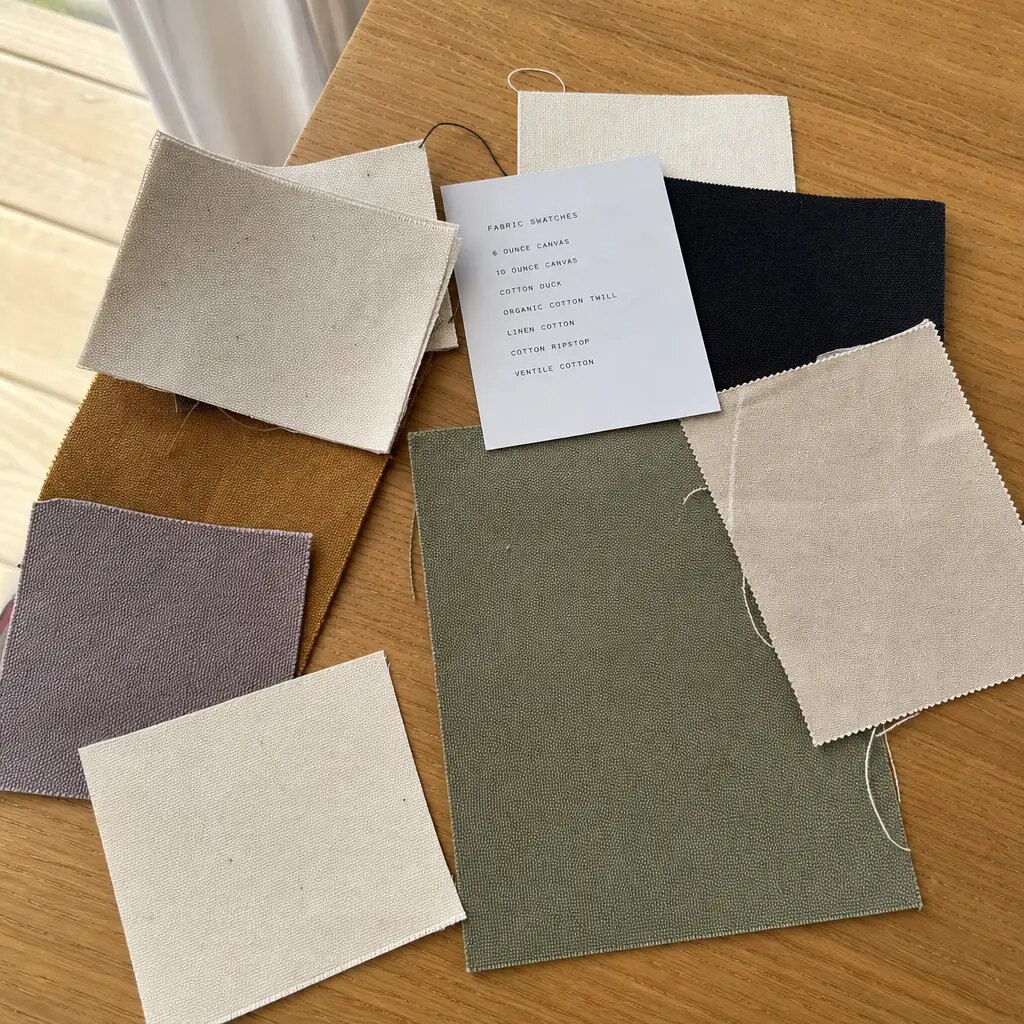
Start with the job the portfolio must do
For a coffee roaster, a canvas zipper portfolio is rarely just a folder. It may carry cupping sheets, green coffee notes, wholesale price lists, roast profile documents, distributor contracts, sample cards, order forms, menus, training sheets, a notebook, or a tablet. It is also opened in front of café owners, grocery buyers, hotel purchasing teams, and distributor partners. That makes material selection part of the sales experience, not a minor production detail.
The procurement problem is simple: suppliers may quote very different products under the same name. One factory may price 10 oz canvas, thin 190T lining, one sleeve, no reinforcement, and a low-cost zipper. Another may include 14 oz canvas, 300D lining, foam panels, several pockets, a better slider, a woven label, and individual packing. The photos can look close. The landed product will not be the same.
Before asking for price, define the commercial purpose. A wholesale onboarding kit needs enough structure to protect documents and enough polish to support the brand. A trade-show handout may need simpler construction, lower weight, and faster production. A retail merchandise piece has different needs again: barcode placement, label consistency, and cleaner finishing may matter more. The use case tells you where to spend money.
More material is not always better. Heavy canvas, full foam, board reinforcement, and individual packing can raise carton cube, freight cost, and handling cost. A strong B2B specification usually balances the system: suitable canvas weight, reliable lining, size 5 nylon coil zipper, selective reinforcement, and a practical interior layout that matches real work.
- Define the use case before pricing: sales kit, onboarding folder, trade-show handout, staff kit, retail item, or gift program
- Compare quotes only after fabric, lining, zipper, pocket count, reinforcement, branding, packing, and carton data are aligned
- Natural canvas texture supports coffee branding, but it still needs measurable specifications
- A polished sample can fail in use if the zipper strains or pockets tear when loaded
- Write the RFQ so the factory prices your design, not its assumptions
Canvas weight: use finished GSM, not a vague heavy-feel request
For most canvas zipper portfolios for coffee roasters, 12 oz to 14 oz cotton canvas is the sensible starting range. That is roughly 407 to 475 GSM, depending on the conversion method and finishing. This weight range gives enough body for a professional presentation while still sewing cleanly around zipper curves and pocket openings.
A 12 oz canvas generally works well for paper documents, pricing sheets, business cards, a pen, and a notebook. It feels more substantial than lightweight promotional fabric without making the item bulky. A 14 oz canvas is better when the portfolio needs stronger shape retention, thicker document capacity, or tablet support. If the buyer wants more structure, selective reinforcement often works better than simply moving to heavier fabric everywhere.
Canvas above 16 oz can make sense for a rugged or premium briefcase-style product, but it comes with tradeoffs. Seam bulk increases. Zipper corners are harder to control. Sewing slows down. Carton weight rises. The finished portfolio may also become too stiff to open flat or to use comfortably during a sales meeting.
State the fabric weight as finished GSM after dyeing, washing, coating, and pre-shrink finishing. Some suppliers quote greige fabric before finishing. Others quote coated or washed fabric. Those numbers are not directly comparable. Add a normal tolerance, such as ±5% GSM, and ask how fabric lots will be controlled. For natural canvas, also approve the acceptable level of slubs, seed specks, neps, and shade variation before bulk production starts.
- 10 oz, about 339 GSM: mainly for lower-cost promotional folders with simple interiors
- 12 oz, about 407 GSM: good baseline for B2B sales portfolios and wholesale document kits
- 14 oz, about 475 GSM: stronger option for premium presentation, thicker paper sets, or tablet support
- 16 oz and above: use only when the design needs extra ruggedness and the buyer accepts sewing and freight tradeoffs
- State finished GSM after finishing, not only greige fabric weight
- Use a written tolerance such as ±5% GSM and keep approved fabric swatches for inspection
Canvas construction and finish change print results, shrinkage, and shade control
Canvas is more than a weight number. A tight plain weave or duck weave usually gives better dimensional stability than a loose weave at the same GSM. That matters on zipper portfolios because the outer panels, lining, reinforcement, pockets, and zipper tape all need to line up. If fabric stretches or distorts during cutting and sewing, the finished portfolio can twist or pucker even when the cloth feels heavy.
Natural undyed canvas is popular with coffee roasters because it looks honest, tactile, and craft-oriented. It can also simplify development and support lower MOQs. The tradeoff is natural variation. Seed specks, slubs, small yarn irregularities, and panel-to-panel shade differences are common. They are acceptable only if the buyer has approved them in advance. If the brand needs a cleaner uniform look, bleached or dyed canvas may be a better route.
Dyed canvas gives more brand color control, but cotton will not match coated paper exactly. Pantone references help, yet lab dips still need review on fabric. Approve color under lighting that is relevant to the selling environment when possible. Washed and pigment-dyed finishes create a softer, more vintage character, but they can increase shade variation and shrinkage. If finished dimensions matter, test shrinkage before cutting bulk panels.
Light water-repellent or coated canvas can help sales teams who move between cafés, warehouses, and events. The risk is logo adhesion. Some finishes change ink opacity or reduce screen-print bonding. If a treated finish is selected, print strike-offs should be made on the exact production fabric after the same treatment. Do not approve artwork on untreated canvas when the bulk order will use coated or water-repellent fabric.
- Ask for weave type, finished GSM, finished width, shrinkage, and fabric-lot control
- Natural canvas needs an approved standard for slubs, seed specks, neps, and shade range
- Custom dyed canvas should go through lab dip approval before bulk fabric is ordered
- Washed finishes may change both color and dimensions; confirm shrinkage before cutting
- Coated or water-repellent canvas must be tested with the actual logo method
- Keep one approved swatch with the supplier and one with the buyer for final QC comparison
Lining and reinforcement decide how the inside performs
The outside creates the first impression. The inside often decides whether the portfolio is useful. Lining affects how documents slide in, whether pockets sit flat, and how the item looks when opened across a meeting table. A strong canvas shell cannot rescue a lining that wrinkles badly, tears at pocket mouths, or pulls away near the zipper seam.
A 210D polyester lining is a practical default for cost-controlled B2B portfolios. It is smooth, reasonably durable for document use, and easy for factories to sew. A 300D polyester lining gives more body and helps pockets feel more stable during repeated field use. Cotton lining, often 6 oz to 8 oz, supports a more natural material story, but it can wrinkle more visibly and add seam thickness. If cotton lining is chosen, review the sample carefully around card slots, pen loops, and tight corners.
Reinforcement should answer a specific problem. Foam from 1.5 mm to 2 mm helps front and back panels keep shape. PE sheet or paperboard can create a firmer writing surface, but it may reduce flexibility and can dent if packed too tightly. Woven interlining or reinforcement tape at pocket mouths helps prevent stretching and tearing. Zipper-end reinforcement is important because the slider stop area receives repeated pulling force.
Ask suppliers to show construction, not just name materials. Is the lining full-turn, drop-in, or edge-bound? Are pockets stitched before the final assembly? Is foam held by stitching, adhesive, or compression between layers? Does reinforcement extend into the seam allowance? Hidden components deserve a trim board, cutaway photo, or construction drawing before bulk approval.
- 210D polyester lining: economical, smooth, and suitable for many B2B document portfolios
- 300D polyester lining: better pocket body and improved field-use feel
- 6 oz to 8 oz cotton lining: more natural appearance but more wrinkling and sewing bulk
- Use foam for shape, PE or paperboard for firmness, and interlining for stress points
- Reinforce pocket openings, zipper ends, and tablet sleeves before adding unnecessary full padding
- Ask for a construction drawing showing layer order, pocket dimensions, and seam locations
Zipper specification: control both the component and the sewing
The zipper is used every time the portfolio opens, so it is one of the highest-risk components. For most canvas zipper portfolios, a size 5 nylon coil zipper with a metal puller is the best default. Coil zipper is flexible, handles corners well, and is easier to sew consistently into soft goods than metal teeth. It delivers reliable daily-use performance without excess weight.
A metal tooth zipper can look appropriate on a vintage or rugged design, but it is not automatically better. Metal teeth are less forgiving around curves. They add weight and can make a portfolio feel stiff when the user wants it to open flat. If the design has rounded corners or a softer body, nylon coil is usually the safer procurement choice.
Do not write “good zipper” in the RFQ and hope the factory interprets it correctly. Specify coil or metal, size number, tape material, tape color, slider material, puller finish, puller shape, end stops, single-pull or double-pull opening, and zipper-end reinforcement. A size 8 zipper may be useful on a larger or heavily loaded format, but for most document portfolios, size 5 is enough and less bulky.
Test the zipper with real contents. Load the sample with the expected stack of documents, cards, pen, brochure, notebook, and tablet if applicable. Zip it on a table. Open and close it several times. The slider should move without snagging at corners, the tape should not pucker, and the user should not need to force the portfolio shut. If the zipper feels weak, upgrading the slider grade may solve more than changing the whole zipper type.
- Recommended default: size 5 nylon coil zipper with metal puller
- Specify tape color intentionally: matching, tonal, black, natural, or contrast
- Use double pulls only when the larger format or user workflow justifies the cost
- Check zipper function both empty and loaded; empty-sample approval is not enough
- Require reinforced zipper ends and clean stop alignment
- Include zipper smoothness and corner operation in final inspection criteria
Branding on canvas needs artwork rules, not only a logo file
Coffee roaster logos often include badge shapes, fine typography, hand-drawn lines, distressed textures, or small origin text. Those details may print beautifully on packaging but lose clarity on coarse canvas. Textile texture absorbs ink and interrupts edges. A digital mockup almost always looks sharper than the real printed product, so the brand team should approve a fabric-ready artwork version early.
Screen printing is usually the most practical branding method for bold one-color or two-color marks. It offers good value and strong visibility on natural canvas. On dark dyed canvas, an underbase or extra ink pass may be needed for opacity. That adds cost and can change hand feel. The RFQ should state print size, position, ink color reference, number of colors, underbase expectation, and whether the buyer wants a soft hand or heavy coverage.
Woven labels work well for smaller or more detailed marks. They avoid many ink absorption issues and stay clean on dark canvas. A side label feels subtle; a front woven patch is more visible. Cotton patches and debossed leather-like patches can make the item feel more premium, but they add component sourcing, attachment labor, and extra inspection points. Embroidery can work for simple logos, though dense stitching may pucker canvas unless backing and stitch density are tested.
Approve branding on the actual production fabric and finish. A strike-off should confirm line clarity, opacity, color direction, curing, rubbing, and adhesion. For labels and patches, approve the real component size, fold, background color, stitch color, and placement. Use measurable placement tolerance, such as distance from the left and bottom edges or from centerlines. For many soft goods, ±3 mm to ±5 mm is practical, but the final tolerance should match artwork size and factory capability.
- Screen print: best for bold, simple coffee roaster marks and cost-controlled runs
- Woven label: better for small, detailed, or low-contrast logos
- Patch: useful for premium programs but adds component and attachment inspection
- Embroidery: test for puckering, backing visibility, and thread density
- Heat transfer: can hold detail but may feel less natural and needs edge-lift testing
- Approve minimum line thickness, smallest text height, ink opacity, placement tolerance, and strike-off before bulk
Interior layout should follow real roaster workflow
A portfolio can look right from the outside and still frustrate the user. A wholesale representative may need one sleeve for price sheets, another for contracts, a quick-access business card pocket, a pen loop, and space for a small catalog. A trainer may carry cupping score sheets, roast profiles, sensory notes, and training forms. A distributor launch kit may need brochures, account setup documents, order forms, and promotional inserts.
More pockets do not automatically make a better product. Every pocket adds cutting, folding, alignment, stitching, and inspection. Card slots require accuracy. Elastic loops need tension control. Tablet sleeves require padding and exact size confirmation. Overbuilt interiors raise cost and create more defect opportunities. The best layout is usually the simplest one that keeps the user organized.
Dimensions need to be explicit. “A4 size” or “letter size” is not enough. State closed dimensions, open dimensions, spine or gusset depth, pocket depth, pocket opening width, and zipper clearance when loaded. If the portfolio must fit both A4 and US letter, confirm the larger requirement. If it holds a tablet, specify maximum device size and whether the device will be inside a protective case.
Sample testing should use the real kit contents, not a few sheets of blank paper. Insert the document stack, brochure, business cards, pen, notebook, and tablet. Zip the portfolio, carry it, reopen it, and check whether items shift, bend, catch, or strain the zipper. If the portfolio is for account managers, let an actual user review the sample before final approval.
- Common useful layout: one large document sleeve, one smaller sleeve, two card pockets, one pen loop, and flat-opening access
- For B2B sales kits, confirm whether A4, US letter, or both formats are required
- Tablet sleeves need device dimensions, case allowance, and padding decision
- Trade-show giveaways should use simpler layouts to control labor and defects
- Avoid decorative pockets that do not improve user workflow
- Require an interior drawing with pocket dimensions, seam positions, and intended contents
MOQ and lead time: separate stock routes from development routes
MOQ is often driven by material minimums, not only sewing capacity. Stock natural canvas, standard lining, standard zipper tape, a standard metal puller, one-color print, and simple packing may support a first order in the 300 to 500 piece range, depending on supplier availability. Custom dyed canvas, matching zipper tape, custom pullers, special patches, multiple logo positions, or retail packaging can move the project toward 1000 pieces or more.
For many coffee roasters, the first order should stay close to stock materials unless demand is already proven. A stock natural canvas portfolio can still feel highly branded with clean artwork, a woven label, and a useful interior. After the buyer sees reorder demand and field feedback, custom dye, upgraded pullers, or premium patches can be considered for the next run.
Lead time problems usually come from approvals. Lab dips, print strike-offs, trim matching, patch development, sample revisions, and packing approval can each slow the project. Ask the supplier to break the schedule into milestones: swatch, lab dip, blank prototype, printed sample, pre-production sample, bulk material purchase, cutting, sewing, inspection, packing, and export booking. A single promised ship date hides too much risk.
If the launch date is fixed, set fallback choices before sampling begins. A custom dyed fabric might need to become stock natural canvas. A custom zipper puller might become a standard puller plus woven label. A multi-color print might become one color. Decide those options internally before the timeline becomes urgent.
- Lower MOQ route: stock canvas, standard lining, standard zipper, standard puller, one logo, simple packing
- Higher MOQ route: custom dye, custom zipper tape, custom puller, patch, retail labeling, multiple logo placements
- Ask for stock-material and custom-material quotations side by side
- Treat custom color as a lab dip and bulk shade-control process, not a quick color choice
- Request milestone lead time instead of only total production days
- Build buffer for sample shipping, buyer review, inspection, rework, and export booking
Sample approval and QC need measurable tolerances
A pre-production sample should prove that the factory can make the product, not just that the design looks good. A canvas zipper portfolio combines fabric, lining, zipper, pockets, reinforcement, stitching, branding, and packing. If sample approval checks only appearance, bulk production can still fail on fit, function, or consistency.
A controlled sample path helps. First approve a material swatch or trim board showing canvas, lining, zipper tape, puller, thread, label, patch, and reinforcement. Next review a blank prototype for size, pocket layout, zipper path, and loading capacity. Then approve a print strike-off or printed sample on the actual production canvas. Finally, seal a pre-production sample as the reference for bulk inspection.
Record tolerances in the approval notes and purchase order. Main finished dimensions on soft goods commonly use practical tolerances around ±5 mm for length and width unless tighter control is required and confirmed by the factory. Print placement may be controlled at ±3 mm to ±5 mm depending on artwork size. GSM may be controlled at ±5%. Pocket dimensions should be judged against the intended inserts as well as the pattern.
Final inspection should compare bulk goods against the approved sample and the written specification. Check fabric shade, odor, hand feel, zipper smoothness, stitch density, pocket fit, print quality, label placement, loose threads, seam security, and packing. For a loaded-use product, inspect loaded samples. If the portfolio cannot zip comfortably with the agreed contents, it has failed functionally even if the surface appearance is acceptable.
- Approve material swatch or trim board before cutting bulk fabric
- Test blank prototype for closed size, open size, pocket layout, zipper path, and load capacity
- Approve print strike-off on actual production canvas and finish
- Record tolerances for GSM, dimensions, print placement, pocket openings, and label position
- Keep a sealed sample or dated photo record for final QC comparison
- Inspect loaded zipper function, not only empty product appearance
Packing and carton data affect landed cost
Packing is often left until the end, but it can change landed cost and receiving efficiency. Canvas zipper portfolios are flat in theory. In practice, foam, board, heavy canvas, and interior structure can increase carton cube. A low unit price may become less attractive if the reinforced version ships with fewer units per carton or a higher gross weight.
For B2B kit assembly, individual polybags may not be needed. If the portfolios will be unpacked and inserted into wholesale welcome kits, bulk protective packing can reduce plastic and handling. If the goods will move through multiple warehouses, sit in storage, or ship as individual merchandise, then polybags, hangtags, barcode labels, and carton marks may be necessary.
Printed panels need special attention. If ink is not fully cured, stacked portfolios can scuff or transfer. Interleaving paper may be needed for some prints or finishes. Reinforced panels can dent when cartons are overpacked. Zippers can deform when the portfolio is forced into a carton that is too tight. Ask the factory how units are oriented, whether interleaving is used, and what maximum carton weight they recommend.
A serious quotation should include units per carton, carton dimensions, net weight, gross weight, carton material, inner carton use if any, barcode position, carton marks, and country-of-origin labeling if required. This lets procurement estimate freight, receiving labor, storage, and compliance before the purchase order is approved.
- Request carton dimensions, units per carton, net weight, and gross weight at quotation stage
- Set a maximum carton gross weight based on warehouse handling rules
- Use interleaving when print scuffing or transfer is a risk
- Avoid overly tight cartons that crush corners, dent reinforcement, or distort zippers
- For retail channels, define barcode, hangtag, polybag warning, SKU label, and carton marks
- For internal B2B kits, consider bulk protective packing when individual polybags add no value
Specification comparison for buyers
| Spec decision | Recommended option | When it fits | Buyer risk to check |
|---|---|---|---|
| Outer canvas weight | 12 oz to 14 oz canvas, approximately 407 to 475 GSM finished fabric weight, with ±5% GSM tolerance stated in the PO | Best for coffee roaster sales portfolios, wholesale onboarding kits, cupping-document folders, distributor presentation cases, and account-manager field kits | Confirm whether the supplier quotes greige, dyed, washed, coated, or finished GSM. Ask for weave type, finished width, shrinkage after finishing, and whether stiffness comes from fabric weight or coating. |
| Canvas construction | Plain-weave or duck-weave cotton canvas with stable construction and pre-shrink finishing where possible | Good default when buyers need consistent sewing, predictable screen print results, and a natural coffee-brand appearance | Loose weave can distort at zipper curves and pocket mouths. Request yarn count if available, fabric lot control, slub/seed-speck acceptance standard, and panel shade matching rules. |
| Fabric finish | Natural undyed, reactive-dyed, pigment-dyed, enzyme-washed, or light water-repellent finish selected by channel | Natural canvas fits earthy roaster branding; dyed canvas supports brand palettes; light water repellency helps field teams that carry documents outside cafés and trade venues | Washed effects create shade and dimension variation. Water-repellent or coated finishes can reduce ink adhesion. Require print testing on the approved finish, not on substitute fabric. |
| Lining choice | 210D polyester for cost control, 300D polyester for more body, or 6 oz to 8 oz cotton lining for a natural interior | Polyester lining gives smoother document insertion and lower cost; cotton lining supports a cohesive material story; heavier lining helps pockets sit flat | Thin lining may tear at pocket openings, wrinkle, or snag near zipper seams. Specify denier or GSM, color, colorfastness expectation, and pocket reinforcement method. |
| Zipper type | Size 5 nylon coil zipper with metal puller for most portfolio programs; size 8 only for larger or heavily loaded formats | Balanced option for repeated opening, corner sewing, lower bulk, and reliable closure around rectangular or rounded portfolio edges | Low-grade sliders often fail before the canvas. Specify zipper size, coil type, tape color, slider material, puller finish, end stops, single/double pull, and functional test method. |
| Reinforcement | Selective 1.5 mm to 2 mm foam, PE sheet, paperboard, or woven interlining where structure is needed | Useful when portfolios hold contracts, cupping sheets, tablets, wholesale price lists, catalogs, or presentation documents that should stay flat | Full reinforcement increases carton cube and freight. Ask suppliers to quote no reinforcement, panel-only reinforcement, and full reinforcement with carton dimensions for each option. |
| Logo method | Screen print for bold marks, woven label for small detailed logos, cotton patch or debossed patch for premium programs | Screen print suits one-color roaster logos and medium runs; labels remain clean on dark canvas; patches create a stronger retail or gift impression | Fine lines and small text can fill in on textured canvas. Define minimum line thickness, smallest text height, ink color, underbase need, placement tolerance, and strike-off approval. |
| Interior layout | Full zip closure with 2 to 4 useful compartments, document sleeve, business card pocket, pen loop, and optional tablet sleeve | Fits sales reps, wholesale account managers, distributor teams, trade-show staff, and roaster trainers carrying price sheets, forms, cards, and product literature | Each pocket adds cutting, sewing, inspection time, and defect risk. Require an interior construction drawing with pocket dimensions, seam positions, and intended contents. |
| MOQ route | Stock canvas colors and standard trims for many 300 to 500 piece first orders; custom dye, custom zipper tape, or specialty patches often 1000+ pieces | Best for first orders, pilot onboarding kits, seasonal sales tools, and programs that need flexibility before committing to custom materials | Low-volume custom dye may create shade variation and surcharges. Compare stock-color and custom-color quotes side by side, including sample lead time and reorder matching policy. |
Buyer checklist before sampling
- Define the commercial use first: wholesale onboarding kit, account-manager sales tool, trade-show handout, distributor launch pack, staff field kit, retail merchandise, or gift-with-purchase.
- State exact closed dimensions, open dimensions, spine/gusset allowance, and target finished weight. Confirm whether it must fit A4, US letter, both formats, tablet, cupping sheets, contracts, catalogs, or a specific notebook.
- Specify outer canvas in oz and GSM, and state that the value must be finished fabric weight after dyeing, washing, coating, and pre-shrink finishing, with a target tolerance such as ±5%.
- Choose the fabric finish: natural undyed, dyed solid color, pigment-dyed, enzyme-washed, coated, or light water-repellent. Define acceptable shade variation and whether slubs, seed specks, and nep marks are acceptable.
- Specify lining material, denier or GSM, color, colorfastness expectation, wipe-clean need, recycled-content requirement if any, and whether pockets need interlining or binding reinforcement.
- List the zipper requirement: nylon coil or metal tooth, size number, tape color, slider grade, puller style, puller finish, single-pull or double-pull, zipper-end reinforcement, and whether a logo puller is required.
- Attach vector logo artwork with print size, location, color reference, minimum line thickness, smallest text height, and approved alternatives such as woven label, cotton patch, embroidery, heat transfer, or debossed patch.
- Define internal layout by function: document sleeve count, business card pockets, pen loops, elastic holders, tablet sleeve size, gusset depth, pocket opening width, pocket depth, and load expectation.
- Clarify reinforcement requirements: none, foam in front/back panels, PE board, paperboard, spine reinforcement, zipper-end reinforcement, pocket-mouth interlining, or reinforced tablet sleeve.
- Request sample approval checks covering fabric shade, finished GSM, shrinkage, zipper operation when loaded, stitch density, seam allowance, print adhesion, print placement, pocket fit, finished dimensions, and packing method.
Factory quote questions to send
- What is the exact outer fabric construction, including fiber content, weave type, finished GSM, oz equivalent, yarn count if available, finished width, normal GSM tolerance, and shrinkage after finishing?
- Is the quoted canvas from stock material or a custom dye lot? What MOQ, lab dip process, bulk shade tolerance, color approval method, and reorder matching policy apply to each route?
- Is the fabric pre-shrunk, enzyme-washed, pigment-dyed, reactive-dyed, coated, or water-repellent? How will this finish affect final dimensions, hand feel, odor, and print adhesion?
- What lining material, denier or GSM, color, and colorfastness level are included? Is the lining full-turn, drop-in, edge-bound, or attached by another construction method?
- Which reinforcement layers are included: foam thickness, PE board thickness, paperboard weight, woven interlining, zipper-end reinforcement, pocket-opening reinforcement, tablet-sleeve padding, or none?
- Which zipper specification is quoted: nylon coil or metal tooth, size number, tape material, tape color, slider material, slider quality level, puller finish, puller length, end stops, and single-pull or double-pull construction?
- Can the zipper supplier, zipper grade, or equivalent quality level be identified? What in-house functional check or opening-cycle test can be performed on the approved sample and during final inspection?
- How many internal compartments, document sleeves, card slots, pen loops, elastic loops, tablet sleeves, and reinforcement layers are included in the quoted unit price? Please provide pocket dimensions.
- What print or branding method is priced: screen print, heat transfer, embroidery, woven label, side label, cotton patch, leather-like patch, debossed patch, metal badge, or custom puller?
- What are the print limitations on the selected canvas for minimum line thickness, smallest readable text height, ink opacity, underbase requirement, ink hand feel, curing time, and color consistency?
Quality-control points to confirm
- Finished outer fabric GSM should stay within the agreed tolerance, commonly ±5%, measured on approved fabric lots. Bulk panels should not mix visibly different fabric lots unless shade variation was approved.
- Canvas shade should be commercially consistent against the approved swatch, lab dip, or sealed sample. For natural cotton, define acceptable slubs, seed specks, nep marks, minor yarn irregularity, and panel-to-panel shade variation before inspection.
- Fabric finish should match the approved sample for hand feel, stiffness, coating level, washing effect, and odor. Treated canvas should not show uncontrolled streaking, tackiness, oily residue, or chemical smell.
- Finished dimensions should follow agreed tolerances, commonly around ±5 mm for main length/width on soft goods unless a tighter tolerance is agreed. Document sleeves must fit the intended A4, US letter, or custom inserts without bending.
- Zipper must open and close smoothly across the full path when empty and when loaded with intended contents. Check for tape puckering, skipped-coil appearance, slider snagging at corners, uneven zipper ends, weak stops, and excessive closing force.
- Slider, puller, end stops, and metal trim should be free of sharp edges, plating scratches, rust marks, oil residue, burrs, and inconsistent color. Puller attachment should not twist open, detach, or feel loose under normal manual force.
- Stitch density and tension should match the approved sample, with no skipped stitches, broken thread, loose backstitching, open seams, or needle damage. Critical zones include zipper corners, pocket mouths, spine, labels, and reinforcement points.
- Interior pocket openings must match approved dimensions and fit intended inserts such as business cards, cupping forms, wholesale price sheets, sample cards, catalogs, or tablets without tearing, excessive tightness, or gaping.
- Print placement should follow an agreed tolerance, such as ±3 mm to ±5 mm depending on artwork size and factory capability. Position should be measured from fixed edges or centerlines, not judged visually only.
- Printed artwork should be checked for line clarity, registration, ink opacity, pinholes, bleeding, cracking, peeling, scuffing, curing, and transfer marks caused by stacking before ink is fully dry.