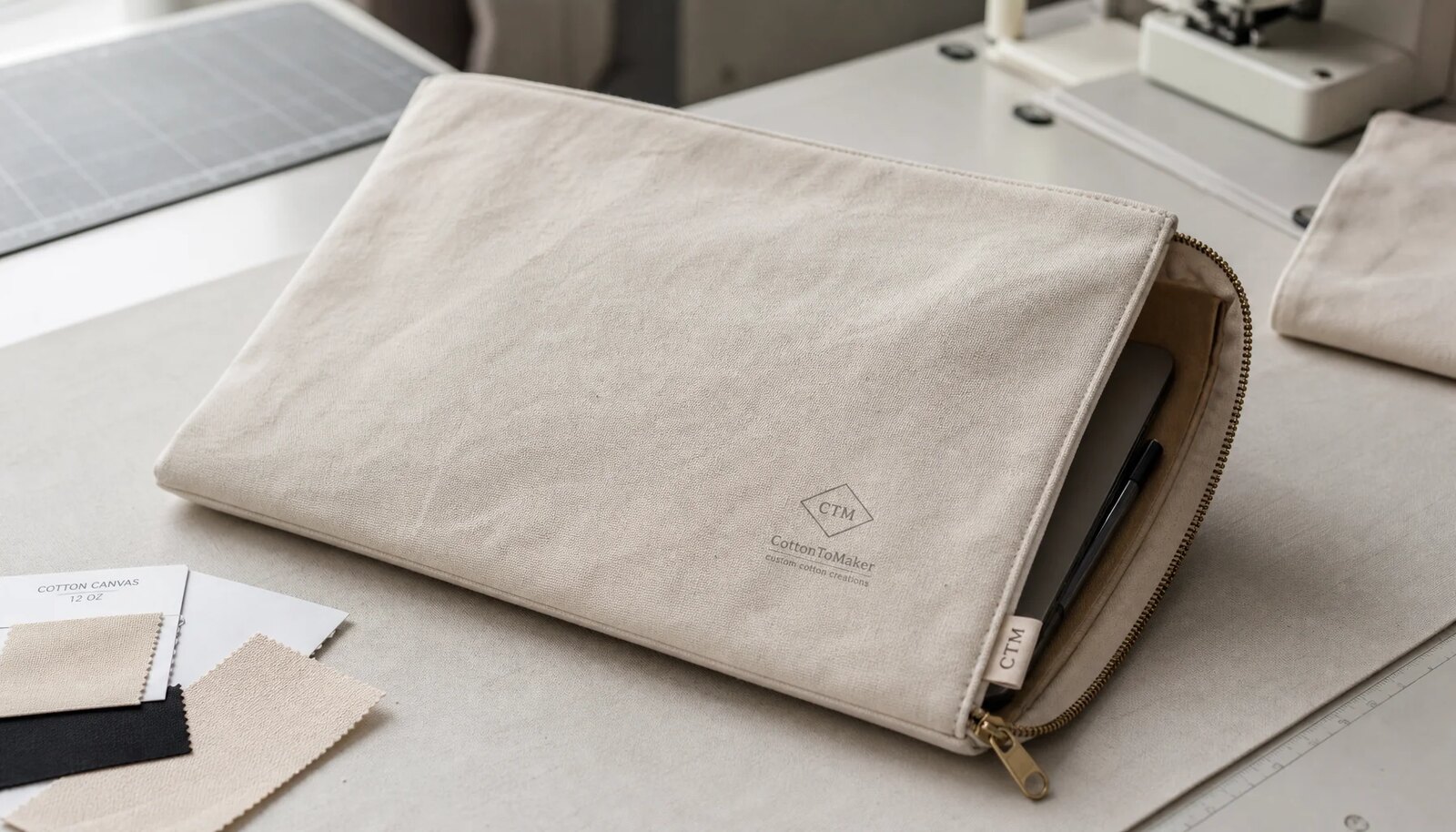
Buying Problem: Logo Placement Is Not a Mockup Detail
For a coffee roaster, a canvas zipper portfolio is rarely just a giveaway. It can carry wholesale price sheets, cafe onboarding forms, roast profile cards, cupping notes, contracts, menus, sample labels, stickers, and business cards. It may sit on a cafe counter during a sales call, travel with a distributor rep, or be handed to a retail buyer after a trade show meeting. In those settings, a crooked or poorly placed logo does more damage than most buyers expect. The fabric can be excellent and the zipper can work smoothly, yet the finished item still feels careless if the mark is too close to a seam, tilted against the bottom edge, or scuffed by the puller.
The most common sourcing problem is approving a good-looking digital mockup without turning it into measurable production instructions. A render does not show seam allowance, zipper tape bulk, panel stretch, corner radius, gusset fold, or carton compression. Once the panels are cut, printed, sewn, turned, pressed, and packed, a logo that looked centered on screen may sit a few millimeters off. On a flat business portfolio, buyers notice that shift quickly.
Treat logo placement as a specification. The RFQ should show logo width, logo height, distance from bottom seam, distance from side seam, zipper direction, zipper pull resting point, front pocket seams, gussets, folds, and any boxed corners. Avoid phrases like “lower front,” “centered nicely,” or “same as mockup.” Cutting, printing, sewing, finishing, and packing may be handled by separate teams. Each team needs the same fixed references.
Also decide what the branding is meant to do. A premium roaster may prefer a small woven side label and a clean natural canvas face. A wholesale program may need a larger front screen print that is easy to see when a sales rep places the portfolio on a table. Both choices can work. What matters is locking the logo size, placement, method, and tolerance before bulk printing begins.
- Use a measured artwork map with final portfolio dimensions, not the logo file alone.
- Keep the front logo at least 35 mm from side seams and 40 mm from the bottom seam when the construction allows.
- Keep the logo at least 25 mm from zipper tape stitching, and farther if the slider or puller rests on the printed face.
- State zipper opening direction so the logo faces the user correctly when the portfolio is opened.
- Approve the logo with the portfolio closed, opened, filled, stacked, and packed.
Start With the Contents, Then Set the Portfolio Size
Logo position should not be the first decision. The first decision is what the portfolio must hold. Coffee roasters may use it for A4 sheets, US letter sheets, price lists, sample cards, green coffee notes, equipment service forms, cafe menus, contracts, notepads, business cards, and stickers. Finished outside dimensions do not tell the whole story. Seam allowance, lining, zipper tape, interior pockets, and corner construction reduce the usable opening.
Ask suppliers to quote both finished outside size and usable document space. A portfolio that measures large enough on the outside may still be tight at the zipper mouth. If paper corners catch when the user inserts documents, the item feels cheap. If the filled contents create tension across the front panel, the logo can bow or distort. For a roaster’s sales kit, the test is not whether one loose sheet fits. Test the full set that will be used in the field.
Construction changes the available logo area. A basic version may use front and back canvas panels, a top zipper or two-side zipper, and a simple interior. More developed versions may add lining, padding, divider panels, piping, card slots, a pen loop, elastic straps, a front pocket, or a gusset. Every additional seam or layer creates a new area to avoid when placing artwork. Screen printing is easiest before assembly, while decorating finished stock blanks can limit print access near the zipper and corners.
Keep the build as simple as the program allows. A flat, unlined portfolio is lighter and usually more economical. A lined version looks cleaner inside and protects documents better, but it adds cost and more inspection points. A padded version feels more premium, yet it increases carton volume and can require a larger logo safe zone. The best construction protects the documents, supports the logo method, and stays within the landed-cost target.
- Confirm whether quoted dimensions are outside dimensions or usable document space.
- Specify A4 and US letter requirements separately instead of assuming one universal format.
- Request zipper opening length, not only total zipper length.
- Keep the front panel flat if the logo needs to be large, crisp, and easy to inspect.
- Test the pre-production sample with the exact papers, cards, and inserts planned for use.
Canvas Weight, GSM, Finish, and Shrinkage Control
Canvas choice affects structure, print quality, sewing, packing, and freight. For many wholesale canvas zipper portfolios, 10 oz to 12 oz cotton canvas, roughly 340-410 GSM before washing or finishing, gives a practical balance. It has more body than lightweight tote fabric, supports screen print better, and still moves through sewing and packing without becoming overly bulky. An 8 oz canvas can work for a lower-cost document pouch, but it may wrinkle more, show document edges, and feel less substantial in account meetings.
Be precise about fabric weight. Some suppliers quote greige weight before finishing. Others quote finished weight after washing, dyeing, coating, or other treatment. Some use “oz” locally without providing GSM. If the purchase order only says “heavy canvas,” two suppliers can deliver very different materials. A stronger specification reads: 10 oz cotton canvas, approximately 340 GSM before washing, natural color, no lamination, fabric swatch approval required before bulk cutting.
Natural and unbleached canvas are popular with coffee brands because they pair well with kraft bags, earthy palettes, and simple premium packaging. They are also imperfect print surfaces. Slubs, seed flecks, yarn variation, and shade movement are normal within agreed limits. Dark brown, black, charcoal, forest green, and navy often read better than pale or low-contrast ink. If the logo includes small origin names, roast level icons, or detailed badge text, approve a strike-off on the actual production canvas.
Dyed canvas can support a fixed retail color system, but it adds control points. Ask whether the fabric is piece-dyed or yarn-dyed, whether it is washed after dyeing, and whether approval is based on a lab dip or a bulk swatch. Dyed fabric may require higher MOQ and longer lead time because the mill or dye house has its own minimums. If the program will reorder, write a shade tolerance and require a new swatch approval for later lots.
- Specify both oz and GSM, and state whether the weight is before or after washing or finishing.
- Use 10 oz canvas for balanced cost, structure, printability, and manageable carton weight.
- Use 12 oz canvas when a more structured or premium hand-feel is required.
- Avoid vague terms such as “thick canvas” or “premium cotton” without measurable fabric data.
- Approve fabric swatch, shade, hand-feel, and print strike-off before bulk cutting.
Logo Placement Rules, Safe Zones, and Measurement Points
The safest logo area is flat, stable, and away from hardware. Keep artwork clear of zipper tape, slider movement, piping, seam intersections, gusset folds, boxed corners, front pocket seams, and packing fold lines. For many zipper business bags, the lower center or lower right front panel works well. It stays away from the zipper and remains visible when the portfolio is carried closed or placed on a table. Badge-style roaster logos often suit the lower third. Horizontal wordmarks should align to the bottom seam or side seam, not to a zipper edge that may have slight wave.
Write placement as a measurement, not a preference. Example one: print logo 90 mm wide, centered left-to-right on the front panel, with the bottom of the logo 55 mm above the bottom seam. Example two: print logo 80 mm wide on the lower right front panel, with the right edge 45 mm from the right side seam and the bottom edge 50 mm from the bottom seam. These instructions can be checked with a ruler. A mockup cannot be inspected with the same confidence.
Agree on tolerance before production. For front-panel screen printing, ±5 mm from the approved sample is a common working target when the construction supports it. The factory should confirm whether that tolerance is realistic for the chosen material and process. Natural canvas can stretch during handling. Sewn panels can shift. A tighter tolerance may require slower marking, printing, and sewing control, which can affect cost and reject rate.
Do not ignore angle. A wordmark can be within distance tolerance and still look wrong if it is rotated against the bottom seam. Inspectors should check the logo angle against a straight seam or approved placement guide. Photograph the approved sample with a ruler beside it, and use the same reference points during final inspection.
- For many medium portfolios, 70-110 mm logo width is visible without overpowering the canvas surface.
- Keep print at least 25 mm from zipper tape stitching, with extra clearance if the zipper pull rests near the logo.
- Avoid boxed corners, bottom folds, piping, front pocket seams, and thick seam intersections.
- Measure from fixed seams, not from soft fabric edges that may shift during sewing.
- Write logo position tolerance and angle expectations into the purchase order.
Choose the Decoration Method Around the Artwork
Screen printing is usually the first choice for wholesale canvas zipper portfolios when the logo is bold and uses one to three solid colors. It is practical for repeat orders, works well on flat panels, and can be controlled with strike-offs. For coffee roasters, it suits wordmarks, bean icons, simple badge logos, wholesale program marks, and cafe account branding. Send vector artwork, Pantone or brand references, final logo dimensions, and the measured placement map. Then check how the ink actually reads on natural canvas rather than judging color only on screen.
Many print problems start in the artwork. Thin serif letters, small origin names, tight circular borders, fine roast icons, and dense badge details can fill in or break up on textured cotton. Ask the factory for minimum line thickness and minimum text height based on the mesh, ink, fabric texture, and print location. For multiple colors, inspect registration in the strike-off. Do not wait for bulk output to discover that a border shifts or small text becomes unreadable.
Heat transfer can reproduce gradients, photographs, and detailed full-color event graphics. The trade-off is hand-feel. It may look smoother or more film-like than ink printed into canvas. It can be suitable for a seasonal campaign or complex art, but adhesion, edge lifting, cracking, and abrasion should be tested. Embroidery can look premium on a small logo, yet it may pucker thin panels and leave thread backing inside the portfolio. Test it on the final construction before approving.
Woven labels are a strong option when the brand direction is quiet and premium. A small side label, front patch, or internal label can make the product feel finished without a large print. Labels also help keep branding consistent across zipper portfolios, totes, aprons, and other roaster merchandise. The trade-offs are label MOQ, sewing accuracy, lead time, and setup cost. A common B2B approach is a one-color front screen print plus a small woven side or interior label.
- Choose screen print for bold logos, predictable bulk cost, and repeatable placement on flat panels.
- Choose woven labels for subtle premium branding or cross-product consistency.
- Choose embroidery only after checking puckering, reverse-side thread, and small-letter readability.
- Choose heat transfer when full-color detail is more important than canvas-like hand-feel.
- Require a strike-off on actual production canvas for fine type, multi-color logos, or critical brand colors.
Zipper, Puller, Thread, and Trim Details Buyers Should Lock
The zipper is both a functional component and a branding risk. A No.5 nylon coil zipper is a practical standard for many canvas zipper portfolios because it is smooth, flexible, light, and available in many tape colors. A metal zipper or brass-tone puller can give a more premium look, but it adds weight and may mark printed panels if units are packed face-to-face without protection.
Specify the zipper completely: size, type, tape color, slider color, puller shape, puller finish, opening direction, and end stop construction. Opening direction matters because it determines where the slider rests when the portfolio is closed. That resting point may sit near the logo or press against the front panel in a carton. A heavy puller, sharp edge, or raised metal detail can leave an impression on natural canvas after compression.
Thread and seams also deserve attention. Thread color should be approved against the body fabric and zipper tape. Stitch length should be consistent. Stress points should be back-tacked. The zipper seam is a high-risk area because it combines fabric layers, zipper tape, repeated opening, and corner movement. If the design includes lining, check that the lining is cleanly caught and does not enter the slider path.
Trim decisions influence MOQ and timing. Stock zipper tape, stock thread, and standard pullers are easier to source. Custom zipper tape colors, embossed pullers, private metal pullers, and custom woven labels often carry separate minimums, setup fees, and longer lead times. Ask suppliers to price these items separately so procurement can decide which custom details are worth keeping.
- Use No.5 nylon coil zipper for standard cost control and smooth function.
- Use metal teeth or metal pullers only after abrasion, weight, and packing checks.
- Specify zipper tape color, slider finish, puller shape, opening direction, and end stop type.
- Check whether the puller rests on the logo during storage or carton compression.
- Confirm thread color, stitch length, back-tacking, and zipper seam finish in the approved sample.
MOQ, Cost Drivers, and Fair Quote Comparison
MOQ is tied to the production route, not only to supplier policy. It depends on fabric availability, cutting efficiency, decoration setup, trim sourcing, sewing line planning, and whether the supplier is decorating existing blanks or making cut-and-sew portfolios from panels. A stock natural canvas portfolio with one-color screen print may be feasible around 300-500 pcs depending on the factory. Dyed canvas, custom lining, special zipper tape, woven labels, metal pullers, multiple logo versions, or multiple sizes can push MOQ higher.
Separate blank product cost from branding and development cost. One quote may include screen setup in the unit price. Another may show screen charges, sample fees, strike-offs, label setup, puller mold cost, packing upgrade, inland freight, or inspection support as separate lines. A lower unit price is not always the lower program cost. To compare suppliers fairly, send the same technical specification to each factory and request the same quote format.
Do not compare stock blank decoration and cut-and-sew production as if they are identical. Stock blanks can shorten lead time and support lower MOQ, but the available logo area may be limited because printing on a finished zipper portfolio is harder near seams and hardware. Cut-and-sew production usually allows printing on flat panels before assembly, giving better placement control, but it often needs more time and higher order quantity.
If this portfolio will become a recurring wholesale account tool, ask about reorder terms. Can the screen be reused? How long are label patterns or puller molds stored? Can the next order match the first fabric shade? Natural and dyed canvas can vary between lots, so repeat orders may need fresh swatch approval. These details matter when procurement is planning more than a one-time promotion.
- Lowest complexity: stock canvas, stock zipper, one print color, one logo position, no private trim.
- Higher complexity: dyed canvas, custom zipper tape, woven label, metal puller, lining, retail sleeve, multiple SKUs.
- Ask whether the quote is for stock blank decoration or cut-and-sew production.
- Compare landed cost, including setup, samples, packing, inland freight, inspection, and carton data.
- Confirm reorder terms for screens, labels, pullers, fabric shade, and repeat MOQ.
Sample Approval Workflow for Coffee Roaster Portfolios
A pre-production sample should prove the real production route. It should use the same canvas weight, fabric color, zipper, thread, decoration method, logo size, logo placement, interior layout, labels, and packing method planned for bulk production. An early shape sample made with substitute fabric can help confirm size or layout, but it should not approve final hand-feel, ink color, zipper function, or logo placement. Mark substitute samples as development references only.
Review the sample with the actual contents. Insert the wholesale price sheets, cafe forms, sample cards, contracts, menus, notepad, and business cards that the finished portfolio will carry. Check whether documents slide in cleanly, whether the zipper closes without catching paper, and whether the filled contents change the logo appearance. A portfolio that looks flat and tidy when empty may strain at the zipper once loaded.
Photos help, but they cannot approve everything. A photo may show shape and approximate placement. It will not confirm print thickness, ink hand-feel, zipper smoothness, fabric odor, seam strength, or carton compression effects. Measure logo distance from bottom and side seams. Zip and unzip the sample repeatedly. Inspect the inside for loose threads. Check label alignment. Review the printed face after the sample has been packed as it would be for shipment.
If the artwork changes after approval, pause the process. Even a small change in logo size, line thickness, or color count can affect print clarity on canvas. Late changes are especially risky in cut-and-sew production because panels are often printed before sewing. A safe approval sequence is artwork lock, fabric swatch, print strike-off, pre-production sample, packing sample, then bulk production.
- Measure logo distance from bottom seam and side seam on the physical sample.
- Zip and unzip at least 20 cycles during sample review to catch slider or corner issues.
- Fill the portfolio with intended documents and check clearance, zipper stress, and logo visibility.
- Photograph the approved sample with a ruler and keep a signed approval record.
- Do not release bulk production if final artwork, fabric, zipper, or packing differs from the approved sample.
Bulk QC: Tolerances, Defects, and Inspection Focus
Write QC requirements before production begins. Finished canvas zipper portfolios are not easy to correct once the logo is printed and the panels are sewn. The purchase order should define logo placement tolerance, logo angle, print quality, zipper function, seam standards, fabric appearance, odor limits, packing method, and carton marks. For front-panel printing, ±5 mm from the approved sample is a common working tolerance when the construction supports it. Body dimensions may need a different tolerance because fabric behavior and sewing can vary by size.
Classify defects by severity. Broken zippers, open seams, unreadable logos, wrong logo placement, missing labels, wrong zipper color, severe front stains, mold odor, and wrong SKU packing should be treated as major defects. Small internal loose threads, slight natural slubs, or minor shade character within the approved range may be minor. This distinction protects the buyer from visible brand and function failures while recognizing the normal character of cotton canvas.
Functional inspection is as important as visual inspection. Open and close the zipper across the full length. Check slider strength, skipped teeth, secure end stops, back-tacking at stress points, and pocket usability. Insert the intended business card, pen, or document size into each feature. If the portfolio has lining, check that it does not bunch or catch in the zipper.
Print inspection should use the approved strike-off and pre-production sample as references. Check logo size, position, angle, color, edge clarity, pinholes, smudges, bleeding, registration, and ink buildup. Inspect the front face more strictly than hidden areas because it is the brand surface. If a slub or thick yarn crosses the print, decide whether it remains within the approved natural canvas tolerance or makes the logo unreadable.
Inspect packed goods, not only loose pieces. Pull units from cartons after compression and check for zipper impressions, abrasion, moisture marks, and permanent creases through the printed panel. Confirm carton quantity, carton marks, logo version segregation, gross weight, net weight, and carton condition. Final inspection should compare production against the signed sample, placement map, packing instruction, and purchase order.
- Major defects include broken zipper, open seam, wrong logo placement, unreadable print, visible front stain, mold odor, and missing label.
- Minor defects may include small internal loose threads, slight natural slub, or minor print density variation within approved range.
- Check logo position with a ruler and logo angle against a straight seam.
- Inspect both loose goods and packed goods after carton compression.
- Keep one sealed approved sample at the factory and one with the buyer for dispute control.
Packing, Cartons, and Transit Protection
Packing can protect the finished presentation or damage it. A portfolio may look perfect at the sewing table and arrive with zipper impressions, rubbed ink, moisture marks, or a hard crease through the logo. Flat packing is usually safer than folding through the printed face. If folding is unavoidable, approve a folded packing sample and check whether the crease recovers after several days.
Individual polybags protect against dust, moisture, and abrasion. Some coffee roasters, however, prefer paper sleeves, tissue wrap, or reduced-plastic packing to align with brand values. Decide this during RFQ, not after production, because packing affects labor, presentation, carton size, and freight. If units are packed without individual bags, printed faces may need tissue separation or face-to-back packing so zipper pulls do not press into ink.
Carton quantity depends on portfolio size, canvas weight, lining, padding, zipper type, and packing style. Many orders may fall around 25-50 pieces per export carton, but buyers should request actual carton data rather than assume. A 12 oz lined portfolio with a metal puller packs differently from a flat 10 oz nylon-zipper version. Carton dimensions and gross weight are needed before comparing courier, air, sea, or warehouse receiving costs.
Carton marks should make receiving easy. Include SKU, item description, color, logo version, quantity, carton number, gross weight, net weight, and country-of-origin information when required by the shipment plan. If multiple cafe programs, distributor logos, or colorways are produced together, do not allow mixed cartons unless the receiving team has approved that method. Mixed cartons create counting errors and make QC claims harder to trace.
- Place printed faces away from zipper pulls or separate pieces with tissue, sleeves, or protective sheets.
- Avoid any fold line through the logo unless the approved packing sample proves it is safe.
- Request carton dimensions, gross weight, net weight, pieces per carton, and carton strength before booking freight.
- Use clear carton marks for SKU, logo version, quantity, color, and country-of-origin requirements.
- Check packed goods during final inspection, not only loose production pieces.
Specification comparison for buyers
| Spec decision | Recommended option | When it fits | Buyer risk to check |
|---|---|---|---|
| Front logo placement | Lower right or centered lower third; commonly 40-70 mm above the bottom seam, 35-50 mm from side seams, and at least 25 mm from zipper tape stitching | Coffee roaster sales kits, cafe onboarding packs, distributor meetings, trade show follow-up folders, and retail gift sets where the portfolio is seen closed and carried flat | Artwork placed near zipper pull paths, boxed corners, gusset folds, curved seams, or fold lines can look off-center, rub, or distort after sewing and packing |
| Logo size | 70-110 mm wide for many medium document portfolios; confirm against actual front-panel size before tooling screens or labels | Roaster wordmarks, circular badge logos, wholesale program marks, and simple cafe account branding that should read clearly without overpowering natural canvas | Oversized ink coverage can feel stiff, increase drying time and print cost, crack on folds, and make 3-5 mm placement variation more visible |
| Canvas fabric weight | 10 oz to 12 oz cotton canvas, approximately 340-410 GSM before washing or finishing; specify if weight is greige, finished, or washed | Balanced structure, print support, sewing manageability, and carton weight for B2B zipper portfolio orders | Quotes using only “heavy canvas” or “thick cotton” may hide low GSM, inconsistent fabric sourcing, shrinkage differences, or weak hand-feel |
| Canvas color | Natural or unbleached canvas for standard roaster aesthetics; dyed canvas only after lab dip, bulk swatch, and shade tolerance approval | Natural canvas suits kraft packaging, coffee packaging palettes, and low-contrast premium branding; dyed fabric supports retail color systems | Natural canvas includes slubs and seed flecks; dyed fabric can require higher MOQ, longer lead time, and shade-lot control |
| Logo method | Screen print for bold one- to three-color marks; woven label for small premium branding; embroidery only after puckering test; heat transfer for complex color artwork | Repeat wholesale orders from about 300 pcs upward where branding must be legible and consistent on textured canvas | Fine serif type, thin origin text, tight badge borders, and multi-color registration can fail unless a strike-off is approved on production canvas |
| Zipper and trim | No.5 nylon coil zipper for standard orders; No.5 metal zipper or brass-tone puller for premium-facing programs after weight and abrasion checks | Nylon controls cost, smoothness, and lead time; metal trim supports a higher-value look for customer-facing kits | Metal teeth and pullers add weight, can scratch print, may oxidize depending on finish, and can leave impressions if packed face-to-face |
| Interior layout | One main document compartment plus one card pocket and pen loop unless the buyer supplies a measured insert layout | Wholesale price sheets, cafe account documents, cupping forms, sample cards, menus, contracts, and business cards | Excess interior pockets increase sewing time, inspection points, dimensional variation, and cost without improving the visible brand area |
| MOQ logic | 300-500 pcs may be feasible for stock canvas and one-color screen print; higher MOQ for dyed fabric, custom zipper tape, custom puller, lining, woven labels, or multiple sizes | Regional roasters, distributor programs, multi-location cafe groups, and retail buyers testing a branded business bag line | Very low MOQ quotes may rely on stock blanks, limited print areas, substitute trim, higher unit price, or looser tolerance control |
| Sampling requirement | Strike-off plus pre-production sample using final canvas, zipper, thread, logo size, placement, label, interior layout, and packing method | Needed before bulk cutting, printing, deposit balance decisions, trade show deadlines, or retail program launch approvals | Photo-only approval can miss zipper waviness, print hand-feel, slub interference, odor, document fit, and actual logo visibility |
Buyer checklist before sampling
- Define the portfolio by real contents: A4 sheets, US letter sheets, contracts, sample cards, cupping forms, menus, business cards, stickers, or a notepad, including thickness of the filled set.
- Specify finished outside dimensions, usable document opening, zipper opening length, seam allowance, zipper clearance, and whether the portfolio must lie flat when filled.
- State canvas weight in oz and approximate GSM, and confirm whether the quoted weight is greige, finished, washed, coated, laminated, or after dyeing.
- Ask whether the supplier is producing cut-and-sew portfolios from panels or decorating stock blanks, because MOQ, logo area, and placement tolerance differ.
- Provide vector artwork, Pantone or brand color references, logo width and height, and a measured placement map from fixed seams rather than a visual mockup only.
- Set a logo safe zone away from zipper tape, slider path, corner radius, boxed gussets, piping, bottom folds, and heavy seam intersections.
- Require a printed strike-off on production canvas when the logo includes small text, thin lines, badge borders, multiple colors, or tight registration.
- Approve zipper size, zipper type, tape color, slider direction, puller finish, puller shape, and whether the puller can touch the printed face during packing.
- Define acceptable logo placement tolerance, commonly ±5 mm from the approved sample for front-panel printing when construction supports it.
- Set QC rules for zipper function, seam strength, stitch consistency, fabric stains, print smudges, ink bleeding, shade variation, odor, and carton damage.
Factory quote questions to send
- What finished portfolio dimensions, usable document opening, zipper opening length, seam allowance, and zipper clearance are included in your quotation?
- What canvas weight in oz and GSM will be used for the body, and is the weight measured before or after washing, coating, dyeing, or finishing?
- Is the canvas natural, bleached, piece-dyed, yarn-dyed, washed, laminated, or coated, and how will that affect shrinkage, hand-feel, and print color?
- Are you producing cut-and-sew portfolios from fabric panels or decorating pre-made stock blanks, and where in the process will the logo be applied?
- Can the logo be printed at the exact placement shown in the artwork map, and what bulk position tolerance do you normally hold for this construction?
- Which decoration method do you recommend for this logo on natural canvas, and what minimum line thickness and minimum text height should we maintain?
- Can you provide a strike-off on the actual production canvas before making the full pre-production sample, and will it show final ink color and hand-feel?
- What is the MOQ for one-color screen print, two-color screen print, woven label, custom zipper tape, custom puller, dyed canvas, lining, and multiple sizes?
- Will the pre-production sample use the same fabric, zipper, thread, logo method, label, interior layout, packing method, and carton packing as bulk production?
- What zipper size, zipper material, tape color, slider finish, puller type, puller direction, end stop method, and slider direction are included in the price?
Quality-control points to confirm
- Logo placement should normally be controlled within ±5 mm from the approved sample for front-panel printing unless the written specification states another tolerance for the construction.
- Logo angle should be checked against a straight bottom seam or side seam with a ruler or gauge, not only by eye, because a rotated wordmark is visible on a flat portfolio.
- Logo size should match the approved artwork and sample; inspect width, height, clear space, and whether the mark remains readable after the portfolio is filled.
- Screen print edges should be clean, with no visible pinholes, drag marks, ink bleeding, heavy ink buildup, registration shift, or fabric slub interference that makes the logo unreadable.
- Ink color should be compared under consistent light against the approved strike-off, allowing only the agreed variation caused by natural canvas shade and texture.
- Zipper must open and close smoothly across the full length, with no skipped teeth, loose slider, broken pull, sharp edges, tape waviness, or catching at corners.
- Body dimensions should match the approved sample within written tolerance, especially outside size, usable document opening, zipper clearance, and panel alignment.
- Seams around zipper, corners, pockets, labels, and stress points should have consistent stitch length, secure back-tacking, no skipped stitches, no thread nests, and no exposed raw edges.
- Natural canvas should be free from heavy oil spots, water marks, mold odor, severe shade panels, large stains, and visible contamination near the front logo area.
- Interior pockets, pen loops, business card slots, labels, and divider panels should be aligned, functional, and strong enough for repeated insertion rather than only visually attached.