Why portfolio compliance matters for coffee roaster buyers
A canvas zipper portfolio for a coffee roaster is usually more than a giveaway. It may carry wholesale price sheets, café training guides, cupping forms, green-coffee origin notes, distributor agreements, brew recipes, notebooks, pens, and customer onboarding material. Even when the item is not food-contact, it represents the brand in front of café partners, retailers, wholesale buyers, and sales teams.
The sourcing risk is that many quotations look similar at first glance: natural canvas, black zipper, front logo, one internal sleeve, bulk carton packing. The real differences are hidden in the bill of materials, zipper choice, fabric weight, print method, packing standard, and documentation path. A supplier can send a good sample while still planning to change zipper source, fabric weight, lining, patch material, or packing in bulk unless change control is clear.
For procurement teams, the right question is not only, “Can the supplier make this?” It is, “Can the supplier repeat the approved sample and prove what was used?” A practical supplier compliance checklist for canvas zipper portfolios should link the quote, sample, material records, trim card, packing instruction, and inspection criteria before production starts.
This matters most when portfolios are ordered for trade shows, distributor launches, retail promotions, or seasonal wholesale programs. Late defects create avoidable costs: relabeling, repacking, extra inspection, air freight, missed launch dates, or internal document chasing. A tighter RFQ reduces those problems without overcomplicating a straightforward business bag.
- Common weak point: approving a good-looking sample without confirming that the sample BOM matches the bulk quote.
- Higher-risk components: dark dyed canvas, metal pullers, plated hardware, PU or leather-alternative patches, solvent-heavy inks, adhesives, and low-grade polybags.
- Useful approval file: signed spec sheet, physical sample, trim card, artwork placement guide, packing instruction, and written deviation rule.
- Procurement mindset: treat the portfolio as a branded zipper business bag with measurable construction details, not as a generic promotional pouch.
Start with the use case and insert load
The best specification starts with how the portfolio will be used. A wholesale sales folder opened daily needs more durable zipper movement and pocket usability than a one-time event credential pack. A distributor onboarding kit may need room for contracts, price sheets, insert cards, and a notebook. A café training folder may need A4 or US Letter handouts, laminated brew guides, pens, and business cards.
Paper size is a small detail that causes real sourcing errors. A4 is about 210 x 297 mm. US Letter is about 216 x 279 mm. If one design must serve both markets, the sleeve should fit the wider US Letter dimension and the taller A4 dimension with insertion clearance. Specify usable pocket opening and usable depth, not only the flat panel size.
A buyer should approve the sample with real contents. A pocket can measure correctly but still catch documents if seam allowance, zipper tape, binding, or a rounded corner reduces access. Likewise, a portfolio can close cleanly when empty but bulge when filled with a notebook and sales sheets. Function testing is the cheapest sample-stage control.
- Define contents: sheet size, number of pages, notebook thickness, tablet size, business-card format, pen diameter, and any coffee sample cards.
- Specify closed size, open size, usable pocket dimensions, zipper opening length, spine or gusset, and maximum filled thickness.
- Avoid unnecessary compartments for simple document holders; each pocket adds labor, inspection points, and defect risk.
- For premium kits, add reinforcement, lining, or binding where it improves function rather than only increasing fabric weight.
Build a component-level RFQ suppliers can quote accurately
An RFQ that says “canvas zipper portfolio with logo” almost guarantees uneven quotes. One supplier may price 12 oz cotton canvas and a nylon coil zipper. Another may price a cotton-poly blend, lighter fabric, fewer pockets, a generic zipper, and simpler packing. The unit prices may look comparable, but the products are not.
A stronger RFQ breaks the portfolio into fabric, zipper, thread, lining, binding, pockets, reinforcement, logo method, labels, patches, packing, carton data, and documentation. The word “canvas” is not specific enough. It can mean cotton canvas, cotton-poly canvas, recycled cotton blend, recycled PET canvas, or a polyester fabric with a canvas look.
Fabric weight should be stated in GSM or ounces per square yard, and the supplier should confirm whether the number refers to finished fabric. Greige fabric can change after dyeing, washing, coating, or finishing. The quote should also state the expected weight tolerance. For example, a buyer might use a ±5% to ±10% range as a starting discussion, but the final tolerance should be agreed with the supplier and any testing or inspection requirement.
Zippers also need detail. Nylon coil zippers are often practical for portfolios because they flex around corners and usually run smoothly. Metal teeth can look premium but add weight, scratch risk, and plating documentation questions. Resin molded teeth can work, though they may be bulkier. Specify zipper type, gauge, tape width, tape color, teeth color, slider, puller, end stops, and reinforcement.
- Fabric spec: composition, finished weight, weave, color, finish, backing or coating, handfeel reference, and tolerance.
- Construction spec: seam allowance, SPI range if used, binding width, pocket dimensions, corner shape, reinforcement points, and finished-size tolerance.
- Branding spec: artwork file, logo size, Pantone references, method, placement from fixed seams, and placement tolerance.
- Packing spec: individual or bulk packing, insert board, barcode, hangtag, carton quantity, carton weight, carton marks, moisture protection, and packed-sample approval.
Fabric, color, and sustainability claims to verify
Canvas choice affects appearance, structure, print behavior, zipper sewing, freight volume, and compliance support. Cotton canvas gives the natural handfeel many coffee brands prefer. Cotton-poly blends may reduce cost and improve dimensional stability, but they change the material story. Recycled cotton blends or recycled PET canvas may fit brand goals, but any recycled-content claim should be supported before it appears in packaging, marketing copy, or retailer product data.
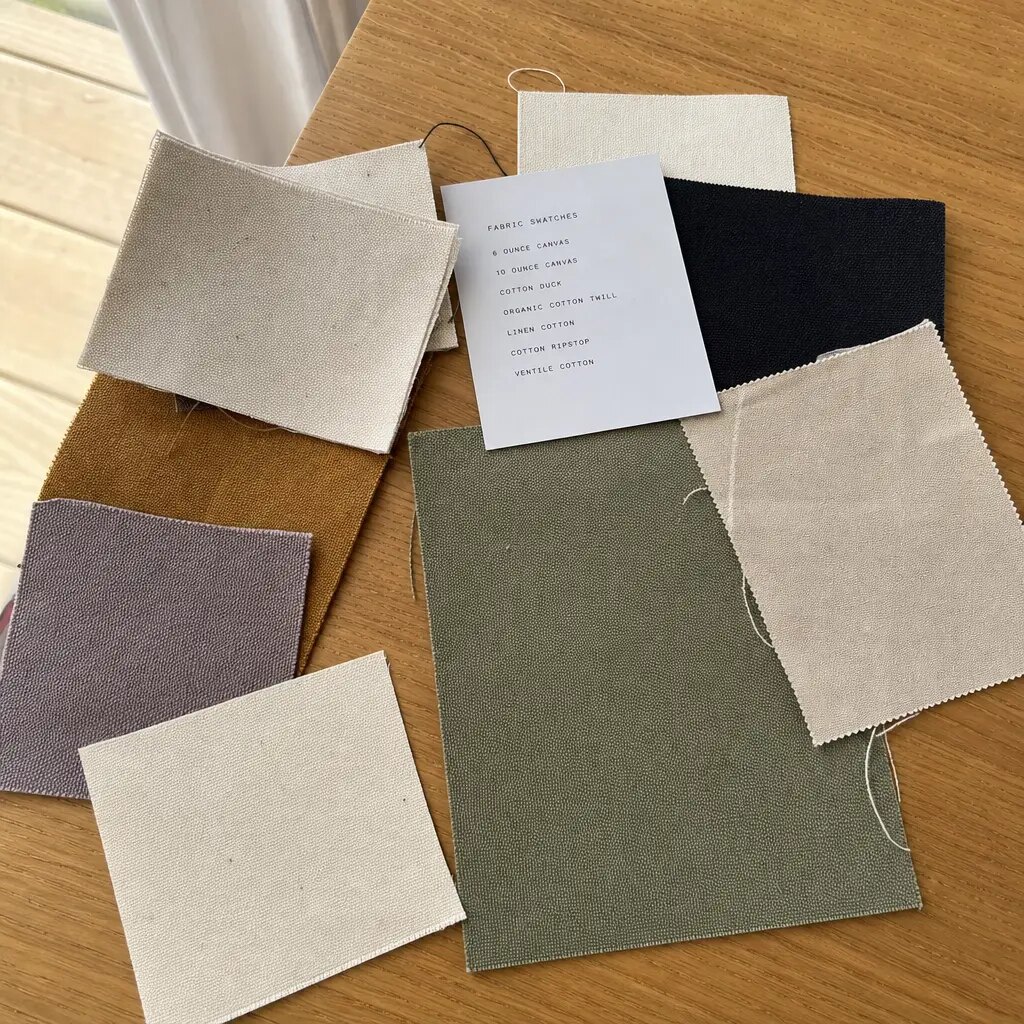
Color control is harder on fabric than on a screen mockup. Natural canvas can range from cream to beige depending on yarn and finishing. Black, navy, forest green, and brown canvas can show lint, shade variation, print-opacity issues, and crocking risk. For strict brand colors, approve a lab dip or physical swatch before bulk fabric purchase. For small stock-fabric orders, exact Pantone matching may not be realistic.
Material declarations should follow the actual bill of materials, not a generic product category. A useful file may include fiber content, dye or finish notes, print ink declaration, zipper tape and slider information, patch material, label material, adhesive, thread, polybag, carton, and paper insert. Avoid unsupported claims such as “eco-friendly,” “organic,” “non-toxic,” or “recycled” unless the supplier can support the exact component and claim.
- For natural canvas, approve an acceptable shade range instead of expecting every lot to be identical.
- For dark canvas, request a rub or crocking check if white documents or light packaging will touch the portfolio.
- For custom color, confirm lab dip timing, bulk dye MOQ, shade tolerance, and who pays if the shade is rejected.
- For coated or backed canvas, verify odor, stiffness, folding behavior, print adhesion, and documentation impact.
- For recycled or organic claims, confirm whether evidence applies to fabric only, a component, or the whole finished product.
Documentation paths for EU, US, retailers, and internal audits
Not every canvas zipper portfolio needs formal laboratory testing, but every buyer should know what evidence may be required by the destination market or sales channel. The documentation path should be agreed before sampling because materials that are easy to buy may not be the easiest to document later.
For EU programs, buyers may ask about REACH restricted substances, nickel release for metal parts if relevant, azo dye restrictions for textiles, packaging waste requirements, and retailer-specific chemical lists. For US programs, common questions may involve fiber content labeling where applicable, California Proposition 65 risk review, CPSIA if the item is intended for children, and retailer restricted-substance policies. These are examples, not a universal checklist; the buyer’s legal, compliance, or retailer requirements should drive the final test plan.
Retailer and distributor programs often add their own requirements: product data forms, packaging declarations, barcode rules, carton markings, polybag warning text, country-of-origin marking, SKU separation, and sometimes restricted-substance declarations. Internal brand audits may focus on material claims, supplier traceability, and consistency with sustainability language.
The strongest evidence is current, relevant, and component-linked. A test report for a different tote bag made two years ago does not prove that a new portfolio’s canvas, zipper, patch, ink, or packaging is acceptable. Ask the supplier to connect records to the actual quoted BOM.
- Useful records: component BOM, material declarations, relevant test reports, fabric lot records, zipper trim records, print approval, trim card, packing specification, and inspection report.
- Weak records: expired certificates, cropped files, unrelated product descriptions, different fabric composition, missing dates, missing lab details, or documents not tied to the quoted materials.
- EU examples to discuss: REACH, azo dyes, nickel where relevant, packaging requirements, and retailer RSL/MRSL requests.
- US examples to discuss: Proposition 65 review, CPSIA only if child-directed, fiber/content labeling where applicable, and retailer RSL requests.
- Retail examples to confirm: barcode, carton label, polybag language, country-of-origin marking, packaging declarations, and compliance portal uploads.
Choose the right sourcing route
Factory-direct sourcing often gives the best technical control for canvas zipper portfolios. The item is not mechanically complex, but it is detail-sensitive. Zipper alignment, panel squareness, pocket access, corner bulk, logo placement, and thread trimming all depend on disciplined cutting and sewing. Direct communication usually makes sample corrections clearer.
A trading company or sourcing agent can be useful when the portfolio is part of a wider merchandise kit with tote bags, aprons, notebooks, POS cards, pins, or retail inserts. The control question is whether the trader can disclose the actual production site, maintain the BOM, answer factory-level questions, and take responsibility for inspection outcomes.
Retail-ready suppliers are valuable when portfolios must arrive with barcode labels, hangtags, belly bands, insert cards, inner cartons, SKU bundles, distributor receiving labels, or strict carton marks. These services cost more than bulk packing, but they can reduce warehouse labor and receiving delays. If retail packout is not needed, avoid paying for packaging complexity that does not create value.
Whichever route is chosen, require the same controls: approved sample, signed spec sheet, trim card, packing instruction, inspection criteria, and deviation process. The less transparent the sourcing route, the more important the paper trail becomes.
- Choose factory direct for construction detail, repeat consistency, and faster technical feedback.
- Choose a trader only if they can identify the real factory, control the BOM, and own QC decisions.
- Choose retail-ready capability when barcode, SKU, insert, hangtag, or distributor carton rules are part of the order.
- Red flag: the supplier will not confirm whether sample and bulk production use the same facility, materials, and process.
Branding method, placement, and trim decisions
Coffee roaster branding often uses clean wordmarks, origin names, roast-program icons, café-channel messaging, or simple monochrome artwork. A one- or two-color screen print on a flat front panel is often cost-effective for stable bulk orders. Printing before assembly usually improves placement because the panel is flat.
For smaller runs with several versions, woven labels or sewn patches can be more efficient than changing body colors. One base portfolio can support different distributor, event, market, or roast-line branding. Labels and patches still need control: yarn or base material, backing, edge finish, adhesive if used, thread, placement, and restricted-substance support if a retailer may request it.
Embroidery can look durable and premium, but it may pucker lighter canvas and may require lining to hide reverse-side threads. Heat transfers can reproduce detailed artwork, but need checks for adhesion, cracking, tackiness, and texture compatibility. Debossed PU or leather-alternative patches add visual value but also add material declarations, mold cost, attachment checks, and sometimes retailer review. Custom zipper pullers are distinctive but require tooling, plating decisions, pull-strength checks, and hardware documentation.
Placement should be measured from fixed reference points. “Centered on front” is too vague when fabric panels stretch and zipper seams curve. State the distance from the top edge, side seam, zipper seam, or panel centerline, then agree on tolerance. As a starting point, many fabric-bag buyers discuss about ±3 mm to ±5 mm depending on method and panel size, but the final standard should be confirmed before production.
- Screen print: efficient for simple artwork, larger runs, and clear front-panel branding.
- Woven label: useful when several artwork versions share one base construction.
- Embroidery: premium and durable, but check puckering, reverse side, stitch density, and added labor.
- Patch: strong brand detail, but verify material, edge durability, attachment, and documentation.
- Custom puller: high visibility, but confirm tooling, plating, burrs, pull strength, and restricted-substance support.
MOQ, price breaks, and landed-cost drivers
MOQ for canvas zipper portfolios is not one number. It is shaped by fabric purchase minimums, dye-lot minimums, zipper color minimums, custom puller minimums, label or patch minimums, print setup, cutting efficiency, sewing batch size, packing materials, and inspection cost. When a supplier states 500 pieces, ask whether that means per style, per fabric color, per zipper color, per logo version, per packing version, or per shipment.
The easiest way to reduce MOQ without making the product generic is to standardize the base. One natural canvas body, one black zipper, one lining, one interior layout, and several label or print versions are usually easier to manage than three body colors, two zipper colors, and five pocket layouts.
Ask for price breaks at realistic quantities such as 500, 1,000, 2,500, and 5,000 pieces, but also ask what changes at each break. Sometimes price drops because fabric is bought more efficiently. Sometimes setup costs are spread across more units. Sometimes sewing labor dominates and the price barely moves. A useful quote explains the cost driver, not only the price ladder.
Ex-factory price is not landed cost. A cheaper quote may exclude sample charges, setup charges, mold charges, compliance support, barcode application, insert cards, individual polybags, moisture protection, or realistic carton dimensions. Weak packing can increase freight volume, damage, and warehouse rework.
- Major cost drivers: canvas weight, composition, dyeing, lining, pocket count, zipper quality, custom puller, binding, reinforcement, logo method, and retail packing.
- MOQ levers: standardize fabric, standardize zipper, reduce pocket variations, group artwork versions, and avoid unnecessary custom hardware.
- Quote breakdown to request: unit price, setup charge, sample charge, mold charge, label charge, testing support, packaging adder, carton quantity, and estimated CBM.
- Landed-cost view: include repacking, relabeling, defect sorting, extra testing, air-freight risk, warehouse handling, and internal document-chasing time.
Sample approval and change control
A pre-production sample should not be treated as a beauty sample. Buyers often focus on the logo first, but later complaints usually come from function: the zipper catches when filled, the document sleeve is too narrow, the front panel wrinkles, the corners are bulky, pocket stitching blocks insertion, or the portfolio does not close square.
A practical sample process may include a layout drawing, material swatches, print strike-off, physical fit sample, and pre-production sample using intended bulk materials. For simple orders, some steps can be combined. For retail, distributor, or corporate gifting programs, brand, logistics, and compliance should all review the sample before approval.
The pre-production sample should use the intended bulk fabric, zipper, puller, thread, lining, logo method, label, patch, and packing direction. If substitute materials are used to save time, mark the sample as a prototype and do not treat it as final approval. Fabric weight, zipper gauge, and ink can change both appearance and performance.
After approval, seal the sample and link it to a signed spec sheet. The supplier should keep one duplicate, and the buyer should keep one. The PO file should include fabric spec, zipper spec, artwork file, placement measurements, pocket dimensions, inspection criteria, packing method, carton marks, and approved deviations.
- Test with real inserts: price sheets, contracts, cupping forms, notebooks, tablets, business cards, pens, or training materials.
- Run the zipper repeatedly around corners with the portfolio empty and filled; note catching, twisting, or slider resistance.
- Measure pocket opening width as well as depth because usable access matters more than flat measurement alone.
- Fold and rub the print zone lightly to check early cracking, tackiness, transfer, poor adhesion, or ink buildup.
- Seal one approval sample and one approved packing sample or packing photo set with the purchase-order file.
Inspection plan: define defects before production
Bulk defects usually appear in predictable places: zipper performance, panel alignment, stitching, logo consistency, pocket usability, shade variation, odor, and packing accuracy. These problems are easier to control when the buyer defines inspection criteria before production starts.
A practical inspection plan defines critical, major, and minor defects. Critical defects make the item unusable or create unacceptable safety, legal, or channel risk: broken zipper, missing puller, sharp metal burr, wrong barcode, wrong logo, mold, severe odor, or missing required label. Major defects reduce function or sellability: zipper catching, open seams, unusable pockets, severe print smear, panel twist, heavy shade mismatch, or loose patches. Minor defects are workmanship issues that do not affect normal use, such as small removable thread ends or slight canvas texture variation within the approved standard.
AQL levels should be agreed with the supplier or inspector, but defect definitions are just as important as the numeric AQL. Canvas is textured, so the standard should allow normal weave character while rejecting stains, holes, severe slubs, oil marks, water marks, mold, and shade mixing beyond the approved range.
Inspection should not wait until cartons are sealed. Incoming fabric and zipper checks catch wrong materials early. Print strike-off approval prevents a full batch of off-color logos. First-piece assembly catches construction problems before the line repeats them. Final random inspection verifies quantity, function, appearance, and packing before shipment.
- Inspection checkpoints: incoming fabric, zipper receiving, print strike-off, first-piece assembly, in-line sewing, pre-packing check, and final random inspection.
- Critical examples: broken zipper, missing puller, wrong logo, wrong barcode, sharp burr, severe odor, mold, missing pocket, or unsafe packaging.
- Major examples: zipper catching, severe print smear, wrong dimensions, loose patch, open seam, skipped-stitch cluster, or unusable pocket.
- Minor examples: small removable thread ends, slight non-critical waviness, or tiny print variation within agreed limits.
- Photo evidence to request: measurement points, zipper test, logo close-up, pocket-fit test, stitching close-up, puller finish, carton mark, barcode, and open-carton assortment.
Specification comparison for buyers
| Supplier option | What to verify | Commercial advantage | Buyer risk to control |
|---|---|---|---|
| Direct sewing factory | zipper source record, production-line zipper test photos, approved trim card, cutting marker photos, and final open-carton count | Better sample-to-bulk control and faster production feedback | May be weaker on export paperwork or branded packing unless checked early |
| Trading company | Factory name, production photos, trim-source proof, and who owns QC decisions | Can coordinate small mixed orders and extra services | Markup can hide real factory capability and slow defect decisions |
| Specialized bag workshop | zipper gauge, zipper tape width, puller finish, binding tape, corner reinforcement, seam allowance, and document-size tolerance | More practical for detailed construction, trims, and repeat programs | Capacity may be limited during peak seasons |
| Low-price general supplier | 300D-600D polyester, 10-12 oz canvas, or recycled PET with backing stiffness matched to document weight | Useful for simple promotional runs with loose specs | Material downgrades, weak packing, and vague inspection scope can erase savings |
| Retail-ready supplier | flat packing, insert board if needed, SKU bundles, carton weight limit, moisture protection, and barcode visibility | Can handle labels, SKU separation, carton marks, and receiving rules | Higher unit cost must be compared against reduced warehouse work |
| Compliance-focused supplier | Fabric records, labeling review, test plan, and production traceability | Safer for retail programs and repeat brand orders | Documentation claims need evidence, not only sales language |
| Local sample room plus bulk factory | Signed sample, bulk factory handoff, first-piece photos, and deviation owner | Good for complex branding before large production | Sample room quality may not match bulk line unless handoff is controlled |
Buyer checklist before sampling
- Define the business use first: wholesale sales portfolio, café training folder, distributor onboarding kit, trade-show credential pack, retail gift-with-purchase, green-coffee education folder, or internal brand presentation case.
- State finished closed size, open size, usable document-pocket size, zipper opening length, spine or gusset if any, and maximum intended filled thickness.
- Confirm paper standard: A4, US Letter, or both. Specify usable pocket opening, not only panel size, so documents do not catch on seams or zipper tape.
- List intended contents: cupping forms, wholesale price sheets, contracts, notebooks, tablets, business cards, pens, sample cards, brew guides, or retail inserts.
- Specify fabric composition: cotton canvas, cotton-poly canvas, recycled cotton blend, recycled PET canvas, organic cotton if required, and any backing, coating, wash, softener, or stiffening finish.
- Specify finished fabric weight in GSM or oz per square yard and require the supplier to state the quoted tolerance and whether the weight is greige, dyed, washed, coated, or finished fabric.
- Define color approval by Pantone, lab dip, supplier swatch, approved physical sample, or agreed visual shade range for natural canvas.
- Name zipper type, gauge, tape width, tape color, teeth color, slider, puller style, finish, end reinforcement, and any nickel-free or restricted-substance requirement.
- Map each interior component: document sleeve, business-card pocket, pen loop, tablet pocket, elastic strap, mesh pocket, lining, binding, reinforcement patch, board, or removable insert.
- Choose logo method by order logic: screen print, heat transfer, woven label, embroidered patch, debossed PU patch, leather-alternative patch, zipper pull logo, or mixed branding.
Factory quote questions to send
- What exact fabric construction, composition, finished weight in GSM or oz, weave type, finish, and weight tolerance are you quoting?
- Is the canvas stock-dyed, piece-dyed, yarn-dyed, printed, washed, coated, backed, softened, or stiffened, and how do you control shade variation across fabric lots?
- Can you quote two comparable fabric options, such as 12 oz and 16 oz cotton canvas, while keeping the zipper, pockets, logo method, and packing the same?
- Are you pricing cotton canvas, cotton-poly canvas, recycled cotton blend, recycled PET canvas, organic cotton, or another material? What evidence supports any recycled or organic claim?
- Which zipper are you pricing: nylon coil, resin molded teeth, or metal teeth? What gauge, tape width, tape color, teeth color, slider, puller, and trim source are included?
- Does the zipper price include custom puller tooling, branded pull tab, plating requirement, zipper end reinforcement, spare pullers if needed, and restricted-substance support?
- What zipper checks do you run in production: open-close cycles, puller attachment check, slider smoothness, corner catching check, and failure definition?
- Which logo method is quoted, and does the price include screen setup, label weaving, patch mold, embroidery digitizing, heat-transfer film, color matching, and placement labor?
- What placement tolerances can you hold for logo, pockets, zipper seam, and finished dimensions, and are those tolerances included in the sample approval file?
- What is your MOQ by style, fabric color, zipper color, lining color, artwork version, label version, patch version, packing version, and shipment split?
Quality-control points to confirm
- Finished dimensions must match the approved spec within agreed tolerance; measure closed width, closed height, open width, pocket depth, usable pocket opening, zipper length, spine or gusset, and filled thickness.
- Use tolerances as agreed examples, not assumptions. For many fabric portfolios, buyers may start with about ±3 mm for small pockets and ±5 mm for main body dimensions, then confirm feasibility with the supplier and inspector.
- The portfolio should close square with aligned panels, symmetrical corners, no twist, no severe torque, and no excessive bulging when filled with the approved insert load.
- Canvas weight, stiffness, texture, and handfeel should match the approved sample; reject visible oil marks, needle damage, holes, severe slubs, mold, water stains, or obvious shade mismatch beyond the agreed standard.
- Dark canvas should be checked for crocking or color-transfer risk if the portfolio will contact white paper, contracts, training sheets, sample cards, or light-colored packaging.
- Zipper must run smoothly through repeated full open-close cycles without catching lining, seam allowance, binding, pocket edges, zipper tape, print buildup, or loose threads near corners.
- Zipper tape should be straight and evenly sewn; zipper ends should be secured so the slider does not jam, pull away, or expose raw edges under normal use.
- Puller and slider should have no sharp burrs, peeling plating, rust marks, loose custom tabs, or weak attachment; check metal components before packing, not only after final assembly.
- Print color should visually match the approved standard under agreed lighting; check for pinholes, smear, ghosting, peeling, heavy ink ridge, tackiness, transfer, or cracking after a light fold-and-rub check.
- Logo placement should stay within agreed tolerance from fixed reference points such as top edge, zipper seam, side seam, or panel centerline; avoid judging only by visual center.