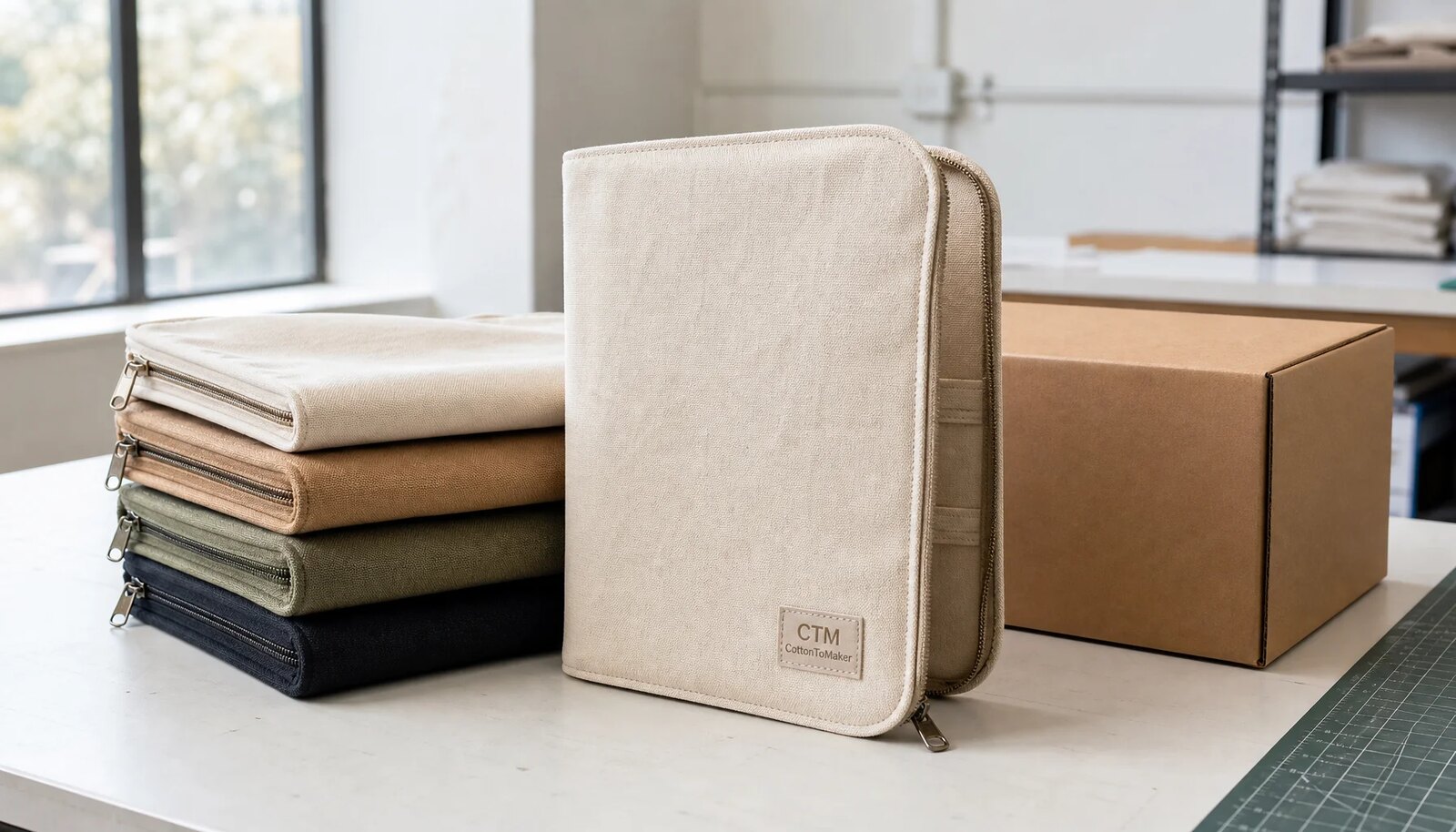
Start With the Receiving Flow
Carton planning for canvas zipper portfolios should begin with the route after production, not with a random pieces-per-carton target. The goods may move through a forwarder, importer, decorator, 3PL, hotel dock, convention center receiving desk, sponsor room, registration team, or kit-packing line before attendees ever see them. Each handoff creates a chance for slow counting, wrong sorting, label confusion, crushed corners, or avoidable labor.
A procurement buyer is buying both the portfolio and the delivery unit. If cartons are too heavy, sponsor versions are mixed, or the first pieces out of the box look flattened and scuffed, the issue appears when the event team has the least time to solve it. A small unit-price saving can disappear quickly if staff must open cartons on the floor, rebuild version piles, relabel boxes, or replace damaged goods.
Map the receiving flow before the RFQ goes out. A one-venue order may need style, color, PO number, quantity, and carton sequence. A multi-site program may need destination code, room name, kit version, sponsor name, event date, and a sequence such as 1 of 18. Hotel and convention center receiving may also require advance labels, delivery appointments, or dock instructions that should be reflected in the packing plan.
- Map every handoff from factory to final distribution table before approving carton count.
- Define whether cartons will be opened immediately, stored, cross-docked, relabeled, palletized, or sent unopened to event zones.
- Set receiver-friendly carton marks: PO, style, color, artwork version, quantity, destination, event name if required, and carton sequence.
- Choose a maximum manual lift weight based on the venue and receiving team, not only on what the factory can pack.
- Treat the carton as part of the event operating plan because it controls counting speed, distribution accuracy, and damage exposure.
Specify the Portfolio Before the Carton
The product specification controls carton density. A flat 10 oz canvas zipper portfolio with no lining behaves differently from a 14 oz gusseted portfolio with a divider, board insert, handle, and large metal puller. Premium construction may be right for speaker gifts or sponsor kits, but the buyer should know what that choice does to carton height, weight, and recovery after unpacking.
Canvas weight should be discussed as a specification range, not treated as a universal default. For example, 12 oz canvas, about 407 gsm, is often used as a middle-ground discussion point because it can provide structure and a stable print surface while still packing efficiently. Lighter canvas may suit high-volume promotional events where quantity and freight cube matter most. Heavier canvas can support a more premium feel but may reduce pieces per carton.
Fabric finish also changes the result. Raw canvas may look structured and natural but can show specks and hold fold lines. Washed or enzyme-finished canvas may feel softer, while shrinkage and dimensional stability need confirmation. Dyed canvas needs shade control, especially when cartons are opened side by side at registration. If an order uses several fabric colors, do not assume every color can use the same packing count because stiffness and finishing can vary.
Zipper and interior details deserve the same attention. A larger slider or metal puller can make the portfolio feel more substantial, but it becomes a hard point under carton compression. Interior pockets, elastic loops, tablet sleeves, dividers, and handles should be included in the sample used for packed-carton testing.
- State finished size as width x height x gusset and clarify whether size is measured empty, flat, or lightly filled.
- Confirm intended contents: A4 paper, US letter, tablet, folder, brochure set, badge packet, or sponsor insert bundle.
- Specify canvas weight in oz and gsm, fabric finish, color standard, shrinkage expectation, and acceptable variation before fabric purchase.
- Define zipper size, tape color, slider finish, puller style, end-stop reinforcement, and puller position during packing.
- Include lining, divider, pocket, handle, binding, and reinforcement details in the RFQ because each feature changes stack height.
Use Tolerances That Can Be Checked
B2B sourcing gets cleaner when tolerances are agreed before production. Buyers do not need unrealistic precision for sewn canvas goods, but the factory, inspector, and receiving team need the same standard. Without tolerance language, a logo shift, fabric shade variation, or carton weight change becomes a subjective debate after the goods are finished.
Finished size tolerance should match the construction. Canvas portfolios can vary because fabric relaxes, sewing tension changes, and finishing affects shrinkage. Discuss finished size in millimeters instead of loose phrases such as close or normal. The practical test is whether the portfolio still fits the documents, tablet, folder, or sponsor kit components it was ordered to hold.
Print placement needs fixed reference points. Measure from the top edge, side seam, zipper line, or center line, then state the allowed movement. Color should be approved against a physical sample or recognized reference where possible, with the understanding that ink on natural canvas will not look identical to ink on coated paper.
Carton tolerances matter because event teams count by carton first. State pieces per carton, allowable gross weight variation, carton dimension tolerance, and whether partial cartons are allowed. If partial cartons are necessary, label them clearly and list them separately on the packing list.
- Agree on finished size tolerance before production and tie it to actual document fit.
- Measure print placement from fixed reference points and state allowable movement in the approval record.
- Approve fabric shade against a physical swatch, lab dip, or signed sample under consistent light.
- State whether natural canvas specks, slubs, or shade variation are acceptable and when they become defects.
- Define carton count, partial-carton labeling, gross weight range, carton dimensions, and carton mark content before packing.
Build Cartons Around Handling Limits
The best pieces-per-carton count protects the product and remains practical for the receiver. Factories may prefer counts that fit standard cartons or line habits. Event buyers need a different lens: can one person lift the carton, can cartons stack without crushing, can staff count quickly, and can the venue store the shipment without blocking working space?
For many manually handled canvas zipper portfolio orders, a gross carton weight around 12 to 15 kg is a useful discussion range. It is not a rule. A flat, unlined, lightweight portfolio may fit more pieces while staying in that range. A gusseted portfolio with lining, insert board, dense embroidery, or a large zipper puller may need fewer pieces. Parcel shipments often need lower weights because each carton faces more individual handling.
Dimensions matter as much as weight. Long cartons can be awkward in hotel corridors, service elevators, and small back rooms. Tall cartons may crush lower layers if board strength and stack pattern are weak. Shallow cartons protect shape but increase carton count, labor, labels, and disposal volume. Compare total cartons, total CBM, total gross weight, and expected pallet count before approving the packing plan.
A quote that says 50 pieces per carton without dimensions and gross weight is incomplete. A quote that gives dimensions without board strength or packing method is still weak. Carton data should be available early enough for freight estimates and then confirmed before booking.
- Start with a receiver-friendly gross weight target, then adjust for construction, decoration, and transport mode.
- Use fewer pieces per carton for gussets, lining, dividers, insert boards, thick embroidery, rubber patches, or bulky pullers.
- Avoid cartons that are too long for manual handling or too tall for stable stacking.
- Require pieces per carton, carton L x W x H, net weight, gross weight, CBM, board grade, and total carton count on the quote.
- For multi-site events, consider carton counts that match venue allocation so teams do not split cartons under time pressure.
Choose Packing Materials for the Arrival Standard
Packing materials should match the event's presentation standard and transit risk. Individual sleeves or polybags protect against scuffing, dust, and some moisture exposure, but they add labor, volume, unpacking time, and waste handling. Tissue paper can improve the first impression for premium kits, although it may shift during long transit. Paper dividers reduce face-to-face rubbing. Board inserts help a portfolio stay crisp, but they increase height and can create pressure lines if placed poorly.
Decide whether the portfolios must arrive presentation-ready or simply protected for later filling. If they will go straight onto a registration table, into speaker gifts, or into sponsor kits, the first pieces out of the carton matter. If a fulfillment team will open cartons and fill every portfolio with brochures, a simpler flat pack may be faster and more practical.
Fold direction deserves explicit approval. A fold across the main logo area can create a crease or stress the ink. A fold that bends the zipper tape may create waviness. A fold that traps the puller against the face panel can leave marks. These issues often do not show on a loose sample; they appear after goods sit under carton pressure.
Moisture and odor control are real procurement points for canvas. Canvas can absorb humidity and warehouse smells if goods or cartons are stored poorly. For longer ocean shipments, ask about dry storage, clean packing areas, container loading conditions, and whether desiccants are appropriate. Desiccants can support a moisture plan, but they cannot fix damp goods or wet cartons.
- Use individual sleeves when scuffing, dust, moisture exposure, long storage, parcel handling, or premium presentation is a real risk.
- Use paper dividers, tissue, or sleeves when the face panel needs protection but full polybagging is not desired.
- Use board inserts only after testing zipper curve, pressure marks, carton height, and gross weight impact.
- Keep zipper pullers away from print panels and away from points that press into adjacent portfolios.
- Specify clean, dry cartons and confirm goods are packed after decoration is cured and fabric is free of dampness or odor.
Control Decoration Before Packing
Decoration can change carton performance more than buyers expect. A one-color screen print usually keeps a portfolio flat and flexible. Dense embroidery, thick heat transfer, rubber patch, leather patch, metal badge, or layered applique creates raised areas that can reduce packing density and leave pressure marks on neighboring portfolios.
Screen printing is often carton-friendly for canvas zipper portfolios because it adds minimal bulk and works well for event logos, sponsor marks, and association branding. The buyer should still define ink color, print size, placement, curing expectation, and rub performance. Ink that is not fully cured can transfer under pressure. Print placed too close to a fold line may crack, crease, or look wavy after unpacking.
Heat transfer can help with multi-color logos, gradients, or smaller versioned runs, but it needs fold, rub, and edge-lift testing on the actual canvas. Embroidery can look premium as a small corner mark, but dense stitching changes handfeel and can make stacks uneven. Woven labels and sewn side labels are often strong options when buyers want durable branding without adding much bulk to the face panel.
For events with sponsor versions, decoration also affects packing accuracy. A program with multiple sponsor logos should not be packed as one mixed order unless the receiver has agreed to sort it. Each artwork version needs carton marks, packing list lines, and inspection sampling.
- Use screen print for simple logos, flexible panels, and efficient carton stacking.
- Use heat transfer only after testing fold recovery, edge lifting, cracking, color rub, and pressure marks in a packed condition.
- Use embroidery selectively for smaller marks because dense stitch areas create uneven stack height.
- Consider woven labels, sewn side labels, or slim patches when branding needs to stay durable and carton-friendly.
- Separate carton marks by artwork version, sponsor, language, color, destination, or kit type when distribution depends on fast sorting.
Compare Suppliers by Packaging Ownership
The sourcing route affects who controls the carton plan. A direct factory is often strongest when the buyer needs control over fabric, zipper, decoration, packing, carton size, and export data. Communication is shorter, and the factory can usually adjust fold method or carton count before mass packing. This suits larger event orders, distributor programs, and importers comparing landed cost.
A trading company can be useful when the order includes related items such as zipper portfolios, tote bags, badge pouches, document folders, notebooks, and apparel. One commercial contact can simplify administration. The risk is that carton decisions may sit with subcontracted factories while the trading company owns the quotation. Ask who approves final packing, who pays for carton changes, and whether packing photos come from the actual production site.
Domestic decorators using imported blanks can be valuable when timing is tight. Decorating stock portfolios near the destination can reduce schedule risk for smaller or urgent events. The tradeoff is reduced control over fabric consistency, zipper grade, blank dimensions, and original carton count. Stock cartons may be designed for warehouse storage, not venue distribution, so repacking may be needed.
Regional converters near the event market can reduce inland freight complexity and support smaller replenishment batches. This is useful for recurring events and agencies that ship to the same venues repeatedly. Buyers should still compare the full landed cost, including production, decoration, packing, freight, storage, damage risk, and receiving labor.
- Use a direct factory when the product specification and carton engineering both need tight control.
- Use a trading company when mixed product programs justify consolidated sourcing, but verify final packing responsibility.
- Use a domestic decorator when schedule risk is more important than full customization and stock blanks meet the event standard.
- Use a regional converter when recurring programs benefit from shorter inland moves and easier replenishment.
- Ask every sourcing route for the same carton data so landed-cost comparison is fair.
Approve a Packed Carton
A loose sample proves only part of the order. For canvas zipper portfolios, approval should cover construction, decoration, fold method, inner pack, master carton, carton marks, and version separation. Many failures appear only after the carton has been closed for a period of time: zipper pullers press into canvas, folds set into the fabric, print areas rub, corners flatten, or gussets fail to recover.
A practical approval sequence starts with a blank sample to confirm size, canvas, zipper, stitching, handle, pocket, and construction. The next step is a decorated pre-production sample to approve logo placement, color, print handfeel, label details, and decoration curing. The final step is a packed-carton sample or documented packed-carton simulation using the approved materials and piece count.
Keep an approved reference sample and a packing approval record. Finished size, print placement, zipper smoothness, stitch quality, packing method, and carton count should all be measurable. Without a record, disputes become subjective. A factory may see a small logo shift as acceptable, while the event team may notice it immediately when portfolios are lined up on a registration table.
Carton approval should include photos and measurements. Ask for photos of the portfolio before folding, the fold method, zipper puller position, inner pack, open carton, sealed carton, carton marks, gross weight on a scale, and carton dimensions. These photos help catch mistakes before the order leaves the factory and provide a reference if receiving claims appear later.
- Approve a blank sample for construction before approving decoration or packing.
- Approve a decorated sample for logo size, color, placement, curing, label, and fold-line behavior.
- Approve a packed-carton sample or packing photo set before mass packing for complex, premium, or multi-version orders.
- Keep the signed sample, artwork approval, carton label proof, and packing record as the final inspection standard.
- Require photos of fold method, puller position, open carton, sealed carton, carton marks, carton weight, and carton dimensions.
Inspect Product and Shipment Together
Quality control for event portfolios should focus on failures that hurt receiving and distribution. A portfolio can look acceptable in isolation but still fail the event workflow if zippers snag, counts are wrong, cartons are mislabeled, decoration versions are mixed, or cartons arrive crushed. Inspection should cover workmanship and shipping readiness in the same review.
Start with material checks where possible. Canvas weight should be verified against the approved range. Color should be checked under consistent light against the approved sample or color standard. Zipper tape, slider, puller, lining, thread, labels, and inserts should match the signed sample. If several colors are used, check each color because dyeing and finishing can affect stiffness and shrinkage.
During production, focus on stress points. Zipper ends, handle joins, pocket corners, binding ends, gusset intersections, and reinforcement patches are common failure areas. Stitch length should be consistent, with no skipped stitches, loose thread clusters, broken thread, puckering, or open seams. Zippers should be opened and closed repeatedly on production units, including pieces that have already been folded.
Final inspection should include carton checks. Count units per carton, verify version labels, weigh selected cartons, measure carton dimensions, inspect carton strength, and confirm the packing list matches the physical goods. Pull samples from different cartons and layers, not only from the top of one carton. For event orders, a correct carton mark can be as important as a straight stitch.
- Check canvas weight, color, shrinkage expectation, odor, surface cleanliness, and fabric defects against the approved standard.
- Test zipper smoothness, puller strength, slider alignment, end stops, and zipper function after folding.
- Inspect stitching at zipper ends, handles, pockets, gussets, binding, labels, and other reinforcement points.
- Test decoration for placement, adhesion, curing, rub resistance, fold behavior, and color consistency.
- Verify carton count, version separation, carton marks, gross weight, dimensions, board condition, packing list, and pallet labels during final inspection.
Plan Lead Time Around Freight and Venue Rules
Lead time for canvas zipper portfolios is not one number. It includes RFQ clarification, material sourcing, sample making, sample transit, buyer review, sample revision, bulk sewing, decoration, curing, packing approval, final inspection, freight booking, customs documents, inland delivery, and event receiving appointment. When buyers treat all of that as one generic production lead time, carton planning is often rushed at the end.
Custom carton marks, destination labels, barcode labels, sponsor-version labels, and pallet labels need data approval. If the order has several venues, the factory needs separate packing instructions and carton sequences. If the event planner changes destination quantities after production begins, carton labels and packing lists may need to be rebuilt.
Freight mode changes the packing answer. Ocean freight rewards efficient CBM, strong cartons, and stable pallet patterns. Air freight makes dimensional weight important, so bulky lightweight cartons can become expensive. Parcel shipment exposes cartons to more drops and individual handling, usually requiring lower gross weights and stronger outer cartons. Truck delivery to a venue may require appointment scheduling, lift-gate service, limited receiving hours, advance paperwork, or dock rules.
A safer timeline separates decisions. Approve product specification first, decoration second, packing and carton marks third. Book freight with confirmed carton data whenever possible, not rough estimates. Add buffer for final inspection, customs release, warehouse intake, and venue receiving windows because the event date will not move just because a carton plan changed late.
- Break the schedule into sample approval, bulk production, decoration, curing, packing approval, inspection, freight booking, and delivery appointment.
- Ask whether carton artwork, destination labels, barcode labels, or pallet labels add approval or production time.
- Use confirmed carton dimensions and gross weight before booking freight whenever the schedule allows.
- Treat ocean, air, parcel, and truck delivery as different packing problems with different cost drivers.
- Reserve time for customs release, warehouse intake, venue appointment windows, and event-team receiving checks.
Specification comparison for buyers
| Procurement decision | Specification to request | Best fit | Risk to verify |
|---|---|---|---|
| Direct factory order | Finished portfolio spec, decoration spec, pieces per carton, carton L x W x H, gross weight, net weight, CBM, board grade, carton marks, and pallet pattern | Export orders, multi-venue conferences, distributor programs, and projects where freight cube affects landed cost | Confirm product approval and carton approval are both controlled by the production site; require packing photos and final inspection records |
| Trading company consolidation | One quote covering portfolio versions, related event items, carton labels, shipping data, and packing responsibility by item | Programs combining zipper portfolios with totes, badge holders, notebooks, apparel, or registration kit components | Clarify which factory sets carton dimensions, who approves carton changes, and whether packaging upcharges are separate |
| Imported blanks with domestic decoration | Blank portfolio style, local decoration method, repack count, relabeling plan, and receiving schedule | Rush events, smaller runs, local fulfillment, or orders where stock blanks are acceptable | Check blank consistency, zipper substitutions, carton count variation, and whether repacking is needed for venue sorting |
| Flat bulk pack | Portfolios stacked flat with approved fold direction, puller position, and paper or tissue only where needed | High-volume giveaways, registration handouts, and on-site kit filling where fast unpacking matters | Test fold memory, zipper waviness, print rub, canvas scuffing, odor transfer, and recovery after 24 hours unpacked |
| Individual sleeve or polybag | One portfolio per protective sleeve, confirmed sleeve size, barcode only if needed, and required warnings where applicable | Long storage, parcel distribution, premium kits, or orders where dust and scuff control matter | Confirm labor, waste handling, moisture risk, unpacking time, and the effect on carton height and CBM |
| Board insert or stiffener | Approved insert thickness, rounded corners, placement, and packed-carton pressure test | Speaker gifts, executive packs, premium sponsor kits, or portfolios expected to arrive crisp | Verify inserts do not bend zipper tape, crack decoration, mark the canvas, or push carton weight beyond handling limits |
| Version-separated cartons | Separate cartons by artwork, color, language, sponsor, venue, or kit version with sequence labels | Multi-sponsor conferences, breakout sessions, regional events, and agency programs with fast distribution needs | Do not approve mixed cartons unless the packing list identifies every version and the receiver has agreed to sort |
| Palletized delivery | Pallet footprint, carton orientation, stack height, corner boards, stretch wrap, pallet label, and delivery appointment rules | Importer warehouses, 3PLs, convention centers, hotel docks, and orders stored before event week | Confirm pallet height limits, dock access, lift-gate needs, compression resistance, moisture protection, and carton sequence |
Buyer checklist before sampling
- Lock the finished size, usable document size, gusset depth, zipper opening length, handle option, pocket layout, and whether the portfolio must fit A4 sheets, US letter, tablets, folders, brochures, or sponsor inserts.
- Specify canvas weight and tolerance as an agreed range, such as 12 oz/407 gsm as an example midpoint, plus weave, finish, shrinkage expectation, color standard, and whether the fabric is raw, dyed, washed, enzyme-washed, or pre-shrunk.
- Define zipper size, zipper type, tape color, slider finish, puller style, end-stop reinforcement, opening direction, and puller resting position during packing.
- Confirm lining, binding, thread color, pocket reinforcement, corner reinforcement, stitch density, seam allowance expectation, and any light pull or functional check required for event use.
- Choose decoration early: print method, logo size, placement, color count, Pantone or approved reference, backing requirement, curing time, fold-line restrictions, and placement tolerance.
- Set a target pieces-per-carton range and maximum gross carton weight. For many manually handled event cartons, 12 to 15 kg gross is a practical discussion range, but the receiving site should set the final limit.
- Request master carton dimensions, gross weight, net weight, CBM, carton board grade, inner pack method, total carton count, and pallet pattern before comparing landed cost.
- Require a blank sample, decorated pre-production sample, and packed-carton sample or photo set when presentation, scuff control, version accuracy, or venue-ready packing matters.
- Approve carton marks, destination codes, version labels, barcode labels if used, carton sequence format, and packing list layout before mass packing begins.
- Ask the supplier to photograph the fold method, zipper puller position, open cartons, sealed carton marks, measured carton dimensions, and carton gross weight during final inspection.
Factory quote questions to send
- What finished dimensions, gusset depth, usable capacity, canvas weight, fabric finish, zipper specification, lining, pocket layout, handle, and reinforcement details are included in the unit price?
- What tolerances apply to finished size, fabric weight, print placement, color shade, and carton gross weight, and how will those tolerances be checked during inspection?
- How many pieces are packed per inner pack and per master carton, and what are the master carton dimensions, net weight, gross weight, CBM, and estimated carton count?
- What corrugated carton grade, flute type, or board strength will be used, and is it intended for palletized ocean freight, air freight, truck delivery, parcel handling, or venue storage?
- Which decoration method is quoted, how many colors are included, what logo size and placement are included, what curing time is required, and what placement tolerance can be held in bulk production?
- Can you provide a blank sample, decorated pre-production sample, and packed-carton sample or packed-carton simulation before mass packing approval?
- What is the MOQ by fabric color, zipper color, print version, label version, carton label version, and destination code?
- Will the portfolios be packed flat, folded, unfolded, individually sleeved, paper-wrapped, tissue-separated, fitted with board inserts, or divided by paper, and how does each option change carton count and freight volume?
- Where will the zipper puller sit in the packed portfolio, and how will you prevent the puller, slider, rivets, labels, or zipper ends from scuffing adjacent canvas panels?
- Can you provide photos of the folding method, inner pack arrangement, open master carton, sealed master carton, carton marks, measured carton dimensions, and carton weight during production or final inspection?
Quality-control points to confirm
- Canvas weight should be checked against the approved range using a documented method, with tolerance agreed before production so handfeel, stiffness, print performance, and carton stack height do not drift unexpectedly.
- Finished size, gusset depth, zipper opening length, and document fit should be checked against the approved sample and intended contents, not only against a flat pattern measurement.
- Zippers must run smoothly through repeated opening and closing, with no snagging, missing teeth, slider looseness, crooked tape, sharp puller edges, weak end stops, or sewing tension that causes waviness after folding.
- Stitching at zipper ends, handle joins, pocket corners, gusset joins, binding edges, and stress points must be straight, secure, and free of skipped stitches, broken thread, loose tails, puckering, and untrimmed thread clusters.
- Decoration placement should remain within the approved tolerance, and ink, transfer, embroidery backing, patch edges, or labels must not crack, rub off, stain nearby panels, distort, or create pressure marks after packing.
- Metal pullers, zipper ends, rivets, snap parts, badges, or labels should not scuff adjacent canvas surfaces during carton compression or vibration.
- Individual wrapping, tissue, paper dividers, desiccants if used, board inserts, and carton liners should be clean, dry, correctly positioned, and not causing uneven stack height or visible pressure lines.
- Cartons should hold the agreed piece count and stay within the agreed gross weight range so warehouse, hotel, and event staff can lift, count, store, and stage cartons safely.
- Master cartons should use the approved board grade, tape method, carton marks, orientation arrows if needed, destination code, and carton sequence, with no bulging, crushed corners, moisture exposure, loose seams, or unreadable labels.
- Packed goods must arrive dry, odor-free, countable, correctly separated by version, and protected from scuffing, with no distorted portfolio shape, zipper waviness, crushed corners, damp cartons, or mixed-version cartons without approval.