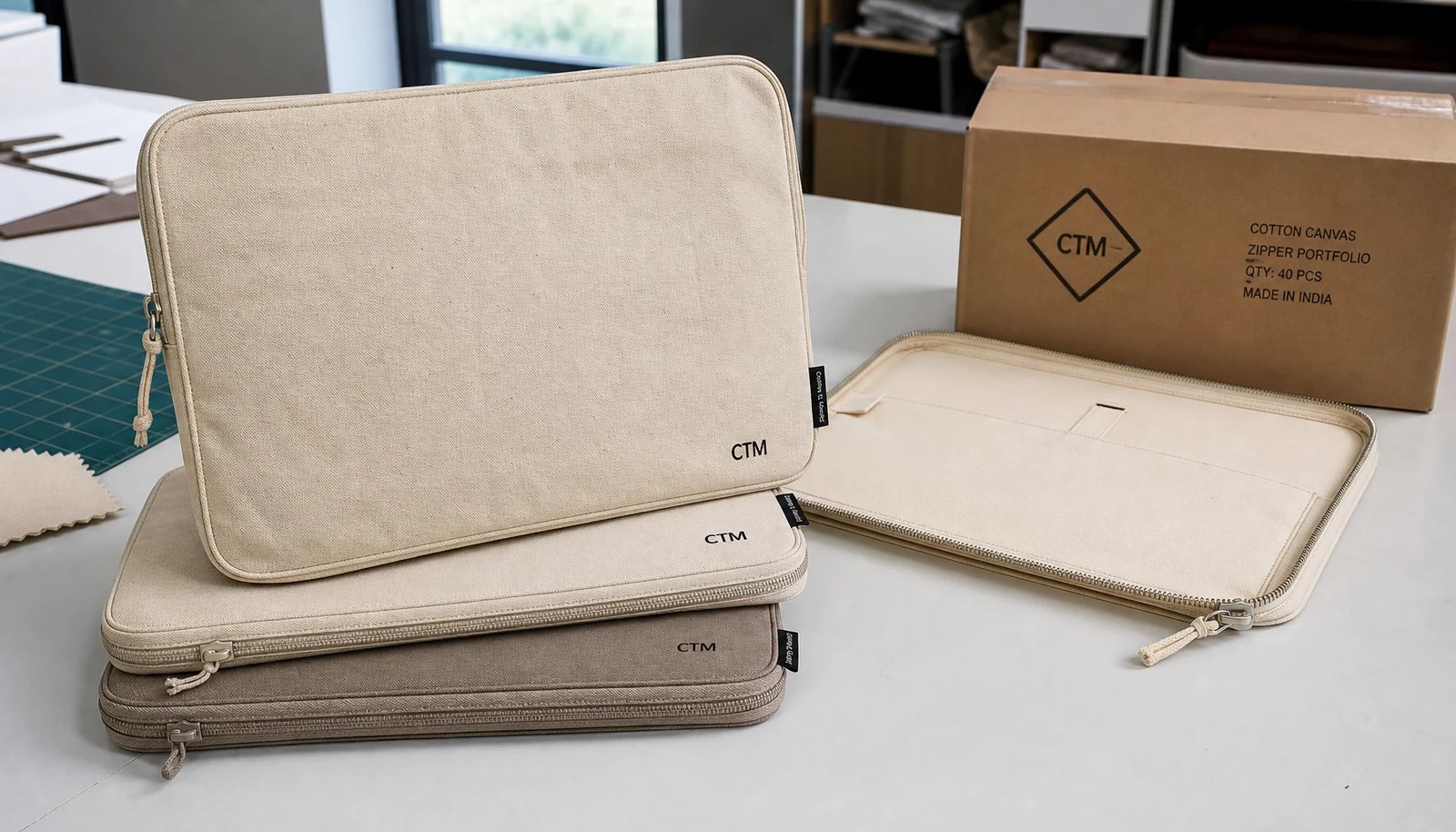
The Carton Problem Behind a Simple Portfolio
Canvas zipper portfolios for university bookstores are usually bought as practical retail items: document holders, orientation pack covers, alumni gifts, or department-branded stationery accessories. The product looks flat, so many RFQs treat carton planning as an afterthought. That is where landed cost and receiving problems start. A portfolio with stiff canvas, a long zipper, foam padding, or a large printed logo can behave very differently in a carton than a basic cotton pouch.
For procurement teams, carton planning should be part of the first quote, not a detail handled after production. The buyer needs to know how many pieces fit per export carton, whether they are packed flat or slightly nested, the gross weight, and whether the carton can pass normal handling without crushing the printed face. A quote without carton data is not complete for an importer, distributor, or bookstore buyer comparing total cost.
- Treat the carton as a cost item, not only a shipping container.
- Ask for carton dimensions before approving the unit price.
- Compare suppliers on volume per piece and gross weight per carton.
- Avoid packing methods that crease the zipper line or transfer print ink.
- Confirm whether bookstore receiving teams have weight or carton-size limits.
Define the Portfolio Before Pricing
A strong RFQ starts with the actual use case. A portfolio for loose admissions documents does not need the same body stiffness as one used for tablet protection. A bookstore resale item may need a cleaner surface, tighter print alignment, and a better zipper pull than a free orientation giveaway. The same keyword can describe several different products, and the factory will price based on what is specified or assumed.
Buyers should define finished dimensions, usable opening, gusset or no gusset, internal pockets, padding, handle requirement, and retail packaging. A common mistake is giving only A4 or letter paper size. The factory then builds around paper dimensions without enough clearance, and the finished product feels tight once seams, zipper tape, and fabric thickness are included. For a document portfolio, allow practical clearance so students can insert notebooks or handouts quickly without bending corners.
- For A4 paper, build in clearance beyond 210 x 297 mm.
- For US letter paper, build in clearance beyond 8.5 x 11 inches.
- For notebooks, measure the thickest intended item, not only the cover size.
- For tablets, state device size and whether foam padding is required.
- For retail resale, specify front-facing print position and shelf presentation.
Fabric Weight and Body Feel
For canvas zipper portfolios, the most common commercial range is 10 oz to 16 oz cotton canvas, roughly 320 to 540 GSM depending on weave and finishing. A 10 oz canvas can work for low-cost document pouches, but it may feel thin for bookstore retail. A 12 oz canvas, usually around 380 to 410 GSM, is often a better balance for campus stores because it gives enough body without making cartons bulky. A 14 oz canvas can feel more premium but may reduce pieces per carton and raise freight cost.
Heavier fabric is not automatically better. A stiff 16 oz canvas can create zipper waves, thicker seam stacks, and more variation in finished size. It also increases gross weight, which matters if cartons are moved through bookstore distribution centers rather than only palletized warehouse receiving. If the product needs a structured feel, consider light interlining or foam only where needed rather than upgrading the whole body to a very heavy fabric.
- 10 oz canvas: cost-focused, lighter feel, easier carton packing.
- 12 oz canvas: balanced retail hand feel and manageable carton cube.
- 14 oz canvas: stronger perceived value but higher weight and seam bulk.
- 16 oz canvas: premium stiffness, usually only justified for high-end positioning.
- Dyed canvas needs colorfastness review, especially for light printed logos.
Zipper Choices That Affect Returns
The zipper is the working part of the product, so it deserves more attention than it usually gets in a tote-bag-style RFQ. Nylon coil zippers are practical for canvas portfolios because they are flexible, lighter, and less likely to scratch documents or tablets. Metal zippers can look more premium, but they add weight and may not sit as smoothly on soft canvas. Plastic molded zippers are less common for flat portfolios because the teeth can feel bulky.
A buyer should specify zipper length, tape color, slider finish, puller style, and reinforcement at both ends. If the zipper reaches close to the side seam, the factory must control seam allowance so the slider does not jam. A sample that looks fine in photos can still fail if the slider catches thread tails or if the zipper opening is shorter than the intended document width. For campus bookstore resale, zipper smoothness is a real quality point because customers test it immediately in store.
- Use nylon coil zipper for most bookstore canvas portfolios.
- Match zipper tape color to body fabric or artwork contrast strategy.
- Add bar tack or reinforced stitching at zipper ends.
- Define slider and puller finish if the product is sold as a premium item.
- Reject samples where the zipper catches seam allowance or loose thread.
Logo Method and Artwork Risk
University bookstore products often carry school marks, department names, or event artwork. Screen printing is usually the safest method for solid one-color or two-color logos on canvas. It gives good coverage and keeps unit cost controlled. Heat transfer may be useful for gradients, small text, or full-color graphics, but it can feel less integrated with the fabric and must be tested for edge lifting. Embroidery can look premium but may distort thin canvas panels and adds thread backing inside the portfolio.
Artwork should be reviewed against the canvas texture. Fine lines can break up on coarse fabric, and large solid ink areas can crack if the print layer is too thick or the fabric is folded tightly in packing. The RFQ should state artwork size, print position, Pantone reference, acceptable color tolerance, and whether the logo must be centered to the sewn body or to the visible front panel. Those are not always the same once zipper tape and seam allowance are included.
- Screen print works best for bold university marks and bookstore logos.
- Heat transfer needs wash, rub, and fold review before bulk approval.
- Embroidery is better for small badges than large filled artwork.
- Print position should be measured from finished edges, not cut panels.
- Light ink on dark canvas may need an underbase, affecting cost and hand feel.
MOQ Logic for Campus Programs
MOQ depends less on the shape of the portfolio and more on material, color, artwork version, and zipper customization. If the buyer accepts natural canvas, standard zipper color, and one screen print, a factory may be able to support a lower MOQ such as 300 to 500 pieces, depending on workload and print setup. If the buyer needs custom dyed canvas, custom zipper tape, woven labels, retail hangtags, or multiple department logos, the practical MOQ rises because each component has its own minimum.
University bookstore buyers often split orders by campus, department, event, or semester. That is normal, but it should be planned in the quote. Ten artwork versions of 100 pieces each are not the same production job as one artwork version of 1,000 pieces. Each version needs screen setup, print alignment, packing separation, carton marks, and SKU control. A good RFQ shows the total quantity and the breakdown by artwork so the supplier can quote realistic setup charges and packing labor.
- Lower MOQ is easier with natural canvas and standard zipper colors.
- Custom dyed canvas often needs higher fabric booking quantity.
- Multiple logos can add screen charges even when total quantity is attractive.
- Separate SKU packing increases carton labeling and warehouse handling work.
- Reorders are easier when the buyer keeps fabric, zipper, and logo specs stable.
Carton Planning and Packing Method
Flat packing is normally the best method for canvas zipper portfolios. It protects the zipper line, keeps the front panel presentable, and makes carton counts easier to verify. Depending on size, fabric weight, padding, and individual packaging, an export carton may hold 25 to 50 pieces. The right count is not the maximum possible count; it is the count that keeps the carton square, prevents bulging, and stays within the buyer's gross weight limit.
Individual OPP bags improve cleanliness but add labor, plastic, and carton volume. Paper bands or tissue interleaving can be better for retail buyers with sustainability policies, but they offer less moisture protection during ocean shipment. If the logo is printed with heavy ink or placed near another product surface, interleaving may be needed to prevent print transfer. Carton planning should include the packed sample, not only a theoretical calculation from flat product measurements.
- Request carton dimensions in centimeters or inches, not only pieces per carton.
- Keep gross weight practical for manual handling at bookstore receiving points.
- Use interleaving for light-color canvas or heavy ink coverage.
- Avoid rolling portfolios unless the design is specifically built for it.
- Require carton photos showing open carton, packed layers, and closed carton marks.
Sample Approval That Prevents Bulk Mistakes
A photo sample is not enough for this product. The buyer should approve a physical pre-production sample because fabric hand feel, zipper smoothness, print adhesion, and actual packed thickness cannot be judged accurately from images. A first sample may use available fabric or zipper if the buyer only needs construction review, but the pre-production sample should match the bulk materials as closely as possible before cutting starts.
Sample comments should be written as measurable instructions. Instead of saying the logo is too high, state the required distance from the finished bottom edge and side edge. Instead of saying the zipper feels cheap, define the zipper type, slider finish, and operation standard. A practical approval file includes sample photos, measurement table, fabric weight, print method, packaging method, and any agreed deviations. This becomes the reference for inspection and avoids arguments after bulk production.
- Measure finished width, height, zipper opening, and seam allowance.
- Open and close the zipper repeatedly before approval.
- Rub printed artwork with a dry white cloth and inspect ink transfer.
- Insert the intended documents or notebook bundle to test usable capacity.
- Pack several samples into a mini carton layout to estimate real thickness.
Lead Time and Schedule Risk
A typical timeline includes artwork confirmation, material booking, sample making, sample approval, bulk cutting, printing, sewing, trimming, inspection, packing, and export documentation. For a simple natural canvas portfolio with standard zipper and one print, the sample stage may be the main variable. For custom color fabric, custom zipper tape, or multiple artwork versions, material and printing coordination become the schedule risk. Buyers should not count lead time from the RFQ date; it starts after final artwork, deposit or PO release, and sample approval conditions are clear.
University bookstore demand is often tied to semester starts, orientation dates, homecoming, alumni events, or graduation. Missing the selling window hurts more than a small unit-cost increase. Build buffer for sample courier time, artwork correction, production inspection, and vessel schedule changes. If the order is for a fixed event, state the in-store required date and work backward through inland delivery, customs, ocean or air transit, and factory completion.
- Allow separate time for artwork strike-off when print color is critical.
- Do not approve bulk cutting before fabric weight and color are confirmed.
- For multiple SKUs, add time for carton marking and packing separation.
- Reserve inspection time before shipment, not after goods are already loaded.
- Use air freight only with clear carton volume and gross weight estimates.
Quote Data for Landed-Cost Comparison
The lowest unit price is not always the best quote. For canvas zipper portfolios, landed cost depends on product weight, carton cube, pieces per carton, packing material, inland handling, and the number of SKUs. Two suppliers may quote the same FOB price, but one may pack 30 pieces per carton while another packs 45 pieces without crushing the product. That difference affects container utilization, LCL charges, warehouse labor, and store receiving efficiency.
A complete quote should show unit price, tooling or screen setup fee, sample fee, bulk lead time, carton size, gross weight, net weight, pieces per carton, HS code suggestion, packing method, and validity period. If the buyer is comparing sea and air options, carton dimensions become essential. For branded bookstore products, the quote should also separate repeat-order costs from first-order setup costs, because a reorder with the same artwork and materials may price differently.
- Compare cost per usable piece landed, not FOB unit price alone.
- Request carton cube so freight forwarders can estimate LCL or air cost.
- Separate one-time setup charges from repeat-order unit pricing.
- Require SKU-level carton data when artwork versions are packed separately.
- Ask for realistic overrun or underrun policy before PO release.
Specification comparison for buyers
| Spec decision | Recommended option | When it fits | Buyer risk to check |
|---|---|---|---|
| Canvas body fabric | 12 oz cotton canvas, about 380-410 GSM, pre-shrunk or controlled shrinkage | Campus bookstores needing a sturdier retail feel than a basic cotton document pouch | Very heavy 16 oz canvas increases carton weight and can reduce units per carton without improving shelf value |
| Portfolio size | A4 or letter-size body with 15-25 mm document clearance and finished tolerance of +/-5 mm | Retail programs carrying notebooks, admission packs, alumni documents, tablets, or stationery bundles | If the buyer only gives flat document size, the zipper opening may become too tight after sewing allowance |
| Zipper construction | Nylon coil zipper with colorfast tape, smooth slider, and reinforced zipper ends | General bookstore resale where soft handling, low snag rate, and mid-range cost matter | Metal zippers look premium but can scratch tablets, add weight, and create inconsistent closing on soft canvas |
| Logo method | Screen print for solid university marks; heat transfer only for gradients or small multi-color art | Most single-color bookstore or department logos on natural, black, or dyed canvas | Thick ink on coarse canvas may crack if the supplier does not run a rub and fold test before bulk |
| Internal structure | Unpadded single compartment or light 2-3 mm foam only when tablet protection is required | Bookstore gift sets, conference packs, and document holders where carton cube must stay controlled | Over-padding makes the portfolio bulky and pushes carton volume higher than the unit cost suggests |
| Carton packing | Flat packed 25-50 pcs per export carton with interleaving only for printed light colors | Sea freight, LCL consolidation, or domestic bookstore distribution centers | Rolling or over-compressing causes zipper waves, print transfer, and poor shelf presentation |
| MOQ logic | 300-500 pcs for plain stock canvas with print; 800-1000 pcs for custom dyed fabric or custom zipper color | Trial orders, department-specific artwork, or multi-campus programs with split logos | Combining many small artwork versions can create setup charges and packing complexity even if total quantity is high |
| QC acceptance focus | Zipper operation, print position, finished size, stain control, needle holes, and carton drop resistance | Retail products where visible defects cause store returns faster than technical strength failures | AQL focused only on stitching misses zipper roughness, print skew, and carton crush problems |
| Quote comparison basis | Request FOB unit price plus carton size, gross weight, pcs per carton, sample fee, setup fee, and lead time | Importers comparing suppliers by landed cost and warehouse handling cost, not unit price only | A cheaper unit price can lose value if cartons are oversized, underfilled, or too heavy for store receiving teams |
Buyer checklist before sampling
- Define the final use: bookstore retail resale, orientation kit, alumni gift, department document pack, or conference item.
- Specify finished size, not only paper size, including zipper opening width and document clearance.
- Choose fabric weight by retail feel and carton cube, not by assuming heavier canvas is always better.
- State whether the portfolio must hold loose documents, notebooks, tablet devices, pens, or bundled merchandise.
- Provide artwork file, print size, print position, Pantone color, and acceptable placement tolerance.
- Set zipper requirements: nylon coil or metal, tape color, slider style, puller length, and minimum smoothness standard.
- Request carton size, gross weight, net weight, pieces per carton, and packing method with the first quotation.
- Require pre-production sample approval for fabric hand feel, print adhesion, zipper operation, and carton fit.
- Confirm whether cartons must meet distribution center limits for weight, labeling, barcode, and pallet pattern.
- Reserve time for artwork strike-off, sample courier transit, bulk material booking, production, inspection, and shipment.
Factory quote questions to send
- What fabric weight, GSM range, yarn construction, and shrinkage control are included in the quoted price?
- Is the quotation based on natural canvas, dyed canvas, or custom color fabric, and what is the fabric MOQ for each option?
- What zipper type, zipper tape width, slider material, puller style, and zipper color are included?
- What finished size tolerance, print position tolerance, and seam allowance are you using for the portfolio?
- Which print method is quoted, and what are the setup charges for each artwork or colorway?
- How many pieces fit per export carton, and what are the carton dimensions, gross weight, and net weight?
- Will each piece be packed in an OPP bag, paper band, recycled polybag, or bulk packed without individual bags?
- What is the sample lead time for a printed prototype and the bulk lead time after sample approval?
- What QC standard will be used for zipper function, print rubbing, stains, size, stitching, and carton strength?
- Can you provide photos or a short video of the packed carton, zipper pull test, print rub test, and finished sample measurement before shipment?
Quality-control points to confirm
- Finished body size within agreed tolerance, commonly +/-5 mm for simple canvas zipper portfolios.
- Zipper opens and closes smoothly for the full length without catching seam allowance or loose threads.
- Zipper ends are bar-tacked or otherwise reinforced so the slider does not pull off during normal bookstore handling.
- Print placement stays within agreed tolerance, commonly +/-3 mm to +/-5 mm depending on artwork size and seam structure.
- Printed logo passes dry rub and light fold tests without obvious cracking, peeling, or powdering.
- Canvas surface is free from oil stains, heavy slubs, dirty yarn marks, mildew odor, and visible needle damage.
- Interior seams are trimmed cleanly so paper edges and notebook corners do not snag inside the portfolio.
- Carton is not overfilled, bulged, under-taped, or too heavy for the buyer's receiving limit.
- Retail-facing pieces at the top and bottom of cartons are protected from abrasion and print transfer.
- Carton marks match the PO, SKU, artwork version, quantity, gross weight, and destination requirements.