The Buying Problem Behind the Carton Plan
Canvas zipper portfolios for university bookstores look simple in a catalog, but the packing plan often decides whether the program runs smoothly. A bookstore buyer is not only buying a canvas folder. They are receiving cartons into a campus store, distributor warehouse, or bookstore distribution center where SKU accuracy, shelf handling, barcode scanning, and delivery timing matter as much as sewing quality.
The keyword issue is carton planning because portfolios are flat but not weightless. Heavy canvas, zipper tape, lining, cardboard inserts, and retail labels can create cartons that are too dense, too tall, or too loose. A poor packing plan causes crushed corners, zipper waves, dirty fabric, barcode errors, and inflated freight cost. A good RFQ should define the portfolio specification and the carton data together, not as separate afterthoughts.
- Treat carton packing as part of the product spec, not only a shipping detail.
- Compare quotes using pieces per carton, carton CBM, and gross weight, not only FOB unit price.
- Require the supplier to show how the product sits in the carton before bulk production.
- Plan for bookstore receiving teams that may handle mixed campus logos, colorways, and seasonal reorders.
Set the Portfolio Body Spec Before Discussing Cartons
The first control point is finished size. Most university bookstore canvas zipper portfolios are built around A4, US letter, tablet, or document organizer use. If the buyer only writes “canvas zipper portfolio” in the RFQ, factories may quote different sizes, gussets, zipper openings, and inner layouts. Those differences change material consumption, carton count, and freight cost.
For a bookstore program, a practical base spec might include 12 oz natural cotton canvas around 380-400 GSM for a softer value item, or 14-16 oz canvas around 450-540 GSM for a more structured retail gift item. If the portfolio must stand upright on shelf or protect documents better, the buyer may add light padding, cardboard stiffener, or non-woven reinforcement. Each reinforcement improves presentation but increases thickness and reduces pieces per carton.
- Define closed size, open size, and usable document pocket size separately.
- State whether the portfolio is flat, gusseted, padded, or reinforced with board.
- Use GSM or oz, and avoid vague terms such as “thick canvas” or “premium cotton.”
- Clarify whether natural cotton specks are acceptable on the final visible panels.
Fabric Weight, Structure, and Real Cost Drivers
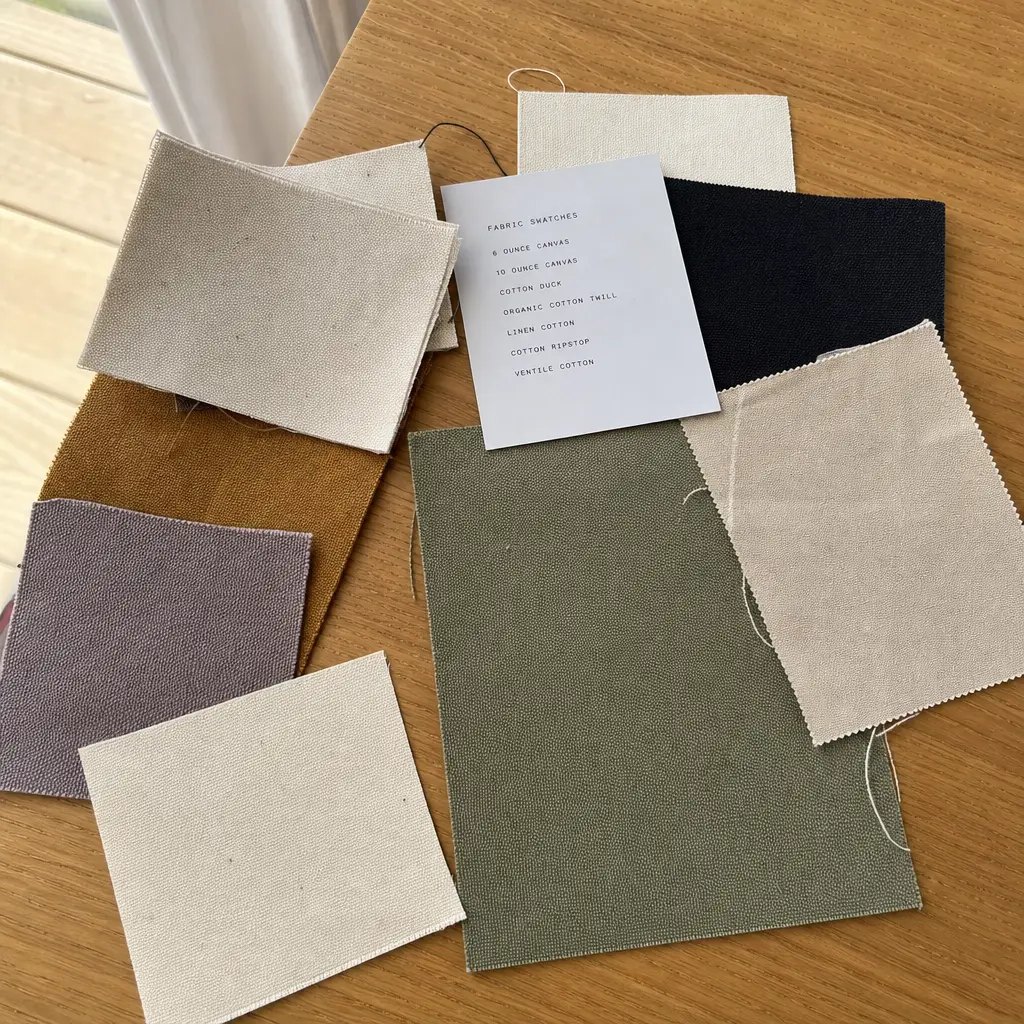
Canvas weight is one of the biggest cost and packing drivers. A 12 oz canvas portfolio may look acceptable for a promotional bookstore item, while a 16 oz canvas version feels more retail-grade but takes more fabric cost, needle control, and carton space. If the design includes lining, zipper, pockets, and edge binding, the finished product may become much thicker than the fabric swatch suggests.
Cost also depends on fabric finishing. Natural canvas is usually more economical and faster than custom dyed canvas, but it can show cotton seed flecks and shade variation. Dyed canvas gives stronger school color alignment but introduces dye-lot MOQ, lab dip approval, and possible rubbing or shrinkage concerns. Laminated canvas can improve dirt resistance but may crack or wrinkle if folded tightly in cartons.
- 12 oz canvas: economical, flexible, easier to pack, but less structured.
- 14 oz canvas: balanced choice for bookstore retail programs with moderate durability expectations.
- 16 oz canvas: stronger hand feel, higher perceived value, but more CBM and corner bulk.
- Washed canvas: softer look but more size variation and shade variation.
- Laminated canvas: cleaner surface but requires careful folding and carton pressure control.
Zipper and Interior Details That Affect Defects
For zipper business bags, the zipper is not a small accessory. A portfolio has long zipper runs and tight corner turning, so weak zipper tape or poor sewing tension becomes visible quickly. A No. 5 nylon coil zipper is usually suitable for standard document portfolios. For heavier padded designs, some buyers move to No. 8, but this adds cost and can make the product look more like a tool case than a bookstore portfolio.
The interior layout must match the retail promise. If the bookstore listing says document sleeve, pen loop, card pocket, and tablet pocket, those elements need functional dimensions. Card slots that are too tight, pen loops placed too low, or tablet pockets without reinforcement can create returns even when the outside looks correct. Each added pocket also increases sewing time and QC inspection points.
- Use zipper tape color that matches the fabric or the brand trim color approved in the sample.
- Reinforce zipper ends because repeated opening stress concentrates at the corners.
- Keep lining away from the zipper teeth to prevent catching during inspection and use.
- Measure pocket openings with real cards, pens, notebooks, and tablets when relevant.
- Avoid overcomplicated interiors if the buyer needs low defect rates and fast replenishment.
Logo Method and Campus Brand Control
University bookstore programs often carry licensed marks, department logos, mascot graphics, or simple school wordmarks. Screen printing is normally the most stable choice for solid logos on canvas, especially for one to three colors. It gives good cost efficiency at bulk quantities, but the factory must control ink deposit, curing, and print placement on a textured fabric surface.
Heat transfer is useful for gradients, small details, or lower quantities, but buyers should test edge adhesion and hand feel. Embroidery can look premium but adds thickness, backing, and possible fabric puckering. Woven labels or sewn side labels are useful for brand identity without large print coverage, but label placement must be included in the artwork approval. For licensed programs, a pre-production sample with final artwork is not optional.
- Screen print: best for solid marks, larger runs, and controlled unit cost.
- Heat transfer: useful for detailed graphics, but requires peel and flex review.
- Embroidery: premium look, higher cost, and more risk of puckering on lighter canvas.
- Woven label: good for understated branding and multi-campus base stock.
- Debossed patch: suitable only if the design includes a leatherette or PU patch area.
MOQ Logic for Bookstore Programs
MOQ should be discussed by component, not only by final SKU. A buyer may want ten campus logos, three fabric colors, and two zipper colors. That sounds like a single program, but to the factory it may be many small production lots. If the base fabric and zipper are shared, the factory can cut one larger batch and print separate logos. If every campus uses a different dyed fabric and trim color, the MOQ and lead time change sharply.
A clean RFQ separates common base materials from variable branding. For example, one natural canvas body with black zipper and natural lining can support multiple bookstore logos through screen print or sewn labels. This is often more efficient than custom-dyeing school colors for each campus. If school colors are mandatory, buyers should group orders by fabric color and accept longer approval steps for lab dips and shade control.
- Share one body spec across multiple logos when retail positioning allows it.
- Group orders by fabric color before splitting by print design.
- Use common zipper and lining colors to reduce component MOQ pressure.
- Expect higher unit cost for small runs with custom dyed canvas or custom zipper tape.
- Request price breaks at realistic order levels, such as 500, 1,000, 3,000, and 5,000 pieces.
Carton Packing Plan That Prevents Damage
A workable carton plan starts with the finished portfolio thickness. Flat portfolios can often be packed 10-20 pieces per carton, but the correct number depends on canvas weight, padding, inner board, zipper puller thickness, and whether each unit has a polybag, paper band, hangtag, or barcode label. The carton should be full enough to prevent movement but not so tight that zipper pullers emboss neighboring fabric or corners become permanently bent.
For export shipments, a 5-ply carton is a safer baseline than a light domestic carton, especially if cartons will be palletized or stacked. Buyers should require carton dimensions, gross weight, net weight, and CBM in the quote stage. This allows importers to estimate landed cost and warehouse handling before committing to an apparently cheap unit price.
- Use flat layer packing when portfolios have stiff panels or board inserts.
- Alternate zipper puller direction if it reduces pressure marks on the canvas surface.
- Add tissue or paper divider only when needed; unnecessary material increases labor and waste.
- Keep carton gross weight practical for warehouse handling, usually avoiding overly dense cartons.
- Mark cartons by SKU, logo, color, quantity, PO number, and destination requirement.
Sample Approval Should Include Packing
Many buyers approve a nice loose sample on a desk, then discover problems after the first carton is opened. Canvas portfolios can pick up creases, pressure marks, and dust during packing. Zipper sliders can press into the front panel. Hangtags can bend. Barcodes can become hidden if the inner bag is folded the wrong way. A real approval process includes product appearance after packed storage, not only the fresh sample.
The best sample sequence is material swatch, blank structure sample, logo sample, then pre-production sample with final packing. For larger bookstore programs, ask for photos or a short video of the packing method. If the factory can provide one packed sample carton or a mini carton simulation, the buyer can verify count per carton, label position, compression, and unpacking presentation before the production team repeats the method thousands of times.
- Approve final canvas, zipper, lining, thread, logo, and label together.
- Open the packed sample after at least 24-48 hours to review compression marks.
- Scan barcodes through the final bag or retail label placement.
- Measure a sample from the top, middle, and bottom of the carton if a test carton is available.
- Keep one approved sample sealed for factory reference and one for buyer inspection reference.
Lead Time and Schedule Risk
Lead time depends on material availability, logo complexity, approval speed, and carton requirements. A simple natural canvas zipper portfolio with standard zipper and screen print can move faster than a dyed canvas version with custom lining, licensed labels, and special retail packing. Buyers should not accept a lead time that begins from inquiry date. Production lead time should start after deposit, final artwork, material approval, and pre-production sample approval.
University bookstore calendars create their own pressure. Back-to-school, alumni events, orientation, graduation, and holiday gift seasons have fixed receiving windows. If the product arrives late, the margin may be lost even if the factory technically shipped. A safer schedule includes time for artwork review, sample courier transit, buyer approval, bulk material purchasing, production, inspection, booking, and customs documentation.
- Separate sample time from bulk production time in the RFQ.
- Add buffer for licensed artwork approval if university marks are controlled.
- Confirm whether material is stock available or requires dyeing and finishing.
- Lock carton marks and barcode data before packing begins.
- Schedule final inspection before balance payment and before cargo handover.
Quote Data Needed for Landed-Cost Comparison
For importers and distributors, the lowest FOB price is not always the lowest landed cost. A factory may quote a low unit price but pack fewer pieces per carton, use bulky inner packaging, or omit retail labels and carton marks. Another supplier may quote slightly higher but provide better carton density, fewer defects, and clearer receiving labels. The buyer needs quote data that allows comparison beyond unit cost.
A complete quote should include product spec, material spec, logo method, MOQ, unit price, sample cost, tooling or screen cost, carton size, pieces per carton, gross weight, net weight, estimated CBM, lead time, payment terms, and exclusions. If the supplier cannot provide carton data at quote stage, they should at least provide an estimated packing plan based on similar production and update it after sample approval.
- Calculate CBM per 1,000 pieces to compare freight impact.
- Compare gross weight per carton against warehouse handling limits.
- Separate product price from special packing, barcode labeling, and palletization.
- Require written assumptions for fabric weight, zipper type, and print method.
- Treat missing carton data as a commercial risk, not just an administrative gap.
Specification comparison for buyers
| Spec decision | Recommended option | When it fits | Buyer risk to check |
|---|---|---|---|
| Outer fabric weight | 12 oz to 16 oz cotton canvas, usually 380-540 GSM | Bookstore portfolios that need a structured hand feel without becoming too heavy for shelf cartons | Very light canvas may crease badly in cartons; very heavy canvas increases CBM and makes zipper corners bulky |
| Lining structure | 210D polyester or TC lining with one document sleeve and one pen loop | Retail programs needing a clean interior and controlled sewing cost | Too many inner compartments slow production and increase inspection points; lining color must be approved under store lighting |
| Zipper type | No. 5 nylon coil zipper with metal or molded puller | Most A4, letter-size, and tablet portfolio formats for campus stores | Cheap zipper tape can wave after sewing; puller plating should pass basic rub and tarnish review |
| Print method | Screen print for solid university marks; heat transfer for gradients or small runs | Screen print fits bulk logo programs, while transfer fits short seasonal designs | Ink cracking on folded canvas, wrong logo placement after seam allowance, and color shift on natural fabric |
| Carton packing style | Individual polybag or paper band, 10-20 pieces per export carton depending on size | Programs where bookstores receive mixed SKUs and need clean shelf-ready handling | Overpacking creates compression marks; underpacking raises freight cost per unit |
| Carton board grade | 5-ply export carton for sea freight; stronger edge crush for stacked pallets | Distributor warehouses, campus bookstore DC deliveries, and mixed container loading | Weak cartons collapse under zipper portfolio weight, especially if cartons are tall and loosely filled |
| MOQ logic | Combine fabric color and zipper color to reach fabric dyeing or cutting efficiency | Buyers running several campus logos on one base portfolio body | Separate small colorways can trigger hidden surcharges, fabric waste, or longer lead time |
| Sample approval | Pre-production sample with final canvas, zipper, lining, logo, and folded packing method | Programs with retail barcodes, licensed logos, or strict bookstore delivery windows | Approving a shape sample only may miss carton creasing, zipper smoothness, and print rub issues |
| Quote basis | Request FOB unit price plus carton size, gross weight, net weight, pieces per carton, and sample fee | Importers comparing factories and calculating landed cost before PO release | A low unit price can lose advantage if carton CBM, packing labor, or inner packaging is not included |
Buyer checklist before sampling
- Define finished portfolio size, document size fit, spine depth, zipper opening direction, handle or no-handle design, and acceptable size tolerance.
- Lock fabric weight in oz or GSM and confirm whether the quote uses greige, dyed, natural, washed, or laminated canvas.
- Specify zipper number, zipper tape color, puller material, slider finish, and required smoothness after corner sewing.
- Confirm logo method, print size, PMS target, placement from seams, print hand feel, and rub resistance expectation.
- Approve inner layout using a functional sample: document sleeve, card slots, pen loop, tablet pocket, lining color, and seam reinforcement.
- State carton packing method with units per carton, inner bag or paper band, barcode placement, desiccant use, carton marks, and pallet requirements.
- Require quote data for carton dimensions, gross weight, net weight, CBM per carton, MOQ by color, sample time, bulk lead time, and payment terms.
- Set inspection checkpoints for fabric defects, zipper function, print accuracy, sewing strength, size tolerance, carton compression, and barcode scanning.
Factory quote questions to send
- What canvas weight in oz and GSM is included in your quoted price, and is the fabric natural, dyed, washed, laminated, or treated?
- What is the MOQ by fabric color, zipper color, lining color, and print design, and which components can be shared across campus versions?
- Which zipper specification is included: coil size, tape material, slider type, puller finish, and expected zipper life under repeated opening?
- Which print method do you recommend for our artwork on this canvas, and what print area, color limit, and curing time are assumed?
- What carton packing plan is included in the quote: pieces per carton, carton dimensions, gross weight, inner packaging, carton board grade, and carton marks?
- Can you provide a packed sample carton photo or packing simulation before mass production to verify compression, creasing, and barcode visibility?
- What sample stages do you propose: material swatch, blank structure sample, logo sample, and pre-production sample with final packing?
- What are your standard inspection tolerances for finished size, zipper function, print position, print color, sewing defects, and carton damage?
- What lead time is based on available stock materials, and what lead time applies if canvas or zipper tape must be custom dyed?
- Which quote items are excluded, such as testing, licensed hangtags, retail labels, palletization, fumigation documents, or courier sample freight?
Quality-control points to confirm
- Finished size tolerance should usually be controlled within plus or minus 5 mm for document portfolios unless the design has a thick gusset or padding.
- Zipper must open and close smoothly around corners without catching lining, broken teeth, slider tilt, or visible waviness along the tape.
- Print position should be measured from fixed seams, not from raw fabric edges, with a practical tolerance agreed before bulk cutting.
- Canvas panels should be inspected for stains, slubs beyond agreed limit, oil marks, shade variation, and severe creases before sewing.
- Seam strength should be checked at zipper ends, corners, spine fold, pocket openings, and any handle attachment points.
- Each retail barcode should scan through the final bag or label position before cartons are sealed.
- Packed cartons should be weighed and measured against the approved packing plan, with no excessive bulging, rattling, or corner collapse.
- AQL inspection should include both product defects and packing defects because bookstore deliveries often fail from carton labeling and mixed SKU errors.