Start with the receiving problem
Canvas zipper portfolios for university bookstores look straightforward until the shipment reaches receiving. The product is flat, the branding is visible, and the buyer often needs it for a fixed campus date. That combination leaves little room for vague specifications. If the inquiry only says canvas zipper portfolio with university logo, every supplier will fill in missing details differently. One quote may assume 10 oz promotional canvas and bulk packing. Another may include 12 oz retail canvas, individual barcode bags, and SKU-separated export cartons. A third may price a heavier build that looks premium but increases carton weight and freight cube. Those prices are not directly comparable.
The carton packing plan belongs in the RFQ, not at the end of production. Bookstore orders are often tied to orientation, semester start, admissions events, alumni weekend, department conferences, or private-label retail launches. A shipment can technically contain acceptable products and still fail the buying objective if cartons are too heavy, mixed by logo, missing barcode labels, or impossible to reconcile against PO lines.
A good sourcing brief connects product design and packing design. Finished size affects carton dimensions. Canvas weight affects gross weight. Zipper placement affects stacking pressure. Logo position affects whether pullers or seams leave marks. SKU splits affect carton labels, packing lists, and inspection sampling. Buyers who request carton count, net weight, gross weight, CBM, carton mark layout, barcode rules, and no-mix instructions at quotation stage usually get cleaner pricing and fewer receiving disputes.
- Define the purpose: retail shelf item, orientation kit, admissions folder, alumni gift, department handout, or bookstore accessory.
- State the route: central bookstore warehouse, direct-to-store campus delivery, distributor cross-dock, department drop, or consolidated import shipment.
- List every SKU variable: fabric color, logo version, campus, department, barcode, hangtag, PO line, and destination.
- Set a handling target before quote, commonly under 15-18 kg gross weight per carton unless another limit is approved.
- Use one SKU per carton as the default rule unless the buyer has approved a written mixed-carton plan.
- Ask each supplier to quote the same packing assumptions so unit price, CBM, and receiving labor can be compared fairly.
Specify canvas in measurable terms
Canvas needs more than a casual weight description. Put composition, ounce weight, GSM, finish, color reference, and tolerance into the specification. Ounce weight and GSM are related, but mill construction and finishing can change the conversion. A 12 oz cotton canvas is commonly quoted around 380-410 GSM, depending on the mill. For many bookstore portfolios, 10-12 oz is the practical range: substantial enough for a retail hand feel, but not so heavy that zipper seams become bulky or cartons exceed manual handling limits.
Lighter 8-10 oz canvas can work for budget orientation programs, especially when the portfolio is used for a short event or welcome pack. It lowers cost, carton weight, and freight density, though the product may feel more promotional than retail. Heavier 14-16 oz canvas can support a premium position, but it requires closer control of needle size, seam thickness, zipper tape alignment, and corner finishing. It also reduces the number of pieces that can be packed safely per carton.
Finish changes the buyer's risk profile. Natural canvas may show seed specks, slubs, and slight tone variation. These can be acceptable if they are disclosed and approved before bulk. Bleached or dyed canvas gives a cleaner look but requires shade-lot control. Washed canvas feels softer, yet it can alter shrinkage, panel flatness, zipper waviness, and print registration. The RFQ should say which variations are acceptable characteristics and which are rejectable defects.
- Quote fabric as composition plus ounce weight plus GSM target, such as cotton canvas, 12 oz, approximately 380-410 GSM.
- Set a GSM tolerance, commonly +/-5%, and require approval if production fabric falls outside the agreed band.
- For natural canvas, define acceptable slubs, seed flecks, tone variation, and weaving irregularities before cutting.
- For dyed canvas, approve a swatch or shade band and keep visibly different dye lots out of the same SKU carton.
- For washed canvas, check shrinkage, zipper waviness, panel flatness, and print placement after the final wash process.
- Request bulk fabric roll or cut-panel approval before production when shade consistency matters for licensed merchandise.
Control size and construction
A procurement-ready portfolio spec should describe finished dimensions, usable document area, zipper opening, corner shape, seam allowance, inner layout, reinforcement points, and tolerance. Letter-size and A4-size portfolios need more than exact paper dimensions. A practical design usually adds 15-25 mm clearance around the intended document size so handouts, receipts, bookstore flyers, and course materials slide in without bent corners. Too little clearance creates complaints. Too much clearance wastes fabric, increases carton cube, and can make the product feel loose.
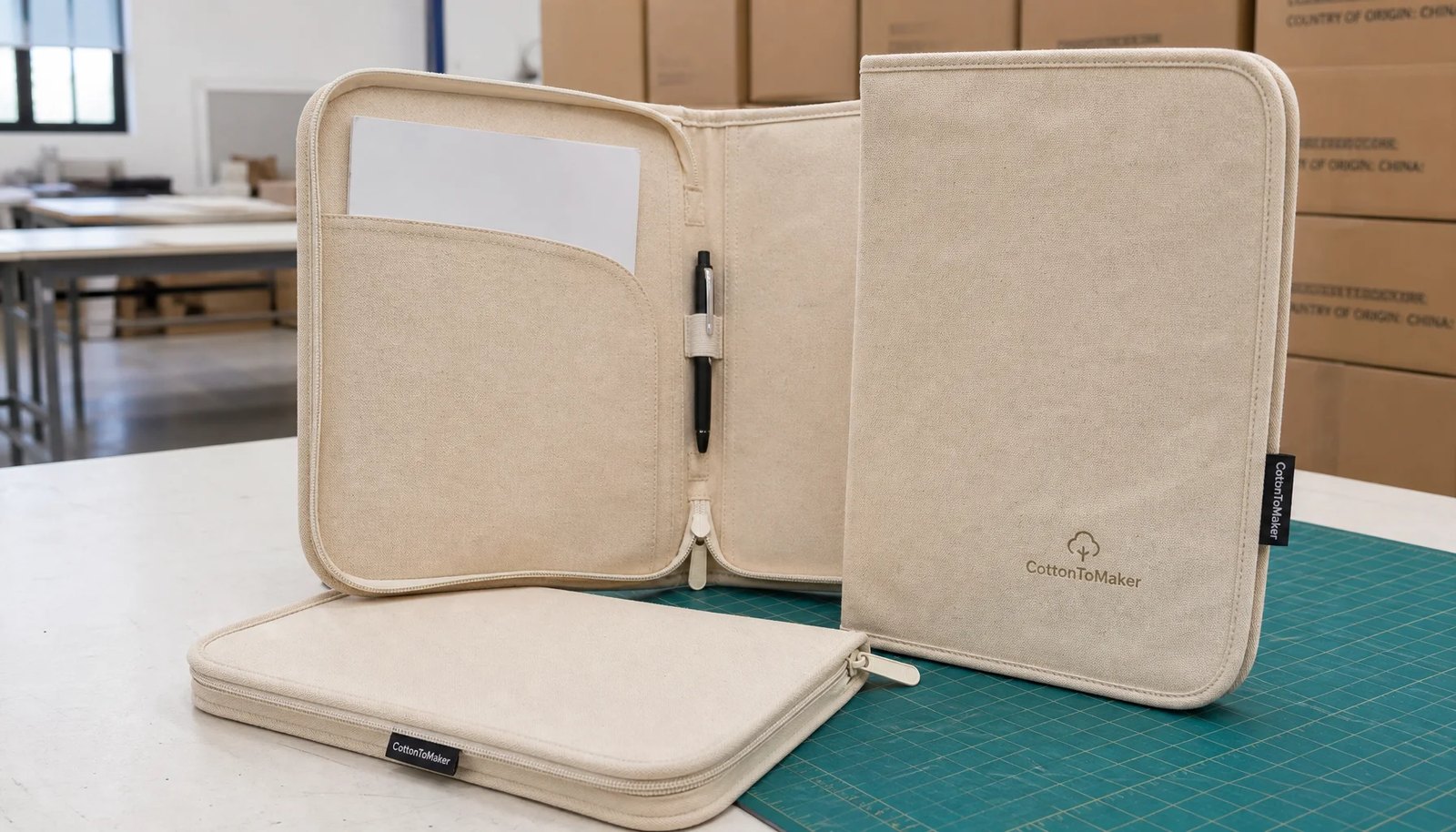
The most reliable base construction is usually a flat portfolio with one main zipper opening, one internal document sleeve, and one pen loop. Extra card pockets, mesh panels, elastic loops, gussets, and padded sections can be useful, but they also add cutting, positioning, stitching, and inspection points. For first-time bookstore programs or multi-SKU orders, a repeatable construction often protects the schedule better than a feature-heavy layout.
Use a drawing, annotated photo, or approved sample to control the details. Show zipper start and stop points, whether the opening is on the long or short side, where the logo sits, whether corners are rounded or square, and where backstitching or bar tacks are required. Rounded corners need consistent templates or dies. Otherwise, pieces from different operators may look slightly different even when the fabric and logo are correct.
- Set finished size using paper size plus 15-25 mm clearance, then state whether tolerance is +/-5 mm or another limit.
- Specify usable zipper opening length, not only outside dimensions, because a narrow opening can still bend documents.
- Use #5 nylon coil zipper as a common starting point unless the design requires a different size or look.
- Define corner radius, seam allowance, zipper tape color, puller style, and puller direction in packing.
- Reinforce zipper ends, pocket mouth corners, pen loop attachment, and label seams with backstitching or bar tacks where appropriate.
- Avoid changing pocket layout after sample approval because small changes can alter sewing time, panel tension, and carton thickness.
Match branding to canvas texture
University logos should be treated as controlled production details, not decoration added at the last minute. Provide vector artwork, Pantone or brand color references, logo dimensions, placement coordinates, and any licensing notes before final pricing. Screen printing is usually efficient for solid 1-3 color logos on canvas zipper portfolios. It can give good coverage on a flat panel and predictable repeat-order setup, but results depend on fabric texture, ink choice, artwork detail, and print location.
Heat transfer can be useful for fine crests, gradients, small runs, or complex marks that are difficult to screen print cleanly on coarse canvas. It should never be approved from a digital proof alone. Adhesion needs to be checked on the actual production canvas, especially because portfolios may be stacked under pressure during transit and campus storage. Embroidery can look premium, but it may stiffen the panel, show backing on the inside, and affect flatness if stitch density is high. Woven labels, rubber patches, and hangtags can also work; quote them as separate components with their own MOQ, placement, and lead time.
Logo placement should consider packing pressure. Prints placed too close to zipper tape, seam ridges, rounded corners, or puller contact points are more likely to show cracking, abrasion, or impressions. If portfolios are stacked face-to-face, print transfer risk increases. A stronger carton plan protects the printed face with individual bags, interleaving, or a layer orientation that keeps hardware away from printed areas.
- Provide vector artwork, Pantone targets, logo size, placement measurements from edges, and clearance from seams or zipper tape.
- For screen print, confirm color count, screen charge, ink opacity, registration tolerance, and white underbase need on dark canvas.
- For heat transfer, approve peel, dry rub, light scratch, edge lift, and packed-pressure checks on final canvas.
- For embroidery, confirm backing, stitch density, thread color, reverse-side appearance, and whether documents still slide smoothly inside.
- For labels or patches, define placement, sewing method, component MOQ, lead time, and whether they are included in unit price.
- Keep an approved print strike-off or signed pre-production sample as the color and placement standard for inspection.
Make MOQ and SKU splits explicit
MOQ is rarely one simple number. For canvas zipper portfolios, MOQ may apply to fabric color, zipper color, logo version, print screen, barcode label, carton mark, or total shipment. A factory may accept 300 pieces for a single-logo design, but the unit cost usually rises because sampling, cutting, setup, and print preparation are spread across fewer units. Many bookstore programs become more stable at 500-1000 pieces per SKU, while larger orders only become efficient when SKU and carton rules stay controlled.
SKU splitting is a hidden cost in many university orders. A 2,000-piece order with one logo is very different from a 2,000-piece order split across eight departments, four barcodes, two fabric colors, and three delivery destinations. Each variation can require artwork checks, screen setup, labels, carton marks, packing list lines, and separate inspection attention. If those details appear after the quote, the supplier may revise pricing or rush the packing process.
Ask for tier pricing and separate charges. Unit price should not bury screen charges, sample fees, barcode labeling, carton upgrades, or special sorting. Procurement should also ask for repeat-order pricing after one-time setup charges are removed. That gives the bookstore a better view of whether the portfolio can become a seasonal reorder item rather than a one-time event purchase.
- Request tier pricing at 300, 500, 1000, and 3000 pieces per SKU, not only one total quantity price.
- Ask whether MOQ is per fabric color, logo version, zipper color, barcode, carton mark, or total shipment.
- Separate unit price, screen/setup charges, sample fees, barcode labels, hangtags, polybags, cartons, and inland freight.
- Provide a SKU matrix with quantity, color, logo, department, barcode, PO line, carton mark, and destination before final quote.
- Agree overage or shortage tolerance, such as 0% for strict bookstore allocations or a small approved percentage for custom production.
- Confirm repeat-order pricing and whether existing screens, labels, or approved materials can be reused.
Build the carton plan early
The carton packing plan is part of the product specification. Flat packing is usually preferred because it protects the document-ready shape, zipper alignment, and printed panel. Folding may reduce carton length, but it can leave creases, distort corners, or put zipper pullers against printed areas. For flat portfolios, 25-40 pieces per export carton is a common range. The right count depends on finished size, canvas weight, zipper bulk, pocket structure, polybag thickness, carton strength, and the buyer's maximum gross weight.
A complete plan states individual packing, layer orientation, pieces per carton, carton dimensions, net weight, gross weight, CBM per carton, carton ply, tape method, carton marks, and pallet requirements if any. Do not approve the final sample without knowing whether the same item can be packed safely at the proposed carton count. A portfolio can look excellent on a table and still fail after 40 pieces press against each other for weeks.
For bookstore receiving, cartons should normally contain one SKU only. Mixed cartons can reduce carton count, but they increase sorting labor and shortage disputes. If mixed cartons are required for department distribution kits, the contents and quantities should be written into the carton mark and packing list. Otherwise, no mixed cartons should remain the default rule.
- Pack portfolios flat unless folding is approved after checking crease, zipper, and print-pressure results.
- Keep zipper pullers away from printed panels through consistent orientation, interleaving, or individual bags.
- Use individual polybags for retail sale, barcode scanning, seasonal storage, multi-handling shipments, or dust-sensitive presentation.
- Set pieces per carton only after checking gross weight, carton bulge, corner compression, and print or zipper impressions.
- Require carton data in the quote: L x W x H, pieces/carton, N.W., G.W., CBM/carton, CBM/piece, carton ply, and tape method.
- Use carton marks showing PO, SKU, color, logo version, quantity, destination, carton sequence, and country of origin if required.
Approve samples with evidence
A useful sampling sequence reduces rework: fabric swatch, blank construction sample, logo strike-off, packing mockup, and final pre-production sample. A blank sample confirms shape, zipper, pockets, and sewing, but it does not prove print color or adhesion. A print strike-off confirms decoration, but it may not prove carton pressure behavior. The final pre-production sample should combine final fabric, final zipper, final logo method, final packing, and final barcode or label position.
Photo approval is not enough for a branded bookstore order with fixed receiving deadlines. The buyer should measure the sample, insert actual documents, cycle the zipper, rub the print, scan the barcode, and check seam stress points. If the sample is couriered folded while bulk will ship flat, note that difference. Otherwise, the sample may create a false impression of creasing or packing behavior.
Approval comments should be measurable. Instead of saying the logo is too low, state the required distance from the lower edge or define the logo center point. Instead of saying the zipper feels cheap, identify the zipper size, slider roughness, blocked stitching, or puller issue. If a change affects print position, fabric, zipper, pocket layout, or carton packing, request a revised pre-production sample rather than relying on email correction alone.
- Measure length, width, zipper opening, pocket depth, pen loop position, logo size, and logo edge distances against the spec sheet.
- Open and close the zipper 10-20 times and check for rough slider movement, blocked stitching, and weak end stops.
- Insert actual letter or A4 documents and confirm papers slide in without bending, catching, or distorting the pocket mouth.
- Rub the logo with a dry white cloth and inspect for visible ink transfer, cracking, poor opacity, edge lift, or ghosting.
- Scan barcode labels from each SKU and confirm they match the SKU matrix and carton mark plan.
- Request packed sample photos showing polybag, layer orientation, pieces per carton, carton mark, carton dimensions, and gross weight.
Inspect where failures happen
Bulk defects on canvas zipper portfolios tend to repeat: fabric shade variation, stains, print shift, zipper problems, skipped stitches, weak pocket corners, loose threads, barcode mismatch, carton count errors, and mixed SKUs. AQL inspection can help, but only when the buyer defines critical, major, and minor defects first. For university bookstore procurement, a wrong logo, wrong barcode, broken zipper, or mixed SKU carton is not a small cosmetic problem. It can block sale, delay distribution, or trigger receiving claims.
QC should happen in stages. Fabric inspection catches shade mismatch, oil stains, weaving holes, mildew odor, and unacceptable slubs before cutting. First-piece inspection confirms that the sewing line follows the approved sample before full production runs. Inline inspection catches zipper, pocket, and print issues while rework is still practical. Final inspection verifies dimensions, appearance, function, packing count, carton marks, barcode scans, and packing list reconciliation.
Inspect packed cartons, not only loose pieces. Carton weight should match the plan within an agreed allowance, carton marks should match the packing list, and SKU labels should scan correctly. If the order ships to multiple campuses or departments, destination labels are part of quality control. A correct portfolio delivered to the wrong campus still fails the procurement objective.
- Treat wrong logo, wrong color, broken zipper, severe stain, unsafe hardware, wrong barcode, missing pocket, or mixed SKU carton as critical defects.
- Treat open seams, crooked print, size outside tolerance, cracked ink, skipped zipper stitching, crushed corners, or wrong carton count as major defects.
- Treat small trim-able threads, light dust, or natural slubs within the approved standard as minor defects unless retail presentation is affected.
- Inspect first finished pieces from each sewing line, print setup, and SKU before full production continues.
- During final QC, check random pieces for size, zipper function, logo, pockets, stitching, stains, barcode scan, and packing accuracy.
- Reconcile carton quantity, carton numbers, SKU counts, gross weights, and packing list totals before shipment release.
Protect campus deadlines
University bookstore dates are often immovable. Orientation goods must arrive before orientation. Back-to-school merchandise must land before semester traffic. Department gifts may be tied to conferences, donor events, or alumni weekends. Plan backward from the required in-hand date, including domestic receiving, campus distribution, and internal bookstore processing. The supplier's production lead time is only one part of the schedule.
A realistic timeline includes artwork preparation, university licensing or brand approval, fabric and zipper sourcing, sample making, courier time, buyer review, revised sample time if needed, bulk material approval, cutting, printing, drying or curing, sewing, trimming, inspection, barcode labeling, carton packing, export booking, and transit. Factories can shorten some steps when materials are in stock, but compressing print curing, inspection, or packing verification can create defects that cost more than a few extra days.
The RFQ and PO should define the lead-time trigger. Some suppliers count from deposit. Others count from final artwork or pre-production sample approval. For a branded university item, bulk production should not be considered released until artwork, fabric, construction, barcode files, carton labels, and packing plan are approved. Multi-department orders need a simple approval log by SKU so one late logo does not quietly delay the whole shipment.
- Build the schedule backward from the campus need date, including receiving, unpacking, internal distribution, and shelf setup time.
- Confirm whether lead time starts after deposit, final artwork, fabric approval, pre-production sample approval, or all approvals together.
- Allow extra days for university licensing, brand office review, bookstore merchandising approval, or department sign-off.
- Do not start bulk cutting before fabric shade, GSM, and construction are approved when appearance consistency matters.
- Approve barcode files and carton labels early because packed goods cannot move efficiently if receiving labels are unresolved.
- Reserve time for re-sampling when changes affect logo placement, zipper color, pocket layout, fabric finish, or carton packing.
Compare quotes by landed cost
The lowest unit price is not always the best procurement result. A quote based on 10 oz canvas, a generic zipper, bulk packing, and 60 pieces per carton cannot be compared with a quote based on 12 oz canvas, #5 nylon coil zipper, individual barcode bag, 30 pieces per carton, and SKU-separated cartons. The two suppliers are pricing different products, different risks, and different receiving labor. Normalize the quote before choosing a supplier.
Carton data is essential for landed-cost review. Calculate CBM per piece from carton dimensions and pieces per carton, then compare it with gross weight and handling limits. Dense cartons may lower freight cost but increase the risk of print transfer, zipper dents, crushed corners, and heavy receiving. Loose cartons may protect presentation but increase freight, storage space, and handling count. The best target is a saleable, scannable, countable portfolio at the lowest reliable landed cost.
The purchase order should repeat the approved specification instead of relying on scattered emails. Include finished dimensions, fabric GSM, zipper details, logo method, artwork reference, approved sample reference, packing method, pieces per carton, maximum gross weight, carton mark format, SKU separation rules, barcode requirements, inspection standard, lead-time trigger, shipment terms, and shortage or overage tolerance. Once the carton packing plan is written into the PO, both buyer and supplier have a clearer basis for inspection and dispute resolution.
- Compare quotes only after normalizing canvas GSM, zipper size, construction, logo method, individual packing, and carton count.
- Calculate CBM per piece from carton dimensions and pieces per carton to estimate freight and storage impact.
- Check carton gross weight against bookstore, distributor, or campus handling rules before approving a high piece count.
- Separate sample cost, setup charge, screen charge, unit price, packing cost, carton cost, labeling cost, and inland freight.
- Ask for a packing list template showing PO, SKU, carton number, quantity, destination, N.W., G.W., and carton dimensions.
- Write no-mix carton rules, carton marks, barcode requirements, and inspection standards directly into the purchase order.
Specification comparison for buyers
| Procurement decision | Recommended specification | Why it matters for bookstore buyers | Verification before bulk |
|---|---|---|---|
| Canvas fabric weight | 10-12 oz cotton canvas for most bookstore programs; 12 oz is commonly about 380-410 GSM depending on mill conversion; agree GSM tolerance, usually +/-5% | Changes hand feel, print opacity, seam thickness, carton gross weight, CBM, and how flat the portfolio remains after packing | Approve swatch; request composition, ounce/GSM statement, shade reference, shrinkage note if washed, and first-bulk roll photo before cutting |
| Finished portfolio size | Letter or A4 format with 15-25 mm document clearance; practical flat-size tolerance +/-5 mm unless a sleeve or insert requires tighter control | Prevents bent handouts, course packs, receipts, orientation inserts, and bookstore flyers while avoiding unnecessary fabric and carton cube | Measure length, width, zipper opening, pocket depth, corner radius, logo coordinates, and usable document area on pre-production samples |
| Zipper specification | Nylon coil zipper, often #5 for this product type; quote tape width, slider, puller, end-stop method, and color | A flexible zipper keeps the canvas body flatter; vague zipper specs create price gaps and function failures | Cycle zipper 10-20 times on samples; inspect slider smoothness, tape stitching, end stops, corner alignment, and puller security |
| Logo method | Screen print for solid 1-3 color marks; heat transfer for fine detail or gradients only after adhesion testing; embroidery, patches, or labels quoted separately | University marks must match brand standards; the wrong process can blur on canvas, crack under carton pressure, or stiffen the panel | Approve production-fabric strike-off; check Pantone target, print size, edge sharpness, dry rub, light scratch, and packed-pressure result |
| Interior structure | Base design: one document sleeve plus one pen loop; optional card pocket or elastic loop only when retail price and inspection time support extra operations | More pockets can improve usefulness but also add cutting, alignment, sewing, and QC risk | Load actual letter/A4 sheets, test pocket mouth tension, confirm backstitching at stress points, and check that pockets do not block zipper movement |
| Retail unit packing | Flat individual polybag or recyclable bag with SKU/barcode label for retail; paper interleaf only where print transfer or zipper impression risk appears | Keeps goods dust-free, scannable, shelf-ready, and easier to receive during campus storage or distribution | Approve bag size, warning text if applicable, barcode placement, scan readability, print-to-print contact, and packed sample photos |
| Export carton count | Usually 25-40 pieces/carton for flat portfolios; set maximum gross weight before quote, commonly 15-18 kg for manual handling unless buyer approves otherwise | Controls freight cube, warehouse labor, carton failure, and damage risk; too-dense packing can mark prints or crush corners | Require pieces/carton, carton dimensions, N.W., G.W., CBM/carton, CBM/piece, carton ply, layer orientation, and carton mark sample |
| MOQ and SKU structure | Quote 300, 500, 1000, and 3000 pieces per SKU; clarify whether MOQ is per fabric color, logo version, zipper color, barcode, or total order | University programs often split by campus, department, or logo; each split affects setup, sorting, labels, carton count, and inspection | Ask for setup charges, screen charges, sample charges, SKU labeling cost, mixed-carton rules, over/under shipment tolerance, and repeat-order pricing |
| Carton labeling | One SKU per carton unless approved; carton mark to show PO, SKU, color, logo version, quantity, carton number, destination, and country of origin if required | Bookstore receiving teams need carton-level identity; vague or mixed cartons create manual sorting, shortage claims, and late distribution | Match carton marks to packing list; scan barcode labels by SKU; reconcile carton count before release and photograph representative cartons |
Buyer checklist before sampling
- Define the buying purpose: retail merchandise, orientation kit, alumni gift, admissions folder, department event, faculty welcome pack, or bookstore private-label accessory.
- Confirm receiving route and handling limits: central bookstore warehouse, direct-to-store campus delivery, department drops, distributor cross-dock, or consolidated import shipment.
- Specify finished dimensions, document clearance, zipper side, corner radius, gusset or no gusset, seam allowance, pocket layout, and measurement tolerance.
- State canvas composition, ounce weight, GSM target, GSM tolerance, fabric finish, color reference, shrinkage expectation, and acceptable natural canvas slub level.
- Provide vector artwork with Pantone or brand color references, logo size, placement coordinates, print method preference, and minimum distance from zipper tape or seams.
- List every SKU split by quantity: fabric color, logo version, department, campus, barcode, hangtag, PO line, destination, and no-mix carton requirement.
- Require quote lines for unit price, sample cost, screen/setup charge, packing material, carton cost, barcode labeling, inland freight, inspection support, and export documents if needed.
- Set carton rules before sampling: pieces per carton target, maximum gross weight, carton dimensions if fixed, carton ply, layer orientation, tape method, and carton mark content.
- Request sample photos showing front, back, zipper ends, corners, inner sleeve, pen loop, print close-up, barcode label, polybag, carton layers, carton mark, and carton gross weight.
- Approve a pre-production sample only after checking size, zipper function, logo color, print adhesion, pocket fit, barcode scan, packing behavior, carton count, and carton mark accuracy.
Factory quote questions to send
- What exact canvas composition, ounce weight, and GSM are you quoting, and what GSM tolerance will you control in bulk production?
- Is the canvas greige, natural, bleached, dyed, pigment dyed, or washed, and what shade tolerance should we expect between sample, bulk, and repeat orders?
- Is fabric from stock or made to order, and will you submit a bulk fabric cutting approval before production starts?
- What finished length, width, corner radius, zipper opening length, seam allowance, pocket size, pen loop size, and production tolerance are included?
- Which zipper size and type are included, such as #5 nylon coil, and what tape width, slider finish, puller style, end-stop method, and zipper color are quoted?
- What logo method are you quoting: screen print, heat transfer, embroidery, woven label, rubber patch, hangtag, or another process?
- How many logo colors, print positions, artwork versions, and screens are included before extra setup charges apply?
- Can you provide tier pricing at 300, 500, 1000, and 3000 pieces per SKU, with unit price, setup charges, sample costs, and packing costs separated?
- Does MOQ apply per fabric color, per logo version, per zipper color, per barcode, or per total shipment?
- What sample stages can you provide: fabric swatch, blank construction sample, print strike-off, barcode/packing mockup, and final pre-production sample?
Quality-control points to confirm
- Fabric GSM should match the approved standard within the agreed tolerance, commonly +/-5% unless the buyer sets a tighter or looser limit.
- Canvas shade should match the approved swatch or shade band; visibly different dye lots should not be mixed within the same SKU carton without buyer approval.
- Finished length, width, pocket depth, zipper opening, and logo placement should remain within the approved tolerance, often +/-5 mm for flat sewn dimensions.
- Zipper must open and close smoothly without skipped teeth, blocked stitching, loose pullers, broken sliders, weak end stops, tape waviness, or corner distortion.
- Logo print should match approved artwork for position, scale, color, opacity, registration, and edge sharpness, with no major bleeding, ghosting, cracking, peeling, or offsetting.
- Printed panels should pass agreed dry-rub, light scratch, and packed-pressure checks using the actual canvas, actual ink or transfer, and final packing method.
- Seams around zipper tape, corners, document sleeves, pen loops, labels, and reinforcement points should have secure backstitching and no open seams.
- Stitching should be visually suitable for retail, with no severe skipped stitches, loose thread nests, needle cuts, uneven tension, or untrimmed long threads on presentation areas.
- Canvas surfaces should be free from obvious oil stains, dirt, mildew odor, weaving holes, severe slubs outside standard, color streaks, and unapproved shade mismatch.
- Inner pockets should hold the intended document size without pulling the outer panel out of shape, blocking the zipper, tearing at the pocket mouth, or creating visible panel distortion.