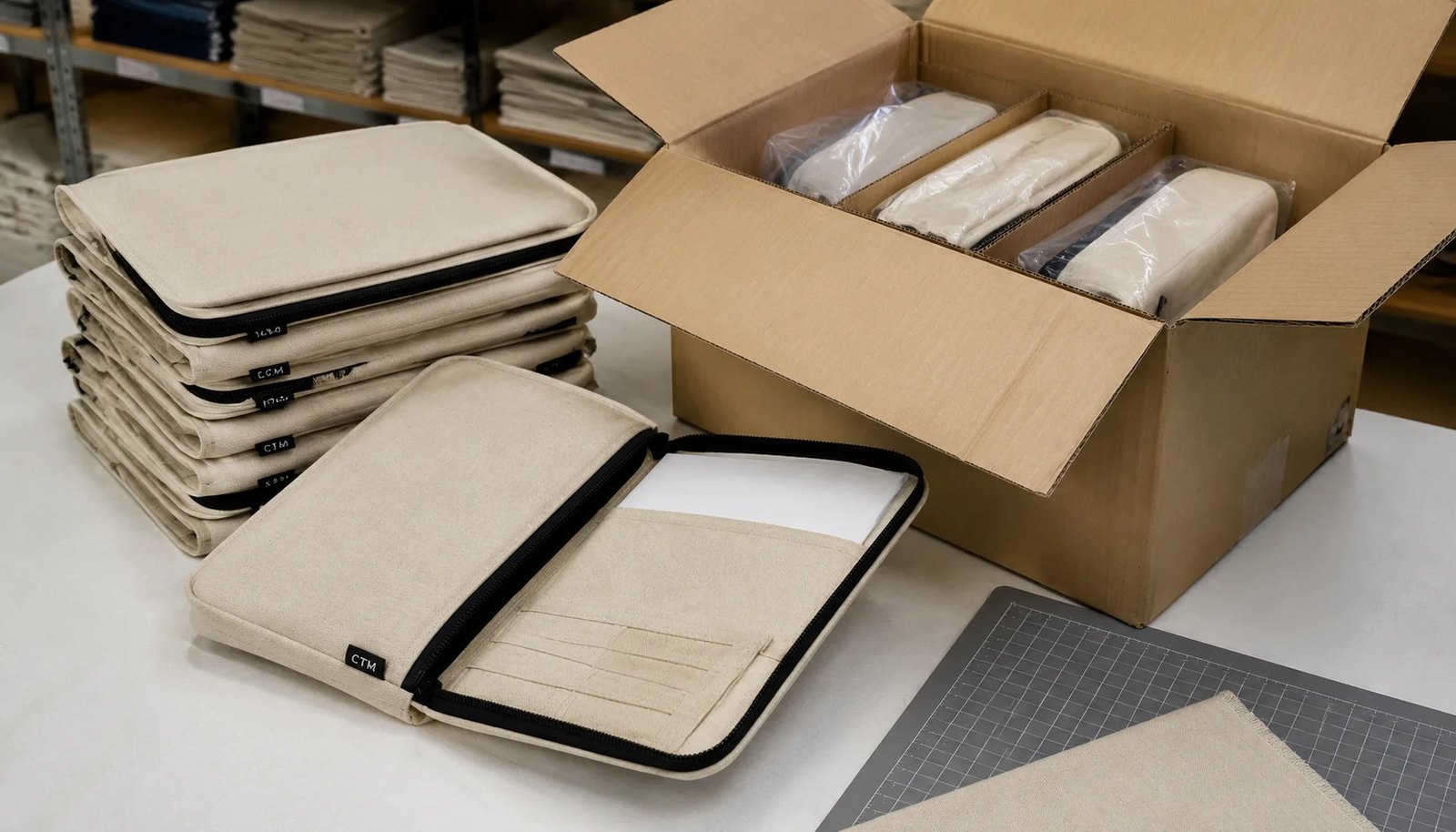
The buying problem: portfolios are soft goods, but cartons decide the landed cost
Canvas zipper portfolios look simple on a product sheet, but the packing plan can change the real cost more than many buyers expect. A natural grocer program may only need a clean reusable document pouch for loyalty materials, vendor folders, employee onboarding, or retail gift sets. If the carton is too large, too weak, or packed in the wrong orientation, the buyer pays for air, damaged corners, zipper pressure marks, and extra warehouse labor.
The correct carton plan starts before the purchase order. The factory needs finished size, fabric weight, zipper type, print position, individual packing, barcode requirements, and maximum acceptable carton weight. Without those details, suppliers may quote the cheapest carton count first, then revise CBM after sampling. That creates a landed-cost gap between quotes that looked similar at RFQ stage.
- Do not compare only unit price; compare pieces per carton, carton CBM, and gross weight.
- A soft portfolio can still be damaged by zipper slider pressure if cartons are overpacked.
- Retail receiving requirements often matter more than factory convenience when barcodes and carton marks are involved.
- The packing plan should be approved with a real sample, not only estimated from a flat drawing.
Recommended base specification for natural grocer canvas zipper portfolios
For most natural grocery retail programs, the practical base fabric is 12 oz cotton canvas, roughly 390 to 410 GSM. It has enough body to feel reusable and retail-worthy, but it can still be packed flat without excessive carton height. If the portfolio is only used as a light document folder, 10 oz canvas may work. If it must carry heavier catalogs or be sold as a premium accessory, 14 oz to 16 oz canvas gives a stronger hand feel but increases sewing difficulty, unit weight, and carton cube.
A common buyer mistake is specifying only 'natural canvas' without weight, finish, or shrinkage control. Natural cotton canvas can vary in shade, slub level, and hand feel. The RFQ should state whether the buyer accepts unbleached natural canvas, bleached canvas, dyed canvas, or washed canvas. For a natural grocer brand, unbleached or lightly bleached canvas usually fits the sustainability look, but the approved swatch must become the shade standard for bulk.
- Entry option: 10 oz canvas, about 320-340 GSM, for light document use and lower freight.
- Balanced option: 12 oz canvas, about 390-410 GSM, for reusable retail or staff portfolios.
- Premium option: 14-16 oz canvas, about 450-540 GSM, for heavier hand feel but lower carton efficiency.
- Specify shrinkage expectation if the fabric is washed, dyed, or heavily printed.
Size, structure, and zipper details that affect carton packing
Portfolio size should be built around the document it must hold, not copied from a generic pouch. A4 documents need different clearance than US letter documents. For grocery buyers working with coupons, vendor forms, wellness program papers, or recipe cards, a finished size around 340 x 250 mm often gives useful clearance without creating a loose oversized bag. If the portfolio must hold a tablet, buyer-supplied device dimensions and thickness should be added to the RFQ.
The zipper is the thickest and most vulnerable area in many canvas portfolios. Nylon coil zipper is normally the safer option for soft canvas because it bends with the bag and is less likely to crack than molded teeth under compression. Metal zippers can look premium, but they increase weight and can mark natural canvas if the slider rubs during packing. The carton plan should account for zipper thickness by alternating directions or using a stack method that avoids all sliders sitting in one line.
- State the zipper opening length, not only the total bag width.
- Define whether the zipper runs on the top edge, around two sides, or around three sides.
- Avoid oversized metal pullers if cartons will be tightly packed.
- Use a zipper end-stop construction that does not create a hard lump at the corner.
Print method choices and how they change packing risk
Most natural grocer branding works well with water-based screen print on cotton canvas. It gives a softer hand feel than heavy plastisol and fits the simple, natural look many grocery buyers want. For one to three solid colors, screen printing is usually economical and durable. For small multicolor artwork, heat transfer can reproduce detail, but the buyer should test hand feel, edge lifting, and resistance to heat or pressure inside cartons.
Printing affects packing because fresh or poorly cured ink can scuff, stick, or transfer when portfolios are stacked tightly. Large solid ink blocks on natural canvas also create stiffness differences across the panel, which can make the stack uneven. If the print is on both sides, inner paper sheets or individual bags may be needed. A buyer who wants plastic-free packaging should test paper sleeves carefully because rough kraft paper can rub against dark ink during transit.
- Screen print: best for solid logos, store slogans, simple icons, and earth-tone branding.
- Heat transfer: useful for detailed art, but verify edge adhesion and carton pressure marks.
- Embroidery: premium look but adds thickness and may create carton pressure points.
- Woven label: good for small brand mark with low ink risk, but placement must not irritate zipper sewing.
MOQ logic and cost drivers behind supplier quotes
For canvas zipper portfolios, MOQ is driven by fabric availability, zipper procurement, printing setup, labor balance, and carton packing material. A simple natural canvas portfolio using stock fabric and stock zipper may be workable from 500 to 1,000 pieces, depending on factory workload. Custom dyed canvas, unusual zipper tape color, custom puller hardware, or multi-position printing can push practical MOQ to 2,000 pieces or more because suppliers must buy minimum material lots.
When comparing quotes, buyers should separate unit construction cost from packing and compliance cost. A low unit price may exclude individual polybags, barcode labels, inner cartons, moisture liners, stronger export cartons, or palletization requirements. For natural grocer distribution, these small items can prevent receiving problems. The RFQ should force suppliers to list what is included, otherwise the cheapest quote may become expensive after the retailer's routing guide is applied.
- Fabric cost increases with weight, dyeing, washing, and tighter shade control.
- Zipper cost increases with custom tape color, metal finish, branded puller, and longer opening.
- Labor cost increases with internal dividers, rounded corners, binding, and zipper-around construction.
- Packing cost increases with individual bags, paper interleaving, barcode labels, moisture protection, and stronger cartons.
- Freight cost increases with carton cube, gross weight, and inefficient stack height.
Carton packing plan: pieces per carton, stack method, and protection
A practical packing plan for 12 oz canvas zipper portfolios is usually a flat stack of 25 to 50 pieces per master carton, depending on finished size, internal structure, and zipper thickness. The factory should measure the bulk sample stack before confirming final carton dimensions. A single sample cannot predict carton height accurately because fabric thickness, seam bulk, print coverage, and zipper placement compound over a full stack.
For portfolios with zipper sliders on one side, alternating orientation can prevent one edge from becoming much thicker than the other. For printed front panels, all units should face the same direction only if print scuffing is controlled by individual bags or interleaving. Cartons should be strong enough for export handling and warehouse stacking. A moisture barrier is recommended for natural canvas because cotton absorbs humidity and can develop odor or mildew if cartons sit in damp conditions.
- Typical master carton target: keep gross weight under 15-18 kg unless the buyer approves heavier cartons.
- Use flat stacking for simple portfolios; use interleaving for heavy print coverage or raised decoration.
- Place zipper sliders away from direct carton corners where impact damage is common.
- Avoid compressing the carton to gain a few extra pieces; zipper impressions and warped panels cost more than saved cube.
- Request final carton dimensions and CBM after pre-production sample approval, not after cargo is ready.
Sample approval should include a packed sample, not only a product sample
A correct sample process for canvas zipper portfolios has several stages: material swatch, print strike-off, fit sample, pre-production sample, and packed sample. Many production issues are caught only when the product is placed into its actual sleeve or carton. For example, a zipper puller may press into the printed panel, a barcode may not scan through the bag, or the portfolio may curve after being packed too tightly.
The approved pre-production sample should include the exact canvas weight, zipper, print method, pocket structure, stitching color, label, and packing material. If the factory uses substitute fabric or a temporary zipper for sampling, that must be written clearly. Otherwise the buyer may approve a hand feel or shade that cannot be matched in bulk. For natural canvas, the approved swatch should include both acceptable and reject examples if shade control is important.
- Approve the product open and closed, because zipper tension can change shape.
- Test document fit using the real paper size and expected document count.
- Scan the barcode through the final individual packing material.
- Stack at least 10-20 samples to see whether the zipper side becomes uneven.
- Keep one signed sample at the factory and one with the buyer or inspection agency.
QC thresholds that prevent retail receiving complaints
Quality control for canvas zipper portfolios should focus on fit, function, appearance, and packability. Finished dimensions should normally hold within plus or minus 5 mm for body length and width, unless the design requires tighter control. Pocket placement can be held tighter, often plus or minus 3 mm, because crooked dividers are visible when the portfolio is opened. Zipper function should be tested repeatedly, not just zipped once during final inspection.
Appearance standards must recognize natural canvas characteristics while rejecting defects that affect retail presentation. Small cotton slubs are normal, but oil stains, dark yarn contamination, broken yarns, heavy crease marks, and print smears should not pass on the front panel. Stitching should be even, seam allowance should not collapse at corners, and loose threads should be trimmed. Carton inspection should include gross weight, carton strength, marks, barcode placement, and whether cartons bulge after taping.
- Run zipper open-close cycles during inspection; 20 cycles per tested unit is a practical minimum.
- Reject skipped stitches longer than 10 mm on visible seams or stress points.
- Use dry rub and light wet rub tests for printed areas before packing approval.
- Check that the portfolio lies reasonably flat after 24 hours out of carton compression.
- Inspect carton marks against the buyer's PO, SKU, color, quantity, and destination requirements.
Lead time planning for importers and retail launch calendars
Lead time should be counted from the correct trigger point. Factories cannot begin reliable production from an incomplete RFQ or low-resolution artwork. For a standard stock canvas zipper portfolio, sampling may take about 7 to 15 days depending on print strike-off and material availability. Bulk production often falls in the 25 to 45 day range after sample approval and deposit, but the actual schedule depends on order quantity, print complexity, and current factory capacity.
Natural grocer programs often involve store launch dates, wellness campaigns, loyalty kit releases, or seasonal merchandising. The highest schedule risk is usually not sewing time; it is delayed artwork approval, unclear barcode data, late routing instructions, and carton changes after inspection. Buyers should build a timeline that includes sample courier time, internal approval, pre-shipment inspection, booking, customs documents, and delivery to the distribution center.
- Reserve time for print strike-off approval before the full sample is made.
- Do not approve bulk fabric until shade, weight, and hand feel are signed off.
- Freeze carton marks and barcode data before packing material is printed.
- Leave buffer for carton dimension correction after real stack measurement.
- For promotional launches, set an inspection date at least several days before the vessel or truck cutoff.
Quote data needed for landed-cost comparison
To compare suppliers fairly, the buyer needs a quote sheet that includes more than FOB unit price. For each quote, capture fabric weight, finished size, print method, zipper specification, individual packing, pieces per carton, carton dimensions, gross weight, net weight, CBM, sample cost, mold or setup charges if any, MOQ, price breaks, production lead time, and payment terms. Without carton data, landed cost cannot be calculated accurately.
A supplier quoting 5 percent lower unit price may still be more expensive after freight if the carton plan is poor. For example, a thicker portfolio packed only 20 pieces per carton may create high CBM, while a properly stacked 12 oz version may ship more efficiently. Buyers should also compare risk cost: stronger cartons, individual protection, and clear barcodes may add cents per unit but reduce damage claims, store receiving delays, and repacking labor.
- Request FOB price and, if useful, EXW price so local handling costs are visible.
- Compare CBM per 1,000 pieces, not only carton size.
- Record gross weight per carton to confirm warehouse handling limits.
- Separate product cost from packing cost so sustainability packaging choices can be evaluated.
- Require written confirmation of what is included in the quoted price.
Specification comparison for buyers
| Spec decision | Recommended option | When it fits | Buyer risk to check |
|---|---|---|---|
| Canvas fabric weight | 12 oz cotton canvas, about 390-410 GSM, pre-shrunk or controlled shrinkage | Balanced option for reusable zipper portfolios sold or issued by natural grocery retailers | Below 10 oz may wrinkle and collapse in carton; above 16 oz increases unit weight, freight, and zipper stress |
| Portfolio size | A4 or letter-size body with 15-25 mm document clearance, commonly around 340 x 250 mm | Fits coupons, loyalty materials, staff documents, supplier forms, or reusable customer kits | Tight sizing causes bent corners after packing; oversized sizing increases carton cube with no retail benefit |
| Zipper type | Nylon coil zipper with smooth slider, color-matched or natural contrast tape | Best for soft canvas folders because it bends without teeth cracking | Metal zipper looks premium but can stain natural canvas and raise weight; cheap sliders fail during store handling |
| Print method | Water-based screen print for solid logos; heat transfer only for small detailed artwork | Natural grocer branding usually favors simple earth-tone graphics on raw or dyed canvas | Heavy ink coverage can stiffen panels, stick during packing, or rub inside polybags if curing is weak |
| Internal structure | One main compartment plus document sleeve or simple divider, no hard board unless needed | Keeps the portfolio flexible enough for economical carton packing | Too many internal layers add sewing time and thickness variation, reducing pieces per carton |
| Unit packing | Individual recycled-content polybag or glassine-style paper sleeve, barcode label facing same direction | Useful when cartons are opened by distribution centers or stores | No individual protection can cause print scuffing; loose barcodes slow receiving and relabeling |
| Carton configuration | Flat stack, 25-50 pieces per master carton depending on thickness, with moisture liner and corner protection | Best for export orders moving through warehouse, DC, and retail backroom handling | Overfilled cartons bulge and crush zipper sliders; underfilled cartons waste freight and shift during transit |
| MOQ logic | 500-1,000 pcs for basic canvas and stock zipper; 2,000+ pcs for custom-dyed fabric or special hardware | Allows factory to buy material efficiently while controlling setup cost | Low MOQ with custom dye or complex printing often hides higher unit price, longer lead time, or fabric substitution |
Buyer checklist before sampling
- Define finished size with document clearance, not only outside dimensions.
- Specify canvas weight in oz and GSM, plus shrinkage tolerance after finishing.
- Decide whether the portfolio must stand flat, fold easily, or carry heavier documents.
- Lock zipper material, tape color, slider finish, puller style, and minimum smoothness standard.
- Provide artwork in vector format with Pantone or approved ink references for natural canvas.
- State individual packing material, barcode placement, carton mark format, and carton drop-test expectation.
- Require a pre-production sample packed in the proposed polybag and carton orientation.
- Request carton dimensions, gross weight, net weight, pieces per carton, and CBM before PO release.
- Set acceptable fabric shade range for natural cotton canvas because lot-to-lot color variation is normal.
- Reserve time for carton packing adjustment after bulk thickness is measured, not only after sample approval.
Factory quote questions to send
- What exact canvas weight will be used in oz and GSM, and is it stock greige, bleached, dyed, or washed fabric?
- What is the finished size tolerance for length, width, zipper opening, and document pocket placement?
- Which zipper supplier grade, zipper tape width, slider type, and puller finish are included in the quoted price?
- Which print method is quoted, how many colors are included, and what curing or rub test standard will be applied?
- How many pieces per carton are planned, and what are the estimated carton dimensions, gross weight, and CBM?
- Will the portfolio be packed flat, alternated zipper-to-zipper, or layered with paper to protect the print?
- Are individual bags, barcode labels, silica gel, moisture liner, and export carton marks included or quoted separately?
- What sample stages are included: material swatch, print strike-off, fit sample, pre-production sample, and packed sample?
- What is the MOQ for stock canvas versus custom-dyed canvas, and what price break applies at 500, 1,000, 3,000, and 5,000 pieces?
- What production lead time starts after which event: deposit, artwork approval, material arrival, or pre-production sample approval?
Quality-control points to confirm
- Finished size tolerance within +/-5 mm for body dimensions and +/-3 mm for pocket position unless a tighter retail spec is agreed.
- Zipper must open and close smoothly for at least 20 manual cycles during inline inspection without slider jamming or seam catching.
- Print adhesion and curing should pass dry rub and light wet rub testing without visible transfer onto white cloth.
- Natural canvas shade variation should stay within the approved swatch range, with heavy slubs or oil marks rejected on front panels.
- Seam allowance should be consistent, with no skipped stitches longer than 10 mm and no loose threads on visible retail-facing edges.
- Carton gross weight should stay within the buyer's warehouse handling limit, commonly below 15-18 kg unless approved.
- Packed cartons should not bulge more than the agreed tolerance, because bulging increases crushing, pallet instability, and dimensional freight cost.
- Barcode labels must scan through any individual bag or be placed externally according to the retailer's receiving rules.