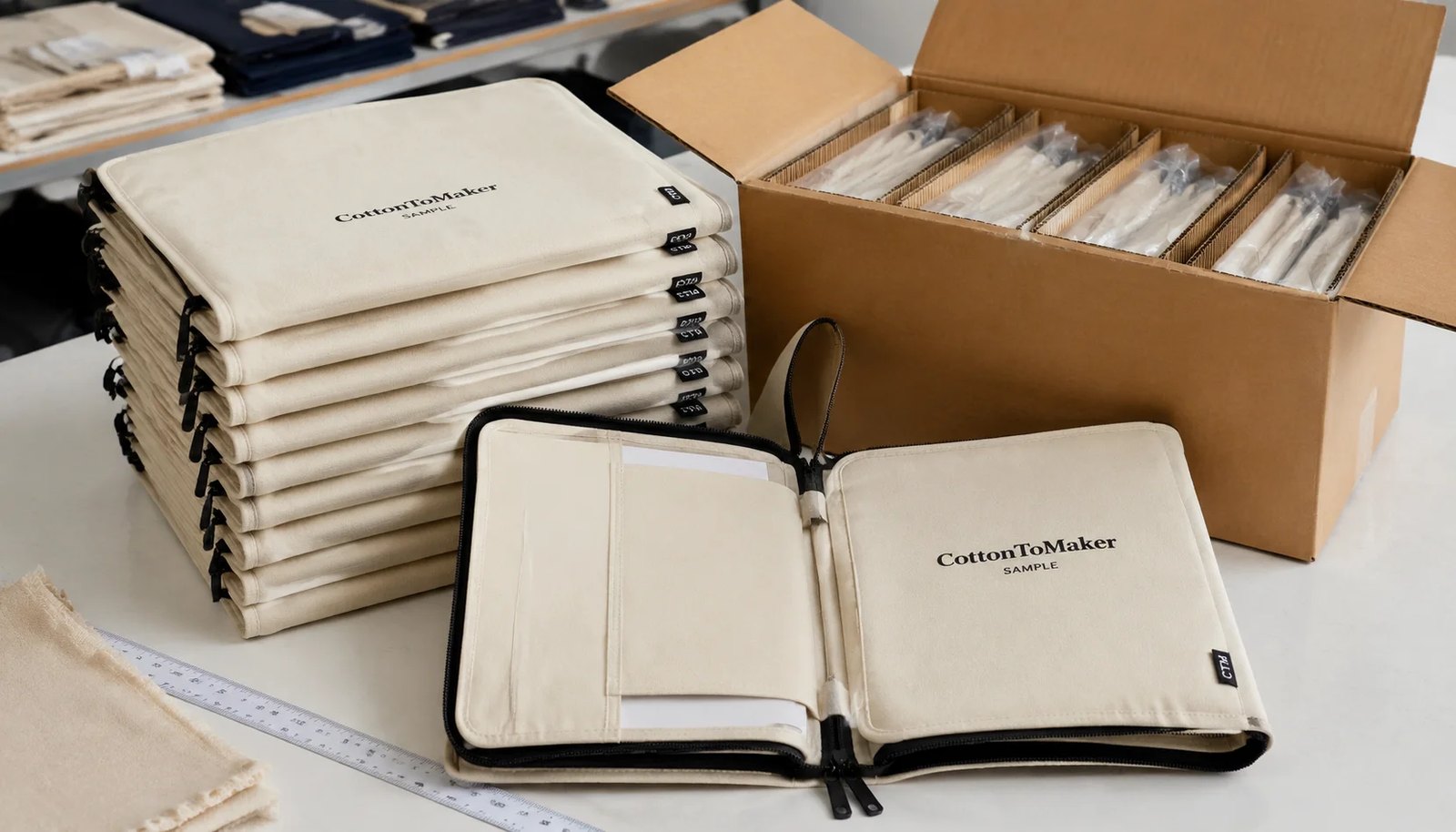
Buying Problem
A custom canvas zipper portfolio looks simple in a quote sheet, but the costly mistakes usually appear after packing. Liquor retailers often use these portfolios for staff training documents, tasting event folders, bottle club materials, distributor sales notes, menu inserts, or premium account packs. The product must arrive clean, flat, and countable. If the carton plan is weak, the buyer receives creased corners, zipper pull marks, dusty canvas, mixed counts, or cartons that cannot be handled efficiently at the warehouse.
For this product, the carton packing plan should be developed together with the specification, not after production. Fabric weight, zipper thickness, logo method, inner pocket structure, and individual packing all change the carton quantity and final landed cost. A procurement team comparing supplier quotes should not only compare unit price. The better quote explains how the factory will fold or lay the portfolios, how many units fit per carton, what the gross weight is, and how the packing method protects the printed canvas during export transport.
- Best use case: flat document or retail program portfolio, not a padded laptop sleeve.
- Main packing risk: zipper pull pressure marks and canvas creasing under carton compression.
- Main quote risk: low unit price with missing carton size, weight, packing labor, or barcode cost.
- Best RFQ approach: request a packed sample carton for approval before bulk production.
Product Specification
For liquor retail programs, the usual specification is a flat zipper business portfolio made from cotton canvas with one main compartment and, if needed, one internal document pocket. A4, letter-size, or custom menu-card dimensions should be confirmed by actual inserts. A portfolio that is only 5 mm too narrow can still look acceptable empty, but it may force staff to bend tasting notes, supplier sheets, or loyalty enrollment forms during use.
A practical canvas range is 12 oz to 16 oz, approximately 380-540 GSM depending on finishing. Lighter 10 oz canvas can work for short promotional use, but it creases more easily and feels less structured. Heavier 18 oz canvas can feel premium, but the zipper corners become harder to sew cleanly and the carton gross weight rises quickly. For a repeat retail program, the best balance is usually a mid-heavy canvas with reinforced binding rather than maximum fabric weight.
- Define finished size as width x height x usable opening, not only panel size.
- State whether the portfolio must hold A4, US letter, menu sheets, coupons, shelf talkers, or training cards.
- Use reinforced edge binding if the product will be handled daily by store staff.
- Keep internal pocket depth practical; very deep pockets slow document removal and add sewing variation.
- Require the approved sample to use the same fabric weight and zipper grade as bulk production.
Canvas And Zipper Choices
Canvas is not only a visual decision. Natural cotton canvas can show seed flecks and shade variation, which many beverage brands accept for an organic look. Dyed canvas gives stronger brand control but adds MOQ pressure and shade tolerance risk. Bleached or white canvas gives clean logo contrast, but it also reveals dirt, oil marks, carton dust, and handling stains. Procurement should select the canvas finish based on receiving tolerance and store environment, not only brand color.
The zipper should be matched to the fabric thickness and opening length. A #5 nylon coil zipper is normally suitable for canvas zipper portfolios because it bends smoothly around corners and reduces scratching risk. A metal zipper may look heavier, but it can mark the canvas during packing and increase unit weight. If the portfolio will be opened frequently by store teams, specify a zipper cycling test in the inspection plan. The test does not need to be complicated: repeated open-close movement on a sample batch will reveal weak pullers, tight corners, and stitching tension problems.
- Natural canvas: good for earthy retail branding, but shade and fleck variation must be accepted.
- Dyed canvas: better brand matching, but ask for lab dip, bulk lot approval, and fabric MOQ.
- White or bleached canvas: strong logo visibility, but higher risk of dirt marks and carton rub.
- Nylon coil zipper: best general option for smooth function and lower scratch risk.
- Metal puller: acceptable if protected during packing and checked for marking.
Logo And Print Method
Most liquor retailers and beverage programs do not need complex decoration on a canvas zipper portfolio. A clean screen print, woven side label, or small patch is usually more durable and easier to control than full-surface artwork. Screen print works well for one to three solid colors and gives a stable unit cost at volume. Heat transfer is useful for gradients, fine details, or short runs, but it must be tested on coarse canvas because texture can reduce edge sharpness and adhesion.
Logo placement should be treated as a manufacturing dimension. If the artwork sits too close to the zipper, seam, or corner radius, the final product can look off-center after sewing. Print before sewing is usually cleaner for flat panels, but it requires accurate cutting and sewing control. Print after sewing can help with placement on finished goods, but zipper bulk and seams may prevent a flat print surface. The RFQ should state whether print tolerance is measured from the zipper seam, side seam, or finished edge.
- Use Pantone references for solid colors and request a strike-off on actual canvas.
- Keep large ink blocks away from high-fold areas and zipper pull contact points.
- For woven labels, define label size, fold type, color count, position, and seam insertion method.
- For retail barcodes or SKU stickers, separate branding artwork from logistics labels.
- Approve logo appearance after the portfolio is packed, not only on a flat unpacked sample.
MOQ And Cost Logic
MOQ for custom canvas zipper portfolios is usually driven by material and decoration, not sewing alone. A factory may be able to sew a small quantity, but custom dyed canvas, special zipper tape color, woven labels, printed hangtags, and carton labels each have their own minimums. A buyer who requests a small order with custom fabric, custom zipper, custom label, and store-level allocation may receive a high unit price because setup and leftover material are spread across fewer pieces.
When comparing quotes, separate the cost drivers. The base bag includes fabric, zipper, sewing, trimming, and normal packing. Added costs may include print screens, heat transfer setup, woven label MOQ, individual barcode stickers, paper sleeves, reinforced cartons, palletization, and sample courier charges. A low quote that excludes these items is not cheaper if the missing costs return after purchase order approval.
- Low MOQ is realistic with stock canvas color and stock zipper color.
- Custom dyed canvas usually needs higher fabric MOQ and longer lead time.
- A one-color screen print is normally more economical than multi-color artwork at volume.
- Individual retail packing adds labor and carton volume; include it before price comparison.
- Request unit price at two or three quantity breaks so the buyer can see where setup costs flatten.
Carton Packing Plan
The carton packing plan should protect flatness, print surface, zipper pull, and count accuracy. For many canvas zipper portfolios, 20-40 pieces per export carton is a practical range, but the correct number depends on finished size, canvas weight, zipper hardware, and individual packing. The carton should not be filled so tightly that zipper pulls press into the front panel. It should also not be too loose, because shifting during transport creates corner wear and dust marks.
Flat packing is usually preferred. Each portfolio can be placed in a recyclable polybag or paper sleeve, then stacked in one direction or alternating direction if zipper pull height creates an uneven stack. If using no individual bag, add tissue or paper between printed panels and protect zipper pulls. For liquor retail distribution, carton labels should show item code, PO number, color, quantity, gross weight, net weight, carton number, and any store allocation data required by the buyer.
- Request proposed carton dimensions and gross weight before approving bulk packing.
- Keep master carton gross weight within a practical manual handling range for the destination warehouse.
- Use five-ply export cartons when cartons will be stacked high or moved through distributor warehouses.
- Avoid tight compression that creates permanent zipper pull marks on natural or light canvas.
- Require a packed carton photo and, for larger orders, a packed carton sample before final production.
Sample Approval
A correct sample process prevents most production disputes. The first sample can confirm size, structure, zipper type, and material hand feel. The print strike-off confirms ink color, coverage, and logo sharpness on actual canvas. The pre-production sample should combine final canvas, final zipper, final label, final artwork, and final packing. Buyers should not approve a beautiful loose sample and then discover that the packed goods crease or mark in the carton.
Sample approval should include measurements and use tests. Put the actual retail documents or inserts inside the portfolio, zip it closed, open it several times, and stack it under light pressure. Review the front logo after the sample has been packed overnight. This simple routine shows whether the zipper pull leaves marks, whether the print sticks to the opposite surface, whether the pocket is useful, and whether the finished size is accurate.
- Measure finished width, height, zipper opening, pocket depth, and logo position.
- Test the real contents that stores or distributors will use.
- Open and close the zipper repeatedly to find tight corners or weak pullers.
- Leave the printed sample packed for at least one night and inspect pressure marks.
- Sign off one retained sample for factory reference and one buyer sample for incoming inspection.
QC Thresholds
Quality control should be written in acceptance terms that an inspector can apply. For this product, critical defects include broken zipper, missing logo, wrong carton count, wrong item code, mildew odor, severe stain, and unsafe sharp hardware. Major defects include visible print skew, zipper waviness, open seams, loose binding, distorted shape, color outside tolerance, and carton damage that affects product condition. Minor defects include small loose threads or slight natural canvas flecks within the approved standard.
The inspection should include both loose product and packed carton review. Checking only unpacked portfolios misses many shipment problems. Inspectors should open random cartons, verify counts, compare carton labels against the PO, check barcode readability if used, and review whether the packing method matches the approved sample. For light canvas colors, rubbing and dust marks deserve special attention because they are common reasons for retail receiving complaints.
- Set finished size tolerance before production, commonly plus or minus 5 mm unless the use requires tighter control.
- Set logo placement tolerance from a fixed seam or zipper line, commonly plus or minus 3-5 mm for simple prints.
- Reject broken zippers, missing pulls, skipped teeth, open seams, heavy stains, mildew odor, and incorrect carton counts.
- Separate natural canvas variation from actual stains by approving a clear reference sample.
- Include carton compression, corner crush, and label accuracy in final inspection.
Lead Time Risk
Lead time should be counted from the last required approval, not from the first inquiry. If the buyer has not approved artwork, fabric color, zipper color, sample structure, and packing method, the production clock has not truly started. For standard stock canvas and simple screen print, the schedule is shorter. Custom dyed fabric, custom woven labels, special zipper tape, retail barcode packing, or store allocation cartons can add time before sewing begins.
Liquor retail programs often connect to seasonal promotions, tastings, holidays, new store openings, or supplier-funded campaigns. Late packaging decisions are a common cause of missed ship dates. If carton labels, barcode files, or store split quantities arrive after production, the factory may need to reopen cartons, rework packing, or delay inspection. The buying team should freeze the packing plan at the same time as the pre-production sample.
- Build the schedule around artwork approval, material procurement, sample approval, bulk cutting, sewing, printing, packing, inspection, and vessel booking.
- Custom dyed canvas and woven labels should be treated as long-lead components.
- Final carton marks and barcode data should be released before packing starts.
- Inspection booking should happen before the planned packing finish date, not after cartons are sealed.
- For fixed retail launch dates, keep a buffer for sample revisions and export booking changes.
Quote Data To Compare
A useful supplier quote should give enough data for landed-cost comparison. Unit price alone is not enough. The buyer needs fabric weight, finished size, zipper specification, print method, packing method, pieces per carton, carton dimensions, gross weight, sample cost, tooling or setup cost, production lead time, payment terms, and shipment term. Without carton dimensions and gross weight, freight estimates will be weak and the apparent cheapest supplier may become expensive after logistics calculation.
For importers and distributors, carton efficiency can change the total landed cost more than a small unit price difference. A portfolio packed 20 pieces per carton with heavy empty space may consume more CBM than another supplier's 30-piece carton plan with good protection. However, pushing too many units into a carton can create damage and receiving claims. The buyer's goal is not the smallest carton at any cost. The goal is a carton that protects the goods, stays within handling weight, and supports accurate warehouse receiving.
- Compare quotes using unit price plus estimated freight per piece, not unit price alone.
- Request CBM per 1,000 pieces based on the proposed carton plan.
- Ask whether the price includes export cartons, inner sleeves, barcode stickers, hangtags, and carton marks.
- Separate sample fees, print setup, label setup, and bulk unit price in the quote table.
- Keep the approved carton specification attached to the purchase order.
Specification comparison for buyers
| Spec decision | Recommended option | When it fits | Buyer risk to check |
|---|---|---|---|
| Outer canvas weight | 12 oz to 16 oz cotton canvas, roughly 380-540 GSM after finishing | Retail staff kits, tasting notes, loyalty documents, and premium bottle-club paperwork that need a firm hand feel | Canvas below 10 oz can crease around the zipper; very heavy canvas may raise carton weight and zipper stress |
| Portfolio structure | Flat zipper portfolio with reinforced edge binding and one internal document pocket | Orders that need clean carton packing and predictable shelf or back-room storage | Bulky gussets or padded panels reduce carton efficiency and can distort under stacking pressure |
| Zipper choice | Nylon coil zipper size #5 with metal puller or branded fabric pull tab | Most liquor retail programs where smooth opening matters more than luxury hardware | Metal zippers can scratch printed canvas and add weight; small #3 zippers may fail on thicker canvas corners |
| Print method | Screen print for solid brand marks; heat transfer only for gradients or small color artwork | Retailer logos, supplier program graphics, tasting event branding, and simple monochrome designs | Large ink coverage on coarse canvas can crack if curing and wash testing are not controlled |
| Logo placement | Centered front panel or small woven side label, kept clear of seam allowance and zipper curve | Brands that need visibility without complicating stitching or packing | Artwork too close to the zipper line may be hidden by folds, stitching, or carton compression |
| Carton quantity | 20-40 pieces per master carton depending on size, fabric weight, and individual polybag use | Balanced export cartons for manual handling and pallet stacking | Overpacking causes zipper pull indentation, corner creases, and cartons above practical lifting weight |
| Inner packing | Single flat-fold portfolio in recyclable polybag or paper sleeve with tissue at zipper pull if needed | Retail DC receiving, store allocation, and clean back-room handling | Loose packing saves material but increases dust marks, zipper scratches, and mixed-count disputes |
| Inspection level | AQL inspection with critical checks for zipper function, print position, stitching, odor, and carton drop resistance | Bulk orders shipping to distributor warehouses or multiple store locations | Only checking finished appearance misses carton crush, color migration, and zipper failure after packing |
Buyer checklist before sampling
- Define the portfolio use: staff document kit, club member folder, tasting event pack, distributor sales pouch, or retail gift-with-purchase support item.
- Set finished size with a real contents test, not only an artwork file. Include the largest bottle list, tasting card, sell sheet, or loyalty form that must fit flat.
- Choose canvas weight by handling requirement and carton weight target. For most zipper portfolios, 12 oz to 16 oz canvas is a practical working range.
- Specify zipper size, zipper tape color, puller style, opening direction, and whether the zipper must pass a repeated open-close test before shipment.
- Lock print artwork size, Pantone references, logo placement tolerance, and whether print should be tested for rub, folding, and carton pressure marks.
- Decide individual packing before quotation. Polybag, paper sleeve, hangtag, barcode sticker, and carton label all affect labor time and carton size.
- Request carton dimensions, gross weight, net weight, pieces per carton, carton material grade, and pallet loading estimate in the quotation.
- Approve a pre-production sample using actual canvas, zipper, print, label, and packing method, not a substitute sample from previous production.
- Set acceptance criteria for stains, loose threads, zipper waviness, print skew, odor, carton deformation, and count shortages.
- Confirm whether the factory quote includes inland trucking to port, export carton marks, spare polybags, barcode application, and final inspection support.
Factory quote questions to send
- What canvas weight in oz and GSM will be used for the approved sample and bulk order after washing or finishing?
- Is the quoted canvas natural, dyed, bleached, recycled cotton blend, or custom dyed, and what shade tolerance will be accepted?
- Which zipper size, tape material, puller material, and zipper supplier grade are included in the quoted price?
- What print method is included, how many colors are covered, and what artwork size is priced before extra screen or setup charges apply?
- What is the MOQ for the body fabric color, zipper color, woven label, print color count, and individual barcode packing?
- How many pieces are planned per export carton, and what are the estimated carton dimensions, net weight, and gross weight?
- Will each portfolio be packed flat, folded, or nested, and how will zipper pulls be protected from marking the canvas?
- What lead time is counted from deposit, artwork approval, material arrival, or signed pre-production sample?
- Which sample stages are included: blank material sample, printed sample, pre-production sample, and packed carton sample?
- What inspection standard will be used for zipper function, print alignment, stitching strength, stains, odor, carton strength, and final count?
Quality-control points to confirm
- Canvas weight should match the approved sample within an agreed tolerance, commonly plus or minus 5 percent if no stricter rule is stated.
- Finished size tolerance should be defined separately for width, height, zipper opening, and internal pocket size, because a small zipper opening loss can make documents hard to insert.
- Zipper must open and close smoothly across the full length without catching at corners, skipped teeth, loose pullers, or wavy tape.
- Print position should be measured from fixed seams, not from a fabric edge that may shift during sewing.
- Ink adhesion should be checked by dry rub, light scratch, fold pressure, and contact with the opposite panel after packing.
- Stitching should be even at stress points around zipper ends, pocket corners, binding joins, and label insertion points.
- Odor, mildew marks, oil stains, chalk marks, and dust are not cosmetic details for liquor retail programs; they can trigger receiving rejection.
- Carton packing should pass a practical compression and drop review before mass shipment, especially if cartons will be stacked in distributor warehouses.
- Carton marks, barcodes, inner counts, and store allocation labels should be inspected against the purchase order before cartons are sealed.
- A retained approved sample and one sealed packed carton sample should be kept for dispute resolution.