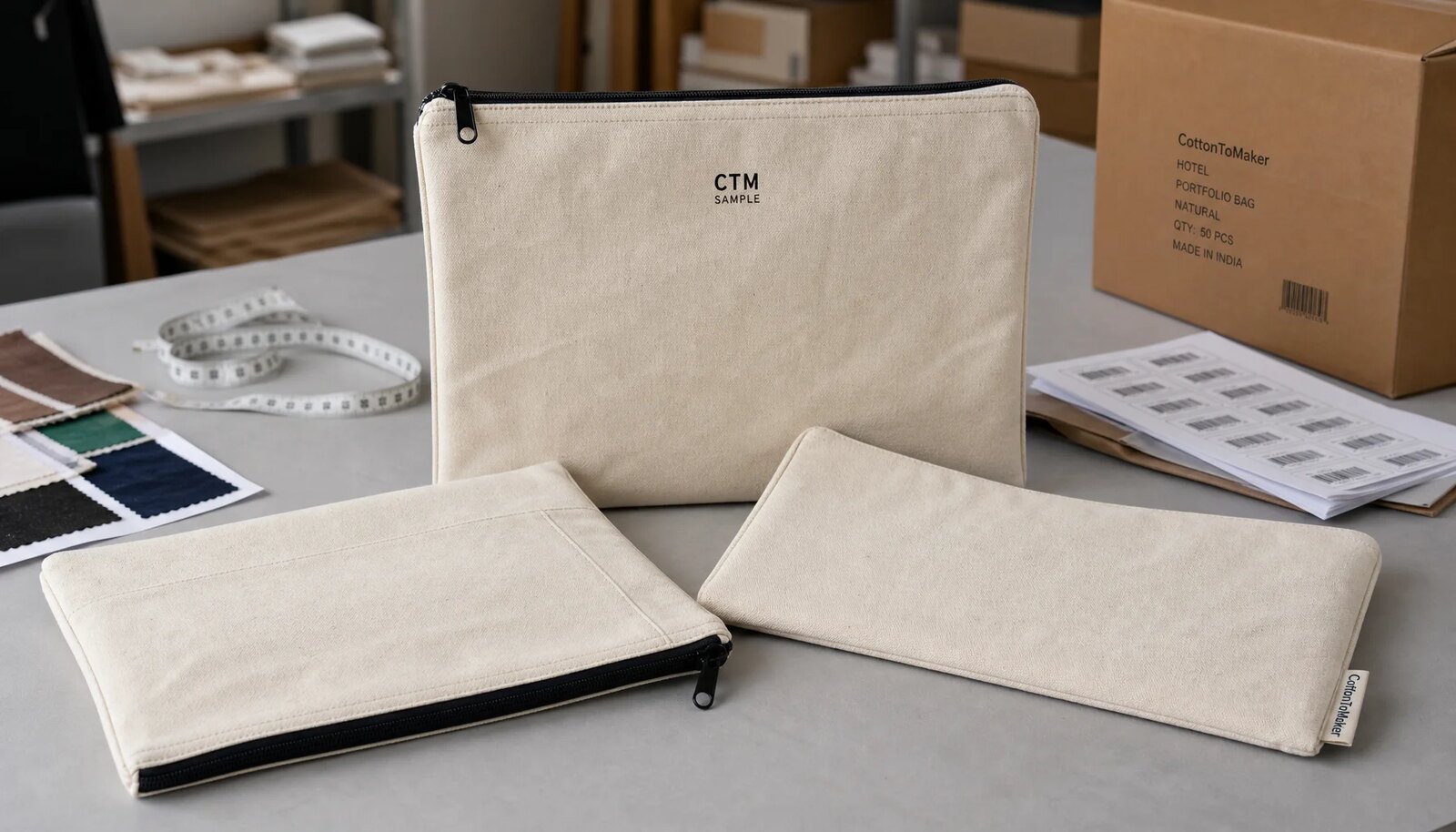
Buying Problem
Canvas zipper portfolios look straightforward in a supplier quotation. In hotel retail, they are not. The same portfolio may be sold in a resort boutique, issued as a meeting pack, placed behind the front desk, packed into a welcome kit, or sent through a distributor warehouse. By the time it reaches the property, it still needs to be flat, clean, correctly branded, easy to scan, and ready for staff to handle without extra repacking.
Most problems start when the product specification and the carton packing plan are treated as separate decisions. Canvas weight affects sewing and carton weight. A stiffener improves shape, yet it can create board-edge marks if the stack is too tight. A retail sleeve protects the surface, but a tight sleeve can bend corners. A premium puller may look good on a sample and still emboss the front panel during transit.
For hotel groups, repeatability matters as much as first-order approval. One property might order 300 pieces; another may need 1,500 for an event season. If every reorder changes canvas shade, zipper tape, board material, sleeve size, or carton quantity, inspection becomes slower and landed cost becomes less predictable. A controlled base specification lets buyers customize property logos without rebuilding the bag every time.
- Use one dated RFQ specification for all suppliers, including fabric, zipper, stiffener, logo, retail pack, carton count, and inspection level.
- Separate the retail selling unit from the export shipping unit; both need approved dimensions, labels, and handling assumptions.
- Treat the carton layout as part of quality control, not as a warehouse choice made after sewing is finished.
- Define success in practical terms: flat panels, clean canvas, correct SKU, smooth zipper, scannable barcode, and undamaged corners.
- Ask factories to price protective tissue, inner cartons, reduced carton count, or stronger cartons as visible line items instead of hiding them in substitutions.
Core Construction Specifications
A typical canvas zipper portfolio includes outer canvas panels, a zipper closure, lining or edge binding, and an internal stiffener. Some programs add a notebook sleeve, document pocket, pen loop, card slots, mesh pocket, tablet pad, elastic strap, gusset, or branded side label. Each feature changes thickness, user feel, and how the item behaves in a carton.
Avoid vague language such as A4 portfolio or letter portfolio without finished dimensions. A4 paper is 210 x 297 mm. US letter is 216 x 279 mm. The finished product still needs space for zipper tape, seam allowance, board edge, lining, and insert clearance. For many zipped designs, 5-8 mm clearance around real documents is a useful starting point, but the final clearance depends on how many papers, vouchers, cards, or notebooks will be inserted.
Review the sample in three states: empty, open, and filled with the actual insert set. This small step catches big issues. It shows whether the zipper turns the corners smoothly, whether the portfolio lies flat enough for writing or document review, and whether the packed thickness still fits the sleeve and master carton plan.
- Closed size: state width, height, spine thickness, and tolerance after sewing, not only the paper size it should hold.
- Open size: confirm the full open dimension and whether the item must lie flat for writing, menu review, or document presentation.
- Filled thickness: measure with the intended insert set because this controls zipper stress, sleeve fit, and pieces per carton.
- Zipper path: define three-side zip, L-shape zip, side zip, top zip, or partial zip, including corner radius if applicable.
- Inside layout: list each pocket, slot, loop, elastic, lining, padding, and label position with a drawing or marked sample.
- Insert clearance: test real notebooks, vouchers, cards, and documents instead of relying only on nominal A4 or letter sizing.
Canvas Weight, Finish, And Color Control
For many hotel retail programs, 12oz to 14oz cotton canvas is a practical baseline. Buyers may also see this described as roughly 340-475 GSM, although oz and GSM are not exact equivalents. Yarn count, weave density, moisture, coating, and finishing all affect measured weight and hand feel. A 12oz natural canvas from one mill may feel different from a 12oz washed or coated canvas from another.
Natural canvas gives a relaxed resort look, but it can include cotton seed flecks, slubs, and shade variation. These are not automatically defects if the buyer has approved the range. Dyed canvas gives stronger brand direction, yet it requires lab dip approval and separate zipper tape review because cotton fabric and polyester zipper tape do not match in the same way. Washed canvas feels softer but may increase size variation. Coated or laminated canvas can improve surface stability, though it may stiffen corners and make zipper sewing less forgiving.
Fabric choice should also match the internal structure. If the portfolio uses a rigid board or PP sheet, 10oz to 12oz canvas may still feel structured enough for a budget event or amenity program. If there is little internal support, 12oz to 14oz helps the item keep a better shelf shape. Heavier canvas can look more substantial, but it increases bulk at corners, raises carton weight, and may increase freight cost.
- Quote both oz and approximate GSM, and agree whether the tolerance is measured before or after finishing.
- Approve a signed shade reference for natural canvas and define whether seed flecks, slubs, and small yarn irregularities are acceptable.
- For dyed canvas, approve lab dip, bulk shade tolerance, zipper tape color, and label color separately.
- For washed canvas, confirm shrinkage and finished-size tolerance before bulk cutting because panels may change dimension.
- For coated or laminated canvas, test zipper corners and folding stress because the hand feel can become stiffer.
- Keep one bulk fabric cutting swatch sealed for factory, buyer, and inspection comparison.
Stiffener, Lining, And Interior Parts
The stiffener turns a soft pouch into a portfolio with retail shape. Common choices include grey board, recycled paperboard, PP sheet, and EVA sheet. Paperboard can provide a firm writing surface and a rectangular profile at controlled cost. The tradeoff is humidity and compression risk if the board quality or edge treatment is poor. PP sheet is more moisture resistant and flexible, but it can feel too soft if the gauge is light. EVA adds padding and a softer hand, although it increases thickness and can reduce the crisp portfolio shape.
Do not approve a quote that only says hard board or good board. Ask for material, thickness, and, where relevant, density or GSM. For many flat portfolios, 1.5-2.5 mm board or sheet thickness is a useful evaluation range. The correct choice depends on portfolio size, insert weight, writing-surface needs, and target hand feel. Edge treatment matters because sharp board corners can ridge through canvas or form pressure lines near the zipper.
Interior features create hidden packing risks. A pen loop, card stack, mesh pocket, or notebook sleeve forms a raised area. If every portfolio is packed in the same direction, that raised area can repeat through the stack and mark the opposite panel. Alternating orientation, tissue sheets, inner bundles, or a lower carton count may be needed.
- State stiffener material, thickness, density or GSM where relevant, and whether it is laminated, inserted, or stitched into the panel.
- Check board flatness after humidity exposure or carton pressure if goods ship by ocean or may be stored in humid resort areas.
- Confirm lining material, colorfastness, seam finish, and whether dark lining can transfer color to documents.
- Review pocket placement against stack pressure; raised pockets can mark the opposite panel if the carton is over-compressed.
- Require smooth board edges and rounded corners where the stiffener sits close to zipper seams.
- Measure empty and filled thickness because stiffeners, padding, and pockets directly change carton count.
Zipper, Puller, And Hardware Details
The zipper is one of the first quality signals guests and store staff notice. A poor zipper can create complaints even when the canvas, logo, and sleeve are acceptable. A No.5 nylon coil zipper is a dependable baseline for many A4 and letter-size canvas zipper portfolios because it bends around corners better than many metal zippers and helps control weight. Metal zippers may support a more premium appearance, but they add weight and require careful corner engineering.
The quotation should define zipper tape color, teeth color, slider material, slider finish, puller style, puller size, end stop, and reinforcement. Pullers can be plain metal, cord, fabric, leather-look tab, rubber tab, or custom branded hardware. Each option changes MOQ, setup cost, and packing risk. A large puller can improve retail appearance but leave a visible mark on natural canvas when stacked under pressure. A small puller may reduce pressure marks, but it can feel weak or awkward to use.
Plan the carton around the puller, not after it. If all pullers sit in the same position on the front panel, pressure can create repeated dents through the carton. The supplier can stagger pullers, alternate product orientation, add tissue, use inner packs, or reduce carton quantity. Confirm this before production because it affects labor time, carton dimensions, and freight.
- Use No.5 nylon coil as the default quote basis unless the design requires metal teeth or a special appearance.
- Test zipper function around corners, not only along straight sections, with the portfolio empty and filled.
- Specify puller dimensions and material because puller thickness affects pressure marks and gross carton thickness.
- Require secure end reinforcement such as backstitching, bar tack, or reinforced seam construction at zipper stress points.
- Approve zipper tape shade separately from canvas because exact material-to-material color matching is not realistic.
- Include puller direction and stagger method in the packing photo approval.
Logo And SKU Control
Hotel retail orders often carry several branding layers: hotel group mark, property name, destination artwork, event title, boutique label, and barcode or SKU identity. Screen printing is usually efficient for solid one- to three-color artwork on flat canvas. Heat transfer can handle fine detail, gradients, and small lettering, but adhesion and edge behavior must be tested on the actual canvas texture. Embroidery can look premium for small marks, yet dense embroidery can distort flat panels or create pressure points. Woven labels work well for subtle repeat branding across multiple properties.
Logo timing affects placement. Printing before sewing gives a flatter surface and cleaner ink control, but placement must allow for seam allowance, shrinkage, zipper installation, and board insertion. Printing after sewing can align to the finished item, though zipper, lining, and stiffener bulk can create an uneven print surface. The buyer should define the reference point, such as top-left finished edge, logo center line, or distance from the zipper seam. A placement tolerance such as ±3 mm is a practical starting point when the supplier confirms it.
For multi-property programs, artwork control is also inventory control. Each logo version should have its own SKU line showing quantity, artwork file name, Pantone reference, barcode, sleeve label, carton mark, and destination. Digital proofs help with layout, but a physical strike-off on actual canvas is still needed to judge ink absorption, opacity, edge sharpness, and color.
- Screen print: best for solid hotel logos, resort names, simple icons, and destination graphics.
- Heat transfer: suitable for fine artwork, but test adhesion, cracking, edge lift, and hand feel on actual canvas.
- Embroidery: use for small marks only when panel flatness and carton pressure are not compromised.
- Woven label: reliable for repeat branding, side tags, and programs with multiple property logos.
- Placement: specify artwork size, reference edge, center point if used, color standard, and tolerance in millimeters.
- SKU sheet: link logo file, barcode, sleeve label, carton mark, and quantity for every property or event version.
Retail Unit Packing
Retail packing protects the portfolio and controls store handling. Options include OPP bag, recycled polybag, glassine sleeve, kraft paper sleeve, belly band, printed sleeve, hangtag, or no unit sleeve. For hotel boutiques and distributor inventory, a unit sleeve is usually safer because natural canvas can pick up dust, rubbing marks, or moisture during handling.
The sleeve must fit the real finished portfolio, not the drawing. If it is too tight, it can crush corners, rub the print, and make the item look distorted on shelf. If it is too loose, the unit may shift inside the master carton and scuff against neighboring pieces. For a filled portfolio, sample the sleeve with the intended inserts in place.
Barcode control belongs in production, not only in the label file. The barcode should sit on a flat area that remains visible and scannable after carton pressure. If goods ship to several hotel properties, each retail unit must match the SKU label and carton mark. Ask the supplier to scan samples after the final sleeve is applied and after a short compression test.
Sustainability requirements should be specific. Recyclable paper sleeves, glassine, kraft bands, or reduced-plastic packing may fit hotel brand standards, but they still need rub resistance, moisture resistance, and barcode adhesion. Belly bands reduce material but leave canvas exposed. Paper sleeves can scuff or tear if too thin.
- Define sleeve material, thickness or paper weight where available, opening direction, closure method, and fit tolerance.
- Place barcode and SKU label on a flat area that remains scannable after compression in the master carton.
- Confirm any warning text, recycling mark, country labeling, retail price sticker area, or hotel internal label requirement.
- Test whether the sleeve rubs printed logos or dark zipper parts during movement.
- Use inner cartons of 5 or 10 pieces when property-level receiving or mixed-SKU control is important.
- Approve one fully packed retail unit, not only the loose portfolio sample.
Master Carton Packing Plan
The master carton plan should protect flatness first. Canvas zipper portfolios with stiffeners are usually safest when packed flat in controlled stacks. They should not be rolled, folded, or forced upright unless that exact orientation has been tested. Many orders fall in the range of 20-40 pieces per master carton, but the correct quantity depends on finished thickness, puller size, stiffener rigidity, sleeve type, carton strength, shipping mode, and buyer handling limits.
Pressure marks are the main shipping risk. Pullers, zipper teeth, seams, pockets, and board edges can imprint into visible canvas when too many pieces are compressed. Light colors and natural canvas show these marks more clearly than dark fabric. Risk can be reduced by staggering pullers, alternating front and back orientation, adding tissue, using inner bundles, reducing carton count, adding corner protection, or upgrading carton strength.
Hotel retail distribution also needs clear carton marking. A carton should show PO number, SKU, property code or destination, quantity, carton number, gross weight, net weight, and any required handling marks. Mixed cartons should be avoided unless the buyer has approved them and the carton mark clearly lists the contents. For palletized cargo, add pallet height, carton orientation, and stacking requirements.
- Flat stack: use as the default orientation for board-backed zipper portfolios unless vertical packing passes a physical test.
- Carton count: set pieces per carton only after checking finished thickness, sleeve, puller position, and maximum gross weight.
- Puller control: stagger pullers, alternate orientation, or add tissue where pullers touch printed or visible canvas panels.
- Corner protection: reduce carton count or add pads if stiff boards create sharp corners that crush under pressure.
- Carton marks: include SKU, property code, PO, quantity, carton number, weight, and destination where needed.
- Mixed-SKU rule: prohibit mixed cartons unless each inner pack is labeled and the carton mark lists exact quantities.
- Weight limit: agree maximum gross weight based on hotel receiving and warehouse handling, not only factory convenience.
Sampling And Approval Gate
A loose sample is not enough for canvas zipper portfolios sold through hotel retail. The pre-production approval should include the actual canvas, zipper, puller, stiffener, lining, pockets, logo method, retail sleeve, barcode label, inner pack, and master carton layout. If artwork is not final, the buyer can approve structure first, but bulk printing and final packing should wait for signed logo and packing approval.
Sample review should be measurable. Check closed size, open size, empty thickness, filled thickness, logo placement, stitch density, zipper travel, board flatness, sleeve fit, barcode scanability, and carton count. Ask the factory to pack several samples in the intended direction under weight for at least 24 hours. Then inspect for puller dents, zipper teeth marks, board waves, print transfer, sleeve scuffing, and corner compression.
Keep approval records for the first order and reorders. One signed sample should stay with the factory, and one should stay with the buyer or inspection company. Photograph the front, back, inside layout, zipper corner, puller, logo close-up, sleeve, barcode, inner carton, carton stack, and sealed master carton. For multi-property orders, approve each artwork version and link it to the SKU sheet.
- Material approval: sign off canvas shade, weight, finish, lining, stiffener, zipper tape, slider, and puller before bulk production.
- Strike-off approval: approve logo color, opacity, edge quality, and placement on actual canvas, not only a PDF proof.
- Insert test: review one sample filled with the real notebook, documents, cards, or hotel welcome pack.
- Sleeve test: confirm the final retail unit slides in and out without bending corners or scuffing the print.
- Carton mock-up: photograph stack direction, puller position, tissue, inner pack, master carton, and carton marks.
- Deviation control: document any change after approval with a revised sample note or written buyer acceptance.
Inspection And Defect Classification
Final inspection should cover product quality, retail packing, and carton execution. AQL inspection can be used for workmanship, but hotel retail orders often need added checks for logo version, barcode, and zipper function, especially when goods ship directly to properties. The inspection plan should define critical, major, and minor defects before production starts.
Critical defects are issues that make the product unsafe, unsellable, or impossible to receive correctly. Examples include wrong logo, wrong SKU, barcode failure, sharp exposed hardware, mildew odor, severe stains, or mixed property cartons. Major defects include zipper snagging, print offset beyond tolerance, board warp, crushed corners, open seams, broken stitches, visible oil marks, sleeve damage, or incorrect carton quantity. Minor defects may include small loose threads or slight natural canvas slubs when they are within the approved reference range.
Inspectors should open cartons, not only count sealed boxes. They need to verify that actual packing matches the approved photos: stack direction, puller staggering, tissue, inner carton, sleeve, barcode location, and carton marks. Random units should be opened and tested with the zipper fully operated around corners. Barcodes should be scanned from the finished packed unit, not just from the label sheet.
- Size check: measure width, height, spine, and filled thickness against the agreed millimeter tolerance.
- Zipper check: open and close the zipper fully and inspect slider, puller, tape, end stops, and corner movement.
- Logo check: compare placement, color, opacity, and edge quality against the approved strike-off and reference sample.
- Surface check: reject strong odor, mildew smell, oil stains, glue marks, ink transfer, severe wrinkles, and visible contamination.
- Board check: inspect for warp, ridges, sharp edges, delamination, bubbles, and pressure marks after packed storage.
- Packing check: verify SKU separation, retail sleeve, barcode scan, inner pack, carton count, carton mark, and photo record.
Specification comparison for buyers
| Spec decision | Recommended option | When it fits | Buyer risk to check |
|---|---|---|---|
| Outer canvas | 12oz to 14oz cotton canvas, roughly 340-475 GSM depending on weave, yarn, moisture, and finish; agree tolerance before PO | Hotel boutiques, resort welcome retail, conference kits, and document packs needing structure without excessive carton weight | Oz and GSM are not exact equivalents; shade, shrinkage, slubs, and coating can change hand feel and finished size |
| Internal stiffener | 1.5-2.5 mm grey board, recycled paperboard, PP sheet, or EVA sheet depending on stiffness, humidity risk, and writing-surface need | Flat writing surface, document protection, premium shelf shape, and reduced panel collapse | Paperboard can warp in humidity; hard board edges can ridge through canvas; flexible sheets can look soft under retail display pressure |
| Finished size | A4, letter, or custom size with 5-8 mm clearance around real inserts; measure closed, open, and filled thickness | Welcome letters, spa vouchers, notebooks, menus, maps, cruise documents, and event agendas | Too-tight fit stresses zipper corners, bends documents, changes carton thickness, and increases returns or retail complaints |
| Zipper system | No.5 nylon coil zipper with defined tape color, slider finish, puller style, end stops, and corner radius | Most A4 or letter-size canvas zipper portfolios with three-side or L-shape opening | Weak sliders snag at corners; bulky pullers imprint on canvas; untested corner radius causes zipper waviness or skipped teeth |
| Logo method | Screen print for solid marks, heat transfer for fine graphics, woven label for repeat branding, embroidery only for small low-density marks | Hotel logos, property names, resort artwork, gift shop labels, and event marks | Placement can shift after sewing; ink opacity varies on natural canvas; dense embroidery can distort flat panels |
| Retail unit packing | Individual OPP, recycled polybag, glassine, kraft sleeve, belly band, or paper sleeve with SKU and barcode controls | Hotel gift shops, distributor warehouses, cruise retail, property stockrooms, and direct-to-property shipments | Loose units rub and stain; tight sleeves crush corners; barcode labels can wrinkle or fail scanning after carton pressure |
| Export carton layout | Flat stack with controlled puller direction, typically 20-40 pcs per master carton after weight and thickness check | Ocean, air, courier, or domestic truck movement where panels must arrive flat and clean | High stack pressure creates puller dents, zipper marks, board-edge ridges, and crushed retail corners |
| Carton strength | Export carton with agreed ply, burst or edge-crush requirement where available, tape method, carton marks, and maximum gross weight | Multi-property shipments, distributor receiving, palletized cargo, and hotel back-of-house handling | Weak cartons bow under stacking; over-heavy cartons slow receiving and increase handling damage |
| MOQ structure | One base-product MOQ plus separate MOQs or surcharges for dyed fabric, zipper tape, custom puller, labels, print screens, sleeves, and carton marks | Hotel groups ordering several property logos from one shared portfolio construction | A low headline MOQ can hide setup charges, leftover material billing, per-logo minimums, or substituted materials |
Buyer checklist before sampling
- Issue one dated specification sheet covering closed size, open size, filled thickness, spine width, corner radius, and allowed tolerance in millimeters.
- Send the real inserts or exact insert dimensions: notebook, document set, voucher pack, pen, card, menu, tablet, or welcome letter bundle.
- Specify canvas weight in oz and approximate GSM, fabric composition, weave, finish, color standard, acceptable slubs, shade tolerance, and shrinkage expectation.
- Define internal structure: stiffener material, thickness, density or GSM, lining, board edge treatment, foam padding, pocket layout, pen loop, elastic, and document sleeve.
- Confirm zipper gauge, tape color, teeth color, slider material, puller type, puller size, zipper path, end reinforcement, and puller position for packing.
- Provide vector logo files, Pantone or approved color reference, logo method, artwork size, placement from edges, and placement tolerance such as ±3 mm.
- Define retail packing: sleeve material, bag thickness if poly, warning text, barcode size, SKU label position, hangtag, belly band, inner carton, and sustainability requirements.
- Set carton rules before quotation: pieces per master carton, maximum gross weight, carton dimensions, carton grade, flat stack direction, carton marks, pallet limit, and mixed-SKU restrictions.
- Approve a pre-production sample made with actual canvas, zipper, puller, stiffener, logo method, retail sleeve, barcode label, and carton packing layout.
- Require sample photos under neutral light showing front, back, inside, zipper corners, puller, stitching, logo edge, board flatness, sleeve fit, barcode scan, and carton stack.
Factory quote questions to send
- What exact canvas weight, approximate GSM, composition, weave, finish, color reference, and fabric tolerance are included in the quoted price?
- Is the canvas stock, greige-dyed, yarn-dyed, washed, coated, laminated, or lined, and what lead time applies to each option?
- What shrinkage, shade variation, slub level, and GSM tolerance will you accept for bulk fabric, and how will these be checked before cutting?
- What finished size tolerance can you hold for width, height, spine thickness, and filled thickness after the zipper and stiffener are installed?
- Is the zipper No.5 nylon coil or another type, and what slider material, puller size, tape color, teeth color, and end reinforcement are quoted?
- Which stiffener is included: grey board, recycled board, PP sheet, EVA sheet, or another material, and what thickness or density will be used?
- Does the price include lining, pockets, pen loop, elastic, card slots, document sleeve, tablet padding, or only the basic zipped shell?
- Does the quote include logo printing or labeling, screen setup, strike-off, color matching, placement proof, and one approved production reference sample?
- What MOQ applies separately to body fabric, dyed color, zipper tape, slider finish, custom puller, woven label, printed sleeve, barcode label, and carton mark?
- How many units are planned per retail sleeve, inner carton, and master carton, and what are the estimated carton dimensions, net weight, and gross weight?
Quality-control points to confirm
- Canvas GSM tolerance should be written in the PO; ±5% is a common commercial reference, but tighter control must be priced and confirmed in advance.
- Finished size should be measured in millimeters at top, middle, and bottom because stiffener, lining, zipper tension, and sewing allowance can change edge shape.
- Closed portfolio thickness should be measured empty and with intended inserts because overfilled designs change zipper stress and carton quantity.
- Zipper function should be checked around corners for smooth opening and closing, with no skipped teeth, slider jam, frayed tape, loose puller, or weak end stop.
- Logo color, opacity, edge sharpness, registration, and placement should be judged against approved strike-off, Pantone reference, and physical production sample under consistent light.
- Stitch density, seam allowance, binding alignment, topstitching, bar tack placement, and backstitching at zipper stress points should match the approved sample.
- Internal board or sheet should remain flat after carton pressure and should not show sharp edges, waves, bubbles, delamination, or visible ridges under the canvas.
- Finished goods should be free from strong odor, mildew smell, oil marks, ink transfer, glue marks, loose threads, broken stitches, needle holes outside seams, and visible fabric contamination.
- Retail sleeves, hangtags, barcode labels, warning text, and SKU labels must match the order sheet; barcodes should scan after application to the final packed unit.
- Carton packing should protect front panels, corners, zipper pullers, labels, and sleeves without over-compressing portfolios or exceeding the agreed gross-weight limit.