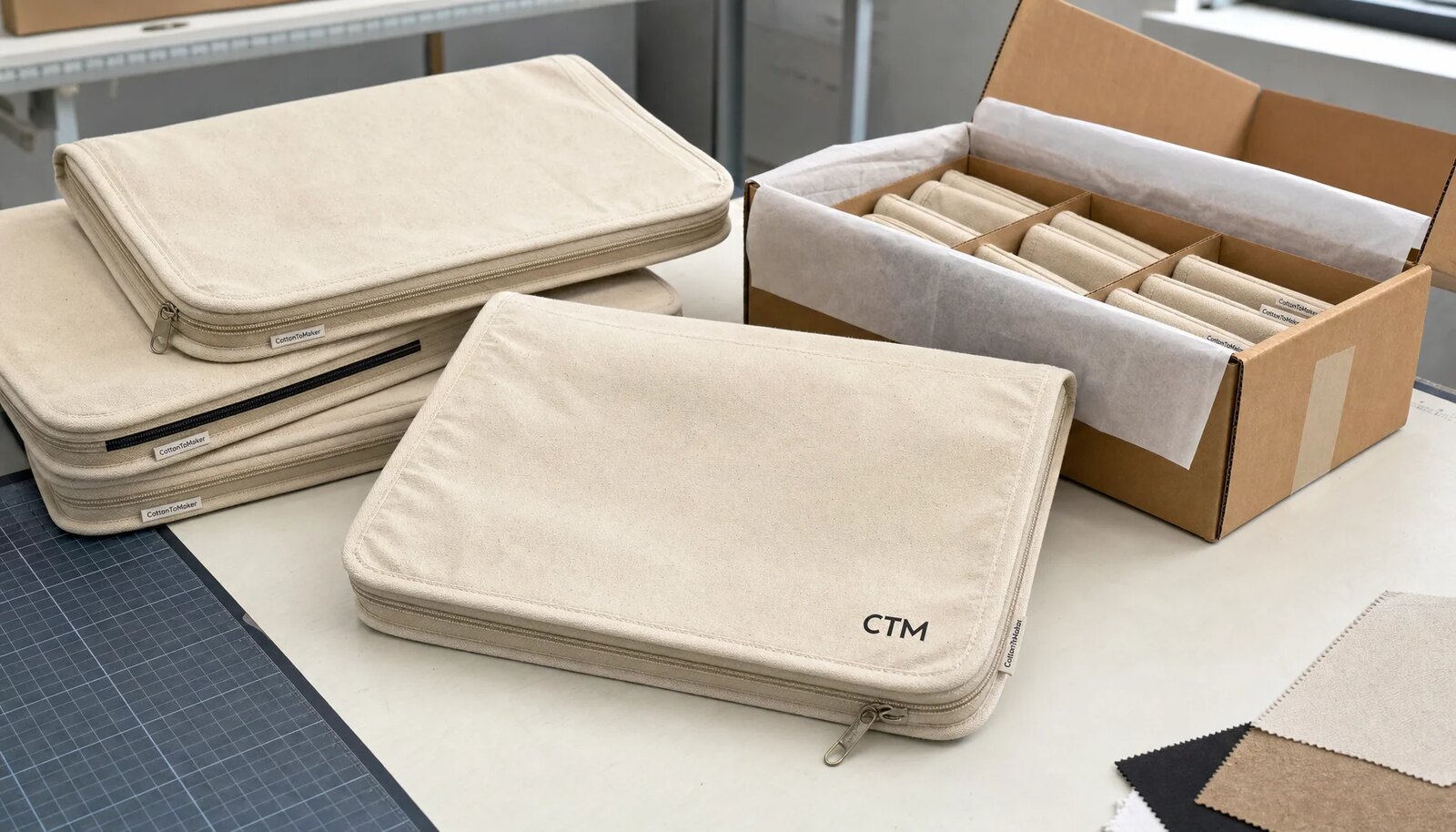
Start With the Packing Problem, Not the Bag Photo
For craft fairs, canvas zipper portfolios are usually handled more roughly than a normal office accessory. They are shipped in cartons, moved into vans, carried through service doors, stacked behind booths, opened repeatedly, and sometimes sold directly from the carton. A carton packing plan therefore affects product appearance, event setup speed, return rate, and freight cost. The buying problem is not only how to make the portfolio; it is how to make it arrive flat, clean, correctly counted, and easy to distribute.
A useful RFQ should describe the route from factory packing table to craft fair booth. If the order will be split across several venues, carton marks and inner bundles matter as much as fabric GSM. If the portfolios are sold as retail goods, face protection and crease control matter more than squeezing the maximum quantity into each carton. The supplier cannot quote accurately from a product image because carton quantity, paper protection, barcode labels, and master carton strength all change labor and material cost.
- State the final use: resale item, exhibitor kit, sponsor gift, document holder, or booth organizer.
- Define whether cartons are opened by warehouse staff, store teams, or event booth workers.
- Set a handling target such as cartons below 15 kg gross weight for easy manual movement.
- Require the carton plan in the quotation, not after production is finished.
Choose Canvas Weight Around Shape Recovery
Canvas zipper portfolios for craft fairs need enough body to look presentable after being unpacked, but not so much thickness that cartons become bulky and freight-heavy. A common working range is 10-12 oz cotton canvas for cost-sensitive programs and 12-14 oz for stronger retail positioning. In GSM terms, many buyers will see about 320-340 GSM for 10 oz, 380-410 GSM for 12 oz, and 430-480 GSM for 14 oz, though actual GSM depends on yarn, weave, finishing, and supplier standard.
The packing plan changes when fabric weight changes. A 14 oz portfolio with lining and a gusset may need fewer pieces per carton than a flat 10 oz unlined version. Natural canvas can show dirt and crease lines more clearly, so it needs cleaner sewing tables and better face protection during packing. Dyed canvas may need shade-lot control and colorfastness checks before the carton plan is approved, because mixed shade cartons are difficult to fix after distribution to craft fair teams.
- Use 10 oz canvas when price and light event distribution matter more than premium handfeel.
- Use 12 oz canvas for the safest balance of stiffness, sewing efficiency, and carton recovery.
- Use 14 oz canvas only when the retail price supports higher material, needle, and freight cost.
- Specify approximate GSM in the RFQ because oz alone can hide different fabric constructions.
Build the Portfolio Spec Before Calculating Cartons
Carton quantity cannot be set correctly until the portfolio construction is fixed. A flat zipper portfolio, an envelope-style document pouch, and a padded business organizer may all be called a canvas zipper portfolio, but they pack very differently. The RFQ should show finished size, seam allowance expectation, zipper direction, corner style, lining, pockets, label placement, and whether the piece must hold A4, US letter, tablets, catalogs, or craft documents.
For most craft fair programs, a practical size is slightly larger than the document it carries. For A4 inserts, buyers often allow 15-20 mm around the paper so the zipper does not scrape corners. For US letter markets, the finished size should be adjusted instead of using an A4 pattern by habit. If the portfolio includes a bottom gusset, the buyer should define whether that gusset is functional storage depth or only a folded shape; this affects stacking thickness inside cartons.
- Define finished length and height with tolerance, commonly plus or minus 5 mm for simple sewn canvas goods.
- Identify whether the zipper opens on the long side, short side, or around two sides.
- State lining material if required, such as 150D polyester, 210D polyester, or cotton lining.
- Include side label, woven label, care label, barcode sticker, and hangtag positions in the artwork file.
Control Zipper and Print Choices That Affect Packing
A zipper portfolio is only as good as the zipper after carton pressure. Size 5 nylon coil zipper is often the safest choice for canvas business bags because it flexes, resists minor bending, and keeps the product soft enough for carton packing. Size 3 may reduce cost but can feel weak on a large portfolio. Metal zippers can look premium, but the teeth and pullers may mark adjacent canvas when pieces are tightly stacked unless each unit is protected.
Print method also affects how units are packed. Screen printing is stable for bold craft fair logos, sponsor marks, and simple retail graphics. Heat transfer can carry more color detail but needs temperature and pressure control, especially on uneven canvas surfaces. Embroidery adds perceived value but creates raised back threads that can press into neighboring pieces. For carton safety, the factory should protect printed or embroidered faces from zipper pullers, hard labels, and direct abrasion.
- For simple logos, quote one-color screen print first and add multi-color pricing only if artwork needs it.
- For detailed art, test heat transfer adhesion and edge lifting on the selected canvas before bulk approval.
- For embroidery, request backing control and packing separators to prevent raised thread pressure marks.
- For zipper pullers, avoid sharp metal shapes unless each piece has individual face protection.
Set MOQ Logic by Materials, Not by Wishful Quantity
MOQ for canvas zipper portfolios is usually driven by fabric procurement, dyeing, zipper color, print setup, cutting efficiency, and packing material. A supplier may accept a low total quantity if the buyer uses stock natural canvas and stock zipper colors. The same quantity becomes harder when the buyer needs custom dyed canvas, custom zipper tape, multiple print artworks, retail barcode labels, and separate carton assortments for different fairs.
Procurement teams should avoid asking only for one MOQ number. A better RFQ separates MOQ by fabric color, logo design, zipper color, and packing version. This helps brand owners decide whether to simplify the assortment or pay for small-batch complexity. For distributors, the carton packing plan should also reflect MOQ: if each SKU has only a few hundred pieces, mixed cartons may look efficient but can create receiving errors unless carton marks and inner bundles are controlled.
- Lowest MOQ usually comes from natural canvas, stock zipper, one print color, and bulk carton packing.
- Custom dyed canvas may require fabric mill minimums that exceed the sewing factory MOQ.
- Multiple logos require separate screens, setup time, approval samples, and carton segregation.
- Retail labels and barcodes add packing labor even when the portfolio construction stays unchanged.
Use a Carton Plan That Protects Shape and Count Accuracy
A workable carton plan for canvas zipper portfolios should balance carton size, gross weight, stack pressure, and picking accuracy. Many buyers start with 40-60 pieces per master carton for flat unpadded portfolios, then adjust after a sample pack. If the portfolio is lined, padded, gusseted, or fitted with metal pullers, the carton count may need to drop. The goal is a carton that can be moved by one person and opened without finding crushed corners or zipper dents.
The carton layout should be written clearly: individual pack method, units per inner bundle, bundles per carton, direction of stacking, separator material, and carton mark format. For printed portfolios, alternating face direction or adding tissue between printed faces can prevent ink transfer. For natural canvas, a paper band may be more sustainable than an individual polybag, but it gives less moisture protection. Buyers should choose based on shipping route, warehouse cleanliness, and retail presentation requirements.
- Target master carton gross weight below 15 kg when cartons will be carried at event venues.
- Use 5-ply export cartons when stacking height, sea freight, or multiple warehouse transfers are expected.
- Pack zipper pullers inward or protected so they do not press into visible front panels.
- Photograph the first packed carton before bulk packing continues.
Approve Samples With Packing Included
A loose sample tells you sewing quality, but it does not prove the product will survive the carton plan. For canvas zipper portfolios used at craft fairs, sample approval should include one finished product sample and one packing simulation. At minimum, the factory should fold or stack the sample in the intended way, add the proposed separator, place it under reasonable carton pressure, and show the recovered appearance after unpacking.
The sample stage is also the right time to catch print position problems. A portfolio logo that looks centered on a flat panel may shift visually after sewing because seam allowance, zipper tape, and corner curve change the visible area. The buyer should approve a marked measurement from the finished edge, not a vague instruction such as centered on front. If retail buyers require barcodes, hangtags, or price stickers, those should appear on the approval sample before carton dimensions are finalized.
- Approve fabric swatch, zipper swatch, print strike-off, and finished sample as separate checkpoints.
- Measure logo position from finished edges after sewing, not from cut panels before sewing.
- Test zipper movement after the sample has been stacked under pressure.
- Confirm whether sample shipping uses the same folding and protection method as bulk packing.
Write QC Thresholds the Inspector Can Actually Use
Quality control should translate the buyer's expectation into measurable checks. For canvas zipper portfolios, the most common inspection failures are dirty natural fabric, uneven stitching near zipper ends, print shade variation, zipper catching, loose threads, wrong count per carton, and carton marks that do not match the packing list. These are preventable when the QC standard is part of the purchase order instead of a late email before shipment.
Use acceptance criteria that can be checked on a table with normal factory tools. Finished size tolerance can be plus or minus 5 mm for many simple portfolios, while logo position tolerance may be plus or minus 5-8 mm depending on print method and panel size. Zippers should open and close smoothly several times without separation. Print adhesion can be checked with a rub test or tape test agreed in advance. Carton inspection should include random carton opening, bundle count, SKU verification, and gross weight comparison.
- Classify broken zipper, wrong logo, severe stain, and wrong SKU count as major defects.
- Classify minor thread ends or small washable marks according to agreed AQL and product positioning.
- Inspect packed goods, not only unpacked pieces from the sewing line.
- Keep approved sample, artwork sheet, and packing list available during final inspection.
Quote Data Needed for Real Landed-Cost Comparison
Two supplier quotes can look similar at unit price level and still produce different landed costs. A portfolio quoted at a lower EXW unit price may use thinner canvas, weaker zipper, fewer separators, or heavier cartons because of poor packing density. Another quote may look higher but include stronger cartons, tissue protection, barcode labels, and clearer carton marks that reduce receiving labor and event problems. The buyer should compare the full packing and logistics data, not just the first unit price.
A complete quote should show product cost, mold or screen cost if any, sample cost, packing material cost, carton size, pieces per carton, gross weight, lead time, incoterm, and validity period. For sea freight or courier estimates, carton dimensions and gross weight are essential. For distributors shipping to multiple craft fair locations, the cost of carton relabeling, mixed SKU packing, or inner bundle labeling should be separated so the buyer can decide whether the factory or local warehouse should handle it.
- Request unit price under the same specification, packing method, and incoterm from every supplier.
- Compare CBM per 1,000 pieces because bulky packing can erase a low product price.
- Separate one-time print screen charges from repeat-order unit price.
- Ask whether export carton cost and carton marks are included or charged separately.
Protect the Schedule From Late Artwork and Carton Changes
Lead time risk often comes from decisions that seem small: changing zipper color after fabric is cut, moving the logo after the print screen is made, adding barcode labels after cartons are ordered, or reducing pieces per carton after final packing starts. A realistic schedule separates sample development, material booking, cutting, printing, sewing, trimming, inspection, packing, and export paperwork. For many custom canvas zipper portfolio orders, buyers should plan sample time first, then bulk lead time after written approval.
Craft fair orders are date-sensitive because the goods must arrive before booth setup, not just before the fair opens. The purchase order should include latest acceptable warehouse arrival date, not only ship date. If the buyer is importing by sea, allow time for customs clearance, domestic delivery, and repacking if cartons need to be split. If the order is urgent, simplify the spec: stock canvas, stock zipper, one print color, standard carton, and no complicated mixed assortments.
- Freeze artwork before print screens or transfer films are made.
- Freeze carton quantity before export cartons and shipping labels are produced.
- Build inspection time into the schedule instead of treating it as optional.
- Use air freight only for urgent quantities if the full order is too bulky for economical air shipment.
Specification comparison for buyers
| Spec decision | Recommended option | When it fits | Buyer risk to check |
|---|---|---|---|
| Canvas body fabric | 12 oz cotton canvas, about 380-410 GSM, pre-shrunk if washing or garment-dye effect is required | Good balance for craft fair retail display, document protection, and repeat handling without feeling too heavy | Light 8-10 oz canvas may crease badly in cartons and look cheap after compression; heavy 16 oz canvas raises freight and sewing cost |
| Portfolio size | A4 or letter size plus 15-20 mm allowance around documents, commonly around 350 x 260 mm depending on market | Fits certificates, order sheets, catalogs, sketch pads, and craft fair booth paperwork | Too-tight sizing causes curled documents and zipper stress; require a finished-size tolerance such as plus or minus 5 mm |
| Zipper construction | Nylon coil zipper size 5 with metal or color-matched puller and reinforced bartacks at both zipper ends | Best for flexible canvas portfolios shipped in bulk cartons and opened frequently at events | Cheap size 3 zippers can jam after carton compression; metal teeth may mark adjacent canvas during transport |
| Logo method | Single-color screen print or heat transfer on flat front panel before sewing, with 5-8 mm print position tolerance | Suitable for craft fair merchandise, sponsor packs, and brand retail programs with moderate artwork detail | Printing after sewing may distort near seams or zipper; dark canvas requires underbase or adjusted ink opacity |
| Inner structure | Unlined canvas for budget orders, or 150-210D lining with one slip pocket for higher perceived value | Unlined works for giveaways and simple retail; lined version works for brand owners selling at a higher shelf price | Lining changes measurement, sewing time, and inspection points; quote both versions instead of assuming one price |
| Individual packing | OPP bag or recycled paper band per piece, then 10 pieces per inner bundle with tissue between printed faces | Protects screen print, keeps colors separated, and speeds craft fair booth replenishment | No tissue or face-to-face packing can cause ink transfer, zipper rub marks, or uneven creases |
| Master carton plan | 40-60 pieces per export carton depending on size and structure, target gross weight below 15 kg where possible | Practical for small retail teams moving cartons by hand into craft fair venues | Overpacked cartons reduce freight count but increase crushed corners, bent zipper tracks, and worker handling complaints |
| Carton marking | SKU, color, size, quantity, PO number, gross and net weight, carton number, and destination label on two sides | Works for distributors splitting inventory across stores, event teams, or regional craft fair booths | Missing carton data causes receiving delays and mis-picks; require a packing list format before mass production |
Buyer checklist before sampling
- Define the finished portfolio size by the documents or inserts it must carry, not by a catalog photo.
- Specify canvas weight in oz and approximate GSM, plus whether the fabric is natural, dyed, washed, or laminated.
- State the zipper type, zipper size, puller material, color, and reinforcement method at both zipper ends.
- Confirm logo method, artwork size, print position tolerance, ink color, and whether printing happens before sewing.
- Approve one packed sample or carton mock pack, not only one loose pre-production sample.
- Set the carton quantity by gross weight, compression risk, and booth handling needs, not only by lowest freight cost.
- Require a packing list showing SKU, color, carton count, pieces per carton, gross weight, net weight, and carton dimensions.
- Include AQL level, measurement tolerance, print adhesion test, zipper cycling, and carton drop resistance in the QC brief.
- Separate costs for portfolio, individual packing, carton, inner divider or tissue, barcode label, and inspection support.
- Lock the ship date only after fabric, zipper, artwork, carton plan, and sample approval dates are all confirmed.
Factory quote questions to send
- What canvas weight in oz and GSM are you quoting, and is it greige, dyed, washed, or pre-shrunk?
- What is the finished size tolerance for the portfolio after sewing and pressing?
- Which zipper size, zipper material, and puller type are included in the price?
- Is the logo printed before sewing on flat panels, and what print tolerance can your line control?
- How many pieces will you pack per inner bundle and per master carton for this exact size?
- What are the proposed carton dimensions, gross weight, and net weight for each SKU?
- Will printed faces be protected by tissue, paper band, polybag, or another separator?
- What MOQ applies by fabric color, zipper color, print design, and packing method?
- How many days are required for sample, material booking, bulk sewing, inspection, and export packing?
- Can you provide photos of the first packed carton and the carton drop or compression check before shipment?
Quality-control points to confirm
- Canvas weight verified against approved swatch, with visual comparison for weave density, shade, and handfeel.
- Finished size measured on flat relaxed pieces with tolerance agreed before order confirmation.
- Zipper opens and closes smoothly for repeated cycles without teeth separation, slider catching, or end tearing.
- Seams have consistent stitch density, no skipped stitches, no loose threads at zipper ends, and reinforced stress points.
- Logo position, color, opacity, and adhesion match the approved artwork and sample after rub testing.
- Portfolio lies flat enough for retail presentation after unpacking, with no severe diagonal twisting or crushed corners.
- Individual packing protects printed panels from zipper abrasion and ink transfer during carton compression.
- Master carton quantity, carton dimensions, gross weight, and carton marks match the approved packing list.
- Random cartons are opened during final inspection to verify assortment, SKU labeling, and inner bundle count.
- Export cartons use suitable board strength and tape pattern for stacking, warehouse movement, and venue handling.