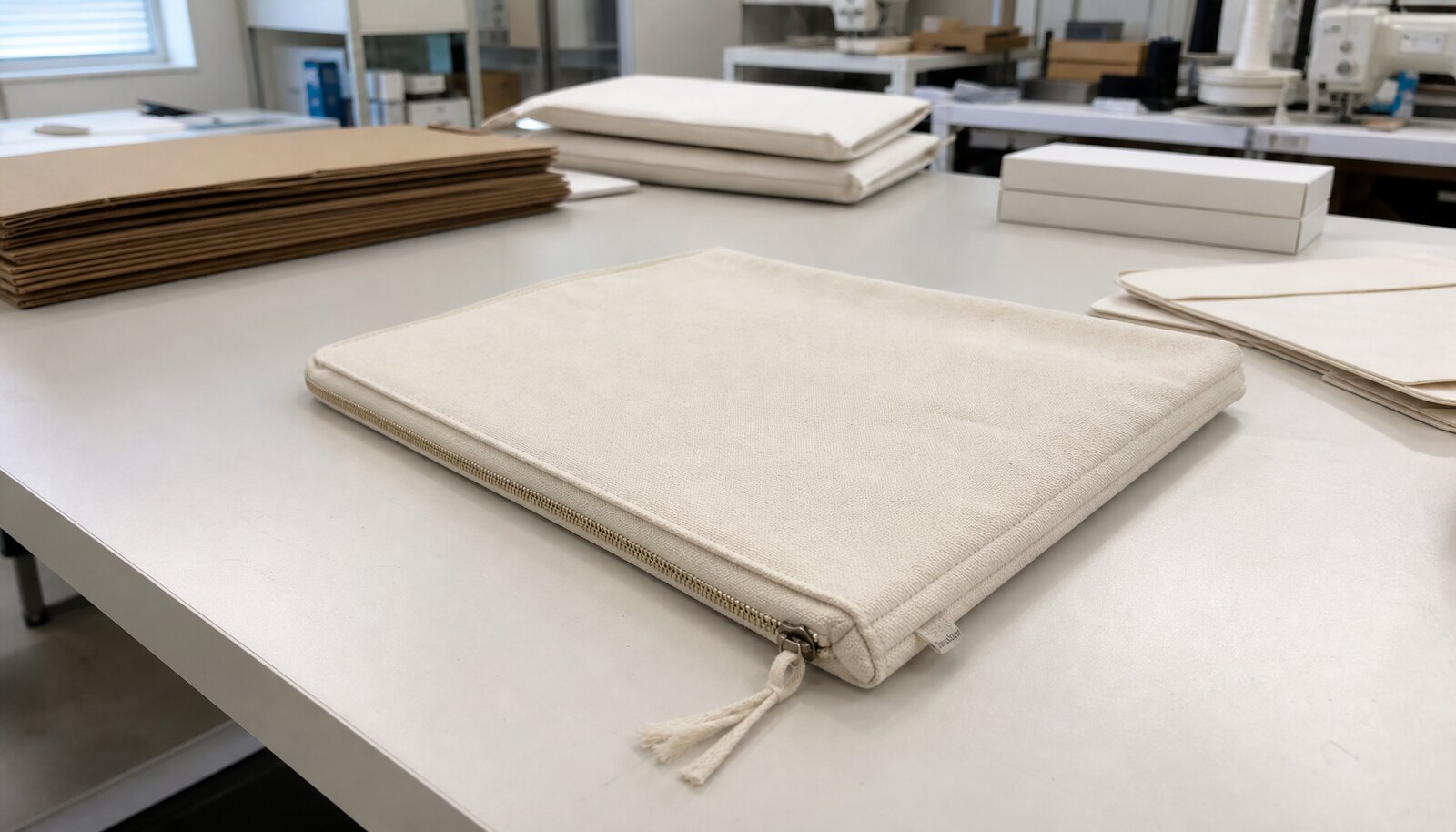
Start with the commercial purpose
A canvas zipper portfolio for corporate gifting is a procurement item before it is a design item. It has to look clean when the recipient opens it, but it also has to move through sampling, approvals, production, packing, freight, warehousing, and event distribution without creating claims. The best buying process starts by defining how the product will be used: employee onboarding, conference welcome kits, client gifts, training materials, dealer meetings, or executive mailers. Each use case changes the required structure, presentation pack, carton strength, and inspection focus.
A lightweight document holder for a one-day event does not need the same canvas, zipper, lining, or carton plan as a portfolio carrying a notebook, charger, brochure pack, and badge set. Likewise, a gift shipped to one central warehouse can be packed differently from a program that will be broken down into hundreds of destination shipments. Procurement teams get better pricing when suppliers see this context early because the factory can quote the right construction instead of padding risk into every line.
The phrase canvas zipper portfolios carton packing plan for corporate gifting sounds long, but it captures the real buying problem: the product, the closure, the distribution pack, and the campaign purpose have to be specified together. If those decisions are split between marketing, purchasing, and logistics too late, the order usually pays for the gap through rework, air freight, repacking, or damaged presentation.
- State the gift use case and recipient channel before asking for the lowest unit price.
- Decide whether the portfolio must carry inserts, protect documents, or simply present a logo cleanly.
- Tell suppliers whether cartons go to a central warehouse, multiple branches, an event venue, or individual fulfillment.
- Treat packaging, freight volume, and QC as sourcing decisions, not back-office details.
Write an RFQ suppliers can price
A strong RFQ removes guesswork. At minimum, it should include finished dimensions, gusset depth if any, canvas weight, lining, zipper size, slider and puller style, thread color, stitch appearance, reinforcement points, decoration method, logo size, unit packing, carton plan, shipment quantity, destination, incoterm, and required delivery date. When any one of these is missing, suppliers fill the blank with their own assumption, and the buyer ends up comparing different products that happen to share the same name.
Use plain commercial language in the RFQ. Instead of asking for a premium canvas zipper portfolio, specify something like 350 mm x 260 mm finished size, 30 mm gusset, 12 oz to 14 oz cotton canvas subject to sample approval, cotton lining, No. 5 nylon zipper, metal slider with fabric puller, one-color screen print on front panel, individual recyclable polybag, 20 pcs per 5-ply export carton, FOB Ningbo or Shanghai. The exact numbers can change, but the discipline matters: a supplier should be able to price the body, decoration, packing, and shipment data without calling to clarify every line.
If the project is still exploratory, ask for tiered options instead of vague advice. A useful quote can show a base build, a reinforced build, and a presentation-pack build. That lets procurement see the cost of each upgrade, while marketing can judge whether the visible improvement is worth it. The RFQ should also ask suppliers to name exclusions clearly, because small items such as hangtags, printed insert cards, barcode labels, and pallet wrap often become late-stage cost surprises.
- Include size, material, zipper, lining, decoration, packaging, carton, incoterm, destination, and delivery date in the first RFQ.
- Ask for separate pricing on base product, logo setup, unit packaging, carton upgrade, palletizing, and optional inserts.
- Require suppliers to list assumptions and exclusions, not only the final unit price.
- Use one RFQ template for all suppliers so commercial differences are visible.
Specify the portfolio body
The body specification should match what the portfolio needs to carry. For common corporate document portfolios, a 12 oz to 14 oz canvas range is often a practical starting point because it can provide enough body without adding unnecessary stiffness or freight weight. That is guidance, not a universal standard. A slim sleeve with no insert can use a lighter construction, while a premium kit carrying a hard notebook, brochure stack, or tech accessory may justify heavier canvas, reinforcement, or a structured lining.
Canvas terminology should be checked carefully. Suppliers may quote in oz/yd2, GSM, or informal local fabric names. Procurement should ask for the unit of measure and tolerance, not just the headline weight. If fabric is dyed, washed, coated, or laminated, hand feel and shrinkage can change. A swatch approval is useful, but the pre-production sample should be made from the actual bulk material or a clearly identified production-equivalent lot.
The zipper is another cost and failure point. No. 5 nylon zipper is common for many portfolio applications, but metal, resin, waterproof-style, or oversized zippers may be proposed for appearance. Buyers should check smoothness, tape color, slider finish, puller comfort, and whether the zipper line creates pressure marks when cartons are stacked. A beautiful puller that scratches the front panel during transit is not a premium detail; it is a packing defect waiting to happen.
- Match canvas weight to insert load, desired structure, sewing feasibility, and freight impact.
- Ask for fabric weight tolerance and whether the quoted material is dyed, washed, coated, or untreated.
- Confirm zipper size, zipper tape color, slider material, puller style, and opening direction.
- Test the portfolio with the actual intended insert set before approving bulk production.
Control MOQ by decision point
MOQ is not only about total order quantity. It can change by canvas color, zipper tape, lining, logo method, thread color, label, carton mark, and individual packaging. A supplier may accept 500 pieces for a stock natural canvas body but require 1,000 or 3,000 pieces for a dyed canvas color, custom zipper tape, or special printed sleeve. Procurement teams should break MOQ into its drivers so internal stakeholders understand which design choices are creating cost or lead-time pressure.
Logo versions need special attention. A corporate gifting program may have one master brand, several department logos, and different destination labels. If each version needs a separate print setup and carton mark, the real MOQ may be per artwork rather than per order. The same applies to mixed colors: two canvas colors in one PO may look like a single 2,000-piece order to the buyer but two 1,000-piece production batches to the factory.
The cleanest approach is to ask for an MOQ matrix. Request price breaks for 500, 1,000, 3,000, and 5,000 pieces if those volumes are realistic, and ask the supplier to show which components create minimums. This is especially important when choosing between a stock body with overprint and a fully custom portfolio. The stock option may reduce MOQ, but the buyer must still verify that the existing carton count, body size, and zipper quality fit the campaign.
- Separate MOQ by body color, zipper color, logo version, label, packaging, and carton mark.
- Ask whether price breaks are based on total order quantity or per version quantity.
- Confirm setup charges for each logo and whether repeat orders keep the same tooling or screen cost.
- Use a stock body only after checking that its existing carton plan and quality level are acceptable.
Choose decoration for transit reality
Decoration is not finished when the logo looks good on a table. It has to survive folding, stacking, carton pressure, humidity changes, and repeated handling during distribution. For many flat corporate logos, single-color screen print is the most economical and stable option, especially when the print area is large and the artwork is not overly detailed. It can look clean on natural canvas when ink, mesh, curing, and fabric shade are controlled.
Heat transfer, digital transfer, woven patches, leather patches, embroidery, and debossed labels all have a place, but each brings different risks. Transfers can show edge lift or cracking if placed across a fold line or exposed to heat. Embroidery can pucker lighter fabric or add bulk near seams. Patches can look premium but require alignment control and extra stitching inspection. A method that looks more expensive in a mockup may not be the most reliable method for a large, packed corporate gift order.
Logo approval should happen on the real substrate. Pantone references are useful, but canvas absorbs and reflects color differently than coated paper. Natural canvas also has flecks and shade variation that can affect perceived logo clarity. Ask for a strike-off or pre-production sample using the planned bulk fabric and final packing method. After packing, inspect whether the logo scuffs, transfers, or gets marked by zipper pulls from neighboring units.
- Keep screen print in the shortlist for simple flat logos and volume orders.
- Use transfer or patch methods when artwork complexity justifies the added inspection risk.
- Avoid placing logos on fold lines, heavy seam areas, or points that contact zipper pulls in the carton.
- Approve print color and placement on actual fabric, not only on a digital artwork proof.
Engineer the carton, not just the count
Carton planning is where many portfolio quotes become vague. Procurement should ask for a proposed packing method with numbers: unit pack, pcs per carton, carton dimensions, net weight, gross weight, CBM per carton, and total CBM. For example, a medium canvas zipper portfolio might be individually polybagged, packed 20 pieces per master carton, with an estimated carton size of 58 cm x 38 cm x 32 cm and a gross weight around 13 kg to 15 kg depending on fabric, lining, and inserts. Those figures are not a universal specification, but they show the kind of detail that belongs in the quote.
CBM is simple but often omitted. Calculate carton CBM as length x width x height in meters. A 58 cm x 38 cm x 32 cm carton is 0.58 x 0.38 x 0.32 = 0.0705 CBM. At 20 pieces per carton, 2,000 pieces would require 100 cartons, or about 7.05 CBM before pallets. If another supplier quotes a slightly lower unit price but uses 0.085 CBM cartons at the same pack count, the freight difference may erase the saving. This is why carton data should be requested before supplier award, not after production.
Gross weight matters as much as volume. Corporate gift cartons are often handled by warehouse teams, event staff, or branch employees, not only by forklifts. Many buyers prefer cartons under roughly 15 kg to 18 kg when manual handling is expected, but the right limit depends on the destination's receiving rules. Overpacked cartons can deform the product, split at corners, or become hard to stack neatly. Underpacked cartons may waste freight and allow units to shift inside. The carton plan needs to balance product protection, freight efficiency, and handling reality.
- Ask for pcs/carton, carton L x W x H, net weight, gross weight, and CBM/carton in every quote.
- Use CBM math to compare freight impact across suppliers, not only unit price.
- Set carton gross weight around the receiving and handling environment, not an arbitrary maximum.
- Check whether the portfolio shifts, bends, or gets zipper impressions inside the packed carton.
Set carton strength and pallet rules
A 5-ply export carton is a common starting point for sea freight, but the exact board grade, flute, edge crush, burst strength, tape, straps, and moisture exposure all affect performance. A buyer does not need to over-engineer every order, but the carton must be strong enough for the route. Long ocean transit, humid seasons, stacked warehouse storage, and courier re-shipping after arrival all increase the need for stronger cartons or tighter internal packing.
Compression targets should be discussed in practical terms. Ask the supplier what stacking height the packed carton can tolerate and whether they can perform or arrange a carton compression check. For many procurement programs, the goal is not a laboratory-perfect carton; it is a carton that does not bow, crush, split, or deform the portfolios under normal stacking during storage and transit. If the order will be palletized, specify whether cartons may be stacked five, six, or more layers high and whether top loading is allowed.
Pallet planning changes the freight picture. A carton that looks efficient by itself may create a poor pallet pattern with overhang or wasted space. Ask for cartons per layer, layers per pallet, total cartons per pallet, pallet height, and gross pallet weight. For example, if the carton footprint allows 8 cartons per layer and 5 layers, one pallet holds 40 cartons. At 20 pieces per carton, that is 800 portfolios per pallet. If the order is 2,000 pieces, procurement can immediately see whether three pallets are needed and how much loose carton handling remains.
Carton marks should be controlled with the same care as product labels. A corporate gifting order may require PO number, SKU, color, logo version, destination, carton number, gross weight, net weight, country of origin, and handling symbols. If cartons are mixed by logo version or destination, the marking rules must be fixed before packing. Wrong carton marks can delay receiving even when the product inside is acceptable.
- Specify carton grade or performance expectation, not only the word export carton.
- Ask for compression or stacking guidance when cartons will sit in storage or ship by sea.
- Request pallet pattern details before final freight booking.
- Freeze carton marks before mass packing and inspect them during final QC.
Build inspection into the PO
QC works best when it is written into the purchase order instead of negotiated after a problem appears. For canvas zipper portfolios, inspection should cover material, dimensions, stitching, zipper function, decoration, cleanliness, unit packing, carton packing, and carton marks. Buyers can reference ANSI/ASQ Z1.4 or ISO 2859-1 sampling plans where appropriate and define AQL levels for critical, major, and minor defects. A common consumer-goods approach is zero tolerance for critical defects, with separate AQL limits for major and minor defects, but the exact levels should match the buyer's risk and category rules.
Size tolerance should be measurable. For a standard portfolio, a tolerance such as +/-5 mm on length and width may be practical, while insert-driven products may need tighter control on internal pocket width or zipper opening. Print placement can also be specified, such as +/-3 mm from approved position if the design requires precision. Without numeric tolerances, inspectors are forced to judge by eye, and factories may dispute rejections.
Zipper testing does not need to be theatrical, but it should be repeatable. Sampled units can be opened and closed 50 to 100 cycles, then checked for snagging, slider failure, tape separation, tooth damage, and puller loosening. If the portfolio is designed for heavier daily use, the cycle target should be higher and agreed before pricing. The test should include units after packing because tight folding or pressure can reveal zipper issues that are not obvious on a loose sample.
Print inspection should include dry and damp rub checks. A practical method is to rub the printed area with a clean white cloth for a defined number of strokes under consistent pressure, then check for color transfer, smearing, dulling, or edge damage. The buyer and factory should agree what level of transfer is unacceptable. This is especially important for natural canvas, dark inks, and orders where portfolios are stacked face-to-face inside polybags or cartons.
- Reference an agreed sampling plan and AQL levels in the PO or quality agreement.
- Define measurable tolerances for finished size, logo placement, and carton dimensions.
- Test zipper function on sampled units before and after packing.
- Use dry and damp rub checks to control print durability on canvas.
Approve samples in the right order
Sampling should narrow risk step by step. The first sample may confirm size, structure, and general appearance. The next stage should confirm actual canvas, zipper, lining, logo method, and sewing finish. The pre-production sample should represent the bulk order as closely as possible. For corporate gifting, a loose product sample is not enough when presentation and transit condition matter; the buyer should also approve the unit pack and, for larger or higher-risk orders, one packed master carton.
A packed carton sample answers questions that photos cannot. Are the portfolios too tight? Does the zipper pull mark the neighboring unit? Does the logo scuff against the polybag? Is there dead space that lets products shift? Does the carton bulge after sealing? Can the warehouse team lift it comfortably? These are ordinary problems, but they are expensive to discover after all units are packed.
Approval records should be specific. Keep the approved sample, signed specification sheet, artwork proof, carton drawing, carton marks, and inspection checklist together. If multiple logo versions or destinations exist, name each version clearly. Factories move fast during packing, and small ambiguity can become a mixed-carton problem. Procurement does not need bureaucracy for its own sake; it needs a clean reference when the order reaches the inspection table.
- Use development samples for design decisions and pre-production samples for bulk approval.
- Approve the final logo on production-equivalent fabric and with the intended packing method.
- Request a packed carton sample when freight, presentation, or claim sensitivity is high.
- Keep approved samples, specs, artwork, carton marks, and QC checklist in one controlled file set.
Compare landed cost honestly
The lowest ex-factory price is not always the lowest landed cost. Canvas weight, zipper grade, lining, decoration, carton count, carton dimensions, palletization, inspection, inland freight, export fees, ocean or air freight, duties, destination handling, and repacking all influence the real cost. A supplier who provides accurate carton data early may look slightly higher on unit price but lower once freight and handling are included.
Incoterms must be aligned before comparison. EXW, FOB, CIF, DAP, and DDP quotes assign different costs and risks to the buyer and supplier. If one supplier quotes EXW and another quotes FOB, the buyer must add inland freight, customs export handling, and port charges to make the comparison fair. For corporate gifting, delivery date is often fixed by an event or campaign launch, so freight mode risk also belongs in the landed-cost view. A late sample approval that forces air freight can overwhelm every small unit-price saving.
Optional packing items should be priced separately. Tissue, paper belly band, printed insert, hangtag, barcode, carton label, desiccant, upgraded carton, corner protector, pallet, stretch wrap, and third-party inspection may each be small, but together they can change the budget. Separating these lines helps marketing choose what improves the recipient experience and helps procurement remove items that add cost without reducing risk.
Landed-cost comparison also protects supplier relationships. When the buyer gives all suppliers the same product spec, carton plan, and incoterm, the negotiation becomes clearer. The factory can explain where cost sits, and procurement can decide whether to adjust fabric, decoration, pack count, or freight plan. That is healthier than forcing a lower unit price and later discovering that the supplier removed carton strength, print checks, or packing labor to make the number work.
- Compare suppliers using the same incoterm, shipment mode, destination, and carton assumptions.
- Calculate total CBM and gross shipment weight before awarding the order.
- Separate optional packing and presentation items from the base unit price.
- Include inspection, pallet, destination handling, duty, and contingency freight in the landed-cost view.
Specification comparison for buyers
| Supplier/spec scenario | Best fit | Quote items to lock | Procurement risk to control |
|---|---|---|---|
| Direct cut-and-sew factory with in-house packing | Repeat corporate gifting programs, fixed artwork, custom dimensions, and orders where carton consistency matters | Canvas weight, lining, zipper type, logo method, unit pack, pcs/carton, carton size, carton marks, inspection level | Factory may quote low before carton engineering is finalized, so require packed-carton data before award |
| Direct factory using an outside print partner | Orders needing a capable sewing line plus decoration that the factory cannot perform internally | Print vendor responsibility, approved ink or transfer type, curing time, color tolerance, print rework process | Defect ownership can become unclear if print flaws appear after sewing or packing |
| Stock portfolio body with logo overprint | Short deadlines, modest customization, lower MOQ campaigns, and simple brand marks | Available body size, stock color, zipper spec, print area, existing carton pack count, overprint lead time | Stock carton dimensions may not match the buyer's freight target or presentation expectations |
| Trading company or consolidator | Mixed gift kits, multi-SKU programs, or buyers who need one commercial contact for several factories | Factory identity, sample source, packing ownership, QC method, consolidation fee, shipment handoff point | Less visibility into actual material, sewing line, and carton packing controls |
| 12 oz to 14 oz cotton canvas, lined | Common corporate document or notebook portfolios where structure, cost, and freight weight need balance | Actual fabric weight tolerance, shrinkage, lining fabric, reinforcement points, finished weight | This range is typical guidance, not a universal standard; heavier inserts may need a different construction |
| 16 oz canvas or reinforced build | Higher perceived weight, heavy inserts, tablet sleeves, or premium programs with stricter hand feel goals | Needle/stitch spec, seam allowance, zipper strength, carton gross weight, deformation after packing | Can raise sewing cost, carton weight, CBM, and stiffness without improving the recipient experience |
| Single-color screen print | Flat corporate logos, volume programs, good unit economics, and simple brand colors | Pantone reference, print size, placement tolerance, ink cure, rub test requirement, setup charge | Poor curing or carton pressure can cause scuffing, ink transfer, or dull edges |
| Heat transfer or woven/printed patch | Small runs, multicolor logos, complex artwork, or a more dimensional brand detail | Transfer film or patch material, edge adhesion, sewing placement, heat resistance, fold position | Edges can lift or patches can distort if placed near folds, seams, or zipper pressure points |
| 5-ply export master carton, unit polybag | Sea freight, warehouse handling, and standard bulk gifting distribution | Pcs/carton, carton dimensions, gross weight, CBM, flute/burst strength, sealing method | Loose internal movement, weak corners, or damp storage can damage otherwise acceptable product |
Buyer checklist before sampling
- Define the finished portfolio size, gusset, opening direction, canvas weight, lining, zipper tape, slider, puller, and reinforcement points before requesting prices.
- Separate the MOQ by body color, fabric dye lot, zipper color, logo version, packaging format, and carton marking requirement.
- Send vector artwork with Pantone references, print size, print location, tolerance for placement, and whether the logo must avoid seams or folds.
- Ask each supplier to quote the same incoterm, currency, payment term, destination port or warehouse, and shipment mode assumption.
- Require carton data in the first commercial offer: pcs/carton, carton L x W x H, gross weight, net weight, CBM/carton, and estimated total CBM.
- Request a packed sample carton for approval when the order ships by sea, moves through multiple warehouses, or includes premium presentation packaging.
- Confirm whether unit polybag, tissue, paper sleeve, hangtag, barcode, desiccant, silica-free request, insert card, and palletizing are included or optional.
- State inspection expectations in the PO, including AQL level, critical/major/minor defect definitions, dimensional tolerance, zipper test, print rub test, and carton checks.
- Approve a physical pre-production sample made with bulk material, bulk zipper, final logo method, and final packaging, not only a photo or digital mockup.
- Freeze carton marks, shipping labels, PO references, destination addresses, and mixed-carton rules before bulk packing starts.
Factory quote questions to send
- What exact finished size, gusset depth, canvas weight tolerance, lining material, zipper tape size, slider material, and puller style are included in this price?
- Is the quoted canvas greige, dyed, washed, or finished with any coating, and can you provide actual GSM or oz/yd2 test data from the bulk lot?
- What is the MOQ by canvas color, zipper color, logo design, packaging format, and carton mark version?
- Which decoration method is quoted, how many colors are included, what is the setup charge, and what artwork file format do you require?
- What are the print placement tolerance, Pantone tolerance, curing process, and rub-resistance test you will use before packing?
- Please provide the unit pack, inner pack if any, master carton pcs/carton, carton dimensions, net weight, gross weight, and CBM per carton.
- What carton grade is quoted, such as 5-ply K=A/K=K or equivalent, and what compression or stacking target do you recommend for this packed product?
- Can you share a suggested pallet pattern, including cartons per layer, layers per pallet, pallet height, and whether cartons will overhang?
- Is the quote EXW, FOB, CIF, DAP, or another incoterm, and which port, warehouse, or destination address is assumed?
- What is the sample timeline for artwork proof, pre-production sample, packed carton sample, and bulk production approval?
Quality-control points to confirm
- Use ANSI/ASQ Z1.4 or ISO 2859-1 sampling where appropriate, with the PO stating the selected inspection level and AQL for critical, major, and minor defects.
- Classify critical defects as safety, contamination, wrong logo, wrong product, unusable zipper, mold, sharp metal burrs, and severe carton mislabeling that blocks distribution.
- Check finished size against an agreed tolerance, for example +/-5 mm on length and width for standard portfolios and tighter tolerance only where inserts require it.
- Verify canvas weight, color, hand feel, lining, zipper tape, slider, puller, stitch density, seam allowance, reinforcement, and loose-thread trimming against the approved sample.
- Run zipper function checks on sampled units before and after packing; for procurement specs, define a simple cycle target such as 50 to 100 open-close cycles unless a higher-use product requires more.
- Inspect print or transfer for placement, color, sharpness, edge lift, ink cure, pinholes, cracking, and visible scuffing after normal folding.
- Use a defined rub check for logo durability, such as dry and damp cloth rubbing for a set number of strokes, with no heavy color transfer or logo breakdown beyond the approved limit.
- Confirm that any notebook, insert, tablet mock-up, or document set fits without zipper strain, corner bulging, or panel distortion.
- Check unit packaging for scuff protection, zipper-pull isolation, moisture risk, barcode readability, and correct orientation inside the carton.
- Inspect master cartons for grade, dimensions, sealing, strap or tape method, carton marks, PO number, item code, color, quantity, gross weight, destination, and sequential carton count.