Start With the Real Use Case, Not the Product Name
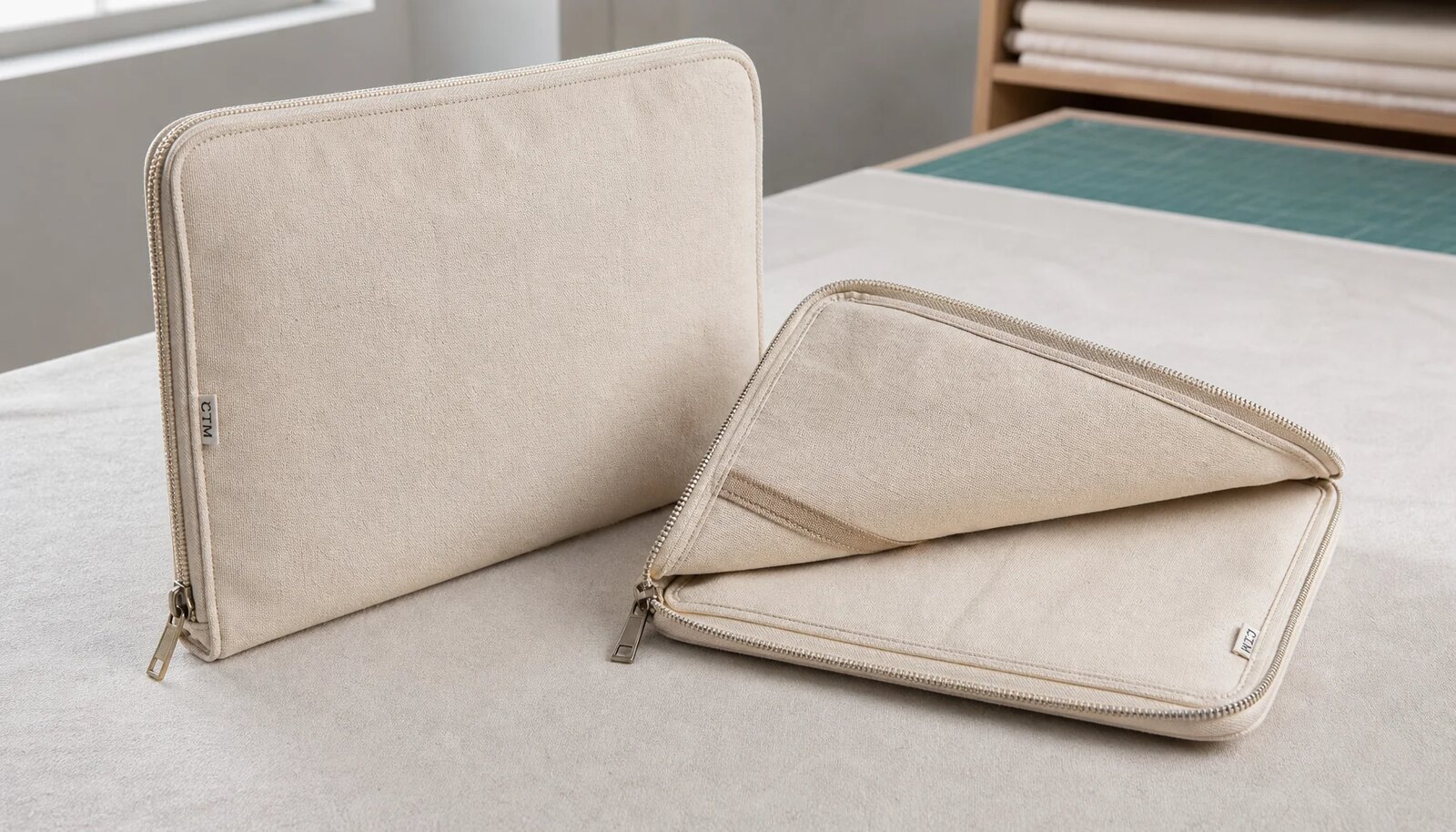
Canvas zipper portfolios for eco apparel brands can look similar in a catalog, but they are not all doing the same job. One buyer may need a light document holder for an internal meeting. Another may need a reusable line-review kit that carries fabric swatches, hangtag cards, price sheets, and a small seasonal catalog. A third may need a branded sales portfolio that travels with reps through showrooms, retail appointments, and trade events. Those use cases place very different loads on the zipper, canvas, corners, seams, and decoration.
Procurement teams get better quotes when they define the job before asking for price. The useful starting point is not only size and logo. It is the expected contents, handling frequency, shipping route, and presentation standard. A portfolio that will be given away at a one-day event can use a lighter build than a portfolio that will be reused for multiple selling seasons. A portfolio shipped empty can be packed differently from one shipped filled with catalogs or swatches. A portfolio held by an internal team may tolerate a visible wrinkle; a portfolio sent to retail partners usually cannot.
For eco apparel brands, the portfolio also has a brand function. It should feel consistent with the material story, but it still has to work as a business bag. Natural canvas, recycled cotton canvas, low-impact print, or plastic-reduced packaging can support the sourcing message, yet none of those choices replaces durability testing. A sustainable-looking item that fails after a few uses creates waste and weakens the program. The better procurement target is a portfolio that is responsibly specified and durable enough for the intended use.
- Write the use case in the RFQ before the size chart: who carries it, what goes inside, and how often it will be opened.
- State whether the portfolio ships empty, ships filled, or will be repacked by a warehouse or sales team after delivery.
- Separate low-abuse promotional use from repeat field use so suppliers do not underbuild a product that needs a stronger spec.
- Decide whether the portfolio is mainly a document carrier, a sales tool, a sample kit, or a brand-facing packaging item.
- Give the supplier a target loaded weight or content list so canvas weight, zipper size, and reinforcement can be chosen intelligently.
Choose Canvas Weight, Weave, and Shrinkage Controls Early
Canvas weight is one of the biggest drivers of durability and price, so it should be locked before suppliers compete. For light document use, 12 oz canvas, roughly 407 gsm, can be acceptable when the portfolio carries papers only and is not expected to survive heavy daily handling. For most B2B apparel brand programs, 16 oz canvas, roughly 542 gsm, is the more practical starting point because it holds shape better, gives the zipper line more stability, and resists corner wear more convincingly. When the portfolio carries heavier swatch sets, tablets, small sample books, or dense catalogs, 18 oz canvas, roughly 610 gsm, may be worth testing.
The fabric number alone is not enough. A tight weave usually supports cleaner printing and better edge wear than a loose weave, even at a similar weight. Pre-shrunk or controlled-shrinkage fabric can reduce size change after steaming, handling, or finishing. Natural canvas can vary in shade and seed fleck distribution, so the buyer should set a realistic tolerance rather than expecting every panel to look identical. If the brand wants recycled cotton canvas, the supplier should explain fiber blend, lot control, shrinkage behavior, and whether the fabric has enough strength for the intended seam construction.
Procurement should also consider how the canvas behaves after sewing. Heavy canvas can look premium, but it can create bulky seams at zipper ends and corners if the pattern is not adjusted. Light canvas can keep costs down but may collapse when the portfolio is filled. A sample built from substitute fabric is therefore risky. The buyer should approve the handfeel, stiffness, fold behavior, and print performance on the same canvas planned for bulk production.
- Use 12 oz canvas only for light paper carry, short-term event use, or low-load internal distribution.
- Use 16 oz canvas as the default starting point for reusable eco apparel brand portfolios and sales kits.
- Test 18 oz canvas when the portfolio carries dense swatches, tablets, catalogs, or heavier retail presentation materials.
- Ask for canvas weight in GSM or oz, not vague terms such as heavy duty or premium cotton.
- Confirm weave, shrinkage tolerance, shade range, finish, recycled content route, and whether the fabric is washed, dyed, undyed, or coated.
- Reject final approval samples made from substitute canvas unless the buyer clearly labels them construction samples only.
Build the Zipper Spec Around Repeated Opening and Flex
The zipper is often the first component to disappoint buyers because it is easy to under-spec and hard to judge from a product photo. A canvas zipper portfolio may be opened dozens or hundreds of times during its life, and the zipper has to work while the body is bent, partially loaded, or pressed against contents. For many builds, a #5 nylon coil zipper is a sensible baseline because it bends smoothly, resists light misalignment, and is widely available. Wider or heavier portfolios may need a #8 coil zipper, especially when the closure line spans a large opening or carries tension from a thick contents stack.
Metal zippers can look premium, but they should not be chosen only for appearance. They add weight and may feel less forgiving when the portfolio bends. Plastic molded teeth can be strong in some bag applications but may not be ideal for a flat portfolio that flexes along the zipper path. The buyer should test smooth opening, slider alignment, tape stability, and end-stop strength using the real shape and load. If the zipper must match a brand color, the supplier should confirm whether the tape is stock dyed, custom dyed, or substituted from available inventory.
The slider and puller deserve their own line in the quote. A cheap slider can make a good zipper feel poor. A decorative puller can snag, scratch the canvas, or create pressure marks during packing. If a branded puller is requested, the buyer should ask about tooling cost, MOQ, metal finish, corrosion resistance, and lead time. For procurement, the safest zipper spec is one that names the size, type, tape color, slider, puller, end treatment, and cycling expectation instead of leaving these decisions to the factory after price approval.
- Specify zipper size, type, tape color, slider finish, puller style, and whether the slider must self-lock.
- Use #5 nylon coil as a practical standard for many flat canvas portfolios, then test #8 coil for larger or heavier builds.
- Cycle-test the zipper on a filled sample, not only on an empty sample lying flat on a table.
- Check zipper ends for reinforcement because many failures start where the slider hits the end of the tape.
- Ask whether zipper components are stock items or custom items with separate MOQ, color risk, and lead time.
- Require written approval for any zipper tape, slider, puller, or color substitution after sample signoff.
Reinforcement and Stitching Turn a Nice Sample Into a Repeatable Product
A clean sample can hide weak construction if the reinforcement plan is not visible or documented. Canvas zipper portfolios are stressed at predictable points: zipper ends, top corners, fold lines, pocket openings, handle roots if handles are included, and any inner divider attached to the outer shell. These areas need more than neat topstitching. They may require bar-tacks, box stitching, added seam tape, binding, wider seam allowance, or pattern changes that spread tension away from a single stitch line.
Buyers should ask the supplier to explain the sewing method, not just promise strong quality. Stitch density should be appropriate for the canvas weight and thread. Too few stitches can weaken the seam and look rough. Too many stitches can perforate the fabric and create a tear path, especially near corners or zipper ends. Thread should be chosen for strength, colorfastness, and compatibility with the canvas finish. Needle size also matters because heavy canvas can show visible needle damage if the factory uses the wrong setup.
A repeatable product also needs tolerances. The portfolio must remain square, close smoothly, and hold the intended content without twisting. If the body is slightly out of alignment, the zipper may feel tight even when the zipper itself is good. If seam allowance varies, the finished dimensions may drift and the portfolio may no longer fit the intended inserts. The sealed pre-production sample should show the final reinforcement method and sewing quality, and the inspection checklist should treat missing reinforcement as a major defect.
- Ask the factory to mark reinforcement locations on a sample photo or technical sheet before bulk approval.
- Require reinforcement at zipper ends, corners, pocket openings, fold-stress areas, and handle or strap attachment points.
- Confirm stitch density, seam allowance, thread type, and whether bar-tacks or box stitching are included in the quoted price.
- Inspect loaded samples after flexing because weak stitching often appears only when the portfolio bends under real content weight.
- Treat missing reinforcement, skipped stitches at stress points, and loose zipper-end stitching as major quality defects.
- Keep one sealed reference sample so inspectors can compare reinforcement placement during inline and final inspection.
Test Decoration for Abrasion, Curing, and Placement Risk
Brand decoration on canvas zipper portfolios should be evaluated as a wear surface, not only as artwork. Eco apparel brands often prefer understated logos, natural ink looks, woven labels, or sewn side labels. Each option has a different durability profile. Screen printing can be efficient for simple logos and larger quantities, but it needs proper curing and rub resistance on the actual canvas. Water-based inks can support a softer handfeel, yet they can still fade or abrade if the weave is rough or the cure is incomplete. Heat transfers may suit short runs or detailed marks, but they need peel and flex checks before bulk approval.
Embroidery, woven labels, and sewn labels can reduce surface-print abrasion risk, but they introduce other checks. Embroidery can pucker canvas if tension is wrong. Woven labels need clean edge finishing and consistent placement. Sewn labels should not interfere with the zipper path or create a raised pressure point during packing. A side label may look more aligned with an eco apparel brand than a large front print, but procurement still needs to approve exact size, stitch color, fold, and placement tolerance.
Placement is as important as method. Avoid putting the main logo directly on a fold line, under a zipper pull path, or on a corner that will rub against cartons and tables. If the portfolio opens flat, test the decoration after repeated opening. If units ship stacked, test whether the zipper pull or inner hardware marks the printed face. The approval sample should include final artwork, final canvas, final ink or label, and final packing method so decoration risks are visible before bulk production.
- Approve decoration on final canvas, not on a smoother substitute swatch.
- Run dry rub, light abrasion, fold-flex, and packing pressure checks before signing off the pre-production sample.
- Keep printed logos away from fold lines, zipper pull paths, high-abrasion corners, and areas likely to be compressed in cartons.
- For screen print, confirm ink type, curing method, color tolerance, and whether extra setup charges apply per color or placement.
- For woven or sewn labels, confirm label material, edge finish, stitch color, placement tolerance, and whether the label can twist or fray.
- Classify decoration cracking, peeling, poor curing, wrong placement, or unacceptable color drift as inspection defects.
Set a Practical Durability Testing Checklist Before Bulk Approval
Durability testing for canvas zipper portfolios does not need to be complicated, but it must match real use. The buyer should test the sample while it is loaded with the intended contents or a weight equivalent. Open and close the zipper repeatedly, carry or flex the product, rub the printed area, check corners after table contact, and inspect seams after the body has been bent. These simple checks reveal more than a perfect studio photo or a quick visual inspection at the factory desk.
For procurement teams, the key is to define pass and fail conditions before testing. A zipper that feels slightly stiff may be acceptable if it smooths out after a few cycles, but it is not acceptable if the slider tilts, teeth separate, or tape pulls away from the seam. Canvas wrinkles may be normal, but permanent creasing across the logo from poor packing should be rejected. Thread ends can be trimmed, but skipped stitches or loose reinforcement at stress points should trigger rework. The checklist should separate cosmetic issues from functional issues so the factory understands what must be fixed before shipment.
A basic buyer-side test can be done on the pre-production sample and repeated during production inspection. For larger or returns-sensitive orders, the buyer can ask for third-party lab testing or supplier test records, but the tests must match the exact material and trim lot used for the order. Old reports from a different bag, canvas lot, or zipper supplier are weak evidence. The most useful durability testing checklist connects the test to the approved build and the expected use case.
- Zipper cycle test: open and close the filled sample 100-300 times, then check slider alignment, tape separation, snagging, and end-stop stress.
- Loaded carry test: fill to target weight and carry or handle for a fixed period, then inspect handle roots, seams, zipper corners, and body distortion.
- Fold-flex test: open, close, and bend the portfolio along natural fold points, then inspect canvas whitening, print cracking, seam creep, and zipper waviness.
- Corner abrasion check: rub or slide corners against a clean rough surface for a controlled number of passes, then compare edge wear to the approved sample standard.
- Print rub check: rub printed or labeled areas with a dry white cloth and, if relevant, a lightly damp cloth, then check transfer, fading, peeling, and surface tack.
- Packing compression check: pack samples in the proposed carton format for at least 24 hours, then inspect zipper marks, logo pressure marks, creasing, and shape recovery.
- Dimension check: measure length, width, gusset or thickness, pocket size, and zipper opening after handling to confirm the portfolio still fits the intended contents.
Use Sample Stages to Control Change, Not Just Approve Appearance
A strong sample process has a purpose for each stage. The first construction sample confirms the shape, opening, pocket layout, size, and general sewing approach. It may use available canvas or stock trim, but it should be clearly labeled as non-final if anything is substituted. The second stage should be a pre-production sample made with final canvas, zipper, slider, puller, lining, thread, label, decoration, and packing. That is the sample procurement should approve for bulk production.
Many production problems happen when buyers approve a sample without knowing which materials are final. A supplier may show a good zipper on the sample and then use a cheaper stock zipper in bulk. A print may look clean on a sample made from smoother canvas but behave differently on the actual fabric. A lining or pocket may shift when the factory changes sewing sequence. To prevent this, the buyer should ask the supplier to list every component in the pre-production sample and confirm that it matches the bulk order.
The sealed approval sample is a quality tool. One should stay with the buyer or inspection team, and one should stay with the factory. During inline inspection, workers and QC staff can compare stitching, reinforcement, logo placement, zipper feel, and dimensions against the sealed reference. If the factory needs to change a material after approval, the buyer should request a revised sample or at least a documented component approval before production continues. Change control is especially important for eco apparel brands because material claims and brand presentation are part of the product’s value.
- Label construction samples clearly when fabric, zipper, lining, label, print, or packing are not final.
- Approve bulk only from a pre-production sample using final materials and the proposed production method.
- Ask the supplier to provide a component list for the approved sample, including canvas lot, zipper source, slider, thread, label, ink, and packaging.
- Keep matching sealed samples with the buyer and factory so bulk inspection has a physical reference.
- Require written approval for substitutions after sample signoff, even when the supplier says the replacement is equivalent.
- Use inline inspection to catch sewing, reinforcement, and decoration drift before the whole order is finished.
Make Quotes Comparable by Breaking Out Cost Drivers
A low unit price is only useful if the quoted build is the same. Canvas zipper portfolios have several cost drivers that can be quietly changed: canvas weight, fabric width and waste, zipper grade, slider and puller type, lining, inner pockets, reinforcement, thread, decoration method, label type, packing, carton strength, and inspection requirements. If one supplier quotes 12 oz canvas with a basic zipper and another quotes 16 oz canvas with reinforced ends, the prices should not be compared as equal offers.
Procurement should request a structured quote instead of a single number. The quote should restate the finished size, material composition, canvas weight, zipper spec, print or label method, packaging, MOQ, sample fee, setup fee, and lead time. It should also show price tiers by quantity and note which costs are one-time charges. This makes it easier to compare suppliers and easier to avoid late cost surprises. If the buyer expects a specific testing standard, carton mark, recycled-content documentation, or branded puller, those items should appear in the RFQ rather than being negotiated after sampling.
MOQ should be read carefully. A supplier may offer a low product MOQ but require a higher MOQ for custom zipper tape, custom dyed canvas, screen printing, woven labels, or branded metal pullers. Multiple logo versions or body colors can split the order into smaller production runs and raise cost. A quote that states MOQ by color, trim, and decoration version is more useful than one headline MOQ. The goal is not to make the RFQ long for its own sake; it is to remove the ambiguity that causes re-quotes and substitutions.
- Ask each supplier to restate the exact build in the quote so mismatches are visible before negotiation.
- Separate unit price, sample fee, print screen charge, tooling, label cost, packing cost, test fee, carton cost, and inland freight.
- Request price tiers for the same spec at practical quantities, such as 300, 500, 1,000, 2,500, and 5,000 units if relevant.
- Confirm MOQ by body color, zipper color, logo version, label type, puller style, and packaging format.
- Ask which costs are one-time charges and which repeat on every replenishment order.
- Reject vague quote language such as standard zipper, thick canvas, or normal packing unless the supplier defines those terms.
Match the Supplier Route to Program Risk
The best supplier type depends on the buyer’s risk profile. A direct bag factory with experience in canvas sewing and zippered construction is usually the strongest option for repeat programs, controlled specs, and larger retail or distributor orders. The factory can adjust pattern, stitch method, reinforcement, and packing together. A trading company can be helpful when the buyer needs sourcing speed, mixed product categories, or supplier discovery, but the buyer should require transparency about the production site and sample accountability. A stationery or promotional supplier may work for light-use document carriers, but it may underbuild the product if it treats the portfolio as a giveaway rather than a reusable business bag.
Eco apparel brands should also evaluate whether the supplier understands material claims. If the portfolio is described as recycled cotton, organic cotton, undyed canvas, plastic-reduced, or lower-impact packaging, procurement should ask what evidence supports that claim. The supplier does not need to overpromise, but it should be able to identify the fabric source, content claim, packaging material, and any available documentation. Vague language such as eco canvas or sustainable bag is not enough for a buyer who needs internal approval or customer-facing consistency.
Supplier capability should be proven through similar work, not only polished photos. Ask for records or images of zippered canvas bags, business portfolios, sample holders, or structured canvas pouches. Tote bag experience is useful but not identical because open totes do not stress zipper ends in the same way. A supplier that can explain its sewing sequence, reinforcement plan, material controls, and QC process is more likely to repeat the approved build than one that only offers a quick price.
- Use a direct bag factory when repeatability, construction control, and bulk consistency are priorities.
- Use a trading company only when it can identify the factory, maintain the approved sample, and control substitutions.
- Use a promotional or stationery supplier mainly for low-abuse programs with lighter durability expectations.
- Ask for evidence of similar zippered canvas portfolio or business bag production, not only tote bag examples.
- Confirm how sustainability claims are documented and tied to the exact production material.
- Prefer suppliers that can discuss pattern, zipper, reinforcement, decoration, QC, and packing in one production conversation.
Plan Packing, Cartons, and Transit Protection With the Product Spec
Packing is part of the product specification because poor packing can damage an otherwise approved build. Canvas zipper portfolios are vulnerable to pressure marks, zipper creasing, print abrasion, corner crushing, and moisture exposure. If units are folded too tightly, the zipper tape may develop a permanent bend and the print may show a crease. If heavy zipper pulls press into the front panel, they can leave marks during export transit. If cartons are understrength or overfilled, the first visible defect may appear before the buyer receives the goods.
The packing method should match the portfolio shape and brand requirements. Some programs can use simple flat packing in recyclable paper sleeves or minimal inner wrapping. Others may need tissue, a protective insert, a biodegradable or recycled polybag, or individual SKU labeling. The buyer should decide whether plastic-free packaging is a requirement or a preference, then test whether the option protects the product well enough. Reducing packaging is valuable only if it does not cause avoidable damage and replacement waste.
Carton planning also affects landed cost and warehouse handling. The quote should include units per carton, carton dimensions, gross weight, carton grade, carton marking, and palletization if needed. For multi-color or multi-logo orders, carton marks should match the receiving workflow so the buyer’s warehouse can count and sort efficiently. A packed-carton inspection should confirm that units are clean, dry, correctly labeled, and not over-compressed. When the portfolio ships filled, the buyer should run a separate transit-style packing review because the internal contents can change pressure points and stress the zipper line.
- Define whether each portfolio is flat packed, tissue wrapped, sleeved, individually bagged, lightly stuffed, or packed with inserts.
- Test the proposed packing format for zipper creasing, logo pressure marks, corner crushing, odor, dust, and moisture risk.
- Confirm carton quantity, carton dimensions, gross weight, carton strength, carton marks, and whether cartons are suitable for export handling.
- Avoid packing methods that press metal pullers, sliders, or zipper ends directly into printed canvas faces.
- Make plastic-reduced or recyclable packaging requirements explicit instead of assuming the supplier will choose them.
- Inspect packed cartons before shipment, not only loose finished pieces on a factory table.
Specification comparison for buyers
| Spec decision | Recommended option | When it fits | Buyer risk to check |
|---|---|---|---|
| Canvas body weight | 16 oz / about 542 gsm cotton canvas as the default buyer baseline | Most eco apparel brand portfolios used for line sheets, swatches, sample tags, sales kits, and repeat field handling | A quote based on 10-12 oz canvas may look cheaper but can lose shape, wrinkle at the zipper line, or wear faster at corners |
| Heavier-use canvas option | 18 oz / about 610 gsm canvas or reinforced panel construction | Programs carrying heavier swatch books, tablets, catalogs, or filled kits shipped to sales teams and retailers | Heavier canvas can make the portfolio stiff; confirm zipper bend, sewing capacity, and finished weight before approval |
| Zipper specification | #5 nylon coil zipper for standard use; #8 nylon coil for wider or heavier builds | Best balance of smooth opening, flex tolerance, and practical replacement sourcing | Low-cost local zippers may pass visual review but fail cycle testing or show slider misalignment after loading |
| Reinforcement plan | Bar-tacks, box stitching, or added seam tape at zipper ends, corners, handle roots, and load points | Required for any portfolio expected to be reused, packed full, or carried between showrooms and retail meetings | Supplier claims such as double stitched are not enough unless the reinforcement locations and stitch method are shown |
| Decoration method | Screen print, woven label, embroidery, or sewn label chosen by abrasion risk and brand look | Screen print fits simple logos; sewn labels or woven labels fit lower-abrasion, understated eco branding | Ink curing, fabric texture, and placement can cause cracking, fading, or logo distortion if not tested on final canvas |
| Supplier route | Direct bag factory with canvas sewing and zipper experience | Repeat orders, controlled specs, seasonal replenishment, and programs where quality consistency matters | A factory that mostly makes tote bags may not understand zipper end stress, portfolio structure, or flat-pack distortion |
| Sustainability documentation | Material declaration, recycled content route if claimed, dye or finish notes, and packaging choice listed in the quote | Eco apparel brands that need product claims to align with internal sourcing standards | Avoid vague eco language; claims need to be tied to the material and packaging actually used in production |
| Sample approval method | Construction sample first, then pre-production sample using final canvas, zipper, trim, print, label, and packing | Best practice before bulk release, especially for first-time suppliers or new portfolio dimensions | Approving a prototype made from substitute fabric or stock zipper creates a weak reference for bulk QC |
| Packing format | Flat packing with zipper protection, tissue or recyclable sleeve as required, and export carton spec | Programs where portfolios must arrive clean, uncrushed, and ready for distribution or retail receiving | Over-compression can crease zipper tape and logo areas; loose packing increases freight cost and transit abrasion |
Buyer checklist before sampling
- Define the actual use case: paper document carrier, fabric swatch kit, sales meeting portfolio, trade-show handout, employee onboarding pack, or retail partner kit.
- List the expected contents and target loaded weight before choosing canvas weight, zipper size, seam reinforcement, and handle or strap details.
- Lock the canvas weight in GSM or oz, plus weave, shrinkage tolerance, dye route, recycled content if applicable, and acceptable shade variation.
- Specify finished dimensions with tolerance, including whether the portfolio must fit A4, US letter, hangtag cards, swatch sheets, catalog inserts, or a tablet.
- Choose zipper type, zipper size, tape color, slider finish, puller style, end finish, and whether a self-locking slider or branded puller is required.
- Require reinforcement details at zipper ends, corners, fold points, handle roots, pocket openings, and any area that carries load or repeated flex.
- State decoration method, logo size, artwork file requirements, print color count, label placement, and acceptable rub, peel, and colorfastness performance.
- Request a construction sample for shape and pocket layout, then a pre-production sample built with final canvas, zipper, lining, label, decoration, and packing.
- Run practical durability checks on the approved sample: zipper cycles, loaded carry, corner abrasion, fold stress, print rub, seam pull, and packing compression.
- Confirm MOQ by canvas color, zipper color, logo version, label type, packaging format, and any custom trim that may have its own minimum.
Factory quote questions to send
- What exact canvas weight, weave, fiber composition, dye or finish route, shrinkage allowance, and shade tolerance are included in your quoted unit price?
- If recycled cotton or blended canvas is included, what documentation can you provide and how do you control lot-to-lot handfeel, color, and shrinkage?
- Which zipper specification is included: size, coil or teeth type, tape material, slider type, puller style, brand or local source, and available test history?
- Are the zipper tape color, slider finish, puller style, and zipper length standard stock items or custom items with separate MOQ and lead time?
- How are zipper ends, corners, fold lines, pocket openings, and load points reinforced, and is that reinforcement already included in the price?
- What stitch density, seam allowance, thread type, and needle plan will you use for this canvas weight and portfolio construction?
- Which print, embroidery, woven label, or sewn label method are you quoting, and what setup charges apply by color, placement, and artwork version?
- What decoration durability checks do you recommend for this fabric, and can the test be done on the pre-production sample before bulk release?
- What is your MOQ by body color, zipper color, print version, label version, packing format, and any custom trim component?
- What sample stages do you provide, what does each sample prove, and which sample becomes the sealed approval reference for bulk inspection?
Quality-control points to confirm
- Canvas weight matches the approved swatch or sealed sample, with no underweight substitution, loose weave change, obvious slub concentration, or unexpected stiffness change.
- Canvas shade and handfeel stay within the agreed tolerance across the production lot, especially when natural, undyed, garment-washed, or recycled-content canvas is used.
- Finished dimensions stay within the approved tolerance so the portfolio still fits intended documents, swatch cards, sample sheets, catalogs, inserts, or tablet sleeves.
- Zipper opens and closes smoothly across repeated cycles with no snagging, tape waviness, skipped coil, slider tilt, sharp puller edges, or separation at the ends.
- Zipper ends are securely finished and reinforced so the slider does not hit weak stitching or expose raw tape after repeated opening and closing.
- Stitching is straight, balanced, dense enough for the material, and free from skipped stitches, loose threads, needle cuts, broken thread, or uneven seam allowance.
- Seam reinforcement is present at zipper ends, corners, fold points, handle roots, pockets, and other stress points, and it does not open when the portfolio is loaded and flexed.
- Print, embroidery, woven label, or sewn label placement matches the approved sample and remains legible after dry rub handling, fold stress, and light surface abrasion.
- Ink or transfer decoration shows no obvious cracking, peeling, sticky surface, color migration, or poor curing on the actual canvas used for production.
- Lining, inner pockets, binding, and dividers align correctly and do not twist the body, catch the zipper, reduce usable capacity, or create pressure marks on the exterior.