Start the Pricing Plan With the Selling Role
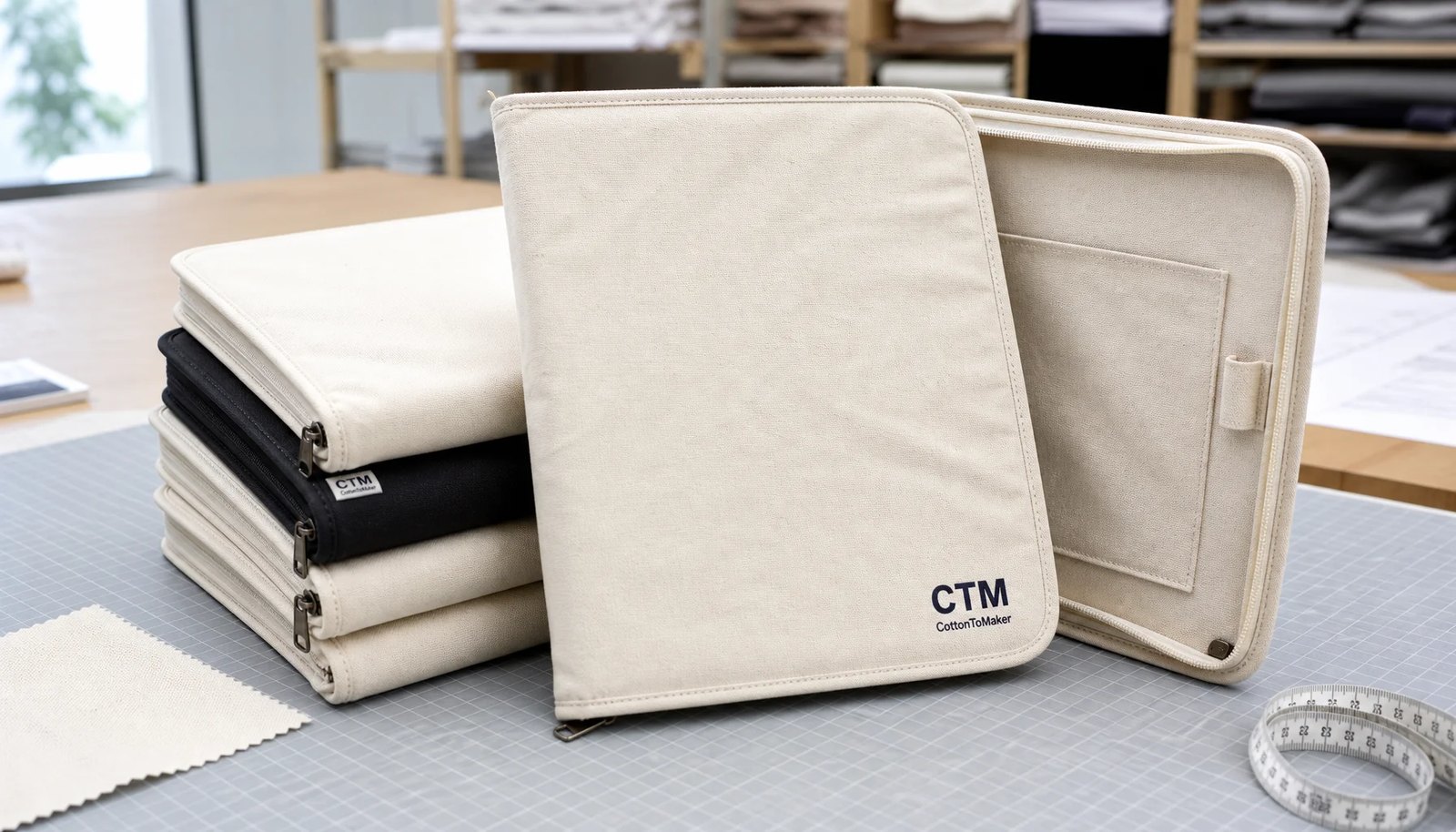
Canvas zipper portfolios for university bookstores can be low-cost orientation items, mid-range branded retail products, or premium alumni merchandise. Those three roles should not share the same RFQ. A giveaway portfolio can accept a simpler interior, standard natural canvas, and one-color print. A retail product needs better zipper action, cleaner seams, stronger packing, and a more controlled logo finish because students and parents will compare it with other shelf merchandise.
Before requesting bulk pricing, define the selling role in one sentence: who buys it, where it sits, what it must hold, and what return risk the bookstore cannot accept. This prevents suppliers from quoting a generic canvas document bag while the buyer expects a finished portfolio suitable for licensed merchandise. The price plan then becomes a set of controlled tradeoffs, not a race to the lowest unit price.
- For orientation kits, prioritize MOQ efficiency, quick lead time, and simple one-color branding.
- For bookstore retail, prioritize zipper feel, print accuracy, packing presentation, and consistent dimensions.
- For alumni or department merchandise, consider heavier canvas, embroidery, woven label, or upgraded puller.
- For licensed university logos, build in extra time for artwork proofing and color approval.
Choose Canvas Weight Without Overbuying
The most common cost mistake is asking for heavy canvas because it sounds more premium, then discovering that freight, sewing time, and retail price all move up together. For most bookstore zipper portfolios, 10 oz to 12 oz cotton canvas, around 280-340 GSM after finishing, gives enough structure for document protection while staying economical for bulk orders. Below that range, the product may feel like a flat pouch rather than a portfolio. Above it, the item can become stiff at the zipper edge and more expensive to ship.
The RFQ should request finished fabric weight, not only the raw fabric description. Natural canvas, bleached canvas, dyed canvas, and washed canvas can all behave differently. A supplier may quote 12 oz fabric before processing, but the finished goods may not match the buyer's approved sample if shrinkage, softening, or coating changes the handfeel. For university bookstore programs, the material standard should be easy to repeat for reorders.
- Use 8 oz to 10 oz canvas only when the product is mainly a budget pouch for documents.
- Use 10 oz to 12 oz canvas for the safest retail balance of structure, printability, and freight cost.
- Use 14 oz canvas only when the premium handfeel justifies higher sewing and shipping cost.
- For dark dyed canvas, test ink opacity early because print cost may rise with extra passes.
Build Price Tiers Around Real MOQ Logic
Bulk pricing for canvas zipper portfolios does not drop evenly at every quantity. The biggest changes usually come from spreading fixed setup costs, buying fabric more efficiently, improving cutting yield, and reducing factory changeover time. A small run may carry higher print setup and material handling cost. A larger run may unlock a better fabric roll price or zipper purchase price, but only if the specifications use standard materials already available in the market.
A useful pricing plan asks for tiers that match the bookstore's buying behavior. For example, 500 pieces may fit a pilot program, 1,000 pieces may fit one campus season, 3,000 pieces may support multiple stores or departments, and 5,000 pieces may support a distributor or licensed merchandise rollout. The buyer should not compare only the lowest tier from one supplier against the highest tier from another. Compare the same quantity, same packing, same print method, same incoterm, and same sample approval process.
- Request a clean unit price for each tier instead of one blended price.
- Separate one-time setup charges from repeat-order unit pricing.
- Identify which price breaks depend on custom fabric color, zipper color, or label MOQ.
- Ask whether overrun or underrun tolerance applies, especially for dyed fabric runs.
- Confirm whether the quoted MOQ is per design, per color, per logo, or per total order.
Control the Zipper and Construction Details
The zipper is the part buyers touch first, so it carries more quality risk than the canvas weight on paper. A nylon coil zipper is usually the practical choice for canvas portfolios because it is flexible, affordable, and smooth when sewn correctly. Metal zippers can look premium but may add cost, weight, and corrosion concerns if the product is stored in humid conditions. The zipper tape should not wave, twist, or pull the front panel out of shape.
Construction details need to be described in production language. State whether the portfolio opens on the long side or short side, whether it has a gusset, whether seams are bound, and whether there is an inner slip pocket or pen loop. Every added pocket increases cutting, sewing, inspection, and defect risk. A clean bookstore portfolio often performs better with one main compartment, one simple inner pocket, and a reinforced zipper end than with a complicated interior that pushes the price beyond the retail target.
- Specify zipper length, zipper tape color, slider color, puller style, and whether spare pullers are required.
- Use seam binding when the inside will be visible to retail buyers or gift recipients.
- Require reinforcement at zipper ends and pocket openings where stress is concentrated.
- Avoid very narrow seam allowances on heavy canvas because they increase fraying and open-seam risk.
Match Print Method to the Artwork
Screen printing is normally the best value for university bookstore bulk orders when the logo is one to three solid colors. It gives a clean branded result, handles repeat production well, and keeps unit cost predictable. The challenge is that cotton canvas has texture, so tiny legal text, thin mascot outlines, and small department names may lose sharpness. The buyer should not approve artwork only on a digital mockup; the decision belongs on real fabric.
Heat transfer can handle gradients or high-color artwork, but it changes the surface feel and may not suit every retail expectation. Embroidery looks premium but adds stitch-density limits, backing considerations, and higher cost. Woven labels or sewn side labels are useful when the front logo should stay subtle. The right method depends on the artwork, retail price target, and wash or abrasion expectations, not just the number of colors.
- For bold university logos, use screen print with Pantone references and a confirmed print size.
- For fine line art, request a strike-off before approving the production sample.
- For premium bookstore merchandise, compare embroidery cost against a woven label plus screen print.
- For dark canvas, confirm whether underbase printing is included in the quote.
- Set print position tolerance, such as plus or minus 3 mm to 5 mm, before bulk production.
Read Supplier Quotes Beyond Unit Price
A low quote may be real, but it often excludes something another supplier included. For canvas zipper portfolios, the missing items are usually print setup, sample freight, individual packing, carton strength, zipper upgrade, custom label, or inspection photos. If the buyer only compares the headline unit price, the final landed cost can change after artwork approval or after the packing method is confirmed.
A clean quote should show the specification, quantity tier, currency, incoterm, sample cost, tooling or setup cost, packing method, carton information, production lead time, and payment terms. For importers and distributors, quote data should also support landed-cost calculation. Carton dimensions and gross weight are not decoration; they decide freight class, warehouse handling, and whether the item still fits the planned retail margin.
- Compare quotes using the same fabric weight, finished size, zipper type, print method, and packing.
- Require carton quantity, carton size, gross weight, and estimated CBM for each quote.
- Separate sample cost, setup cost, and unit price so repeat-order pricing is visible.
- Check whether the supplier quotes EXW, FOB, CIF, DDP, or another term.
- Watch for vague lines such as canvas bag, standard zipper, or normal packing without measurable detail.
Use Samples to Prevent Bulk Mistakes
The sample process should prove the production method, not only the appearance. A showroom sample made from similar canvas can help with early decisions, but it should not release bulk production. For bookstore orders, the pre-production sample should use the actual confirmed fabric, zipper, thread, print ink, inner construction, label, and packing. If any of those items change after approval, the buyer should treat it as a new approval point.
Sample review should be practical and measurable. Insert the intended documents, zip and unzip the product repeatedly, inspect the corners, rub the printed area lightly, and check whether the portfolio lays flat enough for shelf presentation. Keep one signed sample at the factory and one with the buyer or inspection team. This avoids arguments when bulk goods are close but not equal to what the buyer expected.
- Approve fabric swatch first when color, weight, or handfeel is important.
- Approve print strike-off before full sample if the logo has small text or tight color control.
- Approve pre-production sample only after checking size, zipper, print, stitching, and packing together.
- Photograph approval points and mark any tolerated variation in writing.
- Do not allow bulk cutting before the final sample is signed or clearly approved by email.
Set QC Thresholds Before Production Starts
Quality control becomes easier when the buyer defines failure points before production. For canvas zipper portfolios, the main inspection areas are fabric defects, size accuracy, zipper operation, print quality, seam strength, cleanliness, and packing count. A university bookstore may reject goods for problems that a giveaway buyer would tolerate, especially if the portfolio is sold at retail with a visible logo.
Use acceptance criteria that the factory and inspector can apply consistently. For example, a small slub in natural canvas may be acceptable if it is not on the logo area, but oil stains or sharp metal fragments are not acceptable. A slightly uneven stitch may be tolerated inside the portfolio, but an open seam at the zipper end should be a major defect. Clear thresholds reduce rework, claims, and late shipment disputes.
- Measurement tolerance should be stated for length, width, gusset, pocket position, and print placement.
- Zipper testing should include repeated open-close cycles on randomly selected pieces.
- Print defects should be classified by visibility, logo area, color deviation, cracking, and registration.
- Stitching defects should include skipped stitches, loose threads, broken thread, puckering, and open seams.
- Packing inspection should verify count per carton, label accuracy, carton marks, moisture protection, and barcode position.
Plan Packing for Retail Handling and Freight
Packing is a cost driver and a damage-control tool. Individual polybags keep canvas clean, but some university bookstores prefer paper belly bands or reduced-plastic packing. A belly band can look better for retail handling but may not protect the surface as well during export shipping. If the portfolios have light-colored canvas, the packing method should prevent dust, rubbing, and color transfer from cartons or other goods.
Carton planning should be part of the quote, not an afterthought. Too many pieces per carton can compress corners and create deep creases. Too few pieces per carton can increase freight and handling cost. The supplier should provide carton size, gross weight, net weight, pieces per carton, and estimated CBM. For distributors, carton labeling may need SKU, PO number, color, quantity, barcode, and destination code.
- Use individual packing for retail-ready goods, licensed merchandise, or light natural canvas.
- Use bulk inner packing only when the buyer will repack locally or distribute through kits.
- Add desiccant when shipping through humid routes or storing goods before campus season.
- Confirm whether hangtags, barcode stickers, or price labels are applied at factory or locally.
- Run a simple carton drop and compression review for heavier 12 oz to 14 oz canvas portfolios.
Protect the Schedule Around Approval Risk
Lead time is not only sewing time. A realistic schedule includes artwork correction, fabric sourcing, zipper purchasing, sample making, sample shipping, buyer approval, bulk material booking, cutting, printing, curing, sewing, trimming, inspection, packing, and export pickup. The risk areas are usually artwork approval, custom material MOQ, print strike-off delay, and late packing changes.
University bookstore programs often work around fixed campus dates: orientation, homecoming, admissions events, semester start, or holiday retail windows. Missing the date can turn a profitable product into discounted inventory. The safest plan builds approval deadlines into the purchase order. If the buyer needs delivery by a fixed date, the RFQ should state the required in-warehouse date, not only the desired ship date.
- Allow extra time for licensed artwork approval when university brand rules are strict.
- Confirm whether natural canvas is in stock or must be woven, dyed, washed, or finished.
- Lock zipper and label materials early because small custom trims can delay a simple bag.
- Reserve inspection time before shipment instead of trying to inspect after the vessel cutoff.
- If the date is immovable, quote both ocean and air options early for landed-cost comparison.
Specification comparison for buyers
| Spec decision | Recommended option | When it fits | Buyer risk to check |
|---|---|---|---|
| Canvas fabric weight | 10 oz to 12 oz cotton canvas, roughly 280-340 GSM after finishing | Good balance for bookstore retail: firm handfeel, printable surface, not too heavy for freight | Low GSM quotes may look cheaper but collapse after packing; verify finished GSM, not only grey fabric weight |
| Zipper specification | Nylon coil zipper with metal or molded puller, color matched or contrast color | Works for A4 or letter-size portfolios where smooth opening matters more than luxury hardware | Weak pullers and uneven zipper tape cause returns; require a zipper pull test and sample cycling |
| Portfolio size | Letter or A4 document fit with 15-25 mm allowance around inserted papers | Best for campus events, alumni shops, orientation kits, and branded retail shelves | Too-tight sizing saves fabric but bends inserts; require measurement tolerance on finished goods |
| Printing method | Screen print for solid bookstore logos; heat transfer only for high-color artwork; embroidery for premium runs | Screen print gives the best unit cost at bulk quantities and holds well on canvas texture | Fine text can fill in on coarse canvas; approve strike-off on actual production fabric |
| Internal construction | One main compartment plus simple slip pocket or pen loop, with bound seams | Enough function for retail buyers without turning the item into a high-cost organizer | Overcomplicated pockets increase labor and defect points; count every seam and bartack in the quote |
| Bulk pricing breaks | Separate price tiers at practical quantities such as 500, 1,000, 3,000, and 5,000 pieces | Allows bookstore buyers to compare reorder economics and freight impact | A low 5,000-piece price can hide high setup or packing costs; request a full costed quote |
| Packing method | Individual polybag or paper belly band, then export carton with moisture control | Retail-ready packing helps bookstores receive, count, and shelve goods faster | Overpacked units increase labor and freight; underpacked canvas can rub, crease, or pick up dust |
| Sampling path | Pre-production sample using confirmed fabric, zipper, thread, logo, and packing | Needed when the item will be sold at retail or supplied through licensed campus channels | Sales samples made from substitute fabric are not enough; lock a signed PPS before bulk cutting |
Buyer checklist before sampling
- Define the intended use: retail sale, orientation kit, department giveaway, alumni merchandise, or licensed bookstore stock.
- Specify finished size, document format, zipper side, zipper color, puller type, seam binding, inner pocket layout, and logo placement.
- State canvas weight in oz and GSM, and require the supplier to confirm finished fabric weight after dyeing or washing.
- Provide artwork as vector files with Pantone references, print size, print position, and any university licensing restrictions.
- Request tiered bulk pricing with separate lines for product cost, logo setup, sample cost, packing cost, export carton details, and freight terms.
- Approve a strike-off on the actual canvas before the pre-production sample if the logo has small text, fine lines, or light ink on dark fabric.
- Set measurement tolerance, print tolerance, zipper function criteria, stitching density, thread color, and acceptable defect levels before production starts.
- Confirm carton dimensions, quantity per carton, gross weight, polybag or paper wrap requirement, barcode label position, and inner assortment if applicable.
- Build the lead time around artwork approval, material booking, sampling, bulk cutting, printing, sewing, inspection, packing, and vessel or air pickup.
- Keep one signed approval sample with the supplier and one with the buyer so QC can compare real goods against the same standard.
Factory quote questions to send
- What is the exact finished canvas weight in oz and GSM, and is the fabric bleached, natural, dyed, washed, or coated?
- Which zipper type, zipper size, puller style, and zipper tape color are included in the quoted price?
- Does the quote include screen setup, ink mixing, artwork adjustment, sample making, inner packing, master carton, and export documentation?
- What are the price breaks at 500, 1,000, 3,000, and 5,000 pieces, and which cost items change at each quantity?
- What is the minimum order quantity for custom canvas color, custom zipper color, custom puller, and custom woven side label?
- Can the factory provide a print strike-off on production fabric before making the full pre-production sample?
- What finished size tolerance, print position tolerance, and zipper defect tolerance will the factory accept in writing?
- How many pieces fit per carton, what is the estimated carton size and gross weight, and can the carton pass normal export handling?
- What is the production lead time after sample approval, and which materials are the longest lead items?
- Who performs final inspection, what AQL level is used, and can photos of carton marking, packing, and random opened pieces be supplied before shipment?
Quality-control points to confirm
- Finished canvas GSM and handfeel match the approved pre-production sample, with no unexpected coating, yellowing, or loose weave.
- Finished size stays within the agreed tolerance, commonly plus or minus 5 mm for simple zipper portfolios unless the design requires tighter control.
- Zipper opens and closes smoothly across the full length, with no skipped teeth, twisted tape, broken pullers, or trapped fabric at the ends.
- Print color, registration, opacity, and position match the approved strike-off; fine university text remains readable on the canvas surface.
- Seams are straight enough for retail presentation, with no open seams, skipped stitches, loose threads, puckering, or uneven binding.
- Stress points near zipper ends, corners, pocket openings, and handle tabs if used are reinforced according to the approved sample.
- Each unit is clean, dry, and free of oil marks, chalk marks, fabric stains, strong odor, metal contamination, or loose needle fragments.
- Packing follows the confirmed count per carton, inner pack format, barcode label position, carton mark, and moisture protection requirement.