Start With a Procurement Spec, Not a Product Name
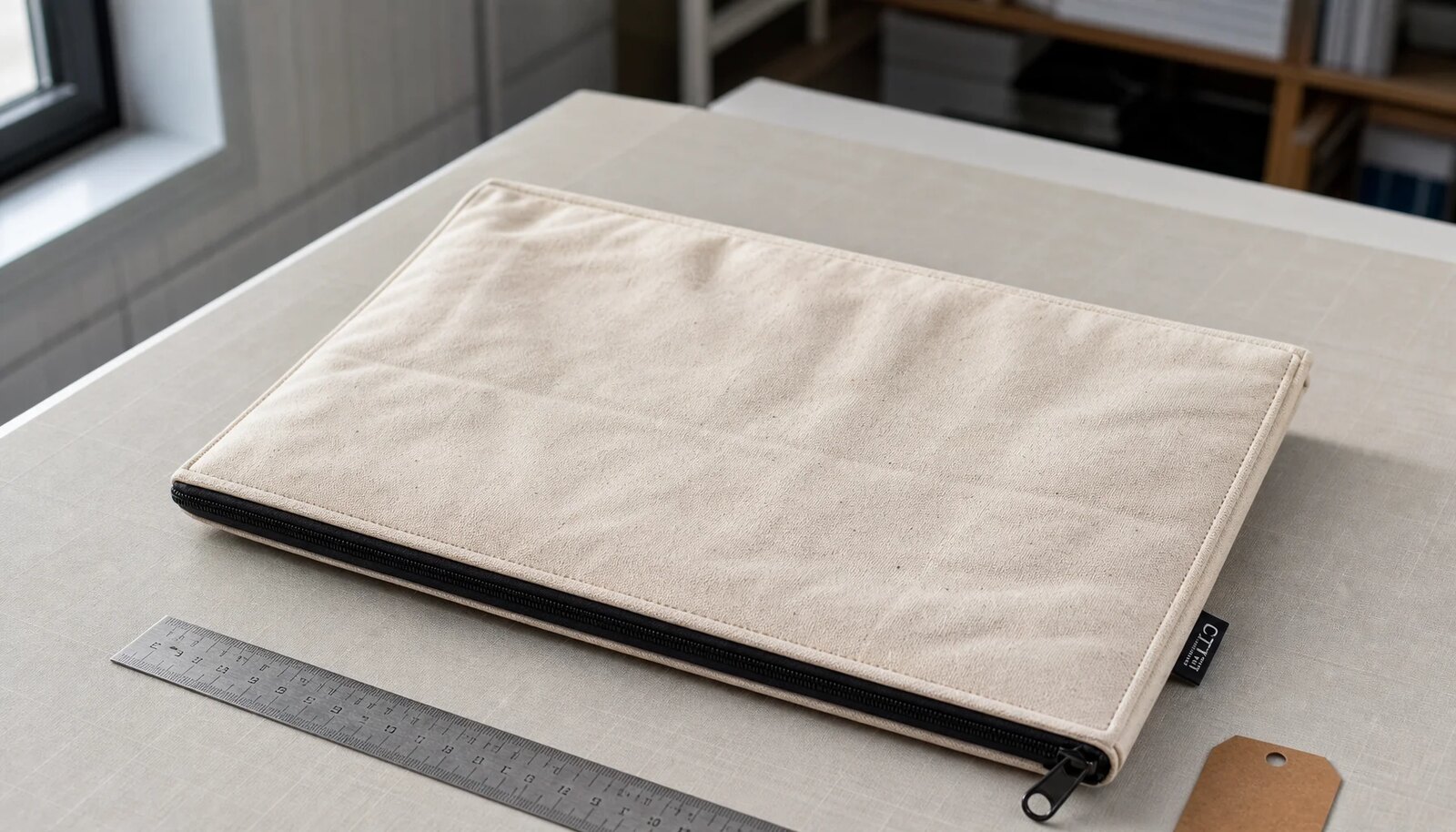
A reliable canvas zipper portfolios bulk pricing plan for event planners starts with a written specification, not a quick description. The phrase canvas zipper portfolio can mean a slim document sleeve, a padded tablet organizer, a three-sided conference folder, or a premium welcome-kit carrier. Those products may look similar in a catalog image, but they do not use the same fabric consumption, zipper length, lining, labor time, packing volume, or inspection criteria.
For B2B procurement, the goal is to make quotes comparable. If one supplier assumes 10oz unlined natural canvas with a top zipper and one-color print, while another assumes 12oz lined canvas with a three-sided zipper, document sleeve, pen loop, woven label, and individual packing, the lower price is not automatically better. It may simply be quoting a lighter product with fewer details.
The first RFQ should define the event use, document standard, loaded thickness, material, zipper, interior layout, decoration, packing, quantity breaks, Incoterm, delivery address, and inspection standard. Suppliers should be required to state any assumptions they make. That one discipline prevents most quote confusion and gives procurement a cleaner basis for negotiation.
A good pricing plan also separates unit price from landed cost. The factory unit price is only one part of the spend. Carton count, CBM, duty treatment, freight mode, destination handling, local delivery, storage, repacking, and late shipment risk can change the true cost of the program. Event planners should compare the cost of receiving usable portfolios at the right venue date, not just the lowest ex-factory number.
- Use one written RFQ spec for every supplier so the comparison is clean.
- Define the portfolio by size, load, material, zipper, layout, logo, packing, and delivery term.
- Require suppliers to list assumptions instead of hiding them in one unit price.
- Compare landed cost and event risk, not unit price alone.
Map the Event Load Before Setting Size
The correct size depends on what the portfolio must carry on the busiest day of the event. A conference version may need an agenda, venue map, sponsor sheets, exhibitor list, badge envelope, pen, and feedback card. A training program may include a workbook, worksheet pack, product guide, and tablet. A VIP welcome kit may include travel information, access credentials, stationery, and a slim charger. The portfolio should be designed around the thickest realistic load, not the neatest product photo.
Procurement should name the paper standard and the usable internal clearance. A4 sheets are 210 x 297 mm, US letter is 216 x 279 mm, and legal is 216 x 356 mm. The sewn portfolio must be larger than the paper because seam allowance, zipper tape, lining, pocket construction, and corner radius reduce usable space. A practical RFQ might state that a US-letter portfolio needs at least 225 x 300 mm internal clearance after sewing, while an A4 version needs about 230 x 320 mm. Exact clearance should match the insert pack and opening style.
Thickness is just as important. A flat portfolio can work for a few sheets, but a pen, folded lanyard, badge stack, cable, or tablet can push the zipper out of alignment. For light agenda packs, 8 to 12 mm usable thickness may be enough. For heavier event kits, 15 to 25 mm is more realistic. If the portfolio needs to close around a workbook and accessories, a small gusset may cost more but reduce zipper strain and attendee frustration.
Opening style should follow use. A top zipper is economical and easy to sew, but access is limited. A two-sided zipper improves usability for larger documents. A three-sided zipper behaves more like a folio and is easier for workbooks or tablets, but it uses more zipper tape and requires better corner sewing. Buyers should test the sample loaded with actual inserts before approving the bulk order.
- List every intended insert and identify the thickest realistic event kit.
- Specify A4, US letter, legal, tablet, or mixed-use sizing with internal clearance.
- State maximum loaded thickness in millimeters, not only exterior dimensions.
- Approve the sample only after testing it with real agenda packs, pens, badges, and inserts.
Choose Canvas With Measurable Standards
Canvas weight is one of the biggest cost and quality variables. For light promotional document sleeves, 10oz canvas may be acceptable. For most event portfolios, 12oz canvas is a balanced starting point because it feels more substantial without creating excessive carton weight. Premium programs may use 14oz canvas or reinforced construction, but the buyer should expect higher fabric cost, thicker seams, more difficult sewing, and increased freight volume.
Weight should be stated in oz and, when possible, gsm. A common 12oz cotton canvas is often around 400 gsm, but conversion varies by fabric construction and finishing, so suppliers should not rely on loose terminology alone. The RFQ should request actual fabric weight, acceptable tolerance, finish, and whether the material is natural, dyed, washed, coated, conventional cotton, recycled blend, or certified organic cotton. If a sustainability claim will be printed in event materials, procurement should ask what documentation is available before using that claim.
Shade control matters more than many teams expect. Natural canvas can show slubs, seed flecks, and shade variation. That may support a natural look, but it can conflict with a strict corporate standard. Dyed canvas gives more control, but it introduces lab dip approval and potential re-dye delay. For repeat events or multi-venue shipments, ask whether fabric lots will be separated, identified, or mixed. A visible shade jump between cartons can make a registration counter look poorly managed even when every piece is technically usable.
The interior finish affects perceived value and paper handling. Unlined canvas is cheaper, but exposed seams may catch document corners. A 210D polyester lining, cotton lining, or bound seam finish makes the inside cleaner. Lining and binding add labor and can reduce usable space, so they must be included in the dimension spec. Interfacing or light board can improve structure, but too much stiffness increases carton volume and may create pressure marks at corners.
- Use 10oz for simple handouts, 12oz for most event portfolios, and 14oz or reinforced builds for premium programs.
- Request actual fabric weight, tolerance, finish, color standard, and lot-control method.
- Confirm whether natural slubs and seed flecks are acceptable or considered defects.
- Include lining, binding, and interfacing in both cost and internal-clearance calculations.
Specify Zippers Like a Functional Component
The zipper is the part users touch most, so it deserves a complete specification. A #5 nylon coil zipper is usually the best default for canvas zipper portfolios because it is flexible, smooth, cost-effective, and better suited to curved corners than many rigid zipper types. A #3 zipper may look slimmer but can feel weak on a loaded portfolio. Metal zippers can look premium, but they add weight and are less forgiving if the sewing line or corner geometry is inconsistent.
A complete zipper spec includes zipper size, coil or tooth type, tape color, slider finish, puller style, opening direction, zipper path, end-stop treatment, and reinforcement at zipper ends. The supplier should also confirm whether zipper tape is stock or custom dyed. Stock black, natural, navy, and gray tapes are usually faster and more economical than custom tape colors. Custom pullers can improve branding, but they add tooling, MOQ, and approval time, so they should be used only when the event budget and timeline support them.
The zipper must be checked under load. An empty sample can glide smoothly while a loaded sample catches at corners or strains near the puller. The sample should be packed with the intended agenda, pen, badge envelope, and any thick accessories. The buyer should close and open the zipper multiple times, including around corners, and check whether the slider jams, the tape twists, the puller detaches, or the end stop feels weak.
Zipper inspection should be part of the final QC plan. Sampled units should be opened and closed across the full path, not only checked visually. Defects such as missing coil, wavy tape, loose slider, broken puller, poor corner sewing, or zipper tape trapped in seam allowance should be classified as major when they affect function. For event items, a portfolio that cannot close neatly is not a small cosmetic issue.
- Default to #5 nylon coil zipper for most canvas event portfolios.
- Specify tape color, slider finish, puller type, zipper path, opening direction, and reinforced ends.
- Test zipper function with the real loaded insert pack, not only an empty sample.
- Treat non-functioning zippers, catching corners, and loose pullers as major defects.
Control Interior Features Before Quoting
Interior features can make a portfolio more useful, but they also increase sewing time, defect risk, and cost. A basic event portfolio may need only one document sleeve and a pen loop. A sales meeting version may need business card slots and a tablet sleeve. A sponsor kit may need a mesh pocket for inserts or small items. Procurement should avoid vague wording such as with organizer pockets because every factory may interpret that differently.
Each feature should be dimensioned. A document sleeve needs opening width, depth, and seam reinforcement. Card slots need width, height, quantity, and spacing. A pen loop needs loop diameter or flat width, position, and elastic or fabric choice. A tablet sleeve needs target device size, padding requirement, clearance, closure method, and whether the sleeve must protect corners. A mesh pocket needs mesh type, zipper or elastic edge, and load expectation.
Feature placement affects function. A pen loop placed near the zipper pull may create a bulge that makes the portfolio harder to close. A tablet sleeve may reduce document clearance. Card slots sewn too tightly may be unusable once the lining and seam allowances are included. The buyer should review a layout drawing or marked sample before approving the quote, especially for orders above 1,000 pieces where a small layout issue becomes a large rework problem.
For cost control, ask suppliers to quote the base portfolio and optional features separately. This reveals the true cost of a tablet sleeve, mesh pocket, additional card slots, woven label, or reinforced handle. It also gives the event team a practical way to reduce price without downgrading the fabric or zipper. Removing low-value pockets is usually better than accepting weak canvas or a poor zipper.
- Define pocket quantity, size, position, opening, material, and reinforcement points.
- Quote optional organizer features as separate line items.
- Check that added pockets do not reduce document clearance below the approved spec.
- Load-test the sample to confirm pens, badges, cards, and devices do not distort the zipper.
Match Branding to Canvas and Budget
Branding method affects both unit cost and quality risk. One-color screen printing is often the most efficient option for bulk event portfolios because it is clear, economical, and familiar to factories that print on canvas. Two-color screen print can also work well, but registration and curing must be controlled. The RFQ should include vector artwork, print size, Pantone or approved color target, placement from edges, and minimum line weight.
Canvas texture is not the same as smooth paper. Very thin lines, tiny reverse text, gradients, and complex sponsor lockups may not print cleanly on 10oz or 12oz canvas. A practical screen-print spec should confirm minimum line thickness and whether the supplier recommends artwork simplification. A strike-off or decorated pre-production sample is important because a digital mockup cannot show ink coverage over slubs and weave texture.
Woven labels, stitched patches, and small embroidery marks can give a cleaner B2B look than a large printed logo. Woven labels are useful for repeat programs because the label can stay consistent across canvas colors or event versions. Patches can feel more premium but add material and sewing steps. Embroidery works best for small marks; dense embroidery can pucker lighter canvas and slow production. For large logo coverage, screen print is usually more predictable.
Sponsored events need extra discipline. If many sponsor logos must appear, the portfolio may become visually crowded and less reusable. Procurement should ask whether the portfolio is the right surface for every logo. A refined approach may use one event mark on the portfolio and sponsor recognition on printed inserts. That keeps decoration cost lower and makes the item more useful after the event.
- Use screen print for clear one-color or two-color bulk branding.
- Use woven labels or small patches when repeatability and a refined look matter.
- Avoid tiny reverse text, thin lines, and dense multi-logo panels unless the strike-off proves they work.
- Set decoration placement tolerance, such as plus or minus 3 mm to 5 mm, before production.
Build Quantity Breaks That Explain Cost
A useful canvas zipper portfolios bulk pricing plan for event planners should include realistic quantity breaks, not one number. Common RFQ breaks are 300, 500, 1,000, 2,000, and 3,000 pieces, though the right list depends on the event calendar. Lower volumes carry sampling, cutting, printing setup, machine setup, packing setup, and inspection overhead. At higher volumes, those fixed costs spread across more units, and the supplier may reach more efficient fabric, zipper, label, or carton purchasing levels.
The price curve may not be smooth. A supplier may offer a better break when the order reaches a full fabric roll, a full zipper tape lot, or a more efficient sewing-line plan. Another supplier may show a higher price at larger quantities if the timeline is too tight and requires overtime or subcontracting. Buyers should ask what drives each break. The explanation helps reveal whether the supplier is pricing from real production inputs or guessing from a catalog item.
Line-item pricing makes negotiation cleaner. Ask for blank body cost, decoration setup, per-piece decoration cost, added pocket cost, label or patch cost, individual packing, master carton, sample fee, export documents, and freight assumptions. This allows procurement to reduce cost by changing features with low event value. For example, switching from a large two-color print to a woven side label may improve appearance and reduce print risk. Removing unused card slots may lower sewing cost without affecting attendee experience.
Sample cost should not be treated as an afterthought. A low-cost sample made from substitute fabric or generic zipper has limited value. For bulk procurement, the pre-production sample should use the actual canvas, zipper, lining, decoration, pocket layout, and representative packing. Clarify whether sample freight is included, how many revisions are included, and whether any sample fee is credited after order placement.
- Request quote breaks at quantities that match real event decisions.
- Ask suppliers to explain price changes at each quantity break.
- Separate body, decoration, pocket, packing, sample, and freight costs.
- Reduce cost by simplifying low-value features before downgrading core construction.
Compare Sourcing Routes by Operational Risk
Direct factory sourcing is often the strongest route for repeat event programs because it gives the buyer better control over construction, material lots, production timing, and inspection. It is especially useful at 1,000 pieces and above when the design will repeat across conferences, sales meetings, or annual programs. The buyer must provide a clear spec, but the reward is better visibility into how the product is made.
A trading company or sourcing consolidator can be useful when the portfolio is one component in a larger kit. If procurement also needs totes, notebooks, lanyards, pouches, badge holders, and pack-out, one coordinator may reduce administrative work. The risk is reduced visibility. The buyer should ask which factory makes each item, which processes are outsourced, who approves samples, and who is responsible if final inspection fails.
Local stock wholesalers and decorators solve speed problems. They are useful for 100 to 500 pieces, late attendee additions, pilot events, or replacement inventory. They may not match a custom portfolio in canvas shade, zipper quality, internal layout, or size. For a premium event standard, stock should be considered a contingency route unless the buyer has approved the exact stock item and decoration method.
A hybrid strategy can reduce event risk. The main volume can be produced through a factory route with proper sample approval and inspection, while a small local reserve covers late registrations or lost cartons. The reserve does not need to be identical if it is clearly assigned to emergency use, staff use, or late registrants. The key is to plan it before the event date becomes urgent.
- Use direct factory sourcing for repeatable specs, volume control, and clearer QC.
- Use a trading company when multi-item coordination is worth the added margin.
- Use local stock for urgent replenishment or small quantities with flexible specs.
- Plan contingency quantities early instead of buying emergency replacements at the last minute.
Set Inspection Tolerances Before Production
Quality control should be measurable before cutting starts. For sewn canvas portfolios, a common practical size tolerance may be plus or minus 5 mm on exterior width and height, but the buyer should set the tolerance based on the portfolio design and insert requirements. Internal opening clearance is more important than outside dimensions. If the product must hold A4 or US letter documents without creasing, QC must measure the usable opening after sewing, lining, zipper tape, and pockets are in place.
Logo placement should also have a stated tolerance. For many event portfolios, plus or minus 3 mm to 5 mm from the approved position is a reasonable discussion point, depending on logo size and construction. A small woven label may need tighter visual control than a large screen print because tilt and edge distance are easier to notice. Decoration QC should check print color, edge cleanliness, curing, rub resistance, embroidery puckering, label alignment, and whether artwork crowds the zipper or seam.
Zipper function deserves a specific test. Sampled units should be opened and closed across the full zipper path, including corners, several times. Inspectors should look for catching, twisted tape, rough sliders, broken pullers, weak end stops, and coil damage. A loaded test is important: the inspector should check at least selected units with the approved insert pack or equivalent thickness to confirm that the zipper closes without strain.
Defect classification keeps final decisions practical. Critical defects include unsafe contamination, sharp broken needles, mold, severe odor, or foreign objects. Major defects include wrong size, non-functioning zipper, wrong logo, wrong color, open seams, missing pockets, unstable pullers, or print that rubs off. Minor defects may include small loose threads, slight slub variation within the approved standard, or minor surface irregularities that do not affect function. Agreeing on these definitions early reduces arguments at shipment release.
- Set exterior and internal size tolerances before bulk cutting.
- Measure usable document clearance, not only outside dimensions.
- Use agreed tolerances for logo position, pocket size, and decoration alignment.
- Classify critical, major, and minor defects before inspection begins.
Plan Packing, Cartons, and Venue Routing
Packing choices affect both presentation and landed cost. Canvas zipper portfolios should usually ship flat because tight folding can create creases, zipper pressure marks, and crushed corners. If the portfolio includes metal pullers, patches, or inserted documents, stacking pressure should be controlled. Tissue sheets, paper bands, or inner packs may protect the surface while keeping packing efficient. Overpacked cartons may look economical in CBM but can cause visible damage when opened at the venue.
Individual packing should match the event workflow. Polybags protect against moisture and handling, but they add waste and unpacking labor. Paper bands, glassine sleeves, or bulk inner packs may be better when portfolios are assembled into kits soon after receipt. If the supplier will insert agendas, sponsor cards, badge envelopes, or stickers, the buyer should approve a packed sample that shows the exact insert sequence and orientation.
Carton data should be requested before freight decisions are made. Ask for units per inner pack, units per master carton, carton dimensions, gross weight, net weight, and estimated CBM at each quantity break. A change from 40 pieces per carton to 30 pieces per carton can affect freight, pallet count, warehouse handling, and local delivery. Carton weight should also be practical for the receiving team, especially at hotels, convention centers, and temporary registration areas.
Multi-venue programs need precise labels. Carton marks should include item name, SKU or version, color, PO number, quantity, carton number, destination, event name, and receiving date if required. If VIP portfolios, sponsor portfolios, and general attendee portfolios are different, each version should have a distinct item code. The packing list must match carton marks exactly so the receiving team can sort quickly under event pressure.
- Ship flat unless the approved sample proves another packing method will not crease or deform the product.
- Approve individual packing, inner packs, and insert sequence before mass packing.
- Request carton dimensions, weights, CBM, and pallet information before booking freight.
- Use clear carton marks for multi-venue, multi-date, or multi-version event programs.
Specification comparison for buyers
| Spec or sourcing decision | Recommended option | When it fits | Buyer risk to check |
|---|---|---|---|
| Body size standard | A4: minimum internal clearance about 230 x 320 mm; US letter: about 225 x 300 mm after seams and zipper tape | Conference agendas, sponsor sheets, registration documents, training packs, and venue maps | Do not approve by exterior size only; seam allowance, lining, and zipper placement can reduce usable space by 8 to 15 mm |
| Canvas weight | 10oz for light handouts, 12oz to 14oz for most event portfolios, heavier only when structure is worth added freight | Event kits that need a natural textile feel without becoming too bulky in cartons | Ask for gsm or oz, finish, color standard, roll lot control, and whether weight tolerance is plus or minus 5% or another stated range |
| Zipper construction | #5 nylon coil zipper with matched or contrast tape, standard metal or molded puller, reinforced ends | Bulk orders where smooth function matters more than decorative hardware | Check zipper path, corner radius, end stops, slider pull force, and whether the zipper catches when the portfolio is loaded |
| Interior layout | One document sleeve plus pen loop as the base; add card slots, tablet sleeve, or mesh pocket only when required | General attendee kits, sales meetings, training programs, and sponsor packs | Every added pocket changes labor and usable capacity; require measured pocket depth, opening width, and reinforcement points |
| Decoration method | One-color screen print or woven label for the best cost-control balance | Most event logos, sponsor marks, and repeat conference programs | Canvas texture can break fine lines; set minimum line weight, placement tolerance, curing/rub test, and Pantone or approved color target |
| Direct factory with in-house sewing and printing | Best route for stable repeat programs that need controlled construction and lower unit cost at scale | 1,000 pcs and up, annual event calendars, or programs with fixed portfolio specs | Verify which steps are in-house versus outsourced: cutting, printing, embroidery, sewing, labeling, packing, and inspection |
| Trading company or project consolidator | Useful when portfolios ship with totes, notebooks, lanyards, badge holders, or full event kits | Mixed SKU sourcing, limited internal procurement bandwidth, or multi-supplier pack-out | Require item-level approved samples and written responsibility for defects, substitutions, and missed packing instructions |
| Local stock wholesaler with logo service | Fastest option for urgent dates, smaller runs, or replacement inventory | 100 to 500 pcs, short-deadline replenishment, or simple one-color logo orders | Stock canvas shade, zipper quality, dimensions, and pocket layout may not match the main program |
| FOB quotation | Good for importers with a forwarder, customs broker, and landed-cost model | Buyers comparing factory cost and managing freight separately | Unit price excludes freight, duty, destination handling, local delivery, and some documentation costs |
Buyer checklist before sampling
- Confirm whether the portfolio must fit A4, US letter, legal, tablet, or mixed inserts, and state the minimum internal clearance required after sewing.
- List the exact event load: agenda, workbook, venue map, sponsor sheets, badge envelope, pen, lanyard, business cards, tablet, charger, or other inserts.
- Set a maximum loaded thickness in millimeters, then decide whether a flat body, 10 mm gusset, 20 mm gusset, or wider organizer body is needed.
- Lock the exterior size, internal usable size, zipper opening style, corner radius, gusset depth, and whether the portfolio must lie flat inside a tote.
- Specify canvas weight in oz and/or gsm, acceptable weight tolerance, color standard, fabric finish, lining requirement, interfacing, and seam finish.
- State zipper size, zipper type, tape color, slider finish, puller style, zipper path, opening direction, end-stop treatment, and corner sewing requirement.
- Define every interior feature with measurements: document sleeve, card slots, pen loop, tablet sleeve, mesh pocket, elastic band, label position, and reinforcement points.
- Provide vector artwork, print size, placement from edges, color standard, decoration method, minimum line weight, and approval process for strike-off or decorated sample.
- Set measurable tolerances before production, including size tolerance, logo placement tolerance, pocket depth tolerance, and acceptable shade variation.
- Ask each supplier to quote the same quantities, same Incoterm, same packing plan, same delivery address or port, same sample scope, and same inspection standard.
Factory quote questions to send
- What is the MOQ for each version: blank stock body, one-color screen print, multi-color print, woven label, embroidery patch, custom-dyed canvas, custom zipper puller, and added interior pockets?
- Which canvas weight in oz and gsm, yarn type, weave, finish, shrinkage control, color tolerance, and fabric lot policy are included in the base quote?
- Is the quoted canvas natural, dyed, washed, coated, organic, recycled, or conventional cotton canvas, and what documentation is available if a fiber claim is requested?
- Which lining fabric, interfacing, binding tape, reinforcement material, and seam finish are included, and which are optional adders?
- Which zipper size, coil or tooth type, tape material, tape color, slider finish, puller style, puller strength, end-stop method, and zipper path are included?
- Can you itemize blank body cost, decoration setup, per-piece logo application, label or patch cost, added pocket cost, individual packing, master carton, sample fee, and document charges?
- What does the sample fee include: actual fabric, actual zipper, real decoration, interior pockets, packing mockup, sample freight, and how many revision rounds?
- What production lead time starts after final sample approval and deposit, excluding buyer artwork delays, lab dip rework, raw material shortages, holidays, freight transit, and customs?
- Which processes are completed in-house and which are subcontracted: fabric sourcing, cutting, sewing, screen printing, embroidery, label making, packing, and final inspection?
- What QC standard will you use for size tolerance, zipper function, stitching, logo position, print curing, fabric defects, carton count, and AQL final inspection?
Quality-control points to confirm
- Exterior width, exterior height, gusset depth, and internal usable opening are measured against the approved spec, with a typical sewn-goods tolerance agreed before production, such as plus or minus 5 mm unless the design requires tighter control.
- Canvas weight, hand feel, shade, weave density, slub level, finish, and lining color match the approved sample and do not show obvious roll-to-roll shade jumps inside the same shipment group.
- Zipper opens and closes smoothly across the full path, including corners, without catching, twisted tape, missing teeth or coil damage, loose sliders, broken pullers, or hard end stops.
- Loaded zipper test confirms the portfolio closes with the approved insert pack and maximum stated thickness without strain, bulging corners, or paper damage.
- Logo position, logo size, print color, woven label placement, embroidery placement, and decoration alignment match the approved artwork within the agreed placement tolerance.
- Printed areas are fully cured with clean edges and no cracking, peeling, ink transfer, tackiness, pinholes, heavy bleed, or smearing after normal dry rub handling.
- Corner stitching, zipper ends, pocket stress points, pen loop attachments, label seams, and gusset joins are reinforced with no skipped stitches, broken threads, loose thread tails, or open seams.
- Pocket depth, card slot width, tablet sleeve clearance, mesh pocket size, and pen loop placement match the approved sample and do not reduce the usable main compartment below the stated clearance.
- Portfolio lies flat or holds the approved structure after packing, without deep fold marks, crushed corners, zipper pressure dents, moisture odor, oil marks, fabric snags, needle damage, or mildew.
- Individual packing, insert sequence, paper band or polybag use, carton quantity, carton marks, barcode labels, carton dimensions, and carton weights match the purchase order and packing list.