Why bulk pricing fails on craft fair zipper portfolios
The difficult part of buying canvas zipper portfolios in bulk is rarely finding a factory willing to quote. The difficult part is knowing whether each quote describes the same product. One supplier may price a 10 oz unlined shell with a basic zipper and no inside organizer. Another may include 12 oz canvas, lining, a document sleeve, a pen loop, a woven label, cleaner inside binding, and a stronger zipper. In a spreadsheet, both lines may simply read canvas zipper portfolio. In production, they are not the same item.
Craft fair buyers often sit between promotional purchasing and retail accessory sourcing. The portfolio may hold exhibitor paperwork, booth packets, class handouts, order forms, wholesale catalogs, sponsor inserts, or resale merchandise. It needs to feel better than a disposable pouch, yet the landed cost often has to stay disciplined because the buyer may be outfitting hundreds or thousands of participants. That is where vague specs become expensive. Small changes in GSM, zipper gauge, pocket count, reinforcement, and packing can move both unit price and reject rate.
A useful canvas zipper portfolios bulk pricing plan for craft fairs turns assumptions into line items. Procurement should know what is included, what is optional, what is a setup charge, and what changes on a reorder. The lowest FOB number is not helpful if it excludes lining, underprices decoration, uses lighter canvas, or packs in a way that increases freight and damage risk.
- Normalize quotes by finished GSM, fiber content, and construction layers instead of relying on trade terms such as 10 oz or 12 oz.
- Separate shell construction from interior features because pockets, dividers, loops, lining, and reinforcement add labor.
- Ask whether decoration, samples, carton labels, polybags, insert cards, and packing photos are included or billed separately.
- Compare landed cost, including packed volume and carton method, rather than only FOB unit price.
- Require a physical pre-production sample before bulk approval when fabric, zipper, artwork, or layout is customized.
Define the buying use case before chasing the target price
A strong RFQ starts with the job the portfolio must do. A document holder for vendor agreements can be flatter and simpler than a resale portfolio displayed on a booth table. A workshop kit may need to hold handouts, pens, badges, coupons, and small product cards. A catalog carrier may need extra spine allowance so the zipper closes without stress when filled. These are practical differences, and they change the sewing pattern, material choice, and labor minutes.
The buyer should name the contents the factory must design around. Specify whether the portfolio needs to fit US letter sheets, A4 documents, folded brochures, an 8.5 x 11 notepad, a 5 x 7 postcard stack, order forms, or a small tablet. Generic phrases such as canvas organizer invite the factory to quote the simplest version. That may be fine for a short-use giveaway. It is risky for a resale item or vendor kit that needs to arrive ready for real use.
Expected product life also matters. A one-weekend event program does not need the same structure as an item intended for repeated fair-season use. Still, even short-use portfolios are handled at close range. Buyers notice zipper drag, crooked printing, loose threads, and limp corners. The better cost plan removes features that do not serve the use case; it does not randomly downgrade every material until the product loses its purpose.
- Exhibitor paperwork holder: prioritize document fit, zipper reliability, clean stitching, and simple inside organization.
- Vendor welcome kit: prioritize packing presentation, insert compatibility, easy distribution, and clear branding.
- Retail resale portfolio: prioritize structure, print finish, label quality, consistent stitching, and shelf-ready appearance.
- Workshop or class kit: prioritize pocket access, pen loop placement, paper protection, and quick opening at check-in.
- Catalog or order-form carrier: prioritize spine width, zipper path, sleeve depth, and resistance to corner stress.
Fabric weight, composition, and structure choices
Canvas weight is one of the first cost drivers, but it has to be discussed in finished fabric weight. A 10 oz canvas, often around 280-300 GSM, can work for lightweight document programs, promotional portfolios, and flat paper use. A 12 oz canvas, often around 330-350 GSM, is a stronger baseline for many craft fair buyers because it gives enough body for repeated handling while keeping cartons manageable. A 14-16 oz canvas, often around 390-450 GSM, creates a more substantial product, but it increases material cost, seam bulk, sewing difficulty, and packed volume.
Fabric weight alone does not define the finished hand feel. A 12 oz unlined shell may feel less structured than a 10 oz shell with lining and a light support layer. Ask the factory to break the product into layers: outer canvas, lining, interlining, foam, board, binding, zipper reinforcement, and pocket material. This makes quotes easier to compare and reduces disputes when one supplier has priced a shell-only pouch while another has priced a finished organizer.
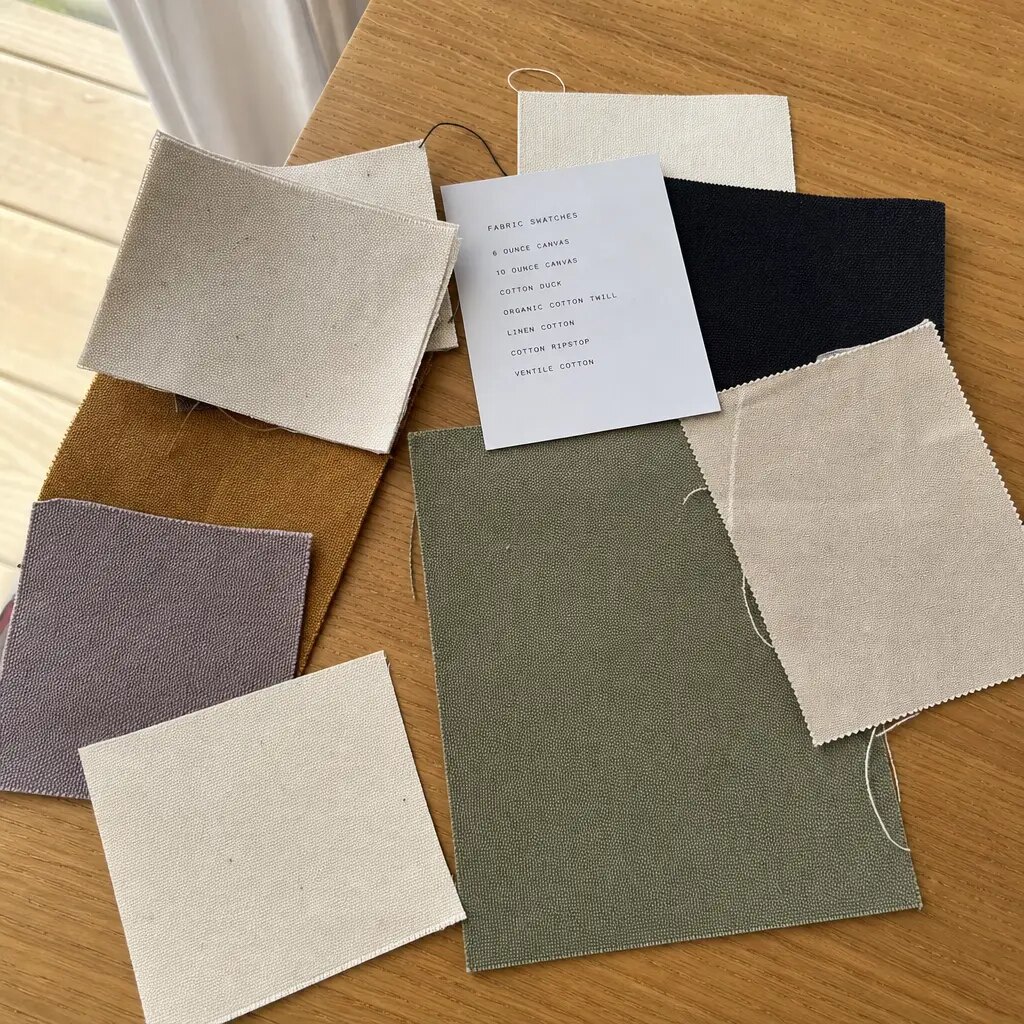
The surface standard should be agreed early. Natural cotton canvas can show slubs, neps, small shade shifts, and weave variation. Some craft buyers like that because it fits a handmade or workshop atmosphere. Others need a cleaner surface for sharper artwork and retail consistency. Neither choice is wrong. Problems start when the buyer expects a polished retail surface but approves natural canvas without defining what surface variation is acceptable.
Composition also affects procurement language. Cotton canvas, recycled cotton canvas, organic cotton canvas, and cotton-poly canvas may look similar in a photo, but they differ in sourcing, documentation, shrinkage behavior, print response, and marketing claims. If the portfolio will be described to exhibitors or retail customers using a material claim, the quote should include the documentation path before the artwork or hangtag copy is finalized.
- Economy construction: 10 oz canvas, single-layer shell, basic nylon zipper, one flat pocket, and minimal internal binding.
- Balanced construction: 12 oz canvas, light lining, document sleeve, pen loop, clean inside finishing, and #5 nylon coil zipper.
- Premium construction: 14-16 oz canvas, lining plus support layer, reinforced spine, branded puller, woven label, and tighter finishing standards.
- Natural canvas note: define acceptable slubs, neps, shade variation, and print coverage before approving the bulk lot.
- Dyed canvas note: request a lab dip, color standard, or approved swatch when shade consistency matters across SKUs or repeat orders.
Zipper and layout decisions that change cost
The zipper is not a minor trim on this product. It controls the main user action, affects perceived quality, and can become the first complaint if it snags or feels weak. For most craft fair portfolios, a nylon coil zipper is the practical choice. It is flexible, relatively light, cost-effective, and more forgiving around corners than metal. A #5 coil zipper is a sensible starting point for medium portfolio bodies. Smaller gauges may reduce cost but can feel underbuilt on thick canvas. Metal zippers add weight and may create pressure marks or scratch paper inserts during packing.
The zipper path needs clear language. A straight top opening is simpler and cheaper. A two-sided or three-sided zip improves access but requires more careful sewing around corners. If the portfolio must open flat, the pattern needs enough allowance for zipper tape width, seam allowance, lining thickness, and any reinforcement. A digital mockup will not reveal whether the zipper pulls smoothly when the item contains real documents. The sample should be filled, closed, opened, and flexed before approval.
Interior layout is another place where a short description can hide a large cost difference. One document sleeve is not the same as several divider panels. A pen loop is not the same as elastic holders for tools or accessories. Card slots are more labor-intensive than a slip pocket because each slot requires alignment, stitching, and inspection. Buyers can choose a detailed organizer layout, but it should be quoted as a measured feature set rather than a broad phrase such as organizer inside.
Small functional details deserve attention because they affect daily use. Pocket openings should not catch paper. Pen loops should hold the intended pen size without tearing the seam. A document sleeve should be deep enough that papers do not slide out when the portfolio is opened on a booth table. If the buyer expects a tablet pocket, the spec should state device dimensions, padding expectations, and whether the pocket is for storage only or light protection.
- Specify zipper gauge, tape color, slider finish, puller type, stop type, and whether the puller is standard or custom.
- Test zipper movement when the portfolio is empty and again when it is moderately filled with the intended contents.
- Define whether the product opens flat, opens like a book, or functions as a top-entry pouch.
- List pocket dimensions, sleeve depth, slot count, loop width, divider height, and placement tolerance on the spec sheet.
- Reinforce zipper ends and high-pull stress points where users will open and close the portfolio repeatedly.
Branding and decoration without surprise charges
Most craft fair portfolio programs use practical branding: an event logo, maker marketplace name, sponsor mark, reseller identity, or private-label detail. A 1-color screen print on a flat panel before stitching is often the best value for clean artwork and repeatable production. It keeps the panel flat under the screen, improves placement control, and avoids printing too close to zipper seams. A 2-color print can still work well, but every extra color adds setup, registration risk, and approval time.
Decoration should match both the artwork and the order structure. Screen print suits bold logos and simple text. Heat transfer can hold finer detail, but buyers should check adhesion on textured canvas and decide whether the transfer feel is acceptable. Embroidery can look premium, especially on heavier canvas or reinforced panels, but it can pucker lighter fabric and add backing bulk inside the portfolio. Woven labels, canvas patches, and branded pullers are useful when one base body serves several fairs, sponsors, or retail channels.
Dark canvas needs its own proof step. White ink, pale colors, thin rules, and small lettering may need a strike-off to confirm opacity and edge sharpness. Natural canvas needs a different check because weave texture and slubs can soften print edges. If the logo must look exact, approve a decorated sample or strike-off before bulk production. If the budget is tight, simplifying the artwork is often smarter than forcing a complex decoration method onto a textured fabric.
Quote structure matters here. A supplier may include one screen and one artwork version in the unit price, then charge separately for additional colors, label versions, or puller tooling. Those charges are not unreasonable, but they need to be visible before the buyer builds the assortment plan. Repeat-order pricing should also clarify whether screens, label molds, or puller tooling are reusable and under what conditions.
- Use screen print for bold 1-color or 2-color logos where cost control and repeatability matter.
- Use woven labels or patches when multiple SKUs share one body but need different brand identities.
- Use heat transfer only after checking adhesion, edge quality, flexibility, and hand feel on the selected canvas.
- Use embroidery selectively on heavier canvas or reinforced panels to reduce puckering risk.
- Quote setup charges separately by artwork, print color, screen, label version, puller version, and repeat-order status.
MOQ strategy for mixed craft fair assortments
Craft fair buyers often need assortment. One show may want natural canvas with a simple logo. Another may need black canvas, a sponsor mark, or a different label. A resale program may need two colorways while the vendor kit uses the same body with different packaging. The total order may look large, but the factory sees multiple material and trim runs. That is why a single headline MOQ is not enough. Sewing MOQ, fabric MOQ, dye MOQ, zipper color MOQ, label MOQ, print setup, and packaging MOQ should be separated.
The most cost-efficient plan is usually a shared platform. Keep one body size, one construction, one zipper type, one lining color, one pocket layout, and one carton plan. Then vary the exterior print, side label, insert card, or belly band. This lets the supplier purchase and cut material more efficiently while keeping QC standards consistent. When every version changes fabric color, zipper color, print method, pocket layout, and trim, the buyer is effectively placing several small orders that ship together.
A master spec also helps with reorders. Seasonal fair calendars can create repeat demand, but only if the original product is documented well enough to reproduce. Store the signed spec, approved sample photos, artwork files, print placement, zipper reference, carton standard, and inspection notes. Without that record, each reorder becomes a fresh negotiation, and small changes can creep into fabric, shade, pocket size, or packing.
For uncertain demand, consider where customization has the most value. A blank common body with domestic insert cards, belly bands, hangtags, or kit labels may be more flexible than committing to many low-volume printed SKUs. That approach is not right for every retail program, but it can help procurement handle late sponsor changes or show-specific messaging without restarting production.
- Ask for MOQ by finished body color, fabric lot, zipper color, lining color, print version, label version, puller version, and packaging version.
- Keep zipper and lining colors common when order quantity is modest because these variations often create sourcing friction.
- Split artwork only after confirming setup charges and minimum quantity per design.
- Use a master spec sheet so all versions share the same body dimensions, pocket layout, zipper standard, and QC rules.
- For uncertain demand, evaluate a common blank body with domestic belly bands, insert cards, or secondary packaging.
Build a quote sheet that compares real bulk pricing
A useful quote sheet does more than show one FOB price. It explains what the price includes and what changes when quantity, fabric, trim, decoration, or packing changes. Canvas zipper portfolios have several fixed or semi-fixed costs. Print screens, woven label setup, custom pullers, sample development, and carton decisions may affect the first order more than a reorder. If the buyer sees only a headline price, it is hard to tell whether the supplier has allowed enough cost for stable quality.
Separate product construction from commercial terms. Product construction includes fabric, lining, zipper, pockets, reinforcement, decoration, and packing. Commercial terms include MOQ, sample cost, payment terms, production lead time, inspection timing, incoterm, carton data, price validity, and reorder assumptions. When these are mixed together, supplier comparison becomes muddy. One factory may look more expensive because it lists setup charges clearly, while another may add those charges after artwork approval.
Ask for specific alternatives instead of asking for a lower price in general. Request the cost difference between 10 oz and 12 oz canvas, between standard puller and branded puller, between screen print and woven label, or between individual polybag and bulk pack. This protects the features that matter while identifying where savings are actually available. It also encourages the supplier to explain production tradeoffs instead of quietly reducing quality to meet a target.
The quote should also show packed data. A portfolio with board support, lining, zipper hardware, and individual packaging may have a different carton count than a soft unlined version. Packed volume can change the landed cost enough to affect the best choice. Buyers should request carton dimensions and estimated CBM at the quote stage, not after bulk goods are ready to ship.
- Show first-order setup charges separately from repeat-order unit price.
- List price breaks at realistic quantities such as 300, 500, 1,000, 2,500, and 5,000 units where relevant.
- Include carton quantity, carton dimensions, gross weight, net weight, and estimated packed volume.
- Identify which costs are one-time, which repeat every order, and which change by SKU.
- Ask for a value-engineering option that preserves the intended use case instead of only lowering material grade.
Sample approval should prove use, not just appearance
The pre-production sample is the buyer's best protection against expensive bulk mistakes. For canvas zipper portfolios, it should prove fabric body, zipper function, internal layout, decoration quality, and packing assumptions. A sample made from substitute stock fabric can help confirm rough shape, but it does not prove how the actual bulk canvas will fold, print, sew, or pack. If the schedule is tight, an early construction sample can be useful, but final approval should still be tied to intended bulk materials whenever possible.
Sample review should be hands-on. Put the actual documents, brochures, order forms, notebook, pen, badge, or tablet into the sample. Close the zipper. Open it several times. Check whether the corners strain, whether the sleeve is too shallow, whether paper catches on an inside edge, and whether the portfolio lies acceptably flat on a table. A product can photograph well and still fail the event use case.
Approval should end with a signed spec sheet, not only an email saying the sample looks good. The spec should include finished measurements, material references, decoration placement, zipper details, pocket dimensions, packing method, and tolerance. If the buyer approves a sample but the factory lacks measurable standards, final inspection becomes subjective. The goal is to make bulk production repeat the approved sample in a way that can be checked carton by carton.
For multi-SKU orders, sample discipline matters even more. Approving one natural canvas sample does not automatically approve a black canvas print, a second label version, or a different zipper color. Decide which variants need full samples and which can be approved by swatches, strike-offs, or trim photos. That keeps the process efficient without leaving critical changes untested.
- Review the sample with actual contents, not empty.
- Measure body size, zipper opening, sleeve depth, pocket placement, pen loop width, and print position.
- Check zipper action at normal speed and after the portfolio is moderately filled.
- Flex the spine and corners to identify puckering, bubbling, panel distortion, or stress at zipper ends.
- Approve a retained sample, signed spec sheet, final artwork file, and packing standard before bulk cutting.
QC standards for canvas portfolios in bulk
Quality control should focus on the failures that matter for this product: wrong fabric, poor zipper function, weak stress points, messy decoration, and packing damage. A general bag inspection may catch obvious defects, but procurement should add portfolio-specific checks. The inspector should measure closed size, open size, spine width, sleeve depth, print location, and pocket placement. The item also needs to be opened and filled, because some problems only appear when the zipper travels around bulk or when paper slides into internal pockets.
Zipper testing deserves more than a quick glance. Inspectors should open and close samples from each inspection lot and watch for snagging, uneven resistance, tape twist, loose stops, and jamming at corners. Zipper ends are common stress points because users pull from the same positions repeatedly. Reinforcement and stitch quality near those ends should be checked closely, especially on heavier canvas where seam bulk can make sewing less consistent.
Decoration QC should match the chosen method. Screen print needs checks for opacity, registration, edge sharpness, placement, smudging, and rub resistance. Heat transfer needs adhesion and edge checks. Embroidery needs thread trimming, backing, puckering, and alignment checks. Woven labels and patches need straight stitching and consistent placement. The standard should be written in practical terms: for example, print center tolerance, label distance from seam, and unacceptable stains or ink marks.
Canvas surface inspection should be fair but specific. Natural fabric may include some texture variation, yet oil marks, dye streaks, water marks, mildew odor, heavy abrasion, or obvious shade mismatch should not pass as character. Retained fabric swatches and approved samples make the conversation easier. Without them, the final inspection can turn into an argument about taste rather than a decision against agreed standards.
- Set critical defects for safety, contamination, wrong material claim, unusable zipper, severe odor, mildew, or sharp internal components.
- Set major defects for wrong size, failed zipper, weak seam, severe print error, wrong logo, incorrect pocket layout, or visible stains.
- Set minor defects for small thread ends, slight surface variation within the approved standard, or minor cosmetic issues away from the main panel.
- Inspect carton-level packing for moisture, odor, barcode accuracy, carton marks, quantity, and SKU separation.
- Keep approved samples, swatches, trim references, and inspection photos available for both the factory and the buyer's receiving team.
Packing, freight, and landed cost controls
Packing can quietly change the landed cost of canvas zipper portfolios. The item may look flat, but fabric stiffness, lining, internal reinforcement, zipper sliders, insert cards, and polybags all affect carton count. A soft 10 oz unlined portfolio may pack densely. A 14 oz lined portfolio with board support may need fewer pieces per carton to avoid creasing and zipper pressure. If procurement compares only unit price and ignores carton cube, the cheaper product may not be cheaper after freight.
Decide early whether individual polybags are necessary. Polybags can help with dust protection, warehouse handling, barcode labeling, moisture control, and retail distribution. They may also be expected for kit assembly or multi-location fulfillment. Still, they add material cost, unpacking labor, and sustainability concerns. For some event programs, bulk packing with clean interleaving and controlled carton orientation is enough. The right choice depends on storage time, handling points, destination requirements, and how the portfolios will be distributed.
Carton orientation should protect the zipper and printed panel. If all zipper sliders press into the same spot, they can leave dents. If printed panels rub against hardware or rough carton interiors, scuffing can appear before the goods reach the buyer. Request pack-out photos before production is sealed. For LCL shipments, courier movement, or long domestic trucking, carton strength and maximum carton weight deserve extra attention because handling is less predictable than a direct full-container route.
Landed cost planning should include what happens after arrival. Event kits may need receiving, counting, sorting by SKU, inserting sponsor materials, relabeling, or repacking for fair distribution. A small saving at origin can disappear if the packing plan creates extra labor at the destination. Procurement should involve the receiving or fulfillment team before locking the carton plan.
- Confirm units per carton, carton size, gross weight, net weight, estimated CBM, and pallet or container assumptions if available.
- Specify stack orientation so zipper sliders do not create pressure marks on printed panels.
- Set maximum carton weight based on destination handling requirements, commonly below 15-18 kg where appropriate.
- Decide whether individual polybags, tissue, interleaving, insert cards, barcode labels, SKU stickers, or master carton labels are required.
- Review packed-carton photos and consider drop or compression checks for LCL, courier, or long-haul distribution.
Specification comparison for buyers
| Spec decision | Recommended option | When it fits | Buyer risk to check |
|---|---|---|---|
| Base fabric weight | 12 oz canvas, about 330-350 GSM finished weight | A strong default for craft fair portfolios that need body for documents, brochures, order forms, samples cards, and light accessories without making cartons inefficient | Ounce terms are often used loosely. Require finished GSM, fiber composition, finish type, color standard, and a retained swatch from the approved lot. |
| Economy fabric route | 10 oz canvas, about 280-300 GSM finished weight | Short event programs, lower retail price points, giveaway kits, or flat document holders used for light paper only | Corners can collapse, print show-through may increase, and the product can feel too thin for resale unless lining or structure is added. |
| Premium structure route | 14-16 oz canvas, about 390-450 GSM, often with lining or a light support layer | Higher-end resale assortments, vendor kits intended for multiple fair seasons, or portfolios carrying catalogs, notebooks, forms, and small tablets | Material cost, seam bulk, sewing speed, and freight cube rise. Confirm the pattern is adjusted so the zipper does not wave or pucker at corners. |
| Canvas composition | Cotton canvas or cotton-poly canvas with percentage declared | Cotton supports a natural maker-market position; cotton-poly can improve dimensional stability and reduce some shrinkage concerns | Composition affects print behavior, hand feel, label claims, wash response, and price. Avoid quotes that say only canvas with no fiber content. |
| Zipper specification | #5 nylon coil zipper for most medium portfolio bodies | Good balance of cost, flexibility, weight, and smooth function, especially when the zipper travels around corners | Low-grade coil can snag, twist, or fail at stops. Confirm gauge, slider type, tape width, puller style, end stops, and color standard. |
| Print method | 1-color or 2-color screen print on a flat panel before stitching | Cost-effective for craft fair branding, vendor program logos, reseller private label, and event artwork | Placement can drift and opacity can vary on dark or textured canvas. Approve print tolerance in mm and request a strike-off when color matters. |
| Logo detail route | Woven label, small canvas patch, simple print plus side label, or branded zipper pull | Useful when one base body needs several brands, fair themes, sponsor versions, or retail channels | Label MOQ, trim lead time, sewing labor, and setup charges can offset a low body price. Quote each branding element separately. |
| Interior layout | One document sleeve plus pen loop as a balanced standard | Works for exhibitor packets, order forms, catalogs, class materials, and resale portfolios without turning the item into a complex organizer | Card slots, elastic loops, zipped pockets, tablet sleeves, dividers, and mesh panels add labor and QC points. Price every feature as a line item. |
| MOQ planning | One master material lot split across 2-4 controlled artwork or label versions | Good for buyers who need assortment across shows while keeping construction efficient | MOQ may be low for sewing but high for fabric dyeing, zipper color, label production, print setup, or custom packaging. Ask for MOQ by component. |
Buyer checklist before sampling
- Define the commercial role first: exhibitor document holder, vendor welcome kit, resale portfolio, press kit, catalog carrier, class kit, or light tablet sleeve.
- Set finished size in closed and open format, including spine width, gusset, or internal allowance if the portfolio must hold more than flat paper.
- State the real contents: US letter sheets, A4 documents, brochures, order forms, coupons, notepad, postcard stack, pens, badges, catalogs, or a small tablet.
- Specify measurement tolerance, commonly +/-5 mm on body size and +/-3-5 mm on pocket placement or print position depending on construction.
- Choose canvas by finished GSM and composition, not only by trade terms such as 10 oz, 12 oz, heavy canvas, duck canvas, or natural cotton.
- Ask whether fabric weight is measured before or after dyeing, washing, coating, or finishing, because that changes hand feel and true price comparison.
- State whether the fabric must be cotton canvas, recycled cotton canvas, organic cotton canvas, or cotton-poly canvas, and require documentation for any claim you plan to market.
- Select zipper type, gauge, tape color, slider finish, puller shape, end-stop style, and whether the zipper runs around corners or only across one opening edge.
- List every internal feature: document sleeve, card slots, pen loop, elastic holder, notepad slot, tablet pocket, divider panel, business card window, mesh pocket, or lining.
- Confirm whether the portfolio needs padding, board reinforcement, binding tape, turned seams, internal edge covering, or raw-edge control.
Factory quote questions to send
- What is the exact fabric specification in finished GSM, composition, weave, shrinkage tolerance, finish, and color standard?
- Is the canvas stock-dyed, piece-dyed, yarn-dyed, printed, washed, coated, or sourced after order confirmation, and which step affects lead time?
- Does the quoted price include lining, foam, board insert, binding, internal dividers, zipper tape reinforcement, and edge finishing, or is it shell construction only?
- Which zipper type is quoted: nylon coil, resin, or metal, and what gauge, slider type, puller, tape color, stop type, and brand level are included?
- Is the zipper path straight, two-sided, or three-sided around the portfolio body, and has the factory produced this same construction before?
- Which logo application is included: screen print, heat transfer, embroidery, woven label, canvas patch, leather-look patch, custom puller, or insert card?
- How many setup charges apply per artwork, per print color, per label version, per puller version, and per SKU?
- What is the MOQ by body color, fabric lot, print version, zipper color, lining color, label style, puller type, insert card, and carton label?
- Can one master body production be split across several logo versions, and what is the minimum quantity per version?
- How many sample rounds are included, what is chargeable, what is refundable, and can the pre-production sample use bulk materials?
Quality-control points to confirm
- Measure closed size, open size, spine width, zipper opening length, document sleeve depth, pen loop placement, and pocket placement against the approved specification; body tolerance usually needs to stay within +/-5 mm unless the design requires tighter control.
- Weigh and verify fabric GSM from a cut panel, retained fabric swatch, or supplier test report; lower-than-approved GSM is a common hidden cost-reduction risk in canvas goods.
- Confirm fiber composition if the order depends on cotton, recycled cotton, organic cotton, or cotton-poly claims, and retain documentation before labels or marketing copy are finalized.
- Run zipper open-close cycles on inspected pieces from each carton or inspection lot; reject units with snagging, slider resistance, tape twist, broken stops, uneven teeth, or jamming at corners.
- Check screen print, heat transfer, embroidery, label, patch, or puller for color match, edge sharpness, adhesion, registration, thread trimming, alignment, and placement tolerance.
- Inspect seam strength at zipper ends, spine corners, pen loop joints, card slot openings, document sleeve stress points, and handle attachments if included.
- Review canvas surface for neps, slubs, oil marks, dye streaks, water marks, print contamination, abrasion, and excessive shade variation, especially on natural or light canvas.
- Confirm lining, foam, board insert, or internal reinforcement sits flat without bubbling, shifting, sharp corners, loose adhesive, exposed raw edges, or panel distortion.
- Check inside finishing for loose threads, skipped stitches, needle holes, binding gaps, raw edges, and pocket openings that catch paper during use.
- Test the approved contents inside the portfolio and close the zipper to confirm the product works when filled, not only when empty.