Start the pricing plan with the real use case
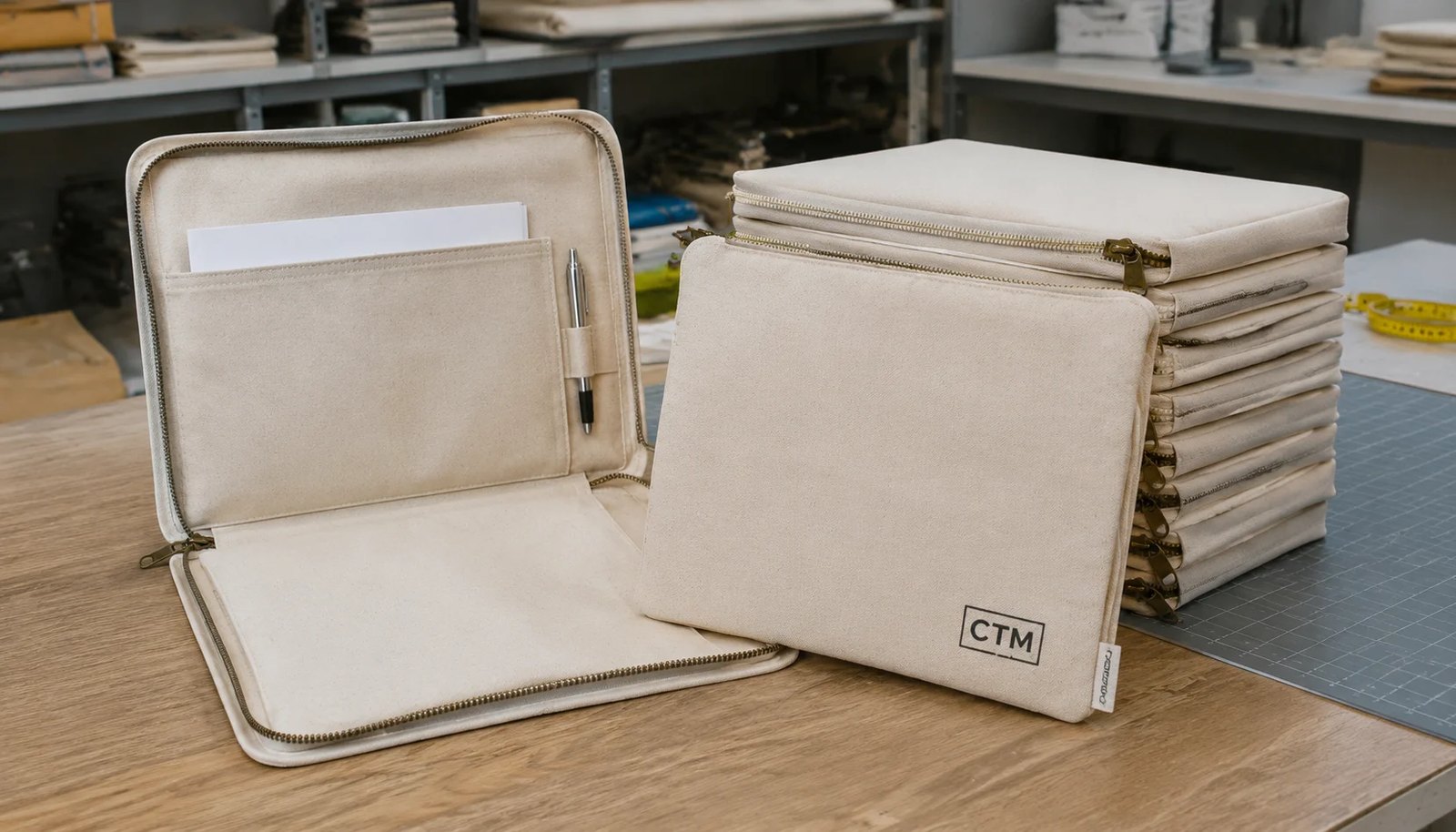
Canvas zipper portfolios are not a standard grocery bag with a zipper added. For natural grocers, the buying purpose usually falls into one of four areas: staff training folders, vendor meeting kits, loyalty or membership gifts, and retail merchandise near stationery or checkout. Each use case changes the acceptable fabric weight, zipper grade, interior layout, packing style, and price ceiling.
A procurement team gets better pricing when the RFQ states the business purpose instead of only asking for a custom canvas portfolio. A staff-use portfolio can be simpler and packed in bulk cartons. A retail item may need a hangtag, barcode sticker, cleaner folding, individual sleeve, and stricter cosmetic inspection. Those requirements affect labor minutes and carton volume more than many buyers expect.
- For internal staff use, prioritize zipper durability, document fit, and bulk packing efficiency.
- For vendor meeting kits, prioritize a neat logo, A4 or letter paper fit, pen loop, and professional hand feel.
- For retail resale, add barcode label, hangtag, cleaner thread trimming, and presentation packing.
- For loyalty gifts, keep decoration simple and put more budget into fabric feel and zipper reliability.
Choose fabric weight before comparing unit prices
The biggest mistake in canvas zipper portfolio sourcing is comparing quotes where one supplier uses 8 oz canvas and another uses 12 oz or 16 oz canvas. The product name may look the same, but the result is not. A 12 oz natural cotton canvas, roughly 390-420 GSM depending on finishing and weave, is a practical middle point for bulk grocery programs. It has enough body to hold documents without feeling like a thin pouch, but it still folds and packs efficiently.
A heavier 14 oz or 16 oz canvas can look more premium, but it raises material cost, needle wear, sewing time, carton weight, and freight. It may also make the zipper seam bulky if the design has folded edges or inner pockets. Lighter 8 oz or 10 oz canvas may fit a giveaway budget, but it can wrinkle heavily and collapse when a buyer places documents, order forms, or a small tablet inside.
- Budget tier: 10 oz canvas, about 310-340 GSM, only for light promotional use.
- Balanced tier: 12 oz canvas, about 390-420 GSM, suitable for most grocery procurement programs.
- Premium tier: 14-16 oz canvas, about 450-540 GSM, better hand feel but higher freight and sewing cost.
- Specify whether the canvas is natural unbleached, dyed, washed, or stiff finished because each changes shrinkage and shade.
Build the portfolio spec around paper size and zipper clearance
For natural grocers in North America, most buyers choose letter-size capacity. For importers selling into mixed regions, A4 capacity may be safer. The finished outside size should allow paper insertion without fighting the zipper opening. If the portfolio is too close to the paper size, staff will bend documents at corners and the zipper tape will take unnecessary stress.
The zipper should sit on the long side or around two sides depending on the design. A simple top zipper is cheaper and faster to sew. A wrap zipper around two sides improves access but adds labor and increases the chance of corner puckering. If the portfolio includes an interior pocket, business card slot, or pen loop, those should be designed after the finished paper fit is confirmed, not squeezed in after the first quote.
- Common outside size for letter documents: around 350 x 260 mm, adjusted for seam allowance and pocket layout.
- Common outside size for A4 documents: around 360 x 270 mm, with enough opening width for easy insertion.
- Keep zipper tape and printed logo away from thick folded seams to avoid distortion.
- If using a gusset, define the gusset depth clearly; even 20-30 mm changes fabric consumption and packing volume.
Use MOQ logic instead of chasing the lowest first quote
Bulk pricing for canvas zipper portfolios is mainly controlled by fabric buying efficiency, cutting yield, printing setup, zipper procurement, and sewing line balance. A first custom run at 500 pieces can be realistic when using standard natural canvas and a simple one-color logo. The unit price usually improves at 1,000 pieces because printing setup and cutting preparation are spread over more units. At 3,000 pieces, the factory can plan fabric rolls, zipper color, packing materials, and line time more efficiently.
The hidden MOQ issue is artwork splitting. If a grocery chain wants five regional logos at 200 pieces each, the factory may treat each logo as a smaller print run even if the total order is 1,000 pieces. The same applies to different zipper colors, thread colors, pocket layouts, or store-specific labels. To protect bulk pricing, keep the base item common and separate personalization only where it is truly needed.
- 500 pcs: good for pilot orders, but sample and setup cost have a larger effect on unit economics.
- 1,000 pcs: better for first chain-wide deployment or distributor stock order.
- 3,000 pcs and above: stronger position for fabric booking, zipper purchasing, and carton optimization.
- Avoid splitting one order into too many small artwork variants unless the merchandising value justifies the cost.
Print method: match the natural grocery look to production reality
Most natural grocer programs use a simple logo, store message, or sustainability statement. On natural cotton canvas, screen printing is usually the best cost-performance choice for one or two solid colors. It gives a clean, durable mark when the ink is mixed and cured correctly. Buyers should approve a strike-off on the same canvas as bulk production because natural cotton flecks and yarn texture change the appearance of fine lines.
Heat transfer can reproduce gradients and small details, but it may look less integrated with the fabric and can change the hand feel. Embroidery is possible, but on a zipper portfolio it increases cost and may create backing marks inside the product unless the construction is planned for it. Woven labels are useful when a subtle brand mark is preferred, but they require label MOQ and add sewing operations.
- Use screen print for bold one-color or two-color CTM-style logos and clean grocery branding.
- Use heat transfer only when artwork includes gradients, photo-style graphics, or very small multi-color details.
- Use woven label for a quieter retail finish or when the main panel must remain mostly natural canvas.
- Set a print placement tolerance before production; plus or minus 3 mm to 5 mm is more realistic than expecting zero movement.
Quote comparison: separate cost drivers that suppliers often bundle
A useful bulk pricing plan separates the base product cost from the items that change by artwork, packing, or logistics. When everything is hidden inside one unit price, procurement cannot tell whether a supplier is cheaper because of better efficiency or because they removed a material detail. For a canvas zipper portfolio, the quote should show fabric spec, zipper type, print cost, interior layout, packing method, carton quantity, and price basis.
FOB pricing is usually easier for importers and distributors to compare because export handling is included to the named port. EXW can look cheaper but may exclude inland transport, customs documentation, terminal handling, or export service. For a retail buyer buying through a domestic distributor, landed cost may matter more than FOB, but the upstream factory quote still needs clean data so freight and duty estimates are not guessed.
- Base product: canvas shell, zipper, thread, inner pocket, cutting, sewing, trimming.
- Branding: screen setup, ink mixing, print labor, strike-off, curing, inspection.
- Packing: polybag or kraft sleeve, hangtag, barcode sticker, carton, carton liner if needed.
- Export data: carton dimensions, gross weight, net weight, pieces per carton, FOB port, lead time.
- Commercial terms: sample cost, sample refund policy if any, deposit, balance payment, inspection timing.
Sample approval should test construction, not only appearance
A good pre-production sample is a small production test. It should use the actual fabric weight, zipper, thread, print method, pocket layout, and packing approach. If the factory uses substitute canvas or a temporary zipper for the sample, the buyer should treat it as a shape sample only. That may be enough early in development, but not enough to release bulk production.
For natural canvas portfolios, shade and hand feel can vary between fabric lots. The approved sample should be sealed or clearly marked, and both buyer and factory should keep one. The final inspection should compare bulk goods against that sample for fabric shade range, logo color, zipper behavior, and overall stiffness. This is especially important when the item will be sold in stores, where customers may compare several pieces side by side.
- Measure finished width, height, zipper opening, and pocket position on the sample.
- Open and close the zipper repeatedly to find catching, tape wave, or corner stress.
- Insert actual documents, order forms, or training materials to confirm usable capacity.
- Rub the printed logo after curing to detect poor ink adhesion or under-cured print.
- Review packing with the sample because tight folding can crease the logo or bend the zipper.
Set QC thresholds that a factory can inspect consistently
Canvas is a natural material, so the QC standard should be practical. Tiny cotton seed flecks, slight yarn slubs, and small shade movement are normal on natural unbleached canvas. Serious defects are different: oil stains, mildew odor, broken yarns, large dark marks on the logo area, skipped stitches, zipper failure, misaligned pockets, and badly tilted printing. Defining this distinction in the purchase order prevents arguments during final inspection.
For dimension control, sewn canvas portfolios should not be judged like molded plastic parts. A tolerance of plus or minus 5 mm on width and height is often workable, depending on size and construction. Print placement can usually stay within plus or minus 3 mm to 5 mm if jigs are used. Zipper function should be close to zero tolerance because a stuck zipper makes the whole item unusable.
- Critical defects: zipper cannot close, sharp metal edge, broken seam, wrong logo, mildew smell, severe stain.
- Major defects: noticeably crooked logo, open seam, skipped stitches at stress point, pocket not usable, wrong size beyond tolerance.
- Minor defects: small natural flecks, tiny thread ends, slight shade variation within approved range.
- Inspection timing: inline check after first production output and final random inspection before shipment release.
- Keep carton samples after inspection if the order is split across distribution centers.
Packing choices affect both presentation and landed cost
A canvas zipper portfolio is flat, but it is not weightless. Heavy canvas, zipper hardware, inner panels, and retail packing can push carton weight up quickly. A typical packing plan may use 25 to 50 pieces per export carton depending on size and fabric weight. More pieces per carton lowers carton cost but can compress products, crease printed areas, or make cartons too heavy for warehouse handling.
Natural grocers often prefer reduced plastic, but ocean freight and warehouse storage create moisture risk. If using kraft sleeves instead of individual polybags, consider a carton liner or moisture control method. For retail programs, barcode labels and hangtags need to be positioned so they do not cover the logo or damage the fabric when removed. For staff distribution, simple bulk packing may be more responsible and cheaper.
- Individual polybag: best moisture protection, lowest cosmetic risk, but more plastic use.
- Kraft sleeve: better retail presentation for natural brands, but needs humidity-aware carton packing.
- Bulk pack: lowest cost for internal deployment, but requires clean warehouse handling.
- Carton markings: include SKU, PO number, color, quantity, carton number, and destination if split shipment is planned.
- Do not finalize freight estimates until carton dimensions and gross weight are confirmed after sample packing.
Lead time risk comes from materials and artwork changes
The production calendar for canvas zipper portfolios normally starts after sample approval, artwork approval, and deposit. Bulk lead time depends on fabric availability, zipper color, printing workload, sewing capacity, and packing material readiness. Natural canvas is often easier to source than custom dyed fabric, but the exact weight and finish still need booking. Custom zipper tape, pullers, or woven labels can extend the schedule.
The fastest way to lose a shipment window is to keep changing artwork after strike-off approval. A small logo size change may require a new screen, new placement jig, and another approval round. If the order supports a grocery launch date, regional meeting, or seasonal retail shelf date, build the schedule backward from the required warehouse arrival date, not from the date someone hopes production can begin.
- Development phase: artwork review, material confirmation, first sample, printed strike-off.
- Approval phase: buyer comments, revised sample if needed, sealed pre-production sample.
- Bulk phase: fabric cutting, printing, curing, sewing, trimming, inline QC, packing.
- Shipment phase: final inspection, carton measurement, booking, export documents, pickup.
- Schedule protection: freeze logo, fabric weight, zipper type, and packing before bulk materials are purchased.
Specification comparison for buyers
| Spec decision | Recommended option | When it fits | Buyer risk to check |
|---|---|---|---|
| Main fabric weight | 12 oz canvas, about 390-420 GSM | Balanced cost and structure for grocery staff meetings, vendor files, and light retail resale | Below 10 oz may collapse after packing; above 16 oz increases freight and sewing time |
| Zipper style | No. 5 nylon zipper with metal puller or cotton tape pull tab | Good for daily opening, smoother than low-grade metal zipper, easier color matching | Require zipper pull test and slider movement check; cheap sliders cause most early complaints |
| Print method | Screen print for 1-2 color grocery logo; heat transfer only for fine gradients | Best unit cost for bulk natural canvas portfolios with simple brand marks | Natural canvas absorbs ink unevenly; approve actual fabric strike-off, not paper artwork |
| Interior layout | One document pocket plus business card slot and pen loop | Useful for buying teams, training folders, supplier meetings, and regional managers | Too many compartments raise labor cost and create tolerance problems at binding seams |
| MOQ planning | 500 pcs for first custom run; 1,000-3,000 pcs for stronger tier pricing | Works for a grocery chain pilot or one seasonal merchandising campaign | Changing artwork by store region can split MOQ and remove price advantage |
| Branding position | Front lower right or centered 80-120 mm logo, leaving zipper seam clearance | Keeps a clean natural-grocery look without turning the portfolio into a giveaway billboard | Logos too close to edge may distort during stitching or disappear under seam allowance |
| Packing method | Individual polybag or kraft sleeve, then 25-50 pcs per export carton | Polybag protects from moisture; kraft sleeve supports plastic-reduction retail programs | Kraft-only packing needs humidity control and carton liner for ocean freight |
| Price basis | Quote FOB with separate sample, mold, print setup, inner packing, and carton data | Allows procurement to compare factories without hidden charges inside the unit price | A very low EXW quote may exclude inland transport, export documents, and carton upgrade |
Buyer checklist before sampling
- Define the use case first: staff document holder, vendor meeting kit, loyalty gift, or resale item.
- Select one base fabric weight before requesting quotes; 12 oz natural canvas is a practical starting point.
- Provide finished size, zipper side, gusset depth if any, pocket layout, print size, and artwork color references.
- Separate the quote into product cost, printing cost, sample cost, packing cost, and freight-ready carton details.
- Request a physical pre-production sample using the real canvas, real zipper, real thread, and real logo method.
- Set acceptance tolerances for finished dimensions, zipper movement, print position, print color, and seam strength.
- Confirm carton quantity, carton dimensions, gross weight, moisture protection, barcode or retail label needs.
- Protect the schedule by locking artwork and fabric color before bulk cutting starts.
- For multi-store distribution, provide carton marking and packing split requirements before production, not after.
- Keep one approved sample at the factory and one with your buying team for final inspection comparison.
Factory quote questions to send
- What is the exact fabric specification: cotton content, canvas construction, ounce weight, and approximate GSM after finishing?
- Is the quoted zipper No. 5 nylon, resin, or metal, and what pull strength or slider standard is used in factory inspection?
- Does the unit price include screen printing setup, ink mixing, strike-off, and one-color or two-color logo application?
- What MOQ applies to the base portfolio, and what MOQ applies if we split logo colors, store names, or regional artwork?
- What is the sample lead time for a printed prototype and what parts of the sample are production-grade versus substitute materials?
- What are the finished size tolerance, print placement tolerance, and acceptable defect level used for final inspection?
- How many pieces are packed per inner carton and master carton, and what are the estimated carton dimensions and gross weight?
- Can you quote FOB and also provide an estimated EXW comparison so our forwarder can calculate landed cost accurately?
- What is the normal bulk lead time after sample approval, and which materials must be booked before purchase order deposit?
- Will the factory keep a sealed approval sample for inline and final QC comparison?
Quality-control points to confirm
- Fabric weight should be verified by cutting a measured swatch and weighing it, not only by supplier declaration.
- Finished portfolio size should stay within agreed tolerance, commonly plus or minus 5 mm for width and height on a sewn canvas item.
- Zipper must open and close smoothly for several full cycles without tooth separation, slider catching, or tape puckering.
- Print position should stay within approved tolerance, commonly plus or minus 3 mm to 5 mm depending on logo size.
- Logo ink should pass a dry rub test and a light scratch check after curing; natural canvas can show weak coverage if under-cured.
- Main seams and zipper seams should have even stitch density, no skipped stitches, and secure backtacks at stress points.
- Interior pocket edges should be flat enough for paper insertion without catching on loose threads or raw seam edges.
- Cartons should be dry, correctly marked, and strong enough for stacking; canvas products absorb odor and moisture during poor storage.
- Metal components, if used, should be checked for oxidation marks, sharp edges, and color inconsistency before packing.
- Final inspection should compare bulk goods against the sealed approved sample for fabric shade, hand feel, construction, and logo execution.