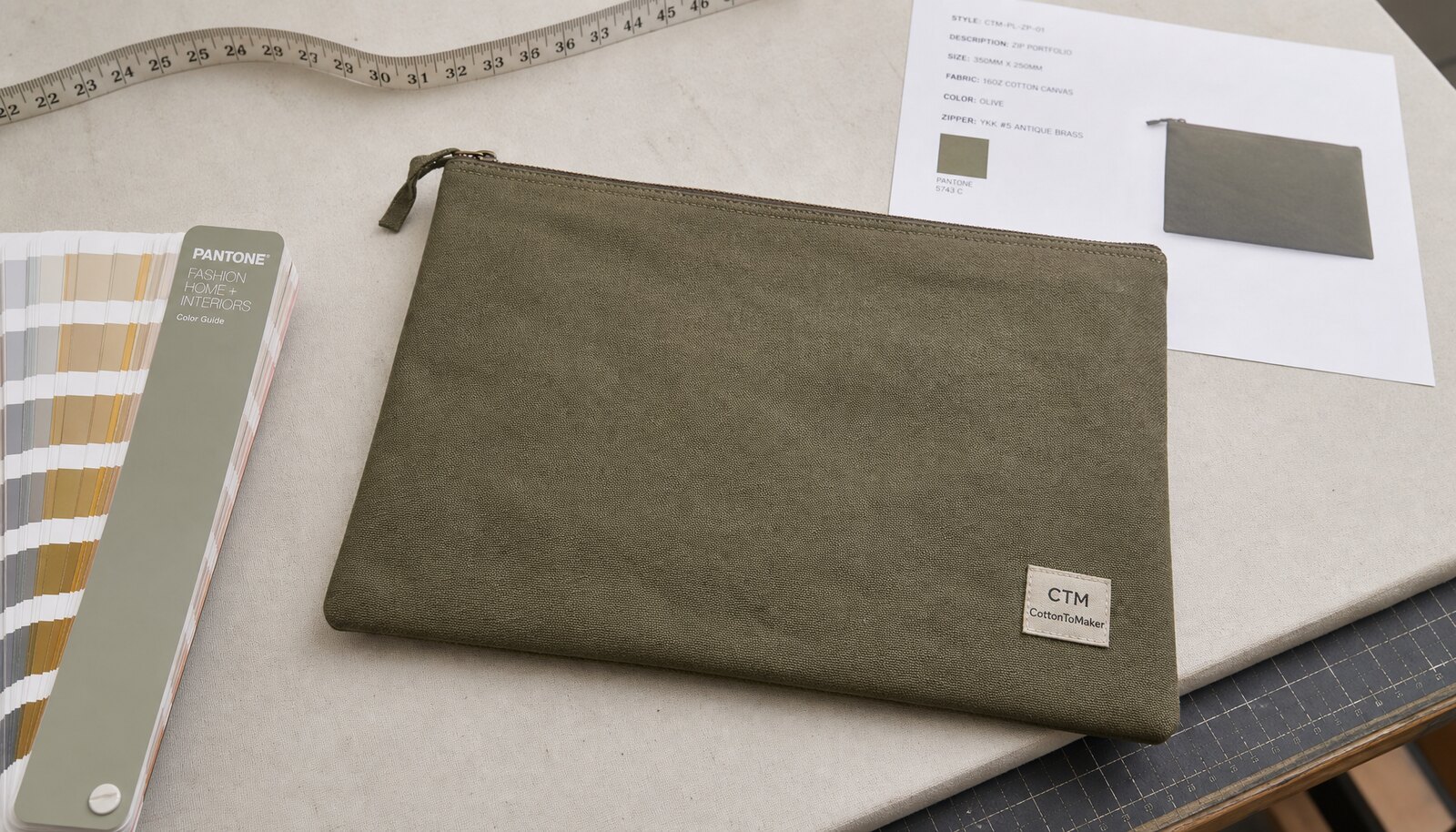
Why boutique wineries need a tighter proofing process
Canvas zipper portfolios for boutique wineries sit in a narrow space between utility and brand presentation. They are used to carry tasting notes, menu inserts, sales decks, vineyard maps, membership materials, or retail collateral, but they still have to look polished enough to represent a premium label. That combination makes small production details more important than they would be for a plain pouch or office folder.
The risk is that the product seems simple at the buying stage. A supplier may say 'canvas zipper portfolio' as if one spec fits all, but the result changes quickly with fabric weight, weave density, zipper grade, pocket layout, and print method. A logo that looks fine in an email proof can shift once it is printed on woven canvas and sewn around a zipper seam. For a boutique winery, that is not just a cosmetic issue; it affects guest perception, distributor confidence, and retail sell-through.
Procurement teams should therefore treat this as a controlled print-and-sew purchase, not just a decorated bag order. The proofing process needs to confirm three things together: how the canvas feels and holds shape, how the logo prints on the actual fabric, and how the zipper and seams affect the final appearance. If those three elements are not approved together, the bulk run can drift away from the sample even when the supplier technically 'followed the art file.'
- Define the product’s job first: guest-facing presentation, retail merchandise, or internal organizing, because each one changes acceptable finish and cost.
- Treat the sewn sample as the contract reference, not just the printed artwork.
- Expect zipper placement, seam allowance, and fabric stiffness to influence logo placement more than a first-time buyer usually anticipates.
Start with the use case, not the logo file
The right spec depends on how the portfolio will be used. A tasting room gift item that holds a few brochures needs a different build from a sales kit that carries a menu set, note cards, or a slim notebook. If the portfolio is intended for retail sale, the buyer usually wants a cleaner face, stronger zipper feel, and more stable stitching than a simple promotional pouch would need. If it will be used by staff or at events, function may matter more than a fully polished retail finish.
This is why the first RFQ question should not be 'what is your price?' It should be 'what exactly must the portfolio hold, and how often will it be opened?' That answer affects finished size, gusset depth, zipper size, interior layout, and whether the logo can safely cross a seam. A winery that plans to insert menus or tasting sheets should measure the actual stack thickness, not just the paper size, because paper weight and lamination can change the usable space significantly.
The most useful procurement brief includes the intended contents, target presentation level, and distribution channel. A tasting room giveaway can usually tolerate a softer canvas body and a simpler interior. A boutique retail item should usually get more structure, cleaner topstitching, and a more controlled print position because the buyer will compare it visually against other premium branded goods.
- State what goes inside the portfolio, including the thickness of paper, sleeves, or inserts.
- Declare the sales channel: tasting room, direct shipping, distributor, or retail shelf.
- Set the appearance target in plain language, such as 'premium gifting' or 'staff utility', before discussing decoration.
Choose the canvas weight and build before comparing print quotes
Canvas weight is one of the easiest ways to misread a quote. Buyers often receive a generic 'canvas' description without a real GSM or ounce figure. That creates problems because the difference between a lighter promotional canvas and a denser retail canvas is visible in hand feel, edge definition, wrinkle resistance, and how the print sits on the surface. For most boutique winery portfolios, 12 oz to 14 oz canvas, roughly 340 to 470 GSM, is the practical middle ground.
A lighter fabric, around 10 oz, can work for low-cost event use or internal organization, but it often looks softer and can telegraph seams more easily. Heavier fabric can feel more premium, but it raises sewing resistance, can bulk up the zipper line, and may cost more to ship. If the buyer expects the portfolio to lie relatively flat in a tasting room drawer or retail display, a medium-weight canvas is usually easier to manage than an overly stiff build.
Procurement should also ask for the fabric finish. Washed canvas, raw canvas, or coated canvas will behave differently in print and sewing. A fabric with more surface finishing may reduce ink spread but can also change the hand feel and make the bag more structured than expected. Ask the supplier to state whether the quoted price assumes pre-shrunk, bio-washed, or untreated material, and verify that the same finish is used on the sample and bulk run.
- Use a written fabric spec: GSM or ounce weight, weave type, finish, and color code if dyed.
- Ask for a measured size chart, not just a marketing description.
- If fit matters, request the finished inner usable width and height after seams and zipper tape are added.
Print method choice should be matched to artwork complexity and order size
The decoration method drives both appearance and rework risk. For a winery logo that uses one to three solid colors, screen print is usually the most stable option because the edges are predictable and the unit cost works well for repeat orders. Screen printing also tends to hold a more intentional, tactile feel on canvas, which suits many premium brands. If the artwork changes often, includes gradients, or needs a very small initial run, heat transfer or digital print may make more sense.
That said, the right method is not determined by the supplier’s default machine. It is determined by the artwork, the target order size, and the acceptable finish. A detailed vineyard illustration may look better digitally, while a strong wordmark or crest may look cleaner as a screen print. Buyers should ask the supplier to show the proof on the actual production fabric, because canvas texture changes how fine lines, small text, and half-tones appear.
For print proofing, request more than a digital mockup. A supplier should provide a physical strike-off or at least a print sample on the real canvas used for production. Review it under the same lighting that will be used for approval, ideally neutral indoor light. Then look for color accuracy, ink coverage, and edge sharpness. If the design crosses a seam or sits close to the zipper tape, confirm that the sample still reads cleanly after sewing, because alignment can change once the panels are assembled.
- Screen print: best for simple logos, fixed color counts, and repeat orders.
- Heat transfer: useful for variable graphics or short runs, but test rub resistance and edge durability.
- Digital print: helpful for detailed or seasonal artwork, but confirm lot-to-lot consistency on the same fabric.
Use a side-by-side comparison to make quotes truly comparable
A procurement quote is only useful if the supplier gives enough detail to compare it against other bids. Many price differences are caused by hidden spec changes rather than genuine savings. One supplier may quote a lower unit price but use lighter canvas, a lower-grade zipper, or a simpler packing method that pushes more work to the buyer. Another may look expensive at first but include better material control, a sewn sample, and cleaner carton packing that reduces inspection time and damage risk.
The easiest way to compare suppliers is to standardize the quote request. Ask every supplier to quote the same canvas weight, the same finished size, the same print method, the same zipper size, the same packing format, and the same sample policy. Then compare the landed cost after sample charges, setup costs, internal packing, and freight assumptions are added. This prevents the most common buying mistake in this category: selecting the lowest unit price without noticing that the spec is not the same.
For boutique wineries, the side-by-side comparison should also show use-case fit. A gift-shop retail version may justify better print definition and a smoother zipper pull. A back-office organizer may not. Procurement should decide where the brand standard is non-negotiable and where cost can be trimmed without affecting guest perception. That conversation should happen before the PO, not after the first shipment arrives.
- Do not compare prices until the spec sheet is normalized.
- Require the supplier to itemize sample cost, setup charges, and packing upgrades.
- If two quotes differ, ask whether the difference is material, trim, print, or packing.
MOQ, lead time, and supplier route affect consistency more than many buyers expect
MOQ is not just a number on a quote; it is a control mechanism. A supplier with a normal production MOQ can usually hold fabric consistency, zipper sourcing, and print setup more reliably than a supplier promising very small quantities at the same price. If the order is for a new winery design, low MOQ can help reduce launch risk. If the product will be reordered or used across multiple tasting rooms, a standard MOQ usually gives better cost stability and fewer material substitutions.
Lead time should be broken into separate steps: sample making, bulk material booking, print approval, sewing, packing, and export handoff. A single '25-day lead time' does not tell procurement where the schedule can slip. If the fabric is custom dyed, the date may depend more on color confirmation than on the sewing line. If the print needs a revised proof, the schedule can move by a week or more. Buyers should ask the supplier to identify the critical path and the point at which changes become chargeable.
Supplier route matters too. Direct factories usually offer clearer control over sewing quality and material traceability, which is helpful when the product is part of a premium brand program. Trading companies or sourcing agents can be useful when the buyer needs multiple items consolidated, but procurement should still confirm who owns the sample, who signs off on production, and who is responsible if the fabric lot or zipper spec changes. If the actual factory is not visible, the buyer should ask for photos of the line, material labels, and the inspection process rather than relying on a sales summary.
- Low MOQ is useful for new art or seasonal programs, but ask what tradeoff the supplier made to offer it.
- Standard MOQ usually improves fabric consistency and lowers setup cost per piece.
- If the project is seasonal, lock the artwork and packing before asking for a final lead-time commitment.
Make the sample stage do real work, not just look good
A good pre-production sample should answer the questions that a flat digital proof cannot. It should show the actual canvas weight, the actual zipper build, the actual stitching, and the actual logo placement. For this product, a paper proof alone is not enough because the finished look depends on how the print behaves after sewing and how the zipper line sits relative to the front panel. The sample should therefore be built from production materials, not from a substitute fabric or a generic zipper.
During sample review, check the product as a user would. Open and close the zipper several times. Place the intended insert inside. Hold the portfolio at normal viewing distance to see whether the logo feels centered and whether seam lines interfere with the artwork. If the buyer plans to use it for menus or tasting sheets, confirm that the opening angle and internal width allow pages to slide in without bending. That functional check matters as much as decoration quality.
Keep a clear approval record. Save the physical sample if possible, and photograph the front, back, zipper edge, seam details, and any areas that could become a dispute later. Write down the measured dimensions, the approved print file name, the color reference, and any agreed deviations. This record becomes essential if the bulk shipment arrives and the supplier says the variation is within normal range. The better the sample record, the easier it is to enforce the agreed standard.
- Require one sewn sample with production fabric and production zipper.
- Confirm that seam lines do not cut through important text, crests, or thin logo strokes.
- Keep photos and notes with measured dimensions and the approved file name.
Set tolerance numbers and defect limits before bulk production starts
Many buying problems come from approval language that is too vague. 'Looks good' is not enough for a custom branded product. Procurement should define reasonable tolerances in writing so the factory knows what counts as acceptable. For small portfolios, a finished-size tolerance of plus or minus 0.25 in, or plus or minus 5 mm, is a practical starting point for many programs, though the exact limit should reflect how tight the inserts fit. For centered logos, a placement tolerance of plus or minus 0.125 in, or plus or minus 3 mm, is often suitable for simple retail presentations.
Color should also have a written acceptance basis. If the winery uses strict brand colors, ask for a physical reference, such as an approved print strike-off or a Pantone target, and specify the approval lighting condition. The bulk run should not rely on memory or screen appearance alone. If the supplier cannot match exact tone across the entire run, the buyer should know that before production begins rather than after cartons are packed.
Defect limits should be practical, not unrealistic. A buyer may allow a small number of minor cosmetic flaws if the order is large and the product is low-risk, but visible defects on the front panel, a faulty zipper, a crooked logo, or a stained piece should normally be rejected. It helps to separate major defects from minor ones. Major defects are those that affect function, brand appearance, or fit. Minor defects are those that do not affect use but still need monitoring, such as a tiny loose thread outside the visible area. Put the limits in writing so the supplier knows when rework, replacement, or discount discussion is justified.
- Write tolerance numbers into the PO or quality agreement.
- Separate major defects from minor trim issues.
- Use the physical approved sample as the color and placement reference.
Packing and carton planning should protect appearance, not just count pieces
Canvas zipper portfolios are often assumed to be rugged, but the printed surface and zipper pull can still be damaged in transit if packing is loose. If the product is supplied to a winery’s retail program, a distributor, or a fulfillment center, then packing needs to support clean receiving and low damage rates. That usually means individual polybags, clear size or SKU labels, and carton counts that are easy to audit.
The buyer should ask for the packing structure before bulk production is approved. How many pieces go in one polybag? Is there a desiccant or insert card? How many units per inner carton and per master carton? What is the carton size and gross weight? These details affect freight pricing, warehouse handling, and how easy it is to reconcile shortages or overages. A quote that ignores carton dimensions can produce a misleading freight estimate later.
For retail or gifting use, cartons should protect against scuffing and crushing. Printed canvas can rub if pieces are packed too tightly without separation. If the supplier uses a carton configuration that stacks too much pressure on the zipper pull, the product may arrive with a visible line or a bent puller. Ask for a pack-out photo or a sample carton configuration if the product is especially presentation-sensitive.
- Use individual polybags if the portfolio will be handled as a retail item or shipped long distances.
- Confirm carton count, gross weight, and carton dimensions before freight booking.
- Avoid loose stacking if the print surface can rub or the zipper pull can press into the fabric.
A supplier-ready RFQ should make verification easy
The strongest RFQ is the one that lets a factory answer clearly without guessing. A simple product name is not enough. Provide a tech pack or spec sheet with dimensions, canvas weight, finish, zipper details, logo file, print count, placement diagram, packing requirements, and a clear sample approval path. If the winery has brand rules, attach them. If the portfolio must fit a specific insert, include the insert size and a physical measurement of the stack thickness.
Your RFQ should also ask the factory how it verifies the quote. Good suppliers can state where material is sourced, how print quality is checked, and how the sample is approved internally before bulk sewing begins. They should be able to explain whether they hold fabric for the run before sample approval or only after. They should also tell you who will inspect the first pieces off the line. Those answers help procurement judge whether the supplier really controls the process or is only passing requests down the chain.
If the product is going to be reordered, define the repeat order reference. Keep the approved artwork file name, sample photo set, and the date of approval in one place. That makes future buying much easier and reduces the chance that a re-order drifts into a near-match that looks slightly different on shelf. For a boutique winery, repeatability is often part of the brand value itself.
- Attach a tech pack or at least a one-page spec sheet with dimension and material details.
- Include brand rules, insert size, and print placement drawings when relevant.
- Save the approved sample record for reorder control.
Specification comparison for buyers
| Procurement decision | Better option for this use case | Why it fits boutique wineries | Tradeoff or supplier risk to verify |
|---|---|---|---|
| Fabric weight | 12 oz to 14 oz canvas, about 340 to 470 GSM | Gives enough body for a premium presentation piece while still folding neatly for packing and retail display | Lightweight fabric can wrinkle, show print distortion, and feel less premium; heavy fabric can increase bulk, sewing difficulty, and freight weight |
| Print method | Screen print for 1 to 3 solid colors; heat transfer or digital for short runs, gradients, or seasonal art | Screen print usually gives the cleanest feel for winery logos and is efficient for repeat orders; transfer or digital helps when artwork changes often | Screen print needs tighter color control and registration; transfer can edge-lift or rub if the wrong film or heat setting is used; digital needs lot-to-lot color checks |
| Supplier type | Direct factory for repeat programs; trading company only when consolidating multiple SKUs or coordinating different product lines | Direct factories usually give better visibility on fabric lot, sewing line control, and rework handling, which matters for brand consistency | Trading routes can be useful for complex sourcing, but procurement should confirm who controls the actual QC, sample approval, and fabric buying |
| Zipper spec | Nylon coil zipper, typically size 5 for most portfolios; size 3 only for very slim builds | Coil zippers are light, flexible, and usually smoother for canvas products that are opened often in tasting rooms or office use | A low-grade slider may jam or feel loose; metal zippers can add weight and may not suit the softer canvas look some wineries want |
| Interior layout | Single compartment with optional slim divider or pen loop | Keeps the product clean and easy to sew, while matching the simple document-carrying use of tasting menus, sales decks, and membership packets | Too many pockets can raise sewing complexity and cost without adding buyer value; no divider may be too plain for premium retail positioning |
| MOQ route | Standard production MOQ with fixed fabric, fixed print, and fixed size | Often gives the best balance of price stability and consistent material sourcing | Very low MOQs can mean higher unit cost, mixed fabric lots, or looser control of zipper and trim consistency |
| Proof stage | Physical pre-production sample plus print strike-off on production fabric | Lets procurement verify look, fit, zipper function, and registration before the bulk run is locked | Skipping a sewn sample increases the chance of surprise issues in fit, seam placement, or logo positioning |
| Packing standard | Individual polybag, size label, then export carton with clear carton count and SKU marks | Makes receiving, shelving, and retail fulfillment easier for wineries and distributors | Loose stacking can scuff print surfaces and make shortage or mix-up claims harder to settle |
| Verification method | Written tolerance sheet with measured sample, approved artwork file, and signed QC reference photos | Gives the buyer a clear basis for acceptance if the bulk shipment arrives with questions | If the supplier does not preserve a physical or photo reference, disputes over color or placement become harder to resolve |
Buyer checklist before sampling
- Confirm the exact end use before quoting: tasting room giveaway, retail merchandise, sales presentation folder, membership packet, or event kit, because the use case changes size, zipper strength, and finish expectations.
- Lock the canvas weight in ounces or GSM and require the supplier to state an actual tolerance range rather than using only the word 'canvas'.
- Request the measured finished size, cut size, and usable internal space so the portfolio still fits the intended papers or inserts after seams and zipper tape are added.
- Approve artwork at actual size with Pantone, CMYK, or spot-color references, and mark any areas that must stay off seams, zipper tape, or top-stitch lines.
- Specify zipper type, zipper size, puller style, and tape color, then require a functional open-close test on the sample.
- Ask for a physical pre-production sample built with production fabric, production zipper, and the final print method before you release bulk production.
- Define packing by piece, inner carton, master carton, and SKU label format before production starts, not after goods are boxed.
- Ask the factory to state production lead time by stage: sample, material booking, printing, sewing, packing, final QC, and export handoff.
- Compare quotes only after normalization: same canvas weight, same zipper spec, same print method, same packing standard, and same sample policy.
- If the product will be used in retail or guest-facing settings, require the supplier to state cosmetic acceptance criteria for print, seams, and surface cleanliness in writing.
Factory quote questions to send
- What exact canvas weight, weave style, and finishing are included in the quoted price, and can you state the tolerance range for that fabric?
- Which print method is included, how many colors are allowed, and what setup, screen, plate, or artwork charges apply?
- What zipper size, zipper tape type, slider quality, and puller finish are included in the quote?
- Is the quoted price based on a pre-production sample approval, and will the sample cost be credited back if the bulk order is placed?
- What is the MOQ for the exact size, fabric color, print method, and zipper specification I need?
- Can you break the lead time into sample making, bulk production, packing, and shipping handoff days?
- What packing standard is included, including polybag type, insert card, silica gel if used, carton count, and carton mark format?
- What QC points are inspected before shipment, and what is the rework policy if print shade, stitch quality, or zipper function fails?
- Can you provide a measured photo of the sample with the approved size, placement, and zipper location marked?
- Who signs off on the production sample, and how are any later material substitutions disclosed before bulk sewing starts?
Quality-control points to confirm
- Fabric weight should match the agreed specification within a practical tolerance, such as plus or minus 5 percent, unless the buyer and supplier agree otherwise in writing.
- Finished dimensions should stay within an agreed tolerance, commonly plus or minus 0.25 in or plus or minus 5 mm for small portfolios, so the product still fits the intended inserts.
- Print placement should stay within the approved template, commonly within plus or minus 0.125 in or plus or minus 3 mm for centered logos unless the artwork requires a looser allowance.
- Print color should match the approved reference under normal indoor light, with no obvious shift that makes the winery brand look different from the proof.
- Registration on multi-color artwork should not show visible offset beyond a small tolerance, commonly no more than 1 mm on simple logos if the art uses tight edges or text.
- Zipper function should pass repeated open-close cycles on inspection units without snagging at the top stop, separating, or catching on seam junctions.
- Stitch length, seam allowance, and topstitch alignment should be consistent across the visible panels, with no loose thread tails left at customer-facing edges.
- Surface defects such as oil stains, glue marks, pen marks, fabric pulls, and storage crush lines should be absent or kept below the buyer’s cosmetic acceptance threshold.
- Carton counts should match the packing list exactly, and mixed sizes should not appear unless the buyer approved mixed packing in writing.
- If the buyer is ordering for retail or gifting, at least one sealed and one unsealed sample from bulk should be checked for scuffing, odor, and zipper feel before release.