Start from the winery date, not the factory date
Canvas zipper portfolios for boutique wineries are usually tied to a fixed event: harvest launch, wine club mailing, trade tasting, holiday gifting, or a tasting-room refresh. That changes how procurement should think about lead time. The relevant date is not when the factory says sewing ends. It is the date the winery needs the goods on hand, counted, and ready to use.
A realistic plan breaks the order into stages. First comes spec lock and content fit. Then sample approval. Then material booking. Then sewing, packing, inspection, and freight. If the buyer treats factory completion as the finish line, the calendar is already wrong. The safer approach is to work backward from the delivery date and assign a date to each gate, including a buffer for one revision, one freight delay, or one packing error that needs correction.
- Use the event date or club ship date as the anchor.
- Separate sample approval, production, inspection, and transit into different milestones.
- Treat any post-approval change as a schedule reset, not a minor edit.
Define the contents before you touch artwork
The biggest source of confusion in this category is that the product name sounds simple, but the use case is not. A canvas zipper portfolio may carry tasting notes, reservation cards, a brochure set, a corkscrew, or a retail insert. It may be handed across a counter, packed into an outbound kit, or used as premium packaging. Those are different jobs, and each one changes the right size, pocket layout, zipper reach, and amount of structure.
Procurement should define the contents first. Measure the real insert stack, not an idealized spec sheet. If the portfolio must hold thick paper stock or multiple inserts, test the fit with the full stack and close the zipper all the way. If it is meant to lie flat in a club mailer, focus on compression resistance and carton efficiency. If it is intended as a presentation piece, the surface finish and closure feel may matter more than extra internal volume.
- Document the exact contents, thickness, and any accessory items that must fit inside.
- Decide whether the unit is customer-facing, warehouse-facing, or mailer insert packaging.
- Approve the fit against the real contents before asking for a price comparison.
Use order size and region to estimate the real calendar
Lead time is not one number. It changes with supplier region, run size, and how much of the build is custom. A North American or nearshore supplier can often shorten the calendar by two to four weeks because sample turn, communication, and freight are simpler, but unit cost is usually higher. A supplier in East Asia can be very competitive on cost, yet it usually needs more planning because sample approval, material booking, and transit sit in different time zones and often involve longer freight windows.
A practical planning range for a standard build looks like this. If the factory already has stock canvas and stock zippers, sample turn may be 5 to 10 working days in a nearshore setup, or 7 to 14 working days in an overseas setup. Production for 500 to 1,500 units is often 10 to 20 working days nearshore and 15 to 30 working days overseas, assuming a simple build. Add 10 to 20 working days when the order needs custom-dyed canvas, branded zipper pulls, or multiple pockets. For sea freight, the transit window can easily add several weeks more; air freight is faster but should be reserved for urgent replenishment or launch recovery, not routine volume.
The cleanest rule is this: if the launch is under 45 days away, keep the spec simple and use stocked materials. If the launch is 60 to 90 days away, you have room for custom trim and a more detailed approval path. If the order is above 3,000 units, assume material booking and production sequencing will matter as much as sewing time.
- Ask the supplier to quote sample time, production time, and transit time separately.
- Add more buffer if the order uses custom trim, a new supplier, or ocean freight.
- Keep the first run simple when the launch date is close.
Choose materials and construction that match the run size
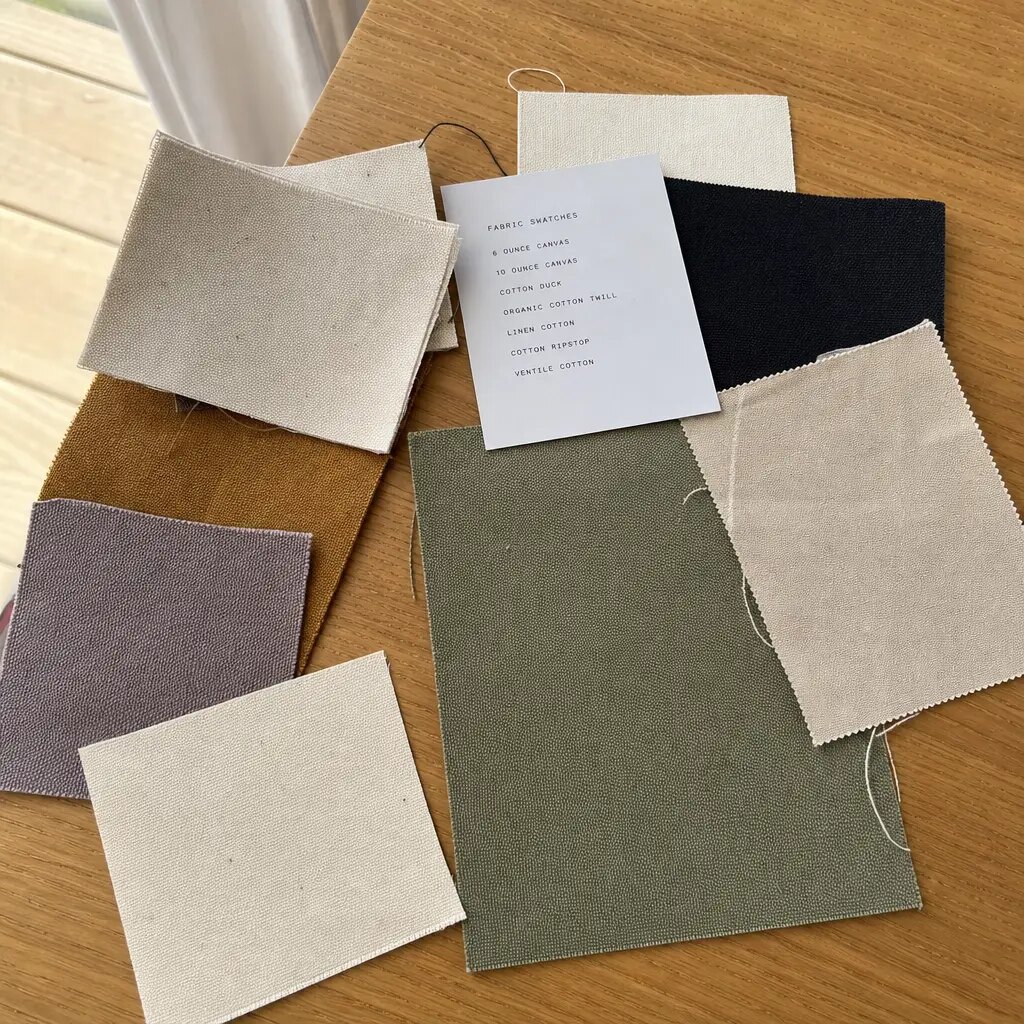
The right fabric weight is the one that fits the use case without creating avoidable delay. For many portfolio-style bags, a midweight canvas around 10 oz to 12 oz is the practical starting point. Move heavier only if the insert stack is thick, the piece needs a stiffer body, or the brand wants a more substantial hand feel. Heavier cloth can look premium, but it also increases sew time, seam bulk, and freight weight. If the batch is small and the calendar is tight, extra heaviness rarely buys enough value to justify the risk.
Construction should be equally disciplined. A single main compartment and one pocket is usually enough unless there is a real contents problem to solve. Gussets, extra bindings, and decorative layers all add cutting steps and alignment risk. For a launch-critical order, simplification is not a downgrade. It is a schedule control decision. Use the simplest build that still protects the contents and supports the brand presentation. Then confirm that the sample was made with the same cloth finish, same zipper grade, and same branding method you intend to buy in bulk.
- Use the lightest fabric that still holds the contents cleanly and closes flat.
- Keep the first order to one colorway if the calendar matters more than assortment.
- Avoid decorative construction unless it solves a measurable fit or durability problem.
Write an RFQ that produces comparable quotes
A weak brief creates a noisy quote set. One supplier quotes thicker canvas, another quotes a cheaper zipper, and a third assumes a different packing method. The unit prices may look close, but the products are not the same. The answer is a single build sheet that forces each bidder to quote the same spec: finished size, insert fit, fabric, zipper, puller, branding method, pack format, destination, Incoterm, and target delivery date.
The quote should also separate costs into visible buckets. Ask for sample charges, setup charges, unit cost, packing cost, and any freight or export handling the supplier will own. This matters more for small runs because setup charges can be a large share of the total. It also matters when the supplier is quietly using lower-cost assumptions. If the quote is low because it excludes the woven label, the branded puller, or the final carton labeling, it is not a useful quote. It is a partial estimate.
The best comparison is landed cost at the required date, not ex-works price on paper. For winery buyers, the cheapest quote is often the one that costs the most time later.
- Send the same tech pack and reference sample to every bidder.
- Ask which price elements are fixed and which change if the quantity shifts.
- Compare total landed cost, not only the factory unit price.
Approve samples in gates, not as decoration
A sample is only useful if it proves the actual production path. A hand-built mockup can help the team review proportion and branding placement, but it should not be the control sample if it was made with substitute cloth, a different zipper, or a different print method. That kind of approval creates false confidence. The sample that matters is the pre-production sample built from production materials, because it tells you whether the spec is repeatable at scale.
Set the approval in stages. First, confirm the visual direction. Then, approve the materials. Then, approve the pre-production sample against a written checklist. That checklist should include dimensions, zipper action, logo placement, seam quality, pocket fit, and packing format. If the sample differs from the final plan in any way, the deviation should be written down and signed off. That protects both sides when bulk production starts and someone later remembers the sample differently.
A good sample process should also expose calendar risk. If the supplier can turn a corrected sample quickly, that is a better signal than a cheap quote with a slow revision loop. Speed with control is what matters here.
- Approve only a pre-production sample made with production fabric, zipper, trim, and branding.
- Test the sample with the actual contents the winery will use.
- Record every approved deviation so the bulk order is not built against a moving target.
Set quality thresholds that the warehouse can enforce
Softgoods QC should measure function, not only appearance. A portfolio can look clean on a table and still fail in use if the zipper snags, the pocket is too shallow, the seams twist, or the logo drifts from unit to unit. For a boutique winery, that matters because the item is part of the guest experience. A small batch with visible defects is more damaging than a generic bulk item with the same defect rate.
Use simple rules that the receiving team can actually apply. Define zero-tolerance defects first: broken zippers, wrong artwork, missing branding, missing bar-tacks, or major stain marks. Then define the measurable tolerances for the rest: overall dimensions, pocket depth, zipper length, and logo placement. If you want AQL inspection, state it in the PO or quality agreement before production starts. Then test sample units from the top, middle, and bottom of the run, not just the first carton that came off the table. The final carton count and labels should match the PO exactly before freight booking is released.
Keep the quality standard tight enough to protect presentation, but not so vague that the factory guesses. Specificity is what keeps a premium small run from turning into rework.
- Set zero tolerance on broken zippers, wrong artwork, and missing reinforcement.
- Inspect units from different parts of the run, not only the nearest carton.
- Write the defect standard into the PO before sewing starts.
Treat packing and labeling as part of production
Packing decisions change labor time, damage risk, and receiving speed. A canvas zipper portfolio that is flat-packed with tissue or a protective polybag is usually easier to count and less likely to scuff than one packed loosely. For a winery warehouse, club fulfillment center, or retail distribution point, carton labels should match the buyer's receiving process. That means item code, color code, carton count, and destination marks that line up with the PO.
Packing also affects how the goods arrive. Overfilled cartons compress canvas and leave visible creases. Underfilled cartons let the product shift and rub. If the item will sit in storage before use, ask whether moisture protection is needed. If the receiving team uses scan-based intake, request barcode labels or SKU labels before cartons leave the factory. The goal is to reduce handling after arrival, not just make the cartons look organized at the plant.
If the quote leaves packing vague, the buyer often pays for it later in receiving labor, relabeling, or damaged presentation stock.
- Confirm whether each unit is tissue-wrapped, polybagged, or left open in the carton.
- Lock the carton count and carton dimensions before final approval.
- Make carton labels match the PO and SKU list so warehouse receiving is fast.
Put freight and Incoterms into the schedule early
Many lead-time misses come from confusion about where the factory's responsibility ends. The production finish date is not the same as the ship date, and neither one is the warehouse receipt date. If the quote uses EXW, FOB, FCA, or another Incoterm, the handoff point must be clear. FOB or FCA is often easier for buyers who want control over freight timing. EXW can look cheaper, but it shifts pickup and export coordination to the buyer. Delivered terms can work, but only when the seller has a proven logistics process and the buyer is comfortable with the handoff.
For a calendar-sensitive winery order, freight should be planned before production begins. Ask who books pickup, who pays origin charges, who handles export documents, who buys cargo insurance, and who owns destination handoff. If the order goes by sea, separate production completion from vessel departure, port transit, and warehouse check-in. If it goes by air, separate cargo readiness from airline booking and customs clearance. A factory can finish on time and still miss the launch if freight booking is left until the end.
Use the lead-time buffer where it matters most: not as a vague cushion, but as protection for one shipping delay, one inspection correction, or one packing rework cycle.
- State the Incoterm in the RFQ and repeat it in the PO.
- Ask for the earliest ship date and the likely transit window, not only the production finish date.
- Book freight with the real delivery date in mind, especially for event-driven launches.
Lock the PO and change control before sewing starts
The PO should turn the quote and the approved sample into a control document. Attach the sample photos, spec sheet, material specification, packing plan, inspection standard, and Incoterm. If the winery needs arrival within a specific window, say so in plain language. If the supplier must notify the buyer before changing anything, that rule should be written into the order. The goal is not more paperwork. The goal is fewer assumptions.
Change control matters because even small edits can move the calendar. A new canvas color, a different zipper puller, a revised logo position, or a different carton count can all trigger a material change, a new sample, or a new production delay. If the order is tied to a harvest launch or club shipment, that delay is expensive even when the unit price stays the same. Make the PO specific enough that the supplier knows what is approved, what is frozen, and what happens if the buyer changes scope after sign-off.
For boutique winery programs, the best result is usually the simplest one: one approved sample, one clear spec, one freight plan, and one named approver on each side.
- Attach the approved sample, spec sheet, and packing plan to the PO.
- Name the buyer-side approver so the factory knows who can sign off.
- Write the change-control rule into the order so scope changes trigger a new timeline.
Specification comparison for buyers
| Spec decision | Practical baseline | Cost / lead-time tradeoff | Buyer tolerance and failure modes |
|---|---|---|---|
| Fabric weight | Use midweight canvas around 10 oz to 12 oz for most portfolio builds; move to 12 oz to 14 oz only when the insert stack is thick or the piece needs more body. Keep roll weight variation within about +/-5% and ask whether the cloth was prewashed or resin-finished. | Heavier cloth feels more substantial, but it slows sewing, increases freight weight, and can make folds and zipper lines harder to control. | Check for shade drift between rolls, shrinkage after steaming, and body skew at the fold line. If the fabric finish differs from the sample, the batch can look and feel wrong even when dimensions are correct. |
| Zipper system | Use a standard nylon coil zipper, usually #5, with a puller finish that matches the artwork plan. Ask for zipper length tolerance within +/-5 mm and a smooth open-close action on the control sample. | Standard coil zippers are easier to source and usually shorten the approval cycle. Custom colors, branded pulls, or metal teeth can add sourcing time and extra sample turns. | Common failures are waviness, tape twist, mis-crimped stops, and color mismatch between the zipper and the approved sample. If the zipper locks up on the sample, it will usually get worse in bulk. |
| Construction | Keep the first run simple: one main compartment, one pocket only if it is doing real work, and standardized seam allowances. Use bar-tacks or reinforcement only where the product actually takes load. | Every extra pocket, gusset, or binding detail adds cuts, alignment checks, and a new place for tolerance stack-up. Simpler construction is faster to sample and easier to repeat. | Watch for puckering, crooked zipper runs, uneven top lines, and corner bulk. Set a finished dimension tolerance of about +/-3 mm on the key fit points, or tighter if the portfolio must house rigid inserts. |
| Branding method | For a first production run, a one-color screen print or woven label is usually the cleanest choice. Set logo placement tolerance around +/-2 mm and require the final method to be tested on production fabric. | Simple branding reduces artwork risk and sample churn. Gradients, tiny type, and multiple ink colors usually add proofing rounds and can delay approval. | Failure modes include bleed, ghosting, faint contrast on darker canvas, and logo drift across the batch. If the brand mark cannot be read clearly at arm's length, the spec is too loose. |
| Supplier model | Prefer a single softgoods factory that controls cutting, sewing, print, packing, and final inspection under one production owner. If any step is outsourced, make the subcontractor list explicit. | Fewer handoffs usually save 3 to 7 working days and reduce blame-shifting. Trading layers can still work, but only if they can name who owns each step and each delay. | Risk rises when the sample and bulk are made in different places, or when the supplier cannot state which site books material, approves artwork, and closes cartons. |
| Order size and MOQ | For 500 to 1,500 units, standard materials and a simple build usually keep the schedule manageable. Above 3,000 units, plan for longer material reservation and possible split sewing; above 10,000, assume the run may need phasing or split shipments. | Smaller runs carry higher setup cost per unit but are easier to move quickly. Larger runs reward simplification, same-dye-lot planning, and early material booking. | Watch for lot splits, shade variation, and a unit price that rises after the first quote because the supplier was pricing a smaller assumed quantity. |
| Sampling plan | Approve a pre-production sample made from production fabric, production zipper, final branding, and the actual packing method. Expect the sample-to-bulk delta to be about 5 to 15 working days if revisions are needed. | A real control sample costs more time than a mockup, but it protects the event date. If the factory can turn a corrected sample quickly, that is a stronger signal than a cheap quote. | Do not sign off a substitute-material prototype as the control. A mockup can hide fit problems, incorrect zipper behavior, or a finish that is impossible to repeat in bulk. |
| Packing method | Flat-pack the portfolio with tissue or a polybag, then use PO-matched counts and clear carton marks. Keep carton dimensions only as large as needed to reduce crush and dimensional-weight charges. | Better packing adds labor, but it saves warehouse time and reduces scuffing during transit. Tight cartons also make receiving easier for club fulfillment centers and winery warehouses. | Common failures are overfilled cartons, creased canvas, missing SKU labels, and count mismatches. If the receiving team has to re-sort cartons, you have lost the packing advantage. |
Buyer checklist before sampling
- Start with the use case: tasting-room handout, wine club mailer insert, trade-show kit, retail packaging, or a premium presentation folder.
- Measure the real contents first, including the full insert stack thickness, brochure size, any accessory item, and the closure pressure needed to keep everything flat.
- Lock the fabric weight, zipper grade, puller finish, pocket count, and branding method before asking for prices.
- Request one control sample built from production materials and keep it as the reference for bulk approval.
- Ask the supplier to quote the exact same build across all bidders, including setup, printing, packing, and any tooling or screen charges.
- Build the schedule backward from the winery event date and set milestone dates for sample approval, material booking, sewing, inspection, and freight booking.
- Ask which steps happen in-house and which steps are outsourced, then write down who owns each handoff.
- Confirm the production tolerance for width, height, pocket depth, zipper length, logo placement, and carton count.
- Specify the defect standard in writing, including what is a critical defect, what is a major defect, and what can be cleaned or trimmed before packing.
- Clarify the Incoterm, pickup point, freight owner, cargo insurance, and destination receiving process before the PO is issued.
Factory quote questions to send
- What exact canvas specification are you quoting, including weight, finish, width, color, and whether it is the same cloth used for the sample?
- Which zipper grade, zipper source, and puller finish are included, and what is the backup if that zipper is not in stock?
- What is the finished dimension target and the tolerance for width, height, pocket depth, zipper opening, and logo position?
- What changes in unit price, setup cost, and production days if we order 800 units instead of 2,500 units?
- Which parts are made in-house and which are outsourced for cutting, printing, sewing, packing, and carton labeling?
- What sample stages do you include, and which sample is the control sample for bulk production?
- How many working days do you need after sample sign-off, and what is the current queue for this product type?
- What is included in screen charges, label charges, pattern making, packing, and any special trim or tooling?
- Can you keep the same dye lot and trim lot across the full run, and how do you handle a partial roll or shortage?
- What inspection method do you use, and can we add our own final inspection checklist or third-party inspection before shipment?
Quality-control points to confirm
- Canvas matches the approved swatch in color, weave, hand feel, and finish, with no obvious roll-to-roll shade drift on visible panels.
- Zipper opens and closes smoothly through repeated checks, with no snagging, waviness, or visible tape twist.
- Puller shape, puller finish, and zipper color match the approved sample or an approved written deviation.
- Stitching is straight at the zipper line, seam edges, corners, and load points, with no skipped stitches and no loose thread buildup at the stress areas.
- Reinforcement stitching or bar-tacks are present where the build calls for them and are aligned with the control sample.
- Finished dimensions stay within tolerance so the portfolio closes cleanly and fits the intended insert stack without bulging or twisting.
- Logo placement, logo size, and print or label color stay within the approved position and reference sample, with no ghosting or bleed.
- Pocket depth and opening width are verified with the real contents the winery will use, not just a flat dimension sheet.
- No oil marks, glue marks, broken threads, needle damage, or surface stains are visible on exterior or interior panels.
- Carton count, carton marks, SKU labels, and PO references are exact, and there is zero tolerance for carton miscounts on a launch-critical order.