Why MOQ Negotiation Is Different for Bakery Portfolio Orders
Wholesale canvas zipper portfolios for artisan bakeries sit between a document pouch, a promotional bag, and a retail brand item. A bakery group may use the same product for wholesale price sheets, tasting appointments, franchise onboarding, subscription welcome packs, staff training documents, holiday gift certificates, and in-store merchandise. That mixed-use profile makes the product look simple while the factory must coordinate fabric purchasing, cutting, printing, zipper sewing, trimming, inspection, and packing.
MOQ negotiation should therefore be treated as a production-planning discussion, not a request for a random lower number. A bag factory calculates efficiency around roll fabric usage, cutting table setup, print screens or transfer sheets, line changeover, operator sewing minutes, label handling, packing materials, and carton count. If each branch wants a different canvas color, zipper tape, label, print size, inner pocket, and retail pack, the order becomes several small production runs instead of one efficient wholesale run.
Artisan bakery orders are often fragmented. A buyer may need 100 pieces for a flagship shop, 150 pieces for a holiday corporate gifting offer, 200 pieces for wholesale route sales, and smaller quantities for partner cafés. The supplier may still need to purchase full fabric rolls or prepare a cutting lot larger than any single design. The best negotiation position is to consolidate what the factory needs to keep stable while giving marketing teams flexibility where it is cheapest, usually artwork.
For the keyword target wholesale canvas zipper portfolios for artisan bakeries MOQ negotiation guide, the practical rule is simple: protect the base specification first, then negotiate design variation. Keep size, fabric, zipper, thread, pocket, and packing consistent. Then ask whether the supplier can split the total order across several one-color bakery logos. This protects quality while giving the supplier a realistic way to reduce per-design MOQ.
- Treat MOQ as the result of material, cutting, printing, sewing, and packing setup, not only a sales policy.
- Consolidate bakery locations into one shared production base whenever possible.
- Use the first order to prove demand before adding custom dyed fabric, branded hardware, or complex compartments.
- Negotiate visible setup charges instead of allowing hidden material downgrades.
- Ask suppliers to state MOQ by total order, artwork, fabric color, zipper color, and packing SKU.
Start With Function, Insert Size, and Channel
The word portfolio is not precise enough for a B2B RFQ. In one workshop it may mean a flat canvas zipper pouch. In another it may mean a structured document organizer with foam, handles, dividers, binding, and pen loops. Bakery buyers should define the function first: what the product must hold, who will use it, how often it will be opened, whether it will be resold, and whether it must protect documents during delivery or simply present them attractively.
Start with usable inside space, not outside dimensions. A4 sheets, US letter documents, menu sheets, order forms, invoices, tasting notes, wholesale catalogs, gift cards, and corporate order packets have different clearance needs. For flat paper documents, buyers often allow about 8-15 mm clearance per side so inserts slide in without crushed corners. If the portfolio must hold several sheets, a small brochure, or a gift-card carrier, add thickness clearance and confirm the zipper opening is long enough for easy loading.
Outside dimensions should be confirmed only after the factory accounts for seam allowance, zipper tape, canvas thickness, inner pocket construction, and turning loss. A product can measure correctly outside while failing the real document-fit test. This is common when a zipper opening is shorter than the panel width or when reinforced ends reduce access at the corners.
Channel also matters. A wholesale sales representative may open the portfolio many times per week, so zipper smoothness and stitch durability matter more than a decorative hangtag. A retail bakery gift item needs cleaner presentation, barcode control, and consistent print placement. An internal staff training folder can use bulk packing and simpler branding. Defining the use case early prevents over-specifying features that raise MOQ without improving the buyer’s business outcome.
- State target insert type: A4, US letter, menu card, gift certificate, route-sales sheet, or custom bakery packet.
- Define usable inside length, width, and zipper opening before outside finished size.
- Confirm whether documents must slide in flat without bending at zipper-end corners.
- Choose flat portfolio, gusseted pouch, one-pocket portfolio, or structured organizer before comparing prices.
- Tell the supplier whether the item is for retail sale, gifting, staff use, distributor use, or wholesale reps.
- List optional features separately so handles, foam, dividers, or pen loops do not inflate the baseline MOQ.
Canvas Specifications That Affect MOQ and Quality
Canvas is usually the main visible material and one of the largest MOQ drivers. For canvas zipper portfolios, 10 oz to 12 oz cotton canvas, approximately 340-410 GSM depending on yarn count and weave, is a practical baseline. This range gives enough body for document presentation while remaining manageable around zipper seams. It is also easier to pack flat than very heavy canvas and usually provides a solid surface for one-color bakery branding.
Lighter canvas can be suitable for short-term promotional pouches, but buyers should be specific. A 6 oz to 8 oz fabric can ripple on a large flat panel, show more wrinkling, and make the product feel like a giveaway rather than a durable portfolio. Heavier canvas can feel premium, but 14 oz and above may slow sewing, increase needle wear, thicken zipper ends, and raise carton weight. A heavier number is not automatically better; buyers should balance handfeel, print appearance, sewing quality, and landed cost.
Use both oz and GSM in the purchase order. Oz ratings can be interpreted differently by market, while GSM gives a measurable fabric weight. A practical tolerance for cotton canvas is often plus or minus 5% unless the buyer and supplier agree otherwise. The supplier should confirm whether the quoted weight is greige, finished, washed, or coated, because finishing can change weight, shrinkage, and handfeel.
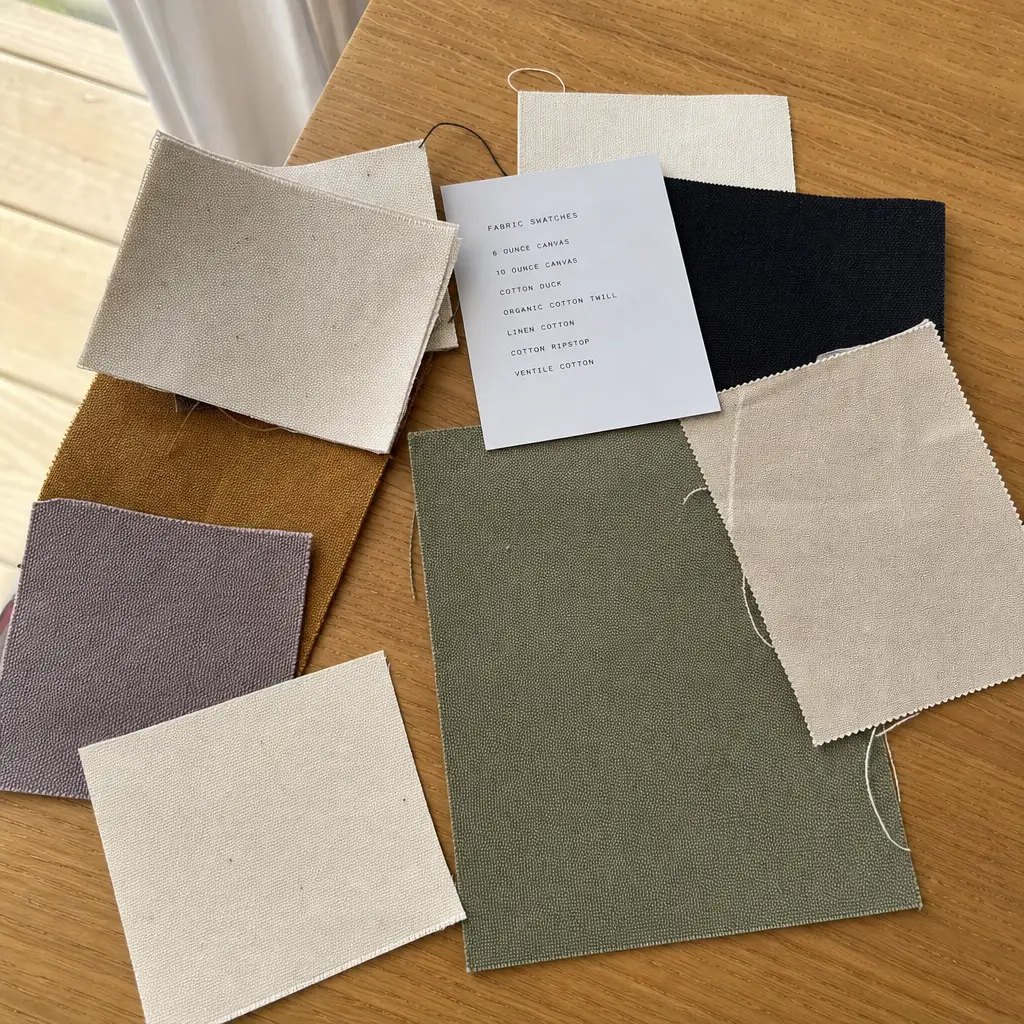
Color and finish are also MOQ levers. Stock natural or ecru canvas is often the easiest low-MOQ choice for artisan bakery branding. Stock black, navy, olive, or brown may be available, but buyers should still approve shade. Custom dyeing can trigger fabric mill minimums, lab dips, shade-band risk, longer lead times, and a need to keep leftover fabric. Natural canvas also needs clear acceptance rules. Seed flecks and small slubs may be normal, but oil spots, mildew odor, storage stains, dirty handling marks, and large dark slubs in the logo area should be rejected.
- Baseline: 10 oz cotton canvas for cost-sensitive bakery portfolios and internal document programs.
- Premium baseline: 12 oz cotton canvas for retail merchandise, gifting, and daily sales-rep use.
- State both oz and GSM, with tolerance such as plus or minus 5% unless a different standard is approved.
- Use stock fabric colors when negotiating low MOQ across multiple bakery designs.
- Approve shade, handfeel, slub limits, odor standard, and stain rejection rules before bulk cutting.
- Avoid vague terms such as thick canvas, heavy cotton, eco canvas, or natural look without a measured spec.
Zipper, Puller, Stitching, and Reinforcement Details
The zipper is the most handled component, so it strongly affects perceived quality. A No.5 nylon coil zipper is usually the safest baseline for canvas zipper portfolios because it is flexible, common, and strong enough for repeated document access. It also sews more cleanly into flat canvas than many heavier or more rigid zipper options. A No.3 zipper may reduce cost, but it can look undersized on a document-size pouch and may snag more easily when canvas bulk or loose threads reach the zipper teeth.
Metal zippers can create a premium look, but they are not always the best procurement choice. They can add weight, create a stiffer opening, raise cost, and scratch printed inserts or gift-card surfaces if the interior is tight. If a bakery brand wants antique brass or nickel hardware, quote it as an alternate rather than the default. For the first MOQ-sensitive order, standard No.5 nylon coil with an approved puller is usually easier to control.
Zipper tape color, puller finish, end-stop style, and puller shape must be in the quote. Natural canvas with cream zipper tape gives a soft bakery aesthetic. Black or brown zipper tape creates contrast but should be consistent across all designs if MOQ is tight. Custom pullers, leather tabs, or branded metal pulls can each create separate MOQ, tooling cost, or supplier sourcing lead time.
Sewing details should be written into the specification. Reinforced zipper ends help prevent tearing when users pull the slider to the end. Topstitching should be straight, especially on light canvas where crooked lines are visible. A common stitch-density target for this type of soft goods construction is about 8-10 stitches per inch, subject to fabric thickness and machine setup. Seam allowance, thread color, backtack points, and maximum loose thread length should be approved on the pre-production sample.
- Use No.5 nylon coil zipper as the baseline unless the product brief justifies a different zipper.
- Approve zipper tape color, slider finish, puller shape, end stops, and zipper-end reinforcement on the sample.
- Quote metal zipper, branded puller, contrast tape, or pull tab as alternates if MOQ is sensitive.
- Set stitch density expectations, often about 8-10 stitches per inch where suitable for the canvas and seam.
- Define seam allowance, thread color, backtack locations, and maximum loose thread length such as 3-5 mm.
- Classify zipper snagging, puller detachment, missing end reinforcement, and failed stops as major defects.
Print, Label, and Bakery Branding Controls
Branding is often the reason bakeries buy canvas zipper portfolios, but artwork variation is also a major MOQ driver. Screen printing is generally the most practical method for one to three solid spot colors, flour-sack style graphics, bakery logos, bread illustrations, and branch names. It gives good control when artwork is vector-based and colors are defined by Pantone or another agreed standard. Buyers should specify print size, print location, number of colors, and print orientation before sampling.
Heat transfer can be useful for detailed artwork, gradients, small text, or small mixed-design runs, but it must be tested on the actual canvas finish. Textured canvas can reduce adhesion or create a visible film edge. Transfers may feel glossy or stiff compared with screen print. Digital printing can support complex graphics but may appear less saturated on natural canvas than on white or treated fabric. Embroidery can look premium, but large stitch areas can pucker a flat document panel and increase cost by stitch count.
Print placement should be measured from fixed construction points such as the zipper seam, side seam, bottom edge, or panel centerline. A practical placement tolerance for many sewn canvas goods is plus or minus 3-5 mm, depending on panel size, print method, and fabric movement. This tolerance should be approved before bulk printing. If the logo must align with an inner pocket seam or label, check the construction sequence before approving printed panels.
Labels and retail trim can quietly increase MOQ. A woven side label, inner label, hangtag, barcode sticker, paper band, retail insert, or private-label card may each require a separate artwork approval and minimum order. If a buyer wants each bakery branch to have its own label or barcode, the quote must define whether that creates a separate SKU and packing requirement. For MOQ control, many buyers keep the sewn label generic and vary the front screen print or hangtag only.
- Use screen print for solid bakery logos, one-color illustrations, and most low-MOQ brand programs.
- Use heat transfer only after checking adhesion, edge lift, handfeel, rub resistance, and appearance on bulk canvas.
- Provide vector artwork, Pantone references, print dimensions, and placement measured from fixed seams.
- Set print placement tolerance, commonly plus or minus 3-5 mm for this product type when approved by supplier.
- Quote woven labels, inner labels, hangtags, barcodes, paper bands, and retail inserts separately.
- Confirm whether branch names, seasonal graphics, flavor lines, and barcode versions count as separate artworks or SKUs.
MOQ Levers That Do Not Sacrifice Product Quality
The best MOQ negotiation does not ask the factory to absorb inefficiency silently. It reduces variation in ways that preserve product performance. Keep one size, one canvas weight, one fabric color, one zipper type, one puller, one thread color, one pocket layout, and one packing method. Then ask the supplier to split the print quantity across several bakery logos. This gives the factory one cutting and sewing flow while allowing marketing variation at the print stage.
Total order consolidation is a strong lever for distributors, franchise groups, and bakery chains. A supplier may not want to run 50 pieces of one design as a standalone job, but may accept 500 total pieces split across five or ten artworks if all construction details remain identical. The buyer should ask whether the constraint is fabric purchase, cutting table setup, screen setup, sewing line efficiency, label MOQ, or carton packing. Once the constraint is visible, the buyer can negotiate the correct tradeoff.
Setup charges can be useful when handled transparently. A lower per-design MOQ may require separate screen charges, sample charges, artwork handling fees, or label setup fees. Paying these line items is often better than forcing a lower unit price that encourages the supplier to downgrade canvas, use a smaller zipper, skip reinforcement, or compress packing. For repeat programs, ask whether screens, cutting patterns, label inventory, or artwork files can be retained for reorders.
Buyers should avoid stacking low-MOQ demands on every specification. Low MOQ plus custom dyed canvas, four-color print, branded puller, several zipper colors, individual retail packaging, and separate barcodes for each branch will usually be expensive or unreliable. A clean pilot order proves demand first. Custom hardware, special fabric colors, and complex packaging can be added once volumes support them.
- Best lever: combine multiple bakery logos into one shared cutting, sewing, and packing batch.
- Second lever: use stock natural canvas and a standard No.5 zipper instead of custom fabric and hardware.
- Third lever: keep one pocket layout and delay gussets, handles, foam, and custom pullers to a reorder.
- Useful compromise: accept a minimum total order with smaller minimums per artwork version.
- Clean cost tool: pay separated setup charges instead of accepting hidden material substitutions.
- Avoid combining low MOQ with custom dyeing, multiple zipper colors, multi-color artwork, and retail packing in one pilot.
Quote Data Needed for Fair Supplier Comparison
A unit price alone is not enough for canvas zipper portfolios. Two suppliers can quote the same outside size but very different goods. One price may assume 8 oz canvas, No.3 zipper, no inner pocket, bulk packing, and one-color print. Another may assume 12 oz canvas, No.5 zipper, reinforced ends, inner slip pocket, individual bag, hangtag, and stronger export cartons. The lower unit price may not be the lower landed cost if it creates higher rejects, poor presentation, or inefficient cartons.
A strong RFQ should require the specification behind the price. Essential fields include usable inside size, outside finished size, canvas weight and GSM tolerance, fabric color, fabric finish, zipper size, zipper tape color, puller type, pocket structure, thread color, print method, print colors, artwork count, label details, packing method, MOQ rule, sample charge, sample lead time, production lead time, carton dimensions, gross weight, net weight, total CBM, quote validity, payment terms, and incoterm.
Incoterm clarity prevents false comparisons. EXW, FOB, FCA, CIF, DAP, and DDP prices include different responsibilities and costs. A very low EXW quote may be less attractive after inland trucking, export handling, customs documentation, and consolidation are added. Buyers should compare suppliers on the same delivery basis or build a landed-cost worksheet that separates factory price, inland freight, export charges, ocean or air freight, duty, customs brokerage, and final delivery.
Quote alternates are especially helpful for MOQ negotiation. Ask for 10 oz versus 12 oz canvas, bulk bundle packing versus individual bag, one-color versus two-color screen print, no pocket versus one inner pocket, standard puller versus branded puller, and stock canvas versus custom dyed canvas. These alternates reveal the cost drivers without forcing the supplier to guess which features matter most.
- Compare quotes only when GSM, zipper size, finished size, print method, pocket layout, and packing method match.
- Separate unit price from screen charges, sample charges, labels, hangtags, barcodes, custom pullers, and inland freight.
- Request pieces per carton, carton dimensions, gross weight, net weight, and total CBM before choosing a supplier.
- Confirm whether the price includes export carton marks, inner bundles, silica gel, individual bags, or retail inserts.
- Use one incoterm basis across suppliers or calculate landed cost separately.
- Ask for quote alternates so feature decisions are based on real cost and MOQ impact.
Sampling Controls Before Bulk Cutting
The pre-production sample should prove the complete product, not just the front logo. For bakery portfolios, the sample should confirm fabric handfeel, fabric weight, panel stiffness, finished dimensions, inside document fit, zipper smoothness, zipper-end reinforcement, stitch appearance, pocket depth, print clarity, print color, label position, and packing presentation. If the supplier uses substitute fabric, zipper, thread, label, or packing during sampling, that difference should be documented so the sample is not mistaken for the full production standard.
A staged approval process prevents costly rework. First approve available fabric swatches and zipper options. Then approve artwork digitally, including size, colors, orientation, and placement from seams. Next approve the physical sample. Finally approve bulk cutting and printing in writing. This sequence helps avoid the common problem of fabric being cut before artwork placement changes or printed panels being approved before real document fit is tested.
Sample testing should be practical and repeatable. Insert the actual bakery menu, order form, sales sheet, gift certificate, or retail card. Open and close the zipper at least 20 times to check snagging, slider feel, and end reinforcement. Rub the print with a clean dry cloth and, if appropriate for the ink system, use a light tape pull or scratch check agreed with the supplier. Measure logo placement with a ruler and photograph it. Check how the item looks inside its retail bag or bulk bundle.
Retain an approved sample on both sides. For importers and distributors, a signed or sealed sample helps settle later disputes about fabric shade, canvas slubs, zipper feel, print density, stitching, and packing method. If the program will repeat, keep the sample ID, artwork version, material references, and approval date in the purchase file.
- Approve fabric, zipper, artwork layout, physical sample, and packing as separate milestones.
- Confirm the sample uses bulk-intended materials or clearly record every substitute component.
- Measure actual document fit with the bakery’s real insert, not only a ruler.
- Cycle the zipper at least 20 times on the sample to expose snagging or weak end reinforcement.
- Photograph print and label placement with a ruler before authorizing bulk printing.
- Keep sealed buyer and factory samples for inspection reference and reorder consistency.
Quality Control Plan and Defect Classification
Generic textile inspection is not enough for canvas zipper portfolios because the product has both presentation and function requirements. AQL 2.5 for major defects and AQL 4.0 for minor defects is a common soft-goods inspection framework, but the buyer must define product-specific major defects before production starts. For this item, zipper failure, wrong size, wrong artwork, wrong label, document-fit failure, dirty natural canvas, mildew odor, print cracking, and incorrect packing SKU should usually be treated as major defects.
Dimension control should include outside finished size, inside usable space, and zipper opening length. A portfolio that is 5 mm short may look acceptable until an A4 menu or US letter insert catches at the zipper end. Agree on tolerances in writing, such as plus or minus 5 mm for finished soft-goods dimensions unless the supplier confirms a tighter or looser standard based on construction.
Zipper inspection should be functional, not only visual. Inspectors should open and close sampled pieces, check slider movement, confirm puller attachment, look for tape waviness, verify stops, inspect end reinforcement, and remove loose threads that could catch. Stitching checks should cover density, backtacks, seam allowance consistency, skipped stitches, broken stitches, needle cuts, puckering, and thread trimming.
Print inspection should compare bulk output with the approved sample. For screen print, check color, registration, ink coverage, pinholes, smudges, placement, rub resistance, and cracking across fabric movement points. For heat transfer, check adhesion, edge lifting, film feel, color shift, and cracking. For natural canvas, inspect under good light for oil, dirt, storage stains, mildew odor, large dark slubs in the logo area, and machine marks. Packing inspection should confirm counts, carton marks, barcode readability, SKU separation, carton strength, and flat packing without hard creases across printed panels.
- Classify zipper failure, wrong artwork, wrong size, document-fit failure, odor, and dirty canvas as major defects.
- Measure finished length, width, zipper opening, and inside usable space during inspection.
- Check zipper smoothness, puller attachment, tape alignment, stops, and reinforced ends on sampled pieces.
- Inspect print placement, color, adhesion, registration, smudges, cracking, and transfer edge lift where relevant.
- Reject unacceptable oil spots, mildew odor, storage stains, prominent dark marks, and dirty handling marks.
- Verify carton marks, packing count, barcode accuracy, SKU separation, carton strength, and flat packing condition.
Packing, Cartons, and Landed Cost Control
Packing should be designed for the sales channel, not left to the factory default. Internal bakery programs, distributor replenishment, and wholesale rep kits often work well with bulk bundle packing because it reduces plastic, labor, carton volume, and packing complexity. Retail or gift programs may require individual recycled PE or OPP bags, hangtags, barcode labels, insert cards, paper bands, or dust protection. Each packing choice affects unit cost, MOQ, inspection time, CBM, and landed cost.
Canvas zipper portfolios should generally be packed flat. Folding across the printed area can create permanent creases, especially on heavier canvas or heat-transfer artwork. If a smaller carton requires folding, approve the fold position and recovery standard during sampling. Natural canvas absorbs odor and shows dirt, so cartons should be clean, dry, and suitable for export handling. Moisture protection may be useful depending on shipping route, season, warehouse conditions, and transit time, but it should be specified rather than assumed.
Carton data is procurement data. Ask for pieces per inner bundle, pieces per export carton, carton dimensions, gross weight, net weight, and total CBM. A product with individual bag, paper insert, hangtag, and barcode can have significantly different volume from the same portfolio packed in bulk bundles. For courier and air shipments, dimensional weight may be more important than actual gross weight. For sea shipment, CBM affects consolidation cost and container planning.
Sustainability requirements should be discussed before sampling. Reduced plastic, recycled PE bags, paper bands, FSC-style paper claims, no individual bag, reusable cotton ties, or plastic-free packing can all affect sourcing, price, durability, and presentation. Changing packing after production creates repacking labor, shipment delay, and handling stains, especially on natural canvas.
- Use bulk bundle packing for internal bakery use, distributor replenishment, and lower landed cost.
- Use individual bags when retail hygiene, barcode control, gifting, dust protection, or resale presentation is required.
- Pack flat whenever possible and avoid hard folds across printed front panels.
- Request carton dimensions, gross weight, net weight, pieces per carton, and total CBM in the quote.
- Add carton marks showing SKU, artwork version, quantity, destination, gross weight, carton number, and PO reference.
- Confirm sustainability packing requirements before sampling, not after bulk production.
Specification comparison for buyers
| Spec decision | Recommended option | When it fits | Buyer risk to check |
|---|---|---|---|
| Usable document size | Define inside usable space first, then outside finished size; allow document clearance of about 8-15 mm per side depending on insert thickness | A4 menus, US letter order forms, wholesale price sheets, tasting notes, gift certificates, franchise documents, and sales-rep packets | Outside dimensions can look correct while the zipper opening or seam allowance makes documents bend at the corners |
| Canvas weight | 10 oz to 12 oz cotton canvas, about 340-410 GSM, with bulk tolerance stated as plus or minus 5% unless another tolerance is approved | Daily bakery rep kits, counter folders, retail merchandise, corporate gifting, and reusable document pouches | Below 8 oz can look limp on large panels; above 14 oz can slow sewing, increase carton weight, and cause zipper waviness |
| Fabric color and finish | Stock natural, ecru, black, navy, or other existing canvas before custom dyeing; approve lab dip only for true brand-color programs | MOQ-sensitive first orders, multi-location bakery rollouts, seasonal pilots, and distributor consolidation orders | Custom dyeing can introduce fabric-mill minimums, shade bands, longer lead time, and color variance between lots |
| Portfolio construction | Flat zipper portfolio with reinforced zipper ends and optional one-side inner slip pocket | Wholesale documents, menus, route sales paperwork, gift cards, bakery loyalty programs, and simple retail resale | Extra dividers, foam, handles, pen loops, gussets, or binding add cutting parts and sewing minutes, reducing MOQ flexibility |
| Zipper specification | No.5 nylon coil zipper with approved tape color, standard puller, secure top/bottom stops, and reinforced ends | Repeated opening at counters, trade shows, buyer appointments, retail shelves, and branch onboarding | No.3 zipper may look undersized and snag on canvas bulk; metal zipper may add weight, scratch risk, and higher defect sensitivity |
| Branding method | Screen print for 1-3 solid spot colors; heat transfer or digital print only after adhesion and appearance testing on bulk canvas | Bakery logos, flour-sack graphics, line illustrations, location names, and simple seasonal artwork | Changing print method per design creates setup confusion; transfers can lift at edges or look too glossy on textured canvas |
| Label and retail identity | Front print plus optional woven side label, inner care/brand label, hangtag, barcode sticker, or paper band quoted as separate line items | Private-label bakery merchandise, franchise kits, distributor programs, and retail gift packaging | Labels, hangtags, and barcodes can each create separate MOQ, artwork approval, and packing SKU rules |
| MOQ negotiation lever | Standardize size, fabric, zipper, pocket, thread, and packing; vary only one-color artwork across bakery locations | Distributors, franchise groups, multi-branch bakeries, seasonal launches, and low-risk pilot orders | Supplier may accept low per-artwork MOQ but still require a total cutting lot, fabric roll usage, or printing setup minimum |
| Packing format | Bulk bundle packing for internal use; individual recycled PE/OPP bag, hangtag, barcode, or insert only when retail channel requires it | Bulk cartons reduce labor, plastic, and CBM; individual packing supports retail hygiene, resale, and inventory scanning | Retail buyers may reject bulk-packed goods if barcode control, dust protection, or presentation packaging was expected |
Buyer checklist before sampling
- Define the portfolio by usable inside document size before confirming outside finished dimensions; state target insert size such as A4, US letter, menu card, gift certificate, or custom bakery packet.
- Specify canvas fiber content, weight in oz and GSM, acceptable GSM tolerance, color standard, finish, and whether natural slubs, seed flecks, shade variation, or wrinkles are acceptable.
- Keep MOQ drivers controlled by using one body size, one fabric color, one zipper specification, one thread color, one pocket layout, and one packing method across all bakery artwork versions.
- Provide vector artwork with Pantone references, print method preference, print dimensions, print area limit, placement measured from fixed seams, and acceptable placement tolerance such as plus or minus 3-5 mm.
- Confirm whether each bakery logo, branch name, seasonal flavor line, barcode, hangtag, or language version counts as a separate artwork, SKU, packing version, or MOQ unit.
- Request a pre-production sample made with bulk-intended canvas, zipper, thread, print, label, pocket, and packing whenever possible; document any substitute material used during sampling.
- Ask the supplier to separate unit price, sample charge, screen charge, label cost, hangtag cost, barcode cost, custom puller cost, packing cost, inland freight, and export carton cost.
- Confirm whether MOQ applies per total order, per artwork, per fabric color, per zipper color, per print method, per cutting lot, per sewing batch, per packing SKU, or per shipment.
- Set QC thresholds for finished size, inside usable space, zipper opening length, stitch density, seam allowance, zipper pull smoothness, zipper end reinforcement, print adhesion, print placement, panel cleanliness, odor, and carton strength.
- Request carton dimensions, pieces per carton, gross weight, net weight, total CBM, pallet option if relevant, and loading estimate before comparing landed cost or choosing air versus sea shipment.
Factory quote questions to send
- What is your MOQ for this canvas zipper portfolio by total order quantity, per artwork, per fabric color, per zipper color, per label version, and per packing SKU?
- Which canvas weights and colors are available from stock, what are the roll widths, and what GSM tolerance and shade tolerance should we accept in bulk production?
- Can you quote 10 oz and 12 oz cotton canvas separately, including the GSM range, shrinkage expectation if washed, and any surcharge for dyed or bleached fabric?
- Can you quote No.5 nylon coil zipper as the baseline and show the price difference for contrast zipper tape, metal puller, branded puller, custom pull tab, or anti-rust hardware finish?
- What print method do you recommend for our artwork, what is the maximum stable print area, and what are the setup charges per color, screen, transfer sheet, or artwork version?
- What is the minimum efficient cutting quantity for this finished size, and can multiple bakery logos share one fabric cutting lot, one sewing batch, and one shipment?
- How many sample rounds are included before bulk production, what sample lead time applies after artwork approval, and will the sample use exact bulk fabric, zipper, thread, print, label, and packing?
- What stitch density, seam allowance, zipper-end reinforcement, thread specification, pocket construction, label placement, and logo placement tolerance will you follow in bulk production?
- How will the goods be packed, how many pieces per inner bundle and export carton, and what are the carton dimensions, gross weight, net weight, total CBM, and carton mark details?
- Which defects will you classify as major for this product: zipper failure, wrong size, document-fit failure, skipped stitches, dirty natural canvas, print cracking, wrong label, wrong barcode, odor, or packing damage?
Quality-control points to confirm
- Verify canvas GSM from bulk cutting panels or retained production fabric, not only from the sales swatch or first sample.
- Check fabric color against the approved swatch or lab dip under consistent light; record acceptable shade range for natural, ecru, dyed, bleached, or washed canvas.
- Measure finished portfolio length, width, zipper opening, and inside usable document space against the agreed tolerance, commonly plus or minus 5 mm for soft canvas goods unless otherwise approved.
- Insert the buyer’s real document, menu, order form, or gift certificate during inspection to confirm loading clearance and corner fit without bending.
- Open and close the zipper repeatedly on sampled pieces; it should run smoothly without catching seam allowance, loose threads, fabric bulk, or zipper-end reinforcement.
- Inspect zipper tape alignment, end stops, puller attachment, slider finish, topstitch position, and reinforcement because zipper failure is a major functional defect.
- Test print adhesion with a practical tape, rub, or scratch method suited to the ink, transfer, and canvas finish; compare against the approved sample rather than a vague visual standard.
- Measure logo and label placement from fixed seams or panel edges; apply the agreed tolerance before accepting printed panels or finished goods.
- Check stitch density, seam allowance consistency, backtack security, skipped stitches, broken stitches, needle damage, puckering, and thread tails beyond the accepted length.
- Inspect natural canvas under good light for unacceptable oil spots, mildew odor, storage stains, dirty fingerprints, large dark slubs in prominent areas, and machine handling marks.