Start With the Bakery Use Case, Not the Bag Name
A canvas zipper portfolio for an artisan bakery can be a document holder, a sales-kit pouch, a retail merchandise item, a wholesale account onboarding folder, or part of a gift set. Those uses look similar in a catalog photo, but they need different material decisions. A folder that only carries menus and recipe cards can use a softer canvas and lighter lining. A portfolio used by bakery sales reps for order forms, tablets, and product sheets needs stronger edge construction and a zipper that survives daily opening.
Before comparing supplier prices, define the load and the presentation standard. Procurement teams often receive low quotations because the supplier assumes a flat unlined pouch, while the buyer imagines a structured branded portfolio with lining, zipper puller, inner pocket, and retail packing. That gap creates late cost increases and sample rejections. A good RFQ should state the item function, finished size, target retail or wholesale channel, expected contents, logo method, and whether the product will be sold, gifted, or used internally.
- For bakery wholesale sales packs, prioritize document fit, zipper reliability, and print consistency.
- For retail merchandise, prioritize canvas hand feel, clean seams, individual packing, and shelf presentation.
- For staff or franchise kits, prioritize durability, washable-looking finishes, and reorder consistency.
- For premium gift sets, prioritize structured panels, better zipper pullers, and controlled color shade.
Choose Canvas Weight by Structure and Freight Impact
Canvas weight is the first material decision because it affects hand feel, sewing difficulty, print result, carton volume, and landed cost. For zipper portfolios, 10 oz canvas can be acceptable for a very soft document pouch, but it may wrinkle around the zipper and feel light for a bakery brand selling premium sourdough, pastries, or gift boxes. Most wholesale bakery portfolios sit better in the 12 oz to 16 oz range, roughly 380 to 540 GSM depending on the yarn and finishing process.
Heavier is not automatically better. An 18 oz canvas can look substantial, but it creates bulky zipper seams and thicker corners. This increases needle breakage risk, slows sewing output, and may require a larger zipper gauge or binding method. Importers should compare fabric weight together with panel size and seam design. If the portfolio is only for A4 papers, a firm 14 oz canvas with reinforced zipper ends may perform better than a heavy canvas that folds poorly and raises freight cost.
- 10 oz to 12 oz: budget document pouch, softer body, lower freight, more wrinkle risk.
- 12 oz to 14 oz: balanced wholesale option for bakery sales kits and branded folders.
- 14 oz to 16 oz: more premium hand feel, better structure, higher sewing and freight cost.
- Above 16 oz: use only when the design needs heavy-duty appearance and the zipper construction is upgraded.
Natural, Dyed, Washed, or Coated Canvas
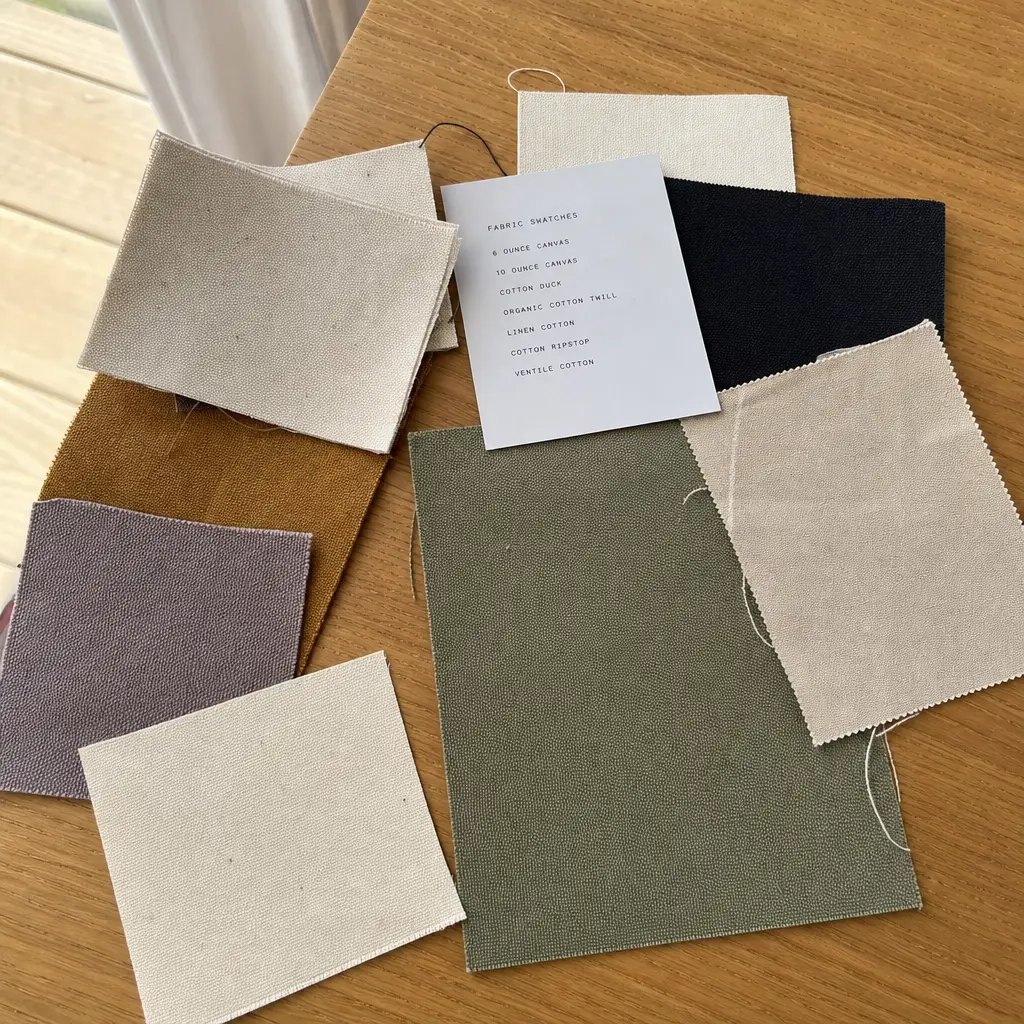
Artisan bakery brands often prefer natural or unbleached canvas because it matches paper bags, linen aprons, wood counters, and kraft packaging. Natural canvas is practical, but shade variation is normal. If the buyer expects every shipment to match a photo exactly, that must be controlled by approved shade bands or fabric lab dips. Natural cotton can also show seed flecks and slubs. These are part of the material character unless the buyer specifies a cleaner bleached or dyed base.
Dyed canvas gives stronger brand color control but changes MOQ and lead time because the factory may need to dye fabric by lot. Washed canvas gives a softer, more casual bakery look, but it can shrink and twist if not tested. Coated or laminated canvas improves stain resistance, useful when portfolios are handled near flour, butter, or coffee counters, but coating can reduce breathability and complicate screen printing. The RFQ should identify the finish clearly, not just say canvas.
- Natural canvas: good rustic look, lower color control, visible cotton flecks.
- Bleached canvas: cleaner print base, less earthy appearance, may cost more.
- Dyed canvas: stronger brand color, higher MOQ, lab dip approval needed.
- Washed canvas: softer hand feel, shrinkage control required before final sizing.
- Coated canvas: better wipeability, print and fold testing needed.
Zipper and Trim Choices Drive Real Usability
For most wholesale canvas zipper portfolios, a No.5 nylon zipper is the safest production choice. It is lighter than metal, easier to sew, less likely to oxidize, and usually smoother for daily opening. Metal zippers look more premium, but they add weight and can discolor if plating quality is weak or if the portfolio is stored in humid cartons. For bakery buyers, the zipper should support the brand position without becoming the main failure point.
The zipper tape, slider, puller, and zipper-end treatment should be specified together. A low-cost zipper can look acceptable in a photo but fail during repeated use or catch the lining. Long portfolios also need attention to zipper waviness. Canvas and zipper tape may shrink differently during pressing or washing, causing a rippled edge. A pre-production sample using bulk canvas and final zipper is the best way to identify this before mass production.
- Use No.5 nylon zipper for most wholesale programs with moderate cost and reliable function.
- Use metal zipper only with approved plating, humidity storage awareness, and buyer acceptance of added weight.
- Match zipper tape color to canvas for subtle branding or use contrast color only after artwork review.
- Add zipper-end reinforcement where the user pulls hard at opening and closing points.
- Avoid oversized decorative pullers if the product will be flat packed tightly in cartons.
Lining, Pockets, and Reinforcement Need Early Costing
Many quote problems happen because lining and internal pockets are discussed after the first price. A simple unlined canvas portfolio is very different from a lined version with an internal slip pocket, card pocket, pen loop, or document divider. Every extra layer changes cutting, sewing, inspection time, and carton thickness. If the portfolio is for bakery account managers carrying price lists and order sheets, pockets may be valuable. If it is a retail add-on item, a clean lined interior may be enough.
Cotton lining supports a natural bakery story, but it can mark during production and may not be ideal for items exposed to chocolate, coffee, or oily packaging. Polyester lining is usually easier to clean and more stable, but it can feel less premium if too thin or noisy. Reinforcement can be hidden inside zipper ends, corners, or handle attachment points if the design includes a wrist strap. These details should be visible in the tech pack or at least described in the RFQ.
- Unlined construction lowers cost but exposes seams and may feel unfinished for retail.
- Cotton lining improves natural positioning but needs stronger handling and stain control.
- Polyester lining improves wipeability and stability but should not be too thin or shiny.
- Internal pockets should be dimensioned by intended contents, not guessed from photos.
- Corner and zipper-end reinforcement should be included for daily-use sales portfolios.
Print Method Must Match Canvas Texture
Screen printing is usually the most reliable logo method for canvas zipper portfolios when the bakery artwork uses one to three solid colors. It handles simple bakery marks, word logos, wheat icons, oven illustrations, and line drawings well if the line thickness is realistic. Natural canvas texture absorbs ink unevenly, so the buyer should approve a strike-off on the actual fabric, not only a digital layout. Pale beige ink on natural canvas may look elegant on screen but disappear in bulk production.
Heat transfer is useful for gradients, small detailed graphics, or multicolor seasonal artwork, but it can change the hand feel and may not match the natural look many bakeries want. Embroidery adds texture but may pucker thinner canvas and is less suitable for fine type. Woven labels or sewn side labels are useful when the portfolio needs a subtle branded finish. For imported wholesale programs, the safest route is to define print size, placement tolerance, Pantone reference, ink type, and wash or rub expectations.
- Screen print: best for solid bakery logos, cost-efficient, needs fabric strike-off approval.
- Heat transfer: better for detailed color artwork, less natural hand feel, adhesion test required.
- Embroidery: premium texture, higher cost, pucker risk on lighter canvas.
- Woven label: clean retail detail, separate MOQ and label lead time may apply.
- Debossing or embossing: only possible with suitable material structure, not standard flat cotton canvas.
MOQ and Price Differences Are Usually Material-Driven
MOQ for canvas zipper portfolios is not only about sewing quantity. The real drivers are fabric availability, dye lot size, zipper color, lining roll quantity, label production, print setup, and packing materials. A factory may accept 300 pieces for natural canvas with a standard black or natural zipper, but require a higher quantity for custom dyed canvas, special zipper tape, metal pullers, or woven labels. Buyers comparing quotes should identify which parts are standard stock and which parts are custom made.
Price comparison should separate the base portfolio from custom options. One supplier may quote a cheaper body price but exclude individual polybags, printed inserts, custom pullers, or export carton markings. Another may include stronger canvas and better packing but appear higher at first glance. For distributors and importers, the correct comparison is landed cost per sellable unit, including carton volume, rejected goods risk, sample iterations, and reorder stability.
- Base cost drivers: canvas GSM, lining, zipper grade, sewing complexity, and print color count.
- MOQ drivers: fabric roll quantity, custom dyeing, zipper tape color, woven label MOQ, and packaging print MOQ.
- Hidden quote gaps: sample fees, setup charges, carton upgrades, inspection cost, and inland transport.
- Landed-cost drivers: units per carton, gross weight, CBM, duty category, and defect allowance.
- Reorder drivers: fabric shade consistency, trim availability, and whether the factory keeps approved standards.
Sample Approval Should Prevent Bulk Surprises
A correct sample sequence reduces commercial risk. Start with a plain fit sample if the size, zipper opening, internal structure, or pocket layout is new. This sample proves whether the portfolio actually fits the intended bakery documents, menus, order sheets, or tablet. After shape approval, approve print strike-offs on the selected canvas. Only then should the factory make a pre-production sample using bulk fabric, final zipper, final lining, final print, and final packing assumptions.
Buyers should not approve only a beautiful showroom sample. Showroom samples often use available fabric, substitute zippers, hand-cut panels, or cleaner workmanship than the production line can repeat. The approved pre-production sample should become the reference for mass production and inspection. It should be photographed, measured, signed off, and stored by both buyer and factory. If the buyer has multiple bakery brand designs, approve each artwork placement and color, even when the portfolio body is the same.
- Fit sample: verifies finished size, zipper opening, pocket layout, and overall structure.
- Material swatch: verifies canvas weight, shade, lining, zipper tape, and hand feel.
- Print strike-off: verifies ink color, edge sharpness, opacity, and placement on real canvas.
- Pre-production sample: verifies final bulk materials, trims, workmanship, and packing.
- Golden sample: used by factory QC and third-party inspection as the acceptance reference.
QC Thresholds Should Be Written Before Inspection
Canvas products have natural variation, so quality control must separate acceptable material character from real defects. Small cotton flecks on natural canvas may be acceptable, while oil stains, mildew odor, large dark marks, skipped stitches, loose zipper ends, twisted lining, and crooked print are not. If the buyer does not define this early, inspection becomes subjective and disputes happen after the goods are packed.
For portfolios, function defects matter more than small cosmetic variation. A zipper that catches, a lining that blocks the slider, or a seam that opens at the corner creates a return risk. Finished size tolerance should be realistic because canvas shifts during cutting and sewing. For most flat zipper portfolios, plus or minus 5 mm is a reasonable target on smaller sizes, while larger padded items may need a wider tolerance. Print placement tolerance should usually be tighter because it is visually obvious on a flat front panel.
- Critical defects: broken zipper, sharp metal burrs, mildew odor, wrong logo, wrong material, unsafe contamination.
- Major defects: zipper catching, open seams, heavy stains, print misplacement, severe shade mismatch, twisted lining.
- Minor defects: small natural slubs, slight thread ends, very small shade variation within approved standard.
- Functional test: open and close zipper several times and confirm no lining is caught.
- Measurement test: record finished width, height, zipper length, pocket size, and print placement.
Packing and Shipping Affect Portfolio Shape
Canvas zipper portfolios look simple, but poor packing can damage their retail appearance. If they are folded too tightly, the front panel may crease through the logo. If cartons are overfilled, corners can bend and zipper sliders can press into neighboring units. Flat packing is usually better for a portfolio, with tissue or light insert support if the item needs a clean shape. For retail channels, individual polybags, paper sleeves, barcode labels, or hang tags may be needed and should be quoted from the beginning.
Moisture control is also important for cotton canvas. Long sea freight, humid warehouse storage, or rainy-season loading can create mildew risk if cartons are weak or products are packed damp after pressing. Buyers should request carton specifications, units per carton, gross weight, net weight, and CBM. This allows landed-cost comparison and prevents the common mistake of approving a low unit price that ships inefficiently because the item is too thick or poorly packed.
- Flat pack whenever possible to protect document-folder shape and logo appearance.
- Use reasonable carton counts so corners are not compressed during palletizing.
- Add silica gel or moisture-control planning when shipping cotton canvas through humid routes.
- Confirm barcode, hang tag, inner sleeve, and carton mark requirements before final quote.
- Review CBM per 1,000 pieces to compare landed cost between suppliers.
Specification comparison for buyers
| Spec decision | Recommended option | When it fits | Buyer risk to check |
|---|---|---|---|
| Outer canvas weight | 12 oz to 16 oz cotton canvas, roughly 380 to 540 GSM depending on yarn and finish | Bakery welcome kits, recipe folders, trade show sales packs, retail gift bundles needing a firm hand feel | Too light may wrinkle and collapse; too heavy may increase freight cost and create bulky seams around the zipper |
| Canvas finish | Washed natural canvas for softer hand feel or greige natural canvas for sharper print edges | Washed works for rustic bakery branding; greige or pre-shrunk canvas works better for tighter dimensions | Uncontrolled shrinkage can distort panels, zipper alignment, and printed logos after pressing or finishing |
| Lining material | Unbleached cotton sheeting or 210D recycled polyester depending on budget and stain resistance | Cotton lining supports natural brand positioning; polyester lining is easier to wipe and usually lower cost | Dark inner items can stain light cotton lining; low-grade polyester can sound cheap and weaken the premium bakery feel |
| Zipper specification | No.5 nylon zipper for most orders; No.5 metal zipper only when premium look outweighs weight and oxidation risk | Nylon suits volume wholesale programs; metal fits gift sets and higher retail positioning | Poor zipper tape shrinkage or weak sliders cause waviness, catching, and returns even when the canvas is acceptable |
| Structure and padding | Single-layer canvas with reinforced edges, or 2 mm padding only for tablet or menu-kit use | Flat document portfolios need structure but not bulk; padded versions suit sales reps carrying tablets or sample sheets | Padding changes sewing tolerance and carton size, so quote padded and non-padded versions separately |
| Logo method | Screen print for solid one to three color bakery logos; heat transfer only for small gradients or detailed artwork | Screen print is stable for natural canvas and cost-effective at wholesale volumes | Fine flour-dust textures, thin serif fonts, and pale ink on natural canvas can lose contrast without a strike-off approval |
| MOQ logic | 300 to 500 pieces per color for basic canvas and print; higher MOQ if custom dyed canvas, custom zipper tape, or woven labels are required | Good for importers testing bakery retail channels without locking too much inventory | Supplier MOQ may be driven by fabric roll, zipper color, or label production, not only sewing capacity |
| Packing format | Flat packed with tissue insert and individual polybag or paper sleeve depending on retail channel | Flat packing protects shape and keeps carton volume predictable for wholesale distribution | Overstuffed cartons bend corners; no moisture barrier can lead to mildew risk during sea freight in humid seasons |
| Sample approval route | Plain fit sample first, then print strike-off, then pre-production sample using bulk fabric and final trims | Reduces rework when the buyer has several bakery logos or retail packaging requirements | Approving a showroom sample without bulk fabric, zipper, and final artwork can hide production differences |
Buyer checklist before sampling
- Define the portfolio use: document folder, bakery gift kit, wholesale sales pack, tablet sleeve, or retail merchandise item.
- Specify finished size with tolerance, not only nominal size; include whether it must fit A4, US letter, menus, recipe cards, or a tablet.
- State outer canvas weight in ounces or GSM and request the supplier to confirm actual bulk fabric test range.
- Separate natural canvas, dyed canvas, washed canvas, and laminated canvas in the RFQ because they change cost, shrinkage, and print behavior.
- Choose lining material and color deliberately; light cotton lining looks premium but marks more easily during handling.
- Confirm zipper type, zipper size, slider finish, puller design, and whether zipper tape color must match the canvas or brand color.
- Provide artwork files, Pantone references, logo size, print placement, and minimum line thickness before requesting final pricing.
- Request carton dimensions, gross weight, net weight, units per carton, and packing method in the first quotation.
- Require a fit sample, print strike-off, and pre-production sample before mass production starts.
- Set QC thresholds for stitching, zipper function, print registration, panel alignment, stains, odor, and finished size tolerance.
Factory quote questions to send
- What canvas weight, yarn construction, and measured GSM will be used for the outer shell?
- Is the quoted canvas natural, bleached, dyed, washed, pre-shrunk, or treated with any coating?
- What is the finished size tolerance after sewing and pressing, and how will it be controlled during bulk production?
- Which zipper brand or grade is included, what zipper size is quoted, and what puller finish is standard?
- What lining material, lining GSM or denier, and lining color are included in the price?
- Which print method is quoted, how many colors are included, and what is the maximum print area?
- Does the MOQ apply per style, per color, per print design, or per shipment?
- What sample types are included, what are the sample lead times, and are sample charges refundable against bulk order?
- What carton size, pieces per carton, gross weight, and packing materials are assumed in the quote?
- What is the estimated production lead time after sample approval, artwork approval, and deposit receipt?
Quality-control points to confirm
- Finished size tolerance should normally be within plus or minus 5 mm for small portfolios and plus or minus 8 mm for larger padded versions unless the design is intentionally soft.
- Zipper must open and close smoothly for repeated cycles without catching lining, loose threads, or seam allowance.
- Print placement should stay within agreed tolerance, commonly plus or minus 3 mm for simple front-panel logos.
- Visible canvas panels should be free from oil marks, heavy slubs, mildew odor, dirty handling marks, and unacceptable color shade variation.
- Corner stitching and zipper-end reinforcement should withstand normal pulling without skipped stitches or seam opening.
- Lining must sit flat without twisting, bunching, or being caught in the zipper teeth.
- Cartons should pass buyer-agreed drop and compression expectations for the selected transport route.