Start With the Date the Bakery Cannot Miss
Canvas zipper portfolios for artisan bakeries are usually tied to a real commercial moment: a holiday gift certificate launch, a wholesale buyer meeting, a catering sales push, a franchise training session, or a distributor presentation kit. If the portfolios arrive after that date, a small saving on unit price will not help the buyer. Procurement should begin with the required in-hand date at the warehouse, store, event site, or distributor location, then work backward through approvals, production, freight, customs, and final allocation.
A portfolio sounds simple until every step is mapped. The schedule can include specification confirmation, artwork cleanup, material sourcing, zipper matching, logo strike-off, pre-production sample making, sample shipping, internal buyer review, revision, bulk material reservation, cutting, sewing, trimming, pressing, inspection, packing, export booking, freight, customs clearance, and domestic distribution. The biggest slippage often happens before bulk production starts. A brief that says only "canvas portfolio with zipper and bakery logo" leaves the supplier to guess the canvas GSM, zipper path, stiffener, internal layout, print size, and packing method.
Treat this item as a custom business bag and brand presentation piece, not a generic folder. Zipper choice changes sewing time. Stiffener changes pattern allowance and corner thickness. Logo method affects pre-production approvals. Packing affects carton volume, freight cost, and retail appearance. Once the pre-production sample is approved, changing fabric color, zipper direction, panel construction, or logo placement can reset the cost and the clock.
- Work backward from the in-hand date, not from the factory's best-case sewing estimate.
- Ask suppliers to separate sample timing, bulk production timing, inspection timing, and export booking timing.
- Flag early lead-time drivers such as custom dyed canvas, woven patches, metal hardware, custom pullers, and retail packing.
- Hold bulk cutting until fabric, zipper, logo, structure, finished size, and packing are approved in writing.
- Give one internal owner authority to collect bakery, marketing, sales, compliance, and distribution approvals on schedule.
Match the Portfolio to the Business Use
A wholesale bakery buyer folder, a retail gift certificate wallet, and a franchise training portfolio should not share the same default construction. The first may need clean document clearance and a professional logo. The second may need better presentation packing and anti-stain protection. The third may need a stronger structure, multiple insert sections, and a pen loop. These differences affect size, zipper path, canvas weight, pocket layout, stiffening, logo method, packing, and MOQ.
The RFQ should describe what goes inside and how the product will be handled. List A4 sheets, US letter sheets, half-letter menus, laminated allergen cards, tasting notes, price lists, order forms, invoices, loyalty cards, business cards, gift vouchers, pens, QR cards, or recipe inserts. Then describe the usage environment. Will sales staff carry it daily? Will retail shoppers handle it near a pastry counter? Will it ship inside a subscription box? Will a distributor bring it to several buyer meetings each week? A design that fits one loose sheet can become too tight once the zipper tape, binding, document sleeve, seam allowance, and stiffener are added.
Finished size is only one part of the measurement story. Procurement should specify outside dimensions, minimum internal usable dimensions, zipper opening width, insert stack thickness, and acceptable tolerance. If the portfolio must fit into existing bakery gift boxes, point-of-sale displays, tote bags, cartons, shelves, or welcome kits, include those limits at RFQ stage. Otherwise a supplier may meet the outside size while delivering an inside pocket that fails with the real contents.
- Wholesale buyer folder: prioritize document clearance, stable logo placement, smooth zipper travel, and clean front panels.
- Retail gift certificate wallet: prioritize clean canvas, dust protection, attractive packing, and consistent color.
- Distributor sales case: prioritize reinforced corners, zipper durability, pen loop function, and repeated-use strength.
- Franchise training portfolio: prioritize organized interior sections, size control, labels, and easy insert removal.
- Subscription welcome kit: prioritize flat packing, lightweight structure, unboxing appearance, and outer-carton fit.
Write a Specification Buyers Can Compare
A quote-ready specification sheet keeps suppliers from pricing different products. One factory may quote 12 oz canvas with a No. 5 zipper, partial stiffener, one-color screen print, and individual sleeves. Another may quote lighter canvas, no stiffener, a smaller zipper, and bulk packing. Both quotes may look competitive on a spreadsheet, but procurement would not be comparing the same item.
The specification should cover finished outside dimensions, minimum internal usable dimensions, zipper opening width, canvas weight in oz and GSM, finish, color standard, zipper type, slider finish, puller style, stiffener type, interior pocket layout, binding method, thread color, logo method, label placement, packing, carton requirements, and inspection criteria. A simple front, back, side, and inside drawing is enough if critical measurements are marked from fixed edges. Do not rely on a centered digital mockup for logo placement; use measured distances from the top, bottom, left, or right edge.
Be deliberate about factory standard components. Supplier standard may be fine for export carton material, basic care labels, or matching thread on a non-retail program. It is risky for visible parts such as canvas shade, zipper tape color, slider finish, logo size, and front-panel placement. If a detail matters to the bakery's brand or to the portfolio's function, define it. If it does not matter, say which alternatives are acceptable so the supplier can price efficiently.
- Include outside size, internal usable size, gusset depth if any, zipper opening width, insert thickness, and tolerance.
- Specify canvas in both oz and GSM, plus finish: natural, bleached, dyed, washed, coated, laminated, or uncoated.
- Define zipper size, zipper type, tape color, slider finish, puller shape, end tabs, path, and opening direction.
- List each interior part with finished usable dimensions after sewing, not just pattern or cut-panel dimensions.
- Attach vector artwork with Pantone references, print or label size, placement measurements, and small-detail warnings.
- State individual packing, carton quantity, carton marks, barcode needs, maximum carton weight, and any store sorting rules.
Choose Canvas and Structure With Handling in Mind
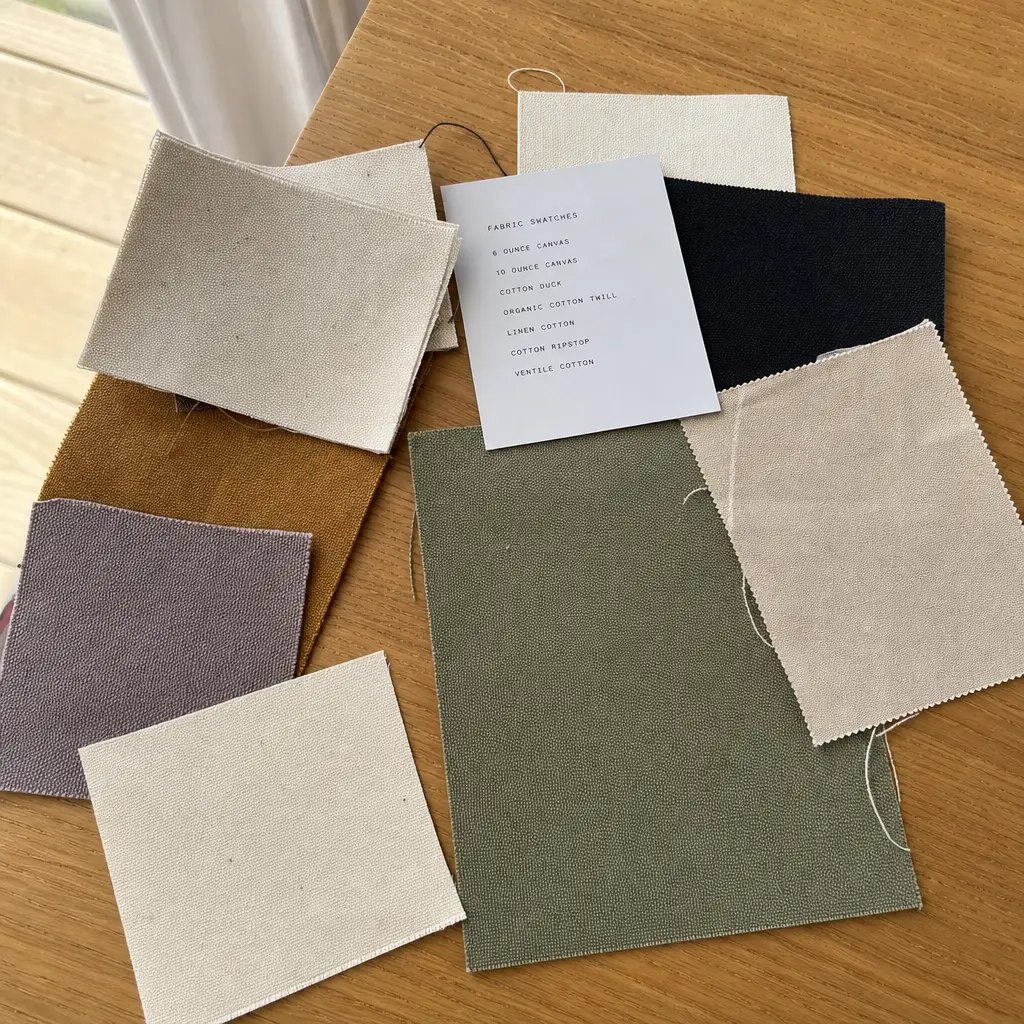
Canvas choice affects hand feel, print performance, durability, sewing speed, panel shape, and landed cost. An 8 oz canvas can work for a very light promotional pouch, but it often feels too soft for a structured business portfolio. A 10 oz canvas can suit a basic document wallet with no stiffener. For many canvas zipper portfolios for artisan bakeries, 12 oz to 14 oz cotton canvas, approximately 400 to 475 GSM, gives a stronger balance of shape, print surface, and perceived value. Going heavier may look premium, but it also increases seam bulk near zipper corners and can slow sewing.
Do not buy by ounce rating alone. Canvas ounce descriptions can vary by market, yarn, weave, and finishing route. Ask for GSM, construction or yarn count if available, and the agreed tolerance for incoming fabric inspection. Around +/-5% GSM is a common practical tolerance, but it should be written into the specification before production. Also confirm whether the fabric is natural, bleached, stock dyed, custom dyed, washed, coated, laminated, or untreated. Washing can soften the hand but may change dimensions. Coating can help with stain resistance, yet it may affect print adhesion and flexibility.
Structure should follow the use case, not the sample-room instinct to make everything stiff. A simple wholesale document pouch may not need board. A retail gift portfolio or franchise training kit may need partial or full reinforcement so panels stay flat. Common choices include 1.0-2.0 mm greyboard, 0.5-1.0 mm PP sheet, EVA foam, or dense nonwoven reinforcement. Greyboard can create a crisp shape but is more sensitive to moisture. PP sheet is more moisture-resistant and flexible, though it changes the hand feel. Specify thickness, coverage area, fold allowance, moisture sensitivity, and whether the stiffener must be fully enclosed.
- Basic document wallet: 10 oz canvas, no board, straight zipper, one sleeve, and simple export packing.
- Standard bakery sales portfolio: 12 oz canvas, partial stiffener, No. 5 nylon zipper, reinforced corners, and one logo.
- Premium gift portfolio: 14 oz canvas, structured panels, woven label or cotton patch, metal zipper, and anti-scratch packing.
- Brand-color program: custom dyed canvas with lab dip, approved swatch, dye lot control, and higher MOQ allowance.
- Humid storage or ocean freight: avoid weak board, request moisture protection, and test packed-sample stability.
Plan the Zipper Before Sampling
The zipper is where many portfolio designs either feel professional or fail quickly. A straight top zipper is faster to sew, easier to inspect, and lower risk. A two-side or three-side zipper improves document access and gives a more finished presentation, but it introduces corner sewing, zipper tape alignment, and slider-travel risks. For medium-to-heavy canvas, a No. 5 zipper is usually more appropriate than a small zipper because the tape and teeth better tolerate thicker seams and stiffened panels.
Nylon coil zippers are usually the practical choice for volume production. They run smoothly, come in many stock tape colors, and are easier to sew around curves. Metal zippers can support a premium bakery gift program, especially in antique brass, nickel, or black nickel finishes. They also need more scratch control. On natural or bleached canvas, metal teeth and sliders can leave marks during packing and freight if the portfolios are stacked too tightly or the pullers are not protected. Define zipper tape shade, slider finish, puller shape, end tabs, zipper stop method, and opening direction in the RFQ.
Test the zipper path on the real material combination. A wraparound zipper that works on unstructured 10 oz canvas may catch on 14 oz canvas with board reinforcement. Corner radius matters more than it looks on screen. A tight corner may save space but can create wavy tape, skipped stitches, rough slider travel, and distorted panel edges. The pre-production sample should be opened and closed repeatedly, especially around corners, before bulk cutting is released.
- Use No. 5 nylon coil zipper when delivery speed, smooth operation, and stock component availability matter most.
- Use No. 5 metal zipper only when premium appearance justifies protective packing and closer inspection.
- Match zipper tape color against the approved canvas swatch, not only against a digital rendering.
- Specify whether the slider parks at the left, right, top, or side position when closed.
- Use a practical corner radius for wraparound designs to reduce catching, rippling, and sewing distortion.
- Inspect loose sliders, twisted tape, sharp ends, missing teeth, skipped stitches, wavy seams, and rough slider travel.
Respect Bakery Artwork Limits on Canvas
Artisan bakery logos often include details that are difficult on coarse fabric: fine serif type, wheat illustrations, distressed seals, small founding dates, neighborhood names, and hand-drawn textures. Those marks may look beautiful in a digital file and still reproduce poorly on 12 oz to 14 oz canvas. Choose the logo method for the material and quantity, not only for the mockup. A logo strike-off on the intended canvas should be approved before the buyer signs off on the full sample.
Screen printing is usually efficient for one- or two-color bakery logos and larger front marks. It can work well for wholesale programs, seasonal campaigns, and multi-location rollouts. The limits need to be acknowledged. Large solid ink areas may show texture variation. Fine reversed-out lettering can fill in. Very small dates or bakery addresses may lose clarity. The purchase order should state print size, ink color reference, placement tolerance, and any minimum line width concerns.
Woven labels and cotton patches often suit bakery branding because they add a tactile, rustic detail and repeat well across replenishment orders. A side seam label can be subtle and durable. A front cotton patch can raise perceived value but adds cutting, positioning, and stitching steps. Embroidery can work for simple marks, but dense stitch areas may pucker canvas and small text can close up. Heat transfer can hold fine details, but buyers should test adhesion, shine, edge lifting, cracking, and hand feel before committing.
- Screen print: best for simple one- or two-color logos, larger front marks, and predictable setup costs.
- Woven label: best for small durable brand marks, side-seam branding, and repeat programs.
- Cotton patch: best for premium retail-facing portfolios where tactile branding matters.
- Embroidery: best for simple icons or initials after testing puckering and small-text readability.
- Heat transfer: best for fine detail only if adhesion, flex, shine, and edge lift are approved on canvas.
- Strike-off approval: essential before bulk printing, especially on natural slubs and coarse fabric texture.
Read MOQ and Price Through the Components
MOQ is usually driven by components, not by a factory choosing a random number. Stock natural canvas, standard zipper tape, standard sliders, and one-color screen printing may make 300 to 500 pieces feasible, depending on size, workload, and material availability. Custom dyed canvas, special zipper tape, custom pullers, woven patches, retail belly bands, and complex interior layouts can push practical MOQ toward 800 to 1000 pieces or more because those materials are purchased or produced in larger lots.
A low MOQ quote is useful only when the assumptions are visible. It may depend on a stock fabric shade, lighter canvas, a smaller zipper, no stiffener, substitute hardware, or bulk packing. Those choices may be acceptable for the bakery's program, but they should not be discovered after sample approval. Ask which component drives the MOQ and what changes if the order quantity rises or falls. Sometimes the smarter route is a shared base portfolio with different labels, hangtags, or packing sleeves for multiple bakery locations or seasonal campaigns.
Review cost drivers by category. Fabric cost changes with GSM, dyeing, washing, coating, and cutting yield. Labor rises with wraparound zippers, binding, reinforced tabs, stiffeners, pen loops, card pockets, and multiple interior sections. Branding cost moves with print colors, patch setup, label MOQ, embroidery stitch count, and tight placement tolerance. Packing cost increases with individual sleeves, tissue, zipper puller covers, belly bands, barcode labels, inner cartons, and store-level sorting. Landed cost also depends on carton CBM and gross weight, not just the ex-factory price.
- Normalize canvas GSM, zipper size, stiffener, pocket layout, logo method, packing, and carton data before comparing quotes.
- Ask whether setup charges are one-time, repeatable, refundable against bulk, or charged again for new artwork.
- Identify whether MOQ is driven by fabric, zipper, woven label, cotton patch, printing setup, or packing material.
- Consider one base construction with location-specific labels or sleeves when several bakery groups share a rollout.
- Compare landed cost using unit price, carton CBM, gross weight, freight mode, duties, and warehouse handling limits.
- Do not remove protective packing if light canvas, metal hardware, or retail presentation is important.
Use Sampling as a Control Gate
A reliable sampling process starts with materials, not a finished portfolio made from whatever is closest in the sample room. Request the canvas swatch, zipper sample, stiffener sample if applicable, logo strike-off, woven label or patch sample, and packing material before approving the sewn pre-production sample. This avoids losing time on a sample made from the wrong fabric weight, zipper shade, logo result, or packing concept. Pattern development can run in parallel when the schedule is tight, but bulk cutting should wait for final material and sample approval.
The pre-production sample should match the intended bulk product as closely as possible: actual canvas, actual zipper, actual thread, actual stiffener, actual logo method, actual interior layout, and proposed individual packing. Photos are useful for early comments, but they cannot prove fabric hand feel, zipper smoothness, internal document fit, odor, stiffener flatness, print texture, rub resistance, or packing compression. For bakery buyers, physical review matters because the portfolio will be handled by wholesale customers, retail shoppers, sales staff, franchise teams, or distributors.
Document every approval. Measure outside size, usable pocket area, zipper opening, logo placement, pen loop width, card slot depth, and sleeve clearance. Insert the real menus, order forms, vouchers, business cards, pens, and laminated allergen cards. Operate the zipper repeatedly, including around corners. Compare the logo to the approved strike-off under consistent lighting. Pack the sample in the proposed sleeve and leave it flat for 24 to 48 hours to check corner compression, zipper marks, odor, and shape retention. Keep one sealed reference sample with the factory and one with the buyer or inspection team.
- Approve canvas, zipper, stiffener, logo strike-off, label, and packing before the full sewn sample.
- Use real bakery inserts to verify pocket size, zipper opening, stack thickness, and practical usability after sewing.
- Record measurements, logo position, zipper comments, odor comments, packing comments, and approval status in writing.
- Reject or revise samples that fail function, not only samples that fail appearance.
- Keep sealed samples available for inline QC, final inspection, shipment review, and dispute resolution.
- Confirm that bulk production cannot substitute fabric, zipper, thread, stiffener, logo material, or packing without written approval.
Build a Lead Time With Buffers
A useful lead time separates each approval and production stage. Artwork review may take 1 to 3 working days when vector files, Pantone references, and placement measurements are complete. Material swatches and zipper samples may take several working days for stock components and longer for custom dyed canvas, special zipper tape, woven labels, or custom hardware. Logo strike-offs add another approval gate, especially when printing on coarse natural canvas where small bakery details can blur or fill in.
Sample making commonly takes about 5 to 10 working days after materials and artwork are ready, although structured portfolios with wraparound zippers or multiple pockets can require more time. Sample shipping and buyer review can add several days to more than a week, depending on destination and how many internal stakeholders must approve. If a revision is likely, schedule it instead of pretending it is an exception. Many delays come from buyer-side review, not from sewing time.
Bulk production may take roughly 25 to 40 days after final sample approval for a standard custom canvas zipper portfolio, depending on quantity, specification complexity, component availability, and factory capacity. A simple stock natural canvas design may be faster. A structured portfolio with metal hardware, wraparound zipper, woven patch, retail belly band, and store sorting will take longer. Add freight, customs, and domestic distribution after the factory ready date. Factory ready is not the same as in hand.
- Fastest path: stock natural canvas, No. 5 nylon zipper, one-color print, one sleeve, and standard export packing.
- Moderate path: partial stiffener, woven side label, card pocket, pen loop, individual sleeve, and carton labels.
- Slower path: custom dyed canvas, custom puller, metal zipper, front patch, retail belly band, and multiple approvals.
- Add buffer for public holidays, peak season capacity, sample revision, inspection booking, export booking, and customs holds.
- Ask when the supplier's clock starts: deposit, artwork approval, material approval, or pre-production sample approval.
- Protect inspection and packing time when light canvas, metal hardware, retail presentation, or store sorting is required.
Pack for Freight, Presentation, and Allocation
Packing is part of quality control for canvas portfolios, especially in natural or bleached colors. Canvas can pick up carton dust, moisture marks, ink transfer, and abrasion from metal zipper sliders. Individual recycled polybags are common for export because they protect the product and keep sets clean. If a bakery brand wants less plastic, glassine-style sleeves, paper wraps, or printed belly bands can be considered, but the buyer should test moisture and abrasion risk before approving paper-only packing for long transit.
Flat packing usually protects finished shape better than folding. It reduces crease risk near the zipper and helps structured panels stay clean, though it increases carton volume. Because canvas portfolios can be bulky, procurement should request carton dimensions, pieces per carton, gross weight, net weight, and estimated CBM before comparing landed cost. A cheaper ex-factory price may lose value if cartons are too large, too heavy, or awkward for warehouse handling.
Distribution rules belong in the RFQ, not in a last-minute email after production. A wholesale sales program may need only clean export packing and clear carton marks. A retail gift certificate portfolio may need a belly band, barcode label, tissue, or anti-scratch divider. A multi-location bakery rollout may need cartons sorted by store, region, launch date, campaign code, or sales rep. These tasks add labor, labels, packing checks, and potential lead time, so they should be priced and scheduled early.
- Use individual sleeves for natural or bleached canvas unless the buyer accepts higher dust and moisture risk.
- Add tissue, divider sheets, or puller covers when metal hardware may mark light fabric.
- Set carton quantity, carton dimensions, maximum gross weight, carton marks, and mixed-carton rules before packing begins.
- Request CBM and gross weight for landed-cost comparison, freight planning, and warehouse handling review.
- Define barcode labels, inner pack quantities, pallet requirements, store sorting, and regional allocation early.
- Check packed samples for corner crushing, zipper imprinting, odor, moisture marks, dust transfer, and shape retention.
Specification comparison for buyers
| Spec decision | Recommended option | When it fits | Buyer risk to check |
|---|---|---|---|
| Outer canvas | 12 oz to 14 oz cotton canvas, approximately 400-475 GSM, with agreed GSM tolerance of about +/-5% unless otherwise stated | Bakery sales kits, wholesale order folders, gift certificate portfolios, franchise training sets, and distributor presentation cases | If only ounces are quoted, suppliers may use different constructions; verify GSM, weave, shrinkage, shade lot, and whether the fabric is washed, dyed, coated, or natural |
| Finished size and document clearance | Specify outside size, internal usable pocket size, zipper opening width, and tolerance; typical sewn-goods tolerance is +/-5 mm for length and width | A4, US letter, half-letter menus, laminated allergen sheets, price lists, vouchers, invoices, or recipe cards | Outside size alone does not guarantee usable space; binding, zipper tape, seam allowance, and stiffener thickness can reduce internal clearance |
| Structure and stiffener | Canvas body with optional 1.0-2.0 mm greyboard, 0.5-1.0 mm PP sheet, EVA foam, or dense nonwoven reinforcement | Use when portfolios must stay flat, protect printed inserts, look premium in retail display, or survive repeated sales visits | Unspecified board can curl in humidity, crack at fold lines, create visible ridges, or make zipper corners bulky and uneven |
| Zipper specification | No. 5 nylon coil zipper for stable volume production; No. 5 metal zipper for premium programs where scratch control is planned | Nylon suits tight timelines and stock colors; metal suits gift sets, buyer presentations, and premium bakery branding | Metal teeth and sliders can mark light canvas; zipper tape shade, slider finish, puller shape, end tabs, and opening direction must be confirmed |
| Zipper path | Straight top zipper for document wallets; two-side or three-side zipper with practical corner radius for presentation portfolios | Straight zipper reduces sewing risk and cost; wraparound zipper improves access and perceived value | Tight corners can catch, ripple, or distort finished size; inspect slider travel, tape alignment, and corner stitching on real production materials |
| Logo method | Screen print for simple marks; woven label, cotton patch, or embroidery for tactile bakery branding after strike-off approval | Screen print fits one- to two-color logos; labels and patches work well for rustic, repeatable brand programs | Fine serif text, distressed seals, small dates, and large solid ink areas may fail on coarse canvas unless artwork is adjusted and strike-offs are approved |
| Interior layout | One document sleeve, one card pocket, one pen loop, optional voucher or receipt pocket with measured usable dimensions | Covers most bakery wholesale, gifting, catering quote, and franchise uses without excessive labor complexity | Too many pockets increase cutting time, seam bulk, misalignment risk, inspection points, and sample revision time |
| MOQ and component logic | 300-500 pcs may be feasible for stock canvas with standard zipper and one-color print; 800-1000+ pcs is more realistic for custom dyed canvas, custom labels, or special hardware | Useful for importers, bakery groups, distributors, and multi-location rollouts comparing order quantities | Low MOQ quotes may rely on stock shades, lighter fabric, substitute zipper parts, limited color control, or higher unit cost |
| Packing and cartons | Individual recycled polybag, glassine-style sleeve, or paper wrap; flat packed in export cartons with corner protection and clear carton marks | Polybag protects during freight; paper options improve retail presentation where moisture risk is controlled | Paper-only packing may not protect natural canvas in humid transit; tight carton loading can bend corners, mark zipper areas, or crush structured panels |
Buyer checklist before sampling
- Define the commercial use: wholesale buyer folder, catering quote holder, retail gift certificate wallet, subscription welcome kit, franchise training portfolio, distributor sales case, or seasonal bakery campaign kit.
- State the required in-hand date, destination, intended freight mode, and any immovable event date such as trade show, holiday launch, franchise training, or retail campaign.
- Provide finished outside dimensions, minimum internal usable dimensions, zipper opening width, document format, insert stack thickness, and tolerance expectations.
- List actual contents by size and quantity: menus, laminated allergen cards, order forms, invoices, product cards, gift vouchers, loyalty cards, business cards, pens, or QR information sheets.
- Specify canvas weight in both oz and GSM, fabric construction if known, color standard, finish, shrinkage expectation, and whether natural slubs are acceptable outside logo areas.
- Confirm whether the portfolio needs stiffening; define stiffener material, thickness, coverage area, flexibility, moisture sensitivity, and whether it must be fully enclosed.
- Define zipper size, zipper type, tape color, slider finish, puller shape, end tabs, zipper path, opening direction, corner radius, and whether sharp metal parts require protective packing.
- Provide vector artwork with Pantone references, logo dimensions, placement from fixed edges, minimum line width concerns, and notes on distressed textures or small bakery text.
- List all interior parts with finished usable dimensions: document sleeve, gusset, card slot, pen loop, voucher pocket, transparent pocket, elastic holder, care label, woven label, or hangtag.
- Request a material approval set before full sampling: canvas swatch, zipper sample, stiffener sample if used, logo strike-off, label sample, and packing material.
Factory quote questions to send
- What exact canvas weight in oz and GSM is quoted, what construction or yarn count is available, and what GSM tolerance will be used for incoming fabric inspection?
- Is the quoted fabric stock natural canvas, bleached canvas, stock dyed canvas, custom dyed canvas, washed canvas, coated canvas, or laminated canvas, and what MOQ applies to that fabric?
- How will bulk shade be controlled: lab dip, Pantone reference, approved swatch, cutting lot approval, or factory production lot standard?
- What shrinkage, colorfastness, coating adhesion, or washing limitations should we know before approving canvas for a structured zipper portfolio?
- Which zipper size, material, tape color, slider finish, puller style, end-tab method, zipper path, opening direction, and corner radius are included in the price?
- Does the price include stiffener board or sheet, binding tape, reinforced tabs, interior pockets, pen loop, care label, woven side label, hangtag, barcode label, and individual packing?
- What logo method is quoted, how many colors are included, what print area is included, what setup charge applies, and what artwork limitations exist on 12-14 oz canvas?
- What finished-size tolerance, logo placement tolerance, and zipper alignment tolerance can you hold in bulk production for this portfolio construction?
- What is the MOQ for this exact specification, and which component drives MOQ if the requested order quantity is lower than the quoted minimum?
- How many working days are needed for artwork proof, material swatches, logo strike-off, pre-production sample, sample revision, bulk material preparation, cutting, sewing, QC, packing, and export readiness?
Quality-control points to confirm
- Finished outside dimensions, internal usable dimensions, and zipper opening width should be checked against the approved sample; a common sewn-goods tolerance is +/-5 mm unless a tighter document fit is required.
- Canvas GSM should be checked against the approved specification with an agreed tolerance, commonly around +/-5%, and bulk shade should be compared to the approved swatch under consistent lighting.
- Zipper operation must be smooth across straight sections and corners without catching, missing teeth, broken sliders, loose pullers, twisted tape, sharp ends, or wavy seam lines.
- Zipper testing should include repeated open-close cycles on inspection samples, with special attention to wraparound corners, stiffened panels, and metal zipper scratch marks on light canvas.
- Logo placement should be measured from fixed edges with a ruler or template; a practical tolerance for front logo placement is often +/-3 mm to +/-5 mm depending on artwork size and sewing variation.
- Print quality should be checked for registration, ink coverage, pinholes, bleeding, cracking, rub resistance, hand feel, and readability of small bakery details such as founding dates or location names.
- Canvas surfaces should be free from obvious oil stains, mildew odor, dirt marks, severe shade bands, needle damage, broken yarns in logo areas, and unacceptable slub concentration on front panels.
- Corner stitching and stress points should be reinforced where zipper ends, binding, tabs, pockets, handles if any, and stiffener edges meet multiple fabric layers.
- Interior pockets should be tested with real documents after sewing and binding, not only measured from the paper pattern; check insertion clearance, pocket depth, and card retention.
- Pen loops, card slots, voucher pockets, and document sleeves should be function-tested with actual buyer-supplied inserts to confirm practical usability before bulk approval.