Define the Bakery Job First
Canvas zipper portfolios for artisan bakeries are usually purchased as working brand tools, not generic office pouches. They may hold wholesale price sheets, seasonal menus, distributor account forms, franchise onboarding papers, tasting-event cards, gift certificates, recipe cards, or retail presentation pieces. The same outer shape can serve several programs, but the right specification changes when the contents, handling route, and receiving requirements change.
Start by naming the job clearly. A wholesale sales portfolio should open smoothly in a buyer meeting and keep documents flat. A retail gift folder must arrive clean and ready to hand over. A distributor kit needs consistent carton counts, readable side marks, and barcode control. A trade-show handout should be light enough for staff to move in volume and simple enough to repack after the event.
- For wholesale sales, prioritize document clearance, flatness, zipper reliability, and handfeel.
- For retail gifting, prioritize clean print, scuff protection, label finish, and individual presentation.
- For distributor kits, prioritize carton count consistency, side marks, and receiving accuracy.
- For trade shows, prioritize low weight, controlled cost, and easy repacking.
- For franchise or staff kits, prioritize durability and clear organization.
Build Around Usable Size
Finished size and usable space are different buying points. A4 paper is 210 x 297 mm, while US letter is 216 x 279 mm. Bakery groups selling across regions may need one portfolio that fits both. The outside size controls product appearance, cutting, packing, and carton planning. The usable inside size determines whether real documents slide in without curling, rubbing the zipper, or jamming into corners.
A practical starting point is 10-15 mm clearance beyond the document or insert stack in each critical direction after sewing tolerance. This is not a universal rule; suppliers should validate clearance on the sampled construction. Laminated menus, tabbed pages, thick catalog stock, or gift-card carriers may require more space, while a simple flat sheet pack may need less.
- State finished outside size and usable inside size in millimeters.
- Confirm whether the design must fit A4, US letter, both, or a custom bakery menu format.
- Measure the real insert stack instead of writing vague wording such as "several sheets."
- List zipper opening length and opening direction for easy document loading.
- Add a gusset only when measured contents require extra depth.
Select Canvas by Performance
Canvas weight affects cost, handfeel, print result, sewing difficulty, and carton gross weight. For many flat zipper business portfolios, buyers compare options around 10-14 oz cotton canvas. A 12 oz construction, often around 390-420 GSM depending on weave and finish, is a useful baseline for reusable bakery sales folders. However, oz and GSM alone do not guarantee performance; the supplier must validate the selected fabric in the actual construction.
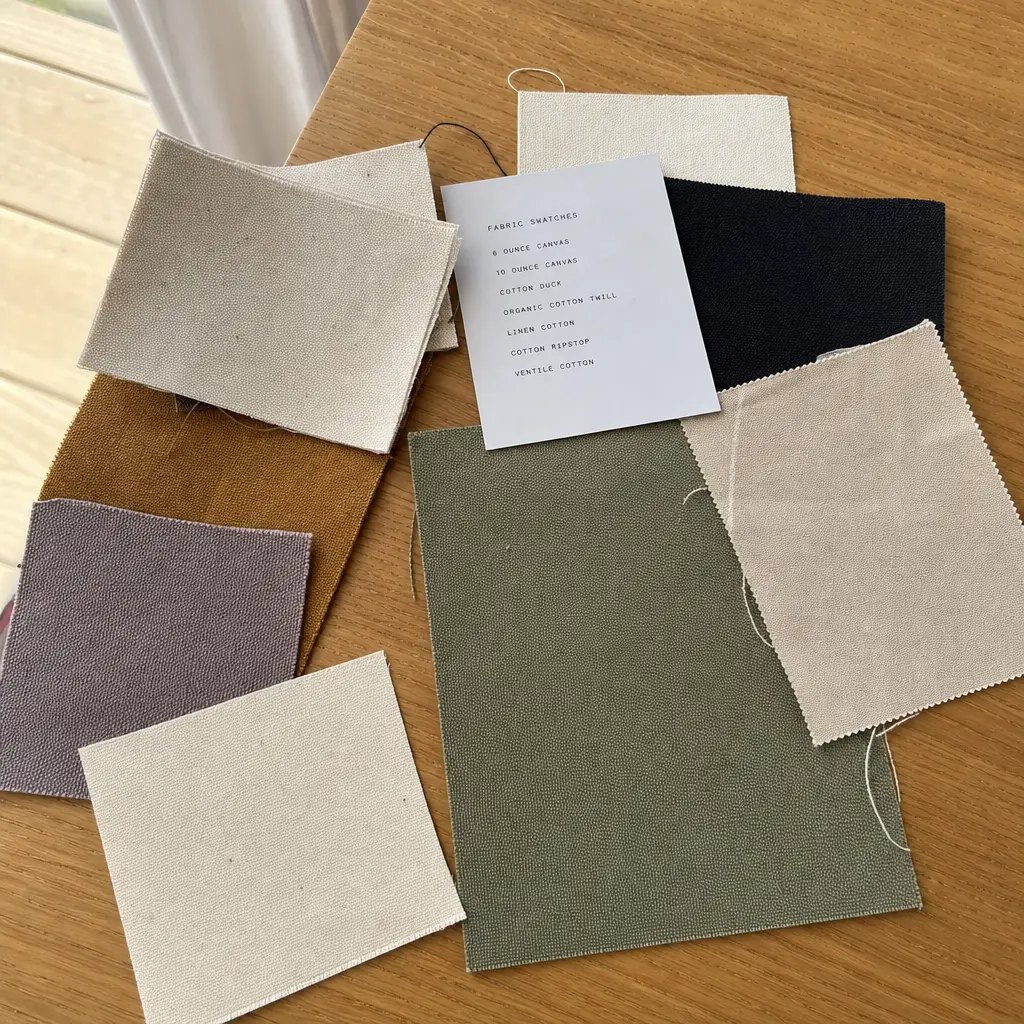
Natural canvas suits artisan bakery branding because it pairs visually with flour sacks, kraft packaging, aprons, and handmade materials. Natural does not mean defect-free or perfectly uniform. Seed specks and small slubs may be acceptable, while oil stains, mildew marks, holes, strong odor, water stains, and obvious shade panels should be rejected. Put the surface standard in writing before production.
- Use lighter canvas for event handouts only after checking wrinkle, structure, and print-through risk.
- Use mid-weight canvas as a balanced starting point for reusable bakery portfolios.
- Use heavier canvas when premium handfeel justifies higher sewing difficulty and carton weight.
- Approve natural, bleached, dyed, washed, or coated canvas with physical swatches.
- Ask whether fabric is stabilized or pre-shrunk if dimensional repeatability matters.
Specify Zippers and Sewing
The zipper is a functional component, not a decoration. A portfolio can look good in photos and still fail in use if the zipper catches fabric, drags around corners, splits under a thick insert stack, or leaves pressure marks on the next piece in the carton. A No. 5 nylon coil zipper is often practical for flat canvas portfolios because it is flexible and smooth, but the final choice should be proven through sample testing.
Metal zippers can create a premium look, yet they add weight and can scratch printed faces during packing or transit. Resin zippers may work on some designs but can feel bulkier and may not lie as flat. The specification should identify zipper type, gauge, tape width, tape color, puller type, puller finish, opening direction, tail length, and end construction.
- Specify zipper type instead of allowing silent substitution.
- Check zipper starts, ends, corners, pockets, and label seams for reinforcement.
- Test at least five open-close cycles on sampled pieces.
- Inspect inside seam finish as well as front appearance.
- Confirm pullers do not mark print faces in the approved carton orientation.
Match Branding to Canvas
Most bakery zipper portfolios use one-color or two-color screen printing because it controls cost and works well for simple marks. Water-based ink may provide a softer handfeel on natural canvas. Other ink systems can improve opacity or surface strength, but they may feel heavier or behave differently under carton pressure. The correct method depends on artwork detail, fabric texture, and packing method.
Bakery artwork often includes small serif type, wheat icons, hand-drawn badges, thin rules, or flour-dust effects. These details can be attractive on paper and risky on woven fabric. Canvas texture can break thin strokes, fill small counters, and soften edges. A digital proof checks layout, but a physical strike-off proves print behavior.
- Provide vector artwork with final print width and height in millimeters.
- Ask the supplier for minimum line thickness, text height, and gap recommendations.
- Approve ink shade on production-equivalent canvas, not only by Pantone code.
- Measure print placement from fixed seams or edges.
- Use tissue or layer protection if print faces touch zipper pulls or dark trims.
Make Samples Decision-Ready
A useful sample path separates layout approval from production approval. A first prototype can confirm shape, pocket layout, zipper direction, and handling. It may use substitute material if clearly labeled. Fabric swatches confirm weight, shade, texture, and finish. Print strike-offs confirm artwork behavior. The pre-production sample should combine approved canvas, zipper, label, print, pocket layout, and proposed packing.
Test samples with real bakery contents. Insert the wholesale menu, order form, gift-card sleeve, tasting card, or distributor document set. Zip the portfolio closed, hold it as a salesperson would, and stack several pieces under light pressure. Then check document curling, zipper drag, corner shape, print contact, puller marks, and overall presentation.
- Approve a layout prototype only for construction, not final quality.
- Measure the sample empty and with the intended insert stack.
- Photograph print and label placement with a ruler from fixed edges.
- Keep buyer and factory reference samples from the same approval stage.
- Do not release bulk production while fabric, print, zipper, label, or packing remains open.
Control MOQ and Cost Drivers
MOQ is connected to material buying, print setup, label production, zipper sourcing, cutting efficiency, sewing line arrangement, inspection, and carton packing. A stock natural canvas portfolio with one-color print may support a lower MOQ than a custom-dyed version with a woven label, special puller, divider pocket, barcode sticker, and retail-ready packing.
Ask suppliers to separate base construction from options. The base item may include fabric, cutting, sewing, standard zipper, and basic trim. Add-ons may include screen charges, extra print colors, woven labels, custom pullers, pockets, hangtags, barcode stickers, tissue, individual bags, stronger cartons, and special side marks. This prevents a low headline price from hiding missing requirements.
- Request price tiers using the same specification and Incoterm.
- Separate screen charge, sample charge, label charge, zipper upgrade, and packing charge.
- Ask which components change if the order falls below MOQ.
- Confirm separate MOQ for custom fabric, labels, pullers, or hangtags.
- Compare carton count and estimated CBM, not only unit price.
Plan Cartons Early
Flat portfolios still need deliberate carton planning. Zipper lines, pullers, print faces, corners, and labels can all be damaged by poor packing. The carton plan should be based on a trial pack using approved or production-equivalent units, not estimated after bulk goods are finished. This is especially important when bakery programs ship to distributors, warehouses, retail locations, or event teams with strict receiving limits.
Ask for pieces per carton, carton dimensions, net weight, gross weight, estimated CBM, layer count, orientation, protective sheets, carton board strength, and side-mark wording. The exact keyword phrase canvas zipper portfolios for artisan bakeries shipping carton planning belongs in SEO fields and search strategy, but the buyer-facing instruction is simpler: trial-pack the actual product and document the result before shipment booking.
- Require trial-pack data before cartons are sealed.
- Keep orientation consistent unless a tested alternating plan reduces pressure.
- Use separators where print faces contact zipper pulls or dark trims.
- Record carton dimensions, pieces per carton, NW, GW, and CBM in the quote.
- Reject over-compression that causes bulging, bent corners, zipper marks, or print transfer.
Set Practical QC Rules
Quality control should be measurable. Wording such as "good quality" does not protect the buyer or guide the supplier. The inspection standard should define finished size, usable size, zipper function, seam reinforcement, print placement, print durability, label placement, fabric defects, odor, carton count, carton marks, and packing orientation. Put these rules into the purchase order or approved specification.
Inspection can be staged. Incoming material review checks canvas shade, weight, odor, stains, slubs, and zipper quality before cutting. Inline inspection checks sewing alignment and pocket placement while corrections are still possible. Final inspection checks dimensions, function, appearance, labels, packing, carton marks, and counts. Packed-carton review confirms that the shipping plan was followed.
- Classify critical, major, and minor defects before inspection.
- Check fabric panels for stains, holes, mildew odor, heavy slubs, and shade bands.
- Measure print and label placement with millimeter tolerances.
- Test zipper function across sampled pieces, not only top-carton samples.
- Tie inspection photos to item number, PO, carton number, and sample reference.
Compare Supplier Quotes Fairly
A comparable quote gives every supplier the same baseline: size, usable space, canvas, finish, zipper, print, label, pocket layout, packing method, carton requirement, quantity, delivery term, and sample path. Without those details, the lowest price may simply reflect lighter fabric, a smaller zipper, missing packing, weaker cartons, or less inspection support.
Use the same Incoterm when comparing offers. EXW, FOB, CIF, and DDP include different responsibilities and cost categories. For landed cost planning, suppliers should also provide carton dimensions and estimated shipment cube. For repeat bakery programs, confirm whether fabric source, zipper type, print screen, label artwork, carton count, and packing orientation will remain consistent on reorder.
- Request unit price by quantity tier with the same specification.
- Require fabric GSM and finish rather than descriptions such as "heavy canvas."
- List screen, sample, label, mold, and special packing costs separately.
- Ask for carton size, carton count, gross weight, net weight, and estimated CBM.
- Compare offers against the approved specification, not incomplete headline prices.
Specification comparison for buyers
| Supplier or material choice | Best fit | What to confirm before approval | Buyer risk if vague |
|---|---|---|---|
| Stock natural cotton canvas | Launch orders, trade shows, wholesale sales folders, and programs needing lower setup complexity | Exact oz and GSM, approved shade range, acceptable slubs and seed specks, odor standard, shrinkage behavior | Natural fabric variation may be treated as acceptable by the supplier even when stains, shade bands, or odor are unacceptable to the brand |
| Custom dyed or bleached canvas | Brand color control, retail gift folders, premium franchise kits, and repeat programs with consistent presentation | Lab dip or swatch approval, dye lot control, MOQ, lead time, color tolerance, crocking or rub risk | Higher MOQ and longer lead time can be hidden until after artwork and launch dates are fixed |
| 10-12 oz canvas construction | Cost-sensitive document packs, event handouts, and lighter sales kits | Supplier validation by sample testing with the real insert stack, zipper, print, and carton pressure | Too-light fabric may wrinkle, show insert edges, or feel disposable if the construction is not tested |
| 12-14 oz canvas construction | Reusable bakery sales portfolios and higher-perceived-value gift or distributor kits | Sewability, zipper waviness, carton gross weight, needle marks, and corner shape after packing | Heavier fabric can look premium but increase sewing defects, freight weight, and pressure marks |
| No. 5 nylon coil zipper | Most flat canvas zipper portfolios needing smooth operation and flexible sewing | Gauge, tape width, tape color, puller type, opening direction, stopper finish, and puller pressure in cartons | Unspecified zipper substitutions can cause snagging, rough pull, staining, or uneven stack pressure |
| Metal or resin zipper upgrade | Premium appearance or stronger visual contrast where extra weight is acceptable | Scratch risk, corrosion risk, puller bulk, carton pressure points, and compatibility with canvas edge sewing | A nicer-looking zipper can damage print faces or create dents when packed flat |
| Screen print on canvas | Simple bakery logos, one-color marks, line art, and ingredient-style typography | Strike-off on production-equivalent canvas, minimum line thickness, rub check, and placement tolerance | Digital proofs may look clean while actual canvas print fills small type or breaks thin strokes |
| Woven label plus print | Retail-ready branding, franchise programs, and repeat distributor kits | Label size, fold type, seam insertion point, placement tolerance, color approval, and inclusion in unit price | Labels can sit crooked, disappear into seams, or be omitted from quotes if not itemized |
| Flat pack with protected layers | Warehouse receiving, freight cube control, print protection, and repeat carton counts | Pieces per carton, layer orientation, protective sheets, NW, GW, CBM, side marks, and carton board strength | Over-compression can bend corners, mark prints, wave zippers, and create carton bulging |
Buyer checklist before sampling
- Define the portfolio use: wholesale sales documents, retail gift folder, distributor kit, staff onboarding pack, franchise material set, trade-show handout, or seasonal bakery launch pack.
- Send the actual insert stack or a measured mock stack, including paper size, sheet count, catalog thickness, card sleeve, rigid insert, and whether the contents must remain flat.
- Specify finished outside size, usable inside size, zipper opening length, pocket dimensions, gusset depth if required, and dimensional tolerance in millimeters.
- State canvas composition, oz weight, approximate GSM, finish, color, shrinkage expectation, approved shade range, acceptable slubs, and unacceptable stains or odor.
- Provide vector artwork with final print size, Pantone target, placement from fixed edges, minimum line thickness concern, and strike-off approval requirement on bulk or production-equivalent canvas.
- List zipper gauge, tape width, tape color, puller material, puller finish, opening direction, zipper tail treatment, end reinforcement, and whether branded pullers are included or excluded.
- Define trim details including woven label size, fold type, seam location, placement tolerance, hangtag, barcode sticker, care label, retail compliance label, and carton side-mark wording.
- Require a pre-production sample made with approved canvas, zipper, label, print, pocket layout, and packing method before bulk cutting or packing approval.
- Set carton requirements: units per carton, maximum gross weight, carton dimensions target, layer orientation, inner protection, carton board strength, side marks, pallet limits, and photo proof.
- Ask suppliers to itemize product body, printing, screen charge, label, zipper upgrade, sample charge, packing material, carton, inspection support, and Incoterm.
Factory quote questions to send
- What canvas oz and GSM are included, and is the fabric stock natural, greige, bleached, dyed, washed, coated, stabilized, or pre-shrunk?
- What finished outside size and usable inside size can you hold for this construction, and what tolerance do you propose after sampling?
- Will the quoted sample be tested with empty portfolios, A4 sheets, US letter sheets, or our actual bakery insert stack?
- Which zipper gauge, tape width, tape color, puller type, puller finish, opening direction, and zipper end construction are included in the unit price?
- What print method is quoted, and what artwork limits do you recommend for small type, thin lines, gaps, halftones, and textured canvas?
- Are woven labels, hangtags, barcode stickers, care labels, individual bags, paper bands, tissue sheets, desiccant, inner packs, and export cartons included or separate?
- How many pieces fit per carton at the proposed carton size, gross weight, net weight, CBM, layer count, and packing orientation?
- What carton board grade or strength is proposed, and is it suitable for sea freight, pallet stacking, courier handling, or only domestic transfer?
- Will you provide trial-pack photos showing open carton layout, layer orientation, closed carton, side mark, carton measurement, and gross weight?
- Which components have separate MOQ or lead time, such as custom fabric color, woven labels, custom zipper pullers, printed hangtags, or barcode stickers?
Quality-control points to confirm
- Validate fabric weight, zipper selection, and dimensional tolerance by construction sample testing; broad oz, GSM, and tolerance ranges are only starting points until the supplier proves the build.
- Check usable inside size with the intended insert stack because seams, zipper tape, pocket lips, and binding can reduce clearance even when outside dimensions pass.
- Control finished size with an agreed millimeter tolerance; flat non-gusset styles may target tighter control than washed, padded, or gusseted versions.
- Test zipper operation for at least five full open-close cycles on inspected pieces, with no skipped coil, catching fabric, rough pull, loose stopper, split tape, or weak end stitching.
- Inspect zipper pullers against the approved packing orientation to confirm they do not dent canvas, mark printed faces, or create uneven carton pressure points.
- Approve print by physical strike-off and check dry rub, light scratch resistance, edge definition, ink shade, and placement from fixed seams or edges.
- Check reinforcement at zipper ends, corners, pocket openings, divider starts, and label insertion points, with no open seams or loose threads longer than the agreed limit.
- Inspect canvas panels for holes, weaving faults, oil stains, heavy slubs, color bands, mildew odor, water marks, and unacceptable shade variation before sewing.
- Verify carton count, carton dimensions, NW, GW, CBM, side marks, layer orientation, protective sheets, and carton condition during final packed-goods review.
- Classify critical, major, and minor defects before inspection so rejection decisions are consistent between buyer, factory, and third-party inspector.