Why bookstore portfolio orders fail at supplier handoff
A canvas zipper portfolio looks simple in a catalog photo, but most production problems start when the buyer gives the supplier only a size, logo, and target price. University bookstores usually need a product that can sit on a shelf, survive student use, carry a campus brand, and pass internal purchasing rules. That makes supplier compliance more important than a generic promotional bag quote.
The buying problem is not only finding a canvas zipper portfolios supplier. The real task is proving that the supplier can repeat the approved sample at bulk scale. A factory may quote a low price using 10 oz canvas, a light zipper, one-color screen print, and loose bulk packing, while another supplier quotes 14 oz canvas, reinforced zipper ends, retail barcode packing, and pre-shipment inspection. Without a compliance checklist, those quotes appear comparable when they are not.
- Treat the RFQ as a production control document, not a price request.
- Separate visual design approval from construction approval.
- Require the supplier to state what is included and what is excluded.
- Compare suppliers on risk, repeatability, and landed cost, not only unit price.
Set the product use case before choosing the canvas
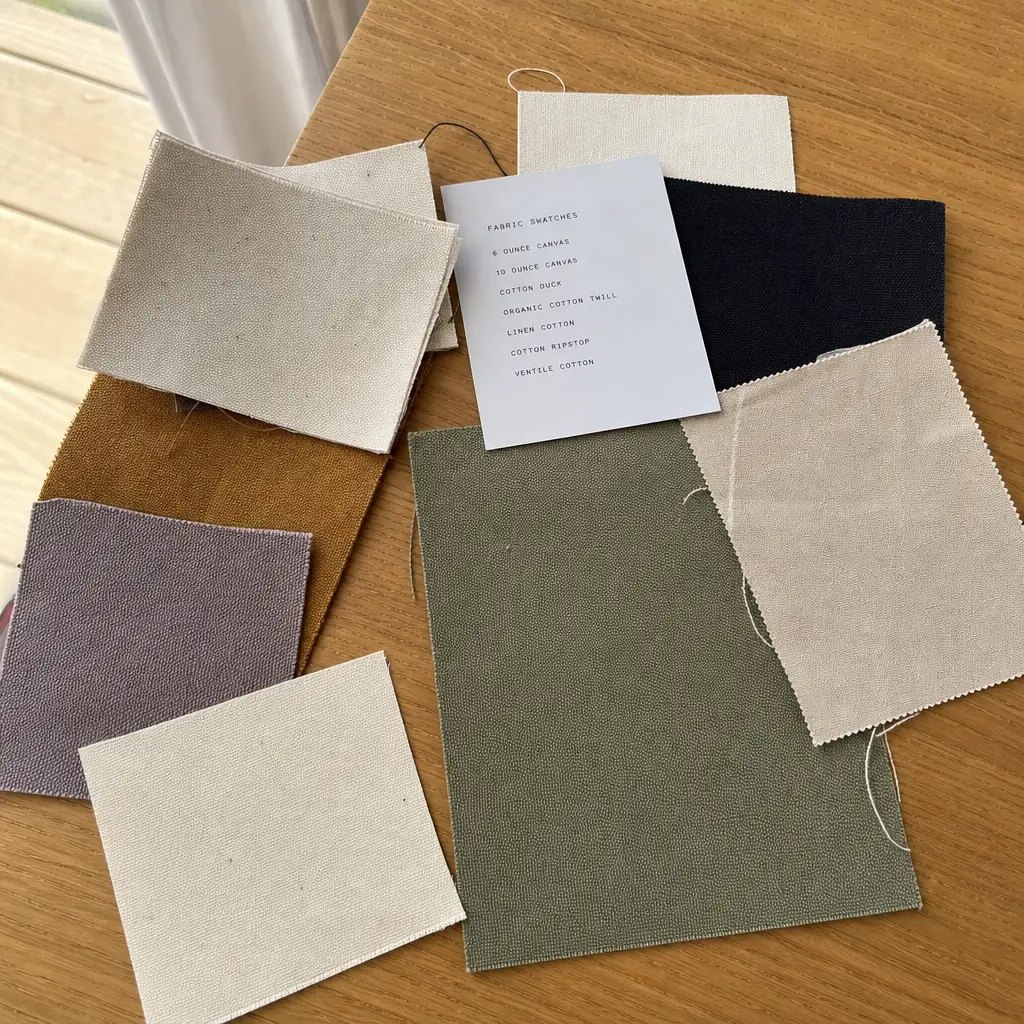
Canvas weight should be chosen by use case. For a low-cost orientation giveaway, 10 oz canvas may be acceptable if the portfolio only carries papers for a short event. For bookstore retail, alumni gifts, or premium campus merchandise, 12 oz to 16 oz canvas is more realistic. In GSM terms, 12 oz is often around 340-360 GSM, 14 oz around 400-420 GSM, and 16 oz around 450-480 GSM, depending on weave and finishing.
Heavier canvas improves perceived value and structure, but it also affects sewing bulk around the zipper, freight weight, and print behavior. A very heavy canvas with tight corners can cause zipper waviness if the factory does not control seam allowance. A buyer should not simply write 'heavy canvas' in the RFQ. State the target oz, GSM range, color, finishing, shrinkage concern, and whether the fabric must stand firm or remain flexible.
- For event giveaways: 10-12 oz canvas can work if zipper and print quality are still controlled.
- For bookstore retail: 12-14 oz canvas usually balances cost, structure, and sewing efficiency.
- For premium gift sets: 14-16 oz canvas gives a stronger hand feel but needs better needle and zipper control.
- For natural canvas: approve slub level and shade, because natural cotton color varies by batch.
- For dyed canvas: request colorfastness and dye lot control before bulk cutting.
Build the RFQ around construction, not only dimensions
Finished outside dimensions matter, but construction details decide whether the portfolio feels like a retail product. A typical bookstore portfolio may need to hold A4 or letter documents, a tablet, pens, cards, receipts, or a small notebook. If the buyer does not define the internal layout, suppliers will quote the simplest panel construction and then charge later for extra pockets or lining.
The RFQ should show the front panel, back panel, zipper path, gusset if any, inside sleeve, pen loop, card pocket, logo placement, label placement, and seam finish. If a buyer is still finalizing the design, the RFQ can include two versions: a standard cost-control version and a retail-upgrade version. This makes supplier comparison clearer and prevents late redesign from damaging lead time.
- State whether the zipper runs along one side, two sides, or three sides.
- Define whether corners are square, rounded, bound, or folded.
- List all internal parts: document sleeve, tablet sleeve, pen loop, card pocket, mesh pocket, or elastic strap.
- Specify seam allowance and reinforcement at zipper ends.
- Include finished tolerance, especially if the portfolio must fit a boxed notebook or device.
Choose decoration methods by durability and approval risk
University marks, bookstore names, alumni logos, and department graphics often go through brand approval. That means decoration must be predictable. Screen print is common for canvas portfolios because it gives good opacity and cost control for one to three solid colors. For fine gradients or full-color artwork, heat transfer may be cleaner, but the buyer should test adhesion and edge lift on textured canvas.
Embroidery can look premium, but it can distort lightweight canvas and create an uneven inside surface unless backed or patched correctly. Woven labels and leather-look patches are safer for a classic retail style, but they add tooling, MOQ, and sample time. The buyer should match the decoration method to both the artwork and the purchasing risk. A beautiful logo method is not useful if it delays licensing approval past the bookstore launch date.
- Screen print: practical for solid school marks, clear text, and cost-sensitive bulk orders.
- Heat transfer: useful for multi-color designs, but test wash, rub, and adhesion on the actual canvas.
- Embroidery patch: better than direct embroidery when the canvas is medium weight and needs clean backing.
- Woven label: good for subtle branding and repeat programs with stable artwork.
- Debossed patch: premium look, but requires added material approval and attachment testing.
Read MOQ logic before comparing unit prices
MOQ is not just a supplier preference. It comes from fabric purchasing, zipper color, printing setup, cutting efficiency, labor planning, and packing materials. A supplier may offer a low MOQ for natural canvas with black zipper and one-color print because materials are standard. The same supplier may raise MOQ when the buyer requests custom dyed canvas, custom zipper tape, a branded puller, printed lining, or several bookstore SKUs.
Procurement teams should ask suppliers to separate the MOQ drivers. This helps the buyer decide where customization is worth it. For example, keeping the zipper standard but using a woven CTM-style side label or bookstore label may protect brand value without forcing a custom zipper puller MOQ. If the order is split across several campus logos, confirm whether MOQ applies per design, per color, per size, or total order.
- Lowest MOQ usually uses stock canvas, stock zipper, standard thread, and simple print.
- Custom dyeing often creates fabric roll MOQ and extra lab dip approval time.
- Custom zipper tape or pullers can trigger accessory MOQ higher than the sewing MOQ.
- Multiple logo versions increase screen setup, packing separation, and inspection complexity.
- Retail barcode labels can create SKU-level packing labor even when construction is identical.
Supplier compliance evidence that matters
Compliance should be practical and tied to the order. A university bookstore buyer may need supplier profile documents, business license, factory audit information, material declarations, restricted substance statements, or social compliance evidence depending on the institution. However, a clean document folder does not prove the zipper will run smoothly or the print will cure correctly. Product-level evidence is still necessary.
A stronger supplier will connect documents to production controls. They should know which workshop cuts fabric, who controls printing, how samples are sealed, how bulk fabric is stored, how carton quantities are verified, and what happens when defects are found. If a supplier cannot explain those steps, the buyer should treat their quote as higher risk even if the unit price is attractive.
- Request factory name and address, not only exporter name.
- Ask whether printing and sewing are in-house or subcontracted.
- Require photos or video of similar zipper portfolio production if available.
- Keep approved fabric swatch, zipper sample, label sample, and print strike-off as sealed references.
- Tie compliance documents to the actual production site and order date.
Sample approval should test the hard parts first
A visual sample can hide production risk. The first sample may look acceptable from a distance but still have a weak zipper corner, poor lining fit, uneven print pressure, or fabric that will shrink after steam pressing. Buyers should approve samples in stages: material swatch, print strike-off, construction sample, and pre-production sample with final packing. Skipping stages saves a few days early but often costs weeks later.
The pre-production sample should be made with actual bulk-intended materials. If the factory uses substitute canvas or a similar zipper for sampling, mark it clearly as a development sample and do not approve it as the bulk standard. For licensed campus marks, keep a signed artwork proof showing Pantone colors, logo size, print position, and any required clear space around the logo.
- Measure outside size, inside usable size, and pocket opening width.
- Open and close the zipper repeatedly, especially around corners.
- Rub the print with a dry and slightly damp white cloth to screen for poor curing.
- Load the portfolio with documents or a notebook to see whether seams distort.
- Review the packed sample exactly as it will arrive at the bookstore or warehouse.
Set QC thresholds before bulk production starts
Quality control must define what is acceptable, not just say 'good quality'. For canvas zipper portfolios, important defects include zipper jamming, broken teeth, skipped stitches, open seams, wrong logo color, print smudging, visible stains, crooked labels, poor corner shaping, and incorrect pocket layout. These should be listed in the purchase order or inspection checklist before the factory cuts bulk fabric.
For many importers, a general inspection level with AQL can be used, but product-specific checkpoints still matter. AQL may catch random defects, but it will not automatically judge whether the portfolio fits the intended notebook or whether the campus logo is positioned correctly. Add measurable thresholds: size tolerance, stitch density, print position tolerance, zipper function count, carton quantity, and barcode match.
- Classify wrong logo, wrong color, missing zipper, or unsafe sharp part as critical or major defects.
- Set print placement tolerance, for example within plus or minus 3 mm to 5 mm from approved position.
- Require zipper function testing on a defined sample quantity during final inspection.
- Define stain limits by location; front panel stains should be treated more strictly than minor inner marks.
- Use the approved pre-production sample as the physical comparison standard.
Packing decisions affect sell-through and claims
Packing is often treated as an afterthought, but bookstore orders usually need clean receiving and fast shelf handling. A portfolio sold as campus merchandise may need an individual polybag, paper belly band, hangtag, barcode label, price sticker area, or inner carton separation by SKU. If the buyer does not specify packing, the supplier may bulk pack tightly to reduce carton volume, which can cause creasing, zipper pressure marks, and mixed SKU cartons.
Carton strength also matters for import shipments. Canvas portfolios are not fragile like glass, but heavy cartons can burst if the factory overloads them. A practical carton plan includes units per inner carton, units per master carton, gross weight limit, carton dimensions, carton marks, moisture control, and pallet requirement if shipping to a distribution center. For natural canvas, moisture protection is important because mildew marks can ruin retail presentation.
- Use individual packing when portfolios go directly to retail shelves or campus fulfillment.
- Limit master carton weight to a level warehouse teams can handle safely.
- Separate SKUs by logo, color, and barcode to prevent receiving disputes.
- Use desiccant or moisture-control planning for long ocean shipments in humid seasons.
- Confirm carton marks match purchase order, SKU, quantity, destination, and country of origin requirements.
Lead time risks and quote data for landed-cost comparison
Lead time should be broken into real production steps. A common timeline may include artwork review, material sourcing, sample making, sample transit, buyer approval, bulk material purchasing, printing, sewing, inline inspection, final inspection, packing, export booking, and freight. When suppliers quote only '30 days production', buyers cannot see where delays may occur. University bookstore launches, orientation events, and seasonal retail windows need a schedule with decision deadlines.
Landed cost comparison should include more than unit price. A supplier with a slightly higher FOB price may be cheaper after fewer defects, better carton packing, lower rework risk, and fewer air freight emergencies. Ask each supplier to quote the same spec and provide cost drivers. If one quote excludes barcode labels, testing, individual packing, or custom sample cost, it is not comparable to a full-service quote.
- Request sample lead time separately from bulk lead time.
- Show the buyer approval deadline required to keep the ship date.
- Ask whether the quoted price includes print setup, label setup, sample fee, testing, and export carton.
- Compare EXW, FOB, and delivered options if your team manages freight centrally.
- Build buffer for licensing approval, exam season purchasing delays, and freight congestion.
Specification comparison for buyers
| Supplier option | What to verify | Commercial advantage | Buyer risk to control |
|---|---|---|---|
| Direct sewing factory | zipper source record, production-line zipper test photos, approved trim card, cutting marker photos, and final open-carton count | Better sample-to-bulk control and faster production feedback | May be weaker on export paperwork or branded packing unless checked early |
| Trading company | Factory name, production photos, trim-source proof, and who owns QC decisions | Can coordinate small mixed orders and extra services | Markup can hide real factory capability and slow defect decisions |
| Specialized bag workshop | zipper gauge, zipper tape width, puller finish, binding tape, corner reinforcement, seam allowance, and document-size tolerance | More practical for detailed construction, trims, and repeat programs | Capacity may be limited during peak seasons |
| Low-price general supplier | 300D-600D polyester, 10-12 oz canvas, or recycled PET with backing stiffness matched to document weight | Useful for simple promotional runs with loose specs | Material downgrades, weak packing, and vague inspection scope can erase savings |
| Retail-ready supplier | flat packing, insert board if needed, SKU bundles, carton weight limit, moisture protection, and barcode visibility | Can handle labels, SKU separation, carton marks, and receiving rules | Higher unit cost must be compared against reduced warehouse work |
| Compliance-focused supplier | Fabric records, labeling review, test plan, and production traceability | Safer for retail programs and repeat brand orders | Documentation claims need evidence, not only sales language |
| Local sample room plus bulk factory | Signed sample, bulk factory handoff, first-piece photos, and deviation owner | Good for complex branding before large production | Sample room quality may not match bulk line unless handoff is controlled |
Buyer checklist before sampling
- Define portfolio size by the document or device it must hold, not by a loose outside measurement; include finished size tolerance such as plus or minus 5 mm.
- State canvas weight in oz and GSM, for example 12 oz around 340-360 GSM or 16 oz around 450-480 GSM, and require the same fabric weight for sample and bulk.
- Specify whether the portfolio is unlined, self-fabric lined, or cotton/poly lined, because lining affects hand feel, cost, zipper sewing, and retail presentation.
- Confirm zipper type, gauge, tape color, puller style, and smoothness requirement; a portfolio sold in a bookstore should not use a weak zipper intended for disposable packaging.
- Provide print artwork size, Pantone references, print position from edges, and whether print is screen print, heat transfer, embroidery patch, woven label, or debossed leather patch.
- Require a pre-production sample with actual fabric, actual zipper, actual logo method, final pocket layout, and final packing, not only a blank shape sample.
- Set acceptance criteria for print rubbing, seam strength, zipper cycling, carton strength, polybag warning text if used, and visible stain limits.
- Confirm MOQ by construction type: stock fabric with standard zipper is lower; custom dyed canvas, custom zipper pullers, or complex interior panels increase MOQ.
- Define retail packing: individual polybag, paper belly band, hangtag, barcode label, inner carton quantity, master carton marks, and pallet preference if applicable.
- Require quote data broken down by material, decoration, packing, sampling, tooling, testing, export carton, and freight term so competing suppliers can be compared fairly.
Factory quote questions to send
- Is your quoted portfolio made in your own sewing factory, or will cutting, printing, zipper sewing, or packing be outsourced?
- What exact canvas weight are you quoting in oz and GSM, and what tolerance do you allow after finishing?
- Is the quoted canvas natural, bleached, dyed, washed, or laminated, and will the bulk fabric match the submitted sample roll?
- What zipper gauge, tape material, puller type, and color are included in the price?
- Which print method is included in the quote, and what is the maximum print size before the price changes?
- What MOQ applies for the standard version, and what MOQ applies if we need custom lining, custom zipper puller, woven label, or custom dyed fabric?
- How many days are needed for artwork proof, sample making, buyer approval, material purchasing, bulk production, inspection, and export packing?
- What inspection standard do you use for canvas portfolios, and can we add AQL levels or specific defect definitions to the purchase order?
- Can you quote the same spec under EXW, FOB, and DDP or delivered-to-warehouse terms so we can compare landed cost?
- What packaging is included: individual polybag, tissue, paper band, hangtag, barcode, inner carton, master carton, and carton drop resistance?
Quality-control points to confirm
- Finished size within agreed tolerance, typically plus or minus 5 mm for width and height unless the design requires tighter fit for a tablet or notebook.
- Canvas weight verified against approved swatch, with no substitution to lighter fabric unless buyer signs a revised approval.
- Zipper opens and closes smoothly for repeated cycles without catching at corners or pulling away from the seam.
- Main seams, zipper seams, handle or loop attachments if any, and pocket stress points are reinforced and free from skipped stitches.
- Print registration, color, opacity, curing, and rub resistance match approved production sample.
- Inside pocket layout, pen loop, card slot, document sleeve, and lining match the approved sample and tech pack.
- Visible surface defects such as oil stain, mildew mark, needle hole, fabric tear, heavy slub, or loose thread are classified before inspection.
- Packing follows retail requirement: correct barcode, hangtag, SKU label, carton quantity, carton mark, and moisture protection method.
- Random carton check confirms no mixed colors, mixed school logos, or wrong quantity per carton.
- Pre-shipment photos include front, back, inside, zipper close-up, print close-up, label, individual packing, and master carton mark.