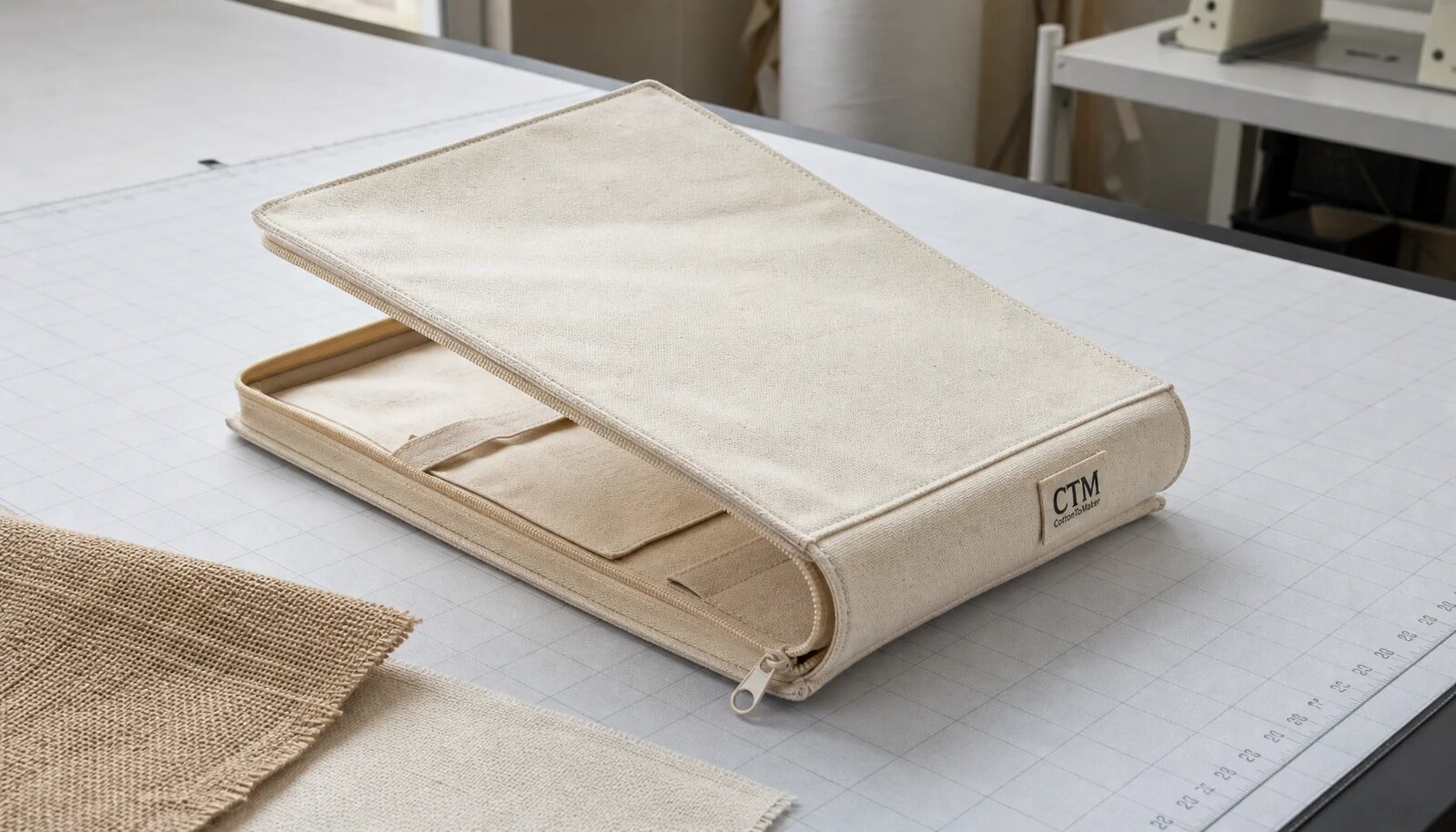
Start with the event use case
Canvas zipper portfolios for event planners can describe several different products. One buyer may need a flat document pouch for agendas, venue maps, badge sheets, and sponsor inserts. Another may need a daily staff organizer with room for run-of-show pages, pens, vendor cards, swatches, and a slim tablet. A distributor may want a clean branded portfolio that drops neatly into a conference kit. The name sounds similar, but the construction and cost are not the same.
Open the RFQ with the job the product must do. Event products are handled at registration desks, site visits, client presentations, room flips, sponsor check-ins, and venue handoffs. They may be zipped repeatedly, stacked in cartons, inserted into welcome kits, or shipped to several locations. Those details affect fabric weight, zipper gauge, pocket layout, reinforcement, logo method, and packing.
A request such as quote 1,000 canvas zipper portfolios with logo leaves too much room for interpretation. One supplier may price 10 oz canvas with a #3 zipper. Another may include 12 oz canvas, lining, a #5 zipper, and a document sleeve. A useful canvas zipper portfolios for event planners RFQ template guide turns the workflow into measurable specifications.
- State the user: attendee, planner staff, agency team, sponsor recipient, VIP client, retail customer, or resale buyer.
- List the contents: A4 documents, US letter sheets, pens, badge cards, hotel maps, contracts, sample cards, tablet, charger, or mixed inserts.
- Define the presentation level: budget giveaway, durable working tool, premium client kit, or retail-ready accessory.
- Tell suppliers whether the item is single-event use, seasonal reuse, or daily staff use.
- Include the distribution route: direct warehouse, event-kit assembly, venue delivery, multi-location shipment, or retail packout.
Make fit measurable
Size is where many portfolio RFQs become vague. Write finished size as width x height x gusset depth, with units clearly stated. Millimeters are usually easiest for international quote comparison. If the portfolio must fit A4 paper, say so, but do not stop there. A4 is 210 x 297 mm; US letter is about 216 x 279 mm. The finished product must be larger because seams, zipper curve, lining, binding, and pocket stitching reduce usable space.
For an A4-oriented flat portfolio, a common starting point is around 350 x 260 mm finished outside size, depending on orientation and zipper opening. For US letter use, many buyers quote closer to 360 x 280 mm. Treat these as starting points, not universal standards. The sample must be tested with the actual documents, folders, tablets, or inserts. A product that looks correct in a photo can still bend a contract corner when closed.
Define the body style before price comparison. A flat portfolio works for paper handouts and kit inserts. A light 20-30 mm gusset helps with brochures, card packs, pens, or small samples. A larger gusset changes the item into a compact organizer bag and usually requires stronger corner sewing, more careful zipper setting, and revised carton planning.
- Specify finished outside size and usable inside opening.
- State A4, US letter, tablet model, folder size, or insert size instead of saying standard document size.
- Define flat, light gusset, or full gusset construction, including target gusset depth.
- Set tolerances, such as +/-5 mm for width and height and +/-3 mm for gusset depth where appropriate.
- Ask whether measurements are taken empty, filled, closed, or laid flat.
Use a practical canvas spec
Canvas weight matters, but heavy is not a specification. A 10 oz canvas is commonly around 280-300 GSM after finishing, although conversion varies by weave and treatment. It can work for budget event distribution where the portfolio mainly carries paper. The tradeoff is usually a softer body, more wrinkling after carton packing, and less structure when held in one hand.
For many B2B programs, 12 oz canvas is the safer default. It is often around 330-360 GSM finished fabric and gives a more substantial handfeel while staying manageable around zipper corners. For premium client kits or heavier staff tools, 14 oz to 16 oz canvas may be suitable. Heavier fabric can feel stronger, but it can also create bulky seam stacks, needle marks, zipper waviness, and higher carton weight.
The RFQ should name composition, finished GSM, weave, color, finish, and shrinkage expectation. Cotton canvas, cotton-poly canvas, recycled cotton blend, dyed canvas, washed canvas, and coated canvas behave differently. Natural canvas may show slubs and shade variation. Dyed canvas can shift between lots. Washed canvas may shrink or distort if the pattern is not adjusted.
- Request composition, finished GSM, ounce weight, weave, color reference, finish, and shrinkage expectation.
- Ask whether the fabric is stock, custom dyed, washed, coated, brushed, enzyme treated, or pre-shrunk.
- Approve a physical swatch before sample making when color, handfeel, or natural-fabric appearance matters.
- Define whether visible slubs, shade variation, and small neps are acceptable within the approved sample range.
- Require buyer approval for any substitution in fabric mill, weight, finish, or color lot.
Lock zipper and reinforcement details
The zipper is one of the most visible failure points. If it snags, separates, waves badly at the corner, or feels undersized, the end user notices immediately. For most canvas zipper portfolios, a #5 nylon coil zipper is a balanced procurement default. It is widely available, smooth on soft goods, and more suitable for repeated opening than a small #3 zipper on a larger portfolio.
Write the zipper details into the RFQ: gauge, type, tape color, slider finish, puller material, puller shape, end-stop construction, and opening direction. If a branded puller is required, price it separately. Custom pullers can involve tooling cost, plating approval, MOQ, and extra sampling time. If zipper tape must match canvas or a brand color, ask whether the supplier will use stock tape or custom dye.
Reinforcement belongs in the same section. Event planners may pull the portfolio from tote bags, overfill it with paper, or zip it around bulky inserts. Stress points include zipper ends, pocket corners, side seams, handle tabs, wrist straps, D-rings, and elastic loops. Bartacks, box stitching, reinforcement patches, binding, or heavier thread may be needed depending on the design.
- Use #5 nylon coil zipper as the default unless the design calls for metal, resin, or another trim.
- Specify zipper tape color, slider finish, puller shape, puller material, end stops, and opening direction.
- Ask for custom puller tooling cost, MOQ, sample lead time, plating option, and approval process as separate quote lines.
- Define reinforcement at zipper ends, pocket corners, handle tabs, wrist straps, and stress-bearing loops.
- Test zipper travel on the pre-production sample and early bulk units, especially at corners and seam stacks.
Build the interior around planner behavior
Interior layout should match the event workflow. A simple document sleeve and pen loop may be enough for conference agendas, venue maps, and run sheets. A staff planner portfolio may need a zipper pocket for badge clips, a slip pocket for vendor cards, and a tablet sleeve. A client proposal kit may need fewer small compartments so printed materials can be presented cleanly.
Every added feature has cost and quality risk. Card slots can be too tight. Pen loops can be too narrow for markers. Tablet sleeves can become unusable after seam allowance reduces the opening. A zipper pocket adds trim, sewing time, and another inspection point. Procurement should request dimensions for each internal feature and test the sample with actual contents.
Lining also needs a clear decision. Unlined canvas can be economical, but interior seams may need binding or clean finishing. Lining improves appearance and can protect contents, yet it adds material, sewing steps, shade risk, and possible puckering. If lining is included, specify material, color, GSM, and whether it is loose, attached, padded, fused, or quilted.
- List each interior component with dimensions: sleeve depth, pocket width, zipper pocket size, pen-loop diameter, and card slot count.
- Confirm whether the document sleeve fits A4, US letter, folders, or planner sheets without bending.
- Specify lining material, color, and weight if a lined interior is required.
- Avoid adding pockets that do not support the end user's real workflow or event-kit contents.
- Inspect internal access after the zipper is closed because usable space may change under tension.
Choose branding before comparing prices
Branding changes price, sampling time, defect risk, and sometimes MOQ. It should be in the base RFQ, not added after the quote. Screen print is often practical for simple one-color or two-color logos on canvas. It can work well for event merchandise, sponsor packs, and agency programs if the buyer gives artwork size, placement, color reference, ink expectations, curing requirements, and print-position tolerance.
Woven labels, side labels, sewn patches, rubber patches, and leather-look patches create a quieter product finish. They can fit staff kits, client gifts, and retail-style programs. They also introduce separate approvals. Small text may not weave clearly. Patches may need die cost or heat testing. Side labels must sit where they do not interfere with zipper movement, seam folding, or packing.
Transfers and digital print may be useful for gradients, fine artwork, or shorter personalization runs, but textured canvas should be tested. Approval should include a basic rub check, edge-lift check for transfers, and comparison against the approved artwork. A supplier photo is not a substitute for a physical branded sample.
- Quote one primary branding method across all suppliers before evaluating unit price.
- Provide vector artwork when possible, with logo size, placement from fixed edges, colors, and orientation.
- Set logo placement tolerance, commonly +/-3 mm to +/-5 mm depending on product size and method.
- Ask for physical proof when brand color, small type, label weave, or patch finish matters.
- Require written approval before changing ink, label supplier, patch material, or artwork placement.
Use a copy-ready RFQ template
The RFQ should be organized enough that a supplier can answer line by line. It does not need long explanations, but it does need clear fields. Separate required specifications from options so the base quote stays comparable. If one supplier includes a gusset, one removes the sleeve, and one switches the zipper, procurement is no longer comparing the same product.
Use the template language as a starting point: Product: canvas zipper portfolio for event planner use. Quantity breaks: 500, 1,000, 2,500, and 5,000 pieces. Use case: event staff folder, client proposal kit, or attendee pack. Finished size: width x height x gusset depth. Usable opening: required document or tablet fit. Fabric: composition, GSM or ounce weight, weave, color, finish, shrinkage expectation. Zipper: gauge, type, tape color, slider finish, puller, opening direction. Interior: sleeve, pockets, pen loop, lining. Branding: method, artwork size, placement, color reference. Packing: polybag, carton quantity, carton marks, barcode labels. Inspection: tolerances, AQL or pass/fail rules. Trade term: FOB, EXW, CIF, DDP, or requested delivery point. Delivery date: required warehouse or event-kit assembly date.
Ask suppliers to show deviations in a separate section. If the factory proposes a lower-cost construction, that can be useful, but it should be visible. A cheaper quote that quietly changes canvas weight, zipper size, pocket count, packing, or branding method is not a saving; it is a different product.
- Include realistic quantity breaks and quote validity date.
- Ask for sample charge, sample lead time, revision lead time, and bulk lead time after approval.
- Request line-item costs for tooling, custom pullers, woven labels, patches, printing screens, packing, and carton labels.
- State the trade term and port or delivery point so freight assumptions do not distort comparison.
- Require suppliers to list all deviations from the RFQ in writing.
Check supplier capability and MOQ drivers
Supplier structure affects accountability. A direct factory may control cutting, sewing, branding, packing, and corrective action more closely. A trading company may be useful for multi-item event programs where one contact coordinates several products. A sourcing agent can help when the buyer needs local follow-up. Any route can work, but the RFQ should identify who owns sample approval, QC response, rework, replacement, and shipment documents.
MOQ is rarely one number. The real minimum may come from canvas color, zipper tape color, custom puller, woven label, patch, print method, hangtag, barcode label, or retail packing. Stock natural canvas with stock zipper and screen print may support a lower MOQ than custom dyed canvas with branded metal pullers and woven labels. Ask suppliers to state MOQ by component.
Lead time should also be broken down. Material sourcing, sampling, sample shipping, revision time, pre-production approval, bulk production, inspection, packing, inland transport, international freight, customs, and warehouse receiving all matter for event-date orders. Bulk lead time often starts only after deposit, artwork approval, material approval, and sealed sample signoff.
- Ask who controls cutting, sewing, printing, labeling, packing, and final inspection.
- Request component-level MOQ for fabric, zipper, label, patch, puller, and packaging.
- Confirm whether lead time starts after deposit, artwork approval, material approval, or pre-production sample approval.
- Ask for the earliest production slot and the latest safe approval date for the event deadline.
- Require written responsibility for rework, replacement, or corrective action if goods fail inspection.
Approve samples as production standards
Sampling is where the written RFQ becomes real. The first development sample may show that the canvas is too soft, the zipper waves, the pen loop is tight, the sleeve is shallow, or the logo looks too large. That is normal. The important work is recording the issue, revising the spec, and approving a final pre-production sample that both buyer and supplier can use as the production reference.
Review samples by measurement, function, appearance, and packing. Measure finished width, height, gusset depth, pocket depth, logo position, zipper alignment, label placement, and key openings. Insert the actual documents, planner sheets, pens, badge cards, swatches, or tablet. Open and close the zipper repeatedly. Check whether corners bind, seams pucker, the print sits level, and the product stacks cleanly in its intended packing.
After approval, seal and label the reference sample with date, version, PO number, material, color, and artwork version. The factory should keep a matching sealed sample. Any later change to fabric, zipper, pocket layout, artwork, logo position, label, packing, or carton marks should require written approval.
- Measure the sample against the written spec sheet and record actual results.
- Use real event contents for fit testing instead of relying on outside dimensions only.
- Approve zipper function, pocket access, stitch quality, logo placement, and packing sample.
- Keep one sealed buyer sample and require the factory to keep one matching sealed sample.
- Do not approve bulk production until material, trim, artwork, and packing are confirmed in writing.
Write QC rules inspectors can enforce
Quality control works best when defect rules are written before production. For canvas zipper portfolios, critical defects usually include wrong product, wrong artwork, missing pocket, broken zipper, detached puller, mold odor, severe stain, incorrect size that prevents intended use, sharp metal burrs, and carton quantity mismatch. Major defects may include zipper snagging, open seams, skipped stitches at stress points, visible logo shift, crooked label, wrong pocket depth, exposed raw edge, or severe shade mismatch.
Tolerances should be practical and stated in the PO. Many canvas portfolio programs can use +/-5 mm for body width and height, +/-3 mm for gusset depth, +/-5 mm for pocket depth, and +/-3 mm to +/-5 mm for logo placement, depending on design and decoration method. Adjust these numbers to the approved sample and supplier capability. Avoid subjective inspection language such as good size or nice print.
Inspection timing matters. Inline checks can catch wrong pocket layout, zipper alignment, print position, and seam construction before the full order is packed. Final inspection should verify product count, variant separation, carton labels, packing condition, moisture control, and defect level. If the buyer uses AQL, state the inspection level and acceptable quality limits in the PO. If not, define sample size, defect categories, and pass or fail rules anyway.
- Classify defects as critical, major, and minor before production starts.
- Set measurement points for body size, zipper opening, pocket depth, gusset depth, and logo placement.
- Require zipper-function checks on bulk units, not only on the approval sample.
- Ask for measurement reports, defect photos, and carton checks for fixed-deadline or repeat programs.
- Treat wrong artwork, broken zipper, severe odor, missing components, and quantity errors as high-priority failures.
Specification comparison for buyers
| RFQ decision | Recommended procurement default | When it fits | Buyer risk to verify before PO |
|---|---|---|---|
| Base construction | Flat canvas zipper portfolio with one main compartment, one document sleeve, and one pen loop | Conference kits, planner staff folders, sponsor packs, proposal sets, and agency merchandise | Confirm usable opening and interior access, not only outside size |
| Finished size | For A4 use, quote around 350 x 260 mm outside size; for US letter use, quote around 360 x 280 mm, adjusted to actual inserts | Agendas, contracts, venue maps, run sheets, badge sheets, planner forms, and client documents | Run a real content-fit test because zipper curve, seams, lining, and pockets reduce usable space |
| Dimensional tolerance | Body width and height +/-5 mm; gusset depth +/-3 mm; pocket depth +/-5 mm; logo placement +/-3 mm to +/-5 mm | Most sewn canvas programs where small variation is normal but brand position and document fit still matter | Put tolerances into the PO, approved sample record, and inspection checklist |
| Canvas specification | Quote one base option first: 12 oz canvas, usually about 330-360 GSM finished fabric, cotton or cotton-rich blend as specified | Reusable event-planner portfolios needing a substantial but still practical handfeel | Request composition, finished GSM, finish, color standard, shrinkage expectation, and approved swatch reference |
| Canvas alternatives | Show optional pricing for 10 oz canvas and 14-16 oz canvas as separate quote lines | 10 oz for budget paper kits; 14-16 oz for premium client kits, staff tools, or heavier contents | Check body collapse on lighter fabric and seam bulk, zipper waviness, needle marks, and carton weight on heavier fabric |
| Zipper specification | #5 nylon coil zipper with matching tape, agreed slider type, and metal or molded puller | Most B2B portfolio programs where smooth travel, cost, durability, and availability need balance | Inspect slider travel, tape shade, end stops, puller attachment, zipper wave, corner alignment, and opened-mouth access |
| Internal layout | One document sleeve, one pen loop, and optional zipper pocket or card pocket priced separately | Planner staff kits, badge desk use, agency proposal sets, and event-day operating folders | Confirm pocket dimensions with real contents; small pockets often fail through tight openings or lost usable depth |
| Branding method | One-color screen print or woven side label quoted as separate line options | Corporate event merchandise, sponsor packs, planner staff kits, repeat procurement programs, and retail-style accessories | Confirm artwork size, PMS or brand reference, placement tolerance, curing, rub resistance, label MOQ, and approval sample |
| Packing method | 1 piece per clear polybag, then 20-50 pieces per export carton depending on size, fabric weight, and carton-weight limit | Warehouse receiving, event-kit assembly, multi-location distribution, and event-date staging | Confirm carton quantity, carton marks, barcode or SKU labels, moisture control, variant separation, and mixed-color rules |
Buyer checklist before sampling
- Define the business use first: attendee giveaway, planner staff tool, client proposal kit, sponsor merchandise, retail accessory, agency resale item, or event-kit component.
- Specify finished outside dimensions in millimeters or inches and state the exact insert size to fit, such as A4 paper, US letter sheets, 10.9-inch tablet, badge sheets, venue maps, or sample cards.
- Request usable internal opening measurements because zipper placement, seam allowance, lining, binding, and rounded corners can reduce document access.
- State whether the body is flat, lightly gusseted, or full-gusseted; include target gusset depth and whether the portfolio must stack flat, fit inside kits, or hold thicker inserts.
- Specify canvas composition, finished GSM or ounce weight, weave, finish, color reference, shrinkage expectation, and whether substitutions require written buyer approval.
- Define zipper gauge, zipper type, tape color, slider finish, puller material, puller shape, end-stop construction, and zipper opening direction.
- Map the internal layout with measurable details: document sleeve depth, slip pocket width, zipper pocket size, pen-loop diameter, card slot count, elastic loop width, or tablet sleeve dimensions.
- Set reinforcement requirements at zipper ends, pocket corners, side seams, handle tabs, wrist straps, D-rings, and any point expected to carry weight or repeated pulling.
- Choose the logo method before quote comparison: screen print, heat transfer, woven label, sewn patch, leather-look patch, rubber patch, or side label.
- Provide artwork size, placement from fixed edges, color reference, number of print colors, artwork file format, and acceptable placement tolerance.
Factory quote questions to send
- What finished outside size, usable inside opening, fabric composition, finished GSM, zipper gauge, seam construction, and internal layout are included in this quote?
- Is production handled in your own factory, a partner workshop, or a subcontracted sewing line, and which steps are in-house: cutting, sewing, printing, labeling, packing, and final QC?
- What canvas fabric is quoted: cotton, cotton-poly blend, recycled cotton blend, dyed canvas, washed canvas, natural canvas, coated canvas, or stock fabric?
- Can you provide fabric swatch, color standard, GSM test result or supplier specification, and expected shrinkage range before sample approval?
- Which zipper is included: #5 nylon coil, metal, resin, lock slider, non-lock slider, auto-lock slider, custom puller, or standard puller?
- Which branding method is included, how many colors or placements are priced, and what artwork file format do you need for sampling?
- What MOQ applies separately to the fabric color, zipper tape color, custom puller, woven label, patch, print method, and retail packing?
- Can you quote the requested quantity breaks and show the unit-price change if we add or remove a gusset, tablet sleeve, zipper pocket, pen loop, or custom puller?
- How many samples are included, what is the sample charge, what is the sample lead time for each round, and can the charge be credited after bulk order confirmation?
- What measurement tolerance do you recommend for finished body size, gusset depth, pocket depth, logo position, zipper alignment, and label placement?
Quality-control points to confirm
- Finished size should remain within agreed tolerance for width, height, gusset depth, pocket depth, zipper opening, and document access, with measurements taken from the sealed sample and bulk units.
- Canvas should match approved composition, finished GSM range, color standard, handfeel, finish, and appearance level, with no unacceptable oil marks, mildew odor, heavy creasing, holes, shade panels, or severe slub clusters.
- Fabric shrinkage should be controlled when washing, dyeing, enzyme finishing, or heat pressing is used; the factory should confirm whether dimensions are measured before or after finishing.
- Zipper should open and close smoothly across the full path without snagging, wave distortion, slider separation, broken coil, loose end stops, exposed misalignment, or puller failure under normal handling.
- Stitch density should be even and appropriate for the material, commonly around 7-9 stitches per inch for many canvas bag seams unless the approved sample specifies otherwise.
- Seams should show no skipped stitches, broken threads, loose thread nests, seam gaps, uneven topstitching, severe puckering, or raw edges visible outside the intended construction.
- Corners and load-bearing areas should be reinforced where documents, tablets, pens, cards, wrist straps, handles, or planner tools create stress, especially at zipper ends and pocket corners.
- Print or label should match approved artwork size, placement, orientation, color range, and legibility, with no cracking, dye bleed, blur, ghosting, lifting, crooked label, or visible offset beyond tolerance.
- Interior layout should match the approved sample exactly, including pocket count, pocket depth, sleeve width, pen-loop diameter, card slot size, lining material, and access after the zipper is closed.
- Functional fit should be checked with the intended contents, such as A4 or letter documents, planner sheets, pen, tablet, badge cards, sample swatches, or event inserts.