Why museum shop reorders fail
Canvas zipper portfolio reorders usually do not fail because the item is complicated. They fail because a simple item invites loose language. The first order may have been approved from one good sample, a short quote, and a casual promise to make the next batch the same. Then the reorder arrives with a softer canvas, a shinier puller, a zipper line that waves slightly, or a logo that sits lower on the panel. Each change may seem small. Together, they make the replenishment look like a different product.
That drift is a bigger problem for museum shops than for many general retail channels. Museum stores are curated environments. A portfolio may sit beside prints, books, stationery, exhibition merchandise, or donor-event items. Customers expect the piece to feel considered, not promotional. A repeat order has to work as a bag, but it also has to belong visually with the existing assortment and any remaining stock from the prior run.
The commercial side can be just as risky. Two factories can quote what appears to be the same canvas zipper portfolio while building the price on different assumptions. One quote may include 14 oz pre-shrunk canvas, a #5 zipper, individual polybags, barcode stickers, and destination carton marks. Another may assume 12 oz stock canvas, a lighter zipper, no barcode application, and basic bulk packing. If the buyer compares only the ex-factory unit price, the cheaper quote can win for reasons that do not support the retail program.
A stronger reorder process treats the product as a controlled version, not a memory. The retained sample, specification sheet, artwork file, quote, purchase order, and inspection standard should all point to the same approved reference. When those documents agree, suppliers have less room to reinterpret the order. When they do not, consistency depends on luck.
- Keep the approved physical sample, current spec sheet, quote basis, and PO language tied to one version reference.
- Treat fabric, zipper, print placement, dimensions, and packing as measurable product requirements rather than general preferences.
- Compare suppliers only after normalizing material basis, trim grade, labeling scope, carton count, and freight-ready packing assumptions.
Start with how the portfolio will be used
The best specification begins with the contents the museum shop actually needs to sell or protect. Will the portfolio hold A4 sheets, US letter documents, prints, maps, notebooks, catalogs, or curated stationery sets? If paper corners must slide in without bending, the buyer should state the internal clear width and height. If a thicker bundle is planned, gusset depth should be calculated from the loaded contents rather than copied from a sample photo.
Outside dimensions alone are not enough. A portfolio can measure correctly on paper and still feel tight in use if the zipper opening is too short, the corners are rounded too aggressively, or the top seam reduces the loading width. Store staff notice this quickly when they are packing flat goods at a counter or building gift sets for an exhibition launch.
For most museum shop programs, 12 oz to 14 oz cotton canvas, roughly 407 to 475 GSM, is a practical starting range. It gives structure and a substantial hand feel without pushing the item into unnecessary sewing difficulty or freight weight. Lighter canvas can collapse around the zipper and feel more like a giveaway. Heavier 16 oz canvas can work for oversized or premium editions, but it should be chosen deliberately because it affects seam bulk, needle choice, zipper stress, and carton weight.
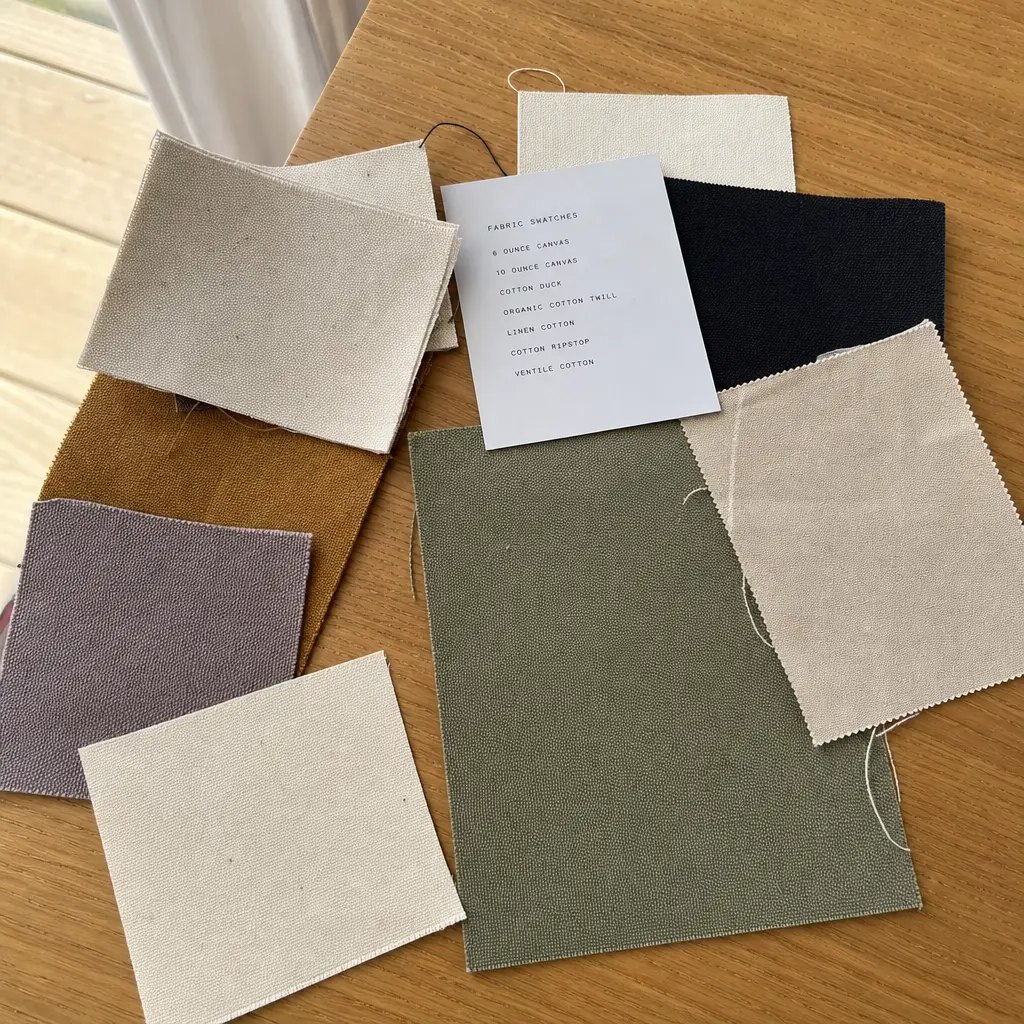
Canvas also needs a finish definition. Buyers should ask whether the fabric is plain weave, dyed, piece washed, pre-shrunk, enzyme washed, or converted from stock greige goods. Natural cotton may show slub and mild shade variation, and that can be attractive. What matters is deciding what variation is acceptable before bulk production, especially if the portfolio will sit next to previous stock.
- Write finished size, internal clear size, zipper length, and effective opening width into the specification together.
- State fabric in both oz and GSM, plus weave, finish, color standard, and shrinkage expectation.
- Align gusset depth and interior finish with what the museum shop actually plans to place inside the portfolio.
Specify the zipper like a functional component
A zipper is not a minor trim on this product. It defines how the portfolio opens, how easily staff can load it, and how the bag feels in the customer’s hand. A quote that says nylon zipper is too open-ended for a repeat order. For most canvas zipper portfolios, a #5 nylon coil zipper is a dependable baseline because it runs smoothly, has enough presence for a medium-weight canvas body, and remains widely available.
The buyer should define chain size, zipper type, tape color, slider type, puller finish, and whether the zipper is closed-end. If an auto-lock or non-lock slider is required, say so. If the prior order used a brushed metal puller and the reorder arrives with a bright shiny one, the product may still function, but it will not look like the same line. Visual trim changes are exactly the sort of detail that can make a museum shop reorder feel uncontrolled.
Zipper length and effective opening width should be checked against the intended contents. A bag can be wide enough overall while still having a mouth that is too narrow for prints or stationery packs. Ask the factory to confirm the usable opening after sewing, not just the cut zipper length. If the zipper turns into the corners, look at whether the paper catches when loading.
Construction around the zipper deserves equal attention. Visible stitching should have a stated range, commonly around 7 to 9 stitches per inch depending on the material and the factory’s sewing standard. Zipper ends, gusset joins, and corner stress points should be secured with backtack or an equivalent reinforcement. If the product is unlined, the inside seam finish also becomes part of the customer experience.
- Specify zipper by chain size, type, slider style, tape color, puller finish, and opening length.
- Define effective loading width so the finished bag works for the intended paper goods or stationery assortment.
- Set stitch density, reinforcement points, and label placement as part of the construction standard, not as afterthoughts.
Choose branding methods that can be repeated
Museum shop branding usually needs restraint. The mark should look intentional, not like a promotional imprint added at the last minute. For recurring front-panel branding, 1-color or 2-color screen print is often the most practical choice. It gives stable reorder economics, works well for institutional marks, and is easier to control than more experimental short-run decoration methods.
Woven labels are useful when the logo should feel more like a textile detail. A side seam label, small corner label, or subtle brand tab can suit a museum shop that wants a quieter signature. Labels can also help when the artwork contains small letterforms that may not print cleanly at reduced size on textured canvas. The tradeoff is visibility: a woven label reads differently from a front-panel print.
Digital print, heat transfer, or other low-volume methods can make sense for exhibition-specific art or limited runs, but they need more careful approval. Textured canvas absorbs and interrupts color differently from smooth paper or synthetic film. Ask how the supplier manages color conversion, what sample-to-bulk tolerance is realistic, and whether the decoration is vulnerable to cracking on fold lines during packing.
Whatever method is selected, approval should be written in production terms. State the print size, Pantone target where relevant, orientation, distance from top edge, distance from side seam, and acceptable placement tolerance. For multi-color artwork, define registration tolerance. The phrase logo as approved is convenient, but it does not help when the bulk lot arrives with the mark 10 mm off position.
- Use screen print for most repeat museum branding programs where consistency and reorder economics matter.
- Choose woven labels when the logo is secondary, fine-detailed, or intended to feel more like a sewn brand signature.
- Write artwork approvals with Pantone, dimensions, and measured placement instead of relying on visual memory.
Normalize quotes before you compare price
A good RFQ makes suppliers quote the same product. Send one spec sheet, one artwork file, one packing instruction, and one quote template to every bidder. Ask for unit price, setup charges, optional trim costs, packing labor, carton data, and MOQ rules as separate lines. Without that structure, the easiest number to compare is the ex-factory unit price, and that number may hide the differences that matter most.
Suppliers should be asked to declare their assumptions. Is the canvas a controlled repeat basis or a stock fabric? Are individual polybags included? Are barcode labels applied by the factory or left for the museum team? Are carton marks by destination included or charged separately? If the RFQ is silent, the factory may quote the fastest or cheapest standard, not the standard the prior order used.
Visual evidence is helpful. Ask for close-up sample photos or physical references showing zipper corners, print edge quality, inside seam treatment, puller finish, and carton label format. If the program is important, a pre-production sample is still worthwhile even when the product has been ordered before. A repeat sample is not bureaucracy; it is a check that the supplier is still working from the same production basis.
Separate one-time charges from repeatable costs. Screen fees, pattern revisions, new hangtags, custom puller development, or barcode setup may belong to a launch or design change. They should not be blended into normal replenishment economics without explanation. When the buyer understands what cost repeats and what cost does not, supplier comparisons become cleaner.
- Issue one RFQ pack with a common spec sheet, packing standard, and quote template for every supplier.
- Require suppliers to list assumptions and exceptions so hidden differences stay visible during evaluation.
- Separate recurring reorder cost from one-time setup or change cost before selecting the commercial winner.
Read MOQ and reorder pricing carefully
MOQ is not only about sewing capacity. It is shaped by fabric buying, zipper sourcing, print setup, packing splits, and the inefficiency of too many small versions. A factory may be able to sew 300 units, but that does not mean 300 units will price well if the order uses a custom canvas color, a special puller, and multiple logo versions.
Ask for step pricing at realistic replenishment volumes. For many museum programs, useful levels might be 300, 500, 1000, and 3000 units, adjusted to the shop’s own sales cadence. A single MOQ answer is less helpful than a price ladder that shows where the economics change. It also helps the buyer decide whether to place a smaller safety reorder or consolidate demand for a cleaner cost.
Reorders should not automatically carry the same setup burden as launches. If the supplier still has the approved pattern, artwork, screens, trim reference, and packing instruction, the repeat order should be easier to run. Ask how long those items are retained and when new setup charges apply. This is especially important for seasonal exhibitions, annual events, or programs that may pause between replenishments.
Variation has a cost. One logo across 1000 units is simple. Two versions split 500 and 500 may still be manageable. Four small versions with separate barcodes, carton labels, and destination packs can quickly raise the real cost per sellable unit. Ask the factory to show those costs rather than blending them into one vague number.
- Ask for step pricing at the volume levels your museum shop is realistically likely to reorder.
- Confirm how long patterns, screens, and approved trim references remain active for repeat production.
- Model the cost effect of split artwork, split packing, and multiple SKU variants before approving the order structure.
Approve samples with measurements, not memory
Sample approval should be a controlled comparison. Put the new pre-production sample beside the retained master sample or gold-seal sample. Check canvas weight and hand feel, shade, zipper straightness, puller finish, logo placement, seam finish, inside construction, and finished dimensions. Review the portfolio both empty and lightly filled if the store will sell it with paper goods or stationery inside.
Tolerances need to be agreed before production. That includes width, height, gusset depth, panel skew, zipper alignment, print placement, and seam allowance consistency. The exact tolerance values should reflect the approved product and the supplier’s capability, but the principle is simple: if a difference would cause rejection after delivery, it should be defined before bulk cutting.
Inline control can prevent expensive surprises. Print shift, zipper waviness, panel shade mismatch, and loose seam control are easier to correct while production is underway. Final inspection still matters because it verifies the finished shipment, carton count, assortment, packing, and random functional checks. But relying only on final inspection gives the buyer fewer options if the defect is widespread.
QC does not need to become laboratory-heavy for every canvas accessory. Reasonable checks include zipper open-close action, measurement verification, light rub review on printed areas, puller attachment review, stitch and backtack inspection, and confirmation that carton labels match the PO. Those checks protect the parts of the portfolio that customers and store teams actually notice.
- Approve pre-production samples against a retained master sample using measured checks, not memory alone.
- Write tolerance rules for dimensions, logo placement, zipper appearance, and panel symmetry before the factory cuts bulk fabric.
- Use inline control for visible defects and final inspection for shipment-level confirmation of function and packing accuracy.
Control packing, carton math, and receiving work
Packing can create damage even when sewing quality is good. A canvas zipper portfolio that is folded too tightly may develop print cracking, zipper wave, or shape memory. Decide whether units should be packed flat, folded once, or supported with an insert. If the logo crosses a fold line, treat that as a packing risk and review the method before bulk production.
Individual polybags are a business choice, not an automatic requirement. They help reduce dust and surface rub, and they can simplify barcode control. They also add cost, labor, and material use. Some museum shops prefer controlled bulk packing for sustainability or presentation reasons. Others need barcoded individual units for retail systems. Either route can work if it is built into the quote and carton plan from the beginning.
Carton details affect landed cost and receiving efficiency. Ask for master carton dimensions, pieces per carton, net weight, gross weight, and estimated carton count during quotation. Dense packing may lower freight volume but increase compression marks. Loose packing may protect the product but raise freight cost. The buyer needs those tradeoffs before choosing a supplier.
Carton labeling should be approved, not improvised. A useful master carton label can show style code, colorway, logo version, quantity, purchase order, destination, country-of-origin marking, and barcode information where required. If a central warehouse must allocate cartons to stores, events, or exhibition locations, clear labeling saves time and prevents misrouting.
- Specify fold method, insert use, and polybag requirement early so transit protection and cost are evaluated together.
- Collect carton dimensions, gross weight, and carton count during quotation because they affect freight and warehouse planning.
- Approve a clear master carton label format when goods will be received centrally and reallocated to multiple museum locations.
Manage lead time and substitution risk
A repeat-order lead time should be broken into stages: sample confirmation, material readiness, printing, sewing, final packing, and ship-ready date. One headline number is not enough for museum retail calendars because delays usually come from a specific stage. Canvas may be available, but the matching zipper tape may not be. The print file may be ready, but the puller finish may need fresh approval.
Substitution risk is one of the most common causes of reorder drift. Under time pressure, a factory may suggest a similar canvas, comparable puller, alternate zipper, or different print route. Sometimes that is a sensible solution. Sometimes it changes the product enough that it no longer matches the approved assortment. The purchase order should state that no fabric, zipper, puller, label, print method, or packing change is allowed without written approval before cutting or sewing.
Buyers should decide which elements are critical and which are flexible. A stock puller may be acceptable if the custom puller is delayed and the puller is not central to the design. A lighter canvas or smaller zipper, however, may damage the hand feel and functionality. Clear priorities help the supplier offer useful alternatives instead of last-minute compromises.
Lead-time decisions should also be reflected in landed cost. Air freight, destination relabeling, split shipments, or repacking can rescue a schedule, but they change the cost per sellable unit. A reorder plan should make those costs visible before the museum accepts a schedule recovery option.
- Ask suppliers to break lead time into sample, material, production, packing, and ship-ready stages.
- State in writing that no substitution of fabric, zipper, print method, trim, or packing is allowed without prior approval.
- Recalculate landed cost when schedule recovery options such as air freight or destination relabeling enter the discussion.
Use RFQ questions that produce real answers
A strong RFQ asks for more than price. It asks the supplier to prove that they understand the controlled standard. Send the retained sample reference, technical specification, logo file, placement drawing, packing requirement, expected quantity, and target delivery window together. Then ask the supplier to identify any missing information or assumptions in writing.
Specific questions create comparable answers. Ask what canvas is being quoted in oz and GSM. Ask what zipper size, tape color, slider, and puller are included. Ask what tolerances are used for width, height, gusset, zipper placement, and logo placement. Ask whether polybags, barcode labels, hangtags, carton splits, and destination marks are included or extra.
It is also worth asking the supplier to declare every difference from the previous approved run. That may include canvas source, fabric finish, ink system, label position, puller finish, carton count, or inspection method. A supplier who cannot clearly describe differences may not have enough version control for a reliable museum shop reorder.
Finally, invite controlled alternatives. If the museum needs a lower MOQ, faster replenishment, or better landed cost, ask the factory to propose changes with tradeoffs. The best answer might be to keep the same canvas and zipper but simplify packing, or keep the construction unchanged while using a stock puller. Good alternatives protect the product details that matter most.
- Send RFQs with a full sample-and-spec reference set so suppliers quote from a controlled basis.
- Ask questions that force specific answers on material basis, tolerance control, packing scope, and repeat-setup status.
- Require suppliers to declare all differences from the previous approved order and to propose alternatives with explicit tradeoffs.
Specification comparison for buyers
| Spec decision | Recommended option | When it fits | Buyer risk to check |
|---|---|---|---|
| Fabric weight and construction | 12 oz to 14 oz cotton canvas, typically 407 to 475 GSM, plain weave, pre-shrunk or washed finish when consistency matters | Core museum shop replenishment programs that need a structured hand feel, stable print surface, and manageable freight weight | Ask for GSM tolerance, shrinkage result after finishing, weave consistency, and whether the quoted basis is stock canvas or a repeat mill standard |
| Zipper system | #5 nylon coil zipper with matched tape color, metal puller or custom pull tab, closed-end construction unless the pattern requires otherwise | Most reorder programs because #5 coil balances smooth running, durability, replacement availability, and cost | Generic zipper language is a common weak point; confirm chain size, slider type, puller finish, end construction, and minimum open-close cycle expectation |
| Logo application | 1-color or 2-color screen print for front-panel branding; woven label for smaller signature branding; digital print only for limited art runs | Programs with recurring branding where the buyer needs stable repeat economics and predictable color control | Vague logo approvals create drift; lock Pantone target, print area size, placement from seam, and acceptable registration tolerance |
| Portfolio size basis | A4 or US letter usable interior size with stated clear opening width and zipper length, plus gusset only where the product actually needs capacity | Museum shops selling documents, prints, stationery sets, or flat gift assortments that must fit without corner damage | Outside dimensions alone are not enough; a short zipper or tight corner radius can reduce functional loading width and slow store packing |
| Interior construction | Unlined body for lower-cost programs; lightweight cotton lining or bound internal seams for premium assortments | Unlined for simple retail carriers; bound seams or lining when interior presentation matters or the product will be opened frequently by customers | Unlined interiors can show seam allowance, print show-through, and fray; require a production sample if the interior is part of the perceived quality |
| Edge and seam finish | Turned-and-topstitched seams or bound seam allowances, 7 to 9 stitches per inch on visible seams, reinforced zipper-end stress points | Programs positioned as refined museum merchandise rather than promotional giveaway product | Loose stitch density, poor backtack, or raw interior edges can make the item feel downgraded even when the fabric is acceptable |
| MOQ route | Repeat order placed against retained pattern, approved sample, and stored artwork/screens with MOQ clarified by color and artwork version | Stable replenishment programs where the museum wants consistency more than speculative price shopping | MOQ often changes by fabric color, print split, or puller variation; a low headline MOQ can hide surcharges or substitutions |
| Packing method | Flat pack or single controlled fold with agreed crease direction, optional individual polybag, labeled master cartons by SKU and count | Warehouse receiving, multi-store allocation, or programs where face-panel print quality must stay presentable on shelf | Over-tight folding can crack print, distort zipper line, or create sell-through damage; confirm fold line, insert use, and carton density |
| Lead-time route | Repeat production using locked materials, approved print file, and confirmed trim source, with separate dates for sample, bulk sewing, and ship-ready packing | Programs tied to exhibition openings, holiday windows, or planned replenishment dates where schedule failure is commercially visible | Factories may quote a short total lead time while leaving trim risk unstated; ask which materials are in stock and what requires fresh purchasing |
Buyer checklist before sampling
- Confirm finished width, finished height, gusset depth, zipper length, effective opening width, and internal clear capacity instead of relying on outside dimensions only.
- Lock canvas in both oz and GSM, fiber content, weave type, finish status, color standard, and whether pre-shrunk, enzyme washed, or stock greige conversion is acceptable.
- Specify shrinkage expectation after finishing and washing if relevant, and state whether lot-to-lot shade variation on natural cotton is acceptable or rejectable.
- Define zipper by chain size, material type, tape color, slider style, puller finish, and whether auto-lock or non-lock slider construction is required.
- Set measurable tolerances before quotation: bag dimensions, gusset depth, zipper alignment, print placement, panel skew, and seam allowance consistency.
- State seam construction, stitch density target, backtack requirement at zipper ends and stress points, and whether raw interior edges are prohibited.
- Specify logo method, Pantone references, print size, artwork orientation, and measured placement from top edge and side seam with a simple placement drawing.
- Define all trims and compliance details: brand label position, barcode sticker, hangtag insertion, country-of-origin marking, fiber label if required, and carton mark format.
- Require a pre-production sample or retained gold-seal sample whenever canvas source, color, logo method, zipper trim, or packing format changes from the last approved run.
- Ask for landed-cost inputs separately: ex-factory unit price, setup charges, optional packing cost, carton details, gross weight, and freight-ready pack configuration.
Factory quote questions to send
- What exact canvas are you quoting in oz and GSM, what is the fiber composition, what finishing process is applied, and what GSM or shrinkage tolerance do you normally hold lot to lot?
- Is the quoted zipper a #3, #5, or other size, nylon coil or molded type, and which slider and puller specification is included in the unit price?
- What zipper performance check do you use for approval, such as smooth run test, pull test, or open-close cycle count, and can you share the internal standard you apply?
- What are your standard production tolerances for finished width, height, gusset, zipper placement, and logo placement, and are these measured before or after packing?
- What stitch density range and seam construction are included, and do you reinforce zipper ends, gusset joins, or corner stress points as standard or only on request?
- What is the MOQ per fabric color, per print version, and per packing configuration, and does the reorder MOQ differ from the first-order MOQ once screens and patterns already exist?
- How many print colors are included in the quote, what setup or screen fees apply, and what cost changes if the logo size, Pantone, or placement is revised?
- Can you quote separate line items for polybag, insert card, retail hangtag, barcode label, carton split by destination, and any additional labor for mixed assortments?
- How long do you retain patterns, approved samples, screens, and artwork files for repeat production, and after what period would new setup charges apply?
- If the specified canvas, zipper, or puller finish becomes unavailable, what is your substitution approval process before cutting, printing, or sewing begins?
Quality-control points to confirm
- Canvas weight must match the approved specification within the agreed GSM tolerance, and the face fabric should show no major thin spots, oil marks, dye streaks, broken yarns, or objectionable slubs beyond the approved natural standard.
- Fabric shade must remain commercially consistent across front panel, back panel, gusset, and any tabs or handles, with no obvious panel-to-panel mismatch under standard retail lighting conditions.
- Shrinkage and distortion risk should be checked against the approved finish standard so the finished bag still meets dimensional tolerance after production conditioning and normal packing.
- Zipper must match the approved size and construction, run smoothly end to end, sit straight along the opening, and show no tape puckering, exposed ends, skipped stitches, or corner distortion.
- Slider and puller finish must match the approved trim standard, with no major plating scratches, burrs, sharp edges, or loose attachment at the puller connection point.
- Print or label application must stay within the approved placement tolerance, maintain edge clarity, and show no cracking, ghosting, smudging, pinholes, or obvious color shift from the approved target.
- Multi-color print, where used, should remain within the agreed registration tolerance so artwork does not look blurred or offset on textured canvas.
- Visible stitching should be even and commercially clean, generally within the agreed stitches-per-inch range, with secure backtack at zipper ends and stress points and no long loose thread tails on customer-facing edges.
- Finished dimensions, panel symmetry, and gusset shape must hold within agreed tolerances when the portfolio is zipped, laid flat, and lightly loaded with a representative insert.
- Interior finishing must match the approved sample, including binding, seam allowance control, label position, thread color where specified, and absence of excessive fray in unlined construction.