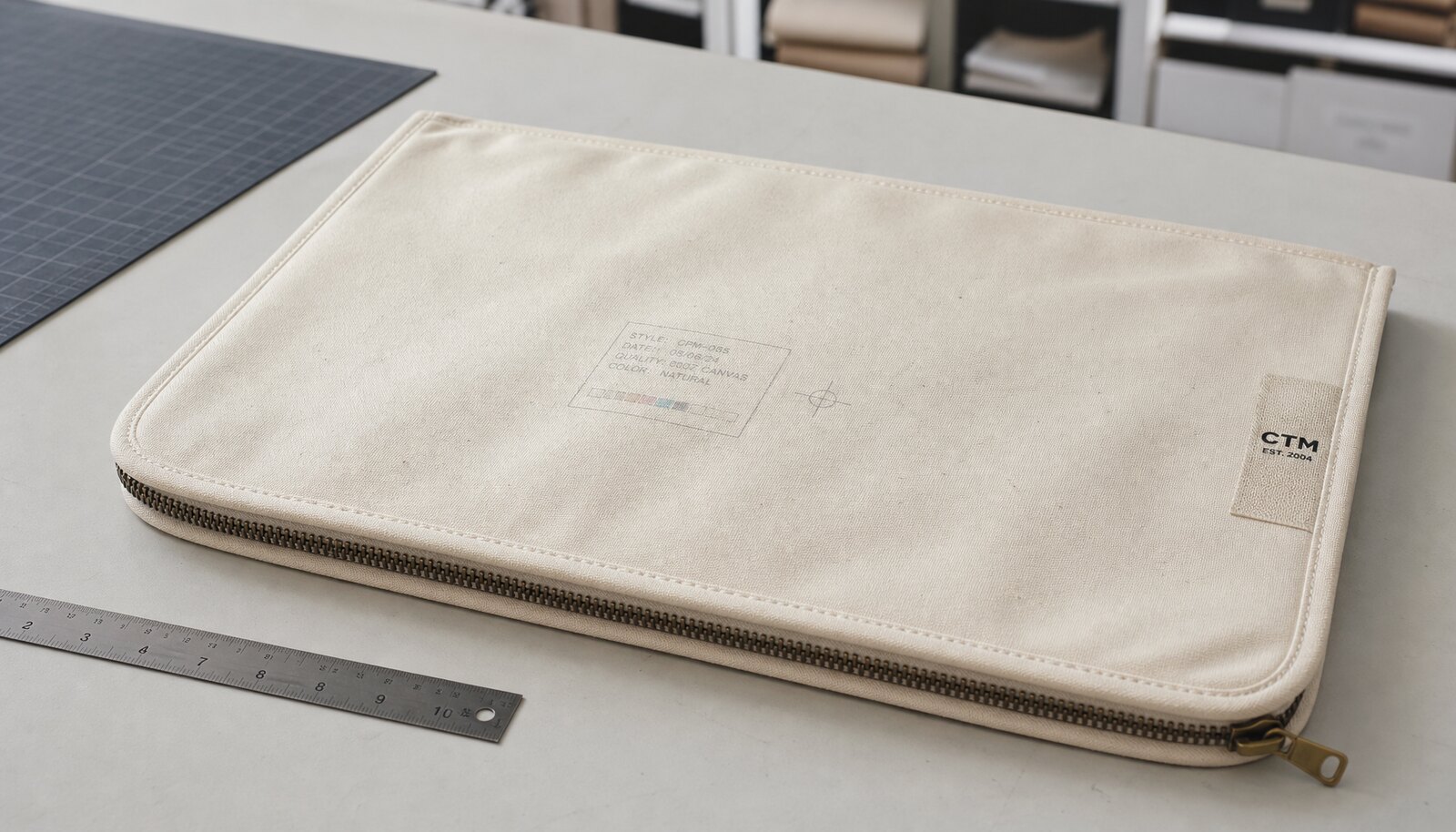
Why print proofing matters on zipper portfolios
For gift shops, a canvas zipper portfolio is not just a pouch with a zipper. It is a shelf-facing retail item that has to look clean when customers pick it up, inspect it, and compare it against other accessories. If the print lands too high, the zipper line distorts the logo, or the colors drift from the approved proof, the item immediately reads as lower quality. In a retail environment, that perception can matter more than small differences in unit cost.
Proofing matters even more on zipper portfolios because the product has more variables than a flat printed bag. The canvas can shift when it is cut and sewn, the zipper opening can pull the front panel out of square, and the final fold can press a visible line through the artwork. A buyer who controls proofing early is not being overcautious. They are preventing avoidable rework after printing, cutting, and hardware placement are already committed.
For procurement teams, the real goal is to turn taste-based approval into production-based approval. That means deciding what the approved item must measure, where the print should sit, what level of surface variation is still acceptable, and which defects are not acceptable at all. Once those rules are written into the RFQ and sample approval, the supplier has a workable standard instead of a moving target.
- Treat the proof as a production control document, not a design mockup.
- Define acceptable movement, color variation, and surface defect levels before sampling begins.
- Judge the item as a retail product that will be handled in-store, not only as a printed canvas blank.
Start with the finished structure, not the artwork file
Before anyone approves a logo, lock the finished construction. For a canvas zipper portfolio, that means deciding the final width, height, depth, zipper opening length, seam allowance, and whether the body has a gusset, lining, or edge binding. If those dimensions are not fixed first, the print may be approved on a flat file that no longer aligns once the bag is sewn. Many later disputes over placement or distortion are really structure problems, not printing problems.
Ask the supplier to quote the completed item, not just the bag body. A portfolio that looks simple on paper can change shape significantly once zipper tape, seam allowances, and binding are added. The front panel may shrink by a few millimeters after pressing or stitching, and that is enough to make a centered logo look off-center on a shelf-facing retail item. Buyers should therefore ask for a measured sample with the bag zipped, flattened, and viewed from normal retail distance.
If your order includes a branded label, zipper pull, or side tab, include those in the structure decision at the start. Each additional component changes thickness, folding behavior, and the visual centerline. For gift shop programs, even a small shift in the hardware package can alter how the print reads. That is why the structure should be frozen before artwork is finalized.
- Confirm the final dimension after sewing, not the flat cut size alone.
- Check how zipper tape, seam allowance, and any lining affect the visible front panel.
- If hardware or labels are part of the design, sample them together with the print, not separately.
Choose the right canvas weight and surface finish
Canvas weight affects more than durability. It changes how the portfolio holds shape, how the print sits on the surface, and how the product feels in a customer’s hand. For most gift-shop programs, 12 oz to 14 oz finished canvas is the most workable range because it gives a substantial feel without turning the bag into a rigid item that is expensive to ship or awkward to store. If the product is meant to look premium or stand upright better on shelf, 16 oz can work, but it should be tested with the chosen zipper and print system before bulk approval.
Ask the factory to state finished fabric weight in the quote. Some suppliers quote yarn weight, loom weight, or unfinished cloth weight, which can sound heavier than the actual finished material. A buyer needs the number that describes what will arrive in cartons, not what was on the loom. If the canvas is washed, coated, or dyed after weaving, that also changes hand feel and may affect shrinkage. Those factors should be disclosed before proof approval so the sample is judged against the same process route as bulk production.
Surface finish matters as much as weight. A rougher weave may suit a natural, craft-driven retail look, but it can break up fine type and thin line art. A smoother finish can improve detail but may reveal scuffs or shine more easily. If the portfolio will be printed with small lettering, line art, or a dense logo block, request a swatch and a proof together so you can compare how the artwork behaves on the actual fabric.
- 12 oz to 14 oz finished canvas: balanced retail feel and better freight efficiency.
- 16 oz finished canvas: better structure, higher cost, and a greater need to confirm print flexibility at fold points.
- Ask whether finishing, washing, or coating changes the final weight or shrinkage profile.
Match print method to artwork complexity and retail expectations
Print method should follow the artwork, not the other way around. For a simple one-color or two-color logo, screen print remains the most reliable choice because it gives stable coverage, predictable repeatability, and easier inspection of color consistency. It is also a practical option when a gift shop buyer wants clean branding rather than a decorative effect. For repeat orders, screen print usually makes it easier to keep future batches aligned with the approved standard.
If the art includes gradients, multiple tonal values, or detailed illustration, transfer methods may be worth considering, especially when the run is short. The tradeoff is that a transferred image can look more layered than integrated, and some finishes are more prone to edge lift, gloss, or rub wear. That may be fine for a low-touch promotional pack, but for a retail portfolio that customers will handle repeatedly, the buyer should inspect the finish under store lighting and decide whether the surface still looks premium enough.
No matter which method is used, ask how the artwork will be printed in relation to the actual bag construction. A flat strike-off can help review color and logo size, but if the final print is near a seam, zipper line, or corner fold, a sewn sample is more useful. Some designs look correct on a flat panel and then distort once the zipper tape is attached. That is why the final approval needs to reflect the real sewn geometry of the portfolio, not only the digital artwork.
- Use screen print for stable logos and limited-color retail branding.
- Use transfer methods only when art complexity justifies the added risk of surface feel or wear.
- If the print is close to seams or folds, approve a sewn sample rather than relying on a flat panel alone.
Write proof standards in production language
A factory cannot reliably follow a proof if the proof only says, “make it look like this.” Buyers should convert the artwork into measurable instructions. State the print size in millimeters, identify the reference edge for placement, and define the acceptable movement relative to the zipper seam, side seam, and top edge. If there is a centered logo, say whether the centerline is calculated from the cut panel or from the finished stitched bag. Those are not interchangeable once seams are added.
The proof should also define the viewing standard. A portfolio can look one way under daylight and another way under warm store lighting. If your retail environment is known, describe the lighting condition used for approval. For example, if the item will be sold in a gift shop with warm LED lighting, ask the sample to be reviewed under similar light. That keeps color discussions grounded in the real environment rather than a generic studio view.
Clear proof language should also include rejection rules. If your logo includes fine type, define a minimum line thickness or minimum character height. If the print has a solid background block, define how much edge roughness, pinholing, or overspray is acceptable. If the supplier knows the reject criteria in advance, the sample stage becomes more efficient and the bulk line has fewer judgment calls. This is especially important when multiple people in the buyer’s team may review the sample at different times.
- State artwork dimensions in millimeters and define the exact reference points used for placement.
- Use the same lighting standard for approval that best matches the retail environment.
- Define reject rules for fine type, edge roughness, overspray, and color drift before bulk starts.
Compare supplier routes by accountability, not just unit price
The cheapest quote is not always the easiest order to manage. For canvas zipper portfolios, the sourcing route affects who controls the fabric, who controls the print, and who owns mistakes when the final bag does not match the proof. A direct factory with in-house cutting, printing, and sewing usually gives the clearest chain of responsibility. That matters when you need repeat orders, stable color, or one place to chase if the zipper, print, and stitching do not match the approved sample.
A trading company can be helpful when you are building a mixed gift-shop program or need access to several workshops, but the buyer should never assume that the trader is automatically controlling quality. Ask which workshop does each step, who inspects the first printed pieces, and who handles rework if the sample is rejected. If the answer is vague, the apparently flexible route may become the most expensive route once delays and miscommunication are included.
Using a blank portfolio plus local printing can be attractive when turnaround time is tight or the artwork is very simple. The risk is that the item has already been sewn before decoration, which means any print error can be harder to fix. Heat transfer and post-sew decoration also introduce distortion risk near the zipper area. Buyers should treat this route as a controlled exception, not the default choice, unless the local decorator can demonstrate consistent results on the same fabric and construction.
- Direct factory: strongest control and best for repeatable retail programs.
- Trading company: workable if the named workshop and defect responsibility are written down.
- Blank plus local decorator: faster in some cases, but higher distortion and rework risk after sewing.
Use the comparison table to test real tradeoffs
The table below is meant to help buyers compare not only specifications but the likely failure modes behind each route. For a retail item like a canvas zipper portfolio, the first-page quote can hide issues that appear later in proofing, packing, or store receiving. A lower unit price may simply mean the supplier excluded a better zipper, used a lighter canvas than expected, or assumed a decoration method that will be harder to inspect later.
When you compare options, ask what happens if the proof is rejected and what changes trigger a second approval cycle. If a factory needs to remake screens, switch zipper tape, or re-cut panels, that can affect both the schedule and the final cost. Procurement teams get better results when they compare not only what the supplier is offering, but also how the supplier behaves when something goes wrong. That is the part of the decision that usually decides whether a program is smooth or stressful.
Set MOQ logic around setup cost and order repeatability
MOQ for canvas zipper portfolios is usually driven by setup, not simply by how many finished pieces you need. Screen preparation, fabric cutting, print registration, zipper sourcing, custom labels, and carton configuration can all influence the minimum. A single-color logo on stock canvas may support a lower MOQ than a multi-color illustration that requires more screens and more proofing time. If the factory is quoting a special zipper pull or woven label, those components can raise the MOQ even if the bag body itself is simple.
For gift shop buyers, the key is to ask whether MOQ is per design, per colorway, or per carton configuration. Those are not the same thing. A supplier may offer a low MOQ on the bag but then charge separately for every artwork change or pack format change. That can make a small program more expensive than it first appears. It is better to know the real production floor before comparing suppliers than to discover it after sample approval.
If you expect replenishment, say so. A buyer who plans to reorder the same portfolio next season should request both the first-order price and the repeat-order price. That tells you whether the supplier is absorbing setup cost in order one or spreading it over multiple runs. It also helps you compare factories that prefer large first runs against those that can support ongoing retail restock. The best quote is the one that matches your buying pattern, not the one that looks cheapest in isolation.
- Ask whether MOQ is set by design, colorway, zipper option, or carton configuration.
- Separate one-time sample/setup costs from repeat-production pricing.
- If replenishment is likely, request a repeat-order quote for the same spec.
Approve samples the same way bulk goods will be judged
A sample only has value if it is built the same way the bulk order will be built. Request a pre-production sample with the exact canvas weight, zipper type, puller, label, print method, and fold method planned for production. If the supplier sends a decorated blank or a sample made from different fabric, that should be treated as a reference sample, not a production approval sample. Buyers often waste time when they approve a nice-looking sample that cannot actually be repeated at scale.
Sample inspection should be tied to a small set of measurable questions. Is the print within the agreed placement tolerance? Does the color match the approved proof under the agreed lighting? Does the zipper run smoothly without snagging the seam? Does the finished bag hold its shape after several open-close cycles? These are the kinds of checks that tell you whether the bulk order is likely to succeed. Subjective comments like “looks close” are not enough for procurement control.
If the sample is slightly off but still within the written tolerance, the supplier can proceed. If it is outside tolerance, do not approve it casually just because the sample is otherwise attractive. Weak sample discipline usually becomes weak bulk discipline. A buyer should be willing to stop the process, ask for a reproof, and reset expectations if the supplier has not yet demonstrated that they can meet the written standard.
- Review the sample using the same lighting and viewing distance expected in retail receiving or store display.
- Test zipper action repeatedly and check for seam snagging or puller misalignment.
- Confirm the sample includes final packing and fold method, not only the bag body.
Specify packing, carton marks, and receiving details up front
Packing is part of product quality because it affects how the item arrives and how quickly a store or warehouse can receive it. If your gift shop distribution team needs individual polybags, barcode labels, and specific carton marks, those instructions should be written into the RFQ before the supplier quotes. Otherwise, the factory may substitute a cheaper packing method that creates labor at your end. A portfolio can be sewn correctly and still fail the program if the counts, labels, or carton codes are wrong at receiving.
For canvas zipper portfolios, folding method matters more than many buyers expect. A heavy canvas item can hold crease lines, press marks, or zipper impressions if it is folded too tightly before packing. Those marks may be visible on shelf even if they disappear later. Ask the supplier what fold standard they use and whether tissue insert, polybag size, or carton fill pattern can be adjusted to protect the print face. If the portfolio is intended for premium gift-shop display, packaging should protect the first visual impression, not only the shipping carton.
Also ask for carton details in the quote: inner pack count, outer carton count, gross weight, carton size, and mark placement. These details matter for freight planning, warehouse stacking, and store receiving. If cartons are too large, they can be awkward to handle; if they are too small or overfilled, the corners may crush. Good packing specifications reduce damage and save time on the back end.
- Write the required inner pack count, carton count, barcode format, and carton mark text into the RFQ.
- Confirm the fold method does not crush the print area or leave visible press lines on the retail face.
- Ask for carton dimensions and gross weight so freight and receiving can be planned accurately.
Specification comparison for buyers
| Spec decision | Recommended option | When it fits | Buyer risk to check |
|---|---|---|---|
| Sourcing route | Direct factory with in-house cutting, printing, and sewing | Best when the portfolio is a repeat retail item, the print must stay consistent across reorder cycles, and you need one party accountable for bulk defects | Confirm that printing, cutting, and sewing are actually done in-house and that the quote names the site that will run production, not just a sales office |
| Sourcing route | Trading company managing named workshops | Useful when you need broader style options, can tolerate more coordination, or are combining several gift-shop items into one program | Ask which workshop handles each step, who signs off the proof, and whether the trader will own defect claims or only pass messages between factories |
| Sourcing route | Blank portfolio plus local decorator | Can work for very simple artwork, short lead times, or domestic replenishment where local control matters more than factory integration | Check for zipper distortion after decoration, shrinkage from heat transfer, and whether the blank construction can survive the chosen print or finishing process |
| Fabric weight | 12 oz to 14 oz finished canvas | Often the best balance for shelf presentation, shipping cost, and retail hand feel in gift shops | Verify that the quoted weight is finished fabric weight, not yarn weight or unfinished cloth weight that will change after washing or coating |
| Fabric weight | 16 oz finished canvas | Use when the portfolio needs more structure, premium positioning, or a stiffer body that stands upright better on shelf | Heavier fabric can raise freight cost, reduce flexibility at the zipper fold, and increase the chance of print cracking if the ink system is not matched properly |
| Print method | Screen print for 1 to 3 solid colors | Best for logos, simple retail graphics, repeat orders, and tighter color control when the art has limited detail | Ask for mesh count, ink type, cure temperature, and whether the strike-off was printed on the same fabric lot as bulk production |
| Print method | Heat transfer or digital transfer for complex art | Useful when the design has gradients, detailed illustration, or short-run artwork that would be expensive to separate into screens | Check rub resistance, surface gloss, edge lift, and whether the transferred area feels too plastic for gift-shop display |
| Closure and hardware | Nylon coil zipper with matched tape color and a self-fabric puller | A practical choice for everyday retail portfolios where the zipper must operate smoothly but cost still matters | Confirm zipper gauge, pull length, bar tack strength, and whether the puller or tape color can vary between sample and bulk |
| Closure and hardware | Upgrade zipper with branded puller or metal pull | Use when the portfolio is a higher-priced retail item and the zipper is part of the perceived value | Inspect for scratching, plating consistency, and whether the added hardware creates delays, extra MOQ, or packaging damage |
Buyer checklist before sampling
- Lock the finished size first, including seam allowance, zipper opening, and any gusset or binding width, before approving artwork.
- Specify fabric weight in finished gsm or oz and state whether the number refers to pre-wash or finished fabric.
- Approve the artwork at actual print size with Pantone references or a defined CMYK target, not just a logo file on a screen.
- Set the print placement tolerance in millimeters from fixed reference points such as the top edge, zipper seam, and side seam.
- Request a pre-production sample made with the exact canvas, zipper, puller, label, and fold method that will be used in bulk.
- Ask for a sewn sample if the print sits close to the zipper line, corners, or seam intersections where distortion is likely.
- State carton pack, inner pack, barcode format, and carton mark wording in the RFQ so those details cannot be swapped later to save cost.
- Confirm overrun and underrun policy in writing, especially for seasonal, promotional, or gift-shop launch orders.
- Ask for basic durability checks if the portfolio will be handled daily, displayed folded, or shipped repeatedly to stores.
- Require a clear reject/accept rule for visible defects such as misregistration, stains, broken zippers, loose threads, and off-color prints.
Factory quote questions to send
- What is the finished canvas weight in gsm or oz, and is that measured before or after printing, washing, or coating?
- Which print method will you use for my artwork, and what tolerance do you hold for color variation versus the approved proof?
- What is the MOQ by design, by colorway, and by carton configuration?
- Can you supply a pre-production sample with the exact zipper, puller, label, and packing that will be used in bulk?
- What is your standard placement tolerance for the logo, and how do you handle misregistration on multi-color art?
- What zipper type, gauge, tape color, and puller style will be used, and can those parts be matched to the approved sample?
- What is the production lead time after sample approval, and which events trigger a revised delivery date?
- How will the goods be packed for retail receiving, and what are the carton dimensions, gross weight, and inner pack count?
- What inspection standard do you use for print defects, skipped stitches, broken zippers, dirty marks, and carton count accuracy?
- If artwork changes after sample approval, what reproofing fee, screen remake cost, or timeline impact should we expect?
Quality-control points to confirm
- Print position within the agreed tolerance across left, center, and right placements, using the same measurement points referenced in the proof.
- Color match checked against the approved proof under daylight and under the type of lighting used in your store, warehouse, or receiving area.
- No ink bleed, pinholes, cracking at the zipper fold, ghosting, or smudging on the front panel and near seam intersections.
- Zipper runs smoothly end to end, with the puller aligned, the slider not snagging fabric, and the bar tacks secure at both ends.
- Finished dimensions stay within the accepted range after pressing, trimming, folding, and packing.
- Stitch density is even at stress points, especially around zipper tape ends, side seams, and any handle or edge binding if included.
- No oil marks, loose threads, fabric stains, needle holes, or misapplied labels on visible retail surfaces.
- Carton pack count, barcode label, and inner polybag count match the shipping documents and purchase order.
- Cartons are clean, dry, and strong enough for store receiving without crushed corners or print damage from overstacking.
- If a defect is visible from normal retail viewing distance, define whether it is rejectable, repairable, or acceptable only as a minor exception.