1. Print proofing is procurement control, not a design formality
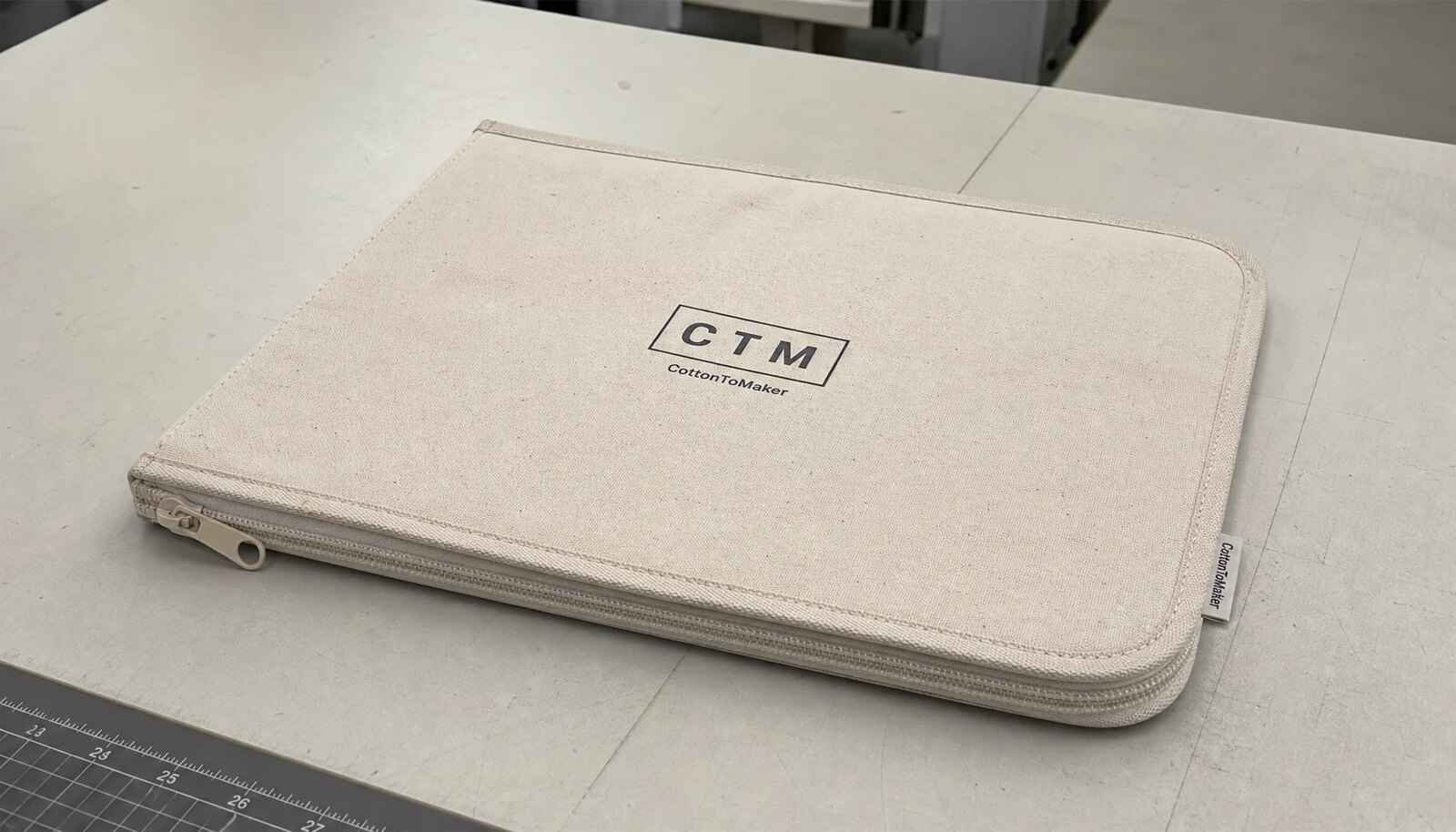
A canvas zipper portfolio is not a flat sheet of fabric with a logo. It is a sewn business bag with zipper tape, seam allowance, corner bulk, thread tension, lining choices, pressing, and packing pressure all working against the clean geometry shown in a PDF. A mark that looks centered on the screen can sit too high once the zipper is installed. A logo that looks safely away from the edge can creep close to the seam after turning and stitching. In wholesale production, that same small error repeats by the carton.
Eco apparel brands often choose natural cotton canvas because the material has a plain, tactile, lower-impact look. That is a good fit for many apparel buyers, but it is not the easiest surface to proof. Natural canvas may have seed flecks, slubs, irregular yarns, and shade movement from roll to roll. Ink can absorb unevenly. White and cream print colors may lose strength against the warm base cloth. Even a dark logo can look softer than it does on coated paper or a polished digital mockup.
Treat the proof as a production risk package. It should answer practical questions: Does the selected canvas hold the print cleanly? Does the zipper clear the documents? Does the logo stay square after sewing? Does the puller press into the printed area in the carton? A signed digital layout is useful, but it is not a bulk standard. The standard should be a physical print strike-off and a complete pre-production sample that procurement, design, and QC can measure, fill, zip, pack, and inspect.
- Approve the portfolio as a finished sewn product, not only as a logo layout.
- Use physical samples to judge canvas shade, print opacity, zipper clearance, and packing contact.
- Define tolerances in millimeters from finished-product reference points.
- Keep signed samples, marked photos, and comments in the procurement file.
- Connect print approval to zipper function, seam quality, and packing protection.
2. Start the RFQ with use case, load, and dimensions
Before asking for wholesale canvas zipper portfolio pricing, write down what the product must actually carry. A slim document sleeve for order forms can be flexible and unlined. A showroom kit for an apparel line may need to hold line sheets, swatch cards, hangtags, trim samples, and small catalogs. A sales-rep portfolio may be opened every day, packed into luggage, and handled by buyers in different showrooms. Those scenarios call for different canvas weights, zipper grades, pocket layouts, seam reinforcements, and packing methods.
State dimensions in two ways: outside finished size and internal usable space. Internal clearance matters most for A4 and US letter documents. If the finished size is only slightly larger than the paper, the actual opening can become too tight after zipper tape, seam allowance, lining, and sewing tolerance are added. If the portfolio needs to carry thick catalogs, swatch boards, or sample cards, specify thickness or gusset depth. Do not assume a flat sleeve will close neatly once it is loaded.
Soft sewn goods are not machined parts, so tolerance language needs to be realistic. Use millimeters, not vague wording such as approximately standard size. A small flat portfolio can usually be controlled more tightly than a thick, lined, gusseted one, but the exact range should be agreed with the supplier during sampling. The same rule applies to logo placement. If the product will be photographed, presented in sets, or opened in wholesale appointments, small differences are more visible than the factory may expect.
- List the intended contents, including dimensions, thickness, and approximate weight.
- Specify outside finished size and internal usable size when papers or tablets must fit.
- Confirm whether the portfolio is flat, gusseted, lined, padded, bound, or pocketed.
- Test the sample with real contents, not only while it is empty.
- Record finished-size tolerance and measurement method in the PO.
3. Specify canvas by weight, finish, shade, and shrinkage
Vague fabric words create expensive misunderstandings. Heavy canvas, natural canvas, and eco canvas can mean different things to different suppliers. For most wholesale canvas zipper portfolios, 12oz to 14oz cotton canvas is a practical starting point. Depending on weave and mill standard, that often sits around 400-475 gsm, but buyers should ask for the supplier’s actual GSM range rather than relying on a simple conversion. A 12oz canvas can work for lighter document sleeves. A 14oz canvas gives more body and a stronger business-bag feel. A 16oz fabric may suit heavier kits, but it also adds seam bulk and can make the zipper curve harder to control.
Finish changes both appearance and manufacturing behavior. Natural unbleached canvas gives a warm, raw look, but shade and flecks are part of the surface. Bleached canvas gives cleaner contrast for many logos. Piece-dyed canvas can support seasonal color programs, yet it introduces dye-lot control, crocking checks, and possible print-color shift. Washed or enzyme-treated canvas may feel softer, but shrinkage can change and softeners may affect ink adhesion if the process is not controlled.
Ask how fabric will be managed before cutting. If the brand needs consistent presentation across all cartons, request bulk fabric from one approved lot where possible and require roll shade review. If natural variation is acceptable, define the approved range with physical swatches instead of leaving it to the cutting room. For repeat orders, keep the swatch and note that future natural canvas lots may not be identical. A clear standard prevents the common dispute where the supplier sees normal canvas character and the buyer sees an off-shade shipment.
- Quote fabric by composition, oz weight, GSM range, weave, finish, and color.
- Confirm whether the canvas is natural, bleached, dyed, washed, enzyme washed, or pre-shrunk.
- Ask for expected shrinkage and whether the fabric is stabilized before printing and sewing.
- Approve natural flecks, slubs, and shade range as part of the signed appearance standard.
- Check dye lot, roll shade, odor, and surface defects before cutting.
4. Choose a print method that respects canvas texture
Screen printing is usually the safest route for solid one- to three-color logos on canvas zipper portfolios. It can deliver good opacity and repeatable placement when the artwork is simple and the fabric surface is stable. Still, screen print is not magic. Tiny legal text, fine strokes, tight multi-color registration, gradients, and delicate distress effects can break up on textured canvas. Before the first strike-off, ask the printer for a minimum line weight and minimum text height based on the actual approved fabric.
Heat transfer and digital printing have their place. They can help with short runs, multicolor artwork, or programs where the artwork changes often. The tradeoff is feel, flexibility, and durability. A transfer may look too glossy on natural canvas. Its edge may lift if it is placed near a fold, zipper curve, or area that flexes during use. Digital print can reproduce detail, but opacity on natural or dark canvas must be checked physically. Photos from another project are not proof.
For eco apparel brands, the logo application should support the product story. A natural cotton canvas portfolio with a thick plastic-looking transfer can feel inconsistent even when the color is technically close. Ask the supplier to identify the ink system, binder, transfer film, curing temperature, dwell time, drying time, or heat-press settings. Those details matter because under-cured prints can scuff, block, or mark adjacent pieces during packing. A useful proof shows the final artwork on the actual canvas base, using the same process planned for bulk.
- Use screen print for solid logos, repeat orders, and stable color programs.
- Use transfer or digital print only after checking handfeel, opacity, flexibility, and edge lift.
- Increase line weight and text size for rough natural canvas.
- Avoid placing transfers near zipper stress points, folds, bulky seams, or high-flex areas.
- Approve every critical print color with a physical strike-off on actual canvas.
5. Build the proof around safe zones and measurable reference points
Most logo issues on zipper portfolios are placement issues, not file issues. The zipper line takes up visual space. The top seam can pull the front panel. Side seams can change the apparent center. If artwork sits close to a construction line, even normal sewing variation becomes noticeable. This is especially true for square logos, bordered graphics, centered wordmarks, and quiet minimalist branding on plain canvas.
Create a finished-product safe-area drawing before the PP sample is signed. Mark the zipper seam, side seams, bottom seam, fold lines, pocket stitch lines, woven labels, bartacks, binding, and gusset edges. A 20 mm minimum distance from zipper tape and major seams is a practical starting point for many flat zipper portfolios. Increase that to 25-30 mm where the canvas is thick, the print is a large transfer, the artwork has a border, or the factory needs more sewing allowance.
Placement tolerance has to be measurable after sewing. Do not write only “logo centered on front.” Use reference points such as left finished edge to logo centerline, right finished edge to logo centerline, and zipper seam to top of logo. The acceptable tolerance may vary by size and construction, so agree it with the supplier during sampling. What matters most is consistency: the PO, marked PP sample, production comments, and inspection report must all use the same measurement method.
- Create a safe-area drawing based on the finished product, not only the flat pattern.
- Keep logos at least 20 mm from zipper seam, side seams, bottom seam, folds, pockets, and labels unless approved otherwise.
- Use larger clearance for bordered artwork, thick canvas, large prints, or transfer applications.
- Measure placement after sewing from fixed finished edges and seams.
- Put the agreed tolerance into the PO, PP sample comments, and inspection checklist.
6. Approve samples in the right order
A strong proofing workflow has four separate approvals. First comes the artwork file: size, color references, line weight, print location, and safe-area map. Second comes the print strike-off on the exact canvas base. This confirms opacity, edge sharpness, handfeel, and color behavior. Third comes the complete pre-production sample made with the planned fabric, zipper, thread, trims, labels, lining, print method, and curing process. Fourth comes packing approval, because the printed face still has to survive handling, stacking, and transit.
Each stage answers a different question. A PDF does not prove white ink opacity on natural canvas. A strike-off does not prove that the logo remains square after sewing. A blank sewn sample does not prove rub resistance. A PP sample without final packing does not prove that zipper pullers will not dent the logo inside a tight carton. Skipping steps may save a week on paper, then cost much more if bulk production repeats a preventable defect.
Review the PP sample like an inspector, not like a design presentation. Measure finished size, internal opening, logo placement, zipper movement, seam straightness, label position, and whether the front panel lies flat. Insert the intended documents or swatches, close the zipper, and check whether the portfolio distorts. Then remove the contents and inspect whether the logo area remains smooth. If the supplier says a defect will improve in bulk, ask what specific process change will make it improve.
- Artwork approval confirms file size, color references, line weights, and safe area.
- Strike-off approval confirms color, opacity, edge quality, and canvas interaction.
- PP sample approval confirms construction, placement, zipper performance, and final trims.
- Packing approval confirms protection from scuffing, pressure marks, moisture, and carton movement.
- Keep one signed physical PP sample and a photo record with measurement points marked.
7. Normalize supplier quotes before comparing unit prices
A low price only helps if every supplier is quoting the same product. Canvas zipper portfolios have obvious cost drivers: fabric weight, finished size, print method, number of print colors, zipper grade, lining, pockets, labels, and packing. They also have less visible costs such as fabric wastage, screen setup, strike-off revisions, outsourced printing, carton loading efficiency, and inspection requirements. If those items are not listed, buyers may compare unlike offers.
Ask for a structured quote rather than a single all-in number. The quotation should state finished size, canvas weight, finish, zipper specification, print method, number of colors, logo size, print location, lining, label package, inner packing, pieces per carton, carton dimensions, sample fees, setup charges, and lead time. When one supplier is much cheaper, find out what changed. It may be lighter fabric, a lower zipper grade, weaker print opacity, no strike-off, simplified packing, or a different interpretation of the logo size.
Break MOQ down by version. A factory may have one minimum for raw canvas purchase, another for custom dyeing, another for custom zipper tape, another for printing setup, and another for labels or packaging. The simplest first order usually uses one canvas color, one logo version, one print location, standard zipper tape, and one packing method. Splitting a small order across several fabric colors or artwork versions can raise cost and quality risk because each changeover must be reset, proofed, and inspected.
- Require suppliers to quote the same size, canvas, zipper, print, lining, labels, and packing.
- Separate unit price from screen charges, sample fees, setup charges, packaging, documentation, and testing costs.
- Confirm whether repeat orders can reuse screens or require new setup.
- Ask MOQ by fabric color, logo version, print location, zipper color, label version, and packing version.
- Clarify whether printing is in-house or subcontracted and who is responsible for print defects.
8. Control zipper, sewing, and structure because they change the logo view
The zipper is both functional and visual. A wavy zipper line can make a centered logo look off balance. A rough puller can snag thread or press a mark into the printed face during packing. A tape color that is close but not approved can make the whole piece feel off-standard even when the logo color is right. For most canvas business portfolios, a #5 nylon coil zipper is a practical choice because it is flexible, smooth, and less bulky than many metal options. The grade still has to be specified.
Confirm zipper tape color, slider material, puller shape, puller finish, pull direction, zipper length, and end-stop reinforcement. If the portfolio will be used repeatedly in buyer meetings, ask for repeated full open-close cycle checks on the PP sample and during inspection. Test empty and filled. Some problems only appear when the product is loaded: lining catches in the teeth, loose threads pull into the slider, or the zipper curve tightens around thick inserts.
Sewing quality shapes the print area too. Uneven top seam tension can pucker the canvas and make a wordmark look bent. Bulky corners can prevent the front panel from lying flat. Skipped stitches, needle cuts, or loose thread near the print can distract from otherwise clean branding. Inspect the logo, seam construction, and zipper together. In a finished portfolio, those details are never separate.
- Specify #5 nylon coil zipper or another approved grade with tape color and puller details.
- Check zipper smoothness through repeated full open-close cycles.
- Make sure the puller does not sit directly on the printed logo during packing.
- Inspect seam tension, stitch density, loose threads, skipped stitches, needle damage, and corner bulk.
- Check empty and filled samples because some zipper and shape defects appear only under load.
9. Keep eco-brand requirements specific and verifiable
Eco apparel brands often want business bags that match their material values, but procurement language should stay factual. Instead of asking for an eco-friendly zipper portfolio, state the fiber composition, canvas finish, dye status, packaging material, and documentation required by your internal compliance or retailer program. Clear specifications reduce confusion and help prevent unsupported claims from entering quotes, packaging, or wholesale sell-in copy.
If the program requires organic cotton, recycled cotton, undyed canvas, restricted-substance testing, recycled-content packaging, paper-based inner packing, or reduced-plastic shipment planning, include those requirements before price approval. Each one can affect MOQ, lead time, availability, cost, and quality checks. Undyed natural canvas may avoid a dyeing step, but it can show more shade variation. Paper sleeves may reduce plastic use, but they may not protect as well as polybags on humid routes or in rough warehouse handling.
Do not treat supplier marketing language as proof. Ask for the documents your company actually needs: material composition statement, certification documents where applicable, test reports, or packaging specification sheets. If documentation is not available, keep product wording factual. Natural cotton canvas zipper portfolio is safer and clearer than a broad sustainability claim that no one can support during compliance review.
- Replace vague eco language with fiber, finish, dye, and packaging specifications.
- Request required compliance documents before price approval, not after production starts.
- Approve natural shade variation with a physical swatch range.
- Balance plastic reduction against moisture, scuffing, storage, and warehouse handling risk.
- Avoid unsupported sustainability claims on packaging, web copy, and wholesale sell-in sheets.
10. Treat packing and carton checks as part of print proofing
A portfolio can pass table inspection and still arrive with damaged branding. Canvas faces can abrade against each other. Zipper pullers can press into the logo. Moisture can create spots or odor during long transit. Dark ink on natural canvas may show scuffing quickly. Transfers can be sensitive to pressure, heat, or blocking if they are not fully cured. Packing is not a final logistics detail; it is part of the print approval.
Flat packing is common for canvas zipper portfolios because it preserves shape and improves carton loading. A tissue sheet or protective paper over the printed face can reduce abrasion. Individual polybags may be needed for moisture and handling protection. Paper sleeves can support some plastic-reduction goals when the shipping route and storage environment allow it. If barcode labels are required, confirm that adhesive never contacts the print and that warehouse scanning does not require removing protection in a way that damages the surface.
Ask for carton quantity, carton dimensions, gross weight, net weight, carton material, and master carton marking. A carton packed too tightly can press pullers into the front panel or crease the zipper edge. A carton packed too loosely can allow sliding and scuffing. For humid routes or ocean freight, discuss desiccants and dry storage expectations. During final inspection, check pieces from the top, middle, and bottom of cartons to see whether pressure damage appears in specific positions.
- Approve inner protection over the printed face before bulk packing starts.
- Position zipper pullers so they do not press directly into the logo.
- Confirm polybag, tissue, paper sleeve, barcode, and carton format in the PO.
- Check carton dimensions, gross weight, net weight, and pieces per carton for freight planning.
- Inspect top, middle, and bottom carton positions for scuffing, dents, odor, and moisture marks.
Specification comparison for buyers
| Spec decision | Recommended option | When it fits | Buyer risk to check |
|---|---|---|---|
| Finished size | Define outside finished dimensions plus internal usable space. For A4 or letter documents, allow clearance beyond paper size so sheets do not catch the zipper teeth or lining. | Line sheets, order forms, showroom documents, catalog inserts, trim cards, and sales-rep presentation packs. | A portfolio that matches paper size exactly may become unusable once seam allowance, zipper tape, lining, and sewing tolerance reduce the opening. |
| Fabric weight | 12oz to 14oz cotton canvas for most portfolio programs. Request the supplier’s actual GSM range, often roughly 400-475 gsm depending on weave and mill standard. | Branded document cases, apparel buyer kits, wholesale meeting folders, line-review packs, and premium gift-with-purchase programs. | Too light and the front panel wrinkles around the print; too heavy and corners bulk up, zipper curves wave, freight weight rises, and sewing tolerance is harder to hold. |
| Canvas finish | Natural unbleached canvas for a raw apparel-brand look; bleached or piece-dyed canvas when sharper logo contrast or tighter shade matching is needed. | Natural works for eco-positioned apparel brands; bleached canvas supports a cleaner presentation; dyed canvas supports seasonal or brand color programs. | Natural canvas has seed flecks and shade variation. Dyed or washed canvas may show lot-to-lot shade difference, crocking risk, shrinkage, or print-color shift. |
| Material claim control | State fiber composition, finish, dye status, and required documentation instead of using broad claims such as eco-friendly or sustainable. | Brands with internal material standards, retailer compliance files, or plastic-reduction packaging goals. | Unsupported environmental claims can create compliance and marketing risk. Supplier descriptions should be backed by documents where your policy requires them. |
| Print method | Screen print for solid one- to three-color marks. Use transfer or digital only after physical testing for opacity, handfeel, flexibility, and rub resistance. | Screen print suits repeat wholesale orders with stable logos; transfer or digital suits complex artwork, smaller runs, or frequent artwork changes. | Fine lines, small text, gradients, or low-opacity white ink can fail on textured canvas. Transfers may look too glossy or crack if placed near flex points. |
| Logo safe area | Keep artwork at least 20 mm from zipper seam, side seam, bottom seam, fold, pocket seam, or label. Increase to 25-30 mm for thick canvas, large transfers, or bordered artwork. | Front-center, lower-front, or corner branding where the logo must remain visible after sewing and packing. | Artwork near seams can distort, pull off square, disappear under zipper tape, or look uneven across a carton even when each piece is technically close. |
| Placement tolerance | Define finished-product measurement points, such as left finished edge to logo centerline and zipper seam to top of logo. Use millimeter tolerances in the PO. | Programs needing consistent showroom presentation, carton unboxing, retail sets, or brand-photo consistency. | Without a written tolerance, the supplier may accept movement that seems small on the line but looks obviously off-center on a plain canvas panel. |
| Zipper specification | #5 nylon coil zipper with approved tape color, smooth slider, suitable puller shape, reinforced ends, and pull direction confirmed on the sample. | Most canvas zipper business bags because coil zippers are flexible, smooth, and less bulky than many metal alternatives. | Low-grade zippers snag, curve at corners, mark natural canvas, catch lining, create pressure dents during packing, or fail cycle testing. |
| Lining and structure | Unlined for a simple flat sleeve; 210D polyester/cotton lining, binding, or light interlining when the portfolio needs more body or interior protection. | Unlined fits lower-bulk document sleeves; lined fits premium sales kits, swatch storage, or repeated buyer-meeting use. | Lining can twist into the zipper, add shrinkage mismatch, increase seam bulk, and change how flat the printed panel looks. |
Buyer checklist before sampling
- Define the use case in the RFQ: documents only, apparel line sheets, fabric swatches, trim cards, hangtag samples, tablet, catalog pack, sales-rep kit, retail gift-with-purchase, or buyer appointment folder.
- Specify outside finished dimensions, internal usable dimensions if documents must fit, acceptable finished-size tolerance, gusset depth if any, and whether the portfolio must lie flat when empty and when filled.
- State canvas composition, weight in oz and/or GSM, weave type if known, color, finish, and whether the cloth is natural, bleached, piece dyed, garment washed, enzyme washed, or pre-shrunk.
- Ask the supplier to declare expected fabric shrinkage after finishing, shade variation between rolls, and whether bulk fabric will come from one weaving lot or dye lot.
- Lock zipper size, zipper type, tape color, slider material, puller shape, puller finish, pull direction, end-stop reinforcement, and zipper length before artwork placement is signed off.
- Approve thread color, stitch type, stitch density range, seam construction, binding if used, lining material, interlining, interior pocket layout, woven label, care label, and barcode label position.
- Confirm logo size, print method, ink or transfer type, color reference, minimum line weight, minimum text height, safe zone, and measurement points for placement tolerance.
- Request a physical print strike-off on the exact approved canvas base for every critical print color, especially white ink, cream ink on natural canvas, metallic effects, and dark ink on dyed canvas.
- Approve a complete pre-production sample using actual bulk-intended fabric, zipper, thread, trim, label, lining or interlining, print, curing process, and final inner packing format.
- Measure logo placement after sewing from two fixed finished-product points, such as the left finished edge and the zipper seam, and record the tolerance in the purchase order and QC checklist.
Factory quote questions to send
- What exact finished size are you quoting, and what finished-size tolerance do you apply after sewing, zipper installation, pressing, and packing recovery?
- What canvas composition, oz weight, approximate GSM range, yarn or weave description, and finishing process are included in the unit price?
- Will the bulk fabric be natural, bleached, piece dyed, yarn dyed, washed, enzyme washed, or pre-shrunk, and what shade and shrinkage tolerance should we expect?
- Can you source all bulk fabric from one approved lot, and how will roll-to-roll shade variation be checked before cutting?
- Which print method is included: screen print, discharge if applicable, pigment print, digital print, heat transfer, or another method, and what setup charge applies per color, logo version, and print location?
- What ink, binder, transfer film, or digital-print chemistry will be used, and what curing temperature, dwell time, drying time, or heat-press setting controls adhesion and rub resistance?
- What minimum line weight and minimum text height do you recommend for this canvas surface and print method?
- Can you provide a print strike-off on the exact canvas base before making the complete pre-production sample, and how many revisions are included?
- How will you measure and control logo placement tolerance near the zipper seam, side seams, bottom seam, fold line, label, pocket seam, or gusset edge during bulk sewing?
- What zipper size, zipper type, tape material, tape color, slider material, puller style, puller finish, pull direction, and end-stop reinforcement are included?
Quality-control points to confirm
- Canvas weight should be checked against the agreed oz or GSM range using incoming fabric records and handfeel comparison to the signed swatch; do not accept only the invoice description.
- Canvas composition and finish should match the purchase order, including natural, bleached, dyed, washed, or pre-shrunk status. Any substitution should require buyer approval before cutting.
- Canvas shade should match the approved physical reference within the agreed range. Natural seed flecks and slubs are acceptable only to the extent shown on the signed approval sample.
- Fabric defects should be screened before cutting, including oil marks, dirty yarn, holes, heavy slubs, weaving bars, dye streaks, crease lines, and odor.
- Finished dimensions should be measured after sewing, zipper installation, pressing, and packing recovery because a correct cut panel can still finish undersized or out of square.
- Internal usable opening should be checked when the portfolio is intended for A4, letter, catalogs, or tablets; documents should slide in and out without catching zipper teeth or lining.
- Print edges should be sharp and complete, with no smearing, pinholes, ghosting, rough registration, fabric show-through in solid areas beyond the signed standard, or ink buildup at edges.
- Print color should be checked in consistent lighting against the approved strike-off or PP sample. PDFs and screen images are not acceptable final color standards.
- Artwork placement should be measured from fixed finished-product reference points and remain within the agreed tolerance, especially near zipper seam, side seam, bottom seam, label, and pocket stitch lines.
- Print durability should be checked for dry rub, light wet rub if relevant to use, bend/flex, fingernail edge lift for transfers, blocking or stickiness, and contact marking after inner packing.