Why this quote model matters
A canvas zipper portfolio pricing worksheet for wine clubs matters because this product often gets quoted as if it were a simple commodity pouch when, in practice, it sits somewhere between packaging, branded merchandise, and a reusable business bag. One supplier may quote a single-layer natural canvas shell with a basic coil zipper and no internal finishing. Another may include a heavier fabric, neater edge construction, a lining, branded zipper puller, shaped corners, and retail-ready packing. Both quotes may use the same product name, but they are not pricing the same item.
For wine club procurement teams, that gap becomes expensive fast. The portfolio may need to hold tasting notes, membership materials, event invitations, gift cards, or premium printed collateral without bending, catching, or looking underbuilt. It may also need to photograph well for subscriber unboxing, stack neatly in a fulfillment center, and survive repeated use after delivery. When those functional requirements are not translated into the RFQ, the factory fills the gaps with assumptions, and each supplier makes different assumptions.
That is why a structured worksheet is more useful than a broad request for price. It forces the buyer to lock down the construction decisions that actually move cost: fabric weight, lining, zipper grade, insert structure, printing method, internal pockets, packing, inspection standard, and lead time trigger. With those inputs aligned, procurement can compare real unit cost, realistic MOQ, and likely defect risk instead of rewarding whichever supplier removed the most scope.
This approach also supports cleaner internal approvals. Brand teams usually focus on appearance, operations teams focus on packing and inbound handling, and sourcing teams focus on price and timing. A detailed worksheet creates one shared version of the product spec so all three functions are approving the same thing instead of commenting on different interpretations.
- Use the same spec line for every quote: finished size, canvas weight, zipper construction, logo method, internal build, and packing.
- Separate functional requirements from decorative preferences so cost drivers stay visible during negotiation.
- Treat lead time start point, sample type, inspection standard, and carton configuration as quote terms, not informal notes.
- Make sure the worksheet reflects how the portfolio will actually be used in the wine club program, not just how it should look in a rendering.
Start with the use case, not the artwork
The most common sourcing mistake is leading with logo files and mood imagery before the use case is defined. A canvas zipper portfolio intended for a winery tasting-room retail shelf is not built the same way as one inserted into a quarterly subscription box. Even when the dimensions look similar, the stress on the product is different. Retail display may prioritize shape retention, panel consistency, and finish quality. Fulfillment use may prioritize flat packing, stable case counts, and a zipper that does not distort when the portfolio is packed with printed inserts.
Procurement should begin by mapping the actual job the portfolio must perform. Will it hold only documents, or also a membership card sleeve and a small promotional insert? Must it fit A4, letter, or a custom tasting-sheet format? Does the wine club want the item to feel like a giftable branded accessory, or simply a durable organizer inside a shipment? These questions affect panel dimensions, opening width, corner construction, and whether a board insert is needed.
Use case also influences acceptable weight and stiffness. If the portfolio has to sit flat in a mailer, too much structure can become a freight and packing issue. If it needs to feel premium when handed to club members at an event, a light and floppy body may damage perceived value. Buyers who define these priorities early can simplify the quote process because the factory knows which features are essential and which are optional.
Once the use case is clear, artwork decisions become easier. A simple one-color mark may be enough for an insert-driven mailing piece. A premium retention gift may justify a woven label, cleaner internal seams, and more deliberate presentation. The sequence matters: define function first, then specify branding to suit that function.
- For flat mailer use: prioritize controlled thickness, clean seam allowance, and carton efficiency.
- For retail display use: prioritize panel shape, zipper alignment, surface appearance, and shelf-ready packing.
- For event or member-gift use: prioritize hand feel, branding durability, and a more polished opening experience.
- State what the portfolio must hold by size and count so suppliers are not guessing internal capacity.
Define the core specification before asking for price
A usable RFQ for a canvas zipper portfolio should read like a build sheet, not a broad idea. Before requesting price, define the finished dimensions, whether dimensions are measured closed or open, tolerance expectations, and any orientation constraints. A supplier cannot quote accurately if one buyer expects a slim document sleeve and another imagines a wider organizer that can accept stacked inserts without zipper strain.
The next layer is construction. Buyers should specify whether the body is single-layer canvas, lined, padded, or reinforced with a board. Internal organization matters too: no pocket, one slip pocket, a card sleeve, pen loop, or document divider all add labor and defect opportunities. Even details that seem small, such as a zipper garage, binding on inner seams, or a hanging tab, should be called out if they are required. Leaving them to factory discretion almost always creates inconsistency between sample and bulk or between suppliers.
Hardware and trim need the same discipline. State zipper type, chain size if known, puller finish, zipper tape color, and whether hardware substitutions require reapproval. If the portfolio uses labels, specify woven label, printed label, or direct print, and where it should be attached. If sustainability claims matter, note whether recycled canvas, recycled poly lining, or specific compliance documents are required. These are procurement decisions because they affect availability, MOQ, and proof obligations.
A complete core spec does not make the quote process slower. It usually shortens it because suppliers spend less time asking clarifying questions, and fewer hidden assumptions appear in the first price round. It also improves sample relevance because the initial sample is more likely to reflect the build that will eventually be approved for production.
- Lock finished size, capacity, and tolerance before artwork review.
- Specify body construction, internal features, and whether any insert board is included in standard build.
- Define zipper type, puller style, tape color, and trim approval rules.
- Call out compliance or recycled-material requirements at RFQ stage, not after sample approval.
Fabric weight, build, and the real cost driver
Fabric weight is usually the most important cost and performance variable in a canvas zipper portfolio pricing worksheet for wine clubs. For many programs, 12 oz to 16 oz canvas, roughly 340 to 450 GSM, is the practical range. It gives enough body for a cleaner silhouette and better abrasion resistance while still sewing efficiently on standard lines. Below that range, the portfolio can feel too soft, show zipper waviness, and look less substantial when filled with club collateral. Above that range, the unit may gain cost and stiffness without creating a proportional improvement in member experience.
Buyers should also distinguish between fabric weight and total build weight. A heavier shell with no lining may still behave differently from a midweight shell with lining or internal reinforcement. Lining can improve perceived quality, protect printed inserts from rough seam allowance, and hide construction details, but it adds labor, more cutting pieces, and another color/shade variable. Reinforcement with cardboard or PE board can improve shape retention for premium gifting, but it increases carton volume and can create warping or edge pressure if packed too tightly.
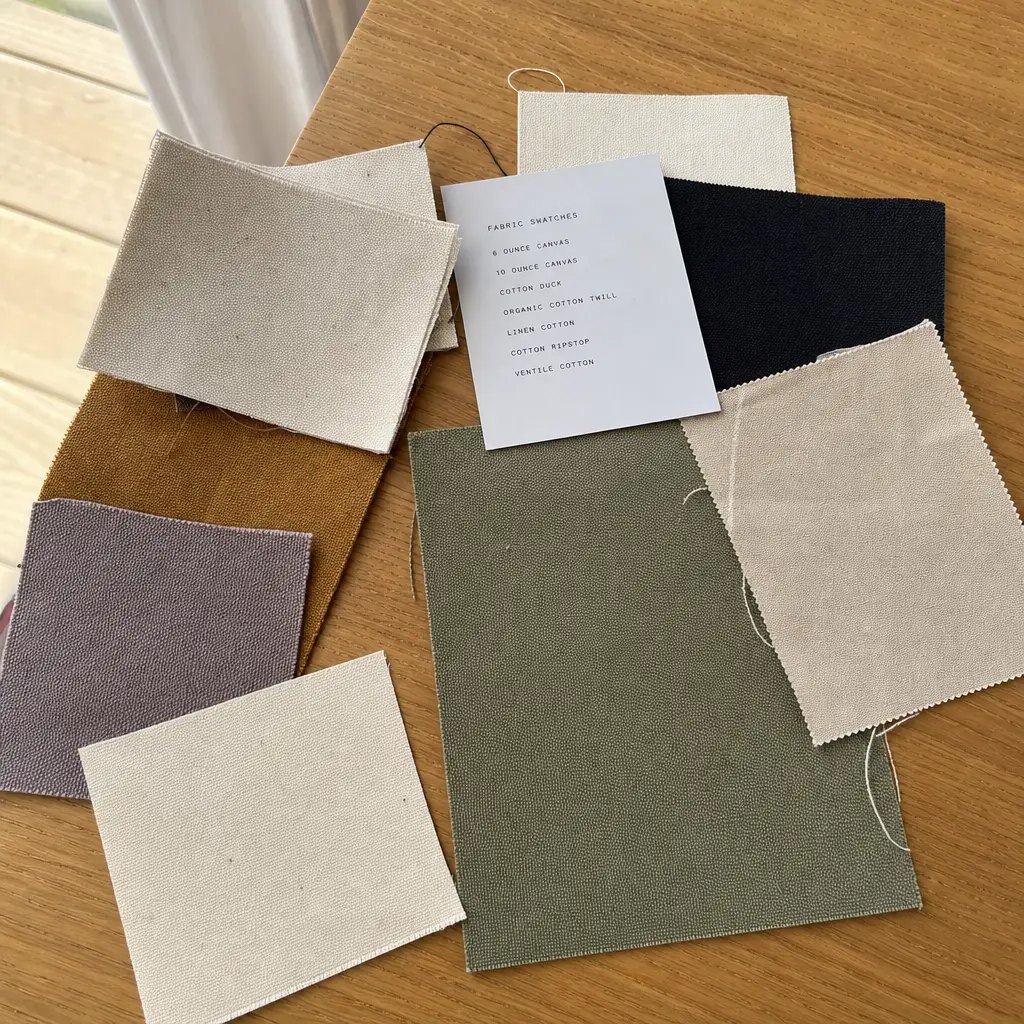
Fabric finish matters as much as nominal weight. Natural canvas, dyed canvas, washed canvas, or bleached canvas each carry different visual expectations and production risks. Washed fabrics can shift slightly in tone and hand feel. Natural canvas can vary shade by lot. Dyed programs require clearer color approval and may have longer raw-material preparation. If suppliers quote different finishes under the same product name, the price comparison becomes misleading.
Procurement should insist that the quote state fabric in both oz and GSM when available, along with finish, color basis, and any treatment such as stain resistance or water repellency. This creates a common language across supplier regions and reduces the chance that a lighter substitute slips into production because the original specification was vague.
- Ask for canvas weight in oz and GSM, plus finish and color basis.
- Check whether the quoted build is single-layer, lined, or reinforced, not just the outer fabric weight.
- Use board inserts only when shape retention is a defined requirement.
- Confirm whether natural shade variation is acceptable or if tighter lot control is required.
Zipper, internal structure, and durability decisions
Because the product category is a zipper business bag, zipper specification deserves more attention than it usually gets in promotional-bag sourcing. A canvas portfolio that looks acceptable on the table can still fail quickly if the zipper chain is underspecified, the tape shrinks differently from the canvas, or the end stops are weak. For most wine club applications, a nylon coil zipper is the safest baseline because it is flexible, cost-efficient, and generally smooth on textile products. The buyer should still clarify chain size, tape color, puller finish, and whether a zipper garage or covered end is required for a cleaner finish.
Internal structure changes how the zipper performs. A slim, unstructured document sleeve places different stress on the opening than a portfolio expected to close around stacked tasting sheets, a card insert, or a thin board. If the bag is routinely overpacked, even a decent zipper may wave or split near the corners. That is not only a hardware issue; it is often a pattern and capacity issue. The spec should therefore define the intended fill condition, not just the empty dimensions.
Corner construction and seam reinforcement deserve quote attention as well. Stress tends to collect at zipper ends, lower corners, and any location where a handle, tab, or internal divider is attached. Buyers should ask whether reinforcement stitching or bartacking is included in the base price. If not, a cheaper quote may be omitting a simple durability feature that prevents returns and rework later.
For wine clubs, durability is not just about long service life. It is also about first-use performance. If the member opens the portfolio and the zipper catches on exposed seam allowance or the puller feels rough, the product reads as low quality immediately. That is why zipper function, seam finishing, and capacity-fit testing belong in sample approval and QC, not just in the materials description.
- Specify nylon coil zipper unless another zipper type is required for branding or appearance.
- State whether the portfolio must zip closed around a loaded insert set, not just when empty.
- Ask whether zipper end reinforcement, bartacking, or covered ends are included.
- Review interior seam finishing because exposed allowance can snag printed materials and hurt perceived quality.
Print method, logo placement, and branding risk
Branding on canvas needs to be specified with the same care as the base construction. Screen print is usually the most efficient and stable method for one-color or two-color logos on natural or light canvas, especially when the artwork is bold and does not rely on fine detail. On a rougher textile surface, very small text and intricate line work may lose definition, so buyers should confirm the minimum readable size during the sample stage rather than assuming the digital artwork will transfer perfectly.
Heat transfer can be useful when artwork contains more detail or multiple colors, but it should not be selected on appearance alone. Transfers may react differently when the portfolio is folded, rubbed in carton transit, or exposed to repeated opening and closing near the print area. For premium programs, a woven label or sewn brand tab can sometimes be the lower-risk choice because it avoids large print areas on textured fabric and gives a more durable mark, though it introduces sewing placement tolerance and another trim component.
Placement is a procurement issue because poor placement creates rework and avoidable reject rates. A logo too close to the zipper can ripple as the product opens. A print area spanning a seam can distort or break visually. A mark placed too low on a front panel may be hidden by how the portfolio is packed or merchandised. RFQs should therefore specify artwork dimensions, orientation, and placement measured from fixed reference points such as top edge, side seam, or zipper line.
Buyers should ask for a strike-off or printed pre-production sample when branding is central to the program. Approving artwork only from a digital proof leaves too much room for interpretation on ink density, edge sharpness, and interaction with the canvas texture. For wine clubs where brand presentation matters, that is a weak control point.
- Use screen print for simple, bold branding with limited colors.
- Use transfer only after rub, fold, and adhesion checks on the actual canvas.
- Consider woven labels for premium programs that need a durable, tactile brand element.
- Specify exact logo placement from physical reference points to reduce sample-to-bulk drift.
How to compare supplier routes and quote structure
Not all suppliers control the product in the same way, and procurement should price that control difference explicitly. A direct factory is often the most practical route for a custom canvas zipper portfolio because communication can tie directly to pattern, cutting, sewing, and final packing. This usually makes repeat orders easier, especially when the program may scale or require seasonal replenishment. A trading company can still be workable, but only if it can clearly identify the producing factory, explain sample control, and provide inspection access or reporting with enough transparency for the buyer to trust the handoff.
The most reliable way to compare supplier routes is to force every quote into the same structure. Ask for a line or subtotal for material, zipper and trims, printing, sewing, packing, and add-on features such as lining, pocket, insert board, or special labels. When a supplier provides only one all-in number, it becomes difficult to see whether the price is low because they are efficient or because they removed scope. This matters even more when comparing a direct factory against a trader or stock importer, since the missing detail often hides in substitutions or exclusions.
Exclusions should be listed as carefully as inclusions. Sample charges, screen charges, barcode labels, warning stickers, export carton testing, spare overage, and inspection costs are common omissions. For wine club programs, even a small packing exclusion can have real operating consequences if the product is moving through a 3PL or a retailer with strict labeling rules. A procurement worksheet that records exclusions helps avoid late cost additions after the supplier has already been selected.
Supplier comparison should also capture responsiveness and technical clarity. A factory that asks precise questions about panel dimensions, zipper chain, packing count, and acceptable tolerances is often easier to work with than a supplier that answers quickly but vaguely. In B2B buying, quote quality is usually an early signal of production control quality.
- Request the same cost breakdown format from every supplier.
- List exclusions in writing, especially labels, sample fees, testing, and packing details.
- Treat route transparency as part of price evaluation, not a separate issue.
- Use quote clarity and technical responses as indicators of likely execution quality.
Sample approval should be functional, not cosmetic
A pre-production sample should prove that the portfolio works in the way the program requires, not just that the product looks acceptable under studio lighting. Too many approvals are based on color and logo position alone, while the functional details that create claims later are barely checked. For a canvas zipper portfolio, the sample must be opened, closed, filled, inspected inside, and packed as it will be packed in production. If the item includes a board insert, internal pocket, label, or tissue wrap, those elements need to be present in the approval sample or the approval is incomplete.
Procurement teams should run a short but disciplined evaluation. Check actual finished dimensions after sewing, measure opening width, cycle the zipper multiple times, inspect zipper ends, and load the portfolio with the real insert set. Observe whether the zipper pulls smoothly under load, whether corners collapse, and whether any print area distorts when the product is filled. Open the item fully and look for exposed threads, rough seam allowance, uneven topstitching, or label placement drift. These are not cosmetic nits; they are early indicators of bulk consistency risk.
Approval records should capture tolerances and subjective standards in plain language. If the buyer accepts a certain degree of natural-canvas shade variance, that should be documented. If print edge sharpness or stitch density must match a sample exactly, that should also be noted. Informal approvals by message thread tend to fail later because different people remember the same sample differently.
It is also smart to simulate the receiving environment. If the product will be handled by a fulfillment center, confirm that polybag opening, barcode visibility, and carton counts fit the operation. If the item will be gift-packed for members, test the complete presentation sequence. A sample that looks good on its own but slows packing or snags inserts is not a production-ready sample.
- Approve blank sample first for construction questions, then printed pre-production sample for final sign-off.
- Load the sample with actual wine club inserts and test zipper performance under realistic fill.
- Record accepted tolerances for size, shade, print position, and stitching in writing.
- Review the sample in the same packing format and handling sequence planned for bulk.
Packing, carton logic, and landed-cost impact
Packing is one of the biggest blind spots in a canvas zipper portfolio pricing worksheet for wine clubs. Buyers often focus on the unit cost of the bag and only later realize that the chosen packing method changes freight, damage rate, warehouse handling time, and even product presentation. A simple flat polybag may be perfectly suitable for warehouse-efficient programs. A premium club gift or retail item may need tissue wrap, insert card support, or cleaner individual presentation. Both options can be correct, but they should never be mixed in quote comparisons without adjusting for cost and operational impact.
Carton logic needs similar discipline. The quote should state pieces per polybag if grouped, pieces per master carton, outer carton dimensions, and gross and net weights. This is basic landed-cost data, not an afterthought. A slightly cheaper bag packed inefficiently may cost more by volume in transit or create receiving problems if cartons exceed warehouse handling limits. If an insert board is included, the buyer should check whether pressure stacking will bend corners or warp the body during shipping.
Protection details deserve attention as well. Zipper heads can mark adjacent pieces if packed too tightly. Sharp corners on insert boards can telegraph through the fabric. Natural canvas can pick up dust or moisture issues if the inner packing is weak. For international shipping or longer storage windows, a buyer may want to confirm moisture protection, carton quality, and whether desiccant or additional liners are needed. These are program-specific decisions, but they should be made before price approval, not after production starts.
In practice, the best packing choice is the one that matches the final distribution path. If the portfolio goes directly into a wine club fulfillment flow, efficiency and damage control generally matter more than decorative wrapping. If it is sold or gifted as a premium branded accessory, presentation may justify the added cost. Procurement should ask suppliers to quote both options only when there is a real internal decision to make; otherwise, optional packing versions can muddy the comparison.
- Request carton dimensions, piece count, and carton gross weight with the first quote round.
- Match packing format to the real distribution path: fulfillment, retail, event, or gift set.
- Check whether zipper heads, insert edges, and stacked pressure can damage adjacent units.
- Factor packing into freight and handling cost before approving the lowest unit price.
Lead time, quality control, and the final landed-cost view
Lead time should be broken into stages: sample development, material booking, printing preparation, production sewing, final inspection, and shipment readiness. A supplier who quotes one total number without explaining what starts the clock is giving procurement a weak planning tool. In wine club programs, the schedule often ties to seasonal releases, club mail dates, event calendars, or coordinated collateral production. A late portfolio can disrupt more than one SKU, so the buyer needs stage-level visibility.
Material risk should be discussed openly during quotation. Natural canvas shade variation, delayed zipper sourcing, print screen preparation, or label procurement can all affect timing. Buyers should ask what substitutions are allowed without approval and what issues trigger a hold for reapproval. A supplier that cannot answer clearly may be managing production reactively, which tends to increase last-minute surprises. It is better to know at quote stage whether the zipper is sourced in-house, whether lining fabric is stocked or ordered, and whether printing is controlled internally or outsourced.
Quality control should also be planned before the PO is placed. For this product category, useful controls include finished measurement checks after sewing, zipper cycling, seam-stress review at corners and zipper ends, rub testing on printed areas, shade review across lots, and carton opening checks for count and packing condition. If the program has a lower tolerance for defects because the portfolio is customer-facing, the buyer may want an AQL-based inspection or a more detailed inline review. The important point is that the QC scope should match the business use, not be assumed.
The final procurement decision should come from landed cost per sellable piece, not from ex-works unit price alone. Landed cost includes product, packing, freight assumptions, duty, local handling, and the likely cost of defects, rework, or schedule slippage. A quote that is modestly higher but better controlled may be cheaper in practice if it produces fewer rejects, cleaner inbound handling, and less disruption to the wine club calendar. That is the real value of a pricing worksheet: it helps buyers compare total commercial reality, not just headline price.
- Separate sample lead time, bulk lead time, inspection timing, and shipment readiness in the quote.
- Ask what materials are stocked, what is custom ordered, and what substitutions require approval.
- Define QC scope before PO placement, including zipper, seam, print, and packing checks.
- Compare suppliers on landed cost per sellable piece, not only on quoted unit price.
Specification comparison for buyers
| Spec decision | Recommended option | When it fits | Buyer risk to check |
|---|---|---|---|
| Outer fabric | 12 oz to 16 oz canvas, or about 340 to 450 GSM | Best for wine club inserts that need structure, abrasion resistance, and a premium retail feel | Too-light canvas can sag after packing; too-heavy canvas raises cost and makes zippers pull unevenly |
| Lining | Unlined for simple document use, polyester or cotton lining for premium inserts | Use lining when the portfolio carries tasting notes, menus, or collateral that should not snag | Unlined bags may show seam allowance and internal loose threads; lining adds sewing time and more reject points |
| Closure | Nylon coil zipper with zipper garage or end stop cover | Good for repeated club shipments and retail resale | Cheap zippers split at the end, catch on canvas, or fail under overpacking |
| Print method | Screen print for one to two solid colors; heat transfer or woven label for detailed branding | Choose by artwork complexity and run size | Fine text can blur on rough canvas; transfers can crack if not tested for rub and fold |
| Insert structure | Cardboard or PE board insert only if the portfolio must hold shape in transit | Useful for gifting programs and shelf display | Extra inserts raise carton volume and can warp if packing pressure is too high |
| MOQ route | Blank or one-color print from lower MOQ; custom fabric, lining, and hardware from higher MOQ | Use lower MOQ for market tests, higher MOQ for national club programs | Mixing too many custom elements often pushes price above the approved target and extends lead time |
| Packing format | Polybag plus master carton, or individual tissue wrap for premium retail | Polybag works for warehouse efficiency; tissue wrap suits direct-to-consumer presentation | Retail-ready packing without carton spec control can crush corners and zipper heads |
| Supplier route | Direct factory for custom build; trading company only when they can prove factory control and inspection access | Direct sourcing is usually better for repeat programs and artwork control | Middleman quotes may hide fabric substitution, weak sample control, or inconsistent carton counts |
| Testing scope | Needle inspection, zipper cycling, seam strength, color rub, and carton drop check | Essential for club packs that ship in volume or through fulfillment centers | Skipping test criteria leaves open claims about snagging, fading, or zipper breakage after first use |
Buyer checklist before sampling
- Confirm finished size, gusset, pocket layout, and whether the portfolio must fit A4, letter, tasting cards, menus, or a custom wine club insert set.
- Lock fabric weight in GSM or oz, then state whether the canvas should be washed, bleached, dyed, natural, recycled-content, or treated for stain resistance.
- Specify zipper type, chain size, puller style, zipper tape color, and whether the zipper must close smoothly around an inserted board, brochure stack, or gift-card sleeve.
- State print method, print size, Pantone references, logo placement from seams, and whether branding must withstand folding, abrasion, and repeated opening.
- Define sample approval requirements for color, stitch density, zipper travel, internal construction, packaging, and loaded fit before bulk release.
- Request carton count, polybag rules, master carton limits, barcode or FNSKU placement, and any retailer or fulfillment-center label format before quoting.
Factory quote questions to send
- What exact fabric weight, weave count, and finishing are included in this quote?
- Is the zipper nylon coil, metal, or molded plastic, and what is the zipper brand or equivalent spec?
- What is the MOQ by color and by print method, and what happens to unit price if we split colors?
- Does the price include lining, internal pocket, insert board, logo label, and packed polybag?
- What sample type is included first: blank sample, pre-production sample, or printed sample?
- What carton size, carton quantity, and carton gross weight are you quoting, and are the cartons export-tested?
- What inspection standard is used for seam defects, print defects, and zipper function?
- What is the confirmed lead time after sample approval, and what parts of the schedule are factory-controlled versus outsourced?
Quality-control points to confirm
- Measure finished dimensions after sewing, not before cutting, and allow an agreed tolerance by panel and zipper length.
- Cycle every zipper sample multiple times to catch snagging, split teeth, weak stops, and puller alignment issues.
- Pull-test handle or body seams where the portfolio will be carried, especially at zipper ends and stress corners.
- Rub-test printed areas for color transfer, cracking, or loss of detail after folding and friction.
- Inspect canvas shade consistency across production lots, because natural canvas can vary more than buyers expect.
- Open a carton sample and confirm the count, polybag condition, moisture protection, and label readability.