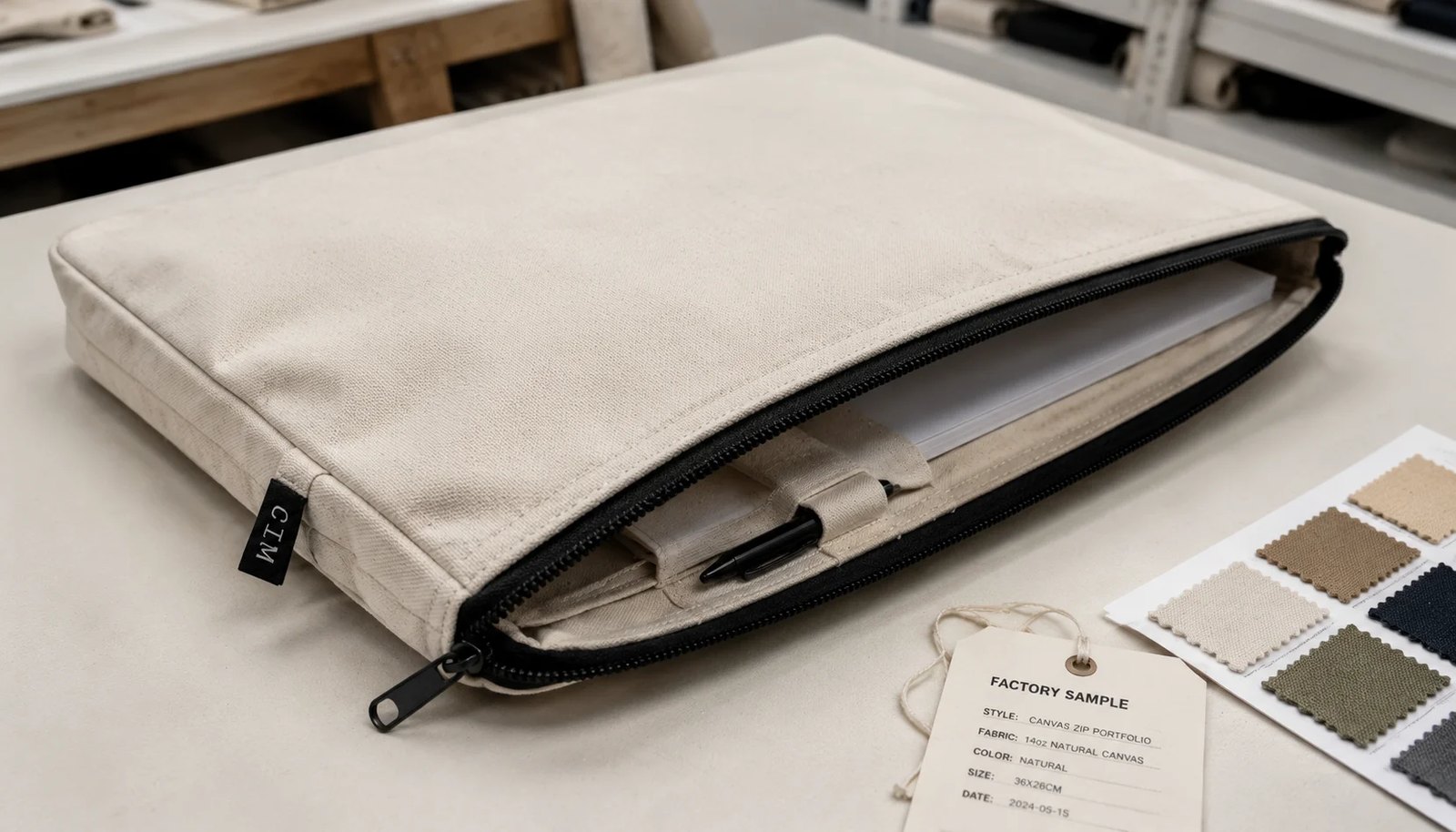
The MOQ problem museum shops usually face
Canvas zipper portfolios sit between souvenir stationery and functional business bags. They are not as simple as flat cotton pouches, but they are not complex briefcases either. For museum shops, the buying problem is usually not whether the product can be made. The real problem is how to reach a workable minimum order quantity while keeping enough artwork variety for exhibitions, locations, donors, or retail seasons.
A factory calculates MOQ from more than finished units. Cutting efficiency, fabric purchase rolls, zipper color, printing setup, label setup, and packing labor all create thresholds. If a buyer requests 200 units split into five artworks, two canvas colors, three zipper colors, and separate hangtags, the order may look small to the buyer but fragmented to production. A better plan keeps the body construction stable and uses controlled artwork variation.
- Good MOQ plan: one fabric, one size, one zipper, two or three print artworks.
- Difficult MOQ plan: multiple fabrics, mixed sizes, different pocket layouts, and short runs per artwork.
- Best RFQ wording: state total quantity, quantity per design, and whether designs share the same construction.
- Useful negotiation point: ask whether artwork changes can be grouped under one cutting batch and one sewing run.
Define the portfolio use before choosing the specification
Museum shop buyers should decide whether the canvas zipper portfolio is a retail gift, a workshop supply item, a membership welcome item, or a premium exhibition accessory. Each use changes the specification. A low-price gift folder can use a lighter canvas and simple one-color print. A portfolio sold near art books and stationery needs stronger shape retention, cleaner zipper finishing, and more controlled print placement.
The most important early decision is the document or object to be carried. A4 paper, US letter paper, postcards, sketch sheets, small catalogs, or tablets all require different clearances. Do not approve only the outside dimensions. The zipper opening, seam allowance, internal sleeve height, and corner shape can reduce usable space. For document products, 10-15 mm internal clearance is often safer than a tight fit.
- A4 paper size: 210 x 297 mm; add practical internal clearance.
- US letter size: 216 x 279 mm; shorter but wider than A4.
- Common retail portfolio outer size: around 250 x 340 mm for A4-style use, depending on seam and zipper design.
- Tablet-focused styles need padding or lining decisions; document styles usually do not.
- If the portfolio will include a notebook or insert, send the actual insert size and thickness to the factory.
Fabric weight and canvas structure that make sense for zipper portfolios
For canvas zipper portfolios, the most common practical range is 10oz to 16oz cotton canvas, roughly 280-450 GSM depending on weave and finishing. A 10oz canvas can work for budget promotional folders, but it may feel soft and show wrinkles around the zipper. A 12oz canvas gives better body for flat retail items. A 14oz or 16oz canvas creates a more premium handfeel, but it can increase sewing bulk at zipper ends and raise freight weight.
Natural canvas is popular for museum shops because it works with heritage graphics, line art, and understated retail displays. Dyed canvas may better match brand guidelines, but colorfastness and shade consistency need more control. Washed canvas feels softer and less raw, yet washing can shift dimensions and affect print sharpness. If the artwork includes fine museum text, select the fabric surface and print method together rather than treating them as separate decisions.
- 10oz / about 280-300 GSM: lower cost, softer structure, better for giveaways than premium retail.
- 12oz / about 340-360 GSM: balanced option for many museum shop portfolios.
- 14oz / about 390-420 GSM: stronger retail feel, good for paid merchandise.
- 16oz / about 450 GSM or above: premium but heavier, with more zipper and corner sewing risk.
- Request actual swatches; oz and GSM alone do not show stiffness, slub level, or print surface.
Print and branding choices for museum artwork
Most museum shop portfolios use screen print, heat transfer, woven labels, leather or cotton patches, or embroidery. Screen print is usually the most direct choice for solid logos, exhibition titles, simple line drawings, or limited-color artwork. It performs well on canvas when the artwork is bold enough and the ink is matched to the fabric surface. For fine type, small copyright notes, and multi-sponsor marks, the minimum line width and text height should be reviewed before sampling.
Digital print can support complex artwork, but it may change the handfeel and cost structure. Embroidery adds texture but can pucker flat portfolios if the canvas is not stabilized. Woven labels are efficient for repeat programs because they separate the brand mark from the changing exhibition print. A museum shop with seasonal exhibitions can often reduce MOQ pressure by keeping a standard CTM-style woven side label or museum label and changing only the front panel print.
- Screen print: best for one to three solid colors and clear graphic shapes.
- Heat transfer: useful for detailed marks but needs adhesion and wash/rub testing.
- Embroidery: premium texture, but avoid large dense stitches on thin canvas panels.
- Woven label: good for recurring programs and low-risk brand consistency.
- Patch branding: adds perceived value but introduces extra material MOQ and stitching alignment checks.
How MOQ is built inside the factory quotation
A canvas zipper portfolio quotation is normally built from fabric consumption, zipper length, lining or internal pocket material, print setup, cutting, sewing labor, trimming, inspection, and packing. MOQ is influenced by the least flexible part of the order. If the factory has natural 12oz canvas in stock, fabric may not be the problem. If the buyer wants a custom-dyed zipper tape or a custom metal puller, that component may set the real minimum.
For museum shop planning, separate the MOQ into three levels: construction MOQ, artwork MOQ, and component MOQ. Construction MOQ is the number needed to run cutting and sewing efficiently. Artwork MOQ is the number per print design or per screen setup. Component MOQ applies to dyed fabric, custom labels, zipper pullers, printed hangtags, and special packing. Once these are separated, buyers can decide where variety matters and where standardization saves money.
- Construction MOQ: affected by size, pocket layout, zipper installation, and sewing line setup.
- Artwork MOQ: affected by screen printing setup, color changes, and print position.
- Component MOQ: affected by custom zipper color, woven label, patch, hangtag, and dyed fabric.
- Lower-risk first order: standard zipper, stock canvas, shared construction, limited print colors.
- Better reorder model: keep construction unchanged and rotate exhibition artwork.
Decision table for a practical first order
The table above can be used as a specification filter before sending an RFQ. It is not a decorative spec sheet; it is meant to prevent the common mismatch between museum retail expectations and factory cost logic. A buyer may want a premium look, plastic-free packing, several artworks, and low opening quantity. That can be possible, but only if the product architecture is kept simple.
For a first production order, the safest route is usually one portfolio size, one natural or dyed canvas, one zipper type, one internal pocket layout, and two artwork versions. This gives the museum shop variety on the shelf without forcing the factory to treat the order like several separate small batches. If the first order sells through, later reorders can add a second color, a patch version, or a premium boxed version.
- Use the table to identify which choices are fixed and which are optional.
- Do not request every premium feature in the first MOQ discussion.
- Separate retail-facing value from hidden complexity; buyers pay for both.
- Keep an approved base pattern for reorders so future artwork changes move faster.
Sample approval should test function, not only appearance
A canvas zipper portfolio often looks acceptable in photos even when it has functional problems. Zipper waviness, tight document fit, bulky corners, fabric caught in the zipper, or crooked internal pockets may not be obvious until the sample is used. The approval sample should be tested with the actual document stack, insert card, notebook, or packaging format planned for retail sale.
A professional sample approval process should include three stages when timing allows: material confirmation, pre-production sample, and production reference sample. The material confirmation locks fabric, zipper, label, and print method. The pre-production sample confirms size, construction, and artwork placement. The production reference sample is used by the sewing and QC team as the physical standard during bulk production.
- Load test: insert the intended paper stack and close the zipper without forcing.
- Zipper test: open and close at least 20 cycles on the sample, including corners.
- Print test: compare color under daylight and indoor store lighting if possible.
- Flatness test: place the portfolio on a table and review twisting or panel distortion.
- Pocket test: verify internal sleeve depth and whether documents catch on seam edges.
- Retail test: place hangtag, barcode, or belly band on the sample before final approval.
Packing decisions affect cost, sustainability, and sell-through
Museum shops often prefer reduced-plastic packing, but canvas products need protection from dust, moisture, and carton abrasion. Natural canvas shows dirt easily, especially on light beige fabric. If individual polybags are not acceptable, consider a paper belly band plus a master poly liner inside the carton, or individual glassine-style paper sleeves if compatible with the budget and destination requirements.
Packing also affects the way the product sells. A flat portfolio may need a belly band, hangtag, or barcode sticker that does not cover the artwork. If the portfolio includes an insert card explaining the museum collection or exhibition, that insert must be included in the packing trial. Overly tight packing can create zipper impressions or creases; loose packing can allow rubbing during ocean or truck transport.
- Individual polybag: clean and economical, but may conflict with plastic-reduction policy.
- Paper belly band: good retail presentation, less protection against moisture.
- Master carton liner: useful compromise when individual plastic is avoided.
- Flat pack: efficient for freight, but protect zipper pulls from marking adjacent units.
- Carton label: include SKU, artwork name, quantity, gross weight, net weight, and carton number.
Lead time planning for exhibitions and seasonal retail
Museum shop deadlines are often tied to exhibition openings, donor events, holiday retail, or catalog launches. These deadlines are less flexible than normal stock replenishment. The lead time should be planned backward from the in-store date, not from the vessel date. Allow time for sampling, artwork revision, bulk material preparation, production, inspection, export handling, freight, customs clearance, and store allocation.
A realistic planning calendar depends on customization level. A standard canvas and zipper with screen print can move faster than a dyed fabric and custom hardware program. Print artwork approval is a common hidden delay because museum graphics may require curator, licensing, sponsor, or legal review. Buyers should build approval responsibility into the schedule before the factory is blamed for waiting.
- Sample development: often 5-15 working days depending on materials and artwork complexity.
- Artwork approval: can be same day or several weeks if licensing review is involved.
- Bulk production: depends on order quantity, printing queue, sewing capacity, and packing complexity.
- Inspection and rework buffer: reserve time before vessel or air booking.
- Freight mode decision: air freight may rescue a deadline but can erase margin on heavy canvas goods.
- Reorder advantage: approved base pattern and print standard can shorten future development time.
Quote comparison: what data makes supplier prices comparable
Comparing unit prices without matching assumptions is risky. One supplier may quote 12oz canvas with a basic zipper and no retail packing, while another quotes 14oz canvas, reinforced corners, individual packing, and barcode application. The cheaper quote may not be cheaper after upgrades are added. For canvas zipper portfolios, the RFQ should force suppliers to price the same fabric weight, size, zipper, print area, internal layout, packing, and inspection requirement.
Request estimated carton dimensions and gross weight with the quotation. Canvas portfolios are not extremely bulky, but heavier canvas and rigid inserts can change landed cost. A buyer importing by air must pay close attention to gross weight, while a buyer shipping by ocean should also consider carton cube and pallet loading. Landed-cost comparison should include setup charges spread across the order quantity, not only the FOB unit price.
- Quote line should include: fabric weight, finished size, zipper type, print method, print colors, pocket layout, packing, and Incoterm.
- Separate charges: sample fee, screen fee, mold or puller fee, label setup, artwork proof, and courier cost.
- Freight data: carton quantity, carton size, net weight, gross weight, and estimated CBM.
- Commercial terms: payment term, quotation validity, sample lead time, bulk lead time, and inspection access.
- Comparison method: calculate landed cost per sellable unit after setup, freight, duty, and expected defect allowance.
Specification comparison for buyers
| Spec decision | Recommended option | When it fits | Buyer risk to check |
|---|---|---|---|
| Outer fabric weight | 12oz to 16oz cotton canvas, washed or unwashed according to artwork style | Museum shops needing a premium handfeel without making the portfolio too heavy for retail display | Very light canvas collapses around documents; very heavy canvas can increase sewing difficulty, freight weight, and zipper stress |
| Portfolio size | A4 or US letter document size with 10-15 mm clearance inside | Most exhibition catalog inserts, workshop handouts, membership gifts, or stationery sets | Exact paper standard matters; A4 and US letter are not interchangeable if buyers expect clean document fit |
| Zipper type | No.5 nylon coil zipper with metal or matte puller; No.8 only for oversized styles | Reliable daily retail use with moderate cost and smoother sewing on canvas edges | Cheap zippers may wave after sewing or jam at corners; test opening after loading with paper stack |
| Branding method | Screen print for solid museum graphics; woven label or leather patch for low-MOQ recurring programs | Artwork with one to three colors, heritage logos, exhibition marks, or artist line drawings | Fine serif text, copyright lines, and small sponsor logos can fill in on coarse canvas unless print size is controlled |
| Interior structure | One main pocket, one flat sleeve, optional pen loop; avoid too many stitched compartments at entry MOQ | Museum shops selling a useful desk accessory rather than a complex office organizer | Every added pocket needs cutting, alignment, and labor time; low MOQ with many compartments usually has unstable cost |
| MOQ strategy | Start with one body fabric, one zipper color, and two print designs sharing the same construction | Multiple exhibition themes or store locations needing variety without splitting factory setup too far | Treating each colorway or print as a separate SKU can push per-SKU MOQ below an efficient cutting and printing batch |
| Packing format | Individual recycled polybag or paper belly band plus master carton with moisture protection | Retail-ready museum shop stock that must arrive clean and scannable | Unbagged natural canvas rubs against cartons and can pick up dust; overpacked units may not match sustainability policy |
| Inspection threshold | AQL 2.5 major / 4.0 minor, with 100% zipper function check on final random sample subset | Bulk production for paid retail sale where returns damage store confidence | Only inspecting print appearance is not enough; zipper travel, corner sewing, and document fit drive actual customer complaints |
Buyer checklist before sampling
- Define the document standard before size approval: A4, US letter, tablet, catalog insert, or membership folder.
- Choose one base construction for the first order; vary artwork rather than pocket layout if MOQ is tight.
- State fabric weight in oz and GSM, and clarify whether the canvas is natural, dyed, washed, or bleached.
- Provide artwork at final print size with Pantone references and minimum readable text height.
- Separate total order quantity from per-SKU quantity when requesting MOQ and pricing.
- Approve zipper sample by actual operation, not only by photo; test it with documents inside.
- Lock packing method early because retail labeling, barcode stickers, and plastic-free packing affect labor.
- Request a carton drop and compression review if the product will ship with rigid inserts or paperboard.
- Keep a signed sample with both buyer and factory, including fabric swatch, zipper puller, and print standard.
- Build the reorder plan around the longest item: dyed fabric, custom puller, woven label, or printed panel queue.
Factory quote questions to send
- What is your MOQ for the full order and for each SKU if the construction is the same but print artwork changes?
- Which canvas weights do you keep in regular stock, and what are the GSM tolerances for each option?
- Can you quote 12oz, 14oz, and 16oz canvas using the same size and zipper specification so we can compare cost and weight?
- Is the zipper No.5 nylon coil, metal, or resin, and what brand or grade is included in the base quotation?
- What print method is included in the quoted unit price, and how many colors, positions, and print sizes are assumed?
- Are cutting, screen setup, artwork proofing, sample making, and custom label charges included or listed separately?
- What sample lead time and bulk lead time apply after artwork approval, material approval, and deposit?
- How many units per export carton, what carton size and gross weight are estimated, and can you optimize for our freight method?
- What are your normal inspection standards for zipper portfolios, including zipper function, print placement, seam strength, and stains?
- If we reorder within six months using the same construction, can the MOQ or setup cost be reduced for repeat artwork or new exhibition artwork?
Quality-control points to confirm
- Finished size tolerance should normally be within plus or minus 5 mm for width and height, unless a tighter document-fit requirement is agreed.
- Zipper must open and close smoothly across the full travel with no skipped teeth, twisting, fabric catching, or hard stop at corners.
- Print placement tolerance should be defined in millimeters from the zipper edge, side seam, or bottom fold, not described only as centered.
- Canvas surface must be free from oil marks, obvious weaving holes, severe slubs across the logo area, and dirt transfer from cutting tables.
- Seam allowance and edge binding should be consistent, with no exposed raw edge where the zipper tape meets the side seam.
- The portfolio should fit the intended paper stack or insert after sewing shrinkage, not only at the paper pattern stage.
- Backstitching at zipper ends, pocket corners, handle tabs if used, and label insertion points should be secure without bulky thread nests.
- Retail barcode, hangtag, or belly band should match SKU artwork and not hide mandatory museum branding or care information.