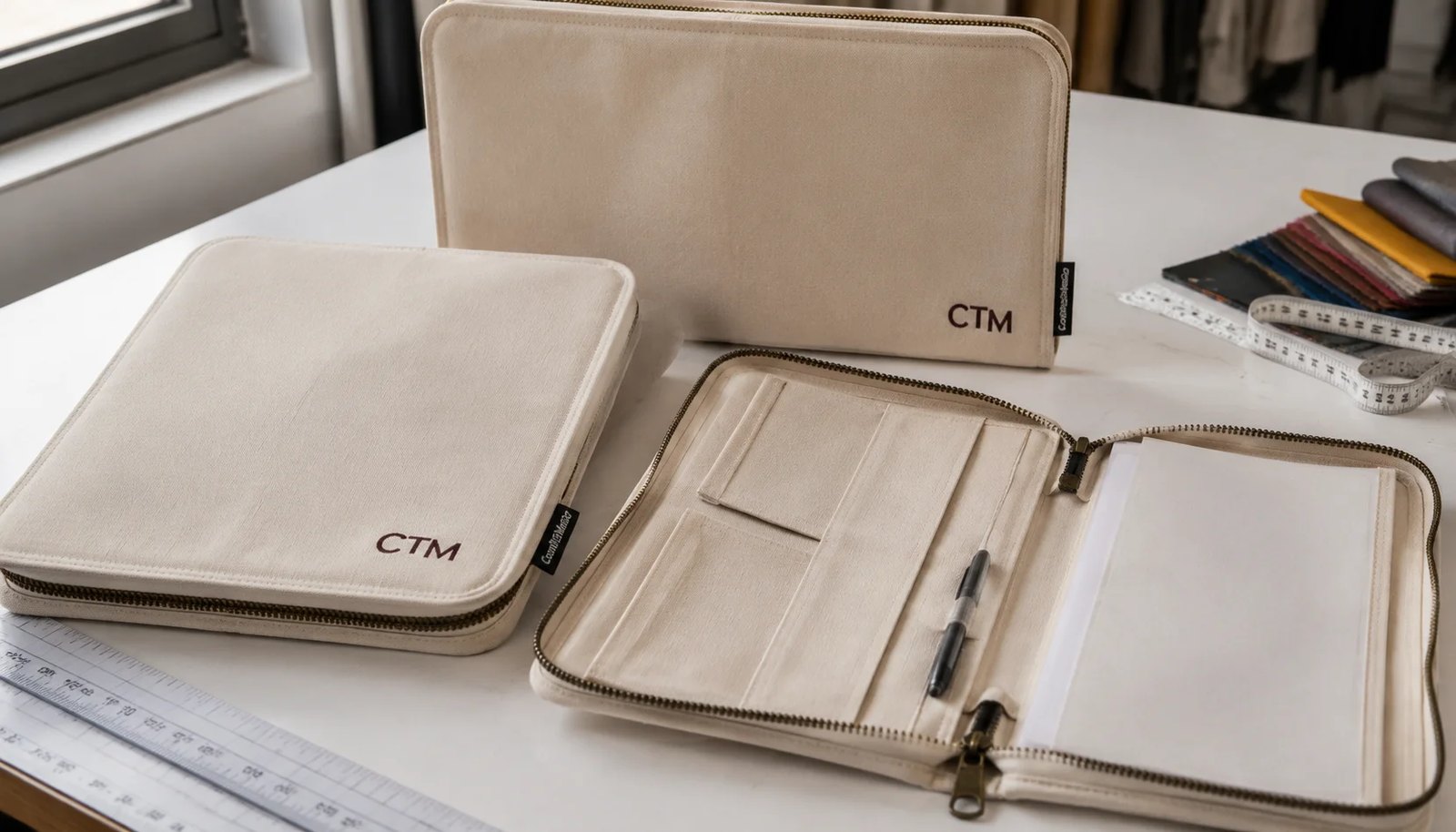
Where MOQ Pressure Comes From
For canvas zipper portfolios, MOQ is rarely a random number. It usually comes from fabric purchase minimums, zipper color availability, printing setup, cutting efficiency, and the labor needed for interior pockets. Liquor retailers often want a premium-looking item for sales teams, store managers, tasting events, or supplier meetings, but the first order may be a regional test. That is where the negotiation starts: which parts of the specification must be custom, and which parts can use the factory's standard supply chain.
A practical RFQ should separate the portfolio's business function from its decorative preferences. If the item only needs to hold price sheets, brand notes, store planograms, and a pen, the buyer can usually keep the internal layout standard and negotiate customization around fabric color, logo, and packing. If the buyer also requires custom zipper pullers, dyed canvas, special lining, foam padding, and retail barcode packing, the supplier's MOQ will move upward because several upstream suppliers become involved.
- Low MOQ is easier when the body fabric is natural, black, navy, or another stock canvas shade.
- MOQ rises when the buyer requests custom dyed canvas because fabric mills normally require a dye lot minimum.
- Logo customization can often be negotiated at lower quantity than fabric customization.
- Interior structure affects labor cost more than many buyers expect, especially if pockets require binding, lining, or multiple sewing operations.
Define the Portfolio Before Negotiating
The phrase canvas zipper portfolio can describe several different products. Some are slim document holders with a zipper around three sides. Others are padded organizer cases with card slots, pen loops, tablet sleeves, and reinforced covers. A liquor retail buyer should define the use first: distributor sales folder, store manager document case, event tasting kit, supplier presentation pouch, or retail staff onboarding pack. The intended contents determine the size, fabric weight, zipper strength, and pocket structure.
Size should be stated as finished outside dimensions and usable inside dimensions. For A4 documents, the portfolio needs more than the paper size because zipper clearance, seam allowance, and document thickness reduce usable space. For US letter documents, the same logic applies. If the portfolio will hold laminated shelf talkers, price books, or tasting sheets in plastic sleeves, the buyer should send the largest insert dimension and stack thickness to the factory. That prevents a common failure: a sample that looks correct when empty but is too tight in actual retail use.
- Give document format: A4, US letter, legal, tablet size, or custom insert size.
- State maximum loaded thickness, not only flat paper size.
- Clarify whether the portfolio must open flat on a counter or only unzip for document access.
- Specify whether the interior needs a pen loop, business card slots, elastic band, clear pocket, or only one main compartment.
Canvas Weight and Construction Choices
For most liquor retail programs, 12 oz cotton canvas, roughly 380-410 GSM, is a sensible starting point. It feels stronger than a lightweight promotional pouch and still runs through sewing lines efficiently. An 8 oz or 10 oz canvas can reduce cost and carton weight, but it may look soft around the zipper and corners. A 14 oz or 16 oz canvas gives a firmer handfeel, but sewing bulk increases at zipper corners and pocket seams, and the item becomes heavier to ship.
Construction also matters. A portfolio made from single-layer canvas is economical, but the cover may wrinkle or show the document edges inside. A lined construction looks cleaner, protects interior seams, and improves the presentation value, yet adds material and labor. Padding can make the item feel more premium, but it is often unnecessary unless the portfolio carries a tablet or glass-related sample tools. For liquor retailers, the better cost choice is usually a clean canvas shell, controlled zipper sewing, and a practical interior pocket layout.
- Economy option: 10 oz canvas, single main compartment, one-color print, stock zipper.
- Balanced option: 12 oz canvas, lined interior, document pocket, pen loop, branded woven label or screen print.
- Premium option: 14 oz canvas, lining, reinforced corners, metal-look zipper, patch or woven label.
- Avoid very stiff canvas if the design has tight zipper corners or many internal pocket seams.
Logo Method and Brand Appearance
Liquor retail buyers often care about brand presentation because the portfolio may be handled by store managers, supplier reps, and trade partners. The lowest-risk decoration for small or mid-size orders is usually one-color screen printing on flat canvas before assembly. It gives clear branding and manageable setup cost. For textured canvas, avoid very fine type and large solid ink blocks unless the factory has already tested the artwork on the same fabric. Ink coverage on natural canvas can look slightly uneven, which may be acceptable for a casual canvas style but not for a luxury retail presentation.
Woven labels, leather patches, cotton labels, and embossed patches are useful when the program will repeat. They can make the portfolio look less like a disposable promotion and more like a retail tool. However, labels and patches introduce their own MOQ, artwork approval, lead time, and placement tolerance. A smart negotiation is to quote one-color print for the first test order and a woven label or patch option for the repeat order. That lets the buyer control first-order MOQ while still planning a better long-term version.
- Screen print works well for simple CTM-style logos, store marks, and one-color distributor branding.
- Heat transfer can reproduce more colors but may feel less natural on heavy canvas.
- Embroidery is possible but can pucker canvas if the artwork is large or dense.
- Woven labels are clean for repeat programs but need label sampling and position approval.
- Patch decoration should be tested for edge lifting, stitch color, and bulk at the sewn area.
MOQ Negotiation That Actually Works
The strongest MOQ negotiation is not asking for a lower number with the same complicated specification. It is showing the supplier which specifications can move. A buyer can say: quote your best MOQ using stock 12 oz natural canvas, stock black zipper, one-color front print, and standard inner pocket. Then quote the MOQ if we change only the zipper color, and quote again if we change only the fabric color. This gives the procurement team a costed map instead of a yes-or-no answer.
Factories are more willing to support a lower MOQ when the order fits existing materials and does not leave unused inventory. For example, a supplier may have natural canvas and black zipper tape available, but not burgundy zipper tape or custom dyed dark green canvas. If the liquor retailer's brand color is important, the buyer can keep the main canvas natural and use brand color in the print, zipper pull cord, woven label, or inner binding. That may preserve brand recognition without triggering a full custom material MOQ.
- Negotiate by variable: fabric color, canvas weight, zipper color, logo method, inner layout, packing.
- Offer a repeat-order forecast only if it is realistic and tied to the same approved specification.
- Ask for a test-order MOQ and a reorder price at higher quantity in the same quote sheet.
- Do not hide retailer packing requirements until after price approval; packing can change labor and carton data.
- Use a standard factory pattern when possible, then customize visible branding points.
Cost Drivers to Compare in Quotes
A low unit price can be misleading if the quotation excludes sample charges, logo setup, inner packing, carton labeling, or extra inspection sorting. When comparing suppliers, procurement teams should request a quote breakdown showing material, decoration, packing, sample cost, mold or screen cost if any, and estimated carton data. This does not mean every factory will disclose full internal costing, but a serious supplier should explain which choices affect price and MOQ.
For canvas zipper portfolios, the biggest cost drivers are canvas weight, lining, zipper quality, pocket complexity, decoration method, packing standard, and order quantity. Freight also deserves attention. A heavier 16 oz portfolio may look better in a sample room but can raise carton gross weight and shipping cost. A thick padded portfolio may reduce pieces per carton. If the buyer is distributing to many liquor store locations, carton size, carton weight, and inner packing format can affect landed cost almost as much as the ex-factory price difference.
- Compare EXW or FOB unit price only after confirming the same fabric weight and construction.
- Include print setup, sample fee, label tooling, and patch tooling in first-order cost.
- Request carton dimensions and gross weight before estimating freight.
- Separate the cost of retailer-specific labeling from standard export carton marking.
- Treat a very low price with vague GSM, zipper type, and packing as an incomplete quote.
Sample Approval and Acceptance Criteria
The sample stage should prove the final buying specification, not only the general idea. A reference sample made from substitute canvas is useful for shape discussion, but it should not be the basis for bulk approval. Before cutting bulk fabric, the buyer should approve a pre-production sample using final canvas weight, final zipper color, final print method, final logo size, and final packing. This is especially important for natural canvas, where fabric shade, slub level, and ink appearance can vary.
Acceptance criteria should be written into the approval comments. For example, finished size tolerance plus or minus 5 mm, print position tolerance plus or minus 3 mm to 5 mm, zipper must run smoothly around corners, and no obvious stains in the front logo area. If the portfolio must hold a specific binder insert or stack of tasting sheets, send that insert to the supplier or provide exact dimensions. The sample should be tested while loaded, opened, zipped, and placed into the intended carton packing.
- Measure outside size, inside usable size, and loaded thickness.
- Zip and unzip each sample repeatedly, especially at the corners.
- Place actual documents inside and check whether corners bend or catch.
- Review print color under normal office light, not only under bright sample-room lighting.
- Photograph approved details: zipper puller, inside pocket, print position, label, stitching, and packing.
Quality Risks in Bulk Production
Bulk production risk increases when the buyer approves a good-looking sample but does not define inspection points. Canvas can pick up dirt marks during cutting and sewing. Zipper tape can be stitched unevenly, causing waves or tight corners. Interior pockets can be too shallow, too tight, or not back-tacked at stress points. Print can shift if the logo is printed after cutting without a clear jig. None of these problems are unusual, but they are controllable with clear tolerances and in-line checks.
For liquor retail programs, appearance defects are often more damaging than small technical deviations because the item represents the store or brand in trade meetings. The front logo panel should be treated as a critical area. Stains, heavy slubs through the logo, crooked print, and visible thread ends should be stricter there than on the back or interior. The buyer should also define AQL level or at least inspection sampling quantity, defect categories, and what happens if the lot fails. Sorting and rework take time, so the inspection plan should be built into the schedule.
- Critical defects: broken zipper, missing logo, wrong artwork, mildew odor, unsafe sharp component.
- Major defects: crooked print, obvious stain on front, wrong size outside tolerance, open seam, loose pocket.
- Minor defects: small thread end, slight canvas slub outside logo area, minor wrinkle from packing.
- Functional test: zipper should open and close smoothly without fabric catching in the teeth.
- Appearance test: front logo area should match the approved sample and be clean enough for retail-facing use.
Packing and Store Distribution
Packing is not just an export detail. Liquor retailers and distributors may need portfolios delivered to headquarters, sales teams, regional warehouses, or individual store groups. A simple individual polybag protects canvas from dirt and moisture, but some retail buyers prefer paper sleeves or reduced-plastic packing. Either option must be tested because natural canvas can mark easily if zipper pulls rub against the front panel during transit.
Carton count should match the portfolio's size and fabric weight. A slim 10 oz portfolio may fit 40 pieces per carton, while a heavier lined 14 oz version may need 20 or 25 pieces to avoid crushing and excessive carton weight. If the portfolios are kitted with printed inserts, tasting sheets, or account documents, kitting should be quoted separately and sampled. The buyer should also state barcode labels, carton marks, purchase order numbers, destination labels, and pallet height restrictions before the final quote is locked.
- Use interleaving paper if zipper pulls or patches can mark the canvas face.
- Avoid over-tight packing that bends portfolio corners or creates permanent creases.
- Confirm whether inner packing is polybag, paper sleeve, belly band, or bulk pack.
- Request carton dimensions, net weight, gross weight, and pieces per carton.
- If goods ship to multiple locations, provide allocation data early because mixed cartons add handling time.
Lead Time and Schedule Risk
A realistic schedule starts after artwork approval, sample approval, deposit or payment arrangement, and final packing confirmation. Many delays come from missing artwork files, unclear logo colors, late barcode data, or changes to the inner layout after the sample is made. For a standard canvas zipper portfolio, sampling may take about 7-12 days after complete information is received. Bulk production may take about 25-40 days after pre-production sample approval, depending on quantity, material availability, and workshop capacity. These are planning examples, not guaranteed delivery promises.
The buyer should identify the true deadline. Is the portfolio needed for a seasonal liquor promotion, a chain-wide manager meeting, a distributor sales launch, or a trade show? If the deadline is fixed, do not spend two weeks debating a custom zipper puller unless it materially improves the program. The fastest stable route is usually standard canvas, standard zipper, standard pattern, and controlled logo decoration. Custom materials should be chosen when brand value justifies the schedule risk.
- Artwork delay affects print strike-off and pre-production sample timing.
- Custom dyed fabric can add time before cutting even begins.
- Retail barcode and carton label delays can hold finished goods in packing.
- Failed inspection can add sorting or rework days, especially for print and zipper defects.
- Air freight can recover time but may remove the savings gained from low unit price negotiation.
Specification comparison for buyers
| Spec decision | Recommended option | When it fits | Buyer risk to check |
|---|---|---|---|
| Canvas body fabric | 12 oz cotton canvas around 380-410 GSM for most liquor retail presentation programs | Good balance for price sheets, tasting notes, retail account binders, and reusable sales kits | Below 10 oz may collapse after filling; above 16 oz increases sewing difficulty, carton weight, and freight cost |
| Zipper type | No. 5 nylon zipper for standard portfolios; No. 5 metal-look nylon if the brand needs a premium finish | Suitable for frequent retail buyer handling without the higher reject rate of heavy metal zippers | Poor zipper tape color matching and weak zipper stops can cause early failure even when the canvas looks acceptable |
| Logo method | One-color screen print for 300-1,000 pcs; woven label or leather patch when repeat orders are expected | Works for liquor retailers needing a controlled brand mark without high tooling cost | Large solid ink areas on textured canvas can look uneven; request a strike-off before approving bulk fabric cutting |
| Interior layout | One document pocket, two card slots, elastic pen loop, and optional sample sheet pocket | Covers common sales folder and retail merchandising use without overbuilding the item | Too many internal panels raise labor time and MOQ pressure; unsupported pockets can tear if buyers load catalogs |
| MOQ negotiation lever | Keep fabric color, zipper color, and inner layout standard; negotiate logo and packing customization separately | Best route for test orders, regional liquor chains, and distributor launch kits | Combining custom dyed fabric, special zipper, and multiple print positions usually pushes MOQ up fast |
| Sample approval | Pre-production sample made in final fabric weight, zipper color, print size, and packing method | Needed before placing a bulk order with retailer-facing brand requirements | A sample made from substitute fabric can hide shrinkage, print bleeding, and zipper stiffness issues |
| Packing plan | Individual polybag or paper sleeve, 20-40 pcs per export carton depending on portfolio size and GSM | Keeps portfolios clean for retail store delivery and reduces abrasion during ocean or courier shipment | Overpacked cartons can crush corners; loose cartons allow zipper pulls to mark the canvas |
| Lead time basis | 7-12 days for sampling after artwork confirmation; 25-40 days for bulk after sample approval, depending on quantity and materials | Realistic for standard canvas and common zipper colors when production capacity is open | Lead time should start after deposit, approved sample, and final packing data, not from first inquiry date |
Buyer checklist before sampling
- Define portfolio size by document use, such as A4, letter size, price sheet folder, or tasting kit insert, not by a vague photo reference.
- State canvas weight in oz or GSM and whether you accept a tolerance, for example 12 oz canvas with 380-410 GSM target.
- Specify zipper type, zipper tape color, puller finish, and whether a metal look is cosmetic or required as real metal.
- Provide final logo artwork with Pantone references, print size, print position, and whether the same logo appears on all colorways.
- Separate mandatory specs from negotiable specs so the factory can offer a lower-MOQ version without changing the core retail function.
- Request a pre-production sample using final materials, final logo method, and final packing before bulk cutting starts.
- Define inspection criteria for zipper operation, print placement, stain marks, stitching defects, and finished size tolerance.
- Include carton packing, inner packing, barcode or retailer label needs, carton marks, and pallet limits in the RFQ.
- Ask the supplier to show MOQ by cost driver: fabric purchase, zipper purchase, printing setup, cutting efficiency, and packing materials.
- Compare quotes using total landed cost and reject risk, not only the unit price on the first quotation line.
Factory quote questions to send
- What is the MOQ for this canvas zipper portfolio if we use your stock canvas color, stock zipper color, and our one-color logo?
- What MOQ changes if we request custom dyed canvas, a different zipper tape color, or a custom puller?
- Which canvas weight do you recommend for a portfolio carrying documents and liquor retail sales sheets, and what GSM tolerance do you control?
- Can you quote screen print, woven label, and patch options separately with setup cost, MOQ, and sample lead time for each?
- Will the pre-production sample use final bulk fabric and final zipper, or substitute material? If substitute, what will change in bulk?
- What is the expected finished size tolerance, logo placement tolerance, and acceptable zipper failure rate during inspection?
- How many pieces fit per export carton, what is the estimated carton size and gross weight, and can you meet our retailer carton label format?
- What production steps are on the critical path after sample approval, and what information from our side can delay the start date?
- Can you provide a costed option for a lower MOQ test order and a second quote for a repeat order quantity with the same approved spec?
- How do you pack light natural canvas items to reduce dirt marks, crease marks, zipper abrasion, and moisture risk during shipment?
Quality-control points to confirm
- Finished size should stay within agreed tolerance, commonly plus or minus 5 mm for portfolio length and width unless a tighter retail fixture fit is required.
- Zipper must open and close smoothly across the full length without catching at corners, loose stops, broken teeth, or uneven tape stitching.
- Print position should match the approved sample within the agreed tolerance, commonly plus or minus 3 mm to 5 mm depending on artwork size.
- Canvas surface should be free from obvious oil marks, dirty handling marks, mildew odor, broken yarns, and severe slubs in the logo area.
- Stitching should be straight, back-tacked at stress points, and free from skipped stitches on zipper edges, pocket openings, and handle or tab areas if included.
- Interior pockets should fit the intended inserts without tearing, curling, or exposing raw edges under normal loading.
- Cartons should pass basic export packing checks: correct count, dry cartons, clean inner packing, readable carton marks, and no crushing of portfolio corners.
- Bulk goods should match the approved pre-production sample for fabric handfeel, zipper color, print color, construction, and packing format.