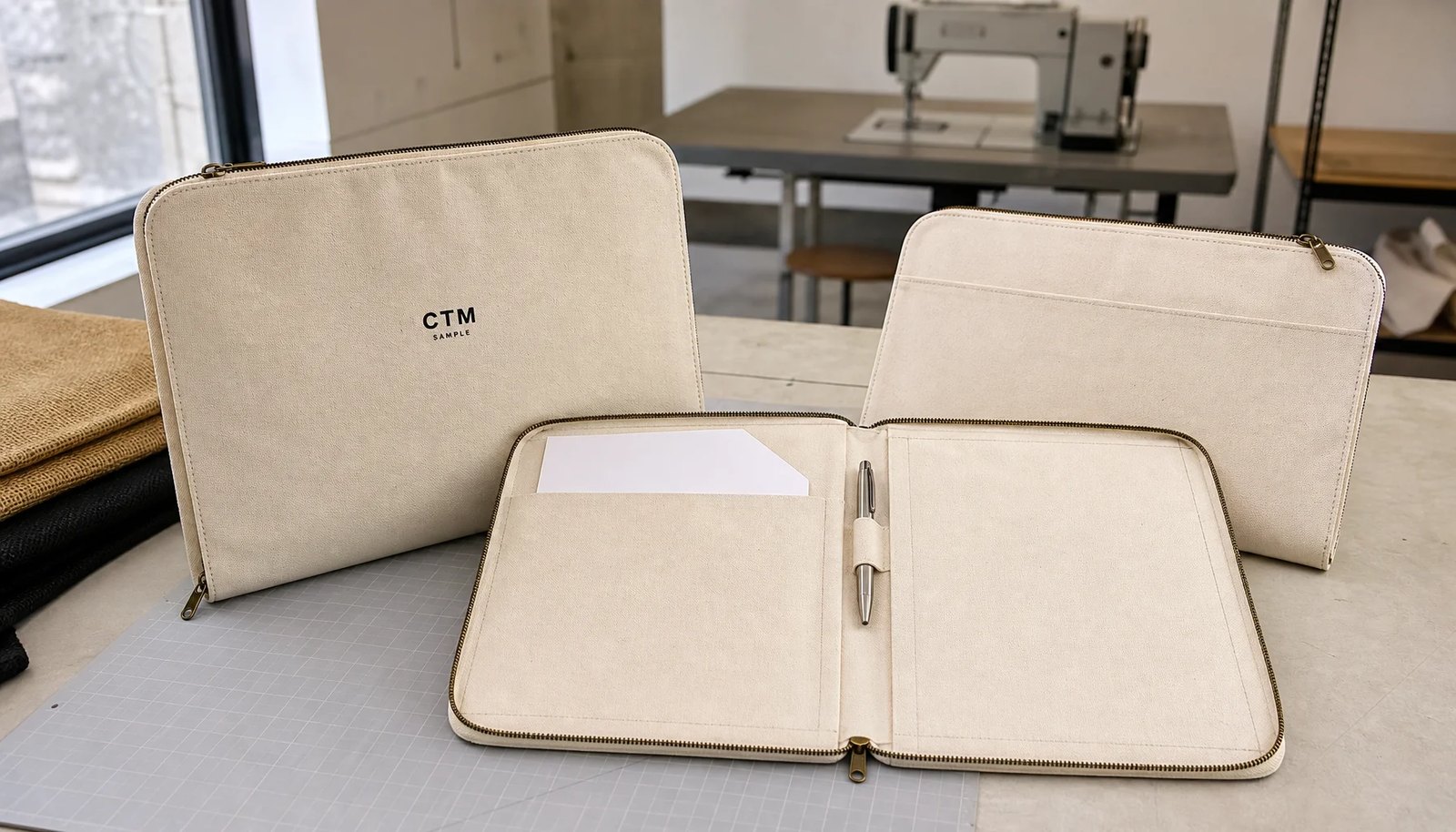
The MOQ Problem Behind Exhibitor Portfolios
Canvas zipper portfolios for trade show exhibitors look simple, but MOQ negotiation often fails because buyers treat them like flat tote bags. A portfolio has more components: canvas body panels, zipper tape, slider, puller, lining or pocket fabric, inner organizer pieces, reinforcement, print setup, and sometimes custom packing. Each component can carry a different minimum. A factory may accept 300 pieces for sewing, but the zipper supplier may prefer 1000 meters, the fabric dye house may require one roll per color, and a woven label supplier may quote a separate label MOQ.
The practical goal is not to force the lowest number on the quotation sheet. The goal is to know which part of the design causes the MOQ and then adjust the specification without damaging the product. For an exhibitor program, the buyer usually needs reliable delivery, consistent branding, and enough perceived value for booth visitors or sales teams. A weak zipper, thin canvas, or messy logo will cost more than the small saving from pushing MOQ too hard.
- Use stock fabric colors when the event date is fixed and the order quantity is below 800 pieces.
- Keep the zipper standard unless the zipper itself is part of the brand look.
- Negotiate by component: fabric MOQ, zipper MOQ, logo setup, packing MOQ, and sewing MOQ.
- Request one clean base quotation first, then add upgrades as separate lines.
Build the RFQ Around Use, Not Decoration
A useful RFQ starts with what the portfolio must carry at the show. If it only holds brochures, order forms, and a pen, a flat canvas zipper portfolio with one document sleeve is usually enough. If it must carry a tablet, charger, badge scanner, or product sample sheets, the structure changes. Padding, lining, and pocket stitching become more important, and MOQ flexibility usually becomes weaker because production time increases.
Finished size is one of the first details to lock. For A4 documents, many buyers choose around 250 x 340 mm finished size, but the zipper path, seam allowance, and document clearance must be considered. For US letter-size inserts, dimensions may need adjustment. A portfolio that is exactly the paper size will be difficult to load after sewing. A better RFQ states the insert size, desired clearance, and whether the portfolio should fit inside a larger event kit carton.
- For documents only: specify one large sleeve, one pen loop, and a simple zipper closure.
- For tablet use: state tablet model or maximum device size and whether padding is required.
- For sales kits: include the maximum loaded thickness so the zipper is not strained.
- For distributor resale: define barcode label, carton mark, and individual packing requirements.
Canvas Weight and Fabric Choices
Canvas weight strongly affects unit cost, perceived quality, print result, and carton volume. For zipper portfolios, 12 oz canvas, roughly around 380 GSM depending on construction, is a practical starting point for many trade show programs. It has enough body for a business gift without becoming too heavy. 16 oz canvas, often around 540 GSM, feels more premium and resists collapse better, but it increases material cost and can make zipper corners harder to sew neatly.
Lower weights such as 8 oz or 10 oz may be acceptable for low-budget giveaways, but they can look tired after folding and handling. Thin canvas also makes inner seams and pocket edges more visible from the outside. When comparing quotes, do not accept only the phrase cotton canvas. Request oz and GSM, fabric construction if available, color status, and finishing. Natural canvas usually gives better MOQ flexibility than custom-dyed canvas because the factory can source from stock rolls.
- 12 oz canvas: balanced option for exhibitor document portfolios and branded sales kits.
- 14 oz canvas: useful middle ground when the buyer wants more body without the cost of heavy canvas.
- 16 oz canvas: better handfeel, higher cost, thicker seams, and potentially slower sewing.
- Washed canvas: softer look but more size variation and extra approval work.
- Custom-dyed canvas: better brand color control but higher MOQ and longer lead time.
Zipper and Construction Details That Change MOQ
The zipper is not a small accessory in this product. It controls the user's first impression and it is one of the most common failure points. A No.5 nylon coil zipper is often the most practical choice for bulk exhibitor portfolios because it runs smoothly around corners, is lighter than metal, and is easier to source in standard tape colors. A No.5 metal zipper can look more premium, especially with natural canvas and brass-tone hardware, but it may require more careful sewing and can raise the price.
Construction should be described in plain factory language. State whether the portfolio is flat, lightly padded, lined, or semi-structured. State whether zipper ends are covered, whether corners are reinforced, and whether inner pockets use self-fabric or lighter lining fabric. Every extra pocket adds cutting, folding, positioning, and stitching work. At low MOQ, a factory has less room to absorb these operations, so a clean layout often negotiates better than a complicated organizer panel.
- Nylon coil zipper: good for smooth use, lower weight, and stronger MOQ flexibility.
- Metal zipper: good for premium appearance but needs scratch and smoothness checks.
- Custom puller: useful for brand programs but may create separate mold or MOQ charges.
- Lining fabric: improves finish but adds material sourcing and sewing steps.
- Reinforced corners: worth adding if the portfolio will be loaded with catalogs or samples.
Logo Method and Print Approval
Most exhibitor programs need the logo to be visible, durable, and consistent across cartons. Screen printing is the normal option for one to three solid colors on canvas. It is cost-efficient, easy to repeat, and suitable for event logos, sponsor marks, and simple brand artwork. The risk is that coarse canvas texture can break fine lines, and heavy ink coverage can feel stiff or crack if curing is poor. This is why a print strike-off is more useful than a digital mockup.
Heat transfer can reproduce more detail, but it may not suit every canvas texture and can look less integrated with the fabric. Embroidery gives a durable premium feel, but it can distort thin canvas and is slower for large logos. Woven labels and PU patches work well for repeat programs because the branding component can be stocked and sewn onto different fabric colors. For MOQ negotiation, the key is to separate logo setup cost from the unit price and understand whether artwork changes will reset the setup.
- Screen print: best for simple logos, event dates, and cost-controlled orders.
- Embroidery: better for small premium marks, not ideal for large filled areas.
- Woven label: good for repeat distributor stock or multi-event programs.
- PU patch: premium look, but confirm attachment stitching and colorfastness.
- Print approval: require actual print on the chosen canvas, not only a paper proof.
How to Negotiate MOQ Without Weakening the Bag
A factory can usually reduce MOQ more easily when the buyer protects material simplicity. The strongest negotiation position is a standard body size, stock canvas color, standard zipper color, simple inner layout, and one print location. In that case, the main fixed costs are sample work, print setup, cutting setup, and production line arrangement. If the buyer also accepts carton-neutral packing, the factory has fewer small-batch obstacles.
The wrong way to negotiate is to keep every custom feature and only demand a lower quantity. That often leads to hidden substitutions: lighter canvas, thinner zipper, less careful packing, or vague inspection standards. A better approach is to request several price breaks with the same specification. For example, ask for 300, 500, 1000, and 2000 pieces, all using the same 12 oz canvas, No.5 nylon zipper, one-color screen print, and individual polybag. The price curve will show whether MOQ is driven by setup time or by a material supplier minimum.
- Trade custom dyeing for stock color before reducing canvas weight.
- Keep the zipper standard before removing corner reinforcement.
- Use a paid sample charge instead of forcing the factory to hide sampling cost in a small order.
- Offer repeat-order visibility if the buyer has several shows in one season.
- Combine multiple regional event quantities under one artwork when possible.
Quote Data Needed for a Fair Comparison
Comparing portfolio quotes without quote data is risky because the lowest unit price may exclude the parts that matter. A complete quotation should state finished size, fabric weight, fabric color, zipper type, logo method, inner pocket structure, packing, carton size, production lead time, sample cost, setup charges, and validity. It should also state whether the price is based on EXW, FOB, CIF, DDP, or another trade term. A low EXW price can become expensive after inland freight, export handling, and inspection are added.
For landed-cost comparison, carton volume matters. Canvas zipper portfolios can be heavier and bulkier than flat tote bags, especially if padded or packed individually. Ask for pieces per carton, carton dimensions, gross weight, and estimated CBM. Then compare freight impact at the same order quantity. A portfolio with a slightly higher unit price but better carton efficiency can be cheaper after ocean or air freight, especially for urgent event replenishment.
- Unit price by quantity: same specification at several order levels.
- Separate charges: sample, screen, mold, label setup, carton printing, inspection.
- Packing data: inner pack, pieces per carton, carton size, gross weight, CBM.
- Trade term: EXW, FOB port, CIF destination, or DDP if available.
- Lead time basis: after deposit, after artwork approval, or after sample approval.
Sampling and Approval Before Bulk Cutting
For dated trade show programs, sample approval should be treated as production control, not a formality. A good pre-production sample confirms the actual canvas weight and color, zipper smoothness, logo placement, inner pocket dimensions, stitching quality, and packed appearance. If the buyer approves only a photo, there is no reliable way to judge handfeel, zipper resistance, ink thickness, or whether the portfolio corners bend inside the carton.
Approval comments must be specific enough for the sewing line to follow. Instead of writing improve quality, mark the issue: zipper wave at top corner, logo 8 mm too low, pen loop too tight for 12 mm pen, document pocket opening too narrow, carton compresses front corner. The factory should keep one approved sample at the production line, and the buyer or inspection agent should keep another reference sample. This reduces arguments during final inspection because both sides know what was accepted.
- Measure finished size on a flat table after the sample is fully zipped.
- Load the intended documents or tablet and test the zipper under realistic thickness.
- Rub the printed logo after curing and look for ink dust, cracking, or poor coverage.
- Open and close the zipper repeatedly, especially around corners.
- Review the packed sample to see whether corners bend or the logo is scuffed.
Packing, Cartons, and Event Delivery Risk
Packing is part of the product for exhibitors because the portfolios may go directly to a trade show warehouse, distributor assembly center, or sales team office. Individual polybags protect against dirt and rubbing, but some buyers prefer paper sleeves or reduced-plastic packing for brand reasons. If using paper packing, test whether natural canvas picks up dust or carton marks. If the product has a dark screen print, avoid packing pressure that causes print transfer.
Carton strength and packing direction affect presentation. Over-compressed cartons can bend zipper corners and create permanent creases. Loose cartons allow the portfolios to slide, which can rub the logo. For higher-value programs, a master carton with consistent layer packing and corner protection may be worth the small extra cost. Carton marks should match the buyer's receiving needs: item code, PO number, quantity, gross weight, net weight, carton number, and destination.
- Confirm whether each piece needs polybag, paper sleeve, hangtag, barcode, or no individual pack.
- Set carton quantity based on weight and corner protection, not only maximum loading.
- Request carton drop or compression comments if the shipment will be couriered or airfreighted.
- Keep printed surfaces separated if ink transfer is a concern.
- Match carton marks to warehouse or show-site receiving instructions.
Lead Time Planning for MOQ Decisions
MOQ negotiation and lead time are connected. A very low MOQ may still fail if materials are not available quickly. Stock natural canvas and standard zipper colors can move faster because the factory avoids dyeing and special component purchasing. Custom-dyed canvas, custom zipper tape, custom pullers, special lining, or branded retail cartons add approval steps before bulk sewing can start. Each approval step can consume several working days, especially if international courier samples are needed.
A realistic schedule separates sample making, sample transit, buyer review, material purchasing, bulk cutting, printing, sewing, packing, inspection, and shipment. For event programs, build a backward calendar from the required warehouse date, not from the show opening date. Trade show freight often needs earlier arrival windows, appointment delivery, or advanced warehouse receiving. When schedule risk is high, simplify the product instead of compressing every factory step.
- Use stock fabric when the warehouse date is fixed within a short window.
- Approve artwork and print size before requesting final sample timing.
- Reserve time for one sample revision if the logo or zipper construction is new.
- Schedule inspection before final payment or shipment release.
- Confirm whether production lead time starts after deposit or after all approvals.
Specification comparison for buyers
| Spec decision | Recommended option | When it fits | Buyer risk to check |
|---|---|---|---|
| Canvas body fabric | 12 oz to 16 oz cotton canvas, about 380-540 GSM, with shrinkage controlled before cutting | Best for exhibitor kits that must feel substantial and protect brochures, contracts, catalogs, or tablets | Very low quotes may use 8 oz canvas that collapses after packing and shows wrinkles around the zipper |
| Zipper grade | No.5 nylon coil zipper for smoother mass production, or No.5 metal zipper for a more premium look | Nylon coil works for larger distributor orders; metal zipper suits brand owner gifts and sales team kits | Metal zipper increases weight, cost, and scratch risk; nylon coil must still pass repeated open-close testing |
| Portfolio structure | Flat padded or semi-structured portfolio with reinforced zipper corners | Useful when exhibitors hand out documents, samples, price sheets, and badge materials in one reusable item | Too much padding raises carton volume; no reinforcement causes corner distortion after loading |
| Logo method | Screen print for 1-3 solid colors; woven label or PU patch for repeat brand programs | Screen print is usually best for event logos and sponsor marks; label or patch works when artwork changes less often | Large ink coverage on coarse canvas can crack if cured poorly or if fabric absorbs unevenly |
| Inner layout | One large document sleeve plus pen loop and business card pocket, unless tablet protection is required | Keeps the unit cost reasonable and helps MOQ negotiation because sewing operations stay predictable | Too many small pockets slow sewing, raise rejection risk, and make low MOQ pricing less flexible |
| Color approach | Natural, black, navy, or dyed stock canvas before custom PMS dyeing | Good for urgent trade show schedules and mixed exhibitor orders where MOQ pressure is high | Custom dyeing may trigger fabric MOQ, lab dip approval time, and shade tolerance disputes |
| MOQ route | Use stock fabric plus custom print for 300-500 pieces; custom fabric, zipper, or lining usually needs 800-1500 pieces | Fits importers and distributors consolidating several exhibitor clients or one brand with regional event demand | A quoted MOQ may hide separate minimums for fabric dyeing, zipper color, woven labels, or printed cartons |
| Packing format | Individual polybag or paper sleeve, 20-40 pieces per export carton depending on size and padding | Works for warehouse receiving, exhibitor kit assembly, and distributor resale | Over-compressed cartons can bend corners; oversized cartons increase dimensional freight cost |
| Approval process | Pre-production sample approved with fabric swatch, zipper pull, print strike-off, and packed carton check | Needed when the portfolio is part of a dated event campaign and replacement time is limited | Approving only a photo sample leaves risk in handfeel, zipper smoothness, ink adhesion, and carton crush resistance |
Buyer checklist before sampling
- Define the finished portfolio size by the documents it must carry, not only by an old sample; allow clearance for A4 or letter-size inserts plus zipper seam allowance.
- State target canvas weight in oz and GSM, such as 12 oz about 380 GSM or 16 oz about 540 GSM, and request tolerance rather than accepting a vague canvas description.
- Separate must-have features from nice-to-have features before MOQ negotiation; pockets, padding, lining, zipper pullers, and labels each affect setup and sewing time.
- Decide whether the order can use natural or stock-dyed canvas; custom dyeing is often the reason a factory raises MOQ.
- Send print artwork with size, position, color references, and acceptable print method; do not ask for MOQ pricing before the logo area is known.
- Request a costed option for both base MOQ and next price break, such as 500 and 1000 pieces, so the buyer can see where fixed charges are diluted.
- Require a physical pre-production sample if the portfolio will carry a brand logo at a live exhibition, especially for dark canvas, large print coverage, or metal zipper styles.
- Confirm packing dimensions, carton weight, and pieces per carton before comparing freight quotes.
- Lock approval dates for fabric, logo, pre-production sample, and bulk packing; MOQ concessions are less useful if the schedule becomes unworkable.
- Keep one approved sealed sample for buyer QC and one for factory production reference.
Factory quote questions to send
- What is the MOQ for the finished canvas zipper portfolio, and are there separate MOQs for fabric color, zipper color, lining, woven label, or carton printing?
- Which canvas weight are you quoting in both oz and GSM, and what is the normal tolerance after dyeing, washing, or finishing?
- Is the fabric stock canvas, greige fabric dyed to order, or already dyed canvas from inventory?
- What zipper type, size, tape color, slider material, and puller style are included in the price?
- Which print method is included, what is the maximum logo size, and how many colors are covered before extra charges apply?
- Can you quote the same design at 300, 500, 1000, and 2000 pieces with the same specification so we can evaluate the price break?
- What sample charges, mold charges, screen charges, label setup charges, or carton plate charges are separate from the unit price?
- How many days are needed for sample making, sample revision, material purchasing, bulk sewing, packing, and final inspection?
- What carton size, gross weight, and pieces per carton are used for the quoted packing method?
- What quality standard will be used for zipper testing, print adhesion, seam strength, stains, size tolerance, and final AQL inspection?
Quality-control points to confirm
- Finished size tolerance should normally stay within +/-5 mm for length and height on a flat portfolio, unless the design uses heavy padding or washed fabric.
- Canvas weight should match the approved swatch within the agreed tolerance; a lower GSM substitution changes handfeel, print surface, and perceived value.
- Zipper should open and close smoothly for repeated cycles without wave distortion, broken teeth, slider jamming, or loose end stops.
- Corners around the zipper path should lie flat enough for retail or event presentation; severe puckering suggests poor sewing tension or wrong seam allowance.
- Logo position should stay within the approved placement tolerance, commonly +/-3 mm to +/-5 mm depending on print size and panel construction.
- Screen print should pass basic rub and tape checks after curing, with no obvious pinholes, bleeding, cracking, or uneven coverage on canvas texture.
- Inside pockets and pen loops should hold the intended inserts without tearing stitches or narrowing the document opening.
- Loose threads, oil marks, fabric stains, broken stitches, sharp zipper ends, and exposed raw edges should be defined as defects before inspection.
- Packed cartons should protect portfolio corners from bending and must match the confirmed carton mark, quantity, gross weight, and destination requirement.