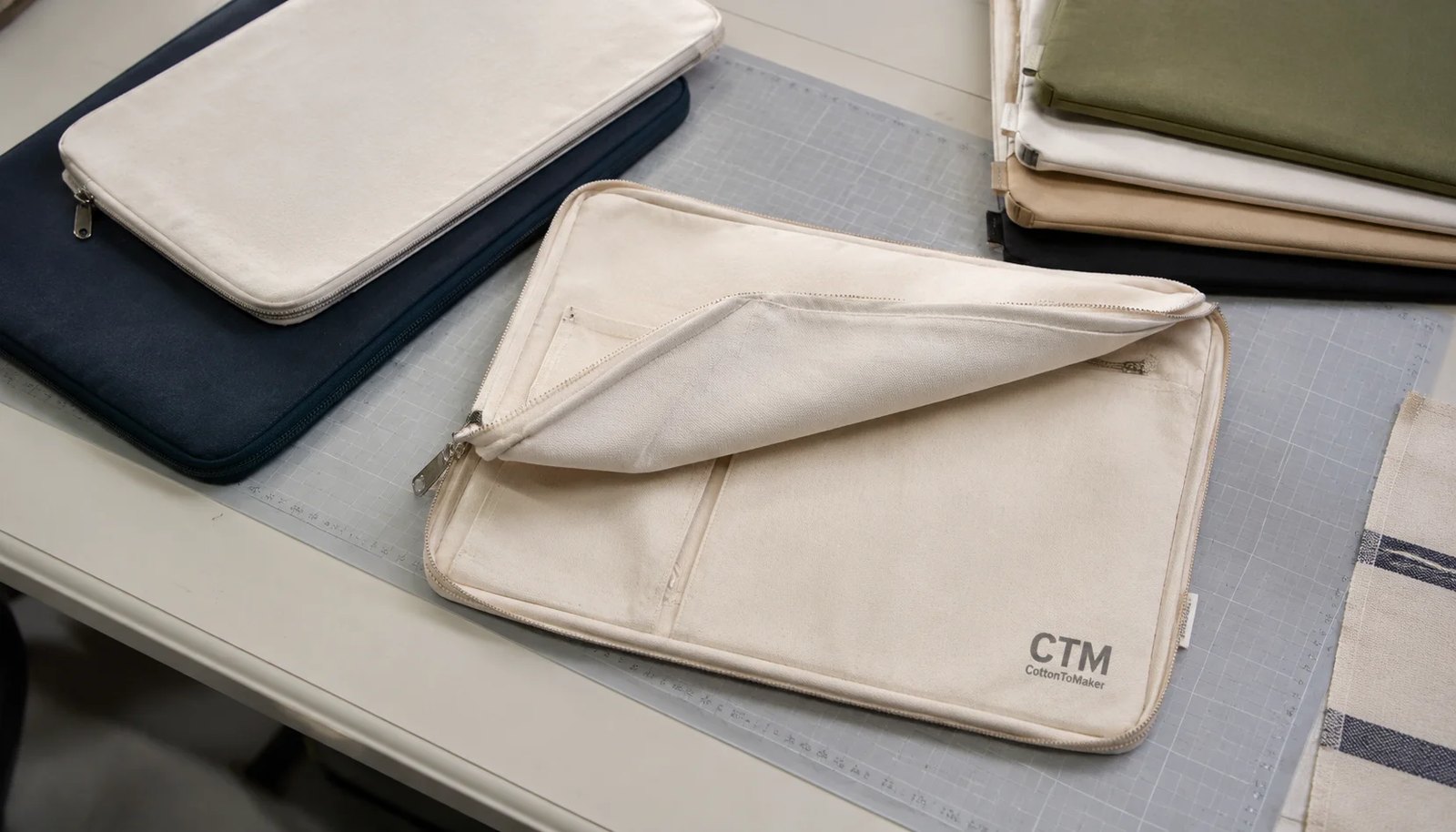
Buying Problem
Wholesale canvas zipper portfolios look simple on a line sheet, but the MOQ often becomes confusing because the product sits between a pouch, a document bag, and a soft business organizer. Natural grocers may use it for staff training folders, vendor meeting kits, wellness event packets, reusable coupon wallets, or premium gift-with-purchase programs. Each use changes the size, canvas weight, zipper route, logo method, and packing expectation.
The cleanest MOQ negotiation starts by separating the standard base from the custom variables. A factory may be flexible on printed logo splits but strict on dyed canvas, zipper tape color, lining fabric, or nonstandard size. Buyers who send one broad RFQ asking for the lowest MOQ on a fully custom portfolio usually receive inflated prices, vague lead times, or quotes that cannot be compared.
- Treat fabric color, size, zipper, print, label, and packing as separate MOQ drivers.
- Decide whether the portfolio is a reusable operational item, a retail product, or a promotional bag before costing.
- Use one approved base spec when multiple natural grocer departments or store groups need different logos.
Base Specification
For a natural grocer program, the most practical starting point is a flat canvas zipper portfolio in 12 oz cotton canvas, roughly 380-420 GSM depending on the mill. This weight has enough body to protect printed materials and small samples without becoming stiff or expensive to sew. If the item must carry heavier catalogs, samples, or staff devices, 14 oz to 16 oz canvas can be considered, but the buyer should expect higher fabric cost, slower sewing, more needle wear, and increased freight weight.
Size should be written as finished size, not approximate paper size. A common document portfolio may be built around A4 or letter-size inserts, but zipper seam allowance, corner radius, and canvas shrinkage can reduce usable internal space. If the portfolio must hold printed coupons, store maps, supplier sell sheets, or product education cards, measure the largest insert and add practical clearance before approving the pattern.
- Recommended everyday canvas: 12 oz cotton canvas or 380-420 GSM recycled cotton blend.
- Heavier option: 14-16 oz when the buyer wants a more structured handfeel and accepts higher landed cost.
- Typical size logic: insert size plus clearance, zipper allowance, and corner construction allowance.
- Tolerance target: finished width and height normally within +/- 5 mm for flat construction.
MOQ Logic
MOQ is not only a factory preference. It comes from fabric purchase minimums, dye lot minimums, zipper procurement, print setup, cutting efficiency, and sewing line scheduling. A factory that stocks natural canvas and black or natural zipper tape may support a lower MOQ than a supplier that must dye fabric, source a special zipper color, or develop a lined organizer structure from scratch.
The strongest negotiation position is to keep the portfolio base standard and move variation into lower-risk areas. For example, one blank natural canvas body with one zipper color can be split into several screen printed logos for regional stores or private label partners. That is much easier for a factory than three canvas colors, three zipper colors, and three sizes at the same total order quantity.
- Lowest MOQ path: stock natural canvas, standard zipper, one size, one print position.
- Moderate MOQ path: same body with multiple logo prints or department marks.
- High MOQ path: custom dyed canvas, custom zipper tape, lining, shaped puller, or several body sizes.
- Negotiation phrase to use: quote the MOQ for the blank base separately from the MOQ per printed design.
Cost Drivers
Canvas weight is usually the first visible cost driver, but labor can overtake fabric once the design adds lining, internal pockets, zipper tabs, binding, organizer panels, or boxed corners. A flat zipper portfolio with one front print is a different production job from a lined business case with pen loops and divided compartments. The RFQ should not hide those details inside a reference photo.
Print cost depends on color count, print area, ink type, setup method, and artwork tolerance. Screen print is usually the most stable choice for one to three solid colors at wholesale quantities. Heat transfer can work for gradients, small runs, or detailed artwork, but it may feel less natural on raw canvas and can become a brand positioning issue for organic or sustainability-focused retail buyers.
- Fabric cost rises with GSM, dyed color, certified or documented material claims, and wastage from nonstandard patterns.
- Labor cost rises with lining, piping, binding, organizer panels, tight corners, and zipper routes around multiple sides.
- Print cost rises with each screen, each color, large coverage areas, and artwork that needs white underbase on dark canvas.
- Packing cost rises with individual bags, hangtags, barcode stickers, retail inserts, and carton sorting by store.
Print And Branding
Natural grocer branding often uses earth-tone palettes, fine-line produce graphics, small certification marks, or multiple sponsor logos. These details need print engineering before final quote acceptance. On natural canvas, ink does not read like it does on coated paper. Fine lines may fill in, pale colors may lose contrast, and large solid areas may show fabric texture through the ink.
A practical print approval should include logo size, placement, Pantone reference, ink type, print method, and acceptable outcome on the selected canvas. If the buyer wants a low-impact look, water-based ink may be suitable, but the color will be softer. If the buyer needs sharp retail shelf presence, a more opaque ink system or transfer may be needed, with a clear discussion of handfeel and durability.
- Keep small text above the factory's minimum printable line and letter height for canvas texture.
- Place artwork away from zipper seams, corner turns, and bulky folded edges.
- Approve color against the actual canvas, not only a digital proof.
- For multi-logo sponsor layouts, define minimum spacing and maximum print area before costing.
Zipper And Construction
The zipper is where many low-cost portfolio quotes fail. A soft canvas body can make a poor zipper look wavy, especially near corners or when the zipper tape is stretched during sewing. For most wholesale canvas zipper portfolios, a No. 5 nylon coil zipper gives a workable balance of cost, flexibility, and smooth opening. Metal zippers can look more premium, but they add weight and may not run as smoothly around corners.
Construction details should be visible in the sample approval. Zipper end tabs, seam allowance, corner shape, stitch density, and thread color affect both appearance and failure rate. If the portfolio will be opened often by store staff or customers, bartacks or reinforced stitching near zipper ends may be worth the small added cost.
- Specify zipper type: No. 5 nylon coil, metal zipper, or molded zipper, with tape color and slider finish.
- Define zipper route: top opening, L-shape, three-side opening, or full wrap.
- Review zipper waviness on a filled sample, not only a flat empty sample.
- Use reinforcement at zipper ends when the portfolio is intended for repeated operational use.
Sample Approval
A two-step sample process reduces wasted time. First approve the blank construction sample for size, zipper movement, seam strength, pocket layout, and overall handfeel. After that, approve the printed pre-production sample using final artwork and final fabric. This sequence prevents the buyer from paying repeated print setup charges while the basic construction is still changing.
The sample should be evaluated with real contents. Put the intended paper inserts, coupon booklets, small product samples, staff cards, or retail materials inside and open the zipper several times. Many portfolio problems appear only after filling: corners pull tight, zipper ends twist, printed panels bend, or internal pockets block the closure.
- Measure finished size at top, middle, and bottom after the sample is filled.
- Test zipper opening and closing with intended contents inside.
- Compare print color under neutral light against the approved physical standard.
- Photograph approved seam, zipper, label, and packing details for the factory production file.
Quote Comparison
A useful quote for wholesale canvas zipper portfolios should show more than a unit price. It should state fabric weight, material type, finished size, zipper specification, print method, number of print colors, label type, packing method, carton details, sample charge, setup charge, lead time, and payment terms. Without these fields, the buyer may be comparing different products under the same name.
For importers and distributors, landed cost matters more than FOB alone. Heavy canvas, low carton efficiency, individual retail packing, or excessive empty space inside cartons can change freight economics. If two suppliers quote similar FOB prices, carton CBM and gross weight may decide the better route. Buyers should calculate cost per usable approved unit after inspection allowance, not just cost per produced unit.
- Require carton dimensions, pieces per carton, gross weight, and estimated CBM in every quote.
- Separate sample, screen, mold, label, barcode, and packing charges from the product unit price.
- Compare MOQ by base product and by each custom split.
- Flag quotes that do not identify the canvas weight or zipper grade.
Packing And Distribution
Packing should match the destination workflow. If the portfolio is sold in a retail aisle or bundled with a paid product, individual polybag, hangtag, barcode sticker, and clean folding may be required. If it is distributed internally to stores, vendor meetings, or community events, bulk packing with tissue separation may reduce cost and packaging waste.
Canvas can pick up pressure marks, dust, and hardware impressions during transit. Zipper pulls should not press directly into printed panels in the carton. For natural canvas, the buyer should also consider moisture protection and carton strength, especially for ocean freight or long warehouse storage. A cheap packing method can erase the savings if goods arrive creased, stained, or difficult to sort by store.
- Use inner separation when metal pullers or dark zipper sliders can mark light canvas.
- Define pieces per inner pack and carton sorting by SKU, logo, store, or distributor.
- Add desiccant or moisture control when shipping during humid seasons or long transit routes.
- Approve barcode placement before production if the portfolio enters retail inventory.
Schedule Risk
Lead time should be counted from approved pre-production sample and material release, not from the first RFQ. The main schedule risks are fabric booking, dyed material approval, zipper color availability, artwork revision, print proof delay, and carton label approval. For a natural grocer event or seasonal promotion, those risks need calendar dates, not vague production promises.
A realistic sourcing workflow gives time for RFQ clarification, sample production, sample transit, revisions, bulk material booking, production, inspection, export packing, and freight. Buyers under deadline should simplify the spec before forcing the factory to compress every stage. Standard canvas, standard zipper, one print method, and bulk packing can protect the schedule more effectively than paying rush charges on a complex design.
- Reserve extra time for custom dyed canvas or nonstandard zipper tape.
- Lock artwork before the pre-production sample to avoid print screen remake delays.
- Schedule inspection after packing trial but before final shipment release.
- For fixed event dates, approve a backup spec using stock material and fewer custom components.
Specification comparison for buyers
| Spec decision | Recommended option | When it fits | Buyer risk to check |
|---|---|---|---|
| Canvas weight | 12 oz cotton canvas or 380-420 GSM recycled cotton canvas | Good balance for grocer staff kits, vendor folders, wellness event packets, and retail gift-with-purchase programs | Below 10 oz may feel limp after zipper installation; above 16 oz can raise sewing cost and carton weight without improving perceived value |
| Zipper type | No. 5 nylon coil zipper with metal or matte painted puller | Most wholesale orders where smooth opening, lower cost, and reliable color matching matter more than luxury hardware | Low-grade coil zippers can wave on soft canvas; request zipper tape color, slider finish, and open-close test standard |
| Portfolio structure | Flat zipper pouch with boxed corner option only when contents need thickness | Works for catalogs, coupons, tasting notes, loyalty papers, small samples, and buyer presentation kits | Adding gusset, lining, or organizer panels may move the order into a higher labor MOQ and longer sample cycle |
| Print method | Screen print for 1-3 solid colors; heat transfer only for detailed artwork or short sampling | Best for natural grocer logos, department marks, organic product campaigns, and simple sponsor branding | Water-based ink on natural canvas can look muted; plastisol or transfer may change handfeel and sustainability positioning |
| Logo placement | Front lower corner or centered front panel, at least 25 mm from zipper seam and side seam | Keeps print clean during sewing and avoids distortion when the portfolio is filled | Artwork too close to zipper tape may wrinkle, skew, or fail buyer visual inspection after packing |
| MOQ negotiation lever | Keep fabric color, zipper color, size, and print method standardized; negotiate logo/colorway split instead | Useful when different stores, brands, or departments need the same portfolio base with different marks | Factories may accept print split MOQs but reject fabric or zipper color split below purchase-batch quantities |
| Packing format | Individual polybag only for retail resale; bulk pack with tissue separator for internal distribution | Bulk pack reduces waste and handling cost for natural grocer branch rollouts or vendor fairs | Unprotected zipper pulls can mark adjacent canvas; carton drop and compression risks increase with loose packing |
| Sampling path | Blank construction sample first, then printed pre-production sample after artwork lock | Prevents paying for repeated print setup while size, zipper, seam, and pocket details are still changing | Skipping construction approval can hide zipper waviness, corner bulk, or weak seam allowance until mass production |
| Quote comparison unit | Compare total landed cost per usable portfolio, not FOB unit price only | Important when freight, carton cube, duties, packing, and inspection cost differ by supplier route | A lower FOB quote may lose advantage if heavy canvas, excessive packing, or poor carton efficiency increases landed cost |
Buyer checklist before sampling
- Define the exact portfolio use: staff onboarding folder, vendor meeting kit, retail giveaway, loyalty program gift, or resale item.
- Set finished size with tolerance, measured after sewing and zipper installation, not only fabric cut size.
- Specify canvas type, weight, color, shrinkage expectation, and whether recycled cotton content must be declared or documented.
- Confirm zipper size, tape color, slider finish, puller shape, and whether the zipper must run on one side, three sides, or full wrap.
- Choose print method based on artwork and quantity; include Pantone references and acceptable color deviation on natural canvas.
- Decide whether inside lining, divider pocket, pen loop, or document sleeve is required before requesting MOQ.
- Separate MOQ for blank base, print color split, zipper color split, and packing split in the RFQ.
- Request pre-production sample photos and one physical approved sample before bulk cutting.
- Lock carton packing, barcode, warning label, country of origin label, and inner pack count before final quote comparison.
- Compare quotes using net usable quantity after inspection allowance, not only supplier-stated production quantity.
Factory quote questions to send
- What is your MOQ for this exact canvas weight, zipper color, and finished size, and which component creates the MOQ limit?
- Can the same blank portfolio base be split across multiple printed logos or store groups, and what is the minimum per print design?
- What canvas GSM or ounce weight is included in the quote, and is it greige, dyed, bleached, recycled cotton, or conventional cotton?
- Which zipper brand or grade is included, and what open-close test or pull strength standard do you use before packing?
- Is the logo price based on screen print, heat transfer, embroidery, woven label, or another method, and how many colors are included?
- Are setup charges, sample charges, screen charges, artwork adjustment, labels, barcode stickers, and export cartons included or separate?
- What is the production lead time after sample approval, and how many days are required for material booking before bulk cutting?
- What are the carton dimensions, gross weight, pieces per carton, and estimated CBM for the quoted packing method?
- What inspection points do you recommend for zipper portfolios, and can you support AQL inspection before shipment?
- If the order quantity is below standard MOQ, what spec can be standardized to reduce the surcharge?
Quality-control points to confirm
- Finished size tolerance should usually stay within +/- 5 mm for flat portfolios and +/- 8 mm for gusseted versions, unless the design uses heavy padding or lining.
- Zipper must open and close smoothly for repeated cycles without tooth separation, slider jamming, or fabric caught in the coil.
- Print position should stay within +/- 3 mm to +/- 5 mm depending on logo size, with no visible ink cracking, smearing, pinholes, or registration shift on approved viewing distance.
- Seam allowance should be consistent at stress points near zipper ends, corners, pull tabs, and any internal pocket opening.
- Canvas surface should be free from oil marks, large slubs outside approved natural fabric character, needle holes, severe creases, and dye lot variation beyond approved sample.
- Cartons should protect zipper pulls and printed panels from pressure marks; inner packing must prevent canvas-to-hardware abrasion during transit.
- Needle count, thread color, bartack position, and stitching density should match the approved pre-production sample.
- Bulk goods should be measured after final pressing and packing trial, because soft canvas can change dimensions after sewing and handling.