Why Material Selection Matters for Salon Chain Portfolios
A canvas zipper portfolio for a salon chain is not a retail accessory—it's a daily-use tool. Stylists carry client forms, product catalogs, tablets, and sometimes small tools. The portfolio must survive constant opening, closing, and occasional spills of hair spray, toner, or lotion. Choosing the wrong fabric weight or zipper type means returns within weeks, not years.
Procurement teams often focus on price per unit and logo placement, but material specs drive 70% of the long-term cost. A lighter canvas may save $0.50 per unit but fail after 3 months, forcing replacement orders that wipe out the savings. This guide helps you specify the right canvas, zipper, lining, and closure for salon-specific conditions.
For a chain with 50 locations and 200 portfolios per location, a $0.50 savings per unit equals $5,000 upfront. But if 10% fail within 6 months, replacement cost (including rush shipping and re-branding) can exceed $8,000. Material selection is a risk-management decision, not just a cost line.
- Salon portfolios face daily handling, not occasional use—spec for durability first
- Material choices affect print quality, stitching strength, and resistance to chemicals
- A well-specified portfolio can last 2-3 years in a salon environment; a poorly specified one fails in 3-6 months
- Total cost of ownership (TCO) includes replacement, shipping, and brand inconsistency—not just unit price
Canvas Weight: The Foundation of Durability and Print Quality
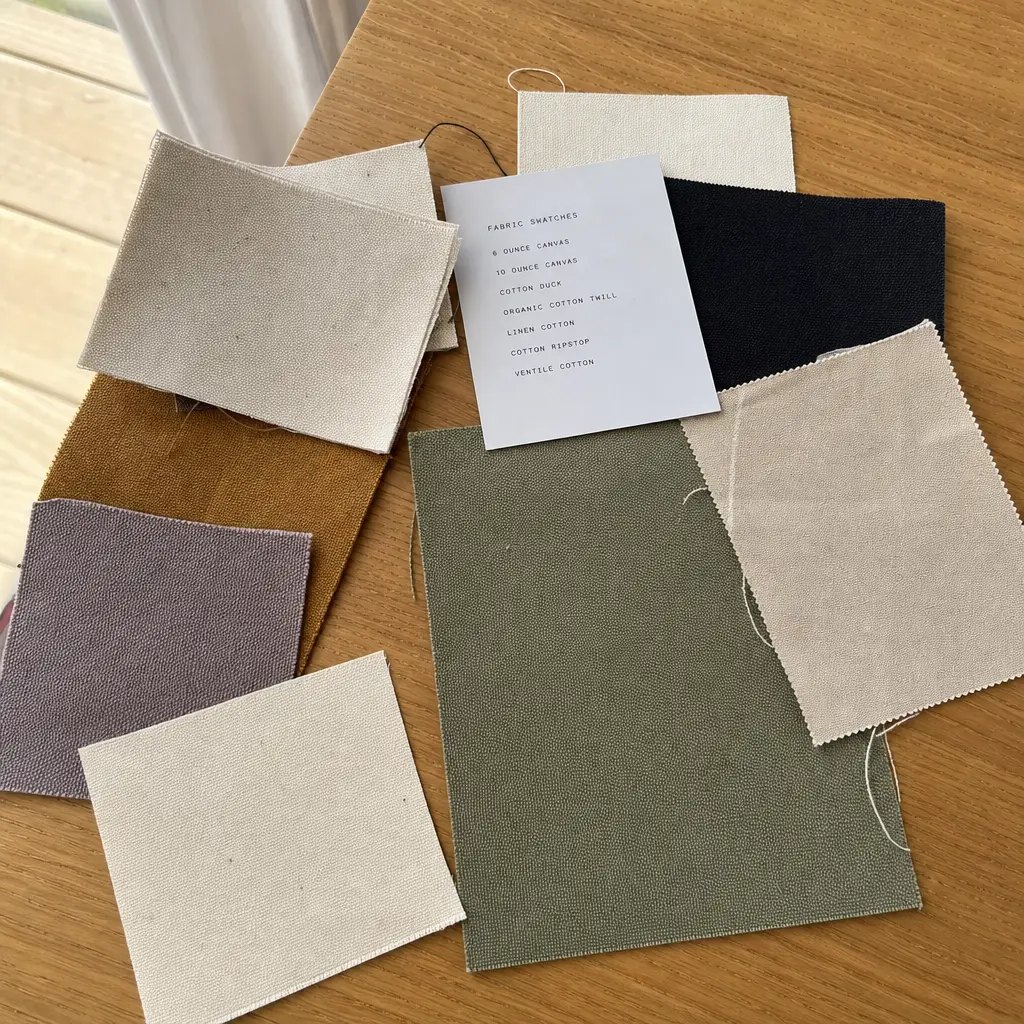
Canvas weight is measured in GSM (grams per square meter) or ounces per square yard. For salon portfolios, 10 oz (340 GSM) is the sweet spot. It's heavy enough to resist tearing from daily zipper use and stiff enough to hold a screen print cleanly without ink bleeding into the weave. Lighter 6-8 oz canvas feels flimsy and may show print distortion after a few washes.
Heavier 12 oz canvas adds cost and stiffness that makes the portfolio harder to fold or store in a salon drawer. It also increases shipping weight by approximately 20%, raising freight costs. Stick with 10 oz unless you need extreme durability for heavy tablet use. Always request a swatch—GSM numbers vary between mills by up to ±10%, and hand feel matters for stylist acceptance.
When evaluating swatches, check the thread count (usually 20x20 or 24x24 for 10 oz canvas) and the weave density. A tighter weave (higher thread count) provides a smoother print surface and better resistance to fraying at cut edges. Ask the supplier for the thread count and warp/weft yarn count to verify consistency.
- 10 oz / 340 GSM is the recommended standard for salon chain portfolios
- Lighter canvas (<8 oz) may cause print bleed and faster wear at corners
- Heavier canvas (>12 oz) increases cost and stiffness without proportional benefit
- Request a swatch to verify hand feel, thread count, and print surface quality
- Check GSM tolerance: ±5% is standard; wider tolerance indicates inconsistent mill quality
Zipper Selection: Nylon Coil vs. Metal vs. Plastic
The zipper is the most stressed component on a portfolio. For salon chains, YKK #5 nylon coil zippers are the best choice. They resist corrosion from hair chemicals, run smoothly even when slightly dirty, and handle 5000+ cycles without failure. Metal zippers can corrode in humid salon environments, and plastic zippers (like molded tooth) may crack in cold weather shipping below 0°C.
Specify a zipper with a self-locking slider to prevent accidental opening when the portfolio is carried by the handle. Also request a cycle test report from your supplier—at least 5000 open/close cycles without failure. Cheaper #3 zippers save $0.10 per unit but fail twice as fast in daily use. For a portfolio used 10 times per day, a #3 zipper may fail in 6 months (1800 cycles), while a #5 zipper lasts 18+ months.
Ask the supplier for the zipper's breaking strength (typically 30-40 kg for #5 nylon coil) and the slider pull force (should be 2-4 kg to open). These figures help you compare zipper quality across suppliers. Also confirm that the zipper tape is made of polyester, not cotton, to resist moisture and chemical damage.
- YKK #5 nylon coil zipper is recommended for salon chemical resistance and cycle life
- Self-locking slider prevents accidental opening during transport
- Request cycle test report: minimum 5000 cycles without failure
- Avoid metal zippers in humid salon environments; avoid plastic zippers for cold-climate shipping
- Check breaking strength (30-40 kg) and slider pull force (2-4 kg) for quality comparison
Lining Options: Polyester Twill vs. Cotton vs. Unlined
An unlined canvas portfolio may save $0.30 per unit, but it's a false economy. Raw canvas interior frays over time and absorbs spills, creating stains that look unprofessional. For salon chains, a 200 GSM polyester twill lining is the best choice. It resists moisture, cleans easily with a damp cloth, and adds structure to the portfolio.
Cotton lining is softer but absorbs hair spray and toner, leading to permanent stains. If you need a premium feel, consider a brushed polyester lining that mimics cotton without the absorption. Always specify lining color—white shows dirt quickly, while dark gray or black hides wear and stains. For a chain with 500 portfolios, dark lining reduces visible wear by 60% over 12 months compared to white.
Test the lining by spraying a small amount of hair spray or water on it—it should bead up, not absorb. Also check that the lining is fully stitched to the canvas body at all seams, not just glued. Glued linings delaminate within 6 months in humid salon environments.
- 200 GSM polyester twill lining resists moisture and cleans easily
- Cotton lining absorbs salon chemicals and stains permanently
- Unlined portfolios fray and look unprofessional within months
- Choose dark lining colors (gray, black) to hide wear and stains
- Test lining with hair spray or water—should bead, not absorb
- Ensure lining is stitched, not glued, to prevent delamination
Closure Style: Zipper Only vs. Flap vs. Buckle
For salon chains, a zipper-only closure is the most practical. It provides a clean branding surface on the front, allows quick access, and reduces weight. Adding a flap or buckle increases cost by $0.50-$1.00 per unit and may cover part of your logo. Buckles also add metal that can scratch salon counters or snag on clothing.
If you need extra security for valuable contents, consider a zipper with a locking slider rather than a flap. Some suppliers offer a zipper with a small leather pull that can be branded with your salon logo—a subtle premium touch that doesn't interfere with the main print area. The leather pull adds approximately $0.20 per unit and can be embossed with a 1-color logo.
For portfolios used by mobile stylists who travel between locations, a zipper-only closure is lighter and easier to pack. Flaps and buckles add bulk that makes stacking and storage less efficient. In a salon drawer, a flap can catch on other items and open accidentally.
- Zipper-only closure is the most cost-effective and practical for salon use
- Flaps and buckles add cost and may obscure logo placement
- Locking slider provides security without adding a flap
- Branded zipper pulls (leather or metal) offer a premium touch without affecting main print
- Zipper-only design is lighter and easier for mobile stylists to pack
Print Methods: Screen Print vs. Heat Transfer vs. Embroidery
Screen printing with water-based ink is the best choice for canvas portfolios. It bonds with the fabric fibers, resists fading, and can achieve fine detail for salon logos. For 1-2 color logos on runs of 500+, screen printing is the most cost-effective at $0.30-$0.60 per unit. Heat transfer (vinyl or silicone) may peel after a few months of daily use, especially on canvas that flexes at the zipper area.
Embroidery adds a premium feel but costs $1.50-$3.00 more per unit and may pucker on thin canvas. If you want embroidery, use it on a woven label sewn onto the portfolio rather than directly on the canvas. This allows you to use a heavier backing that prevents puckering and makes the label replaceable if damaged. A woven label costs $0.50-$1.00 per unit and can include up to 5 thread colors.
For screen printing, specify the mesh count (110-156 for canvas) and ink type (water-based, not plastisol). Water-based ink penetrates the canvas fibers, while plastisol sits on top and may crack. Request a wash-fastness test: the print should show no more than ΔE ≤ 3 color change after 5 machine washes at 40°C.
- Water-based screen print (mesh count 110-156) is recommended for durability and cost on runs of 500+
- Heat transfer may peel on canvas, especially near zipper flex points
- Embroidery on a woven label is better than direct embroidery on canvas
- Request a wash-fastness test: ΔE ≤ 3 after 5 washes at 40°C
- Screen print cost: $0.30-$0.60 per unit for 1-2 colors; woven label: $0.50-$1.00 per unit
Corner Reinforcement: Preventing Zipper Pull-Off and Seam Failure
The most common failure point on a canvas zipper portfolio is the zipper end corners. When the portfolio is overstuffed with forms or a tablet, the zipper pulls against the seam and can tear the canvas. Bar-tack stitching at both ends of the zipper—a dense zigzag stitch about 1cm wide—reinforces this area and prevents pull-off.
Not all suppliers include bar-tack as standard. Ask specifically if corner reinforcement is included in the quoted price. If not, the upcharge is usually $0.10-$0.15 per unit—a small investment that prevents returns. Also check that the bar-tack uses heavy-duty thread (bonded nylon or polyester, Tex 70 or higher) that matches the canvas color.
Test the bar-tack by pulling the zipper end with a force gauge: it should withstand at least 5 kg pull without tearing. For portfolios that will hold tablets (500g-1kg), request a 10 kg pull test. Some suppliers offer double bar-tack (two rows of stitching) for an additional $0.05 per unit—worth it for high-use portfolios.
- Bar-tack stitching at zipper ends prevents tear-out from overstuffing
- Not all suppliers include this as standard—confirm in writing
- Upcharge is minimal ($0.10-$0.15/unit) compared to replacement cost
- Use bonded nylon or polyester thread (Tex 70 or higher) for maximum strength
- Test with force gauge: 5 kg minimum pull; 10 kg for tablet-carrying portfolios
MOQ Logic: How to Scale from Pilot to Chain-Wide Rollout
Most canvas portfolio suppliers have a minimum order quantity (MOQ) of 300-500 pieces per design. For a salon chain with 10-50 locations, this is a reasonable starting point. If you need a pilot run of 100 units for testing, expect a higher per-unit cost (20-30% premium) because the factory must set up the cutting, printing, and sewing line for a small batch.
When scaling to chain-wide rollout, negotiate MOQ splits across multiple salon locations. Some suppliers allow you to order 500 units total but ship 50 to each of 10 locations. This reduces your inventory risk and lets you test different logo colors or lining options per region. Always get the MOQ and split-shipment terms in the quote.
For chains with 50+ locations, consider a tiered pricing structure: 500 units at $8.50/unit, 1000 units at $7.80/unit, 2000 units at $7.20/unit. Negotiate a price lock for 12 months to protect against raw material fluctuations. Also ask about fabric grade discounts—buying 1000+ units may allow you to upgrade from standard to premium canvas at no extra cost.
- Standard MOQ: 300-500 pieces per design for custom print and woven label
- Pilot runs of 100 units cost 20-30% more per unit
- Negotiate split shipments across multiple salon locations
- Get MOQ and split-shipment terms in writing before sample approval
- Request tiered pricing for 500, 1000, and 2000 units; negotiate 12-month price lock
Sample Approval: What to Check Before Giving the Green Light
The sample is your only chance to catch material or print issues before bulk production. When you receive the sample, check the fabric weight by weighing it on a digital scale (a 10 oz canvas portfolio should weigh approximately 200-250 grams for a standard A4 size). Test the zipper by opening and closing it 50 times—any hesitation or snag means the zipper quality is insufficient.
Check print alignment with a ruler: the logo should be centered within ±2mm. Hold the sample under bright light to check for ink bleed. Test the lining by spraying a small amount of hair spray or water on it—it should bead up, not absorb. If the sample passes these checks, take a photo and send written approval to the supplier. Verbal approval leads to miscommunication.
Also check the woven label: it should be sewn flat with no puckering, and the thread color should match the label border. Measure the label placement from the bottom edge of the portfolio—it should be consistent within ±3mm. If the sample has any defects, document them with photos and request a revised sample before approving bulk production.
- Weigh the sample to verify fabric GSM (target 200-250g for A4 portfolio)
- Test zipper with 50 open/close cycles—any hesitation is a red flag
- Check print alignment within ±2mm and inspect for ink bleed
- Spray test lining with water or hair spray—should bead, not absorb
- Check woven label placement within ±3mm and no puckering
- Send written approval with photos; never approve verbally
Packing, Lead Time, and Landed Cost Considerations
Standard packing for canvas portfolios is one unit per polybag, then packed in export-grade corrugated master cartons. For salon chains, request polybags with a small desiccant pack to prevent moisture damage during ocean freight. Also specify that master cartons must have at least 200 lb burst strength to survive stacking in containers. Each master carton should hold 20-30 portfolios, depending on size.
Bulk lead time is typically 30-45 days after sample approval for 500-2000 units. Factor in 2-3 weeks for ocean freight from Asia to the US or Europe. When comparing quotes, ask for a landed cost estimate that includes FOB price, freight, insurance, duties, and customs broker fees. A quote that is $0.30 cheaper per unit may cost more after freight and duties.
For example, a $7.50/unit FOB quote with $0.80/unit freight and 12% duty results in a landed cost of $9.20/unit. A $7.80/unit FOB quote with $0.60/unit freight and 8% duty (due to different HS code classification) results in a landed cost of $9.02/unit. Always compare landed cost, not just FOB price. Also ask about Incoterms—CIF or FOB—and who pays for customs clearance.
- Standard packing: polybag each unit with desiccant, master carton with 200 lb burst strength
- Request desiccant packs for moisture protection during ocean freight
- Bulk lead time: 30-45 days after sample approval
- Compare landed cost, not just FOB price—include freight, duties, and broker fees
- Ask about Incoterms (CIF vs. FOB) and customs clearance responsibility
Specification comparison for buyers
| Spec decision | Recommended option | When it fits | Buyer risk to check |
|---|---|---|---|
| Fabric weight (GSM) | 10 oz / 340 GSM ±5% | Salon chains needing daily use, light file storage, and logo print clarity | Lighter 6-8 oz canvas may show print bleed and wear faster; heavier 12 oz adds cost and stiffness |
| Zipper type | YKK #5 nylon coil, self-locking slider | High-cycle opening/closing by multiple stylists; resists snagging on paper or tools | Cheaper #3 zippers jam under frequent use; metal zippers corrode in humid salon environments |
| Lining material | 200 GSM polyester twill, dark gray or black | Protects interior from makeup, hair product spills, and moisture | Unlined bags fray inside; cotton lining absorbs stains; thin lining (<150 GSM) tears at corners |
| Closure style | Zipper only (no flap or buckle) | Salons that need quick access and clean branding surface | Flap adds cost and hides logo; buckle adds metal weight and potential scratching on salon counters |
| Print method | Screen print (water-based ink), mesh count 110-156 | Solid logos, 1-2 colors, runs of 500+ units | Heat transfer may peel on canvas; digital print fades faster; embroidery adds cost and may pucker on thin fabric |
| Corner reinforcement | Bar-tack stitching at zipper ends, bonded nylon thread | Prevents zipper pull-off when portfolio is overstuffed with forms or tablets | No reinforcement leads to returns within 3 months; standard lockstitch alone fails under load |
| MOQ range | 300-500 pieces per design, split shipments negotiable | Salon chains with 10-50 locations needing consistent branding | Lower MOQ (100 pcs) often means 20-30% higher per-unit cost; above 1000 pcs, negotiate fabric grade discounts |
| Sample lead time | 10-14 days (including print strike-off and woven label) | First-time buyers needing approval before bulk production | Rushed samples (<7 days) skip zipper cycle testing; ask for 50 open/close cycles on sample |
| Bulk lead time | 30-45 days after sample approval | Standard for 500-2000 units with custom print and woven labels | Shorter lead times (<25 days) may use lower-grade canvas or skip pre-shipment inspection |
Buyer checklist before sampling
- Confirm fabric weight in GSM or oz/yd²; request a 10cm x 10cm swatch to feel hand and check stiffness
- Specify zipper brand and coil size (YKK #5); ask for cycle test report (minimum 5000 cycles)
- Choose lining material (200 GSM polyester twill) and color (dark gray or black); request a spill test with common salon products (hair spray, toner, lotion)
- Define print method (water-based screen print, mesh count 110-156) and ink type; ask for a wash-fastness test on a sample print (ΔE ≤ 3 after 5 washes)
- Set corner reinforcement as a written spec (bar-tack, bonded nylon thread); request a photo of bar-tack stitching on production sample
- Clarify MOQ per design and per color; ask if split MOQ across multiple salon locations is allowed
- Request a pre-shipment inspection report including zipper function (50 cycles), print alignment (±2mm), and seam strength (5 kg pull test)
- Confirm packing method: polybag each unit with desiccant, master carton with 200 lb burst strength, no staples near product
- Get a landed cost estimate including FOB price, freight, insurance, duties, and customs broker fees
Factory quote questions to send
- What is the exact GSM of the canvas you quote? Can you provide a 10cm x 10cm swatch cut from current production stock?
- Which zipper brand and model do you use? Can you share a cycle test report for that zipper on 340 GSM canvas (minimum 5000 cycles)?
- What lining material do you include as standard? Is it 200 GSM polyester twill, and what colors are available?
- For screen printing, what mesh count and ink type do you recommend for fine salon logos? Can you provide a strike-off before bulk?
- What is your MOQ for a custom woven label with our salon chain name? Is that included in the portfolio price or separate?
- Do you offer corner reinforcement (bar-tack) as a standard stitch detail? If not, what is the upcharge per unit?
- What is your typical defect rate on zipper portfolios? Do you have a written AQL (Acceptable Quality Limit) of 2.5% or better?
- Can you provide a sample with our logo screen printed and a woven label sewn on? What is the sample cost and lead time?
- What is your packing standard? Do you use polybags with desiccant for moisture protection?
- What is the payment term for first-time orders? Do you offer a discount for full prepayment?
Quality-control points to confirm
- Zipper function: 50 open/close cycles on sample; no jamming, no teeth separation, no slider detachment
- Fabric weight tolerance: ±5% of specified GSM; measure on three random points per roll
- Print alignment: logo centered within ±2mm; no ink bleed beyond design border; color match to Pantone within ΔE ≤ 3
- Seam strength: bar-tack at zipper ends must withstand 5 kg pull without tearing
- Lining attachment: no loose threads, no exposed raw edges; lining must be fully stitched to canvas body at all seams
- Woven label: label must be sewn flat, no puckering; thread color must match label border
- Packaging: each portfolio in individual polybag with desiccant; master carton must have at least 200 lb burst strength; no staples near product