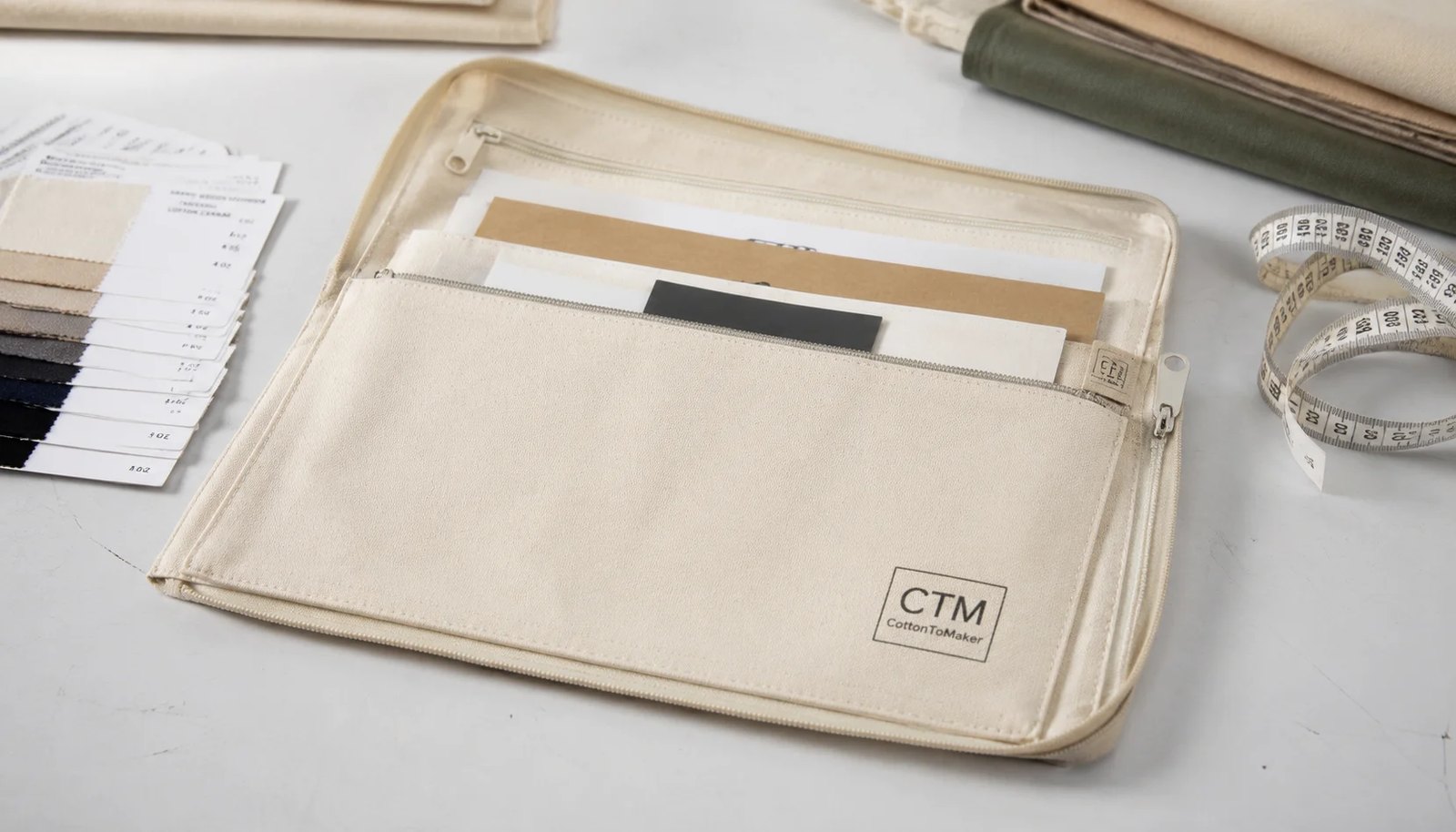
The buying problem: canvas weight changes the whole portfolio
For canvas zipper portfolios used by natural grocers, fabric weight is not a small technical detail. It decides how the item feels in a buyer's hand, whether it lays flat with paperwork inside, how the zipper turns around corners, how cleanly the logo prints, and how much freight the importer pays. A 10 oz canvas portfolio and a 16 oz canvas portfolio may look similar in a quote sheet, but they behave like different products in sampling and bulk production.
Procurement teams usually run into trouble when the RFQ only says “natural canvas zipper portfolio” without GSM, lining, stiffness, zipper gauge, or packing requirement. Suppliers then quote different constructions while appearing to quote the same item. One factory may price 10 oz unlined canvas. Another may price 14 oz canvas with lining and a No.5 zipper. The lowest quote is not always cheaper after sample rejection, repacking, carton damage, or a product that feels too light for retail presentation.
- Use GSM and oz together because some suppliers quote fabric in ounces while mills and inspectors often verify GSM.
- Treat fabric weight, lining, zipper, and board insert as one construction system, not separate decorations.
- Define the actual use: employee onboarding, vendor meeting kit, retail sale item, promotional gift, or reusable document carrier.
- Compare quotes only after the supplier confirms fabric weight, lining, zipper grade, print method, and carton volume.
Practical fabric weight ranges for zipper portfolios
For most natural grocery programs, 12 oz cotton canvas, roughly 400 GSM, is the safest starting point. It has enough body to feel durable without making the zipper corners stiff or increasing carton weight too much. It also accepts water-based screen printing well, especially on natural or bleached canvas. If the portfolio includes a simple document pocket, pen loop, and one-color grocery brand logo, 12 oz usually gives the best balance between cost, handfeel, and production reliability.
A 10 oz canvas, around 340 GSM, can work when cost is tight or the item is meant for a limited event. However, it often needs lining or a light stiffener to avoid a floppy feel. For premium uses, 14-16 oz canvas, about 475-540 GSM, gives a stronger handfeel and better shelf presence. The tradeoff is more needle resistance, higher seam bulk, slower sewing, and a need for better zipper specification. Above 16 oz, many portfolios become heavier than necessary unless the design is intentionally rugged.
- 10 oz / about 340 GSM: budget option, better with lining, less structured.
- 12 oz / about 400 GSM: balanced option for most bulk grocery and distributor orders.
- 14 oz / about 475 GSM: stronger feel, suitable for higher-value promotional or retail units.
- 16 oz / about 540 GSM: premium and rigid, but requires careful zipper, seam, and freight evaluation.
- Do not compare GSM alone if one fabric is plain weave and another is twill; weave also changes stiffness and surface texture.
How natural grocery positioning affects material choices
Natural grocers often want the product to look honest, reusable, and low-waste. That does not automatically mean the portfolio should be made from the thickest natural canvas available. A heavy fabric can feel premium, but it can also increase shipping emissions, carton size, and unit cost. If the portfolio is used to hold membership documents, vendor information, coupons, or training materials, the construction should match that function rather than imitate outdoor luggage.
The common material decision is between natural unbleached cotton canvas, bleached white canvas, dyed cotton canvas, and recycled-content fabric. Natural greige canvas has visible flecks and slubs, which many grocery buyers accept as part of the material character. Bleached or dyed canvas gives a cleaner logo background but adds shade control and possible colorfastness checks. If sustainability claims will be printed on hangtags or retail packaging, procurement should obtain the exact material composition and avoid vague wording that the factory cannot support.
- Natural canvas supports earthy branding but will show shade variation, seed specks, and fabric slubs.
- Bleached canvas gives cleaner print contrast but may look less organic to some grocery audiences.
- Dyed canvas requires colorfastness review, especially for dark green, black, navy, or brown.
- Recycled cotton or recycled polyester lining can be considered, but composition must be documented before claims are used.
- Avoid promising washable performance unless shrinkage, print durability, and zipper behavior after washing have been tested.
Construction details that should be tied to fabric weight
A zipper portfolio is not just two canvas panels with a zipper. The outer fabric weight should drive the lining, seam allowance, zipper gauge, corner radius, pocket design, and reinforcement method. With 12 oz canvas, a No.5 nylon coil zipper usually performs well for A4 or US letter sizes. With 16 oz canvas and a thicker lining, a No.8 zipper may be more stable and easier to operate. If the zipper is too light for the fabric, it may wave, jam, or pull unevenly at the corners.
Interior layout also affects cost and defect risk. A simple full-width slip pocket is easier to sew than multiple card slots, elastic loops, mesh pockets, and gusseted compartments. Natural grocery buyers often want space for recipe cards, member forms, supplier documents, tablets, or coupon sheets. Each internal feature should have a measured purpose. More compartments increase labor time, create alignment risk, and may cause documents to bend if the finished size is too tight.
- Use a larger corner radius when the canvas is thick, because sharp zipper corners are harder to sew and operate.
- Specify seam allowance and reinforcement at zipper ends, especially where users pull the portfolio open.
- Choose lining weight that does not sag into the zipper teeth or wrinkle under pockets.
- For 14-16 oz canvas, test whether the finished portfolio closes easily when filled with the intended documents.
- If adding board or PP stiffener, define whether it is removable, sewn in, or laminated between layers.
Logo printing on different canvas weights
For natural grocer branding, water-based screen printing is usually the practical default on cotton canvas. It gives a softer handfeel than heavy plastisol and supports the simple one- or two-color logos common in grocery programs. On 10-12 oz canvas, print edges are generally cleaner because the surface is less coarse. On 14-16 oz canvas, the deeper weave can break fine lines or small reverse text unless the artwork is adjusted.
Embroidery can look durable, but it is not always the best option for a zipper portfolio. Dense embroidery on the front panel can pucker canvas, add backing material inside, and interfere with a flat writing surface. Woven labels or small side labels are useful when the logo is detailed or when the brand wants a more retail-like finish. For any print method, the approved sample should include the real logo at the final size, not a factory placeholder graphic.
- Keep fine text larger than the printer's minimum line tolerance; very small ingredient-style text is risky on coarse canvas.
- Avoid placing large solid ink areas across seams, zipper curves, or folded edges.
- For natural canvas, approve ink color on actual bulk fabric because fabric shade changes perceived logo color.
- Use embroidery only after checking pucker, thread color, reverse-side finish, and effect on portfolio flatness.
- If the logo must be Pantone matched, define acceptable visual tolerance under a standard light source.
MOQ logic: why the same portfolio has several minimums
Importers often receive confusing MOQ answers because a canvas zipper portfolio has several components with their own minimums. The sewing factory may accept 500 pieces, but dyed canvas might require 1,000 meters, a custom zipper color may require 1,000-3,000 meters, and a molded custom puller may need a separate tooling MOQ. If the RFQ asks for a custom dyed canvas, custom zipper tape, custom lining print, and small quantity, the supplier may either refuse or quote a high surcharge.
For natural grocery programs, MOQ can often be managed by using natural stock canvas, standard zipper colors, and a printed logo instead of custom hardware. If the order is for multiple stores or distributors, the buyer can also consolidate the same body construction while changing only the front logo, paper insert, barcode, or carton mark by region. This reduces material fragmentation and improves production stability.
- Low MOQ friendly: natural canvas, stock lining, black or natural zipper tape, screen-printed logo.
- Medium MOQ: dyed canvas, custom lining color, special zipper puller finish, woven label.
- High MOQ or surcharge: custom woven fabric, custom molded metal puller, printed lining, special packaging structure.
- Split shipments may help distribution but do not reduce fabric and zipper procurement minimums.
- If several grocery banners share one construction, approve one master sample and separate logo strike-offs.
Sample approval should test function, not only appearance
A good sample approval process catches the issues that photos cannot show. The buyer should place the intended contents inside the sample: letter-size documents, A4 documents, a tablet, forms, coupon sheets, or staff training materials. Then close the zipper several times, carry it by the edge if that is expected, and inspect whether the front panel bends, the zipper catches, or the pockets distort the papers. This is especially important when moving from 10 oz to 12 oz or from 12 oz to 16 oz canvas.
The pre-production sample should be made with the same fabric weight, lining, zipper, logo method, and reinforcement as bulk production. A salesman sample made from substitute canvas is useful only for rough layout review. Before bulk cutting, procurement should approve a sealed sample or signed sample report with measurements, material swatches, print color, stitching details, and packing method. Without this, factory teams may follow the earliest sample instead of the latest approved change list.
- Measure finished width, height, spine depth if any, and pocket opening size.
- Run the zipper around the full path at least 20 times during sample review to identify catching or corner strain.
- Load the portfolio with the intended contents and check whether it closes without bulging.
- Review print adhesion, line sharpness, and logo position after the sample has been handled, not only when freshly packed.
- Photograph approved details: zipper end, inside pocket, lining seam, logo location, puller, label, and carton packing.
Cost drivers that make quotes look inconsistent
The largest cost drivers are fabric consumption, fabric weight, lining complexity, zipper quality, labor minutes, logo method, and packing volume. A heavier canvas costs more per square meter and may slow sewing. A portfolio with multiple inner pockets can require more cutting and alignment time than the outer shell itself. A quote that looks expensive may include a lined interior, reinforced corners, and individual packaging, while a cheaper quote may exclude these details.
Freight should not be ignored. Canvas zipper portfolios ship flat, but heavy fabric and board inserts increase carton weight quickly. For sea freight, cubic meter matters. For air freight or courier samples, gross weight matters. Buyers comparing suppliers should request carton measurements and gross weight per carton at quotation stage. Landed cost per usable unit is more meaningful than FOB price when the product is bulky, individually packed, or subject to retail distribution handling.
- Fabric cost rises with GSM, dyeing, finishing, and wastage around rounded corners.
- Labor cost rises with interior organization, binding, topstitching, zipper curves, and reinforcement.
- Logo cost rises with number of colors, print size, setup, strike-off approval, and special ink requirements.
- Packing cost rises with individual bags, belly bands, hangtags, barcodes, carton dividers, and pallet rules.
- Landed cost should include expected defect replacement, inspection fee, banking cost, duty, freight, and destination handling.
Packing and warehouse handling for natural canvas
Natural canvas is more vulnerable to visible dirt, moisture marks, and carton rub than dark synthetic materials. A portfolio that looks clean at factory packing can arrive with zipper pull abrasion, corner dents, or dust marks if it is packed too tightly or without surface protection. For retail or distributor orders, individual recycled polybags provide good protection, but some natural grocers prefer reduced plastic. A paper belly band or glassine-style sleeve can be considered if the supply chain is clean and moisture risk is controlled.
Carton weight should be limited so warehouse teams can handle the goods without crushing the lower layers. Flat packing is efficient, but over-compression can leave zipper impressions on the front panel. If the portfolio includes a board insert, cartons should protect against bending. Export cartons should be marked clearly with item number, quantity, gross weight, net weight, carton size, PO number, and destination routing requirements.
- Test one packed carton by stacking pressure or simulated handling before confirming final carton quantity.
- Separate metal zipper pullers from printed areas if abrasion marks appear during transit tests.
- Use desiccant where humidity risk is high, but avoid direct contact with natural canvas.
- Set a gross weight limit that matches the buyer's warehouse rules, commonly around 12-18 kg depending on handling policy.
- If plastic reduction is required, define exactly whether recycled polybag, paper band, no individual bag, or master inner bag is acceptable.
Lead time and schedule risks for bulk orders
Typical schedule risk is not only sewing capacity. Material booking, logo strike-off approval, zipper availability, and packaging artwork can delay the order before production starts. Natural stock canvas is usually faster than custom dyed fabric. A standard zipper is faster than a custom color with a branded puller. A simple screen print is faster than multiple artwork revisions or a print that requires special testing. Buyers should separate sample lead time, material lead time, production lead time, inspection time, and shipment booking instead of asking for one vague delivery date.
A realistic purchase plan includes a deadline for artwork approval, a deadline for sample comments, and a cutoff for construction changes. If procurement changes fabric weight after sample approval, the zipper, seam bulk, packing, and cost may all need revision. For seasonal natural grocery campaigns, late changes often move the order from sea freight to air freight, which can erase the savings from negotiating a lower unit price.
- Confirm whether quoted lead time starts from deposit, artwork approval, sample approval, or material arrival.
- Reserve extra time for dyed fabric, custom labels, custom packaging, or destination compliance testing.
- Do not release bulk cutting until the final fabric weight and color standard are approved.
- Plan inline inspection when the first 20-30 percent of goods are completed, not only final inspection after packing.
- Keep a written change log so production follows the latest approved specification.
Specification comparison for buyers
| Spec decision | Recommended option | When it fits | Buyer risk to check |
|---|---|---|---|
| Outer canvas weight | 12 oz / about 400 GSM cotton canvas for most grocery retail programs | Good balance for branded document folders, supplier kits, loyalty member gifts, and staff onboarding packs | Below 10 oz can feel soft and collapse; above 16 oz may increase freight and make zipper corners bulky |
| Premium fabric upgrade | 14-16 oz / about 475-540 GSM canvas when a rigid handfeel is required | Useful for executive portfolios, distributor sales kits, and higher retail price points | Need larger zipper gauge and stronger seam allowance; print edges may look less sharp on coarse canvas |
| Budget fabric option | 10 oz / about 340 GSM canvas with inner lining or stiffener | Works for short event runs or light paper carry, if the buyer accepts a softer body | Unlined 10 oz portfolios may wrinkle, telegraph contents, and fail drop-corner perception checks |
| Lining construction | 150D-210D recycled polyester or cotton twill lining depending on brand position | Poly lining improves clean interior finish and pocket function; cotton lining supports natural-material messaging | Cotton lining can shrink differently from outer canvas if washing or steam pressing is used |
| Zipper specification | No.5 nylon coil zipper for standard size; No.8 for heavy canvas or large portfolios | No.5 is adequate for A4/letter portfolios; No.8 gives a more robust retail feel | Cheap zipper tape can wave on thick canvas; zipper puller finish must pass color rub and plating checks |
| Logo method | Water-based screen print on 10-14 oz canvas; embroidery or woven label for 16 oz textured canvas | Screen print is efficient for grocery brand logos and natural color palettes | Fine type under 1.5 mm, reverse logos, and light ink on dark dyed canvas need strike-off approval |
| Internal board or padding | 1.0-1.5 mm greyboard, PP sheet, or light foam only when stiffness is part of the brief | Helps portfolios hold flat documents and improves shelf presentation | Board adds weight, may bend during sea freight, and may conflict with recyclability claims |
| Packing method | Individual recycled polybag or paper belly band, then flat packed in export carton | Protects natural canvas from warehouse dust and carton rub during long transit | Over-compressed cartons create zipper imprint marks; too much packaging weakens sustainability positioning |
Buyer checklist before sampling
- State the finished size and document use: A4, US letter, tablet, forms, coupons, membership materials, or vendor contracts.
- Specify outer fabric by both oz and GSM, not only the word canvas.
- Define whether the portfolio must stand stiff, fold softly, or sit flat on a retail shelf.
- Confirm fabric color: natural greige, bleached white, dyed canvas, or custom Pantone-matched fabric.
- List lining material, pocket layout, zipper gauge, puller style, and any elastic pen loop or card slot requirements.
- Send logo artwork in vector format and define maximum print area, ink color, placement tolerance, and whether the logo crosses seams.
- Request a pre-production sample using bulk fabric, bulk zipper, bulk lining, and the final approved logo method.
- Set acceptable dimensional tolerance, zipper function standard, seam strength expectation, and print color tolerance before mass production.
- Clarify packing: individual protection, carton quantity, carton weight limit, palletization, barcode labels, and any plastic-reduction rules.
- Compare quotes using landed cost per usable unit, including sample fees, export carton volume, inspection, duties, and expected defect allowance.
Factory quote questions to send
- What exact outer canvas weight will be used in oz and GSM, and is the weight measured before or after dyeing and finishing?
- Is the canvas plain weave or twill weave, and what shrinkage or fabric skew tolerance is typical for this material?
- Will the sample be made from actual bulk fabric and zipper stock, or from available substitute material?
- What zipper gauge, zipper tape material, puller metal, and slider finish are included in the quoted price?
- What print method is included for our logo, how many colors are allowed, and what is the maximum reliable print area on this fabric texture?
- What MOQ applies to the bag body, dyed fabric, lining, zipper color, custom puller, woven label, and printed packaging separately?
- What is the estimated carton quantity, gross weight, carton measurement, and cubic meters per 1,000 pieces?
- What sample timeline, production timeline, and material booking cutoff apply after artwork and deposit approval?
- What inline and final inspection points does the factory use for zipper portfolios, and can photos or inspection reports be supplied?
- Which quote items are excluded, such as artwork redraw, mold fees, courier charges, export documents, palletization, or destination testing?
Quality-control points to confirm
- Finished size tolerance should normally be within ±5 mm for body length and width, unless the portfolio is fitted to a rigid insert or retail box.
- Canvas weight should be verified against approved swatch; large deviation in GSM changes stiffness, print absorption, and perceived value.
- Zipper must open and close smoothly around corners without catching lining fabric or twisting the front panel.
- Topstitching should be even, with no skipped stitches, loose threads, broken needle marks, or raw seams visible inside the portfolio.
- Print position should stay within agreed tolerance, commonly ±3 mm for simple front-panel logos and tighter only when technically practical.
- Ink coverage should be even after light rubbing; water-based ink should not feel excessively thick or crack when the panel bends.
- Corners should be reinforced or cleanly bar-tacked where zipper stress concentrates.
- Interior pockets should fit the intended paper size without curling documents or blocking zipper closure.
- Natural canvas should be checked for oil marks, dark slubs, weaving faults, and shade variation against the approved bulk standard.
- Cartons should meet agreed weight limits and protect portfolios from compression marks, moisture exposure, and zipper pull abrasion.