Start with the vendor workflow
A farmers market vendor does not use a canvas zipper portfolio like an office folder stored on a shelf. It may be opened before sunrise, placed on a folding table, pushed into a tote, stacked with signage, handled with damp hands, and carried home after a long selling day. Inside it may hold permits, market maps, order sheets, loyalty cards, wholesale price lists, receipt books, laminated menus, coupons, pens, envelopes, and payment device paperwork.
That workflow creates predictable wear. Zipper ends take repeated stress. Corners rub against cartons and totes. Flat panels bow when thick paper packs are added. Logos scuff where the hand naturally grips the bag. A portfolio that looks crisp in a sample photo can still fail after a few weekends if the fabric, zipper, seam construction, decoration, and packing were not specified together.
For procurement teams, the first step is to describe use conditions before asking for price. Suppliers can then quote the same canvas weight, zipper grade, logo method, reinforcement points, and packing format. Without that detail, a low quote may simply be a lighter build with weaker hardware.
- Map what vendors carry and how often they open the portfolio.
- Treat zipper ends, corners, side seams, and logo placement as durability points.
- Include tote abrasion, damp-table exposure, and repeated weekly handling in sample review.
- Compare suppliers only after the same BOM and packing method are quoted.
Define contents and dimensions
Finished outside dimensions are not enough. Buyers should also define the usable internal area and zipper opening length. A portfolio may be technically large enough for letter-size permits or A4 inserts but still difficult to load if the zipper opening is short, the corners are tight, or the lining reduces usable space.
Load testing should be simple and realistic. Build a sample kit with the expected contents: printed forms, a receipt book, laminated menus, cards, pens, coupons, and any insert or sleeve the buyer plans to include. Zip the portfolio closed, hold it flat, move it in and out of a tote, and open it several times. Watch for panel collapse, zipper distortion, seam puckering, and lining catch.
This step prevents both underbuilding and overbuilding. A light document sleeve does not need the same structure as a weekly-use vendor kit. A portfolio expected to protect menus, permits, and sales paperwork through a season may need heavier canvas, reinforcement, or lining.
- List maximum contents by item type, quantity, and approximate thickness.
- Specify outside size, usable inside size, zipper opening length, and buyer tolerance.
- Test samples loaded with real contents, not empty.
- Set pass criteria: no seam strain, no zipper bowing, no lining catch, and no obvious panel collapse under the approved load.
Specify canvas clearly
Canvas weight is a major cost and performance driver. For light promotional document portfolios, 12 oz canvas, about 340 to 410 GSM when specified by the buyer, may be adequate. For weekly farmers market use, 14 oz to 16 oz canvas, about 475 to 540 GSM, is often a stronger starting point because it gives better body, corner stability, and resistance to soft collapse.
The RFQ should not stop at weight. It should state composition, weave, color standard, finish, and whether the target weight is measured before or after dyeing, washing, coating, or softening. Two fabrics with the same nominal weight can perform differently because yarn, weave density, and finishing affect hand feel, shrinkage, shade, and abrasion.
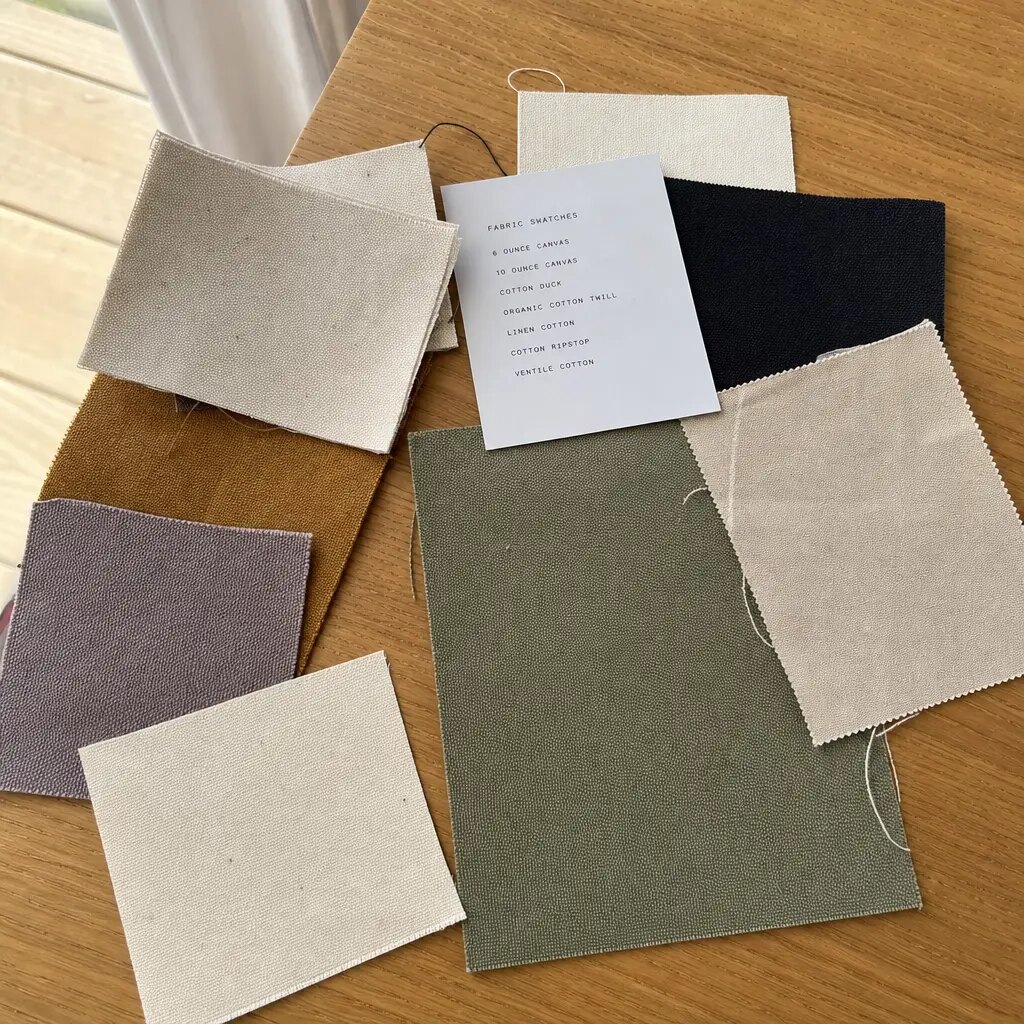
Buyers should approve a fabric swatch from the same fabric family planned for bulk production. If shade or hand feel matters, define the standard against that swatch and set a buyer-approved tolerance. Avoid presenting approximate GSM ranges as universal rules; they are practical buying targets that must be confirmed with samples and supplier capability.
- Use both oz and GSM in the RFQ.
- Clarify whether fabric weight is measured before or after finishing.
- Request composition, weave, finish, shade standard, and shrinkage expectation.
- Approve physical swatches before bulk cutting.
- Set fabric tolerance as a buyer requirement tied to the approved sample.
Choose the right zipper
The zipper is the moving part most likely to expose weak sourcing. For canvas zipper portfolios durability testing checklist for farmers market vendors, nylon coil zippers are usually practical because they are smooth, flexible, and less likely to snag when the panel flexes. Metal zippers can look premium, but they add weight and may scratch printed areas or feel rough when packed tightly.
A useful zipper spec includes type, gauge, tape width, tape color, puller material, puller size, slider finish, and end-stop construction. Gauge should match the body fabric. A zipper that is too light may fail early, while one that is too heavy can distort the edge or make the portfolio feel stiff. Pullers should be easy to grip at a stall without sharp edges or flaky plating.
Zipper testing must happen on the finished sample, not loose tape. Open and close the portfolio while empty and while loaded with the approved contents. Check the corners, tape alignment, end stops, puller attachment, and whether the lining catches. Failures at this stage are cheaper to fix than failures after bulk sewing.
- Specify zipper type, gauge, tape width, puller, and finish.
- Use nylon coil for most frequent-use vendor portfolios unless a premium metal look is required.
- Inspect zipper end reinforcement and bartacks closely.
- Test zipper cycling on finished loaded samples.
- Reject snagging, lining catch, end-stop separation, detached pullers, and tape waviness that affects function.
Add structure where it matters
Lining, interfacing, binding, gussets, and reinforcement patches are functional choices. A lining can help paperwork slide in smoothly and protect printed inserts. Interfacing can improve shape. Binding can reduce raw-edge fray. Reinforcement at zipper ends and corners can prevent early failure at the highest-stress points.
More structure also means more material, more sewing operations, more bulk at corners, and more inspection work. The best build is not always the most complicated one. Buyers should ask suppliers to show exactly where each structural feature is applied and whether it is visible, hidden, full-panel, or limited to stress points.
Once approved, structure belongs in the BOM. If the pre-production sample includes lined panels, bound seams, or reinforcement patches, bulk production should match that construction. Any change can affect cost, stiffness, zipper action, carton count, and perceived quality.
- Choose structure based on load, use frequency, and appearance target.
- Specify exact placement of lining, interfacing, binding, and reinforcement.
- Check whether added structure affects zipper smoothness or corner bulk.
- Lock construction in the BOM and pre-production sample approval.
- Inspect zipper anchors and corner turn-ins first during QC.
Place branding for wear
Branding has to survive handling, not just photograph well. Screen print is efficient for simple logos and repeat orders, but ink system, curing, fabric finish, and placement determine durability. A poorly cured print can crack after flexing or transfer during rubbing.
Embroidery can feel premium, but dense stitching may pucker canvas or stiffen the panel. Woven labels, sewn patches, and side labels can be better for small marks, multi-logo programs, or high-contact surfaces. They also help when the same base portfolio is used across several customer versions.
Placement is often more important than decoration type. Keep logos away from zipper pull paths, fold lines, bottom corners, and areas where vendors grip the portfolio. Ask for logo measurements from fixed seams so inspectors can verify position instead of judging by eye.
- Use screen print only after testing the final ink on the final canvas.
- Consider woven labels or sewn patches for small marks and repeat consistency.
- Avoid high-rub zones, zipper paths, folds, and bottom corners.
- Set logo placement tolerance from fixed seams.
- Check rub, flex, cure, label fray, and embroidery puckering before bulk approval.
Use concrete sample tests
Sample approval should be practical, documented, and repeatable. Start by checking the BOM: fabric, zipper, lining, thread, label, decoration, finished dimensions, and packing. Then load the sample with the approved vendor kit and run function checks while the product is under realistic stress.
For zipper durability, buyers can request a defined sample cycle count. A common procurement approach is 100 cycles for a lower-risk repeat item and 200 to 300 loaded cycles for a first order, new zipper source, or heavier vendor kit. These are buyer-set acceptance checks, not universal standards. The pass condition should be clear: smooth operation, no broken coil or teeth, no detached puller, no failed end stop, no lining catch, and no seam opening.
Follow with seam, corner, and logo checks. Flex each corner, tug lightly at zipper anchors, inspect bartacks, and look for skipped stitches or needle cuts. Rub and flex the logo area with a clean dry cloth and inspect for transfer, cracking, peeling, fray, or distortion. Photograph failures with measurements so the factory can correct the specific issue.
- Verify the sample against the written BOM before testing use.
- Run zipper cycles empty and loaded with approved contents.
- Use 100 to 300 sample cycles depending on order risk and buyer requirement.
- Flex corners and inspect seams, bartacks, zipper anchors, and raw edges.
- Rub and flex the logo area after curing or stitching.
- Document findings with photos, measurements, and revision notes.
Turn QC into acceptance criteria
Bulk inspection works best when expectations are measurable. Replace vague phrases such as strong stitching or good zipper with tolerances and defect definitions. The spec should cover finished size, internal usable space, zipper length, logo placement, stitch density, seam allowance, fabric weight tolerance, and unacceptable functional defects.
A practical QC flow includes incoming material checks, first finished piece approval, inline sewing review, final random inspection, and packed-carton review. Incoming checks catch fabric shade, GSM, zipper color, hardware defects, and label issues before cutting. First-piece approval confirms the production line is following the approved construction. Inline review catches sewing defects before they spread across the order.
Final inspection should define critical, major, and minor defects. Critical defects may include sharp hardware, wrong product, or unsafe contamination. Major defects may include zipper failure, open seams, missing reinforcement, incorrect logo, wrong dimensions, or severe print defects. Minor defects may include small loose threads or slight cosmetic variation within agreed tolerance.
- Set numeric tolerances for size, zipper opening, logo placement, stitch density, and fabric weight.
- Define critical, major, and minor defects before production starts.
- Use incoming, first-piece, inline, final, and packed-carton checks.
- Check zipper function on every sampled unit.
- Link finished goods to fabric lot, zipper lot, logo batch, and production date when possible.
Control packing and transit risk
Packing is part of product durability. Portfolios can leave the sewing line in good condition and arrive with bent corners, scuffed logos, creased zipper tape, or dented pullers if cartons are overfilled or individual bags are too tight. The product should lie flat inside its bag without curling.
If a zipper pull or metal label rests against a printed panel, add a tissue sheet or protective layer where needed. This does not have to be excessive packaging; it is controlled contact between surfaces. For products shipped through distributors or event-kit assembly, abrasion during handling can be as important as ocean or air transit.
Carton specifications should include unit count, carton dimensions, gross weight, board strength, orientation, and carton marks. If the buyer expects reshipment in smaller lots, inner packs can reduce rubbing and make warehouse handling easier. Carton marks should show item code, color, logo version, quantity, carton number, and batch code.
- Specify individual bag size so the portfolio lies flat.
- Prevent zipper pulls from pressing into printed faces during packing.
- Use protective sheets when hardware, labels, or print may rub.
- Define carton count, size, gross weight, board strength, and stacking condition.
- Require clear carton marks for item, color, logo version, quantity, and batch traceability.
Compare quotes by BOM
Canvas zipper portfolio quotes are easy to misread. One supplier may include 16 oz canvas, lining, nylon coil zipper, screen print, individual bag, and export carton. Another may quote 12 oz canvas, stock zipper, no lining, smaller logo, and basic bulk packing. The lower unit price may not represent a better source; it may represent a different product.
Ask suppliers to separate key cost drivers: fabric, zipper, decoration, sewing, lining or interfacing, labels, reinforcement, sample fee, setup fee, packing, carton data, and lead time. Also request carton size, gross weight, and pack count so landed cost can be compared. A slightly heavier build may affect freight, but better packing may reduce scuffing and claims.
MOQ should be reviewed by fabric color, zipper color, logo version, label version, and packing format. A low total MOQ is not useful if custom dyed fabric, zipper tape, or decoration setup requires higher minimums. For first orders, request a test quantity and a standard reorder tier; for mature programs, ask for larger rollout pricing.
- Quote the same BOM across all suppliers.
- Separate material, sewing, decoration, packing, sample, setup, and carton costs.
- Ask for test, reorder, and rollout price tiers.
- Confirm MOQ by color, zipper, logo, label, and packing format.
- Compare landed cost, not only ex-factory unit price.
Specification comparison for buyers
| Spec area | Stronger procurement choice | When it fits | Buyer risk to verify |
|---|---|---|---|
| Sourcing model | Direct factory with sewn pre-production sample | Repeat orders, private label programs, and buyers who need control over fabric, sewing, zipper sourcing, logo, and packing | Confirm whether cutting, printing, sewing, inspection, and packing are in-house or subcontracted; lock the approved BOM before bulk production |
| Sourcing model | Trading company with documented factory and QC plan | Multi-SKU programs, mixed accessory orders, or buyers who need supplier coordination across several materials | Require the production factory name, sample source, final inspection checklist, and confirmation that bulk goods match the approved sample |
| Sourcing model | Domestic decorator using imported blanks | Small seasonal runs, urgent event kits, or short market tests where speed is more important than lowest unit cost | Verify blank portfolio consistency, zipper grade, decoration durability, available colors, and reorder stability |
| Fabric body | 14 oz to 16 oz canvas, about 475 to 540 GSM when specified by the buyer | Weekly vendor use, heavier paper kits, menus, permits, receipt books, and portfolios that must keep shape in totes | Clarify whether weight is measured before or after dyeing, washing, coating, or softening; approve swatches from the intended bulk fabric |
| Fabric body | 12 oz canvas, about 340 to 410 GSM when specified by the buyer | Light document sleeves, welcome kits, limited-use promotional programs, or lower-cost giveaways | Test edge stability, corner wear, seam puckering, and panel collapse when loaded with realistic contents |
| Construction | Canvas with lining, interfacing, bound seams, or targeted reinforcement | Programs needing cleaner interiors, better structure, protected documents, or improved perceived quality | Extra structure can add bulk and sewing variation; specify exact placement and inspect zipper movement after assembly |
| Zipper | Nylon coil zipper with defined gauge, tape width, puller, and end reinforcement | Most farmers market portfolios because it is smooth, flexible, and tolerant of textile dust and slight panel movement | Test open-close cycles on finished loaded samples; check snagging, lining catch, tape waviness, puller strength, and end-stop security |
| Zipper | Metal zipper for selected premium programs | Brand-led products where visible hardware and added weight are acceptable | Check scratch risk against printed panels, corrosion or plating issues, carton abrasion, and rough operation at corners |
| Decoration | Screen print tested on final canvas | Clean logos, larger runs, repeat orders, and simple artwork requiring efficient unit cost | Require cure confirmation, dry rub check, flex check, and placement away from zipper paths, bottom corners, and hand-grip zones |
Buyer checklist before sampling
- Define the intended vendor contents: permits, market maps, receipt books, menus, price sheets, order forms, loyalty cards, coupons, pens, envelopes, or a slim tablet sleeve if needed.
- Specify finished outside dimensions, usable internal dimensions, zipper opening length, and buyer-set dimensional tolerance.
- State target canvas weight in both oz and GSM, fabric composition, weave, finish, color standard, and whether weight is measured before or after finishing.
- Decide whether the body is single-layer, lined, interfaced, bound, gusseted, or reinforced at corners and zipper ends.
- Define zipper type, gauge, tape width, tape color, puller material, puller size, slider finish, and end-stop reinforcement.
- Place branding away from zipper pull paths, fold lines, bottom corners, and high-grip areas.
- Request a sewn pre-production sample made with final canvas, final zipper, final logo method, final label, and final packing.
- Test the sample loaded with realistic vendor contents, not empty or with only one sheet of paper.
- Set stitch density, seam allowance, bartack locations, loose-thread limits, and reinforcement details in the spec sheet.
- Ask which checks are factory routine and which are buyer-required tests, including fabric weight, shrinkage, crocking, zipper cycling, puller strength, seam strength, logo rub, and carton condition.
Factory quote questions to send
- What exact canvas weight, GSM, composition, weave, and finish are you quoting, and are those measurements before or after dyeing, washing, coating, or softening?
- What buyer tolerance do you recommend for finished GSM, shade, shrinkage, and hand feel, and can we set the final tolerance against the approved swatch?
- Is the portfolio single-layer canvas, lined, interfaced, bound, gusseted, or reinforced, and which construction is included in the quoted unit price?
- Which zipper type, gauge, tape width, tape color, slider finish, puller material, and end-stop construction are included?
- Can you test zipper operation after final sewing and decoration, and how many open-close cycles will you use for sample approval?
- What stitch type, stitch density, seam allowance, thread material, and reinforcement method will be used at zipper ends, corners, and side seams?
- Which logo methods can you support on this canvas, and what artwork size, color count, curing process, or label construction is included in the price?
- What rub, flex, curing, or adhesion checks do you perform on the logo method before approving bulk production?
- What is your MOQ by fabric color, zipper color, logo version, label version, and packing format?
- Can you quote test quantity, standard reorder quantity, and larger rollout quantity, with sample, setup, screen, tooling, and repeat-order charges separated?
Quality-control points to confirm
- Fabric weight should be checked against the buyer-approved tolerance rather than treated as a universal factory default; many buyers set a practical range around the target GSM after reviewing swatches.
- Fabric shade should match the approved standard under agreed lighting, with body panels, binding, lining, thread, zipper tape, and labels reviewed together.
- Shrinkage and dimensional stability should be reviewed when canvas is washed, dyed, softened, coated, or otherwise finished before sewing.
- Finished size, usable internal space, and zipper opening should stay within buyer-set tolerance, especially when the portfolio must fit standard permits, menus, or inserts.
- Zipper should complete the agreed open-close cycle check on finished samples without snagging, tape waviness, lining catch, end separation, or rough movement at corners.
- For sample approval, buyers may request 100 to 300 loaded open-close cycles depending on order risk; the pass condition should be no broken teeth or coil, no detached puller, no end-stop failure, and no functional snag.
- Puller attachment should resist reasonable hand force during inspection without bending, loosening, flaking, or creating sharp edges that can scratch contents or printed panels.
- Main seams should be straight, evenly spaced, and reinforced at stress points including zipper anchors, corners, side seams, tabs, and handle points if included.
- Skipped stitches, broken thread, needle cuts, loose bartacks, open seams, raw-edge fray outside the approved construction, and zipper tape separation should be treated as functional defects.
- Logo decoration should pass the agreed dry rub, flex, and visual review without ink transfer, cracking, peeling, bleeding, label fray, embroidery distortion, or puckering.