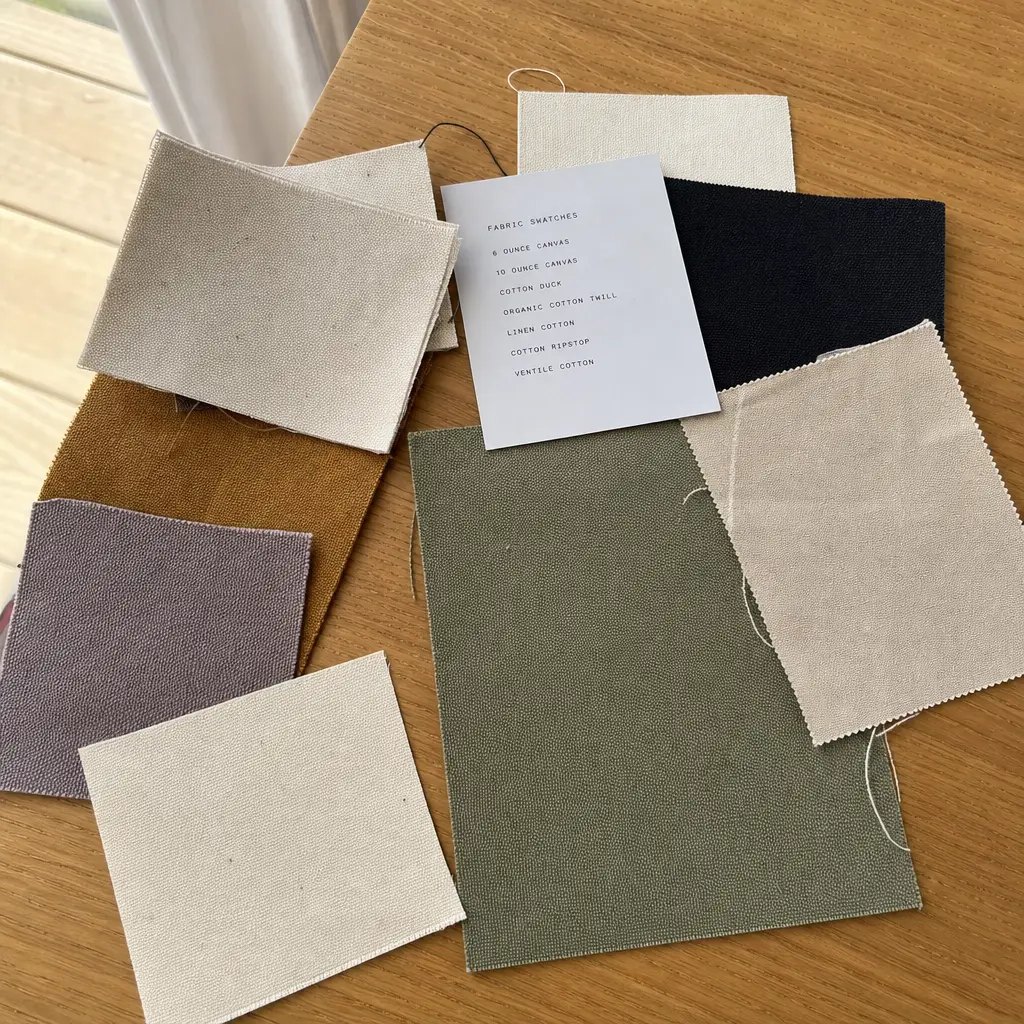
Start With Use Case and Fit
A canvas zipper portfolio can serve several university bookstore roles, and each role changes the specification. A retail SKU needs clean shelf presentation, barcode accuracy, consistent logo placement, and packaging that protects the printed face. An orientation kit component may put more weight on document fit, delivery date, and unit cost. A department gift can justify heavier canvas, a better zipper puller, or a simple inner pocket because the buyer wants the item to feel useful after the event.
The first RFQ line should define what the portfolio must hold. Outside dimensions do not prove usable space. Canvas thickness, seam allowance, zipper tape, binding, lining, and pockets all reduce internal clearance. If the item must hold US letter sheets, A4 documents, a tablet, a workbook, or a packet of campus materials, send the insert dimensions and thickness to the supplier. Ask for minimum internal clear size after sewing, not only cut-panel size.
Presentation requirements should be set early. A bookstore shelf item may need logo-up orientation, a UPC label on the individual pack, and one SKU per carton. A giveaway may only need clean bulk packing and master carton labels. Those choices affect labor, packing materials, carton count, and receiving accuracy, so they belong in the quote rather than in a late packing email.
- Define the use before choosing fabric weight, pockets, and packing.
- State the actual insert size and thickness, not just paper category.
- Require internal clear dimensions after sewing and zipper installation.
- Confirm whether the product opens on two sides or three sides.
- Include barcode, label, hang tag, or shelf display requirements in the RFQ.
Choose Canvas Weight by Tradeoff
For bookstore programs, 12 oz cotton canvas, about 380-410 GSM depending on mill construction, is usually the balanced starting point. It has enough body for retail handling, gives a stable print surface, and does not make cartons as bulky as heavier fabric. It suits common uses such as admissions packs, department merchandise, alumni gifts, and stationery bundles.
Lighter 10 oz canvas, about 320-340 GSM, can work for price-sensitive orientation programs or short-term promotions. It keeps sewing and packing easier, but the portfolio may feel less structured and show more wrinkling. Heavier 14 oz canvas, about 450-480 GSM, can make the product feel more premium, but it raises packed thickness, carton weight, sewing difficulty, and freight cube. Heavy fabric also increases pressure at corners and zipper pulls when cartons are stacked.
Ask suppliers to define fabric weight clearly. Some quote greige fabric before dyeing or finishing; others quote finished fabric. GSM helps compare across suppliers, but it still needs a tolerance. The RFQ should state oz, GSM range, fabric color, dye method, shrinkage allowance, shade tolerance, and whether natural cotton flecks or slubs are acceptable.
- Use 10 oz canvas for budget programs where structure is not the main selling point.
- Use 12 oz canvas for standard bookstore retail and most department merchandise.
- Use 14 oz canvas only after checking sewing cost, carton count, and freight impact.
- Approve fabric by physical swatch, not by photo only.
- State whether natural flecks, slubs, and shade variation are acceptable.
Define the Construction
A portfolio that looks simple in a photo can hide meaningful construction differences. One supplier may quote single-layer canvas with bound seams. Another may include lining, interlining, foam, board stiffener, or a second canvas layer. These choices change handfeel, structure, labor time, packed thickness, and inspection risk.
For most bookstore programs, one flat document pocket plus an optional card slot or pen loop is easier to control than a complex organizer panel. More compartments add sewing variation and may block document insertion. They also make each piece thicker, which can reduce carton quantity or create pressure marks when cartons are stacked.
If the buyer wants a stiffer retail product, ask how the stiffener behaves in transit. Thin board can improve shelf shape but bend at corners if the carton is overpacked. Foam can soften the handfeel but increase cube. Lining gives a cleaner interior but adds labor and more tolerance points. Quote each construction option separately when the decision is not final.
- Request a written construction description, including layers and stiffeners.
- Avoid hidden substitutions between sample and bulk production.
- Measure packed thickness on the sample, not just finished length and width.
- Check that pockets do not interfere with zipper movement or document insertion.
- Quote optional pockets as separate cost lines when procurement is comparing value.
Specify Zipper and Sewing Details
The zipper is the part customers touch repeatedly, so it should be specified like a component, not described only as zipper closure. A No. 5 nylon coil zipper is practical for many canvas portfolios because it bends around corners, keeps bulk moderate, and works well on flat sewn goods. Tape color, slider finish, and puller length still need approval because a poor match can make the product look uncontrolled.
Corner sewing deserves close review. A zipper forced around a tight radius can ripple, catch, or create an uneven stack in the carton. Zipper ends should be reinforced so the slider does not hit loose thread or weak stitching. If the design includes a pull tab, side loop, or handle tab, reinforcement should be visible on the pre-production sample.
Packing behavior should influence zipper choices. Oversized metal pullers can press into the printed face. Pullers placed on the same side of every unit can create a high ridge in the carton. Alternating orientation may solve stack height, but it should be tested to make sure prints do not rub and barcodes remain easy to find.
- Specify zipper size, tape width, tape color, slider finish, puller material, and puller length.
- Confirm opening direction and whether the zipper runs around two or three sides.
- Check zipper movement around corners several times during sample review.
- Reinforce zipper ends and stress points with the method shown on the approved sample.
- Avoid puller designs that create pressure marks during carton stacking.
Control Artwork and Licensing
University bookstore orders often involve school names, mascots, department marks, event artwork, or alumni graphics. The factory should receive vector files, Pantone references, clear-space rules, minimum size rules, and any licensing instructions. Suppliers should not adjust proportions, substitute fonts, or approximate school colors without written approval.
Screen printing is usually the stronger choice for one- or two-color marks on canvas. It is familiar, efficient at volume, and durable when properly cured. Heat transfer is useful for fine detail, gradients, tight registration, or many colors. Either method should be approved on actual production canvas because texture, color, underbase, and ink absorption affect the final result.
Placement needs a measurable reference point. Measure from a finished edge, centerline, zipper edge, or pocket edge. If printing happens before sewing, normal sewing variation can shift the finished logo. If printing happens after sewing, seams and zipper bulk can make the surface less even. Practical tolerances are often +/-3 mm for tighter programs and +/-5 mm for standard canvas production.
- Approve a strike-off on actual canvas before bulk printing.
- Confirm underbase requirements for dark fabric.
- Check opacity, color, registration, handfeel, rub resistance, and cracking.
- Define logo location in millimeters from a stable finished reference point.
- Keep the final licensed artwork approval with the purchase order and inspection file.
Compare MOQ and Quote Structure
MOQ is not only a sewing quantity. Fabric color, dye lot, zipper color, print setup, artwork version, barcode SKU, carton label, and destination split can each create a minimum. A supplier may accept 1,000 pieces total, but five department marks or four barcode SKUs can make the order more complex than the headline quantity suggests.
Ask suppliers to separate unit price from one-time charges and optional costs. Screen charges, sample fees, custom zipper puller tooling, barcode labeling, belly bands, upgraded cartons, palletization, and inland delivery should be visible. This makes quote comparison cleaner and prevents a low FOB price from hiding costs that return later.
For multi-SKU bookstore programs, packing rules matter as much as product cost. One SKU per carton reduces receiving errors and makes distributor handling easier. Mixed cartons can reduce partial carton waste, but they require written approval, exact carton labels, and packing lists that match purchase order lines.
- Ask for MOQ by fabric color, zipper color, logo, print colorway, barcode SKU, and destination.
- Separate sample, screen, tooling, label, carton, pallet, and inland charges from unit price.
- Request CBM per 1,000 pieces so freight options can be compared fairly.
- Confirm whether cartons are one SKU each or mixed by approved ratio.
- Make optional upgrades separate line items instead of bundled assumptions.
Approve Samples in Stages
A sales sample is useful for shape review, but it should not be the only approval for production. A stronger path uses three checkpoints: fabric swatch, print strike-off, and full pre-production sample. The swatch confirms weight, texture, color, stiffness, and surface behavior. The strike-off confirms artwork size, opacity, color, method, and placement. The pre-production sample confirms the final product and packing approach.
The full sample should use actual or production-equivalent canvas, zipper, slider, puller, thread, lining, pocket layout, label, barcode, and individual packing. If any material is substituted, mark the sample as limited approval and keep the remaining risk open. Do not release bulk cutting if fabric, zipper, logo method, or packing is still undecided.
One finished piece does not prove carton behavior. Ask for a stack test or packing simulation using the intended piece count. Photos of 20, 25, or 30 pieces before sealing can show puller pressure, corner bending, uneven height, and print contact. Pair those photos with carton dimensions, gross weight, net weight, and CBM.
- Approve fabric swatch before print strike-off.
- Approve print strike-off before bulk decoration.
- Approve pre-production sample before mass cutting or mass packing.
- Keep one signed sample with the factory and one with the buyer or inspection company.
- Record finished size, internal clear size, logo position, zipper function, and packed thickness.
Build the Carton Packing Plan
Flat portfolios can still be damaged by poor packing. The supplier should define whether pieces are packed logo-up, logo-inward, face-to-face, zipper-to-zipper, or with alternating zipper direction. Each option affects rub risk, stack height, barcode visibility, and pressure marks. The approved carton plan should be part of the purchase order.
For many 12 oz canvas zipper portfolios, 20-30 pieces per master carton is a useful starting range. The final count depends on finished size, zipper puller thickness, pockets, stiffness, and individual packing. The buyer should request carton length, width, height, gross weight, net weight, carton material, and CBM per carton. CBM per 1,000 pieces is helpful for comparing air, LCL, and FCL choices.
Carton strength should match the route. A direct shipment to one controlled warehouse may need less protection than an LCL shipment that moves through consolidation, container unloading, domestic trucking, distributor handling, and campus receiving. For sea freight, pallet stacking, or multi-touch distribution, a 5-ply export carton is a practical norm to quote and test.
- Set a maximum carton gross weight that campus or distributor receiving can handle.
- Use 5-ply export cartons for sea freight, LCL, pallet stacking, or multi-touch routes.
- Avoid excessive empty space because flat products can slide and rub during transit.
- Use tissue, slip sheets, or corner protection where pullers or stiffeners create pressure points.
- Require carton labels, SKU labels, carton numbering, and packing lists to match the PO exactly.
Set Inspection Rules Before Deposit
Quality control should cover the portfolio, the individual pack, and the master carton. A product can look acceptable in a quick photo but still fail at receiving if barcodes do not scan, carton counts are short, zippers catch, or prints rub in transit. Define critical, major, and minor defects before production starts.
Critical risks may include wrong licensed artwork, wrong SKU label, mildew odor, unsafe sharp metal parts, or a zipper that cannot close. Major defects may include visible stains, incorrect size, crooked logo placement, broken stitching, mixed colors in one carton, or wrong packing direction. Minor defects may include small loose threads or slight surface variation within the approved canvas standard.
A practical inspection should measure finished outside size and internal clear size, open and close the zipper several times, compare logo color to the signed sample, check seam reinforcement, scan barcodes, and open random cartons for count and SKU separation. Inspection photos should show the front logo, inner pocket, zipper close-up, measurement method, barcode, carton label, opened carton, and packed stack.
- Set AQL level and defect definitions in writing before deposit or production start.
- Measure internal clear size with the intended document or insert.
- Check zipper function around corners, not only along straight edges.
- Inspect print opacity, adhesion, color, placement, pinholes, ghosting, bleeding, and cracking.
- Open cartons during inspection to confirm count, SKU, barcode, packing direction, and carton condition.
Protect the Campus Calendar
Bookstore demand is tied to orientation, semester start, admissions visits, alumni events, graduation, conferences, and sports seasons. Missing the receiving window can turn a useful product into late inventory. The schedule should be built around approval steps, not only promised sewing days.
A simple natural canvas item with stock zipper, one-color print, polybag, and one SKU can move faster than a custom dyed program with multiple logos, branded pullers, belly bands, barcode sorting, and upgraded cartons. Late artwork approval, Pantone corrections, packing changes, and SKU additions are common reasons schedules slip.
Ask the supplier for a milestone calendar that shows fabric approval, strike-off approval, pre-production sample approval, bulk material arrival, production start, inspection booking, cargo ready date, shipment mode, and required arrival date. Name which materials must be ordered before final sample approval and which can wait. This helps procurement decide whether an upgrade is worth the schedule risk.
- Fastest path: natural canvas, stock zipper, one-color print, simple polybag, one SKU.
- Longer path: custom dyed fabric, multiple logos, custom puller, belly band, barcode sorting, export carton upgrade.
- Highest risk: late licensed artwork approval, repeated color corrections, or SKU changes after labels are printed.
- Reserve time for pre-shipment inspection and carton correction if receiving rules are strict.
- Keep the milestone schedule updated when artwork, packing, quantity, or destination details change.
Specification comparison for buyers
| Decision | Option | Best fit | Tradeoff to check |
|---|---|---|---|
| Canvas weight | 10 oz cotton canvas, about 320-340 GSM | Budget orientation kits, short-term promotions, simple giveaway folders | Lower cost and easier packing, but less structure, more wrinkling, and weaker premium shelf feel |
| Canvas weight | 12 oz cotton canvas, about 380-410 GSM | Standard bookstore retail, admissions packs, department merchandise, alumni gifts | Balanced handfeel and print surface; still confirm packed stack height before setting carton count |
| Canvas weight | 14 oz cotton canvas, about 450-480 GSM | Premium gift programs where weight and structure are part of the value | Stronger feel but higher sewing difficulty, thicker cartons, greater freight cube, and more corner pressure risk |
| Document fit | US letter or A4 internal clear size with 10-15 mm practical clearance | Course handouts, welcome documents, notebook bundles, admissions packets | Outside size is not enough; measure usable space after zipper, seam allowance, pockets, and binding |
| Zipper | No. 5 nylon coil zipper with approved tape, slider, and puller | Flat canvas portfolios that open around two or three sides | Flexible and practical, but poor tape or tight corners can cause waves, catching, and uneven stack height |
| Logo method | Screen print on actual canvas | One- or two-color school marks, department names, bold event graphics | Cost-effective and durable when cured well; needs strike-off for opacity, Pantone match, and placement |
| Logo method | Heat transfer on actual canvas | Fine detail, gradients, small multicolor marks, tight registration | Cleaner detail, but check edge adhesion, cracking, handfeel, and carton rub after folding |
| Retail pack | Individual recycled polybag with barcode label | Warehouse accuracy, dust control, retail receiving, distributor replenishment | Less premium presentation, but stronger protection and easier barcode scanning |
| Retail pack | Paper belly band or hang tag with inner carton protection | Cleaner shelf presentation or gift positioning | Can scuff, slide, or loosen; carton orientation and rub protection become more important |
Buyer checklist before sampling
- Define the selling or distribution channel: bookstore shelf, orientation kit, admissions pack, alumni gift, department event, conference folder, distributor SKU, or replenishment item.
- State the required insert: US letter paper, A4, tablet, workbook, notebook, course packet, welcome packet, or custom document bundle.
- Specify internal clear dimensions after sewing, including clearance around paper edges and zipper seam allowance.
- List outside finished dimensions, zipper path, opening direction, corner radius, and acceptable size tolerance.
- Name canvas weight in oz and GSM, and state whether the quoted weight is greige fabric or finished fabric.
- Approve a physical fabric swatch for color, stiffness, texture, slubs, natural flecks, print behavior, and packed thickness.
- Confirm fabric color standard, shade tolerance, shrinkage allowance, dye method, and whether different fabric lots may be mixed.
- Specify zipper size, tape color, tape width, slider finish, puller style, puller length, opening direction, and end reinforcement.
- Provide vector artwork, Pantone references, licensed mark rules, print size, placement reference point, and logo tolerance in millimeters.
- Request a print strike-off on actual production canvas, especially for dark fabric, underbase printing, fine type, or licensed university artwork.
Factory quote questions to send
- What canvas weight is included in both oz and GSM, and is that greige weight or finished fabric weight?
- What GSM tolerance, shrinkage allowance, shade tolerance, and fabric inspection approach are included in the quote?
- Is the fabric natural cotton canvas, bleached canvas, reactive dyed canvas, pigment dyed canvas, recycled-content blend, or another construction?
- What are the finished outside dimensions and minimum internal clear dimensions after sewing?
- Which zipper is included: nylon coil size, tape width, tape color, slider type, slider finish, puller material, puller length, and opening direction?
- How will zipper ends, corners, pull tabs, and stress points be reinforced, and can these details be shown on the pre-production sample?
- Can you quote screen print and heat transfer for the same artwork size so we can compare cost, handfeel, durability, registration, and lead time?
- For dark canvas, is an underbase included, and how will Pantone color be checked on the actual production fabric?
- What logo placement tolerance can you hold from a finished edge, centerline, zipper edge, or pocket edge?
- What is the MOQ by fabric color, zipper color, logo design, print colorway, barcode SKU, and shipment destination?
Quality-control points to confirm
- Canvas GSM should stay within the approved written range, commonly +/-5% unless buyer and supplier agree to another tolerance.
- Fabric shade should match the approved swatch or lab dip within the agreed tolerance, with no unapproved mixing of visibly different shade lots in one carton.
- Finished outside dimensions should match the approved sample within practical sewing tolerance, often +/-5 mm for length and width on flat canvas portfolios.
- Internal clear dimensions should be checked with the intended US letter, A4, tablet, or document insert so corners do not curl, bind, or catch on seams.
- Zipper must open and close smoothly across the full path without skipped coil, broken slider, twisted tape, loose puller, rough corner, or thread caught in the teeth.
- Zipper ends, radius corners, pull tabs, and stress points should match the approved reinforcement method, including back stitching or bar tacks where specified.
- Print color should match the approved Pantone, strike-off, or signed sample under consistent lighting, allowing for the agreed canvas surface tolerance.
- Print defects to reject include obvious pinholes, ghosting, cracking, ink bleeding, heavy buildup, poor opacity, misregistration, and transfer edge lifting.
- Logo placement should remain within the written tolerance, such as +/-3 mm for tighter programs or +/-5 mm for standard sewn canvas production.
- Canvas surface should be free from oil marks, mildew odor, wet cartons, dark contamination, sharp yarn defects, dye streaks, and unacceptable heavy slubs.