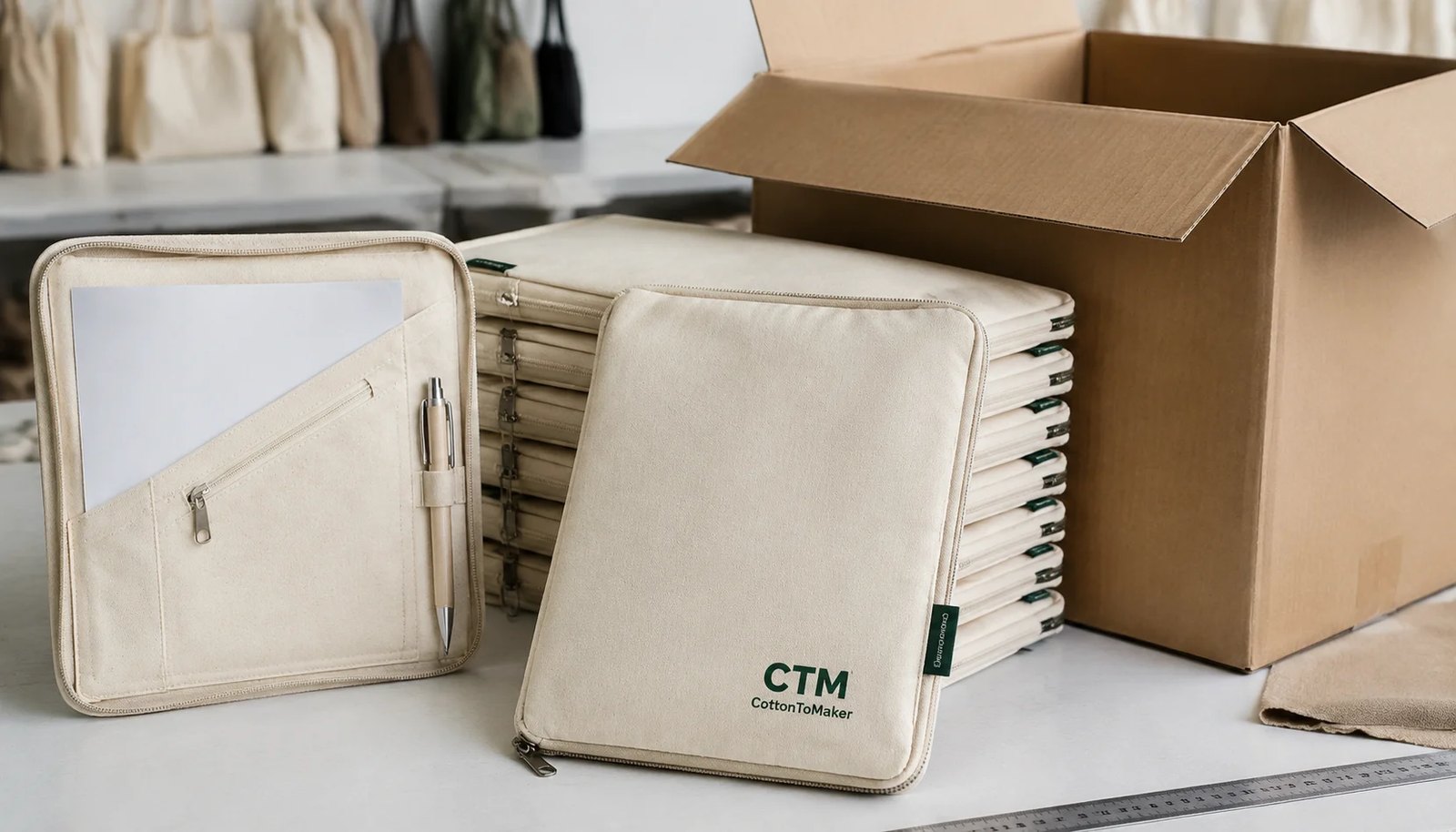
Buying Problem
Canvas zipper portfolios for natural grocers are usually not difficult to sew, but they are easy to pack badly. The product is flat, semi-rigid around the zipper, and often printed on natural canvas. If the carton packing plan is decided after production, the result can be zipper marks on the front panel, dusty fabric, inconsistent carton counts, crushed corners, or cartons that are too heavy for store-level receiving.
Procurement teams should treat the carton plan as part of the product specification, not as a warehouse detail. A portfolio that looks acceptable as a loose sample may fail when 40 pieces are stacked under pressure for a long export route. The RFQ should connect finished size, fabric weight, zipper structure, unit packaging, carton count, carton dimensions, and pallet plan before quotes are compared.
- Main buying risk: approving the product sample without approving how it is packed.
- Main cost risk: comparing unit prices while carton CBM and gross weight are missing.
- Main quality risk: front-panel print damage caused by pressure, abrasion, or uncured ink during stacking.
- Main receiving risk: cartons that do not match grocer routing, barcode, or store allocation requirements.
Use Case Definition
Natural grocers may use canvas zipper portfolios for staff onboarding kits, vendor meeting packets, nutrition program documents, seasonal promotion packs, distributor sales tools, or branded reusable document holders. Each use changes the packing decision. A resale item needs cleaner individual presentation. A store kit may need cartons packed by location count. A distributor sample kit may need extra protection because cartons are opened and reclosed several times.
The RFQ should state what will be placed inside the portfolio after receipt. If the importer plans to insert printed materials locally, the zipper opening must allow fast packing without stressing the corners. If the factory will insert documents, the quote needs a separate labor line and a clear carton recheck step. If the item ships empty, the carton plan can focus on keeping the canvas flat and the print clean.
- For staff kits: prioritize consistent count per carton and easy store allocation.
- For resale: use cleaner unit packaging, hangtag position, and barcode placement.
- For distributor tools: strengthen corners and protect zipper pullers from abrasion.
- For document insertion: confirm opening size, insertion labor, and final carton recount.
Fabric And Structure
For most zipper business bag portfolios, 10 oz to 12 oz cotton canvas is a practical starting point. In metric terms, this is roughly 340 gsm to 410 gsm depending on weave and finishing. It feels substantial enough for a grocery brand without making the carton too heavy. Lighter fabric can lower cost and improve folding softness, but it may show wrinkles and print-through more easily. Heavier fabric improves handfeel but can create bulk at zipper seams.
The structure should be specified around the finished contents. A simple flat portfolio with one internal sleeve is faster to sew and easier to pack than a multi-pocket organizer. If the buyer adds foam padding, thick binding, or a wide gusset, the carton count drops and the packed surface becomes less even. Natural grocer programs often value a clean, reusable item more than a complicated accessory.
- Typical finished size: A4 or letter document size plus zipper clearance, not only paper size.
- Canvas option: natural unbleached canvas for an organic look, dyed canvas for brand color control.
- Reinforcement: add corner reinforcement only where zipper stress or document weight justifies it.
- Tolerance: set finished size tolerance before cutting; canvas shrinkage and sewing turn-in affect final dimensions.
Zipper And Sewing Details
A No. 5 nylon coil zipper is usually the safest choice for canvas zipper portfolios. It bends more smoothly around corners than many metal zippers, is lighter in cartons, and is less likely to scratch printed panels during packing. If the buyer wants a premium look, the puller can be upgraded without changing the whole zipper chain. The zipper color should be approved beside the canvas, because natural canvas can make white or beige zipper tape look mismatched.
Sewing quality matters because zipper wave becomes very visible on a flat product. The factory should control stitch tension, zipper tape feeding, and corner shape. A portfolio that bows after zipper installation will not stack flat. The buyer should also define whether the zipper opens on one side, two sides, or three sides. Three-sided opening improves usability but adds corner risk and inspection time.
- Acceptance point: zipper must open and close smoothly five full cycles on sample and random bulk pieces.
- Sewing point: no skipped stitches, broken threads, loose back-tacks, or exposed raw edges near zipper ends.
- Packing point: zipper pullers should face the same direction in each stack to avoid uneven pressure.
- Cost point: custom pullers increase tooling or MOQ; stock pullers keep the program simpler.
Logo And Print Choices
For natural grocer branding, one-color screen print on the front panel is often the most reliable and cost-efficient option. It works well on cotton canvas, has a familiar handfeel, and is easy to inspect. Heat transfer can handle finer artwork, but it must be tested for adhesion and cracking on textured canvas. Embroidery looks durable but adds thread weight, can pucker the panel, and may create pressure marks when stacked.
The print area should avoid zipper curves, folded edges, and thick seam intersections. Large solid ink coverage on natural canvas can stiffen the surface and may require longer curing time. For a buyer comparing supplier quotes, the print method must be stated clearly because a low quote may assume a small one-color print while another quote includes a larger multi-color mark.
- Best low-risk option: one-color screen print on a flat front panel before final assembly.
- Higher-detail option: heat transfer, tested for adhesion after bending and rubbing.
- Premium option: woven label on side seam plus small front print, useful for subtle retail branding.
- Inspection point: rub test the print after curing and after packed stacking, not only when freshly printed.
MOQ And Cost Logic
The MOQ for canvas zipper portfolios is usually driven by material and setup, not only sewing capacity. Natural canvas in stock color may allow a lower MOQ. Custom dyed canvas, custom zipper tape, special pullers, printed lining, or multi-color artwork can push the MOQ upward. If the buyer needs several store versions or department logos, it is better to separate shared base materials from variable printing in the quote.
A useful quotation should not be only one unit price. It should show which specification assumptions are included and which changes move the price. Procurement teams can then decide whether the extra feature improves the program or only adds complexity. For example, a custom zipper puller may be worthwhile for a retail product, but unnecessary for an internal grocery staff kit.
- Base cost drivers: canvas gsm, zipper grade, sewing complexity, inner pockets, and print area.
- Setup cost drivers: screen charges, sample labor, custom label weaving, puller tooling, carton mark requirements.
- Packing cost drivers: individual bags, paper bands, inserts, barcode labels, inner cartons, and palletization.
- Freight cost drivers: pieces per carton, carton CBM, gross weight, and whether portfolios ship flat or with inserts.
Sample Approval
Sample approval should include more than the loose portfolio. The buyer needs a physical or photo-approved packing sample that shows unit packaging, stack direction, pieces per carton, carton board quality, and carton dimensions. A pre-production sample should be made with actual canvas weight, approved zipper, final artwork size, and the same sewing method planned for bulk production.
For natural canvas, color and surface variation should be judged against an agreed standard. Cotton canvas can contain small slubs, but visible stains, oil marks, mildew smell, or dark contamination on the print area should not pass. If the brand team approves a clean sample without defining fabric surface tolerance, bulk inspection can become a dispute.
- Approve one loose sample for appearance and function.
- Approve one packed sample or packed carton photo set for shipping condition.
- Measure finished size, zipper path, pocket depth, and logo position from fixed reference points.
- Record sample weight so fabric substitution is easier to detect in bulk.
Carton Packing Plan
A practical carton packing plan starts with the finished portfolio size and target maximum carton weight. Flat portfolios are usually stacked in one or two columns inside the master carton. The stack should be snug enough to prevent shifting but not so tight that the zipper teeth or pullers press into the printed panel. If the print is heavy or dark, a thin tissue sheet, paper interleaf, or unit bag may be needed.
The carton count should be selected for receiving logic as well as factory convenience. If stores receive kits in quantities of 25, a 50-piece master carton may be easier to split than a 36-piece carton. If the distributor ships to many store locations, inner bundles can reduce recounting errors. The carton must also meet export handling needs, with adequate edge crush strength for the loaded weight and pallet stack height.
- Common carton count: 25 to 50 pieces per master carton, depending on size, gsm, inserts, and carton weight limit.
- Stack direction: align zipper pullers consistently and alternate only if it improves flatness without marking the print.
- Protection: use unit bags, paper bands, or interleaving based on dust, print scuff, and retailer packaging rules.
- Data required: carton L x W x H, net weight, gross weight, CBM, pieces per carton, and cartons per pallet.
Lead Time Risks
The fastest production path uses stock natural canvas, stock zipper colors, standard pullers, and one-color printing. Custom dyed fabric, special zipper tape, and woven labels add material approval steps before cutting can begin. The lead time should be counted after artwork, sample, material, and packing plan approval, not from the first RFQ email.
Schedule risk often appears when the carton plan is changed late. A buyer may approve 50 pieces per carton during quoting, then request individual retail packaging and inserts after production starts. That can change carton dimensions, labor time, freight cube, and pallet count. The cleanest workflow is to approve product sample and packing plan together before bulk material cutting.
- Lowest-risk sequence: spec sheet, artwork file, sample, packed sample, purchase order, bulk material booking.
- Watch item: print curing time before stacking, especially with large solid logos.
- Watch item: carton printing or retailer routing labels if the grocer has strict inbound rules.
- Watch item: holidays, cotton fabric availability, and zipper color matching before final delivery planning.
Quote Comparison
When comparing quotes, the cheapest unit price is not always the lowest landed cost. A supplier quoting thinner canvas, fewer pockets, loose bulk packing, or higher pieces per carton may look competitive until freight damage or receiving labor is included. The quote should allow the buyer to compare product cost, packing cost, carton efficiency, sample terms, and inspection risk on the same basis.
A good quote for canvas zipper portfolios should read like a production plan. It should identify fabric weight, finished dimensions, zipper grade, print method, MOQ, sample lead time, production lead time, packing method, carton dimensions, and estimated CBM. If those fields are missing, the buyer is not comparing like for like.
- Compare gsm and finished size before comparing price.
- Compare print area and color count before accepting a cheaper decoration quote.
- Compare carton CBM and gross weight before estimating freight.
- Compare inspection standards and sample policy before issuing the purchase order.
Specification comparison for buyers
| Spec decision | Recommended option | When it fits | Buyer risk to check |
|---|---|---|---|
| Canvas body fabric | 10 oz to 12 oz cotton canvas, about 340-410 gsm, pre-shrunk if tight size tolerance is required | Good balance for retail presentation, document protection, and manageable carton weight | Thin canvas can wrinkle at the zipper edge; heavy canvas may increase cube and reduce pieces per carton |
| Portfolio structure | Flat zipper portfolio with boxed or reinforced lower corners, no bulky gusset unless capacity is needed | Works for loyalty documents, staff kits, coupon booklets, wellness program handouts, or reusable checkout paperwork | Oversized gussets make carton packing inconsistent and can crush adjacent units |
| Zipper choice | No. 5 nylon coil zipper with metal or molded puller, smooth curve around corners if using three-sided opening | Reliable for repeated opening and easier to sew cleanly on canvas than stiff metal chain | Low-grade zipper tape can wave after sewing; test opening force before bulk approval |
| Logo method | One-color screen print or heat transfer on flat front panel; woven side label for small CTM-style factory sample branding | Best for natural grocer brand marks, department names, and supplier program logos | Large ink coverage can stiffen the panel and transfer if curing is poor |
| Inner features | One document sleeve plus pen loop; add card pocket only when the program needs it | Keeps the item useful without turning it into a complicated organizer | Too many pockets slow sewing, increase inspection points, and raise defect risk |
| Unit packing | Each piece in recycled polybag or paper belly band, zipper closed, tissue or chipboard only if print scuff risk exists | Suitable for cartons shipped to distribution centers, store kits, or distributor repacks | Unbagged canvas may pick up carton dust; overpacking adds labor and waste claims |
| Carton plan | Flat stack 25-50 pcs per master carton, with carton grade matched to loaded weight and route handling | Predictable for palletizing, receiving counts, and store allocation | Loose stacking causes zipper impressions, crushed corners, and count disputes |
| Sampling approval | Approve size, zipper function, print cure, carton count, and packed carton photos before bulk cutting | Useful when importer, brand owner, and grocer compliance team all need the same reference | A beautiful loose sample does not prove the carton plan will survive export handling |
Buyer checklist before sampling
- Define the portfolio use: document kit, buyer meeting folder, employee launch kit, coupon wallet, or resale accessory.
- Lock finished size with tolerance, not only artwork size; common allowance is +/-5 mm for flat canvas goods unless stricter is justified.
- State canvas weight in oz and gsm, and clarify whether natural, dyed, washed, or bleached fabric is required.
- Specify zipper type, puller color, opening style, and whether the zipper must run on one side, two sides, or three sides.
- Place the print on a flat sewing panel where distortion is low; avoid printing across seams or near zipper curves unless tested.
- Request a pre-production sample packed exactly as bulk goods will be packed, including carton count and inner packaging.
- Set carton maximum gross weight before supplier quotes freight; many buyers keep hand-lift cartons below about 15-18 kg where possible.
- Require carton dimensions, net weight, gross weight, CBM, pieces per carton, and pallet suggestion in the quotation.
- Include barcode, carton mark, polybag warning, recycled packaging, and retailer routing requirements before purchase order release.
- Approve QC criteria for zipper smoothness, print adhesion, fabric stains, seam strength, and carton drop or compression risk.
Factory quote questions to send
- What canvas weight and yarn construction are you quoting, and can you show the gsm tolerance range after finishing?
- Is the quoted size the cut size or finished size after sewing, and what tolerance will the factory accept in final inspection?
- Which zipper brand or zipper grade is included, and can you provide a zipper tape color card and puller options?
- What print method is included in the price, what is the maximum printable area, and how will ink curing or transfer resistance be tested?
- How many pieces will be packed per inner pack and master carton, and what are the carton dimensions, gross weight, and CBM?
- Does the MOQ come from fabric dyeing, zipper color, print setup, or sewing line efficiency?
- How many pre-production samples are included, and will one sample be packed in the approved unit packaging?
- What inspection standard will be used for stains, broken stitches, zipper defects, color variation, and print misregistration?
- What is the production lead time after sample approval and deposit, and which materials have the longest procurement time?
- Can you provide packed carton photos, carton compression guidance, and loading quantity estimates before shipment booking?
Quality-control points to confirm
- Finished size within approved tolerance, with corners square enough for flat stacking.
- Canvas weight and handfeel match approved sample; no oil marks, mildew smell, weaving holes, or heavy slubs on logo area.
- Zipper opens and closes smoothly through the full path without tape twisting, skipped teeth, or catching at the corner.
- Print position, color, opacity, and curing match approved sample; no ink transfer after rubbing or stacking.
- Seams have even stitch length, secure back-tacks, trimmed threads, and no broken needles or metal contamination.
- Inner pockets and pen loops are aligned and functional without pulling the outer panel out of shape.
- Unit packaging prevents dust and print scuffing but does not deform the portfolio.
- Carton count, carton strength, gross weight, dimensions, and shipping marks match the approved packing plan.