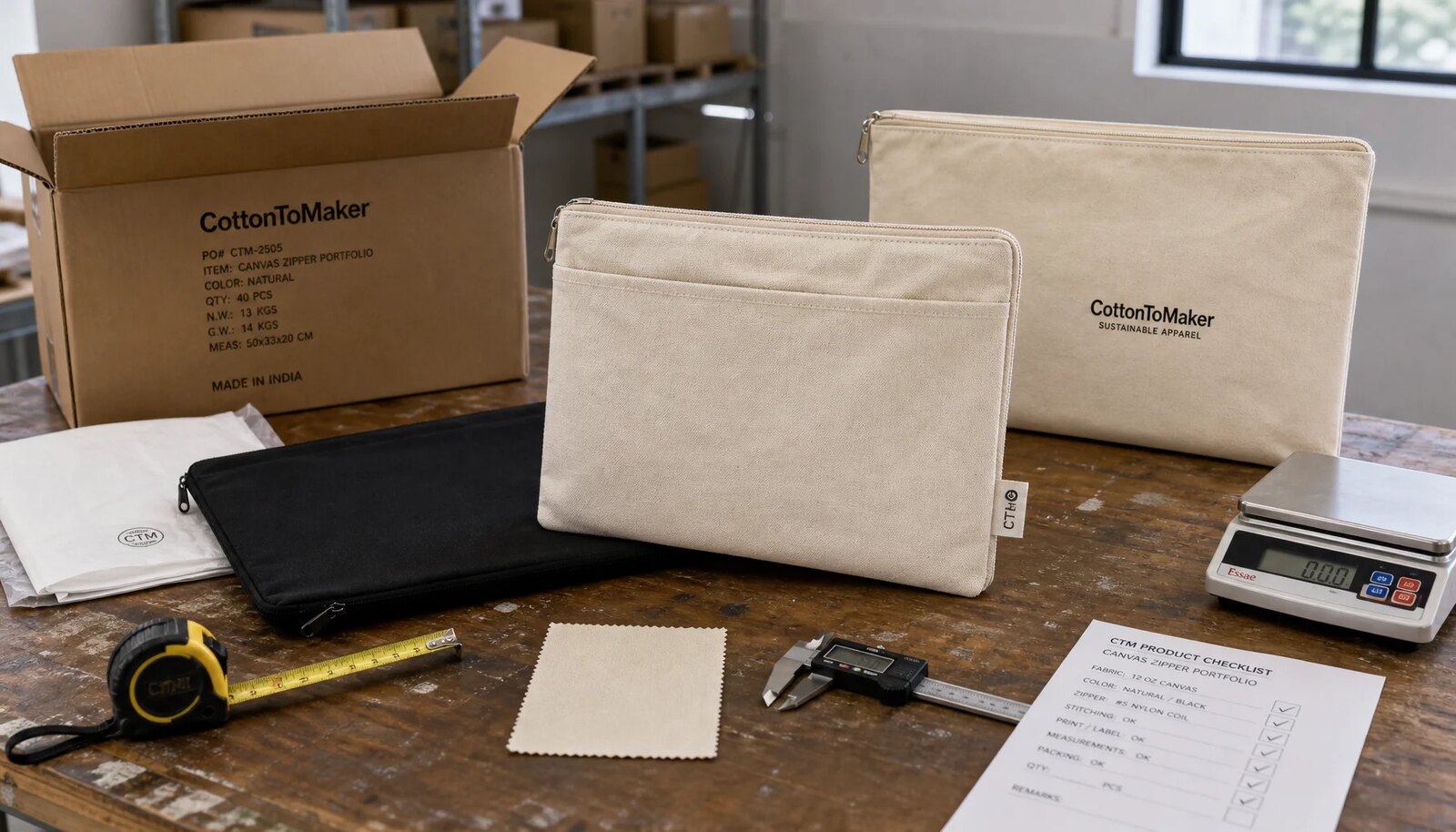
Start with the commercial job, not the sample photo
Canvas zipper portfolios are often purchased as showroom tools, buyer-meeting kits, internal sales folders, press packages, or premium document holders for apparel programs. The same outside look can hide very different cost and packing requirements. A flat document sleeve, a portfolio carrying swatches, and a lightly padded presentation case should not share the same RFQ assumptions.
Define the contents before choosing size, canvas weight, or carton count. List whether the portfolio must hold A4 pages, US letter pages, catalogs, line sheets, fabric swatches, hangtags, a notebook, or a slim tablet. Then specify closed size, open size, usable pocket dimensions, spine or gusset depth, and maximum loaded thickness. The practical approval test is simple: the approved contents must fit without forcing the zipper or bowing the panels.
For many apparel brand uses, finished canvas around 340-400 GSM, roughly 12-14 oz, is a sensible starting point. Lighter canvas may work for paper-only folders. Heavier canvas does not automatically make a better product if the structure relies on board, foam, lining, or binding. Ask the supplier to quote the finished fabric weight after dyeing, washing, coating, or other finishing so bulk production matches the approved sample.
- Define the load: papers, catalogs, swatches, hangtags, notebook, or device
- Approve usable pocket size, not just outside dimensions
- Test loaded zipper clearance before bulk production
- Treat 340-400 GSM finished canvas as a starting point, not a universal rule
- Record sample measurements with photos, scale weight, and thickness
Make the carton plan part of the RFQ
A single desk sample does not show how the product will behave inside a stack of export cartons. Canvas, zipper tape, pullers, lining, pockets, binding, board inserts, and seam allowances all create fixed thickness. A structured zipper portfolio cannot be compressed like a soft tote bag without risking bowed panels, crushed corners, zipper imprinting, or print transfer.
The carton plan should be quoted with the product, not added after purchase order approval. Ask for pieces per carton, carton length, width, height, carton cube, net weight, gross weight, board construction, inner packing, layer orientation, and carton marks. If the supplier quotes only FOB unit price, the buyer cannot compare landed cost, pallet fit, or damage risk accurately.
For eco apparel brands, presentation damage is a real commercial issue. A natural canvas panel with oil marks, a scuffed front logo, or a warped board can weaken the brand impression even if the item is technically usable. Keep approved packed-carton photos or video with the PO so reorders do not drift into a higher carton count, weaker board, or different inner sleeve.
- RFQ must include carton count, dimensions, cube, gross weight, and board strength
- Ask for at least two options, usually 25 pcs and 30 pcs per carton
- Lock layer orientation when pullers, labels, or pockets create uneven thickness
- Reject carton plans that bulge during sealing or stack testing
- Keep carton approval records for reorder consistency
Use eco claim language that procurement can verify
Eco sourcing becomes clearer when the buyer separates material preference from verifiable claims. Natural cotton canvas, organic cotton canvas, recycled cotton, recycled polyester lining, recycled paper sleeves, and recycled-content polybags are different claims. Each needs different evidence. Avoid accepting vague descriptions such as eco canvas, sustainable cotton, or green packaging unless the supplier states exactly what is being claimed and documented.
Acceptable documentation depends on the claim and supply chain. For an organic cotton claim, buyers may ask for scope certificates and transaction certificates where applicable, plus material details for the specific lot. For recycled polyester lining or recycled cotton content, useful evidence may include recycled-content declarations, chain-of-custody records, or composition testing. For recycled paper sleeves or recycled polybags, supplier declarations may be reasonable, but they should state percentage, material type, and whether the claim applies to packaging only.
Unacceptable evidence is usually broad, expired, or unrelated to the goods. A factory brochure saying eco-friendly, a certificate for a different mill, an old certificate with no link to the order, or a claim that recycled packaging makes the whole portfolio recycled should not support marketing copy. Write claim boundaries clearly: for example, outer canvas is undyed conventional cotton, lining is recycled polyester, and inner sleeve is recycled paper.
- Acceptable: claim-specific certificates, declarations, test reports, or chain-of-custody records linked to the material
- Unacceptable: generic eco statements, expired certificates, unrelated mill documents, or packaging claims applied to the whole product
- Define whether the claim covers canvas, lining, thread, reinforcement, zipper, or packaging
- Approve natural flecks, slubs, and shade variation before bulk cutting
- Check whether hidden PP board, EVA foam, or polybags conflict with brand policy
Specify construction details that affect both quality and packing
Construction choices drive both unit cost and carton performance. Reinforcement should be specified by panel: front, back, spine, pocket, or none. Common options include greyboard, PP sheet, and EVA foam. Greyboard can give a paper-based structured feel but is sensitive to moisture. PP sheet is more moisture-resistant but may conflict with plastic-reduction goals. EVA foam adds padding and thickness, which can reduce carton quantity.
The zipper specification should include size, tape color, coil type, slider finish, puller style, puller length, end stops, opening route, and opening direction. A #5 nylon coil zipper is practical for many A4 or US letter portfolios because it is flexible, light, and smooth. Oversized or heavily loaded versions may need a #8 coil. Metal teeth or heavy pullers can look premium but increase abrasion and pressure-mark risk in cartons.
Interior features also change packing density. Gusseted pockets, stacked card slots, elastic holders, pen loops, thick lining, wide binding, and raised patches add thickness in specific areas. If every puller or label lands in the same place, the carton stack becomes uneven. Ask the factory to test alternating face-to-face, back-to-back, or rotated layers before deciding carton count.
- Specify reinforcement material and thickness by panel
- Use #5 nylon coil as a common baseline; evaluate #8 for larger loads
- Define puller style and protection if hardware contacts canvas or print
- Include seam allowance, stitch density, binding width, and pocket tolerance in specs
- Test whether raised trims need alternating orientation in cartons
Choose branding that survives packed pressure
Branding approval should include how the logo looks after storage and shipment, not only on a fresh sample. One-color screen printing can be cost-effective on canvas, but large solid ink areas need proper curing, rub testing, and set-off checks. Heat transfers may give sharp artwork but can crack, lift, or feel too synthetic if not matched to the fabric surface. Woven labels and cotton labels reduce front-panel ink risk, but raised labels can still press into adjacent units.
Place logos away from zipper curves, fold lines, thick seams, and high-pressure carton contact points when possible. If the front panel must carry a large logo, request a packed-pressure test using the intended inner sleeve and carton count. For dark ink on natural canvas, check whether ink rubs onto a paper sleeve. For light ink on dark canvas, check opacity and edge cleanliness.
The artwork approval should state print size, placement tolerance, Pantone target, curing expectation, rub-resistance requirement, and acceptable variation. For labels, define material, fold type, stitch color, position, and tolerance. For rubber patches or metal plates, require a packing plan that prevents raised branding from marking the next unit.
- Screen print: check opacity, curing, rub, and set-off after packing
- Heat transfer: test adhesion, cracking, edge lift, and hand feel
- Woven or cotton label: check stitch quality and pressure marks
- Rubber patch or metal plate: avoid stacked alignment in cartons
- Approve branding after packed-carton pressure, not only on a loose sample
Plan MOQ around stock materials and controlled customization
Minimum order quantity is often driven by components, not only sewing capacity. A small order that customizes fabric color, zipper tape, lining, puller, woven label, sleeve, barcode label, and carton mark creates multiple minimums and leftover-material risks. For a trial order, stock canvas, stock zipper tape, and one custom logo method usually produce a cleaner quote and faster replenishment.
Custom-dyed canvas may be worthwhile when the order supports mill minimums, lab dips, shade approvals, fabric wastage, and longer lead time. If the portfolio must match a seasonal apparel palette, schedule lab dip review under agreed lighting and confirm tolerance before bulk fabric production. Below efficient dyeing quantities, surcharges or shade variation can outweigh the branding benefit.
Multi-market brands can simplify procurement by standardizing the body and changing only the logo, insert card, barcode, or carton mark. Stable construction keeps sample timing, carton dimensions, freight estimates, and reorder pricing more predictable. Ask suppliers to separate product MOQ, material MOQ, trim MOQ, sample charges, and surcharge items in the quotation.
- Trial order: stock canvas, stock zipper, custom print or sewn label
- Custom color: use when volume supports dyeing and shade control
- Separate MOQ by fabric, zipper tape, lining, puller, label, sleeve, and carton mark
- Avoid custom pullers and custom zipper tape unless they support the sales objective
- Standardized body specs keep carton cube and landed cost stable
Compare carton options with landed cost, not carton count alone
The best carton plan is not always the highest pieces per carton. Compare cube, gross weight, handling limits, pallet fit, and expected damage. A 30-piece carton may save little freight versus a 25-piece carton if the cube per piece is nearly the same. If the tighter carton increases pressure marks or rework, the apparent saving disappears.
Use a simple landed-cost framework. First calculate cbm per piece: carton length x width x height in meters divided by pieces per carton. Then multiply cbm per piece by your current volume-based freight rate. Also calculate gross weight per piece, because air, courier, and some forwarder charges may use actual weight, dimensional weight, or whichever is higher.
Example: a 25-piece carton at 50 x 38 x 30 cm equals 0.057 cbm, or 0.00228 cbm per piece. At an illustrative ocean LCL volume charge of USD 120 per cbm, freight is about USD 0.27 per piece. A 30-piece carton at 52 x 40 x 32 cm equals 0.067 cbm, or 0.00223 cbm per piece, also about USD 0.27 per piece. If freight difference is less than one cent, choose based on carton strength, handling weight, and damage risk. Replace the sample rate with your forwarder’s current quote.
- Compare cbm per piece, gross weight per piece, pallet fit, and damage allowance
- Use current forwarder rates; do not rely on old freight assumptions
- Check receiving limits for carton gross weight and dimensions
- Include stronger carton board or dividers if they prevent costly damage
- Do not tighten packing for a tiny freight saving
Build a packing method that protects canvas and hardware
Inner packing should match the product surface, route, and brand policy. Recycled PE or LDPE bags generally provide stronger moisture and dust protection for ocean transit. Paper sleeves, glassine-style sleeves, tissue wrap, or paper bands may reduce plastic use, but they must be tested for humidity, scuffing, barcode durability, and zipper-puller abrasion. A paper sleeve alone will not protect a portfolio if the carton is weak or hardware is pressing into the front panel.
A practical packed-carton test should use production-like units. Measure closed size, packed thickness, unit weight, and puller position. Load the carton in the proposed sequence, seal it, weigh it, stack it, and inspect the bottom units after pressure. If the portfolio has metal pullers, raised labels, rubber patches, or large printed areas, use tissue zones, dividers, or alternating orientation where needed.
Set clear rejection triggers. Rework or reject packed cartons if they bulge, bottom flaps strain, gross weight exceeds the approved range, sleeves are damp, barcodes do not scan, printed panels show set-off, corners are crushed after stack testing, or carton counts do not match carton marks. If a physical packed-carton sample is not possible, request video evidence showing loading sequence, measurements, scale weight, sealed shape, and carton mark.
- Inner pack options: recycled polybag, paper sleeve, glassine-style sleeve, tissue, or paper band
- Test moisture, scuffing, print set-off, zipper abrasion, and barcode scanability
- Use alternating layers if pullers or labels create high points
- Record sealed carton dimensions, gross weight, and carton condition
- Reject bulging, damp, underfilled, overfilled, or unapproved cartons
Approve samples in stages instead of relying on one pre-sale sample
A single sample rarely proves bulk performance. Staged approvals reduce surprises by answering different questions at the right time. The material swatch confirms fabric weight, color, texture, and available claim evidence. The blank fit sample checks dimensions, pocket use, zipper route, loaded closure, and hand feel. The logo strike-off confirms print color, edge quality, curing, rub resistance, and placement.
The pre-production sample should represent actual bulk materials, trims, reinforcement, stitching, lining, binding, labels, and zipper hardware. It should be measured and photographed against the final spec. After that, the packed-carton sample or packing video confirms carton count, inner packing, layer orientation, carton dimensions, gross weight, board strength, and marks.
Keep approval records practical and visual. Request photos of front, back, inside, zipper ends, puller, label, logo close-up, unit on a scale, thickness measurement, loaded carton before sealing, sealed carton on a scale, and carton mark. These records are especially useful for reorders, supplier changes, or inspections handled by a third party.
- Material swatch: fabric weight, color, hand feel, and claim evidence
- Fit sample: loaded contents, pocket usability, zipper path, and dimensions
- Logo strike-off: Pantone, curing, rub, set-off, and placement
- Pre-production sample: actual trims, reinforcement, stitching, and finish
- Packed-carton sample: count, inner pack, board strength, gross weight, and marks
Inspect units and cartons under written QC rules
Quality control should cover appearance, function, construction, and packed-carton condition. Use an agreed inspection plan such as ANSI/ASQ Z1.4 general inspection level II unless your company requires another standard. Many buyers use AQL 0 for critical defects, 2.5 for major defects, and 4.0 for minor defects, but the final levels must be written into the PO or inspection booking.
Functional checks should match the intended load. Insert the approved papers, swatches, catalog, or notebook and close the zipper without forcing. Cycle sampled zippers, check puller security, inspect tape stitching, and look for sharp ends or slider drag. Panels should lie reasonably flat after unpacking, with reinforcement centered and no hard points, glue lumps, warped corners, or visible board edges.
Carton inspection matters as much as loose-unit inspection for this product. Inspect sealed cartons from actual production. Verify count, assortment, inner pack, barcode position, carton dimensions, gross weight, carton marks, square sealed shape, and no damp paper or carton board. Add drop, stack, or compression checks when the route, season, or product structure creates higher risk. A 24-hour stack check can reveal bowing, pressure marks, or crushed corners before shipment.
- Appearance: clean canvas, approved shade, acceptable slubs, no oil marks, no print smears
- Function: loaded document fit, smooth zipper, secure puller, usable pockets, and clean closure
- Construction: seam allowance, stitch density, binding, bartacks, label position, and centered reinforcement
- Packing: correct count, inner pack, dimensions, gross weight, carton mark, and no bulging
- Major rejection focus: wrong material, failed zipper, visible logo defect, moisture damage, or failed packed-carton check
Specification comparison for buyers
| Packing option | Example carton size, cube, and weight | Cost and pallet-fit impact | Damage-rate risk to watch | Recommended use |
|---|---|---|---|---|
| 20 pcs/carton | 48 x 36 x 28 cm; 0.048 cbm/carton; about 0.00240 cbm/pc; estimated 8.5-10.5 kg gross | More cartons and warehouse touches; often easier to hand stack; may fit pallets with less crushing risk but can use more pallet positions | Lowest compression risk in this range; still check puller rub, corner crush, and carton void space | Premium board-reinforced portfolios, padded styles, metal pullers, large front prints, paper sleeves, or first orders where presentation damage is costly |
| 25 pcs/carton | 50 x 38 x 30 cm; 0.057 cbm/carton; about 0.00228 cbm/pc; estimated 10.5-13.0 kg gross | Good baseline for LCL or palletized export; manageable weight for many warehouses; usually better cube per piece than 20 pcs | Moderate-low risk if layers are oriented correctly and inner sleeves prevent abrasion | Standard A4 or US letter canvas zipper portfolios with light reinforcement, #5 nylon zipper, and individual sleeves or bags |
| 30 pcs/carton | 52 x 40 x 32 cm; 0.067 cbm/carton; about 0.00223 cbm/pc; estimated 12.5-15.5 kg gross | Small cube saving versus 25 pcs; may improve pallet count but can approach manual-handling limits depending on unit weight | Moderate risk of bowed panels, pressure marks from pullers or labels, and bottom-layer compression; needs packed-carton approval | Slimmer unpadded portfolios, soft canvas styles, simple labels, and orders where carton shape remains square after stack testing |
| 35 pcs/carton | 55 x 42 x 35 cm; 0.081 cbm/carton; about 0.00231 cbm/pc; estimated 14.5-18.0 kg gross | Not always cheaper because cube per piece may rise again; heavier cartons may slow receiving and require stronger board | Highest risk in this set: bulging cartons, crushed corners, warped boards, pressure marks, and zipper hardware imprinting | Only for soft, lightweight, non-padded portfolios after compression, drop, pallet-fit, and receiving-limit checks |
| Two inner stacks per carton | Example: two stacks of 12 or 15 units separated by a divider; cube depends on outer carton | Can improve carton stability and reduce shifting; adds divider cost and packing labor | Lower side-to-side movement, but divider edges can mark canvas if material is rough or too thin | Useful for portfolios with thick spines, raised labels, or uneven hardware that should not be stacked in one tall pile |
| Alternating orientation by layer | Same carton count as 25 or 30 pcs, but every layer rotates puller or label position | No material cost increase; slightly more packing discipline required; carton shape may improve | Reduces localized pressure from pullers, patches, barcode labels, and pocket layers | Recommended whenever zipper pullers, sewn labels, rubber patches, or gusseted pockets create uneven thickness |
| Paper sleeve plus tissue at puller area | Carton size similar to bagged units; gross weight may rise slightly | Less plastic use but more hand packing; paper thickness can reduce carton count if sleeve is rigid | Moisture and scuff risk can be higher than polybag unless route and humidity are controlled | Plastic-reduction programs, domestic replenishment, or ocean shipments with added moisture controls and pre-shipment checks |
| Recycled PE or LDPE bag | Carton cube usually predictable; bag thickness is small but must be included in packed-unit thickness | Low packing labor and good moisture protection; may conflict with plastic-reduction goals if not documented | Lower moisture and dust risk; still check print set-off inside the bag and suffocation-warning rules | Long ocean routes, humid seasons, natural canvas, printed panels, barcode labels, or shipments with uncertain warehouse handling |
Buyer checklist before sampling
- Confirm the intended contents: A4 sheets, US letter sheets, line sheets, swatch cards, catalogs, notebook, hangtag sets, slim tablet, or showroom kit. Test loaded zipper closure, not only outside size.
- Specify closed size, open size, usable pocket dimensions, spine or gusset depth, maximum packed unit thickness, and measurement tolerances for outer size and functional pockets.
- State finished canvas weight in GSM or oz after dyeing, washing, coating, or other finishing. For many structured portfolios, 340-400 GSM is a practical starting range.
- Define fiber content and claim evidence by claim type. Do not accept broad terms such as eco canvas unless the supplier states what is certified, recycled, undyed, plastic-reduced, or otherwise documented.
- Specify reinforcement by panel: front, back, spine, pocket, or none. Include material and thickness, such as 1.2 mm greyboard, 0.8 mm PP sheet, or 2 mm EVA foam.
- Confirm zipper size, tape color, coil type, slider finish, puller style, puller length, opening route, end stops, and whether pullers must be protected or alternated inside cartons.
- Approve logo method, artwork size, Pantone reference, placement tolerance, curing standard, rub-resistance expectation, label material, stitch color, and whether raised branding can touch adjacent units in the carton.
- Set inner packing: recycled PE or LDPE bag, recycled paper sleeve, glassine-style sleeve, tissue wrap, barcode sticker, suffocation warning if required, desiccant if needed, and carton assortment rules.
- Request at least two measured carton options, such as 25 pcs and 30 pcs per carton, with carton dimensions, cube, net weight, gross weight, board grade or performance, pallet fit, and compression notes.
- Compare landed cost using cbm per piece, gross weight per piece, damage allowance, and your current forwarder rate. Do not choose the tightest carton if the freight saving is negligible.
Factory quote questions to send
- What finished canvas weight are you quoting in GSM and oz, and is it measured after dyeing, washing, coating, or other finishing?
- What is the exact fiber content of the outer canvas, lining, binding, thread, and reinforcement? Which sustainability documents can you provide before order confirmation?
- For organic cotton, recycled cotton, recycled polyester, recycled paper, or recycled polybag claims, can you provide the relevant scope certificate, transaction certificate, supplier declaration, composition test, or chain-of-custody record where applicable?
- What shrinkage or dimensional change should we expect after dyeing or finishing, and how will final product size be controlled in bulk?
- What reinforcement is included in your price by panel, and what material and thickness are used: greyboard, PP sheet, EVA foam, or no insert?
- Which zipper size and grade are included, what slider and puller are quoted, and is the puller stock, engraved, custom-molded, or logo-branded?
- What logo method is included, how many colors, what maximum print area, what Pantone tolerance, and what curing or rub-resistance process is assumed?
- What MOQ applies to stock canvas colors versus custom-dyed fabric, and how does MOQ change for custom zipper tape, lining, labels, barcode labels, pullers, or sleeves?
- Which sample stages are included: material swatch, blank fit sample, logo strike-off, pre-production sample, and packed-carton sample? What are the timing and charges?
- How many pieces per inner pack and per export carton are assumed in the quote, and does the price include bags, sleeves, desiccants, carton marks, and palletization if required?
Quality-control points to confirm
- Use an agreed inspection plan such as ANSI/ASQ Z1.4 general inspection level II unless the buyer specifies another plan. Typical AQL settings may be 0 for critical defects, 2.5 for major defects, and 4.0 for minor defects, but confirm by contract.
- Canvas GSM tolerance should be agreed before bulk production. A practical tolerance is often plus or minus 5% when measured on finished fabric by the same method.
- Finished size tolerance should be stated by dimension. For outer portfolio dimensions, many buyers use about plus or minus 5 mm; functional areas such as pockets, pen loops, card slots, and zipper clearance may need tighter checks.
- Canvas shade should be judged against an approved swatch or lab dip under agreed lighting. Define acceptable natural flecks and slubs, and reject oil marks, stains, shade bands, or major slubs in the logo area.
- Zippers must open and close smoothly without skipped teeth, broken tape stitching, sharp ends, slider jamming, or puller detachment. Cycle-test sampled units, such as 10 open-close cycles, unless a higher buyer standard applies.
- Printed logos should have clean edges, correct position, consistent opacity, acceptable Pantone match, and no rubbing or set-off after curing and packed pressure.
- Reinforcement boards or foam must be centered and stable with no protruding corners, broken board edges, glue lumps, hard points, or visible telegraphing through the canvas.
- Packed-carton inspection should confirm correct count, correct inner pack, barcode position, assortment, carton mark, carton dimensions, gross weight, sealed carton shape, and no bulging or crushed corners.
- For export shipments, perform a practical carton drop check on a packed carton according to buyer routing requirements, or at minimum inspect after controlled drops on edges, corners, and faces for product and carton damage.
- Check moisture risk before sealing: canvas should feel dry, cartons should not be damp, paper sleeves should not be humid, and desiccants should be used when route, season, or material choice requires them.