Start with the wine club use case, not the bag name
A canvas zipper portfolio for a wine club is usually part of a member experience, not a throwaway promotional pouch. It may hold tasting notes, new-member welcome materials, event schedules, vineyard information, loyalty cards, printed menus, or sponsor inserts. The bag has to protect those items, present the club brand well, and arrive at the fulfillment point in a condition that does not create extra handling work.
That changes the procurement logic. A buyer is not only comparing a flat canvas bag with a zipper. The real buying decision covers fabric body, zipper feel, print clarity, insert fit, pack-out method, warehouse labeling, and the risk of sample-to-bulk drift. A portfolio that looks good in one sample photo can still fail in bulk if the canvas becomes thinner, the zipper chain changes, or cartons are packed tightly enough to mark the front panel.
The safest RFQ begins with use conditions. Say whether the item will be shipped to members inside a larger kit, handed out at a tasting event, stored in a winery warehouse, or delivered to a third-party fulfillment center. Those details affect dimensions, packing format, carton marks, and QC priorities. Avoid subjective language such as 'premium feel' or 'durable zipper' unless it is supported by measurable specifications.
- Typical uses: member welcome kits, tasting-note folders, event registration packets, renewal gifts, and branded club merchandise.
- Main procurement risk: approving appearance without controlling zipper spec, inside finish, print method, and carton count.
- Better RFQ language: describe the insert set, handling route, approval samples, and inspection checkpoints.
Define capacity before approving finished size
Many sourcing problems start with a size label that is too loose. 'A4 portfolio' or 'letter-size document bag' is not enough for production. The outside dimension may look correct while the usable zipper opening is too narrow for the actual insert stack. If the wine club is loading folded brochures, stiff membership folders, menu cards, or booklet packs, the opening clearance needs to work without forcing the zipper seam.
Specify finished width, finished height, gusset depth if any, and usable zipper opening length. If the portfolio is flat, state that it has no gusset. If it needs to hold a defined paper stack, give the approximate stack thickness and the largest insert dimension. This lets the supplier judge whether the design needs more clearance, a different seam allowance, or a stronger zipper. It also prevents a factory from treating the item like a simple flat pouch when the real use is closer to a document organizer.
Load expectation should be written down even when the item is not intended to carry heavy goods. Wine club portfolios often move through receiving, kitting, event setup, and member handling. If handles or wrist straps are included, define handle drop, handle width, overlap into the seam, and bartack placement. If there are no handles, the zipper seam and side seams carry more of the repeated opening stress.
- State finished width x height x gusset, plus usable zipper opening length.
- Share the intended insert set, including largest item and approximate stack thickness.
- For handles, specify handle drop, webbing or self-fabric material, overlap length, and reinforcement method.
Choose canvas weight with sewing and packing in mind
For international sourcing, fabric should be stated in both ounces and GSM whenever possible. Some suppliers quote canvas by oz, others by GSM, and vague wording can lead to a thinner bulk result than the approved sample. For many wine club portfolio bags, 12 oz to 14 oz cotton canvas, roughly 407 to 475 GSM, is a practical range. It gives enough body for a clean presentation while remaining manageable for zipper sewing and carton packing.
Lighter canvas around 10 oz or about 340 GSM can be acceptable for cost-sensitive campaigns, but buyers should expect more wrinkling and less structure. Coarse, light canvas can also make fine print look broken or uneven. Heavier canvas may feel more substantial, but it brings tradeoffs: thicker seams, more sewing resistance, more bulk at zipper ends, and fewer pieces per carton. A heavier shell can also increase compression risk if the supplier keeps the same carton count used for a lighter version.
Composition matters. A quote that says only 'canvas' should be clarified before price comparison. Ask whether the material is 100% cotton, cotton-rich blend, or another composition, and whether the bulk fabric will come from one dye lot. Blends can affect print uptake, shrinkage, color behavior, and hand feel. For procurement buyers, the goal is not to choose the heaviest fabric available. The goal is to choose a fabric that supports the club's presentation standard, can be sewn consistently, and can survive the approved packing method.
- Recommended baseline: 12 oz to 14 oz cotton canvas, approximately 407 to 475 GSM.
- Write the acceptable fabric weight tolerance into the specification, commonly plus or minus 5%.
- Ask whether production fabric is stock-dyed, custom-dyed, or split across multiple lots.
Decide whether the interior needs lining
The lining decision is both a cost decision and a user-experience decision. An unlined canvas portfolio can work well for simple paper use, especially when budget and lead time are tight. Even then, the inside finish should not be left to interpretation. Raw edges, overlocked seams, bound seams, and turned seams all look and feel different. A buyer who expects a clean interior should say so before the factory prices the order.
A 210D polyester lining is a common upgrade when the portfolio needs a smoother interior, easier loading, and a more finished impression. This can be useful when the bag carries printed collateral that should slide in without catching on seam allowances. Lining also helps hide internal construction, but it adds material, cutting, sewing time, and thickness. Those costs should appear clearly in the quotation rather than being discovered after sampling.
Lining also affects carton packing. A lined bag may not compress the same way as an unlined bag, and the extra thickness can change the safe quantity per carton. If a supplier quotes both lined and unlined options, ask for carton dimensions and gross weight for each version. Without that, the unit price comparison is incomplete because freight cube and handling efficiency may change.
- For unlined bags, approve the inside seam finish and whether raw edges are permitted.
- For lined bags, confirm lining denier, color, seam attachment, and whether the lining is loose or secured.
- Compare carton pack count separately for lined and unlined versions.
Write the zipper specification in full
The zipper is the part users touch first, and it is also one of the easiest places for quiet cost reduction. 'Zipper closure' is not a procurement specification. The RFQ should state chain type, chain size, tape color, slider type, puller material, puller finish, end-stop construction, and whether an auto-lock slider is required. For most canvas document portfolios, a nylon coil #5 zipper is the sensible starting point. It is flexible, widely available, and stronger in feel than lighter #3 options.
A low-grade slider can make a good canvas bag feel cheap. Ask whether the slider is auto-lock or non-lock, whether the puller is metal or molded, and whether the finish is plated, painted, or plain. If the puller may rub against the printed front panel during transit, check whether the finish or shape could scratch ink or transfer material. For light canvas, also confirm that metal parts will not rust, stain, or shed plating under normal storage conditions.
Zipper installation should be inspected, not assumed. A zipper can open and close while still being poorly sewn. Wavy tape, uneven topstitching, short end stops, tight corners, and misaligned seams create a weak first impression and can reduce service life. During sample approval, open and close the zipper repeatedly and check whether the panel distorts. During final inspection, test zipper function across a meaningful sample size, not only on the top piece in the carton.
- Baseline request: nylon coil #5 zipper, matched tape color, approved slider, and approved puller finish.
- Avoid accepting 'factory standard zipper' on the purchase order.
- Add zipper smoothness, tape waviness, end-stop security, and slider separation to QC checks.
Match branding method to artwork and order volume
Canvas is textured, so artwork that works on paper may not work cleanly on fabric. For one-color or two-color logos with solid shapes, screen printing is often the most stable option at volume. It suits bold marks, simple type, and larger print areas. Fine lines, small reverse text, and very tight registration should be tested on the actual canvas before approval because yarn texture can soften edges and reduce apparent sharpness.
Heat transfer can make sense for shorter runs or more detailed artwork, but it needs real substrate testing. The question is not only whether the first sample looks sharp. Buyers should ask whether transfer edges lift, whether the surface cracks when flexed, and whether the print rubs during carton compression. If a supplier proposes transfer printing, request the exact sample on the same canvas weight and color planned for production.
For premium wine club programs, a woven patch, woven label, or sewn brand tab may be a better choice than forcing delicate artwork onto coarse canvas. Sewn branding can feel intentional and can avoid ink coverage problems. It does add sewing steps, so placement tolerance matters. Define patch size, edge finish, stitch color, stitch line distance from the edge, and placement coordinates. For visible front panels, plus or minus 3 mm is a common practical placement target when the artwork size allows it.
- Use screen print for simple solid logos and larger production runs.
- Use heat transfer only after testing adhesion and edge behavior on the actual canvas.
- For patches and labels, specify edge finish, stitch method, placement coordinates, and tolerance.
Treat carton packing as part of product quality
Carton packing is not an administrative detail for a canvas zipper portfolio. It affects zipper shape, corner condition, print scuffing, carton cube, and receiving efficiency. Two suppliers can quote the same bag and deliver very different landed cost if one packs 25 pieces in a compact carton and another packs 50 pieces tightly enough to deform zipper edges. The RFQ should ask for pieces per carton, carton dimensions, net weight, gross weight, and packing orientation.
Individual polybagging is common for this product because it keeps pieces clean and makes warehouse handling easier. For many standard portfolios, 25 to 50 pieces per export carton can work, but there is no universal right number. Size, lining, canvas weight, zipper bulk, puller shape, patch thickness, and print sensitivity all change the safe pack count. If the front print is raised or the puller presses against the face panel, ask whether tissue, interleaving, or adjusted orientation is needed.
Wine club buyers should also include receiving requirements. A fulfillment center may need SKU labels on polybags, barcode labels on cartons, exact count by carton, or carton marks that match a kit assembly plan. If those details are not in the quote, the supplier will usually default to the simplest export packing. That may save a small amount at origin and cost more later through relabeling, sorting, or repacking.
- Request carton dimensions, net weight, gross weight, pack count, and orientation with every quote.
- Set a carton gross-weight ceiling if your warehouse, forwarder, or fulfillment partner requires one.
- For printed or patched panels, review abrasion risk and consider interleaving or lower carton count.
Use staged samples to prevent expensive surprises
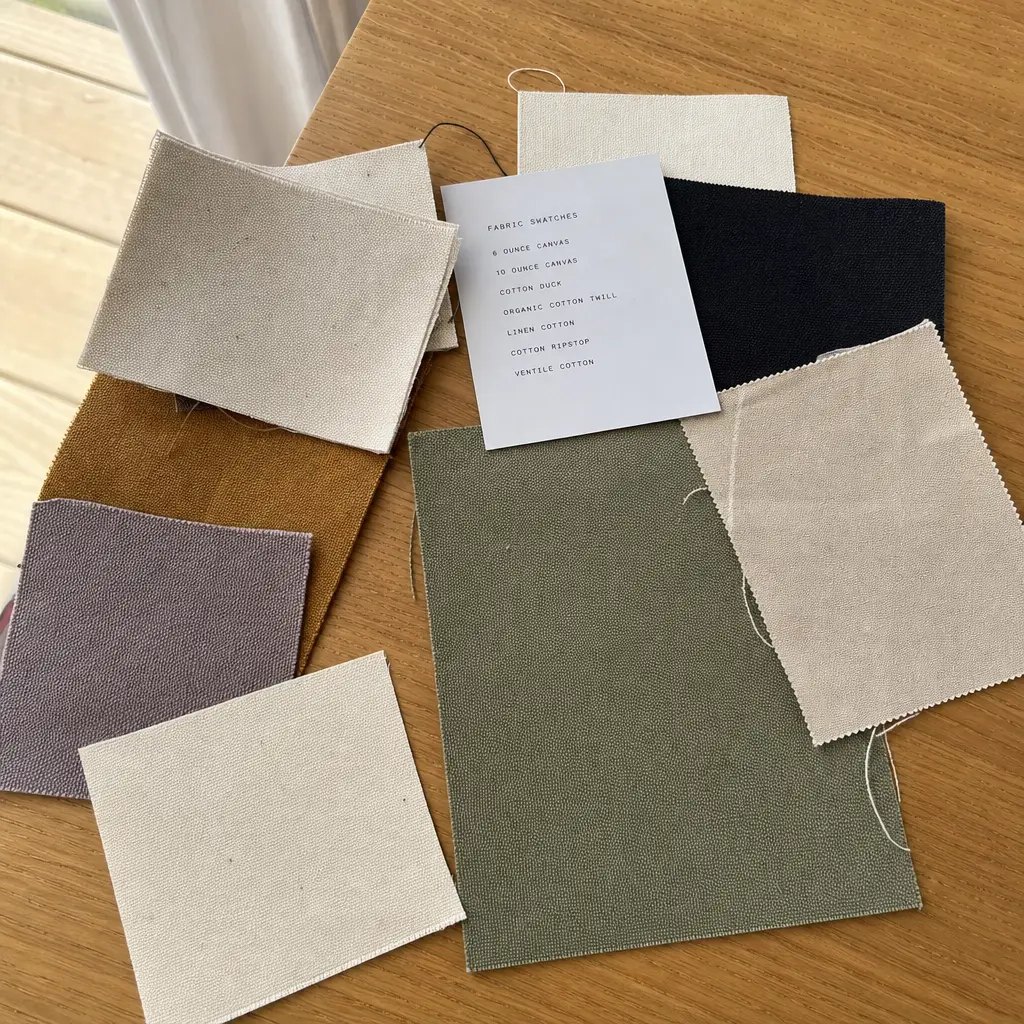
A disciplined sample path separates material approval from construction approval and branding approval. Start with fabric swatches or cuttings when color, weight, and hand feel matter. Then review a blank construction sample to check dimensions, zipper path, corner shape, seam finish, handle placement, and whether the portfolio lies flat. After that, approve a branded sample on the actual canvas so print, patch, or label quality can be judged in context.
For meaningful orders, a pre-production sample should be the final gate before bulk production. It should use the approved shell fabric, zipper, lining if any, branding method, trim, and packing format. This sample is valuable because it confirms the system, not just separate components. A good fabric swatch and a good logo sample do not guarantee that the finished bag will pack correctly or that the zipper will still feel smooth after all construction details are combined.
Approvals should be documented in a written spec sheet. Photos are useful, but they do not capture hand feel, zipper smoothness, fabric body, or transfer edge quality. The approval record should state dimensions, fabric weight, composition, zipper details, branding size and placement, seam finish, carton count, and any special label or barcode requirements. If anything changes after approval, issue a revised spec version and make sure the quotation, purchase order, and inspection plan all reference the same revision.
- Recommended path: fabric swatch, blank construction sample, branded sample, then pre-production sample.
- Approve by written spec and physical reference when hand feel, zipper feel, or print texture matters.
- Record every change to fabric, trim, artwork, carton count, or labels before bulk production continues.
Put measurable QC tolerances in the purchase order
Inspection language should be specific enough that the factory, inspector, and buyer are measuring the same thing. For standard canvas zipper portfolios, many buyers use finished dimension tolerance around plus or minus 5 mm for width and height, though the right tolerance depends on size and construction. For front logo placement, plus or minus 3 mm is often workable when the art size and panel shape allow it. Fabric weight should be checked against the agreed tolerance, commonly plus or minus 5%.
Separate visual checks from functional checks. Visual inspection should cover stains, weaving faults, color variation, loose threads, crooked labels, puckered seams, print defects, zipper waviness, and panel distortion. Functional inspection should cover zipper opening and closing, slider security, end-stop strength, bartack security if handles are included, and seam strength at stress points. If the portfolio is lined, the inspector should look inside for loose threads, missed seams, trapped raw edges, or anything that can catch paper inserts.
Carton-level QC deserves its own line in the purchase order. Count accuracy, assortment, carton marks, barcode labels, pack ratio, carton condition, and gross weight should be checked before shipment. A product can pass piece inspection and still create a receiving problem if cartons are overfilled, mislabeled, too heavy, or crushed at the zipper edge. For export orders, confirm that carton board strength and sealing method suit the shipping route and stacking conditions.
- Use measurable controls for fabric weight, finished dimensions, logo placement, zipper function, and carton pack count.
- Inspect both the display face and the hidden interior construction.
- Check carton marks, barcode labels, assortment, carton integrity, and gross weight before release.
Compare quotes on total procurement risk
A low unit price can be real, but it can also come from missing details. One supplier may quote 12 oz canvas, #5 zipper, individual polybags, branded sample, and carton labels. Another may quote lighter fabric, a vague zipper, no polybag, and only a blank sample. The two prices are not comparable until the RFQ forces the same basis. Put material, zipper, lining, branding, sample path, packing, MOQ, lead time, and QC assumptions into one comparison sheet.
Separate recurring cost from one-time cost. Recurring cost includes the bag, lining, zipper, printing, label, polybag, divider sheets if used, and master carton. One-time or non-recurring cost may include screen charges, transfer setup, sample fees, custom puller tooling, or special barcode setup. Ask suppliers to list these separately so reorder economics are clear. A first order may look expensive because of setup, while repeat orders may be more competitive.
Freight and destination handling should be part of the decision. Carton cube and gross weight can change landed cost, especially when shipments are charged by volume. A slightly cheaper bag can become more expensive if it needs larger cartons or arrives in a format that requires relabeling at the fulfillment center. For wine clubs working to a seasonal calendar, also compare approval lead time and the supplier's change-control discipline. A clean production file can be worth more than a small price difference when the launch date is fixed.
- Compare every quote on the same incoterm, sample scope, packing basis, and inspection basis.
- Separate one-time charges from repeat unit cost.
- Include carton cube, carton weight, receiving labels, and fulfillment handling in landed-cost comparison.
Specification comparison for buyers
| Spec decision | Recommended option | When it fits | Buyer risk to check |
|---|---|---|---|
| Fabric weight | 12 oz to 14 oz cotton canvas, approximately 407 to 475 GSM, with bulk tolerance typically controlled within plus or minus 5% | Wine club welcome packs, tasting-note folders, member renewal kits, event handouts, and premium paper-based inserts that need structure without becoming bulky | Canvas below about 10 oz or 340 GSM can wrinkle more, show less print opacity, and lose shape after carton compression |
| Lining choice | Unlined for simple programs; 210D polyester lining when a cleaner interior and smoother paper loading are important | Unlined works for basic document use; lined construction fits premium club programs, repeated member use, or kits with brochures, cards, and small accessories | Lining changes sewing time, edge treatment, unit cost, and carton cube; buyers should confirm whether inside seams are bound, turned, overlocked, or left raw |
| Zipper spec | Nylon coil zipper, usually #5 for standard portfolios, with matched tape color and approved slider and puller finish | Most A4 or letter-size portfolio bags opened by fulfillment teams and members during events or home tastings | Quotes that say only 'zipper' can hide lighter chain, weak sliders, thin tape, poor end stops, or wavy zipper installation |
| Print method | Screen print for 1 to 2 solid colors; heat transfer for short runs or detailed art; woven patch or sewn label for a tactile premium finish | Screen print suits stable logos at volume; heat transfer suits smaller detailed runs; woven branding suits membership programs where finish matters more than flat ink coverage | Fine lines can break on coarse canvas, transfer edges can lift if heat settings are wrong, and sewn patches need placement and stitch control |
| Handle construction | Self-fabric or cotton webbing handles with defined overlap and bartack reinforcement at stress points | Useful when portfolios carry notebooks, insert packs, tasting guides, event credentials, or multiple printed pieces | If handle overlap, bartack length, and stitch density are not written into the spec, handles may look acceptable but weaken under repeated lifting |
| MOQ route | Use stock greige or stock-dyed canvas when lower MOQs, mixed colors, or faster development are needed | Seasonal launches, regional club campaigns, new-member tests, and programs comparing more than one artwork version | Custom dyeing raises MOQ and adds approval time; split fabric lots can widen shade variation if not controlled |
| Carton pack | Individual polybag, then 25 to 50 pieces per export carton depending on size, lining, zipper bulk, print sensitivity, and carton weight limit | Direct delivery to fulfillment centers, event-kit assembly sites, distributor warehouses, or winery receiving teams | Overpacking can curl zipper edges, flatten corners, and abrade logos; underpacking increases freight cost and can allow too much movement |
| Supplier route | Factory direct for repeat programs with stable specs; trading company when consolidating several accessories into one shipment | Factory direct suits repeatable bags where QC control matters; trading companies can help coordinate multi-item club kits | Indirect routes can blur responsibility for sample changes, trim substitutions, carton marks, and packing instructions unless one approved spec sheet controls every revision |
Buyer checklist before sampling
- Confirm finished dimensions in millimeters or inches, including width, height, gusset if any, usable zipper opening length, and handle drop if handles are included.
- State intended contents and target loading condition, such as tasting notes, membership folder, event pass set, booklet stack thickness, or small promotional accessories.
- Specify shell material by composition, canvas oz, GSM equivalent, weave or hand-feel reference if relevant, and acceptable bulk tolerance such as plus or minus 5% on fabric weight.
- Define color standard by Pantone reference, approved swatch, or fabric lab dip, and state how shade variation will be judged if color matching matters.
- Lock zipper details: chain type, chain size, tape color, slider type, slider finish, puller style, end-stop method, and whether an auto-lock or non-lock slider is required.
- Provide artwork as vector files and define print method, print size, color count, placement coordinates, registration needs, and placement tolerance, commonly within plus or minus 3 mm on visible panels.
- Request a sample sequence that fits order risk: material swatch, blank construction sample, branded sample, and one pre-production sample made to the final approved specification.
- Approve internal finish details, including whether the bag is unlined or lined, whether seams are overlocked, turned, or bound, and whether raw edges are allowed inside.
- Set packing requirements: individual polybag yes or no, warning text if required, desiccant if required, inner quantity, master carton count, carton maximum gross weight, carton marks, and barcode labels.
- Record inspection checkpoints for measurement, fabric hand feel, zipper function, print adhesion, stitch quality, loose threads, stains, count accuracy, assortment accuracy, and carton condition.
Factory quote questions to send
- What exact shell fabric are you quoting, in both oz and GSM, and what tolerance do you control for fabric weight and width in bulk production?
- Is the quoted canvas 100% cotton, cotton-rich blend, or another composition, and does that composition change print behavior, shrinkage, hand feel, or color consistency?
- What zipper chain are you quoting: nylon coil, molded resin, or metal, and what exact size such as #3, #5, or #8 is included in the price?
- Is the slider auto-lock or non-lock, what puller material and finish are included, and will tape color and puller finish match the approved sample in mass production?
- What print method is included, how many colors are covered, what is the artwork setup charge, and how do you test adhesion or abrasion on this canvas surface?
- What is the MOQ by color, size, and artwork, and how does the MOQ change if stock fabric is used instead of custom-dyed material?
- What are the finished product tolerances for width, height, gusset, zipper opening, handle drop, and logo placement on bulk goods?
- Can you provide a full sample path including fabric swatch, blank sample, branded sample, and pre-production sample, and which sample fees are refundable against the bulk order?
- How will each piece be packed, how many pieces will go into each carton, what carton dimensions and gross weight do you recommend, and do you see any compression risk at that count?
- What in-line and final QC points do you run for stitch density, bartack security, zipper operation, print registration, visual defects, carton count, carton marks, and carton compression condition?
Quality-control points to confirm
- Canvas should match the approved reference in composition, weight, color, and hand feel, with bulk fabric weight controlled within the agreed tolerance, commonly plus or minus 5%.
- Finished size should stay within the agreed tolerance, commonly within plus or minus 5 mm for width and height on standard portfolio bags unless another tolerance is approved.
- Zipper must run smoothly from end to end with no snagging, tape twisting, open seams, misaligned stops, slider separation, or obvious waviness after repeated opening and closing.
- Logo position should remain within the approved placement window, commonly within plus or minus 3 mm on front-facing panels, with no obvious skew relative to the panel edge.
- Printed artwork should show clean edges, acceptable opacity, and no major pinholes, ghosting, misregistration, transfer lifting, ink cracking, or color shift beyond the approved standard.
- Stitching should be even and secure, with no skipped stitches, unraveling threads, exposed holes from needle damage, loose bartacks, or weak handle and zipper stress points.
- Inner construction should match approval, including lining presence or absence, seam finish, pocket construction if any, and clean trimming of raw threads inside the bag.
- Metal parts, if used, should show no rust, sharp burrs, plating flake, discoloration, or staining risk against light-colored canvas.
- Cartons should arrive square and intact, with no corner collapse, wet damage, crushing at the zipper edge line, or print abrasion caused by excessive compression or poor orientation.
- Shipment count, assortment, barcode labels, carton marks, pack ratio, and packing list details must match the purchase order exactly.