Why carton packing is a buying decision, not only a warehouse detail
A canvas zipper portfolio looks simple on a quote sheet, but museum shop buyers usually discover packing problems after the goods arrive: bent corners, zipper pull marks, dirty natural canvas, wrong carton counts, or products that look tired before they reach the sales floor. The packing plan has to be designed together with the product spec because the fabric weight, zipper hardware, print area, and retail labeling all affect how the portfolio should be stacked and protected.
For museum shops, the portfolio may be sold as a standalone souvenir, used as an exhibition document holder, included in a membership pack, or distributed through multiple stores. Each use has a different tolerance for wrinkles, dust, carton weight, and labeling. A distributor can sometimes accept bulk inner packing, while a museum retail team often needs clean individual sleeves, barcode labels, and cartons that can be received quickly without repacking.
- Treat carton packing as part of the product specification before asking for price.
- Decide whether the portfolio is a retail SKU, a promotional item, or a kit component.
- Set maximum carton weight early so the factory does not overpack to save freight volume.
- Approve one packed sample carton or at least a packed sample stack before mass production.
Choose the canvas weight around structure, print, and carton load
For zipper portfolios, the common canvas range is roughly 10oz to 16oz. A 10oz canvas, around 300-340 GSM depending on yarn and finish, can work for budget programs or light document sleeves, but it may feel soft when displayed upright. A 12oz canvas, usually about 380-410 GSM, is a practical middle ground for museum retail because it gives better body, accepts screen printing well, and does not make cartons too heavy. A 14oz or 16oz canvas can feel more premium, but the zipper line and corner sewing become more demanding.
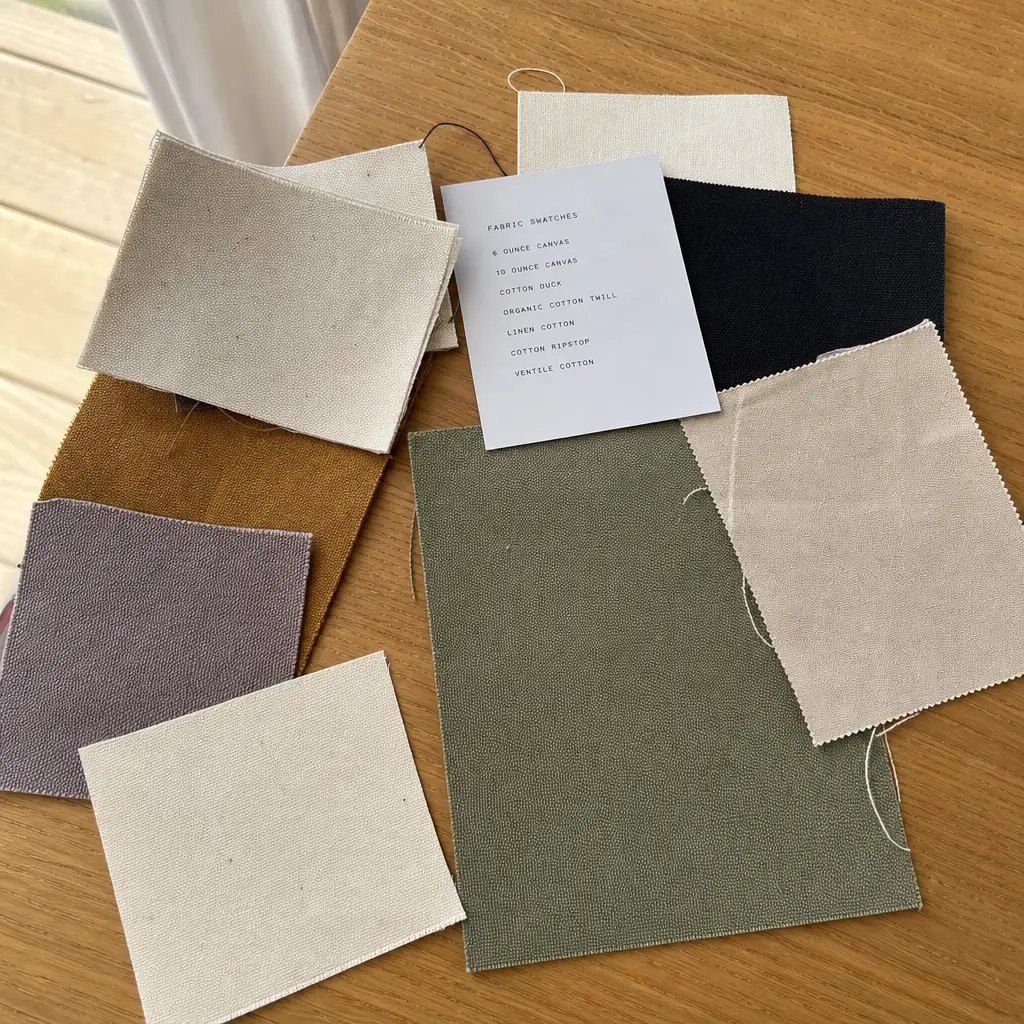
Do not quote only by ounces. Mills and factories may use different conversion assumptions, and the finish can change the handfeel. A buyer should request both oz and GSM, plus a fabric swatch from the intended production batch when possible. Natural cotton canvas also varies in seed specks and shade; that is not always a defect, but it should match the brand expectation and approved sample.
- Budget document sleeve: 10oz canvas, approximately 300-340 GSM, with lower structure.
- Standard museum shop retail: 12oz canvas, approximately 380-410 GSM, good balance of body and carton weight.
- Premium portfolio: 14oz canvas or above, but test zipper sewing, corner bulk, and carton gross weight.
- Typical fabric tolerance to define: plus or minus 5 percent, or the tolerance your supplier can realistically control.
Size the portfolio for the insert, not for the paper name
A common mistake is specifying the portfolio as A4 size or letter size without clearance. A4 paper is 210 x 297 mm, and US letter is 216 x 279 mm, but a sewn canvas zipper portfolio needs extra space for seam allowance, zipper tape, fabric thickness, and easy insertion. If the buyer wants the product to hold exhibition leaflets, prints in a paper sleeve, or a catalog plus receipt, the finished size must be tested with the actual contents.
A practical finished size for A4 documents is often around 350 x 260 mm, depending on the zipper position and seam construction. For US letter, around 360 x 270 mm can be more comfortable. If the portfolio will hold prints with protective backing board, the required size may be larger. The RFQ should state the usable internal space, not only the external finished size, because thick seams and zipper tape reduce the opening.
- Send the factory a sample of the intended insert or exact dimensions and thickness.
- Define external finished size and minimum usable internal space.
- Allow tolerance, but keep insert fit as a functional requirement.
- Test the zipper path with the insert inside, not only on an empty sample.
Zipper and sewing details that affect both retail feel and packing damage
A nylon coil zipper is usually the safest choice for canvas zipper portfolios because it is flexible, smooth, and less likely to scratch adjacent pieces than sharp metal teeth. Metal pullers are acceptable and often look better, but they need protection during packing if the portfolio is natural canvas or light dyed fabric. A color-matched zipper can make the product cleaner, while a contrast zipper can support an exhibition color story, but every zipper color adds MOQ pressure.
The zipper ends need reinforcement because buyers often pull the portfolio open while it is lying flat on a shop counter. Bar-tacks, backstitching, and clean alignment are not decorative details; they prevent returns. In packing, the zipper pull position should be controlled so all pullers face the same direction and do not press into the same area of the next piece. Tissue under the puller or alternating orientation can reduce pressure marks.
- Use nylon coil zipper for most retail canvas portfolios.
- Define zipper tape color and puller finish in the spec sheet.
- Require secure stitching at zipper ends and no skipped stitches along zipper tape.
- Protect metal pullers if products are stacked tightly in cartons.
Print choices for museum artwork and how they change packing risk
Museum shop graphics often include fine lines, exhibition titles, donor marks, or artwork details. Screen printing is dependable for one to three spot colors, especially on cotton canvas. It gives strong coverage and predictable cost at volume. However, heavy ink coverage on natural canvas can become stiff, and if the factory packs too soon after printing, ink can offset onto the back of the next portfolio.
Heat transfer or digital transfer can handle gradients and small detailed art, but the buyer should test edge adhesion and handfeel on textured canvas. Embroidery is possible for small logos, yet it adds thread tension and may pucker the panel. For a zipper portfolio that must lie flat, large embroidery is usually less suitable. The packing method should reflect the print method: printed faces may need interleaving paper, longer curing time, or face-to-face avoidance.
- Screen print: best for solid logos, exhibition names, and limited spot colors.
- Heat transfer: useful for detailed art, but test adhesion after bending and stacking.
- Embroidery: better for small marks than large front-panel artwork.
- For large print areas, approve curing standard and packing delay before mass packing.
MOQ logic: what really drives the minimum order
The MOQ for a canvas zipper portfolio is rarely based only on sewing capacity. It is driven by fabric purchasing, dyeing or bleaching, zipper color, print setup, packaging materials, and carton printing. A natural canvas body with a standard zipper color and one-color screen print can usually support a lower MOQ than a custom dyed body, custom zipper tape, multiple artworks, or retail packaging with separate barcode labels for many SKUs.
Museum shops often have many exhibition designs but modest quantities per design. The cleanest sourcing plan is to standardize the base portfolio and vary only the print where possible. If each exhibition needs a different body color, zipper color, label, and packaging insert, the factory may need to quote separate MOQs and setup charges. Buyers should group designs by shared materials to avoid paying premium costs on every SKU.
- Lowest complexity: same canvas, same zipper, same size, different one-color prints.
- Medium complexity: same size and fabric, but multiple print colors or retail labels.
- High complexity: custom dyed canvas, custom zipper color, multiple sizes, and separate packaging.
- Quote MOQ by SKU and by shared material group, not only as one total order quantity.
Carton packing method: flat stacks, sleeves, labels, and carton strength
Flat packing is normally the best method for canvas zipper portfolios because it protects the shape and helps the receiver count pieces. The stack height must not be so high that the lower pieces get crushed or the carton bulges. For a medium-size 12oz portfolio, 50 to 100 pieces per carton may be realistic, but the final count depends on finished size, fabric thickness, zipper pull bulk, individual sleeves, and the buyer's maximum carton weight.
A 5-ply export carton is a sensible baseline for sea freight and distributor handling. Buyers should require carton dimensions and gross weight on the quote because these numbers affect pallet planning, cubic volume, local delivery charges, and warehouse labor. If the portfolio is individually sleeved, the sleeve should fit without bending the corners. If no sleeve is used, the buyer should accept the higher risk of dust, lint, print rub, and mixed orientation.
- Recommended inner packing: one portfolio per recycled polybag or paper sleeve for retail programs.
- Recommended stacking: flat, aligned zipper pulls, no forced compression.
- Recommended carton: 5-ply export carton with clear shipping mark and carton number.
- Carton data to quote: pieces per carton, carton size, net weight, gross weight, and total CBM.
Sample approval should include a packed product, not only a pretty loose sample
A loose sample can look good on a desk and still fail after carton packing. For a museum shop order, the pre-production sample should include the actual fabric weight, zipper, print, label, sleeve, barcode placement, hangtag if used, and the intended folding or flat packing direction. If the final carton is not ready at sample stage, the factory can still show a packed stack with the proposed piece count and puller orientation.
The sample review should be functional. Put the actual insert into the portfolio, zip it fully, remove it several times, stack several pieces, and inspect whether the print rubs or the zipper pull leaves a mark. Natural canvas should be checked under good light because dirt and oil marks can be hard to see in factory photos. If the museum shop requires a clean premium look, define acceptable seed specks and rejectable stains before production.
- Approve fabric swatch before final sample if shade and handfeel matter.
- Approve print strike-off before full cutting when artwork is detailed.
- Approve pre-production sample with actual zipper and sewing construction.
- Approve packed sample or packed stack before mass carton packing starts.
Lead time risks that affect carton packing and shipment readiness
A realistic schedule is not just cutting and sewing time. Fabric greige availability, dyeing or bleaching, zipper procurement, print screen preparation, ink curing, label printing, barcode data approval, carton production, and inspection booking all sit on the production path. If the buyer changes barcode files or shipping marks late, finished goods may wait unpacked, or the factory may pack first and relabel later, which increases handling damage.
For repeat programs, the buyer can reduce risk by pre-approving a standard carton format and label layout. For exhibition launches, artwork approval is often the critical point. A factory cannot responsibly start screen production without final vector art, Pantone references, size, and placement. Rush packing after delayed print approval is one of the easiest ways to create offset marks, wrong carton quantities, and missed inspection windows.
- Lock artwork, Pantone colors, and print placement before sample approval.
- Release barcode data and carton marks before mass packing materials are ordered.
- Build curing time into the schedule for large screen prints.
- Book final inspection after the factory confirms at least 80 percent packed, unless your inspection policy differs.
Quote data that lets buyers compare landed cost correctly
Two supplier quotes can show the same unit price and still produce different landed costs. A portfolio packed 100 pieces per carton may reduce carton count, but if each carton becomes too heavy or bulges, warehouse handling and damage risk rise. A portfolio packed 50 pieces per carton may cost slightly more in packaging and freight volume, but it can be safer for retail-ready goods. The correct choice depends on your receiving rules and damage tolerance.
The RFQ should request product cost and packing cost transparency where possible. Buyers do not always need a full cost breakdown, but they do need enough data to compare suppliers: fabric weight, print method, piece weight, packing style, carton size, carton gross weight, CBM, MOQ by SKU, sample cost policy, and lead time. Without this, a cheaper quote may simply be using thinner canvas, lighter carton board, fewer labels, or loose bulk packing.
- Compare piece weight against fabric weight; a suspiciously light piece may indicate thinner material.
- Compare carton gross weight against your warehouse handling limit.
- Compare CBM per 1,000 pieces for freight budgeting.
- Compare which labels, sleeves, hangtags, and shipping marks are included in the unit price.
Specification comparison for buyers
| Spec decision | Recommended option | When it fits | Buyer risk to check |
|---|---|---|---|
| Fabric body weight | 12oz cotton canvas, about 380-410 GSM, pre-shrunk if strong print registration is needed | Most museum retail programs needing a structured but still foldable document portfolio | Thin 8oz fabric may collapse in display bins; very heavy 16oz fabric raises carton weight and zipper stress |
| Portfolio size | A4 plus clearance: around 35 x 26 cm or US letter plus clearance: around 36 x 27 cm | Shops selling exhibition catalog inserts, maps, prints, or membership packs | A portfolio sized exactly to paper dimensions can jam at the zipper corners after sewing tolerance |
| Zipper construction | Nylon coil zipper with metal or color-matched puller, end bar-tacked | Retail-grade product where smooth opening matters more than luxury hardware | Low-grade zipper tape can wave on canvas; unprotected metal sliders may mark natural canvas during packing |
| Print method | Screen print for 1-3 spot colors; heat transfer only for fine gradients or small art runs | Museum logos, exhibition marks, line drawings, and donor program graphics | Large solid ink areas can feel stiff and may offset if packed before full curing |
| Inner packing | One piece in recycled polybag or glassine-style paper sleeve, zipper pull protected with tissue | Museum shops requiring clean shelves, barcode labels, and lower handling damage | Loose packing saves cost but increases lint, scuffing, and zipper-pull pressure marks |
| Carton loading | Flat pack 50-100 pieces per carton depending on size, fabric weight, and retailer max carton weight | Importers shipping to warehouse or museum shop distribution centers | Overpacked cartons bow the portfolios, crush corners, and create carton failures in LCL shipments |
| Carton material | 5-ply export carton, 44-48 ECT equivalent as a practical target for heavy canvas goods | Sea freight, mixed pallets, and distributor warehouses with multiple handling points | Domestic-grade cartons may pass factory dispatch but fail after port handling or pallet restacking |
| Retail labeling | Barcode sticker on individual sleeve plus outer carton shipping mark with PO, SKU, quantity, and carton number | Buyers with multiple museum branches, exhibition SKUs, or marketplace fulfillment | Missing SKU-level labels cause receiving delays and chargebacks even when the product quality is acceptable |
Buyer checklist before sampling
- Define the paper or merchandise the portfolio must hold: A4, US letter, small prints, catalog inserts, notebooks, or membership packs.
- Set the fabric target by ounce and GSM, not only by the word canvas; request actual swatch weight tolerance.
- Specify finished portfolio dimensions with acceptable tolerance, normally plus or minus 5 mm unless the insert fit is critical.
- State zipper type, zipper color, puller material, zipper tape width, and whether the zipper pull needs tissue protection during packing.
- Provide print artwork in vector format with Pantone references and exact placement from two bag edges.
- Decide whether the product is retail-ready: individual sleeve, barcode, hangtag, insert card, silica gel, and carton shipping mark.
- Set carton maximum gross weight according to your warehouse rule, commonly 12-18 kg for hand-loaded retail cartons.
- Require carton drop-test or at least sample carton photos showing loading direction, carton size, carton weight, and sealing method.
- Approve a packed pre-production sample, not only a loose product sample.
- Include inspection method: AQL level, critical defects, major defects, minor defects, and carton quantity verification.
Factory quote questions to send
- What canvas weight in oz and GSM are you quoting, and what is the acceptable fabric weight tolerance?
- Is the quoted fabric natural, bleached, dyed, recycled cotton blend, or organic cotton, and how will shade variation be controlled?
- What is the finished size tolerance after sewing and pressing, and how much clearance do you recommend for A4 or US letter inserts?
- Which zipper grade, tape width, puller type, and zipper color are included in the quotation?
- Which print method is included, how many colors, what print area, and is ink curing time built into the schedule?
- What is the MOQ by body fabric color, zipper color, print artwork, and packing style?
- How many pieces per inner pack and export carton are quoted, and what are the estimated carton dimensions and gross weight?
- Is the carton 5-ply export grade, and can you provide the bursting strength or ECT target used by your carton supplier?
- Are barcode labels, hangtags, insert cards, silica gel, and carton shipping marks included or priced separately?
- What sample stages are included: blank sample, print strike-off, pre-production sample, and packed sample?
Quality-control points to confirm
- Finished size within approved tolerance and large enough to accept the intended document or merchandise insert without forcing the zipper.
- Fabric weight, shade, handfeel, and shrinkage consistent with approved swatch and pre-production sample.
- Zipper opens and closes smoothly across the full length with no broken teeth, skipped stitching, waviness, or loose puller.
- Bar-tacks or reinforced stitching at zipper ends and stress points are present, secure, and visually clean.
- Print color, placement, curing, adhesion, and handfeel match the approved strike-off; no offset marks on adjacent pieces.
- Corners are square enough for retail presentation and not twisted from uneven sewing tension.
- Individual sleeve, barcode, hangtag, and insert card match the approved retail packing instruction.
- Carton quantity, assortment, SKU labels, carton numbers, and shipping marks match the packing list.
- Cartons are not overfilled, crushed, wet, bulging, or sealed with weak tape.
- Random packed cartons can be opened and repacked without deforming the product stack.