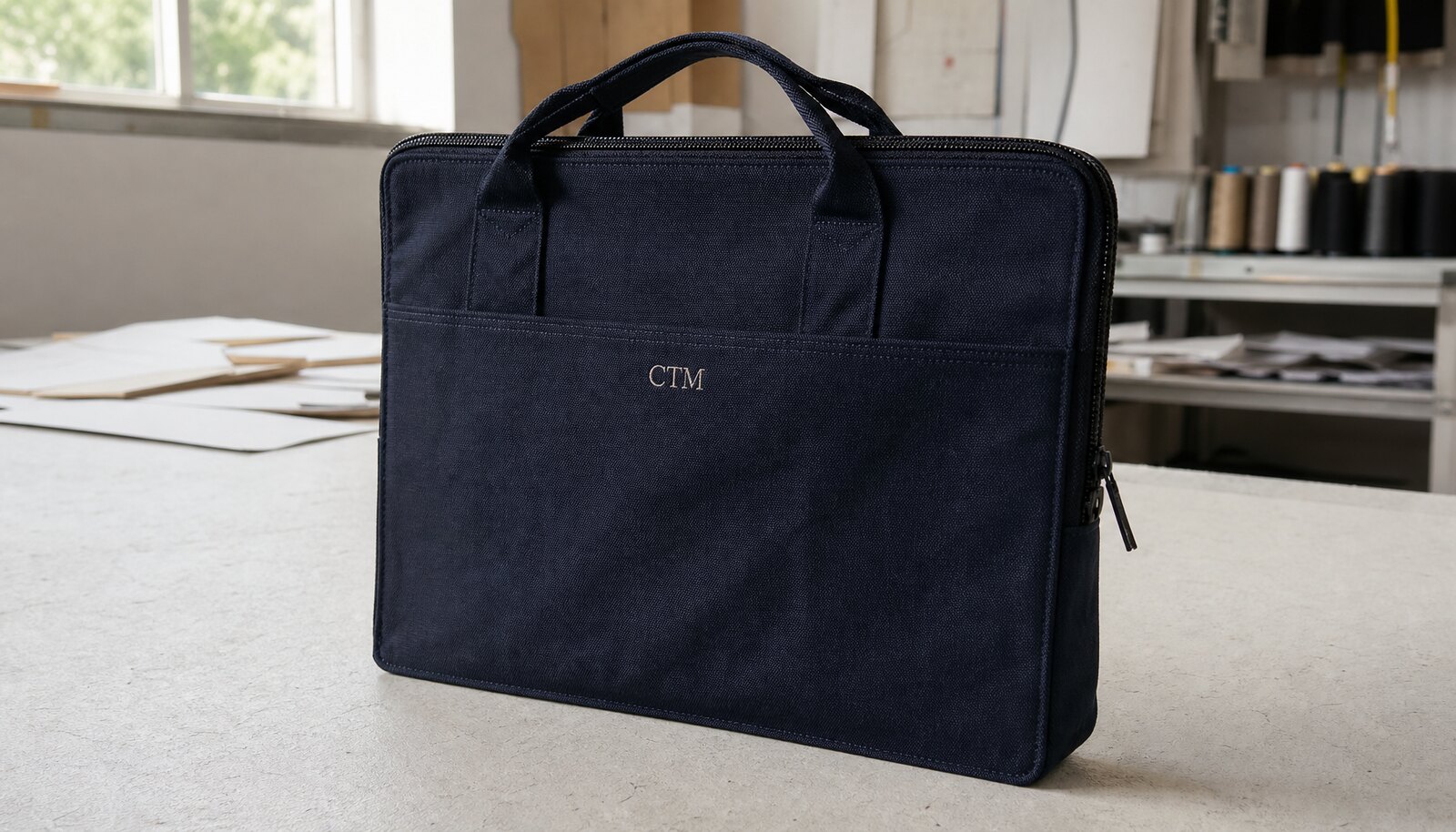
What law-firm buyers are really specifying
For law firms, canvas zipper portfolio bags are not just branded giveaways. They are working carriers for A4 files, letter documents, notepads, tablets, and presentation material, so the bag has to look controlled when carried into a meeting and still function after repeated use. Procurement is not buying a logo on canvas. It is buying a finished item that supports the firm's image while staying practical for daily handling.
That is why the commercial brief needs to start with use case, not artwork. A bag for partner meetings, client events, or recruiting usually needs a firmer body, cleaner edge control, and a more restrained logo. A bag for internal distribution can tolerate lighter canvas and a simpler interior. Once the use case is clear, the supplier can quote the right construction instead of guessing from a logo file alone.
- Define the bag as a document carrier first and a branded item second.
- Separate client-facing programs from internal issue programs before collecting quotes.
- Use finished dimensions and carry behavior as part of the spec, not just aesthetics.
Size, capacity, and structure should be frozen before decoration
The first decision is finished bag size. A law-firm portfolio bag should be specified to hold the intended documents without edge bulge or zipper strain. Buyers should state whether the target load is A4, letter size, or legal pads with room for a pen, business cards, or a thin tablet. If the bag is too shallow, the zipper line will bow. If it is too deep, the bag looks bulky and less formal.
Structure matters as much as size. A front panel with a pocket, a lined interior, or a gusset changes where the logo can sit and how much tension the canvas carries during sewing. A zipper that runs nearly full width may leave less usable flat space above it. The supplier should quote from the finished construction, not from a vague soft brief like 'standard portfolio size.'
- State the exact paper size the bag must hold without forcing the zipper.
- Decide whether the bag should stand upright, lie flat, or both.
- If the bag includes a pocket or gusset, confirm how that changes the logo field.
Canvas grade, lining, and zipper specs change the quote more than most buyers expect
Canvas weight is one of the biggest drivers of appearance and performance. A 12 oz canvas is lighter, usually lower cost, and acceptable for conference distribution or broad internal rollout. A 16 oz canvas has more body, feels more premium, and tends to hold embroidery cleaner on the front panel. For law-firm gifting, 16 oz is often the safer default if the bag is meant to sit on a desk or be carried in meetings.
The quote should also name the zipper in practical terms. A nylon coil zipper is common because it is flexible and less likely to buckle on a canvas bag. Puller style matters because it affects the professional look in hand and the ease of opening. Inside, the lining should be simple unless there is a specific reason to add pockets, pen loops, or padded compartments. More internal complexity means more sewing points, more variation, and more opportunities for a finish issue.
- Use 16 oz canvas when presentation quality and shape retention matter most.
- Use 12 oz canvas when cost matters and the program can tolerate a softer body.
- Specify zipper gauge, zipper length, puller finish, and whether the zipper must be color-matched.
Embroidery, patch, print: choose the method by logo detail, not habit
Embroidery is the most common choice for law-firm portfolio bags because it reads as durable, formal, and long-lasting. On canvas, it creates a tactile mark that fits the category better than most flat prints. The tradeoff is detail loss. Thin lines, tiny serifs, and fine internal gaps can close up during digitizing, especially when the artwork is reduced to fit a small placement field.
A woven label or sewn patch is usually the better answer when the logo is detailed or when the firm uses a crest with small text. A patch can preserve detail that embroidery cannot hold, but it adds a different visual language. Screen print can be acceptable if the logo is larger and the buyer wants a flatter, more modern look with lower unit cost. Heat transfer usually has the weakest long-term case on a structured canvas portfolio bag because edge wear becomes visible over time. The right method is the one that keeps the brand readable after bulk production, not the one that looks best in a mockup.
- Choose embroidery when the logo is simple and the buyer wants a durable executive look.
- Choose a woven label or patch when detail matters more than texture.
- Avoid shrinking a complex crest into a small stitch field unless the factory confirms minimum readable detail.
Logo placement guide for canvas zipper portfolio bags for law firms
Placement is where many programs go wrong. The most reliable location is usually the upper front panel, centered above the zipper line, or on a front pocket panel if the design includes one. That position keeps the logo visible during hand carry and avoids interference with the zipper pull or top seam. It also gives the embroidery machine a flatter surface to work on than a side panel or gusset.
The buyer should not approve placement by eye alone. The factory should provide a measured placement drawing showing distances from the top seam, side seam, and centerline. That drawing should be tied to the finished bag, not the flat pattern. On a sewn product, a few millimeters of drift can change the look enough that one carton appears balanced and another appears off-center. A practical approval method is to mark the exact placement on the sample, photograph it, and keep that sample as the visual master for bulk production.
There is also a visibility decision. Some firms want the logo high and centered for maximum recognition in meetings. Others prefer a more restrained position that sits slightly lower so the bag looks like a premium document carrier first and a branded item second. Either can work, but the choice should be made deliberately before production begins. Once the logo is digitized and the bag is sewn, the placement field is harder to change than most buyers expect.
- Keep the logo clear of zipper stitching and puller travel.
- Measure from seams and centerlines, not from the bag edge alone.
- Approve the location on the finished sample with a ruler and a retained reference photo.
Write the RFQ so suppliers quote the same product
Many quote comparisons fail because each supplier is pricing a different interpretation of the product. One quote includes a heavier canvas. Another uses a simpler zipper. A third assumes a larger logo or a different fold method. That is not a price comparison. It is three unrelated product definitions. Procurement needs a brief that removes ambiguity before the quote stage.
A usable RFQ for this category should specify finished size, canvas weight, zipper type, lining approach, logo dimensions, placement distances, thread color count, packing method, and sample approval expectations. If the law firm has brand standards, include the Pantone or thread reference and say whether the factory may propose the closest available thread system. If the logo includes small type, ask the supplier to state the minimum readable text height after digitizing. That forces the supplier to acknowledge where the decoration will or will not hold up in production.
The cleanest RFQs also separate optional items from must-haves. For example, a buyer may want a front pocket, but the bag can still function without one. Label that as optional so the supplier can quote the core bag clearly and price the add-on separately. That makes it easier to compare a basic model against an upgraded one without mixing the two.
- Freeze the BOM before comparing quotes.
- Separate must-have specs from optional features.
- Ask for setup charges and unit pricing to be listed separately.
MOQ and price differences usually come from setup, not just quantity
A low MOQ can look attractive but still produce a poor purchasing result if the setup cost is hidden in the unit price. On embroidered portfolio bags, the real cost drivers are digitizing, hooping, color changes, machine time, and whether the factory must source trims specifically for the order. That is why two quotes can differ sharply even when the bags look similar.
The buyer should ask whether MOQ is driven by fabric color, logo complexity, thread count, zipper sourcing, or packing configuration. If the order is likely to repeat, a slightly higher MOQ may be the better commercial decision because it supports a stable process and cleaner reorders. The cheap first order can become the expensive second order if the supplier has to recreate the file, the setup, or the material mix from scratch.
For procurement, the right question is not 'What is the smallest quantity you can make?' The better question is 'At what quantity do you make this efficiently enough that the same specification can be repeated without rework?' That is the number that matters for a law-firm program with branch offices, event schedules, or annual replenishment.
- Expect embroidery setup and digitizing to affect price even when the bag body is unchanged.
- Compare quotes on the same artwork size, same thread count, and same packing standard.
- Use reorder efficiency as part of the sourcing decision, not just the first buy.
Sample approval should be measured, not subjective
A screen mockup cannot validate a sewn canvas portfolio bag. The first approval should be a physical sample built from the actual bill of materials: canvas weight, zipper, lining, thread, and label. Canvas behaves differently from a flat digital proof, and stitched seams change the way the bag opens, folds, and holds the logo. If the sample is close, document the difference precisely and resample only if the change is meaningful.
A strong sample review checks logo placement, logo size, thread color, stitch density, zipper function, pocket alignment, and overall fold behavior. If the logo is slightly too low or too large, the factory should not be told to 'make it a little better.' The buyer should say exactly how much to move it and from which seam reference. That prevents a vague approval loop that wastes time and still fails to lock the production standard.
If timing allows, the best practice is to retain one approved sealed sample with the buyer's signature or approval mark. That sample becomes the visual reference for bulk inspection and helps eliminate disputes over whether the final product matches the agreed standard. In sourcing terms, a good sample is not only a design step. It is the control document for production.
- Approve the physical sample against a ruler and not just against memory.
- Ask for front, back, and close-up photos in neutral light.
- Document any millimeter change before asking for a resample.
Quality control has to match how the bag is actually made
QC guidance should be tied to the manufacturing process, not generic slogans. A useful inspection plan checks the bag after sewing, after embroidery, after folding, and after packing because defects can appear at each step. Embroidery that looks fine on a hoop can distort once the seam is added. A zipper that works on a single sample can snag if the top corners are compressed in a carton. The point of QC is not to admire the sample. It is to catch how the production run behaves under real handling.
The most important check on placement is consistency against the approved sample. That means using a simple measurement method: identify the centerline, mark the seam reference points, and measure the logo location from those fixed points on a sample of the production run. If the factory cannot explain how it validates that measurement, the buyer should not assume the number is controlled. The same logic applies to zipper function. The inspection should be repeated on more than one unit from the start, middle, and end of a lot because issues often show up after the line settles into production.
Packing is part of QC, not an afterthought. If the bag is folded so the embroidery creases against a seam, or if a barcode sticker touches thread and leaves residue, the bag can fail a client-facing presentation even if the sewing is correct. A proper QC plan includes bag condition at carton-out, not just seam quality at machine-out.
- Inspect after sewing, after embroidery, and after packing.
- Measure placement from the same fixed references used on the approved sample.
- Check the bag folded and loaded, not only flat on a table.
Sourcing models change accountability and landed cost
There are three common sourcing models for this category. The first is direct factory supply, where the bag body and decoration are coordinated in one plant. This usually gives the buyer the cleanest accountability for placement, lead time, and remake responsibility. The second is a trading or sourcing company that manages several factories. That can help with flexibility and multi-product buys, but it adds handoffs. The third is a split model where bags are made in one place and decoration happens elsewhere. That can work, but it requires tighter control over transport damage, shade variation, and who owns the final approval.
Procurement should choose the sourcing model based on program behavior. If the buyer expects one large launch and no repeat, the flexibility of a trading model may be fine. If the firm wants the same bag reordered over time with the same logo position and same packing, a direct factory or tightly managed OEM model is usually safer. A lower factory price is not helpful if no one can explain who is responsible when the embroidery is off by a few millimeters or the zipper lot changes without notice.
The practical test is simple: ask the supplier to identify the single point of accountability for fabric, embroidery, zipper, and packing. If the answer is vague, the commercial risk is higher than the quote suggests.
- Direct factory sourcing usually improves accountability.
- Split sourcing can work, but only with clear ownership of the final standard.
- Use the sourcing model that matches how often you expect to reorder.
Specification comparison for buyers
| Spec decision | Best default for law-firm programs | When it fits | Buyer risk to check | RFQ detail to request |
|---|---|---|---|---|
| Supplier route | Direct bag factory with in-house sewing and embroidery coordination | Best for repeat programs, private label, and tighter control of placement and pack-out | Confirm who digitizes the logo, who approves the strike-off, and whether all trims are sourced in one plant or split across vendors | Ask for factory role split, responsible contact, and sample approval owner |
| Canvas grade | 16 oz finished canvas for premium client-facing use | Works well for partner gifts, recruiting, client meetings, and any bag that should hold shape on a desk | Heavier canvas can change stitch penetration and panel tension; do not compare fabric swatches without a sewn sample | Request finished fabric spec, weave style, finish, and target finished weight |
| Budget canvas | 12 oz finished canvas for lower-cost distribution | Appropriate for conferences, internal issue, and larger quantity rollouts where structure is secondary | Lighter canvas can pucker around dense embroidery and may collapse when the bag is loaded | Ask for a loaded sample or at least a sewn sample with the actual logo size |
| Decoration method | Flat embroidery for a formal, durable mark | Best when the logo is simple, single-color, or low-detail and should feel permanent | Tiny letters, thin rules, and intricate crests may close up in stitch | Request minimum text height, stitch count range, and a digitized proof |
| Decoration alternative | Woven label or sewn patch for detail-heavy artwork | Useful when the logo includes fine type, gradients, or complex crest elements | Oversized patches can look generic if border width, edge finish, or thread match is weak | Ask for patch size, border style, and attachment method |
| Logo placement | Upper front panel, centered above the zipper line or on a front pocket panel | Usually the cleanest visual position for a portfolio bag carried by hand | Placement must be measured from seams and zipper top, not estimated from the bag edge | Request a placement drawing with centerline and seam-based dimensions |
| Zipper spec | Nylon coil zipper with matching tape and a smooth puller | A practical standard for canvas bags because it balances cost, flexibility, and smooth operation | Check top-corner snagging, puller size, and whether the zipper line distorts the front panel | Specify zipper gauge, puller finish, color, and zipper length |
| Interior build | Light lining with one secure pocket or a simple document sleeve | Enough for documents, business cards, and a tablet without overcomplicating the bag | Too many pockets can add sewing drift and increase variation on bulk runs | Ask for pocket count, lining color, and reinforcement points |
| MOQ strategy | Tiered MOQ by color, logo complexity, and packing format | Useful when buyers want to pilot one office or one practice group before rolling out nationally | A low headline MOQ can hide high setup charges and expensive reorders | Ask how MOQ changes by colorway, logo color count, and replenishment order |
Buyer checklist before sampling
- Confirm finished bag size, zipper opening width, and whether the portfolio must hold A4, letter, or legal pads without bulging.
- Set canvas weight in oz or GSM, plus weave and finish, before asking for a price comparison.
- Define logo size in millimeters, placement distance from seams, and whether embroidery is single-color or multi-color.
- Ask for a digitized logo proof and a physical strike-off before bulk approval.
- Specify zipper type, puller style, lining color, and any internal pocket or sleeve requirements.
- Lock packing rules: polybag, barcode sticker, carton count, and whether the bags are flat-folded or stuffed.
- Request a production plan that separates artwork approval, sample approval, bulk sewing, embroidery, inspection, and packing.
- Verify the QC plan for stitch density, logo registration, zipper smoothness, fabric shade consistency, and carton labeling.
- Confirm whether the supplier or the buyer owns the embroidery file and whether that file will be reused for reorders.
- Ask for a clear policy on remake, scrap, or replacement if placement, zipper operation, or logo color misses the approved sample.
Factory quote questions to send
- What is the exact finished size, and what internal document size should the bag comfortably hold?
- What is the canvas weight, weave, and finish after any washing, dyeing, or coating process?
- Where exactly will the logo sit, and what are the measured distances from the top seam and side seam?
- What is the minimum readable text height you will accept for embroidery on this canvas?
- How many stitches or thread colors are in the logo, and does the price change by color count?
- Is the MOQ driven by bag color, embroidery setup, fabric sourcing, packing, or total quantity?
- Will you send a pre-production sample using the actual zipper, lining, thread, and label materials?
- What zipper gauge and puller style are included in the quote, and are they changeable?
- Who owns the digitized embroidery file, and will it be reused at no extra charge for reorders?
- What are the separate lead times for artwork conversion, sample approval, bulk production, inspection, and shipping preparation?
Quality-control points to confirm
- Embroidery placement is checked against a measured template on the actual finished bag, not against the pattern file; the usual control method is to mark the centerline and seam-based offsets on the approved sample and reproduce those same points in bulk.
- Logo center stays within the agreed placement band, commonly measured in millimeters from the signed-off centerline; the number only matters if it is validated by ruler checks on the sample and then spot-checked in production.
- Embroidery shows no puckering, tunnel effect, or fabric distortion around dense stitch areas; inspectors should test the bag closed and open because tension often changes with zipper loading.
- Thread color matches the approved strike-off under daylight and warehouse light; approval should be done with the physical thread card or sewn sample, not only a screen render.
- Zipper opens and closes smoothly through repeated cycles without snagging at the top corners, garage, or puller; a good check is several hand cycles on multiple pieces from the first cartons.
- Canvas shade is consistent across body panels, handles, and binding; inspect against a retained sealed sample so lot-to-lot color drift can be judged consistently.
- Finished dimensions remain within the buyer's agreed tolerance after sewing and packing; the factory should measure the final article, not the cut panel, because seam allowance changes the result.
- Inner lining and pockets are sewn cleanly with no exposed raw edges, loose threads, or misaligned pocket tops; the bag should be turned, loaded, and reopened during inspection.
- Carton count, barcode labels, and SKU markings match the packing plan; mixed logo versions or mixed sizes should not be allowed unless the buyer explicitly approved a mixed carton.
- Pre-shipment samples match bulk production in logo placement, zipper type, thread color, and fold pattern; if they do not, the shipment should be held until the cause is understood and corrected.