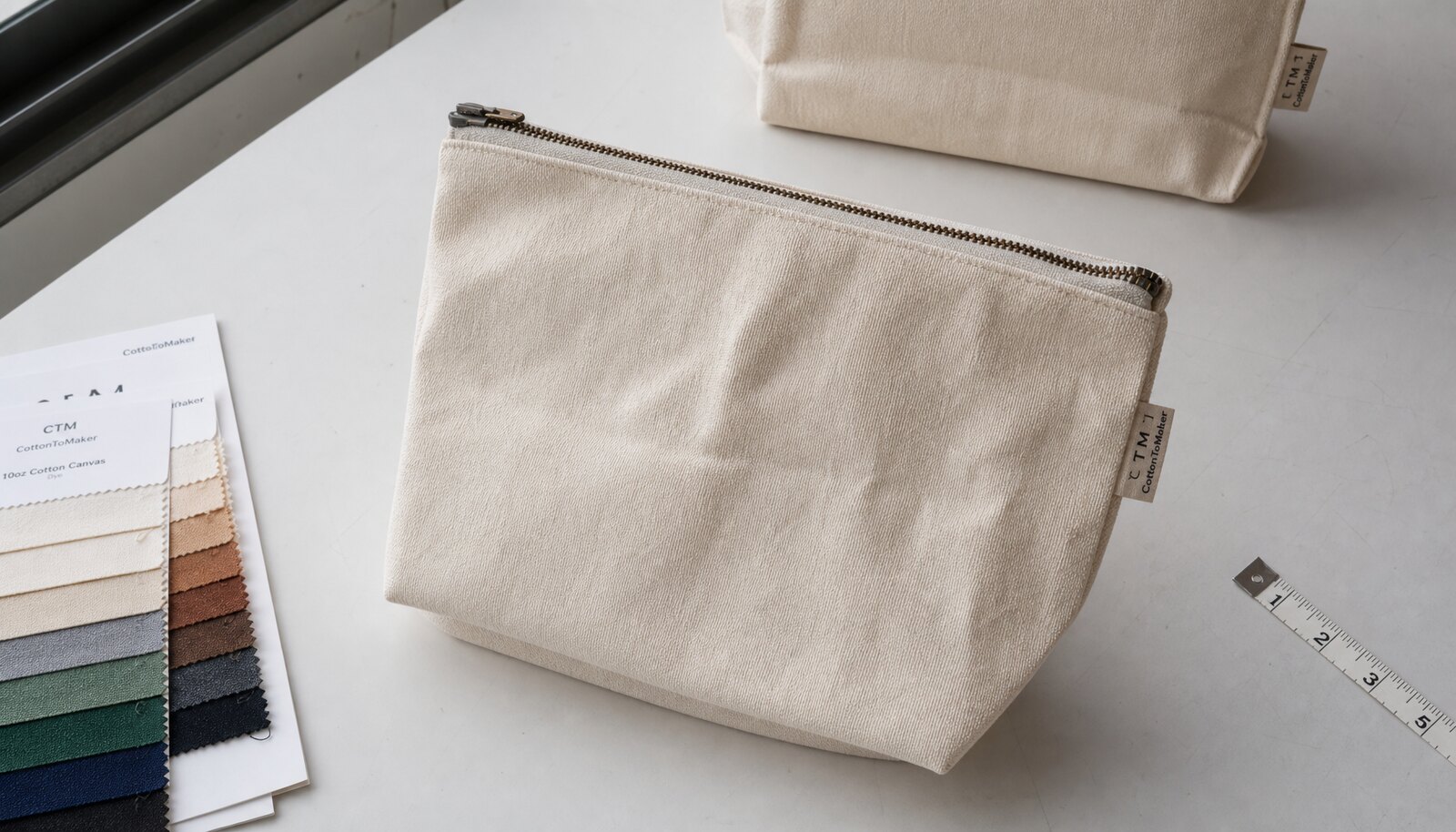
Why retail buyers need a tighter spec on canvas zipper bags
Canvas zipper bags look simple, but retail programs fail when the buyer treats them like a generic pouch. A retail bag has to hold shape on shelf, open smoothly at the till, pack flat in cartons, and survive repeated handling by customers and store staff. If you leave the spec too open, each supplier will fill the gaps differently and the quotes will not be comparable.
The core buying problem is not just finding a bag with a zipper. It is finding a build that balances fabric weight, zipper quality, decoration method, and unit cost. For retail, that balance changes depending on whether the bag is used for cosmetics, stationery, accessories, gift sets, or checkout add-on sales.
- Retail buyers usually need better appearance consistency than event buyers.
- A bag that looks good in a sample room can still fail after flat packing or shelf display.
- The supplier quote should describe the complete build, not only the outer dimensions.
Choose the canvas weight based on shelf feel, not just price
For canvas zipper bags for retail, fabric weight is one of the fastest ways to misread a quote. A 280 GSM canvas may be fine for light cosmetics or stationery, but it can look limp if the bag is meant to carry premium gift items. At the other end, a 400 GSM canvas gives better body but can raise cost, make sewing slower, and take up more carton space.
As a rule, buyers should start with the end use. If the bag is being sold as a low-ticket add-on, 280-320 GSM is often enough. If it is meant to sit beside higher-value merchandise or needs a more structured hand feel, 340-400 GSM is a better commercial choice. Ask for fabric width, weave density, and whether the cloth is raw, pre-shrunk, or bio-washed, because the finish changes the final size and appearance.
- 280-320 GSM: lighter retail bags, promotional add-ons, lower cost per unit.
- 340-400 GSM: better structure, premium retail presentation, stronger shelf impression.
- Pre-shrunk canvas helps control size consistency after steaming or handling.
Zipper construction decides whether the bag feels retail-ready
Many supplier quotes hide the weakest part of the bag: the zipper. For retail, a zipper needs smooth travel, proper top stops, and a puller that feels stable in hand. Nylon coil zippers are usually the safest starting point because they run smoothly and keep weight down. Metal zippers can look more premium, but they add cost and may not suit lighter bags or very fine canvas edges.
The slider and puller matter as much as the tape. A cheap slider can create a rough pull even when the tape looks acceptable. If the bag will be sold in a self-service retail environment, the buyer should insist on repeated open-close testing and ask for the zipper color to match or intentionally contrast with the canvas. The wrong zipper shade can make an otherwise good bag look like mixed stock.
- Nylon coil zipper: best general-purpose option for retail pouch programs.
- Metal zipper: suitable for premium feel, but needs tighter control on finish and alignment.
- Slider and top stop quality should be named in the RFQ, not assumed.
Print method should match artwork complexity and order volume
Canvas is not a smooth substrate, so decoration has to be chosen with care. Screen printing usually gives the best unit cost on one- or two-color logos and is still the most practical method for many retail runs. It works well when the artwork is bold, the logo is large enough, and the buyer can accept a slight texture break across the weave.
If the brand artwork is small, detailed, or color-sensitive, a heat transfer or embroidery approach may be better, but these options change both pricing and production time. Heat transfer can deliver finer detail, though buyers should test for cracking or peeling if the bag will be handled often. Embroidery creates a premium impression on structured canvas, but it may distort very fine logos or thin lettering.
- Screen print: best for simple logos, larger runs, and low setup complexity.
- Heat transfer: useful for detail-heavy artwork or short runs with multiple color variations.
- Embroidery: premium look, but only when the logo size and stitch density suit the canvas.
How MOQ really works on canvas zipper bags for retail
MOQ is rarely just one number. For this product, the real MOQ is a mix of fabric stock, zipper color, print setup, label type, and packing requirements. A supplier may offer a low bag MOQ but still require a larger minimum for a custom zipper puller, woven label, or special canvas color. Buyers should separate the bag body MOQ from the component MOQ, otherwise the quote looks cheap until the add-ons appear.
When comparing suppliers, the useful question is whether the MOQ is driven by standard components or special production. If the bag is built from stock natural canvas, a standard zipper, and one-color print, the MOQ can stay manageable. If the buyer wants custom-dyed canvas, branded metal hardware, or a unique lining, the order volume needs to rise because the factory is absorbing more setup and material risk.
- Lower MOQ often uses stock canvas and stock zipper colors.
- Custom color zipper tapes or pulls can raise the component minimum fast.
- Ask whether the supplier can mix sizes or artwork variants under one order family.
Comparison of sourcing routes for retail buyers
Retail buyers usually have three sourcing routes: direct factory, trading company, or mixed procurement through a sourcing agent. The lowest quote is not always the lowest landed cost. A direct factory can be best when the buyer needs repeat production, clear construction control, and predictable QC. A trader may be useful when the buyer wants speed or when several components must be consolidated from different sources.
What matters is the control point. If your brand needs exact zipper finish, consistent print placement, and packing that survives retail distribution, the route with the most direct process visibility is usually safer. If your buying team lacks time to manage sampling or component follow-up, a supplier that owns more of the process may cost more but reduce schedule risk.
- Direct factory: better for repeat programs and construction control.
- Trading company: useful for fast coordination, but the factory identity and process visibility may be weaker.
- Sourcing agent: helpful when the buyer needs multi-item consolidation, but the quote should still separate factory and service costs.
Packing details can protect margin or destroy it
Retail bags are often damaged after production, not during use. Flat packing can save carton volume and freight cost, but it only works if the zipper line stays straight and the print does not crease. A bag packed with too much fold pressure can arrive with a visible center line, especially on dark prints or embossed labels. On the other hand, loose packing increases carton size and can create dust and handling problems.
For most retail orders, the practical solution is flat packed with one piece in a protective polybag, then sorted into bulk cartons with a clear carton pack count. If the bag needs barcode labeling, shelf tagging, or hangtags, these details should be defined before sampling. It is easier to approve the look on a sample than to discover after bulk packing that the label position blocks the zipper path or interferes with retail scanning.
- Use flat packing only if the bag recovers shape well after unpacking.
- Specify unit polybag thickness if the product is sold in premium retail channels.
- Confirm master carton count, gross weight, and carton dimensions before booking freight.
Sample approval should test the bag the way retail will use it
A retail sample is not approved by appearance alone. The bag should be opened, closed, packed with representative fill, and viewed under normal store lighting. The zipper should travel smoothly from edge to edge. The canvas should sit flat without twisting. The logo should remain centered after the first handling cycle, not only when the bag is placed on a table.
Buyers should also compare the pre-production sample with the reference artwork and not rely on verbal confirmation. If the canvas is natural-colored, dye lot variation is acceptable only within an agreed range. If the print sits too close to the seam, or if the zipper tape disappears into the seam line, the design should be corrected before bulk starts. These are small issues in sample form and expensive issues in retail stock.
- Open-close the zipper at least several times during sample review.
- Compare logo position against the spec drawing, not against memory.
- Approve only after size, color, zipper action, and packing method all match.
How to read supplier quotes without missing hidden cost
For canvas zipper bags for retail, a quote should be read as a build sheet, not a unit price. Two suppliers can both quote the same bag size, but one includes thicker canvas, better zipper hardware, a cleaner print method, and retail-ready packing while the other is pricing a much simpler construction. If the buyer does not standardize the RFQ, the cheapest quote is often the least useful one.
The practical approach is to break the quote into fabric, zipper, print, labor, packaging, and any one-time charges. Then compare landed cost on the same basis. If one supplier offers a lower ex-factory price but requires the buyer to pay separately for artwork setup, test sampling, and carton labeling, the real cost gap may vanish quickly.
- Separate recurring unit cost from one-time setup or tooling charges.
- Use the same packing and carton assumptions across all quotes.
- Request component-level detail when the quote is significantly below the market range.
Lead time risk is usually hidden in artwork and component sourcing
Most delays on this product come from slow sample approval, missing artwork files, or component substitution. Zippers, labels, and pullers may all have their own stock constraints, especially when the buyer wants a specific color match or metal finish. A supplier that promises a short bulk lead time without clarifying component availability may still miss the ship date if one accessory is backordered.
A realistic planning model is sample development in 7-12 days and bulk production in about 20-35 days after approval, depending on order size and customization. If the program includes custom hardware, branded zipper pulls, or special packing inserts, the schedule should be widened. Buyers should build in time for one corrective sample round, because one round of changes is normal and cheaper than accepting a bad retail build.
- Start the schedule from approved sample date, not from inquiry date.
- Expect longer lead time when zipper color or hardware finish is custom.
- Reserve time for carton label approval if the bags move through retail DCs.
Specification comparison for buyers
| Spec decision | Recommended option | When it fits | Buyer risk to check |
|---|---|---|---|
| Supplier route | Direct factory with in-house sewing and printing | Best for repeat retail programs, private label, and controlled QC | Confirm whether zippers, labels, and print are all made in-house or sourced through traders |
| Canvas weight | 280-320 GSM for light retail use; 340-400 GSM for premium structure | Use 280-320 GSM for cosmetic, stationery, or gift retail; use 340+ GSM when shape and durability matter | Too-light canvas can sag after packing; too-heavy canvas can increase unit cost and reduce folding efficiency |
| Fabric finish | Pre-shrunk or bio-washed canvas with controlled shrinkage | Fits branded retail bags that must stay consistent after packing and handling | Unwashed canvas may shrink unevenly or create size mismatch after the first wash or steam press |
| Zipper type | Nylon coil zipper with branded metal puller for general retail | Best for smooth operation, lighter weight, and lower breakage risk | Cheap zipper tape, weak sliders, or poor top stops can cause jamming and returns |
| Printing method | Screen print for simple 1-2 color logos; heat transfer or embroidery for premium small runs | Screen print fits high-volume logo programs; embroidery suits smaller premium retail lines | Fine logo details can blur on textured canvas; color registration and hand-feel should be approved on a strike-off |
| MOQ route | Lower MOQ with standard fabric/zipper colors; higher MOQ for custom dye or special hardware | Works when buyers need faster launch timing or test-market quantities | Low MOQ often means more stock components and less flexibility on exact color matching |
| Packing method | Flat packed with size insert, barcode sticker, and bulk cartons with poly protection | Best for retail distribution and warehouse efficiency | Loose packing can deform bags, complicate barcode scanning, or increase dust and handling damage |
| Lead time structure | Sample in 7-12 days, bulk in 20-35 days after approval | Fits normal retail development cycles with one round of revisions | Color approval delays, zipper sourcing, and artwork changes can extend the schedule quickly |
| Quote comparison basis | Compare on fabric GSM, zipper grade, print coverage, packing, and carton count, not unit price alone | Best when multiple suppliers give different construction levels | A low quote may exclude labor, packaging, testing, or freight-ready carton specs |
Buyer checklist before sampling
- Canvas GSM is stated clearly, with fabric construction and finish named on the quote.
- Zipper type, slider style, and puller finish are specified, not left as 'custom zipper'.
- Finished size, seam allowance, and tolerance are confirmed before sampling.
- Logo artwork is supplied in vector format with print colors matched to Pantone or approved reference.
- Sample approval covers print clarity, zipper function, seam strength, and overall shape.
- Packing method includes unit polybag, barcode label, master carton count, and carton dimensions.
- Bulk lead time starts only after sample approval, deposit, and artwork confirmation.
- Supplier quote separates fabric, zipper, print, labor, packaging, and any testing or tooling charges.
Factory quote questions to send
- What canvas GSM, weave, and finish are included in this quote, and is the fabric pre-shrunk?
- Which zipper specification is quoted: nylon coil, metal, or resin, and what is the slider grade?
- What is the quoted print method, and how many colors, print positions, and setup charges are included?
- Is the MOQ tied to fabric color, zipper color, or full bag specification?
- What is the expected tolerance on finished size, sewing alignment, and zipper placement?
- What packing is included per piece and per carton, and are barcode labels or hangtags quoted separately?
- How long does sample approval take, and does bulk lead time start from PO date or approved sample date?
- Are there any excluded costs such as testing, special labels, rush fees, or split shipment charges?
Quality-control points to confirm
- Measure finished size against the agreed spec with a practical tolerance of plus or minus 0.5 cm for small bags and plus or minus 1.0 cm for larger formats.
- Inspect zipper running action across multiple open-close cycles; the slider should not snag, separate, or catch the seam.
- Check print alignment, edge sharpness, ink opacity, and rub resistance, especially on dark canvas or textured weave.
- Verify stitch density, corner reinforcement, and handle or gusset stress points if the bag will carry heavier retail goods.
- Review seam cleanliness inside the bag: loose threads, skipped stitches, puckering, and broken backstitching are unacceptable in retail stock.
- Confirm the sample and bulk units match on zipper color, puller finish, label position, and fabric shade within an agreed tolerance.
- Open carton samples to ensure flat packing does not crease the print, deform the zipper line, or trap moisture.
- Run a basic odor, dust, and staining check on the delivered sample if the bag will be used for cosmetics, gifting, or premium retail.