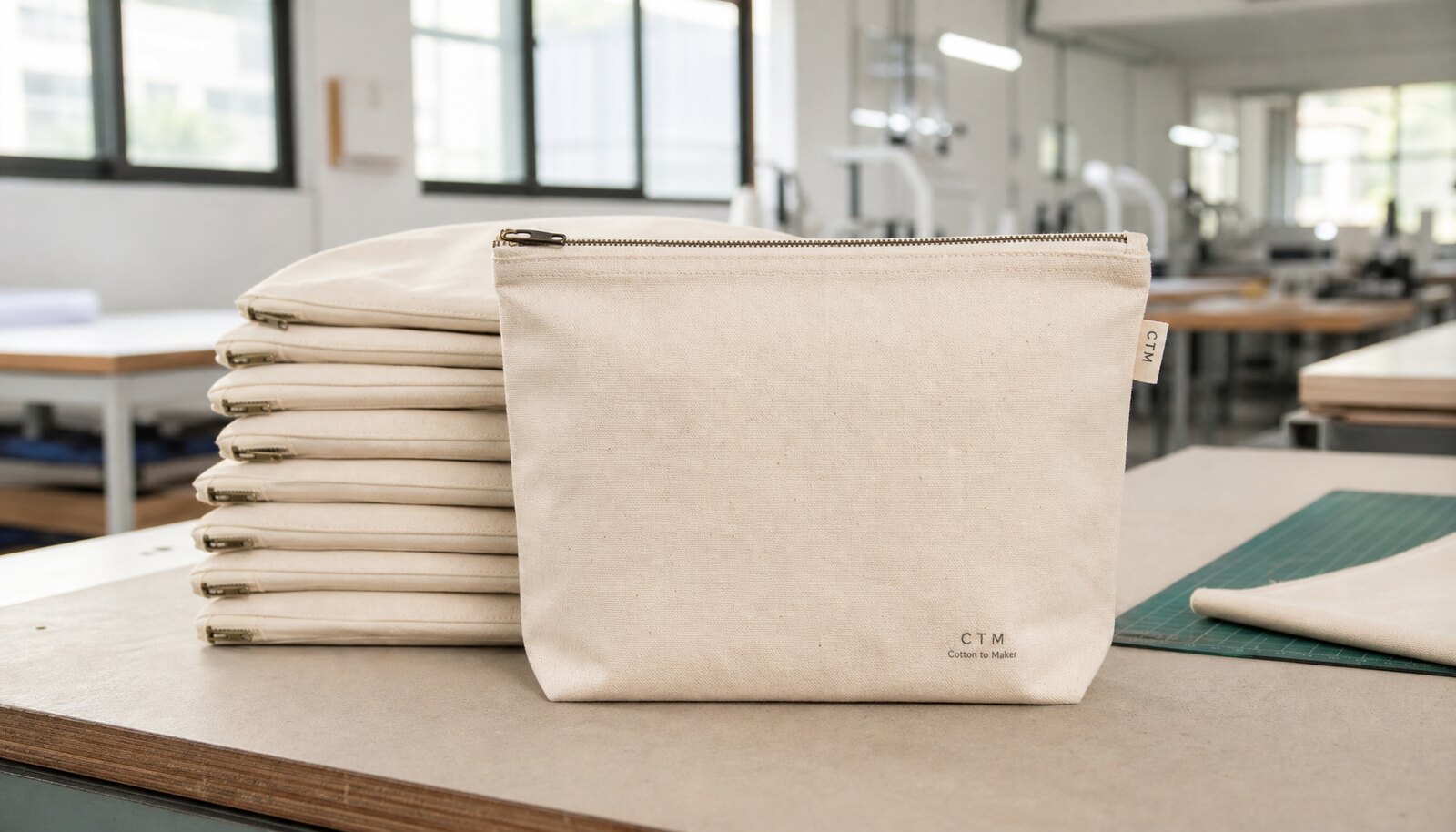
Why ecommerce buyers treat canvas zipper bags as a spec control item
Canvas zipper bags for ecommerce look simple, but the sourcing risk is in the details. A bag can fail in ways that do not show up in a polished sample photo: the zipper binds during fulfillment, the fabric is too soft to hold its shape on arrival, the print breaks on the rough canvas surface, or the packing leaves the zipper pull bent before the customer ever uses it. For procurement teams, the real question is not whether the bag looks attractive on a desk. The question is whether the same bag can be sewn, packed, stored, shipped, and opened repeatedly without generating customer complaints or rework.
That is why these bags should be treated like a controlled product spec, not a generic pouch purchase. Canvas weight, weave, finish, zipper grade, print method, and carton packing all influence unit cost and field performance. If those variables are left open in the RFQ, each supplier will fill in the blanks differently, and the cheapest quote often reflects the weakest assumption rather than the best value. A clear spec protects margin, reduces back-and-forth during sampling, and makes supplier comparison much more reliable.
- Common ecommerce uses include accessory kits, cosmetic pouches, cable organizers, stationery sets, and branded gift packs.
- The right buying goal is lowest landed cost at an acceptable defect risk, not the lowest factory price on paper.
- A simple bag can still trigger chargebacks if the zipper fails, the logo rubs off, or the carton count is wrong.
- When the item is sold direct-to-consumer, first impression matters because the customer touches the bag immediately after unboxing.
Start with fabric weight, weave, and finish
For most canvas zipper bags for ecommerce, 12 oz or 14 oz plain weave canvas is a practical starting point. Twelve-ounce canvas usually gives enough body for the bag to hold its shape in packing and in product photos, while remaining manageable for cutting and sewing. Fourteen-ounce canvas creates a firmer, more premium feel and may suit retail-facing lines better, but it also raises material cost and can make stitching slower, especially around the zipper area and seam corners. If the bag is extremely small or purely promotional, 10 oz can be viable, but buyers should expect a softer hand feel and less structural definition.
The finish matters as much as the base fabric. Raw canvas, bleached canvas, dyed canvas, and washed canvas behave differently in production and in use. Raw canvas often has a natural look, but it may show slubs, fiber flecks, or color variation. Dyed canvas improves brand consistency, but buyers should confirm color tolerance and shade banding. Washed canvas can soften the feel and improve presentation, but it also requires more care on cut size and shrinkage because the fabric may move after finishing. If a factory quotes the canvas without naming the finishing process, the buyer does not yet have a complete spec.
For procurement review, ask the supplier to name the fabric composition, weave type, oz weight or GSM, finishing process, and finished-size tolerance in writing. If the bag is intended for ecommerce fulfillment, add a note on whether the product will be folded, pressed, stuffed, or shipped flat. That detail sounds minor, but it affects how the bag looks when the customer opens the package and whether the zipper line stays straight after pack-out.
- 12 oz: balanced launch spec with reasonable structure and sewability.
- 14 oz: firmer body and more premium feel, but higher material and labor load.
- Raw canvas: natural appearance, but more surface variation and less visual uniformity.
- Washed canvas: softer hand feel, but tighter control is needed on shrinkage and finished size.
- Always state whether the quote assumes raw, bleached, dyed, or washed fabric.
Choose the zipper and closure details before you compare suppliers
The zipper spec is one of the fastest ways to separate a serious factory from a vague quote. For most ecommerce programs, a nylon coil zipper is the safest default because it runs smoothly, is relatively lightweight, and reduces the chance of scratching the contents inside the bag. A metal zipper can look more premium and may suit higher-end lines, but it adds weight, increases cost, and can create complaint risk if the teeth, puller, or tape edge abrade adjacent items. If the bag is intended for cosmetics, tech accessories, or other delicate contents, smooth operation usually matters more than a decorative closure.
The RFQ should name the zipper size or grade, the tape color, the puller finish, the top stop method, and the zipper length tolerance. Generic phrases such as 'good quality zipper' or 'standard zipper' are not enough for procurement. They leave room for substitutions that are hard to detect until the bag reaches warehouse receiving or customer use. If the supplier cannot clearly explain what zipper is included, the quote should be treated as incomplete. For repeat orders, keep the zipper spec stable so the product behaves consistently across lots and does not create a different feel from one shipment to the next.
A good approval test is simple and practical: open and close the zipper repeatedly, check for snagging at both ends, inspect the tape stitching, and look for waves or twist in the zipper line. If the zipper needs a hard pull on the sample, it will probably become a customer complaint once the product has seen more handling. Also ask the factory how the zipper ends are reinforced. Stitched end stops, bar-tacks, and protected seam ends can reduce fray and split risk, especially on bags that will be opened often in ecommerce use.
- Nylon coil zipper: best all-around choice for smooth operation and lower risk.
- Metal zipper: stronger visual weight, but watch scratch risk, weight, and cost.
- Puller style should match the brand level; oversized novelty pullers can raise defect risk.
- Specify tape color and puller finish so repeat orders stay consistent.
- Reinforce the zipper ends to reduce tape fray and seam split after repeated use.
Print method should follow artwork complexity, not habit
The print method should be chosen based on artwork and use case, not simply on what the supplier likes to sell. Screen print is usually the most economical and stable option for simple logos, flat colors, and repeat SKUs. On canvas, it can deliver good opacity if the ink system is matched to the fabric texture and if the number of colors stays manageable. For a straightforward front logo on a natural canvas zipper bag, screen print often gives the cleanest balance of cost and durability.
Heat transfer becomes more useful when the artwork is detailed, includes gradients, or needs a more photographic appearance. The tradeoff is durability: some transfers crack, peel, or show edge lift after handling or abrasion, so they need actual use testing rather than approval by image alone. Embroidery can create a premium look and is often preferred for gift or lifestyle lines, but it can distort on smaller panels and adds thickness near seams or zipper tape. That extra thickness may affect how flat the bag folds in packing or how the zipper line behaves at the top edge.
A woven label is often the most reliable branding option for repeat orders because it avoids ink cracking and is easy to standardize across lots. It also works well when the canvas surface is uneven or too coarse for a detailed print. For ecommerce launches, many buyers use a simple front logo and a small woven side label to balance brand visibility, manufacturability, and repeat-order stability. The key is to tie the print method to the artwork, the bag size, and the expected order volume rather than assuming one decoration method works for every program.
- Screen print: best for simple logos, controlled color count, and cost-sensitive SKUs.
- Heat transfer: better for detailed art, but requires wash and abrasion checks.
- Embroidery: premium appearance, but not ideal for tiny text or tight seam areas.
- Woven label: stable across repeat orders and less dependent on canvas surface texture.
- Do not approve artwork only from a digital proof; review it on the real fabric color and texture.
Use MOQ logic to control cost without weakening the spec
MOQ is not only a factory policy; it is a reflection of how much setup a product requires. If the bag uses standard canvas, an in-stock zipper, and a simple decoration method, the MOQ can often stay relatively low because the factory does not need to open a special material run. Once the order includes custom dyeing, branded zipper pulls, lining, multiple print locations, or unusual packing, the MOQ rises because every added element creates more material risk and more production changeovers. Procurement teams should understand that changeovers are what drive complexity, not just the bag itself.
For ecommerce launches, one of the most expensive mistakes is accepting a low quote that only works for a tiny first run and then failing to plan the reorder path. The first order may look attractive because setup costs are spread over a small quantity, but later reorders can become more expensive if the supplier has to remake custom materials or reopen old color standards. A better approach is to request two versions of the quote side by side: a launch spec using standard materials and a scale spec using the custom features you may want later. That helps the buyer see where the pricing breaks and whether the feature is worth locking in from the start.
If the brand is still testing demand, it is often smarter to keep the body spec stable and customize only one or two elements at first, such as the logo placement or label. This allows the procurement team to evaluate the market without overcommitting to a highly customized SKU. Once the bag has proven volume, the program can move into branded pulls, custom dye lots, or refined packaging. That staged approach protects cash flow and makes supplier comparison more transparent.
- Standard fabric plus standard zipper usually gives the most flexible MOQ path.
- Custom dyeing, lining, special pulls, and multi-location branding commonly raise MOQ.
- Ask the factory to quote both 1-color and multi-color versions so setup cost is visible.
- Separate launch spec from scale spec so the quote is not distorted by future options.
- Do not confuse low MOQ with low total cost if reordering will later require new setup.
Compare supplier routes before you compare price
Canvas zipper bags can be sourced through factories, trading companies, or mixed sourcing channels, and the route matters as much as the headline price. Factory-direct sourcing is usually the strongest option when the design is stable, the brand wants repeatability, and the buyer needs better control over fabric, zipper, stitching, and packing. It is easier to tie the quote back to actual production inputs, which makes quality control and reordering more predictable. For buyers that run consistent ecommerce SKUs, that stability is often worth more than a slightly lower first quote.
Trading companies can be useful when the buyer needs category consolidation, multilingual communication, or sourcing support across several related products. However, the quote must still show the real production assumptions. If a trading company is vague about the mill, the zipper source, the sewing line, or the packing method, the buyer may be comparing incomplete offers. That can hide the real cost of the product and make sample quality difficult to track later.
A practical procurement rule is to ask every supplier to identify whether the bag is a stock-item customization, a semi-custom build, or a fully custom run. Those routes have different risk profiles and different lead-time behavior. A quote based on stock materials may be faster and cheaper, but it may not match the brand’s preferred tone or the repeat order plan. A fully custom run can give more control over appearance and consistency, but it usually carries higher setup cost and longer timeline. Comparing those routes clearly is more useful than comparing unit price alone.
- Factory-direct: best for repeat SKUs and tighter control on materials and sewing.
- Trading company: useful for consolidation, but verify the actual production source.
- Stock-material route: faster sampling and lower MOQ, but less brand differentiation.
- Semi-custom or full custom: better brand control, but higher setup and lead-time exposure.
- Ask every supplier to identify the route explicitly before you evaluate price.
Use a supplier comparison table that reflects real sourcing decisions
The best supplier comparison is not a list of prices alone; it is a decision tool that shows where each offer is strong and where the hidden risk sits. For canvas zipper bags for ecommerce, the practical decision is often between a lower-price quote with weaker control and a slightly higher quote that includes more reliable fabric, clearer sample approval, or better packing. Procurement teams should compare the route to delivery, not just the number at the bottom of the page. That means asking whether the supplier can consistently hit the same fabric weight, zipper grade, print position, and carton pack on every order.
A useful comparison sheet should therefore include more than one line for each supplier: what materials are included, how the sample was made, what the packing assumptions are, what defects are accepted or excluded, and whether the price is based on stock material or a dedicated run. If the supplier cannot answer those questions clearly, the quote should be marked as incomplete. The table below is designed for that type of sourcing review and can be copied into your internal RFQ worksheet.
- Compare on the same spec version, not on approximate descriptions.
- Make sure the sample, quotation, and inspection notes all carry the same revision number.
- If one quote excludes setup or packaging, it is not a fair comparison until those items are added back.
Sample approval should test more than appearance
A canvas zipper bag sample must be approved like a functional item, not like a display sample. The bag should confirm size, zipper performance, logo scale, seam alignment, fold behavior, and how the fabric responds after handling. If the sample looks good but the zipper drags, the print sits too close to the seam, or the panel twists when filled, the bulk order will likely repeat those issues. In ecommerce, those problems matter because the end customer handles the bag directly and often notices defects that a trade buyer might overlook at receiving.
The sample process should move in stages if the specification is still flexible. A plain sample helps validate the structure, size, and zipper function before branding is locked. A second sample should confirm the final print or label, the final trim, and the final packing method. This two-step approach is especially useful when the artwork or interior layout is not yet final. It prevents a brand from approving a decorated sample that later proves difficult to sew or package at scale.
Set sample approval criteria in measurable language. For example: the zipper must open and close at least 20 times without catching; the logo must remain within the agreed placement tolerance; the seams must lie flat with no twisting; and the bag must fit the intended contents without placing stress on the top closure. If the bag will carry a specific product set, test it with that actual loading condition. A sample that works empty is not enough for procurement sign-off.
- Measure finished width, height, and gusset on the actual sample piece.
- Cycle the zipper repeatedly before approving bulk production.
- Check print opacity and edge clarity on the real canvas color.
- Verify barcode, care label, and hangtag placement if the bag will be warehoused or retail-tagged.
- Use a plain sample first if the structure is still under review, then a decorated sample once the spec is locked.
Packing choices change damage rate and warehouse speed
Packing is part of product quality, especially for ecommerce. A bag that is packed loosely in a carton can arrive with bent zipper pulls, surface dirt, or deep creases that affect the first impression at receiving. Flat packing with a fixed inner pack count is usually the most controllable option because it keeps carton content predictable and reduces the chance of random movement during transit. For premium retail presentation, a clean polybag can help protect the fabric surface, but it should be used for a reason rather than by habit. If the polybag adds cost, waste, or warehouse handling steps without improving the condition of the item, it may not be worth it.
The packing spec should name the inner pack quantity, outer carton quantity, carton dimensions, net and gross weight target, and whether the product requires a care card, hangtag, barcode sticker, or export mark. If the factory has to guess, the receiving team will be the first to discover discrepancies. That is why procurement should treat packing as an approval item rather than a side note. A clear packing standard can reduce count claims, protect the zipper pull, and speed up warehouse intake. It also makes quote comparison easier because the buyer can see whether the price includes only the bag or the bag plus a full export-ready pack standard.
For ecommerce programs, carton resilience matters. Ask the supplier how the goods are protected inside the carton and whether separators, tie bands, or internal support are used to prevent zipper damage. If the bags are shipped to a fulfillment center, define the carton marks and any barcode format in advance so the warehouse team can receive the goods without relabeling. Simple packing rules often save more money than a small unit-price discount because they reduce rework, receiving disputes, and time spent fixing damaged inventory.
- Flat pack is usually the safest option for canvas zipper bags.
- Use a fixed inner pack count to reduce warehouse mismatch claims.
- Protect zipper pulls so they do not scratch adjacent bags in transit.
- State carton markings and barcode location before production starts.
- Only use polybags when they improve protection or compliance, not just for habit.
Lead time, quote structure, and landed-cost comparison
For a normal launch order, the schedule usually includes sample confirmation, material allocation, and bulk production. If the factory already has the correct canvas and zipper in stock, the project can move faster because cutting and sewing can start sooner. If not, the lead time expands because color matching, material ordering, and trim allocation all happen before production. Buyers should ask the supplier to split sample time from bulk production time so it is clear where delays are likely to occur and what must be approved before the schedule starts.
A quotation is only useful if every supplier is quoting against the same assumptions. A low price that excludes print setup, carton labeling, inner packaging, or export packing is not a real comparison. Procurement teams should request a quote that shows the fabric weight, zipper specification, decoration method, packing standard, sample fee, one-time setup fee, and the lead time after approval. When those items are visible, the buyer can compare landed cost more accurately and see which supplier is truly better for the program.
If the timeline is important for ecommerce launch, ask the supplier which stage is most likely to move the date: sample revision, fabric sourcing, print approval, or packing changes. This is more useful than a generic promise of fast delivery. A quote that cannot explain its schedule is not ready for procurement review. The stronger the documentation on lead time and inclusions, the easier it is to manage stock planning and avoid launch delays or stockouts.
- Typical quote components: base bag price, print setup, sample fee, packaging fee, and carton cost.
- Compare landed cost using the same Incoterm, packing standard, and carton specification.
- A faster lead time can be worth paying for if it reduces stockout risk on ecommerce channels.
- If the quote does not show what is included, it is not yet a usable sourcing offer.
- Ask the supplier to identify the stage that most often causes delay in their production flow.
Specification comparison for buyers
| Spec decision | Recommended option | When it fits | Buyer risk to check |
|---|---|---|---|
| Fabric weight | 12 oz or 14 oz plain weave canvas, with finished-size tolerance stated | Retail-ready pouch that must hold shape in ecommerce packing and customer photos | 10 oz can feel soft and cheap; heavier fabric increases sew difficulty, seam bulk, and freight |
| Fabric finish | Raw, bleached, dyed, or washed canvas declared in the RFQ | When visual tone, hand feel, or shrinkage needs to be controlled for a branded line | Undeclared finishing creates color drift, inconsistent shrinkage, and logo placement shifts after cutting or pressing |
| Zipper type | Nylon coil zipper for most SKUs; #3 or #5 metal zipper for premium lines | Daily-use bags, cosmetics kits, tech accessory kits, and promo sets | Metal can scratch contents and increase weight; coil zippers need smooth cycle testing and consistent puller quality |
| Zipper specification | State tape color, puller finish, top stop method, and zipper length tolerance | Repeat orders where consistency matters across production lots | Generic wording such as 'good zipper' allows substitutions that are hard to police later |
| Print method | Screen print for simple logos; heat transfer for detail; embroidery for premium lines; woven label for repeat SKUs | Logo-driven ecommerce SKUs with controlled artwork and repeat ordering | Fine line art can break on rough canvas; embroidery can distort on small panels; transfers can crack if durability is not tested |
| Bag structure | Single compartment with optional lining or gusset based on load and volume | Stationery, cosmetics, cables, gifts, and accessory bundles | No gusset limits volume; lining improves finish but adds cost and can extend lead time |
| Closure finish | Top zipper with reinforced seam allowance and end-stop protection | Ecommerce parcels that must survive fulfillment, storage, and repeated consumer opening | Weak end stitching causes zipper split, tape fray, or seam failure after repeated use |
| Branding position | Front-center logo plus optional side woven label or inner care label | Direct-to-consumer retail where unboxing and brand recognition matter | Overlarge logos can cross seams or distort on the panel; label placement may conflict with barcode or compliance needs |
| Packing method | Flat packed with fixed inner pack and carton count; polybag only if it protects surface quality | Bulk export, warehouse receiving, and clear count control | Loose stacking can dent zipper pulls, add dirt, and create carton count disputes |
Buyer checklist before sampling
- Confirm final bag size, gusset depth, zipper length, and usable loading weight before requesting price.
- Specify fabric type, fabric weight in oz or GSM, finish type, color standard, and acceptable size tolerance.
- Send vector artwork and define logo size, print position, Pantone reference, and approved sample color.
- Request sample photos plus one physical pre-production sample before bulk approval.
- Agree carton packing, barcode or hangtag needs, master carton markings, and outer case count before production.
- Set inspection checkpoints for stitching, zipper function, print adhesion, stains, count accuracy, and carton damage.
- Ask the factory to confirm whether the quote includes setup, packaging, labels, and export carton costs.
- Lock the approval version number so the sample, quotation, and inspection sheet all reference the same spec.
Factory quote questions to send
- What exact fabric weight, weave, and finishing process are included in the quote, and what tolerance do you allow on final size after cutting or washing?
- Which zipper supplier or zipper specification is included, and is the puller metal or plastic, standard or branded, and matched to the bag color?
- Is the quoted price based on screen print, embroidery, heat transfer, or woven label, and what is the setup cost for each method?
- What MOQ applies to this exact specification, and how does it change if we switch print method, add lining, change zipper type, or request custom dyeing?
- What sample type is included first: plain pre-production sample, printed sample, or production-representative sample with final trims and packing?
- What packing method is included in the quote, and what carton size, carton quantity, inner pack count, and labeling standard are assumed?
- What is the standard production lead time after sample approval, and what steps can extend it: fabric sourcing, printing, trim allocation, or packaging changes?
- What inspection standard do you use before shipment, and do you accept buyer AQL terms or third-party inspection?
- Can you show the material source, trim specification, and packing list in the quotation so we can compare apples to apples?
Quality-control points to confirm
- Measure finished width, height, and gusset at the agreed reference points, and keep them within the approved tolerance; many buyers use ±5 mm on small bags and a wider tolerance only if the factory documents why it is necessary.
- Check fabric weight against the approved standard and confirm the fabric lot is consistent across the order, not only on the first cut pieces.
- Test the zipper for at least 20 full open-close cycles on sample pieces and random production pieces; reject binding, skipped teeth, crooked tape stitching, or puller detachment.
- Verify seam strength at stress points: zipper ends, side corners, gusset joins, and label attachment points.
- Inspect print placement against the approved artwork placement chart, and check for smudge, edge bleed, cracking, or poor opacity on the actual canvas color.
- If the bag is washed or enzyme-finished, check colorfastness, shrinkage, and hand feel after the finishing step, not just before it.
- For woven labels or care labels, confirm the spelling, content, and stitching direction, and ensure labels do not interfere with folding or barcode scanning.
- Use a sampling standard such as AQL for bulk inspection; many buyers define critical, major, and minor defects separately and reject any lot that exceeds the agreed limit.
- Review carton count, inner pack count, carton mark, and net/gross weight before shipment release so warehouse receiving matches the packing list.
- Open random cartons to check dust, odor, dents, and zipper pull protection, because packing damage is often visible only after transit handling.