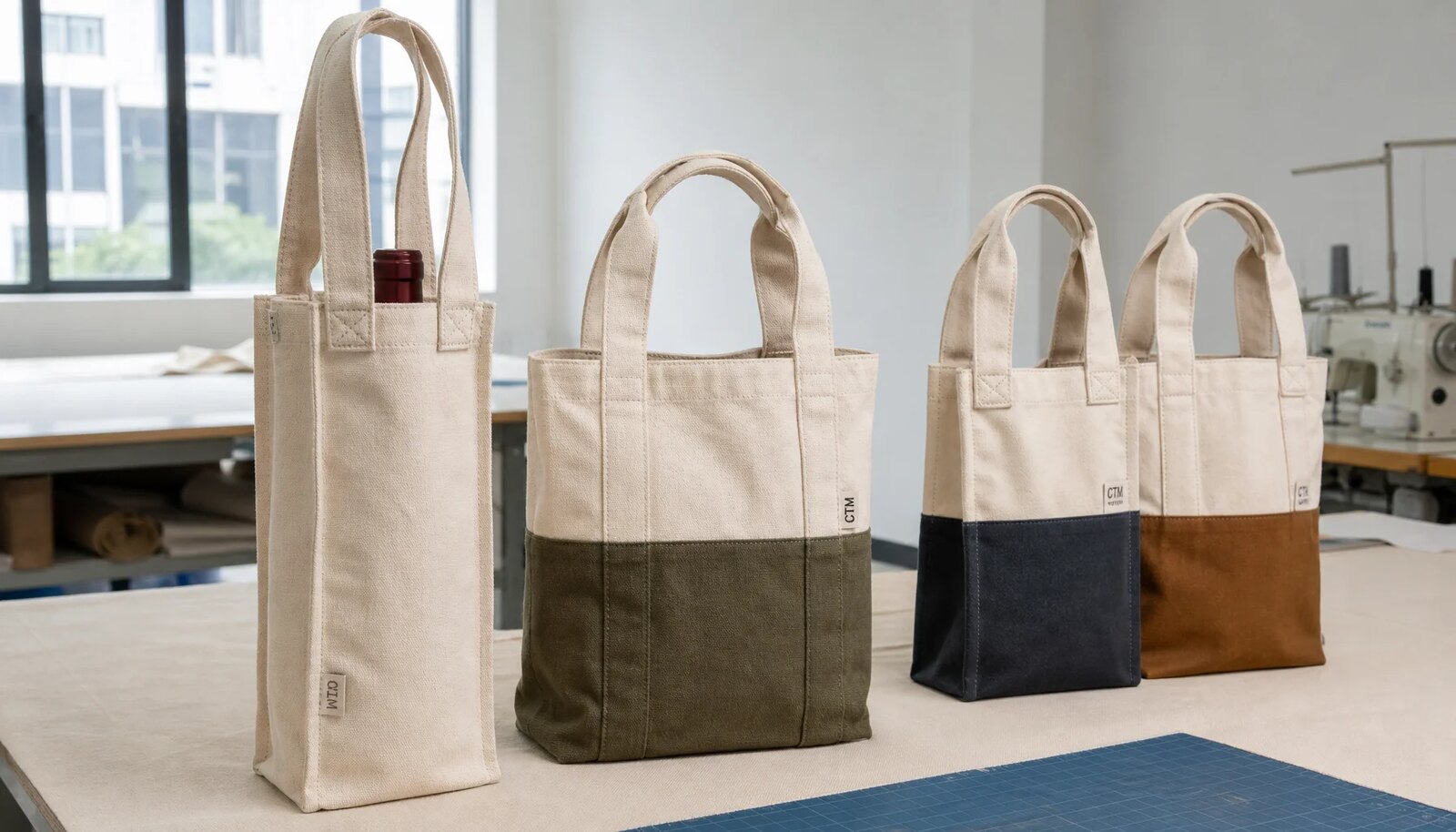
1. Start With the Buying Brief, Not the Logo Mockup
Canvas wine carriers look simple in a rendering. In production, they are not just narrow promotional totes. They carry concentrated weight, rigid glass, and sometimes two bottles that can knock against each other. For an eco apparel brand, the carrier also has to sit comfortably beside garments, totes, gifting items, and sustainability messaging. The right product specification depends on whether the item is a retail accessory, winery collaboration, holiday bundle component, corporate gift, or lower-cost giveaway.
Before you ask for wholesale pricing, write a short buying brief. Keep it practical: channel, order volume, bottle type, target use, packing method, retail presentation, and whether the item is expected to be reusable. A carrier sold beside apparel may need cleaner stitching, better fabric hand feel, subtle labeling, and a more controlled finish. An event giveaway may be judged mainly on cost, print visibility, and fast flat packing. A gift set may need a stronger base, a reliable divider, and packaging that still looks tidy after fulfillment handling.
This step saves money because it stops suppliers from quoting different products under the same name. One factory may assume 8 oz promotional cotton. Another may price 14 oz canvas with a sewn divider. A third may quote a stock blank with local printing. All three can call the product a canvas wine bag, but the landed cost, durability, sample timeline, and brand impression will not be comparable.
- Define the channel: apparel store, winery, event, corporate gift, online bundle, or wholesale resale.
- State whether the carrier ships empty, flat, folded, hanging, or packed with bottles.
- Clarify whether reusability is a formal product promise or only an expected benefit.
- Set the product mood: rustic, minimalist, premium, natural, promotional, or gift-ready.
- List must-have retail details such as hangtag, barcode, shelf-standing ability, SKU label, or carton display packing.
2. Translate Bottle Fit Into Real Measurements
The phrase “fits a 750 ml bottle” is not enough for a production order. Wine and spirits bottles vary by height, body diameter, shoulder shape, base punt, neck length, and weight. Bordeaux bottles are usually slimmer and straighter than many Burgundy or sparkling wine bottles. Champagne and sparkling bottles are often wider and heavier. Spirits bottles can be short, square, tapered, or unusually shaped. If you approve a sample using the easiest bottle in your range, the bulk shipment may distort when customers use the real assortment.
Fit decisions affect the entire pattern: body width, gusset, base size, divider placement, opening height, and handle drop. A one-bottle carrier with too much extra room can look sloppy and allow the bottle to lean. A tight carrier may look clean when empty but strain at the seams when loaded. For two-bottle carriers, the margin is smaller. If the divider is misplaced or the gusset is too narrow, the bottles can press into each other or pull the bag out of shape.
Create a bottle measurement sheet before sampling. Include maximum height, maximum body diameter, shoulder profile, preferred neck exposure, and full loaded weight. If the carrier must work across several bottle styles, design around the largest realistic diameter and tallest realistic height rather than a nominal capacity. Ask the supplier to confirm the maximum usable bottle dimensions in writing, then attach that confirmation to the tech pack and sample approval record.
- Measure the actual bottle or bottle range before pattern development.
- Record maximum height, maximum diameter, shoulder profile, neck exposure, and loaded weight.
- For two-bottle bags, test fit with two full-size bottles at the same time.
- Confirm whether necks should be exposed, covered, tied, or left open.
- Keep fit photos in the approved sample file so later disputes are easier to resolve.
3. Specify Canvas Weight, GSM, Finish, and Fiber Content
Fabric is one of the biggest cost drivers in canvas wine carriers, and small wording differences can change the quote. For reusable retail and gifting programs, 12 oz to 16 oz canvas is a practical development range. Approximate metric conversions are about 407 GSM for 12 oz, 475 GSM for 14 oz, and 542 GSM for 16 oz. Those numbers are useful, but they are not a substitute for a mill specification. Weave, finishing, washing, and supplier conversion habits can change the actual GSM.
A 12 oz canvas can work well for many one-bottle carriers and simpler two-bottle designs if the handles and seams are properly reinforced. A 14 oz or 16 oz canvas usually gives more structure, stronger shelf presence, and a more substantial hand feel. Still, heavier is not always better. It increases material cost, may add carton bulk, can fold less cleanly, and may create a rougher print surface depending on weave and finish.
Fiber content deserves the same level of precision. Options may include conventional cotton canvas, organic cotton canvas, recycled cotton blends, recycled polyester-cotton blends, or another cotton-rich blend. For eco apparel brands, the material story has to stand up to marketing and compliance review. If a product page, hangtag, or sales deck says organic, recycled, undyed, or lower-impact, the documentation should support the exact bulk lot. A catalogue page or general supplier statement is not enough.
- Request both oz and GSM for every fabric option being quoted.
- Compare 12 oz, 14 oz, and 16 oz samples for hand feel, stiffness, print clarity, fold marks, and carton volume.
- Specify natural, bleached, unbleached, dyed, washed, coated, or unfinished canvas clearly.
- Ask whether fabric is stock, custom-dyed, greige-to-dye, or buyer-nominated.
- Keep material certificates or transaction documents tied to the PO and bulk lot when making eco claims.
4. Engineer Handles, Seams, Base, and Dividers Around Load
Most bottle-bag failures happen at stress points, not in the middle of the canvas panel. The handles, handle attachments, bottom seams, side seams, and divider seams carry the real load. A sample can photograph beautifully and still be a weak product if the seam allowance is too narrow, the thread is poor, the stitch density is loose, or the handle material stretches under weight. Avoid vague instructions such as “reinforced handle” unless you also define what reinforcement means.
Start with handle material and measurements. Self-fabric handles give a cohesive canvas look. Cotton webbing is often cleaner for repeatability and perceived strength. Either way, specify handle width, handle drop, attachment length, seam allowance, and stitch pattern. Common reinforcement choices include bar-tacks, box-stitch, box-cross stitch, or multiple rows of secure stitching. The final choice should be approved through sampling and a realistic load test, not just by appearance.
Two-bottle carriers need another layer of engineering. The divider must keep bottles separated during normal carrying without rough internal edges or excessive stiffness. If it sits too low, bottle shoulders can collide. If it is not anchored well at the bottom or sides, it may twist or collapse. For retail display, a boxed base, double-layer bottom, or removable insert can help the carrier stand upright. For low-bulk e-commerce packing, a simpler base may be smarter.
- Specify handle width and drop in centimeters or inches, not only by photo.
- Define the reinforcement stitch: bar-tack, box-stitch, box-cross, double row, or approved equivalent.
- Record seam allowance for handle attachment and main load-bearing seams.
- For two-bottle carriers, confirm divider height, fabric, top edge, bottom anchoring, and side attachment.
- Inspect the loaded sample after repeated lifting for seam strain, thread breakage, distortion, or fabric tearing.
5. Choose Branding That Works With Canvas, Not Against It
Branding changes the unit cost, sample path, defect risk, and perceived value. Screen printing is often the most efficient option for bold logos, limited color counts, and repeat wholesale runs. It works well on canvas when the factory controls ink deposit, registration, and curing. If curing is poor, the print can feel tacky, transfer, crack, or fail a rub check.
Woven labels, side tabs, and sewn patches often make a canvas wine carrier feel more like an apparel accessory than a promotional item. They are useful when the brand wants subtle identification, premium texture, or a label language consistent with garments and reusable totes. Embroidery can look elevated, but test it carefully. Dense stitches may pucker canvas, distort narrow panels, or leave a rough back inside the carrier. Heat transfers can hold fine detail, but on natural canvas they may feel too plastic or show fold lines after packing.
Do not approve decoration from a digital mockup alone. Ask for a print strike-off or decorated sample on the actual production canvas. Canvas shade, weave texture, ink absorption, and panel tension all affect the final result. Define logo placement from fixed points such as the top edge, side seam, centerline, or base seam. Also agree on placement tolerance. A 10 mm shift might be acceptable for a rustic graphic and unacceptable for a centered luxury mark.
- Use screen print for economical one- to three-color logos and bold artwork.
- Use woven labels or side tabs for subtle apparel-style branding.
- Approve embroidery only after checking puckering, tension, backing, and reverse-side feel.
- Test heat transfers by folding, rubbing, and leaving the sample packed before review.
- Define artwork size, color target, placement reference points, and allowable placement tolerance.
6. Build an RFQ That Lets You Compare Suppliers Fairly
A strong wholesale RFQ should read like a product build sheet. If the request only says “canvas wine carrier with logo,” suppliers will fill the gaps in different ways. One may quote lighter fabric, another may exclude the divider, and another may assume a cheaper print or simpler packing. The lowest price may be attached to the weakest specification.
Give every supplier the same technical brief and ask for pricing at practical volume tiers. Common comparison tiers might be 1,000, 3,000, and 5,000 units, adjusted to your real forecast. Separate one-time charges from repeat-order unit costs. Setup charges may include screens, embroidery digitizing, woven-label development, lab dips, sample courier fees, packaging artwork, or extra revisions. If these costs are mixed into the unit price, reorder planning becomes harder.
Normalize commercial terms as well. Confirm currency, payment terms, Incoterm, delivery point, sample fees, inspection responsibility, and packing assumptions. A low EXW price may lose its advantage after inland transport, export handling, or documentation costs. A quote based on flat packing cannot be compared directly with one that includes individual polybags, hangtags, barcode labels, and retail cartons.
- Provide a fixed specification to every supplier before comparing price.
- Ask for tiered pricing at realistic order volumes, not only the supplier’s preferred MOQ.
- Separate fabric, sewing, decoration, trims, labels, packing, sample charges, and setup charges.
- Confirm Incoterm, currency, payment schedule, delivery point, and inspection cost.
- Request carton dimensions, units per carton, gross weight, net weight, and estimated CBM before selecting a supplier.
7. Verify Sustainability Claims Before the Claim Goes Public
Eco apparel brands often use canvas wine carriers to support a broader sustainability message. That can work, but procurement needs to keep the claim accurate. Cotton, organic cotton, recycled cotton, and recycled polyester blends can all be reasonable options depending on the program. The key question is not which phrase sounds best. It is whether the claim can be documented for the actual production lot and communicated without exaggeration.
If you choose organic cotton, ask what documentation is available and whether it applies to the material used in your bags. If you choose recycled content, request the recycled fiber percentage, input type, and supporting certification or supplier declaration tied to the lot. If the look is natural canvas, clarify whether it is unbleached, bleached, washed, dyed, or finished. A natural color does not automatically mean untreated, chemical-free, or lower-impact.
Packaging claims need the same discipline. Replacing individual polybags with paper bands may reduce plastic use, but it can expose the product to dust, humidity, or warehouse handling marks. Adding a rigid base insert may improve shelf presentation, but it also adds material, freight volume, and possible end-of-life complexity. The strongest procurement approach is to choose specifications that match the brand’s actual priorities, then write marketing language only after the documentation and trade-offs are clear.
- Confirm the exact recycled or organic content percentage before marketing review.
- Keep supplier documents tied to the PO, fabric lot, and shipment, not only a general brochure.
- Avoid vague claims such as eco-friendly unless the brand defines what the claim means.
- Clarify whether natural canvas is unbleached, bleached, dyed, washed, or finished.
- Evaluate packaging by function, material use, dust protection, carton efficiency, retailer rules, and customer experience.
8. Treat Sampling as Pre-Production Control
Sampling should remove uncertainty, not simply produce a nice approval photo. An early prototype may use substitute fabric to check size and construction. That is normal. The final pre-production sample, however, should match the bulk fabric, decoration method, handle construction, divider, base, labels, fold method, and packing plan. If the approved sample uses a different canvas weight or decoration process, it cannot be a reliable production standard.
Review the sample with real bottles. Insert the intended bottle or bottles, lift the carrier repeatedly, hold it loaded, set it down, fold it as it will be packed, and reopen it. Watch for the base twisting, the bottle leaning, handles rolling, dividers shifting, or prints cracking at fold points. Measure the sample empty and loaded because narrow canvas panels can look different under tension.
After approval, create a gold sample file. Ideally, keep a signed or sealed physical sample. Also keep photos of the approved construction, measurements, fabric reference, artwork position, label position, packing fold, and carton method. If the supplier proposes changes after approval, require written approval before bulk cutting. A small change to canvas shade, handle webbing, seam allowance, or label placement can become a major dispute when multiplied across thousands of units.
- Separate prototype approval from final pre-production approval.
- Require the final sample to use actual bulk fabric and actual decoration method.
- Test with the heaviest and widest bottle format in the approved range.
- Photograph handle stitching, divider, base, logo placement, label, and fold method.
- Use the approved gold sample as the reference for inline and final inspection.
9. Write QC Tolerances and Defect Rules Before Bulk Production
Quality control should be agreed before cutting starts. For canvas wine carriers, defects can be cosmetic, functional, or safety-related. A small natural slub may be acceptable if it fits the approved fabric character. Oil stains, mildew odor, wrong material, broken seams, or handle failure are different matters. The factory, buyer, and any third-party inspector should work from the same defect definitions.
Set dimensional tolerances that match the design. For small soft goods, buyers often use plus or minus 5 mm to 10 mm for features such as label placement, divider position, and handle attachment. Larger body dimensions may use plus or minus 10 mm to 15 mm, depending on fabric behavior and pattern complexity. Decoration tolerances should cover placement, color target, registration, curing, edge sharpness, and print defects.
Load performance is the most important functional checkpoint. Define the bottle weight, hold time, number of lift cycles if used, and acceptance criteria. A practical buyer-side method is to load the intended bottle weight, hold for 60 seconds, perform repeated lifts, and inspect for seam opening, thread breakage, tearing, bar-tack failure, or severe handle elongation. The point is not to invent a complicated lab test. The point is to use the same repeatable check before approving shipment.
- Classify critical defects: handle failure, broken load seam, wrong material, sharp trim, mildew, strong odor, or unsafe construction.
- Classify major defects: obvious stains, severe shade variation, crooked logo beyond tolerance, poor print curing, or incorrect dimensions.
- Classify minor defects: small loose thread, slight natural slub, or small finishing issue within agreed limits.
- Inspect fabric, cutting, sewing, decoration, finished measurements, load performance, and packing.
- Pull samples from multiple cartons and production times, not only top-layer units prepared for inspection.
10. Plan Packing, Lead Time, and Landed Cost Early
Canvas wine carriers are usually lightweight, so freight cost is often driven by carton volume rather than product weight. Flat packing is efficient when retail presentation allows it. Half-fold packing can reduce carton dimensions but may create crease lines. Individual polybags protect against dust and warehouse handling but add plastic and labor. Belly bands, hangtags, tissue, inserts, and retail cartons can improve presentation, yet each one affects cost, CBM, and fulfillment handling.
Ask for packing options before issuing the PO. Compare unit cost and carton data together: units per carton, carton dimensions, gross weight, net weight, and total CBM. A packaging change that adds only a small unit cost can materially increase freight or storage cost if it reduces carton efficiency. For eco apparel brands, the packing plan should also fit the brand’s material position and any retailer requirements.
Lead time should be broken into stages. Material sourcing, lab dips, printing screens, woven-label development, prototype sampling, pre-production sample approval, bulk cutting, sewing, decoration, inspection, and export packing all take time. If the order is tied to a holiday launch, winery collaboration, or apparel drop, build approval deadlines into the PO. Late artwork, missing bottle measurements, or changed packaging can delay production more than the sewing time itself.
- Compare flat pack, folded pack, belly band, hangtag, polybag, and retail carton options by CBM and presentation value.
- Confirm carton marks, SKU separation, PO number, quantity, country-of-origin marking if required, and barcode needs.
- Request pre-shipment packing photos showing unit fold, inner packing, master carton, and carton labels.
- Build lead time around material, sampling, decoration, production, inspection, and export, not just sewing days.
- Do not finalize landed cost until packing method, carton data, Incoterm, and inspection requirements are confirmed.
Specification comparison for buyers
| Spec decision | Recommended option | When it fits | Buyer risk to check |
|---|---|---|---|
| Supplier route | Direct factory or managed supplier with proven bottle-bag, structured tote, or gift-bag sewing experience | You need control over pattern, bottle fit, canvas weight, divider, handle reinforcement, print, packing, and inspection | Do not assume a flat tote supplier can engineer bottle load. Ask for similar samples, stitch photos, and the load-test method they normally use. |
| Fabric weight | 12 oz to 16 oz cotton canvas, often about 407 to 542 GSM depending on mill conversion and finishing | Most reusable one-bottle and two-bottle retail, gifting, and apparel collaboration programs | Confirm actual GSM from the fabric mill or lot test. Oz labels are not converted consistently across all suppliers. |
| Fabric composition | Conventional cotton canvas, organic cotton canvas, recycled cotton blend, or recycled polyester-cotton blend with lot-level documentation | Eco apparel brands need a material story that can pass internal compliance and marketing review | Do not claim organic, recycled, undyed, or low-impact unless the documents match the bulk lot, not only the supplier catalogue. |
| Bottle format | Pattern built around named bottle styles and maximum diameter/height, not only 750 ml volume | Your program may include Bordeaux, Burgundy, Riesling, champagne, sparkling wine, spirits, or mixed gifting | A bag approved on a slim Bordeaux bottle may distort, lean, or strain at the seams with a wider Burgundy or sparkling bottle. |
| Bottle count | One-bottle or two-bottle carrier as the base wholesale program | You want clear costing, easier inspection, efficient packing, and repeatable retail use | Three-, four-, or six-bottle formats need stronger base engineering and should be developed as separate SKUs. |
| Base construction | Sewn boxed base, double-layer base, or removable board insert depending on the standing requirement | The carrier must stand on shelf, protect a gift set, or handle repeated customer use | Rigid inserts improve structure but add cost, carton volume, and potential end-of-life complexity. |
| Divider design | Sewn center divider with sufficient height and secure top/bottom anchoring for two-bottle bags | Two bottles must remain separated during carrying and retail handling | Loose dividers allow glass-to-glass contact; overly stiff dividers increase cost and packing thickness. |
| Handle construction | Cotton webbing or self-fabric handles with specified width, drop, seam allowance, and bar-tack or box-cross reinforcement | The bag will carry one or two full bottles and should feel safe in repeated use | Weak handle attachment is a critical defect. Define a sample load test before approving production. |
| Branding method | Screen print for bold low-color artwork; woven label or side tab for subtle apparel-style branding; embroidery only after pucker testing | You need repeatable logo placement, durable decoration, and a brand-appropriate finish | Poor curing, dense embroidery, or thin transfers can crack, pucker, peel, or look too promotional on canvas. |
Buyer checklist before sampling
- Define the sales use case: apparel-store accessory, winery collaboration, tasting-room resale, e-commerce add-on, corporate gift, holiday bundle, or promotional giveaway.
- List the exact bottle styles to fit, including maximum bottle height, maximum body diameter, shoulder shape, neck exposure, and loaded weight.
- State whether the carrier ships empty, flat, folded, hanging, packed with a bottle, or packed inside a gift kit.
- Lock the base fabric in both oz and GSM where possible; common retail starting points are 12 oz, 14 oz, and 16 oz canvas.
- Specify composition clearly: conventional cotton, organic cotton, recycled cotton blend, recycled polyester-cotton blend, or another approved fabric.
- Request documentation for any organic, recycled, undyed, or responsible-material claim before marketing copy is finalized.
- Define finished dimensions with tolerances for width, height, depth/gusset, base size, divider position, and handle drop.
- Specify handle material, handle width, handle drop, attachment seam allowance, reinforcement stitch type, thread type if relevant, and intended load test.
- Confirm whether the design includes a sewn divider, bottom reinforcement, removable insert, lining, closure, rivets, snaps, drawstring, binding, labels, or hangtags.
- Choose the branding method and define artwork size, color count, Pantone or approved color target, placement from fixed seams, and acceptable placement tolerance.
Factory quote questions to send
- What exact body fabric are you quoting: fiber content, recycled or organic content if any, canvas weight in oz, GSM, weave type, yarn count if available, and finish?
- Is the price based on stock fabric, greige fabric to be dyed, custom-dyed canvas, buyer-nominated material, or a fabric that requires mill MOQ?
- Can you provide fabric documentation for the exact bulk lot if we need to support organic, recycled, or other material claims?
- What bottle dimensions did you use for the pattern, and what maximum bottle height and maximum diameter can the finished carrier fit without seam distortion?
- For a two-bottle carrier, what divider height, divider fabric, seam construction, and top/bottom anchoring are included in the quoted price?
- Are the handles self-fabric, cotton webbing, recycled-content webbing, or another material, and what are the width, drop length, seam allowance, and reinforcement stitches?
- What thread type and stitch density are assumed for the main seams, handle attachment, divider, and bottom seams?
- Does the quote include a double-layer base, removable insert, lining, binding, rivets, snaps, drawstring, closure, hangtag, care label, or only the outer shell?
- What print method is assumed, how many colors are included, what artwork size is priced, and what setup charge applies per screen, color, plate, digitizing file, or revision?
- Can you provide a print strike-off on the actual bulk canvas before pre-production sample approval?
Quality-control points to confirm
- Fabric weight should match the approved specification within an agreed tolerance, commonly reviewed as GSM against the bulk fabric lot rather than relying only on an oz description.
- Fabric shade should be checked under consistent lighting against the approved lab dip, fabric swatch, or gold sample, especially for natural, black, navy, dark green, and custom-dyed canvas.
- Canvas should be free from oil stains, mildew marks, strong chemical odor, excessive dust, visible shade bands, large weaving faults, objectionable slubs, needle damage, and contamination before cutting.
- Finished width, height, gusset/depth, base size, divider position, and handle drop should stay within written tolerances agreed before production.
- Common soft-goods tolerances may be plus or minus 5 mm to 10 mm for small dimensions and plus or minus 10 mm to 15 mm for larger panels, but the buyer should approve values by design and use case.
- Stitching around handles, side seams, divider seams, bottom seams, and top hems should be even, tight, and free of skipped stitches, broken threads, seam slippage, loose tails, puckering, and exposed raw edges unless intentionally specified.
- Handle attachment should pass the approved static and repeated lift test using the intended bottle load, with no fabric tearing, bar-tack failure, seam opening, thread breakage, or severe elongation.
- A practical buyer-side sample test is to load the intended bottle weight, hold for 60 seconds, perform repeated lifts, and inspect all stress points; the exact standard should be written into the inspection plan.
- Divider placement, if used, should keep bottles separated without sharp seam allowances, rough edges, excessive side movement, or glass-to-glass contact during normal carrying.
- Base construction should remain flat enough for the intended retail presentation and should not twist, collapse, or expose loose internal board edges if inserts are used.