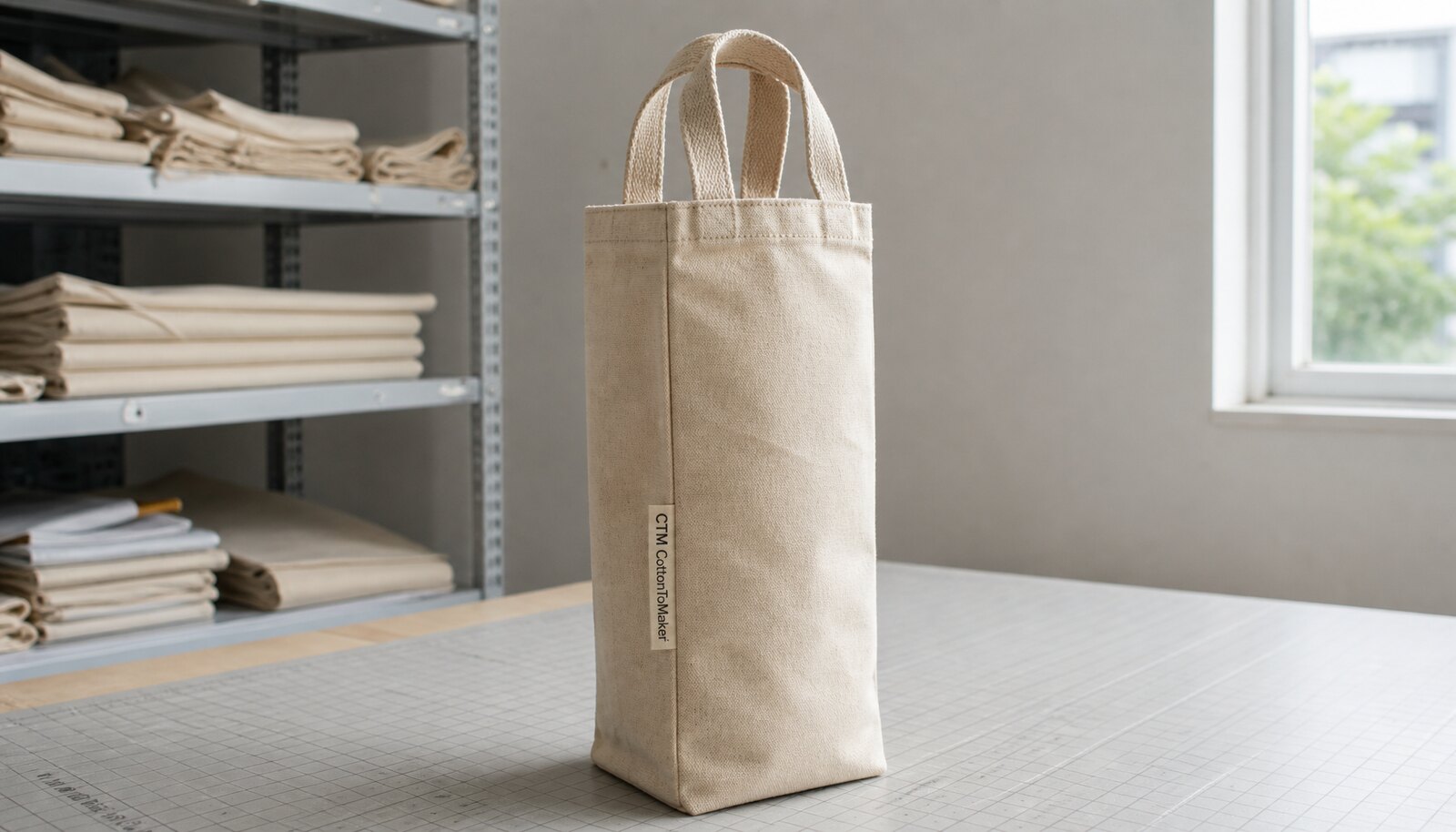
Why canvas wine carriers need a tighter buying brief than standard gift bags
A canvas wine carrier looks simple until procurement starts comparing quotes. The bag has to hold a heavy glass bottle, present well as a corporate gift, and survive packing, transit, and end-user handling. If the RFQ only says “canvas bottle bag,” the factory will fill in the blanks with its own assumptions on fabric weight, handle strength, base shape, and print method. That is how buyers end up with carriers that look fine on a desk sample but sag, wrinkle, or print poorly in production.
For corporate gifting, the buying problem is not just cost. It is consistency. The same carrier may need to move through a distributor warehouse, a brand packing line, and a client-facing gifting event. Your spec needs to protect all three steps. A usable brief tells the supplier what bottle type it must fit, how premium it should feel, how it will be printed, and how it will be packed. Without that, quotes are impossible to compare and the lowest number often wins for the wrong reasons.
- Define the bottle format first, not last.
- Treat handle strength and base structure as commercial spec items, not cosmetic details.
- Separate the bag specification from the gift-box or insert specification if those are handled by another vendor.
Choose the canvas weight based on use, not on appearance alone
Canvas wine carriers are usually quoted by ounce weight or GSM, and that number should be part of the conversation from day one. For standard corporate gifting, 12 oz canvas is often the practical baseline because it balances cost, print clarity, and body stiffness. It is heavy enough to feel credible, but not so rigid that sewing becomes inefficient or the bag becomes bulky in carton pack. If the carrier will be reused often, or if the brand wants a more substantial hand feel, 14 oz is a stronger option.
Very light canvas can reduce unit cost, but it creates risk on three fronts: the bag can collapse around the bottle, print may look less premium, and the seams may distort after filling. Very heavy canvas gives a stronger retail feel, but it also increases fabric cost, sewing time, and freight weight. For buyers comparing supplier quotes, ask for the exact fabric construction, finishing treatment, and shrinkage allowance. Two suppliers can both say “12 oz canvas,” yet one may be using a tighter weave and another a looser one that drifts in size after sewing and pressing.
- 12 oz: good starting point for most corporate gifting programs.
- 14 oz: better for premium reuse, taller bottles, or more structured presentation.
- Request pre-shrunk or controlled-shrink fabric if the finished size matters in boxed sets.
Decide on one construction style that protects both the bottle and the budget
The construction has a direct impact on usability and landed cost. A flat bag with a stitched bottom is simpler to sew and usually keeps MOQ and lead time under control. It works when the carrier is used as a simple gift sleeve rather than a true retail accessory. If the bottle needs more stability, a boxed corner or gusseted side panel is worth the extra sewing time because it helps the bag sit upright during packing and gives the bottle more room at the base.
Handle construction matters just as much. Webbing handles are efficient and strong, especially on higher-volume orders, while double-fold canvas handles can look more premium if the buyer wants the bag to feel fully textile. Bartacks at handle joints are non-negotiable for export orders. A clean sample without stress reinforcement is not good enough; the production sample should show the exact reinforcement pattern, stitch density, and thread color that will be used on the main run.
- Flat base: lowest sewing complexity, good for simple corporate gift use.
- Boxed corner or gusset: better standing stability, slightly higher labor and carton usage.
- Webbing handles: durable and cost-efficient; canvas handles: better visual continuity but can cost more.
Use the print method to control both brand look and production risk
For most canvas wine carriers wholesale programs, one-color screen print is the cleanest option. It keeps setup cost manageable, works well on coarse canvas, and is easy to review at proof stage. If the design is a logo, short line, or event mark, screen print usually delivers the best balance of price and durability. For a more premium program, embroidery or a woven side label can work better because they survive reuse and avoid the washed-out look that sometimes appears on low-quality print.
The buyer risk is choosing a decoration method that is visually attractive on screen but unstable in production. Fine gradients, tiny reversed text, and thin serif details often break down on canvas weave. If the artwork is more complex than a simple one-color mark, get a print strike-off or stitched sample on final fabric before approval. Ask the supplier what print registration tolerance they can hold, whether they apply a base coat or backing, and whether the art will land on a seam, fold, or gusset. Those details change the outcome more than the logo file name does.
- Screen print: best for simple logos, event branding, and repeat runs.
- Embroidery: premium feel, but requires stitch density control and may pull the fabric.
- Woven label or side label: useful when artwork is small or repeated across batches.
Build your MOQ logic around color, print, and packaging, not just total volume
Many buyers hear an attractive unit price and miss the real minimums. On canvas wine carriers, MOQ often changes by body color, print version, and packing format. A factory may quote 1,000 pieces total, but if you split the order into two body colors and two logo placements, the practical MOQ may double. The same issue appears when you add custom inserts, hangtags, or retail-ready polybags. Each variable adds setup time and can break the economics of the run.
A smarter RFQ isolates the commercial variables. Ask for price breaks at a single standard color first, then ask what changes if you add a second color or a second print position. This lets procurement see the actual cost of customization instead of mixing it into one line item. If the carrier is for corporate gifting and not retail shelf display, keep the first run simple: one body color, one print, one packing format. That makes supplier comparison cleaner and reduces the chance of a factory protecting its margin with hidden setup charges.
- Ask for price by volume tier and by customization tier.
- Keep the first production run to one body color if you want the best MOQ leverage.
- Treat extra print positions and special packaging as separate cost items.
Compare supplier routes before you compare prices
The supplier route affects quote reliability as much as unit price. A factory-direct source with a sewing line, sample room, and in-house or tightly managed printing can usually give the cleanest control over fabric, seam quality, and packing. A trader or sourcing agent may help when the buyer needs broader category consolidation, but the quote can hide multiple handoffs. That matters because each handoff adds risk to print accuracy, timing, and issue resolution if a sample is rejected.
If your program involves repeat gifting campaigns or annual holiday orders, favor the route that can show real production photos and recent packed cartons from similar canvas bag work. The most useful evidence is not a sales brochure. It is a photo set of the sample room, sewing line, print station, finished carrier, and export carton. If the supplier cannot clearly explain where print is done, who approves the golden sample, and how the carton count is checked, the quote should be treated as incomplete even if the unit price looks low.
- Factory-direct: strongest for spec control and repeat quality.
- Trader: useful for multi-item buying, but verify who actually makes the bag.
- Hybrid route: can work if production photos, QC responsibility, and lead time are transparent.
Landed cost is more than unit price on the quotation
A clean comparison for canvas wine carriers wholesale needs landed-cost thinking. The bag price is only one part of the total. Freight changes with carton size, carton count, and whether the product is packed flat or with inserts. A carrier with a slightly lower unit price can end up more expensive if the carton is bulky, the packing count is inefficient, or the supplier adds labor for retail packaging at the last minute. Buyers who only compare the unit price often miss the actual margin impact.
Request carton dimensions, gross weight, net weight, and estimated CBM before approval. If the order ships by sea, small differences in carton design can change how many units fit into a container. If the order is air freighted for a campaign deadline, bulky individual packaging can make the invoice jump fast. A practical quote should show not just the ex-factory price, but the packing logic behind the freight calculation. If the supplier won’t break out these details, the quote is not ready for procurement comparison.
- Compare unit price, carton pack, and CBM together.
- Individual polybags add cost and volume; use them only when required.
- Insert cards, hangtags, and retail sleeves should be priced separately.
Approve the sample the way production will actually run
A sample is only useful if it reflects the final order. For canvas wine carriers, that means final fabric weight, final print method, final thread color, final handle length, and final closure if there is one. A plain white sample with a taped logo is not enough for approval because it hides the real production risk. The best practice is a pre-production sample or golden sample that matches the actual sewing flow and finishing sequence, then a written sign-off that locks the acceptable tolerance for size, stitching, and decoration placement.
During sample review, focus on the areas where failures show up after packing: handle attachment, bottle-entry clearance, bottom seam symmetry, and print alignment relative to the top edge. If the carrier will be used in a branded gift set, place the actual bottle or a dimensional dummy inside the sample and pack it into the intended box. That reveals whether the bag bulks up too much, wrinkles the print, or makes the set difficult to close. It is cheaper to catch that at sample stage than to discover it in a finished warehouse carton.
- Use a real bottle or dimensional dummy for fit testing.
- Approve the decoration on final fabric, not on a substitute substrate.
- Write down acceptable tolerances for size, print placement, and seam appearance.
Packing details can create or save margin in corporate gifting programs
Packing is often treated as a minor detail, but in wholesale gifting it can decide whether the order is efficient or messy. Individual polybags protect the carrier surface and keep printed logos clean, but they also add labor and freight volume. Bulk packing is more economical but needs better carton discipline and cleaner factory handling. For B2B gift programs, many buyers choose a balanced approach: each carrier in a simple polybag, packed in export cartons with clear carton marks and no unnecessary retail extras unless the brand asks for them.
If the bag is being shipped to a packer or distributor, standardize the carton count and mark the carton on all four sides with style, color, quantity, and PO number. Include a packing list that matches the order split by color and logo version. A strong packing plan also means deciding whether hangtags, QR labels, or insert cards are applied at the factory or in a local fulfillment center. The wrong decision here can create double handling, delayed assembly, and carton mismatch when the goods reach the destination warehouse.
- Set the unit packing standard before production starts.
- Use clear carton marks and a packing list that matches the PO structure.
- Avoid mixed-version cartons unless the buyer specifically requests them.
A practical QC threshold for buyers who need repeatable results
Quality control for wine carriers should be simple enough for a factory to execute and strict enough for procurement to enforce. The main acceptance points are fabric weight, stitch quality, print appearance, handle reinforcement, and finished dimensions. If the carrier has a base insert or structured bottom, that part needs its own inspection point because a small error there can change how the bottle sits. The goal is not cosmetic perfection; it is consistent, usable product that matches the approved sample and ships without hidden defects.
For incoming inspection, buyers can use a practical threshold approach: no visible loose seams at stress points, no major print smudging, no mixed colors in the same carton unless specified, and no significant size drift that breaks the bottle fit. If the order is destination-sensitive or tied to a seasonal launch, add carton-level checks for count accuracy and outer carton condition. A small number of defects is common in any sewn product run, but the supplier should understand the standard for replacement, rework, or credit before the goods leave the factory.
- Check dimensions and bottle fit against the approved sample.
- Inspect handle reinforcement and bottom seam integrity first.
- Use carton-level checks for quantity, color mix, and packing accuracy.
Specification comparison for buyers
| Spec decision | Recommended option | When it fits | Buyer risk to check |
|---|---|---|---|
| Fabric weight | 12 oz canvas for standard gifting; 14 oz if the bottle is heavy or the carrier will be reused | Most corporate gift programs where the bag needs to feel substantial without becoming bulky | Light fabric can sag at the base; too-heavy fabric raises cost and can make sewing seams harder on high-volume runs |
| Bottom construction | Flat stitched base with boxed corners or gusseted side panel | When the carrier must stand better on packing lines or in gift boxes | If the base is too shallow, tall bottles lean; if the gusset is oversized, cartons waste space |
| Print method | One-color screen print for large runs; woven label or embroidery for premium branding | When artwork is simple and logo durability matters more than photographic detail | Multi-color prints increase setup complexity; embroidery can distort on soft canvas if backing is not specified |
| Handle spec | Webbing handles or double-fold canvas handles with bartack reinforcement | When the bag will be carried by clients, staff, or event guests | Short handles make bottles awkward to lift; weak bartacks fail in transit if the bag is used as a reusable gift bag |
| Closure style | Open top for fast filling; drawstring or flap closure for premium presentation | When gifting teams need quick packing or a more finished retail look | Closures add sewing time and can affect bottle neck clearance and insert speed |
| Supplier route | Factory-direct with sample room and in-house sewing line | When you need spec control, logo accuracy, and carton discipline | Low pricing can hide weak QC, inconsistent panels, or slower approval cycles if the factory outsources printing |
| MOQ strategy | Start with a standard body color and one print position to keep MOQ manageable | When buyers want to test a corporate gifting program before scaling | Custom fabric dyeing, custom zipper pulls, or multiple placements can force a much higher minimum than the sales quote suggests |
| Packing format | Individual polybag plus bulk export carton; add insert cards only if packing labor is planned | When the order ships to a distributor, importer, or gift assembler | Unit packing without carton math can create crushed corners, label mismatch, or excess volumetric freight |
| Sampling route | Pre-production sample with final fabric, final print, and final closure hardware | When the order is for brand gifting, seasonal launches, or timed campaigns | A plain sample only proves shape, not actual production quality, print registration, or seam tension |
Buyer checklist before sampling
- Define the bottle size range in writing: standard 750 ml Bordeaux, Burgundy, sparkling, or a mixed program with taller necks.
- Lock the fabric weight target in ounces or GSM, not just by feel. For most canvas wine carriers, 12 oz is a practical baseline and 14 oz suits premium reuse programs.
- State the print method, artwork count, Pantone reference, and placement size on the RFQ so quotes are comparable.
- Ask for a sample made from final fabric with final handle construction and final closure, not a generic prototype.
- Confirm seam reinforcement at handle joins, bottom corners, and stress points near the bottle base.
- Specify unit packing, inner box requirement, carton pack count, and any barcodes or hangtags before approval.
- Request carton dimensions, gross/net weight, and estimated CBM so freight can be calculated before PO release.
- Compare MOQ by color, print position, and packaging variant, not just by total pieces.
- Get lead time split into sample time, production time, and packing time so the ship date is realistic.
- Approve one golden sample with written notes on fabric shade, logo position, and finishing tolerance before mass production.
Factory quote questions to send
- What is the exact canvas weight, yarn construction, and shrinkage allowance used for the quoted price?
- Is the print done in-house or outsourced, and does the quote include one color, one placement, and one screen set?
- What is the MOQ by color and by print version, and how does the price change at 500, 1,000, and 3,000 pieces?
- Are handle reinforcement, bartacks, and bottom gussets included in the unit price or treated as an upgrade?
- Can you quote with and without individual polybags, and provide carton pack, carton size, and CBM per case?
- What sample charge applies, and is it refundable after order confirmation?
- What is the production lead time after sample approval, and what parts of the process are most likely to delay shipment?
- Can you share photos of the sample room, sewing line, print area, and packed cartons from recent similar orders?
- What tolerance do you allow for logo placement, seam alignment, and finished size after sewing and pressing?
Quality-control points to confirm
- Fabric weight matches the agreed range, with no paper-thin panels or uneven weave density across the body.
- Stitch count is even, seam tension is stable, and no loose threads remain at handles, gussets, or top hems.
- Bartacks are placed at handle stress points and do not pucker the fabric or cut into the webbing.
- Print registration is clean, with no smearing, pinholes, or color bleeding onto fold lines.
- Finished size stays within an acceptable production tolerance, especially if the carrier must fit a gift box or mailer.
- Base shape is stable enough to stand during packing without tipping bottle weight to one side.
- Cartons contain the correct quantity, with no mixed colors, mixed print versions, or packing slip mismatch.
- Polybag or insert quality does not trap moisture or wrinkle the printed surface during transit.
- Final packed cartons pass a simple drop and compression check before shipment if the order is export bound.