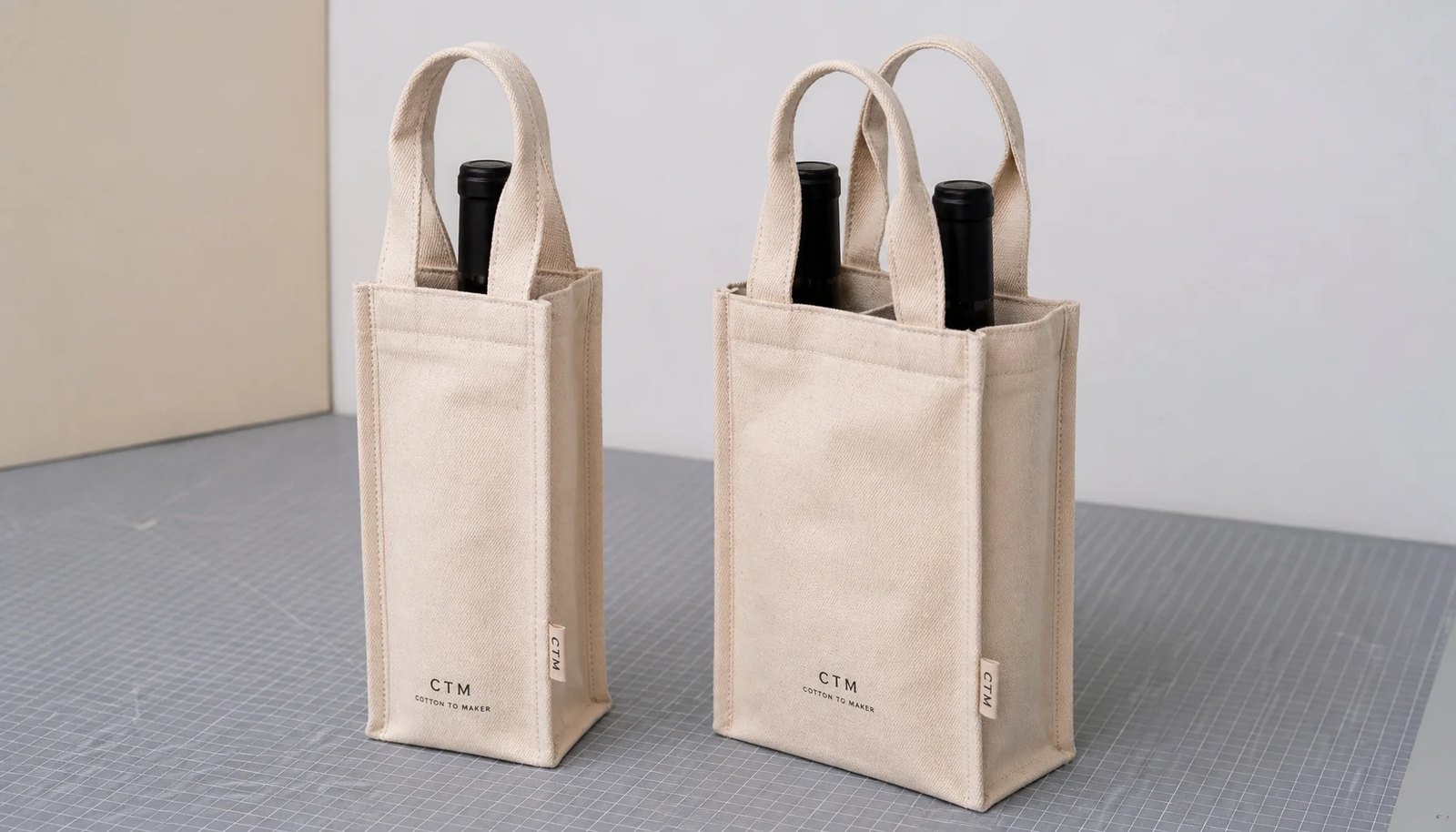
The Buying Problem This RFQ Should Solve
A university bookstore canvas wine carrier is not only a small promotional bag. It has to hold real glass weight, present licensed artwork cleanly, sit well on a retail shelf, and arrive without crushed seams or dirty fabric. The RFQ must remove guesswork from fabric weight, bottle fit, handle strength, logo approval, and packing. If those details are vague, most suppliers will quote different versions of the product and the lowest price will usually hide a thinner fabric, weaker handle, or simplified divider.
The keyword canvas wine carriers for university bookstores rfq template guide points to a very specific purchasing need: buyers want a quote format that works for bookstore retail programs, alumni events, and branded gift assortments. The useful RFQ is not a long legal document. It is a production brief that lets a factory price the same bag that the buyer expects to receive.
- Use the RFQ to lock the physical carrier first: capacity, dimensions, fabric, handle, divider, and closure.
- Treat artwork as a controlled production element, not a decoration to finalize later.
- Separate sample cost, screen cost, unit cost, packing cost, and freight data so quote comparisons stay clean.
- Avoid approving bulk production from a photo of a similar bag; require a sample made to the final construction.
Start With Bottle Fit and Carrier Structure
Before choosing fabric or print, define the bottle the carrier must hold. A standard 750 ml wine bottle is different from a sparkling bottle or tall dessert wine bottle. A bag that looks fine with an empty sample bottle may be too tight once the bottle has a foil neck, label thickness, or gift tag attached. For retail use, the buyer should give the supplier the maximum bottle height, base diameter, shoulder width, and whether the top should remain visible.
Single-bottle carriers are simpler and cheaper because they use less fabric and fewer sewing operations. Two-bottle carriers need a divider that prevents glass contact while still allowing easy insertion. For university bookstores, two-bottle versions often appear more premium, but they increase material use, sewing time, carton volume, and QC risk. The RFQ should say whether the divider is sewn into the bottom and side seams, or only suspended inside the bag.
- Typical single-bottle finished size example: about 10 cm width x 10 cm gusset x 35 cm height, adjusted to the bottle range.
- Typical two-bottle finished size example: about 20 cm width x 10 cm gusset x 35 cm height with a fixed center divider.
- For sparkling bottles, increase gusset and confirm neck clearance before sample approval.
- For retail shelf display, request a flat bottom or boxed base that helps the carrier stand when empty.
Fabric Weight, Canvas Type, and Cost Impact
Fabric is the first major cost driver and the most common source of non-comparable quotes. Many suppliers will write cotton canvas without specifying weight. For a wine carrier, 8 oz canvas can be acceptable for light event giveaways, but it may feel soft and underbuilt for bookstore retail. A 10 oz to 12 oz canvas, roughly 340 to 407 GSM, gives better structure and improves the perceived value of the product without becoming too heavy for freight.
Natural cotton canvas is usually the most practical starting point because it avoids dye lot risk and supports campus logos with a clean, neutral look. Dyed canvas can match school colors, but it adds minimums, color approval time, and risk of shade variation between batches. Recycled cotton or organic cotton may be useful for sustainability positioning, but the RFQ should require evidence and should not assume the same MOQ or fabric handfeel as conventional cotton canvas.
- 8 oz canvas: lower cost, lighter, more flexible, better for short-term event use than premium retail.
- 10 oz canvas: balanced option for most bookstore wine carriers with good printability and manageable freight.
- 12 oz canvas: stronger retail feel, better structure, higher unit cost, more carton volume.
- Dyed canvas: stronger brand color effect but needs lab dip approval and may raise MOQ.
- Natural canvas: easier sampling, cleaner quote comparison, lower shade approval risk.
Print Method for Licensed University Artwork
Most university bookstore wine carriers should start with spot color screen printing. It is durable, cost-efficient for bulk runs, and works well on cotton canvas when the artwork uses a small number of solid colors. The RFQ should include vector artwork, Pantone references, print size, print position, and whether the logo must follow university licensing rules. A factory cannot price accurately if it only receives a low-resolution image pasted into an email.
Heat transfer may be useful for small full-color art, gradients, or detailed mascot artwork, but it changes the handfeel and can look less integrated with canvas. Embroidery is usually less practical on wine carriers because the bag panels are small and the cost rises quickly, but it can work for simple initials, alumni crest marks, or premium gift runs. The buyer should not let the supplier choose the print method only based on price; the right method depends on artwork complexity, fabric texture, and retail expectation.
- Screen print: best for 1-3 spot colors, strong cost control, and stable repeat orders.
- Heat transfer: useful for complex color artwork, but test edge adhesion and flexibility.
- Embroidery: premium look for simple marks, but less suitable for large detailed logos.
- Woven label: good for small side branding when front print should remain clean.
- Ink curing should be checked on the approved canvas, not on a smoother substitute fabric.
Handle Strength and Sewing Details
A wine carrier fails in use at the handle before it fails at the printed logo. One filled bottle can weigh around 1.2 kg to 1.5 kg, and two bottles can exceed 3 kg before including the bag itself. A retail buyer should require reinforced handle stitching and a practical load test. For most canvas wine carriers, self-fabric handles with box-X stitching or bar tacks at the attachment points are safer than narrow straps with one straight stitch line.
Handle length also affects usability. Too short and the customer cannot carry the bottle comfortably; too long and the bottle swings more during walking. The RFQ should state handle width, handle drop, stitching pattern, and thread color. If the bookstore wants the carrier to hang on a display peg, the handle length and folded packing must also be coordinated with merchandising needs.
- Recommended handle width: commonly 2.5 cm to 3.5 cm for comfort and appearance.
- Recommended reinforcement: box-X stitch, dense bar tack, or double row stitching at stress points.
- Load test example: hang the carrier with filled bottle weight for a defined time and inspect seam distortion.
- Thread should match the bag or contrast intentionally; accidental mismatch looks like a production error.
- Handle attachment should not cover or distort the printed logo area.
MOQ Logic and How to Compare Quotes
MOQ for canvas wine carriers is not only a total order quantity. It can apply per fabric color, per size, per artwork, per print color count, and sometimes per packing style. A buyer may think a supplier has accepted 1,000 pieces, but the factory may mean 1,000 pieces for one fabric color and one artwork. If the bookstore needs separate versions for alumni, athletics, and campus store branding, the RFQ should show the expected quantity for each artwork and request a clear MOQ breakdown.
The most reliable way to control MOQ is to standardize the base bag. Use one natural canvas fabric, one size, one handle construction, and then split artwork versions only if the print setup allows it. That approach keeps fabric cutting and sewing efficient while giving the bookstore multiple branded SKUs. If each version changes fabric color, lining, divider, and print location, the order becomes several small productions rather than one combined run.
- Request price breaks at practical levels such as 500, 1,000, 2,500, and 5,000 pieces if those quantities match buying plans.
- Separate one-time screen or setup charges from unit price so repeat orders can be evaluated correctly.
- Clarify whether mixed artwork can share the same MOQ when the base carrier is identical.
- Confirm whether sample charges are refundable, credited to bulk, or separate.
- Do not compare a direct factory FOB quote against a distributor delivered quote without normalizing freight and duties.
Sample Approval That Prevents Bulk Mistakes
The approval sample should represent the bulk order in fabric, construction, print method, and packing direction. A prototype made from available fabric is useful for shape review, but it should not release mass production unless the supplier clearly labels it as bulk-equivalent. For licensed university artwork, the buyer should keep a signed physical sample or a controlled approval record with dimensions, Pantone colors, fabric swatch, and photo references.
A good sample review is practical and measurable. Insert the intended bottle, lift it by the handle, place it on a shelf, fold and unfold it, rub the print, inspect divider alignment, and check whether the bottom sits flat. If the carrier will be sold in a bookstore, look at it as a retail customer would: front panel centered, no loose threads, clean canvas, no oily marks, no crooked label, and no awkward handle twist.
- Measure finished width, gusset, height, handle drop, and print position against the approved spec.
- Use a real filled bottle or equivalent weight during handle and balance review.
- Review print color under consistent lighting instead of relying only on supplier photos.
- Check whether folding creates permanent marks across the printed logo.
- Approve carton packing method if retail appearance after unpacking matters.
Packing, Cartons, and Retail Receiving
Packing decisions affect both freight cost and retail presentation. Canvas wine carriers are usually flat packed, sometimes with light folding to reduce carton size. If the product has a large front print, the fold line should not run across the main logo unless the buyer has reviewed a packed sample. Individual polybags may protect natural canvas from dirt but add cost and may conflict with sustainability expectations. For bookstore receiving, carton sorting by artwork and SKU is often more valuable than maximum compression.
The RFQ should request export carton dimensions, gross weight, net weight, pieces per carton, and carton marks. These data points help the buyer or forwarder estimate freight, warehouse handling, and landed cost. A quote without carton data is incomplete because two suppliers with the same unit price may create very different shipping costs if one packs loosely or uses oversized cartons.
- Common packing: 50 to 100 pieces per carton depending on fabric weight, divider bulk, and handle construction.
- Avoid heavy compression if the print is thick, raised, or newly cured.
- Request inner separation by artwork when multiple campus marks ship together.
- Confirm barcode labels, hangtags, or retail inserts before final quotation.
- Carton marks should include item number, artwork version, quantity, gross weight, net weight, and country of origin if required.
Lead Time and Schedule Risk
Lead time should be broken into sample development, sample approval, material preparation, printing, sewing, inspection, packing, and export handover. A supplier quoting only total days after deposit may not be hiding anything, but the buyer still cannot see where delays usually happen. For university bookstores, the risk is often artwork approval and licensed logo proofing rather than sewing capacity. Put the artwork approval path into the timeline from the beginning.
Peak season can affect canvas availability, screen printing capacity, and freight bookings. If the wine carriers are tied to graduation, alumni weekend, holiday gifting, or a campus event, the RFQ should include the in-store required date, not only the desired ship date. Backward planning from the retail date helps avoid rushed air freight or approving a sample with unresolved issues.
- Sample development can take longer when fabric color, divider design, or print method is not finalized.
- Lab dips for dyed canvas should be scheduled before bulk fabric ordering.
- Licensed artwork proofing should run in parallel with construction sampling when possible.
- Pre-production sample approval should be a gate before cutting bulk fabric.
- Inspection and packing time should be included, not treated as a same-day activity after sewing.
Quote Data Needed for Landed-Cost Comparison
A clean quote should let the buyer compare landed cost, not only unit price. For canvas wine carriers, freight can shift the final cost because heavier canvas, two-bottle dividers, and loose packing increase carton volume and weight. The RFQ should request unit price by quantity, incoterm, sample charge, setup charge, packing cost, carton data, production lead time, and payment terms. Without these details, procurement teams may choose a supplier that looks cheaper but lands higher after freight and handling.
The buyer should also separate cost drivers that are optional from those that are required. For example, a hangtag, individual polybag, dyed fabric, inner divider, or full-color transfer may be useful, but each should be visible in the quote. This prevents late-stage cost surprises when merchandising or compliance teams add requirements after the factory has already priced a basic carrier.
- Quote unit price by quantity tier and state whether it is FOB, EXW, CIF, DDP, or another incoterm.
- List screen charges per color and per artwork if applicable.
- Provide carton size, gross weight, net weight, and pieces per carton for freight estimation.
- Separate optional retail packing, hangtag, barcode label, and insert card costs.
- State whether duty classification support documents, material declaration, and country of origin marking are available.
Specification comparison for buyers
| Spec decision | Recommended option | When it fits | Buyer risk to check |
|---|---|---|---|
| Fabric weight | 10 oz to 12 oz cotton canvas, roughly 340-407 GSM | University bookstore gift items, alumni wine clubs, campus event merchandise, and retail shelf stock needing structure without high freight weight | If the quote says only cotton canvas without GSM or ounce weight, suppliers may substitute thinner fabric that collapses around a bottle |
| Bottle capacity | Single-bottle carrier for lower unit cost; two-bottle carrier with divider for premium gift use | Single-bottle works for broad bookstore retail; two-bottle works for alumni events, donor gifts, and bundled local wine sales | Two-bottle bags need divider height, seam strength, and carton packing confirmed or bottles can knock together during use |
| Handle construction | Self-fabric handles with box-X stitching or reinforced bar tacks | Best for reusable retail bags where buyers expect the carrier to survive actual bottle weight | Low-cost quotes may use narrow handles or single line stitching that passes visual inspection but fails load testing |
| Printing method | Spot color screen print for most campus logos; heat transfer only for fine gradients or small full-color artwork | Screen print fits 1-3 color school marks and bookstore branding with stable cost at bulk quantities | Unapproved ink color, poor curing, or printing over heavy slub texture can create cracking, color drift, or blurred mascot details |
| Interior divider | Canvas or nonwoven divider sewn into side seams for two-bottle versions | Required when the product is sold as a two-bottle gift carrier rather than a decorative sleeve | Loose dividers save cost but move during packing and make the product feel unfinished in retail handling |
| Closure style | Open top for lowest cost; drawstring or flap only when the bottle must be concealed | Open-top carriers fit bookstore shelves and event handouts; closures fit formal gifting or branded wine club shipments | Closures add labor and can interfere with tall bottles unless bottle dimensions are included in the RFQ |
| MOQ route | Consolidate fabric color, size, and print method before negotiating MOQ | Useful when the bookstore needs multiple campus logos or department versions but one shared base bag | Splitting many small designs across fabric colors and print placements can push the real MOQ above the headline MOQ |
| Packing method | Flat packed by style and artwork, 50-100 pieces per export carton depending on fabric and handle bulk | Keeps warehouse receiving simple and reduces creasing before retail display | Vacuum packing can reduce volume but may create fold marks on printed canvas and should not be accepted without sample review |
| Supplier route | Direct factory for custom specs; trading company or distributor for very small repeat orders | Direct factory fits planned bookstore programs with artwork control; distributor fits urgent replenishment of simple stock styles | Supplier quotes are not comparable unless fabric GSM, print process, packing, sample terms, and incoterm are aligned |
Buyer checklist before sampling
- Define bottle type and size range before asking for dimensions: standard 750 ml wine bottle, tall Riesling bottle, sparkling bottle, or mixed assortment.
- State fabric weight in ounces or GSM, not only cotton or canvas, and request tolerance for fabric weight and finished dimensions.
- Specify single-bottle or two-bottle construction, including divider material, divider height, and whether the divider is fixed or removable.
- Provide logo artwork in vector format and identify Pantone colors, print size, print position, and whether the mark is licensed or requires proof approval.
- Require handle width, handle length, stitching method, and minimum load test target suitable for one or two filled glass bottles.
- List packing requirements including pieces per polybag if used, carton quantity, carton marks, barcode labels, and any retail hangtag or insert card.
- Request one pre-production sample using bulk fabric, bulk print method, and final sewing construction before authorizing mass production.
- Compare quotes on the same incoterm, production lead time, sample charge, mold or screen charge, packing method, and carton dimensions.
Factory quote questions to send
- What fabric weight are you quoting in oz and GSM, and what is your normal tolerance for this fabric after dyeing or washing?
- Is the quoted price based on greige natural canvas, dyed canvas, recycled cotton canvas, or organic cotton canvas?
- What finished dimensions do you recommend for our bottle type, and what bottle diameter and height did you use for the pattern?
- For the two-bottle version, how is the divider sewn, how high is it, and what material is used?
- What handle width, handle length, and reinforcement stitch are included in the quotation?
- Which print method is included, how many colors are allowed, and what maximum print size is covered by the quoted price?
- Are screen charges, artwork setup, sample charges, courier cost, and pre-production sample cost included or separate?
- What MOQ applies per bag size, per fabric color, per artwork, and per print color count?
- What is the production lead time after sample approval and deposit, and how does it change during peak season?
- What are the export carton dimensions, gross weight, net weight, pieces per carton, and recommended container loading quantity?
Quality-control points to confirm
- Finished size tolerance should be agreed before production, commonly plus or minus 0.5 cm to 1.0 cm depending on construction.
- Fabric GSM should be checked against the approved swatch or lab record, especially when comparing 8 oz, 10 oz, and 12 oz quotes.
- Print color should match approved Pantone or signed print proof under standard lighting, not only supplier phone photos.
- Print adhesion should pass a practical rub test and folding review on the same canvas texture used in production.
- Handle attachment should pass a hanging load test using filled bottles for the agreed duration without seam tearing or stitch popping.
- Divider alignment should keep bottles separated without twisting, sagging, or pulling the side panels out of shape.
- Needle holes, skipped stitches, loose threads, oil marks, and fabric stains should be rejected above the agreed AQL or visual standard.
- Cartons should be strong enough for export handling, with correct carton marks, style separation, and no excessive compression on printed panels.