1. Treat MOQ as a Production Constraint, Not Just a Price Obstacle
Canvas wine carriers look like a small accessory, but their MOQ behaves differently from a basic flat tote. The carrier must hold glass bottles, keep its divider aligned, show a licensed mark cleanly on textured fabric, and arrive in retail condition. For university bookstores, the order may also involve a fixed campus selling window, internal buying approval, and trademark licensing review. Those factors make the negotiation more than a request for a lower number.
The strongest approach is to ask the supplier what creates the minimum: fabric availability, dye lot, print setup, sewing line efficiency, packing materials, or artwork variations. A factory can often reduce MOQ when the buyer simplifies the spec. It is less likely to reduce MOQ safely if the buyer also wants custom dyed canvas, several logo versions, special labels, and premium packing on a small first order.
- Negotiate around the real driver: fabric, print, sewing, packing, or shipment consolidation.
- Protect functional specs first: bottle fit, handle strength, divider position, and print approval.
- Use stock fabric and one print position when testing demand.
- Avoid accepting a lower MOQ if it depends on lighter canvas or weaker reinforcement.
- Ask suppliers to state MOQ by SKU, not only as one total order number.
2. Match the Spec to the Bookstore Program
A bookstore buying for a holiday wine set does not need the same spec as a bookstore testing a low-price alumni giveaway. The intended use should guide the MOQ discussion before price is negotiated. An empty retail item must sit neatly on shelf and look clean under store lighting. A filled carrier for a donor package needs stronger handles, a stable divider, and packing that prevents crushing. A rush event giveaway may justify simpler construction if the bottle will not be carried repeatedly.
Start the RFQ with the commercial role of the item. Suppliers can then suggest where to simplify without damaging the buyer’s goal. For example, a first-run bookstore SKU can usually stay with stock natural canvas and one bold print. A premium alumni program may be better served by a heavier fabric, retail hangtag, and stricter inspection even if the MOQ is higher.
- Shelf retail: prioritize upright shape, clean print, consistent folding, and barcode placement.
- Filled gift set: prioritize handle reinforcement, divider alignment, base stability, and carton protection.
- Event giveaway: prioritize stock fabric, quick print approval, and realistic delivery timing.
- Licensed merchandise: prioritize artwork proof, sealed approval sample, and print color control.
- Multi-location bookstore program: keep the same body spec and split only the logo if the factory allows it.
3. Use Practical MOQ Scenarios in the RFQ
Buyers get better answers when they request scenario pricing rather than one ideal specification. Ask for the simplest route first, then add variations. This shows the cost of each decision and makes it easier to defend the final choice internally. It also prevents suppliers from quoting a vague low price that later rises once artwork, fabric weight, and packing are clarified.
A useful MOQ conversation might compare stock natural canvas with one screen print against custom dyed canvas with multiple logos. The difference can be significant because custom dyeing introduces mill minimums, lab dip approval, and shade control. Multiple logos may not change sewing, but they add screen setup, printing changeover, sorting, and packing control.
- Scenario A: stock natural 10-12 oz canvas, one size, one-color print, standard carton; often the lowest workable MOQ path.
- Scenario B: same bag body, two logo versions; expect per-logo minimums, screen charges, or handling fees.
- Scenario C: custom dyed school-color canvas; expect dye lot minimums, lab dip time, and higher shade-control risk.
- Scenario D: premium two-bottle carrier with 14 oz canvas, reinforced divider, hangtag, and barcode; expect higher MOQ and freight cost.
- Scenario E: domestic imprint on stock imported blanks; useful for small rush orders, but check construction and replenishment consistency.
4. Specify Fabric and Construction Clearly
For most university bookstore wine carriers, 10 oz to 12 oz cotton canvas, roughly 280-340 GSM depending on weave and finishing, is a practical range. It gives enough structure for retail presentation without making the bag unnecessarily heavy. An 8 oz canvas may work for a giveaway, but it can collapse around a filled bottle and feel too promotional for a paid retail item. A 14 oz canvas can look premium, but it raises fabric cost, cutting effort, sewing difficulty, carton weight, and sometimes MOQ.
Construction needs the same precision as fabric. A two-bottle carrier should define bottle diameter range, divider width, whether the divider reaches the base, and whether the base is flat, gusseted, or boxed. Handles should be self-fabric or cotton webbing with a defined drop and reinforcement. If the RFQ only says “canvas wine bag,” the supplier may quote a light promotional carrier that is not suitable for bookstore resale.
- State fabric in both oz and GSM where possible, with an agreed tolerance.
- Define finished height, width, gusset/base, bottle opening, divider location, and handle drop.
- Specify whether the carrier must fit standard 750 ml bottles, wider sparkling bottles, or mixed bottle shapes.
- Require reinforced handle attachment with box stitch, bartack, or approved dense backstitching.
- Ask whether the canvas is washed, unwashed, bleached, natural, dyed, or treated, because this affects shade and shrinkage.
- Keep construction identical across logo versions if MOQ flexibility is important.
5. Choose a Print Method That Fits University Marks
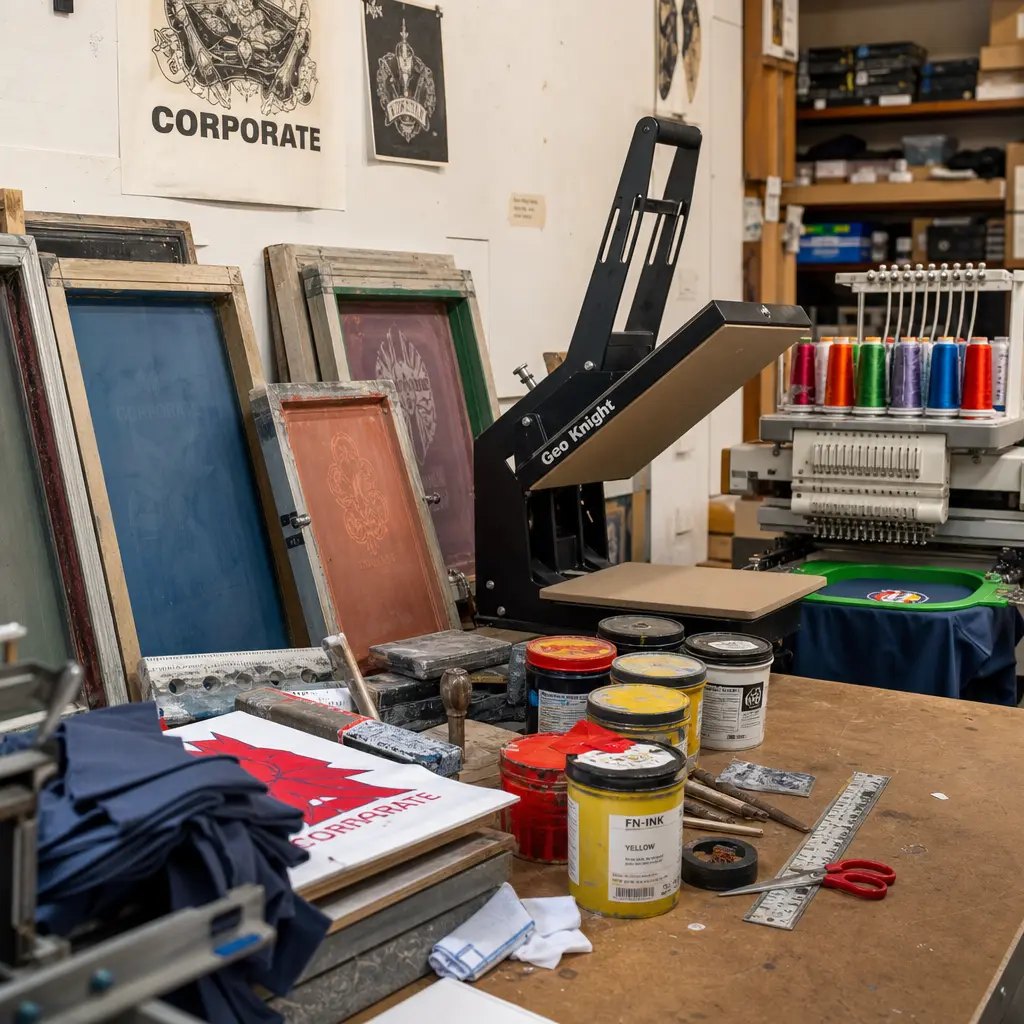
Screen printing is usually the best route for one-color or two-color university marks on canvas. It is economical, durable, and suitable for bold logos, mascots, bookstore names, and alumni messaging. The buyer should still check minimum line thickness, small registered marks, and legal text because textured canvas can soften fine details. A clean PDF proof does not guarantee clean ink edges on woven cotton.
Heat transfer, digital print, and embroidery each have a place, but they change cost and approval risk. Heat transfer can hold more detail but needs adhesion and hand-feel testing. Digital print may support artwork variety at lower quantities but can raise unit cost. Embroidery can look premium, yet narrow wine carrier panels may distort unless the fabric and backing are stable. When negotiating MOQ, reducing print complexity is often safer than reducing fabric strength.
- Use screen print for bold one-color or two-color marks and predictable bulk production.
- Approve Pantone range on actual canvas, not only on paper or a monitor.
- Set minimum text height and line thickness before licensing approval.
- Avoid low-contrast ink on natural canvas unless a physical sample proves readability.
- Confirm whether each logo version requires a separate screen charge and minimum.
- Keep one print position where possible to reduce handling and inspection risk.
6. Compare Supplier Routes, Not Just Unit Prices
Two suppliers can quote the same carrier description and still be offering different products. One may be a direct bag factory with in-house cutting and controlled sewing. Another may be a trading company using a subcontractor. A third may be a domestic decorator printing on imported blanks. None of these routes is automatically wrong, but the buyer should know which route is being quoted before comparing MOQ, lead time, and risk.
For university bookstore programs, verification matters because licensed artwork, sample retention, and repeatability are important. Ask for non-confidential photos of prior bottle-bag production, not just tote bags. Request information on sample retention, inspection access, audit documents if available, and whether the same facility will make the approved sample and bulk order. A supplier that cannot explain the production route may have limited control over quality or schedule.
- Direct wine/bottle-bag factory: best for custom size, divider control, and technical discussion.
- General bag factory: acceptable if sample testing proves bottle fit and handle strength.
- Trading company: useful for coordination, but clarify subcontracting, QC responsibility, and corrective action.
- Domestic decorator: useful for small rush orders, but check blank availability and construction consistency.
- Ask whether printing, sewing, and packing are in-house or subcontracted.
- Keep one sealed approved sample with the buyer and one with the supplier for inspection reference.
7. Make the Quote Complete Enough for Landed-Cost Comparison
A useful quote is more than a unit price. It should show fabric weight, finished size, capacity, divider construction, handle reinforcement, print method, MOQ basis, sample terms, packing format, carton data, lead time, and trade terms. Without those fields, procurement may compare a retail-ready carrier with a lighter promotional version and make the wrong award decision.
Carton data is especially important. Wine carriers with dividers and reinforced handles do not always pack as flat as simple totes. Over-compression can damage the retail appearance, while upright packing can raise CBM and freight cost. A lower ex-factory price may disappear once ocean freight, air freight, receiving labor, and damaged goods are considered.
- Request price at target MOQ plus at least two breaks, such as 500, 1,000, and 2,500 pcs where relevant.
- Separate sample charge, screen charge, artwork charge, hangtag/barcode cost, and bulk unit price.
- Ask for carton quantity, carton dimensions, gross weight, net weight, and estimated CBM.
- State trade term clearly: EXW, FOB, CIF, DDP, or another agreed term.
- Confirm whether price includes inspection support, carton markings, inner packs, and moisture protection.
- Require written confirmation of overrun/underrun allowance and how excess pieces are billed.
8. Approve Samples That Simulate Bulk Production
A showroom sample is not enough for a licensed bookstore wine carrier. The approval sample should use the same fabric weight, print method, ink, divider, handle reinforcement, sewing method, and packing direction planned for bulk. If bulk fabric is not yet available, the supplier should state what is different and provide a pre-production sample before mass production starts.
The buyer should test the sample like a customer and a receiving team would. Insert the intended bottle size, lift it repeatedly, place it on a shelf, check whether the base sits flat, and see whether the divider twists. If the carrier will be shipped flat, leave it compressed for several days and then check whether the front panel and handles recover acceptably.
- Measure finished dimensions, handle drop, bottle opening, divider position, and base stability.
- Check fabric shade, GSM, weave, stiffness, odor, stains, and shrinkage risk.
- Review print color, placement, opacity, edge sharpness, and readability under store lighting.
- Load test with the intended filled bottle weight before approving bulk production.
- Photograph the approved sample from front, back, inside divider, handle attachment, and packing view.
- Seal and label reference samples with date, PO, artwork version, fabric spec, and approval status.
9. Set Measurable QC Criteria Before Production
Quality problems on canvas wine carriers are often predictable: weak handle stitching, divider seams pulling out, bottle openings cut too narrow, dirty natural canvas, tilted logos, ink pinholes, and crushed packing. These issues should be defined before production, not debated after delivery. A written inspection plan gives the supplier a clear target and gives procurement a fair basis for acceptance or rework.
For bookstore merchandise, use measurable tolerances wherever possible. Many buyers use AQL 2.5 for major defects and AQL 4.0 for minor defects, with critical defects not accepted. The exact plan should match order value and risk. Functional checks should include load testing with filled bottles or equivalent weight, not only a visual review of empty bags.
- Critical defects: wrong licensed mark, unsafe seam failure, mold, severe contamination, wrong fabric, or wrong construction.
- Major defects: print outside tolerance, incorrect size, twisted handles, weak stitching, stains, crushed divider, or poor bottle fit.
- Minor defects: small slubs or slight shade variation within the approved natural canvas range.
- Print tolerance: define placement movement, logo tilt, registration, ink coverage, and acceptable color range.
- Construction tolerance: check critical dimensions within about plus or minus 5 mm unless another tolerance is approved.
- Load test: two-bottle carriers should hold two filled bottles or equivalent weight for at least 30 minutes without seam popping or serious deformation.
- Stitching: confirm stitch density, backstitching, bartack or box-stitch placement, and thread trimming.
- Packing: inspect carton condition, moisture protection, SKU labels, quantity accuracy, and whether goods are sellable after unpacking.
10. Plan Lead Time Around Campus Selling Windows
University bookstore calendars have hard deadlines. Homecoming, graduation, alumni weekends, holiday gifting, orientation, and local winery events cannot move because production is late. Buyers should build the timeline backward from the in-store date and include internal approvals, licensing review, sample courier time, bulk production, inspection, freight, customs, warehouse receiving, and store allocation.
Lead time should be written as milestones, not as one broad promise. A supplier may say production takes 30 days, but that may start only after deposit, artwork approval, sample approval, and material arrival. Sea freight and campus receiving can add several weeks. If the launch date is fixed, use production photos, inline checks, and a pre-shipment inspection rather than waiting until cartons arrive to discover problems.
- Artwork and licensing review: allow 1-3 weeks depending on university process and revision rounds.
- Development sample: allow about 7-14 days plus courier time when artwork and materials are ready.
- Pre-production sample: allow about 7-10 days after bulk fabric or final ink is available.
- Bulk material booking and production: allow about 25-45 days depending on MOQ, fabric route, print complexity, and factory season.
- Inspection and final packing: reserve 2-5 days for final inspection, corrections, carton marking, and booking handoff.
- Sea freight and destination handling: often 4-7+ weeks depending on origin, port, customs, and inland delivery; air freight is faster but can erase cost savings.
- Campus receiving and allocation: add time for warehouse check-in, SKU setup, store transfer, and merchandising before the selling window.
- Buffer: keep at least 2 weeks of schedule protection for licensed merchandise or event-critical programs.
Specification comparison for buyers
| Sourcing route or spec path | Practical MOQ range example | Best fit | Buyer risk to verify |
|---|---|---|---|
| Stock natural canvas, one-color screen print, one size | About 300-800 pcs if fabric is available and construction is standard | First bookstore trial, alumni weekend test, local winery collaboration, limited seasonal shelf program | Confirm the fabric weight is stated in oz/GSM, not downgraded to a lighter promotional canvas |
| Stock canvas, two print versions, same construction | About 800-1,500 pcs total, often with per-logo minimums or setup fees | Two campus stores, bookstore plus alumni association, or department split using the same bag body | Ask whether the MOQ is by total run, by artwork, by screen, or by packing SKU |
| Custom dyed canvas with one or two logos | Often 1,500-3,000+ pcs depending on dye lot and mill minimum | Programs requiring exact school color fabric or a premium branded retail line | Require lab dip approval, shade tolerance, and confirmation that excess dyed fabric is not billed unexpectedly |
| Heavier 14 oz canvas, reinforced divider, retail labeling | Often 1,000-2,500 pcs depending on sewing complexity and packing | Premium alumni gifts, donor packages, holiday bottle sets, higher retail price point | Check sewing capability, needle/stitch performance, load testing, and carton CBM before approving price |
| Direct bag factory with bottle-bag experience | MOQ is usually more transparent and negotiable around real production constraints | Custom size, divider, reinforcement, repeat bookstore programs, licensed merchandise | Verify prior bottle-bag production photos, sample retention process, inspection access, and in-house or controlled printing |
| General tote-bag factory adapting a tote pattern | May quote low MOQ, but construction details can be weak | Simple single-bottle carriers where speed and price are more important than premium build | Review divider method, handle reinforcement, bottle fit, and whether the sample is actually made on the intended line |
| Trading company or consolidator | MOQ may be flexible, but the true production route can be unclear | Small buyers needing sourcing support, multiple campus merchandise items in one order | Ask who owns sampling, QC, corrective action, and whether subcontracted factory details can be disclosed for audit or inspection |
| Domestic decorator using imported blanks | Lower order quantities may be possible if blank bags are in stock | Rush programs, very small bookstore tests, quick licensed imprint approval | Compare blank construction, print durability, unit cost, and whether replenishment will match the first batch |
Buyer checklist before sampling
- Define the retail use: empty shelf item, filled gift carrier, alumni event giveaway, winery collaboration, or donor package.
- Specify single-bottle or two-bottle capacity, target bottle diameter range, finished dimensions, base/gusset, divider position, and handle drop.
- State fabric as oz and/or GSM, for example 10-12 oz canvas or about 280-340 GSM, with acceptable tolerance.
- Separate must-have specs from negotiable specs: fabric color, print colors, divider style, handle reinforcement, labels, and packing.
- Provide vector artwork, Pantone references, imprint size, print position, minimum text height, and licensing approval requirements.
- Request MOQ by fabric color, by construction, by print design, by packing SKU, and by total shipment.
- Ask for price breaks at the requested MOQ and at one or two higher volumes to see where setup cost drops.
- Require carton quantity, carton dimensions, gross weight, net weight, CBM, packing method, and carton marking details.
- Confirm sample type, sample lead time, whether the pre-production sample uses bulk fabric and ink, and who keeps sealed reference samples.
- Set measurable QC criteria for fabric weight, dimensions, stitch density, load test, print placement, defect classification, and AQL level.
Factory quote questions to send
- What is the MOQ and unit price for stock natural canvas, one size, one-color screen print, and standard flat export packing?
- What MOQ changes if we need custom dyed canvas, contrast handles, heavier 14 oz fabric, or multiple university logo versions?
- Is the MOQ driven by fabric procurement, dye lot, printing setup, cutting efficiency, sewing line setup, packing material, or shipment minimum?
- Can one total MOQ be split across two print designs if fabric, size, divider, handle, and packing remain identical?
- What exact fabric weight is quoted in oz and GSM, what tolerance applies, and can you provide a fabric swatch or mill report?
- Have you produced bottle bags or wine carriers before, and can you share non-confidential production photos showing dividers, handle reinforcement, and packing?
- Will the approval sample be made with the same fabric, ink, divider, stitch method, handle reinforcement, and packing direction as bulk production?
- Which print method is included, what line thickness and minimum text height are safe on canvas, and how is Pantone matching handled?
- What stitch density, reinforcement method, and load test can you perform for filled glass bottles?
- What AQL level do you support for final inspection, and how do you classify critical, major, and minor defects?
Quality-control points to confirm
- Use a written inspection plan, commonly AQL 2.5 for major defects and AQL 4.0 for minor defects, unless the buyer requires a stricter retail standard.
- Classify critical defects as unsafe handle or divider failure, wrong licensed logo, wrong fabric, mold, severe contamination, or any defect that could create breakage risk with glass bottles.
- Control fabric weight to the approved specification, for example 10-12 oz or 280-340 GSM, with tolerance agreed before bulk production and checked by GSM cutter/scale or mill report.
- Measure finished width, height, gusset/base, handle drop, bottle opening, and divider position; use tighter tolerance on bottle-fit points, commonly plus or minus 5 mm for critical dimensions.
- Set print placement tolerance against the approved sample, such as plus or minus 3 mm to 5 mm for logo position and no obvious tilt beyond the agreed visual standard.
- Check print quality for correct Pantone range, opacity, edge sharpness, registration, ink pinholes, cracking, rubbing, and coverage on textured canvas.
- Require reinforced handle stitching such as box stitch, bartack, or dense backstitching, with no skipped stitches, broken threads, loose lockstitching, or seam puckering at load points.
- Specify stitch density, for example about 8-10 stitches per inch where suitable for the fabric and construction, and confirm it on the approved sample.
- Perform a practical load hang test using the intended filled bottle weight; for two-bottle carriers, test with two filled bottles or equivalent weight for at least 30 minutes and check seam deformation.
- Inspect internal dividers for straight placement, secure seam capture, correct width, and no twisting or pull-out under bottle insertion.