Start With the Real Buying Problem
For university bookstores, canvas wine carriers are usually not purchased as basic packaging. They sit between licensed merchandise, alumni gift, event accessory, and bookstore impulse item. The material choice has to support retail appearance, bottle safety, campus branding, and predictable landed cost. If the RFQ only says “canvas wine bag with logo,” suppliers will quote different fabric weights, handle types, print methods, and packing assumptions, so the cheapest offer may not be comparable.
The main buying problem is selecting a canvas specification that feels substantial enough for a bottle, prints the university mark cleanly, and still ships efficiently. Overbuilding the carrier with very heavy canvas can make it expensive and stiff. Underbuilding it with thin cotton can make it look like disposable packaging. The best specification is usually a controlled middle ground: enough GSM, reinforced stress points, a practical divider if needed, and packing that works for bookstore receiving.
- Use a single RFQ pack for all suppliers so every quote includes the same capacity, dimensions, fabric, print, packing, and inspection assumptions.
- Separate retail value from bottle protection; canvas improves presentation and reusability, but structure still depends on seams, handle reinforcement, and divider design.
- Decide whether the carrier is a licensed retail product, a gift-with-purchase item, or event merchandise because each use justifies a different cost ceiling.
Choose Canvas Weight by Use, Not Habit
Most bookstore wine carrier programs work best in 10 oz to 12 oz cotton canvas, roughly 340 to 410 GSM depending on yarn and weave. This range gives enough body for shelf display and repeated handling while staying manageable for screen printing and carton packing. An 8 oz canvas can work for low-cost event distribution, but it may wrinkle more and feel light when carrying a full bottle. A 14 oz or heavier canvas can look premium, yet it adds sewing difficulty, freight cube, and sometimes a bulky hand feel that is not needed for a small carrier.
Do not compare fabric only by ounce labels. Different mills may use different conversion assumptions, and a tightly woven 10 oz canvas can feel better than a loose 12 oz fabric. Ask for GSM, yarn count if available, weave density, and a physical swatch. For university color programs, dyed canvas also needs shrinkage and colorfastness checks because darker school colors can rub onto labels, tissue, or nearby merchandise if the finishing is poor.
- For budget event use: consider 8 oz to 10 oz canvas only if the handle reinforcement is upgraded.
- For standard bookstore retail: specify 10 oz to 12 oz canvas and approve a swatch before sampling.
- For premium alumni gifts: consider 12 oz to 14 oz canvas, but confirm foldability, sewing quality, and carton cube.
- For dyed school colors: require lab dip approval, shade tolerance, and dry and wet rubbing fastness expectations.
Match Capacity to Bottle Fit and Shelf Plan
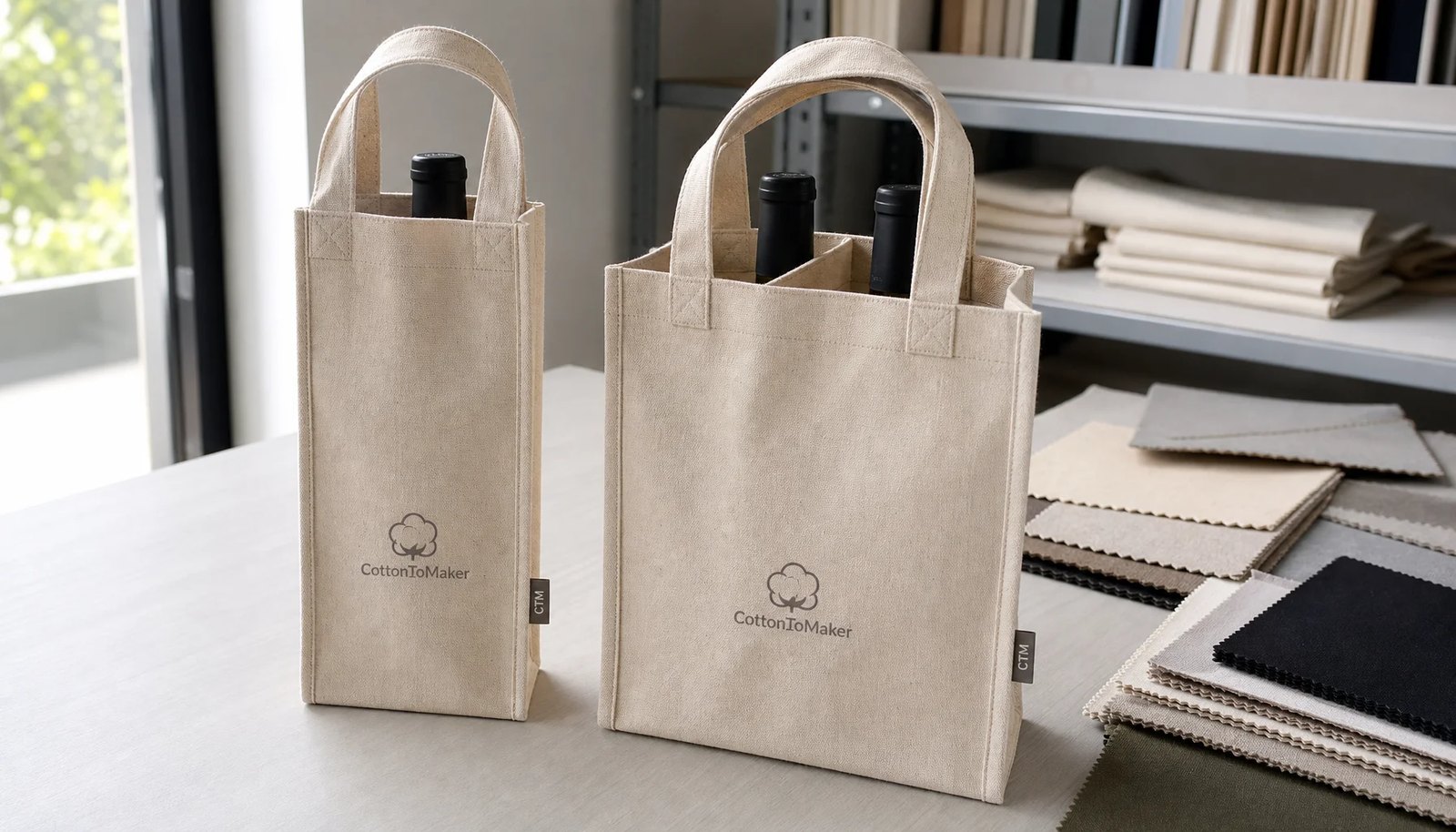
Single-bottle and two-bottle carriers solve different retail problems. A single-bottle canvas carrier is easier to price, easier to pack, and better for impulse purchase near checkout or campus event tables. A two-bottle carrier has higher perceived gift value, but the divider and base construction must be right. If the divider is too low, bottles hit each other near the shoulder. If the divider is loose, the bag feels unfinished and noisy when carried.
The RFQ should include the bottle profile, not only “fits wine bottle.” Standard 750 ml wine bottles, sparkling wine bottles, craft beverage bottles, and olive oil bottles can have different diameters and shoulder shapes. A small change in gusset or divider width affects both fit and carton quantity. For bookstore buyers who sell mixed gift products, the safest route is to send a bottle fit range and ask the factory to test with the largest expected bottle.
- State bottle diameter, bottle height, and maximum loaded weight for fit testing.
- For two-bottle carriers, specify divider height, divider attachment points, and bottom seam connection.
- Avoid tight dimensions that make bottle insertion difficult at retail counters.
- Confirm whether the bag must stand upright empty, stand with bottles inserted, or hang from a display peg.
Specify Handle and Seam Construction Clearly
Handle failure is one of the most expensive mistakes in this category because the product carries glass. A nice fabric and clean logo cannot compensate for weak handle stitching. For canvas wine carriers, self-fabric handles or heavy cotton webbing are common. Self-fabric handles look more integrated and premium, while webbing can be efficient and consistent for larger runs. In either case, the RFQ should describe handle width, handle drop, reinforcement method, and stitch density.
For the body, side seams and bottom seams need enough allowance and neat finishing. A wine carrier is narrow, so small sewing errors are more visible than on a large tote. Box-X stitching, bar tacks, or dense rectangular reinforcement at the handle attachment should be sampled and load tested. If the carrier has a divider, the divider should not be treated as an afterthought; it should be sewn into stable seams so it does not twist after the first use.
- Recommended handle reinforcement: box-X or reinforced rectangular stitch with consistent backstitching.
- Common handle drop: short carry handle suitable for hand carry, not shoulder carry, unless retail design requires otherwise.
- Seam review: no skipped stitches, no exposed raw edges unless intentionally bound, and no puckering around the divider.
- Load acceptance: test with intended bottle weight plus margin, then inspect for stitch popping and seam distortion.
Select Printing Method Around Licensed Artwork
University marks often include strict color and spacing rules. For canvas wine carriers, screen printing is usually the most practical method for solid logos, school names, mascots, and simple event graphics. It gives good opacity on natural canvas and can be cost-efficient across bookstore quantities. The limitation is that coarse canvas texture affects fine lines, small legal text, and tight registration. Artwork that looks sharp on a PDF may fill in or break on fabric.
Heat transfer can handle more detail and full-color graphics, but it changes the hand feel and may not match the traditional canvas look. Embroidery can look premium, yet it is not always suitable for small wine carriers because dense stitching may distort narrow panels and increase cost. Woven labels or side labels work well when the front logo should stay subtle. Buyers should choose the decoration method based on brand approval needs, retail price point, and the fabric surface.
- For one to three solid colors: screen print is usually the first option.
- For full-color mascot art: review heat transfer samples on the exact canvas before approval.
- For premium subtle branding: use a woven side label plus small front print or embroidery test.
- For licensed marks: provide vector files, Pantone references, minimum clear space rules, and approval workflow.
Understand MOQ and Cost Drivers
MOQ for canvas wine carriers is not only about total pieces. It is affected by fabric color, cutting efficiency, print setup, label sourcing, packing method, and SKU split. A quote for 1,000 pieces in one natural canvas color with one screen print is very different from 1,000 pieces split across four school colors and five logo versions. Each color or print change can create setup time, material leftovers, and inspection complexity.
The main cost drivers are fabric weight, dyed versus natural fabric, number of print colors, divider construction, handle reinforcement, retail packaging, and order fragmentation. Buyers should request price breaks at practical levels such as 500, 1,000, 3,000, and 5,000 pieces per design or per shared construction. If the bookstore group supports several campuses, a shared base style with separate logo prints can reduce development cost, but only if fabric color and packing remain controlled.
- Quote natural canvas and dyed canvas separately because dyeing changes cost, lead time, and shade risk.
- Separate tooling or screen charges from unit price so reorder cost is easier to compare.
- Ask for MOQ by fabric color and print design, not only by total shipment quantity.
- Request carton data with each price break because freight efficiency can change the landed cost ranking.
Build a Sample Approval Process That Prevents Rework
A photo sample is not enough for canvas wine carriers. The buyer needs a physical sample made with the intended fabric weight, print method, handle construction, divider, thread color, and packing method. If the sample uses substitute fabric or digital print while bulk uses screen print, approval value is limited. The sample should be tested with actual bottles, displayed on a shelf, folded into the intended carton, and reviewed by the brand approval team if the artwork is licensed.
Pre-production approval should record measurable points, not only general comments like “looks good.” Measure width, height, gusset, handle drop, divider height, print placement, and print color. Photograph the approved sample with a ruler and bottle inserted. Keep one approved sample with the buyer and one sealed sample at the factory. This reduces disputes when bulk inspection finds shade, size, or logo placement variation.
- Approve fabric swatch before full sample if the order uses dyed canvas or special weight.
- Measure finished dimensions and record tolerances on the sample approval form.
- Test bottle insertion, loaded carry, and divider stability before approving bulk.
- Confirm print curing by rubbing the logo after the sample has fully dried.
- Approve retail packing at sample stage if barcode, hangtag, belly band, or inner carton is required.
Set QC Thresholds Before Production Starts
Canvas is a natural-looking material, but that does not mean every slub, stain, crease, or color mark should pass. The buyer and factory should classify defects before production. Minor weave variation may be acceptable on natural canvas, while oil stains, mildew odor, heavy color streaks, and visible print smears should not be accepted for retail bookstore goods. Clear standards prevent the factory from arguing that all canvas irregularities are normal.
For functional testing, focus on handle strength, seam security, divider stability, and print adhesion. AQL inspection can cover visual defects, but the checklist must include product-specific tests. Pulling lightly on handles during final inspection is not enough. Use loaded carry tests, hang tests, and seam review with the expected bottle weight. For screen printing, test adhesion after curing and review opacity on the approved canvas shade.
- Critical defects: broken handle seam, unstable divider, wrong logo, wrong barcode, unsafe sharp object, mildew odor.
- Major defects: heavy stain, obvious print misalignment, wrong fabric shade beyond tolerance, open seam, incorrect size affecting bottle fit.
- Minor defects: small loose thread, slight natural slub, light crease removable by normal handling, tiny print speck outside main logo area.
- Functional checks: loaded handle test, bottle fit test, divider movement test, print rub test, and carton drop review.
Plan Packing for Bookstore Receiving
Packing affects landed cost and receiving labor. Canvas wine carriers are small, but they can become inefficient if each piece is packed in a thick polybag with bulky inserts. For most bookstore retail programs, flat packing with a hangtag, barcode label, or belly band is enough. If the bag is sold as a premium gift item, a neater fold and protective inner pack may be justified. The goal is to prevent dirt, moisture, and SKU mixing without adding unnecessary carton cube.
Carton planning should be part of quote comparison. A lower FOB price can lose its advantage if the carrier is packed in oversized cartons or if mixed SKUs require extra sorting at the bookstore warehouse. Ask for pieces per carton, carton dimensions, gross weight, net weight, and CBM by SKU. If the order includes several university marks, carton marks should show SKU, logo version, color, quantity, and purchase order reference clearly.
- For standard retail: flat pack, grouped by SKU, with barcode or hangtag applied as required.
- For gift programs: consider belly band or kraft sleeve only after checking carton cube and labor cost.
- For import shipments: use moisture protection appropriate to the route without trapping wet fabric in sealed packing.
- For distribution centers: require scannable carton labels and inner pack quantities aligned with store allocation.
Control Lead Time and Schedule Risk
Lead time depends on fabric availability, dyeing, sample approval, artwork approval, production capacity, inspection, and export booking. Natural canvas in common weights may be faster if stock fabric is available. Dyed school colors, special GSM, organic cotton, recycled cotton blends, or custom labels can extend the schedule. The RFQ should define when the lead time starts because suppliers may count from deposit, artwork approval, fabric approval, or pre-production sample approval.
University bookstore calendars often include graduation, alumni weekends, football season, holiday gifting, and orientation. Missing the selling window can matter more than saving a small unit cost. Buyers should build a timeline backward from the in-store date, not only the ex-factory date. Include buffer for brand approval, sample shipping, inspection findings, and customs clearance. If the order is tied to an event date, the supplier should know that before quoting.
- Fastest route: stock natural canvas, standard construction, one-color screen print, simple packing.
- Higher schedule risk: custom dyed fabric, multi-color print, complex divider, licensed label sourcing, many SKU splits.
- Timeline anchor: define requested delivery as ex-factory date, port date, warehouse date, or in-store date.
- Approval discipline: delays in artwork and sample comments usually push production more than sewing time does.
Specification comparison for buyers
| Spec decision | Recommended option | When it fits | Buyer risk to check |
|---|---|---|---|
| Main fabric weight | 10 oz to 12 oz cotton canvas, about 340-410 GSM | Good balance for licensed bookstore merchandise, alumni gifts, and retail wine accessories | Under 8 oz may collapse on shelf; over 14 oz raises freight and sewing cost without much bottle protection gain |
| Fabric finish | Natural unbleached canvas with controlled shrinkage, or dyed canvas with colorfastness testing | Natural works for heritage campus branding; dyed canvas fits school colors and premium gift programs | Dyed lots can shade vary between production runs; request lab dip approval and rubbing fastness result |
| Bottle capacity | Single-bottle carrier for lower retail price point; two-bottle carrier with divider for gift sets | Single style suits campus events and bookstore add-on sales; two-bottle style suits alumni and holiday ranges | Two-bottle bags need divider depth and bottom support verified with real bottle dimensions |
| Handle construction | Self-fabric handles with cross-stitch or box-X reinforcement | Best when the bag carries 750 ml bottles and must feel consistent with canvas body quality | Weak handle bartacks are a common failure point; test loaded hang time and stitch density |
| Printing method | Screen print for solid school marks; heat transfer only for detailed full-color artwork | Screen print is durable and cost-efficient for campus logos, mascots, and short brand messages | Fine type and registration can fail on coarse canvas; confirm printable area and artwork line thickness |
| Inside divider | Canvas divider sewn into side seams and bottom seam for two-bottle styles | Needed when bottles may be carried outside the store or packed as a gift set | Loose dividers shift during use; divider height should prevent glass contact at shoulder level |
| MOQ structure | Base MOQ by fabric color and print design, not only total pieces | Useful when ordering several campus designs across one common bag construction | Splitting 1,000 units into many colors or logos can trigger higher unit cost and extra setup charges |
| Retail packing | Flat packed with hangtag or barcode label; optional belly band for gift presentation | Flat packing protects freight efficiency and supports bookstore receiving and shelf replenishment | Overly bulky individual packing increases carton cube; loose bags can arrive wrinkled or mixed by SKU |
| Inspection standard | AQL inspection with load test, print adhesion test, seam strength review, and carton drop check | Appropriate for importers, distributors, and bookstores selling licensed retail goods | Visual-only inspection misses handle failures, divider problems, and color transfer from dyed canvas |
Buyer checklist before sampling
- Define whether the program needs single-bottle, two-bottle, or mixed capacity carriers before requesting price.
- Specify target fabric weight in oz or GSM, plus whether the canvas is natural, bleached, dyed, recycled, or organic.
- Send actual bottle dimensions if the carrier must fit wine, sparkling wine, olive oil, or university-branded beverage gifts.
- State licensed artwork requirements, Pantone colors, printable area, and whether the logo must pass brand approval.
- Require handle reinforcement details, divider construction, bottom seam method, and finished bag tolerance.
- List SKU split by color, print design, barcode, hangtag, inner pack, and carton mark to avoid quote revisions.
- Request pre-production sample approval using the same fabric, print method, thread color, and packing method as bulk.
- Confirm lead time by artwork approval date, fabric availability, peak season capacity, and final inspection date.
- Compare quotes using packed carton dimensions and gross weight, not only FOB unit price.
- Set acceptance criteria for stains, loose threads, print defects, color variance, seam strength, and bottle fit.
Factory quote questions to send
- What fabric weight in oz and GSM are you quoting, and is it stock fabric or made-to-order fabric?
- Is the quoted canvas natural, bleached, dyed, recycled, organic, or blended, and can you provide fabric test data if required?
- What finished dimensions and tolerances are included for the body, gusset, handle drop, and divider height?
- How many 750 ml bottles were used for fit testing, and what bottle diameter and height were tested?
- Which print method is included in the price, how many colors are included, and what is the maximum printable area?
- Are screen setup charges, sample charges, Pantone matching, hangtags, barcode labels, and inner cartons included or separate?
- What MOQ applies per fabric color, per print design, and per shipment, and how does the unit cost change at higher quantities?
- What is the estimated carton quantity, carton size, gross weight, and CBM for each SKU?
- What bulk lead time starts after which approval point: deposit, artwork approval, fabric approval, or pre-production sample approval?
- What inspection steps are built into production, and can the order support third-party inspection before shipment?
Quality-control points to confirm
- Finished size tolerance should normally be controlled within about plus or minus 0.5 cm for width and height, unless the design has special shaping.
- Loaded handle testing should use the intended bottle weight plus safety margin, with no seam tearing, stitch popping, or handle distortion.
- Print adhesion should be checked by rub test and tape test after curing, especially on dyed or heavy-texture canvas.
- Two-bottle dividers should be sewn straight, reach a practical height, and prevent glass-to-glass contact during normal carrying.
- Stitching should be even, with no skipped stitches, broken thread, raw seam exposure, or loose threads longer than the agreed tolerance.
- Fabric defects such as oil marks, weaving slubs, mildew odor, color streaks, and heavy creasing should be classified before inspection.
- Cartons should be checked for SKU separation, correct barcode placement, moisture protection, carton strength, and readable shipping marks.